Rebecca Collins dropped to her knees in the mud while the last of the cattle thundered into the darkness.
Rebecca stared at the ledger, her hands still covered in flour.
At first, the words made no sense. Then she saw the address.
Mercer Street. Lot Number Twelve.
That was the building she had rented. The little storefront with the wide front window and the brick oven in the back. The place she had imagined filling with the smell of fresh bread every morning.
Beside the address, someone had written three words in dark ink.
Destroyed by fire.
Rebecca looked up at Wade.
“When?”
“Eleven days ago.”
“That’s impossible.”
“I wish it were.”
She took the ledger from him, scanning the page again.
“Mr. Bellamy wrote to me last month. He said the building was ready. I paid six months’ rent in advance.”
Wade’s jaw tightened.
“Then Bellamy took your money knowing he couldn’t give you the property.”
Rebecca felt the ground shift beneath her.
Six months’ rent. Nearly everything she had saved after her husband died.
Gone.
She lowered herself onto a fallen log.
For several moments, neither spoke.
Around them, the injured men groaned while the others gathered what remained of their supplies.
Finally, Rebecca asked, “How did you find out?”
“One of my men brought the news from a freight driver yesterday. I sent a message ahead to confirm it. The answer came back before the stampede.”
“You knew last night?”
Wade looked ashamed.
“I was waiting until we reached town.”
“Why?”
“Because I thought I could find you another place first.”
Rebecca laughed bitterly.
“You thought you could fix my life without telling me it was broken?”
“Rebecca—”
“How much more are you keeping from me?”
Wade said nothing.
And that silence frightened her more than the news itself.
She stood, brushed flour from her skirt, and walked away before he could see her cry.
By noon, the damaged wagon had been repaired well enough to travel.
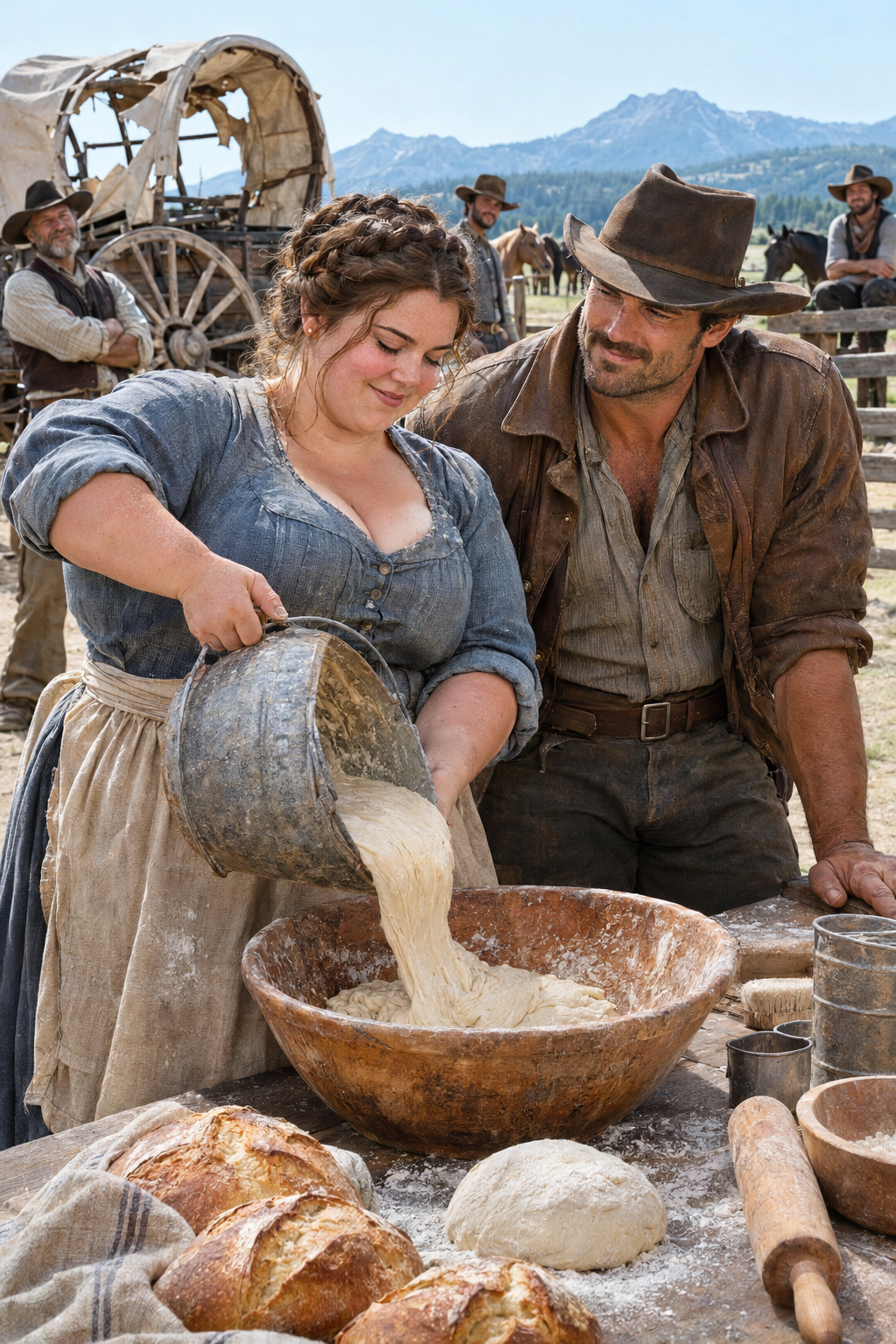
Rebecca had baked twelve small loaves in an iron Dutch oven. She divided them among the men, keeping none for herself.
When Wade discovered that, he handed her his portion.
“I’m not hungry,” he said.
“You’re a terrible liar.”
“I’ve been told.”
She almost smiled.
Almost.
Then a rider appeared on the distant ridge.
He came fast, his horse stumbling over loose stones.
Wade recognized him immediately.
“Thomas!”
The rider pulled up beside the camp, pale and breathing hard.
“Boss, we’ve got trouble.”
“What kind?”
“Bellamy’s men. They’re waiting near Blackwater Pass.”
Wade’s face changed.
Rebecca noticed it at once.
“Who is Bellamy really?” she demanded.
Thomas looked from her to Wade.
“She doesn’t know?”
“Know what?” Rebecca asked.
Wade closed the ledger.
“Silas Bellamy owns half of Cottonwood Crossing. The freight company, the grain warehouse, the bank’s largest outstanding loans.”
“And my building?”
“That too.”
Rebecca folded her arms.
“Why would someone that powerful steal six months’ rent from a widow?”
Thomas swallowed.
“Because he doesn’t want a bakery opening in town.”
The words seemed ridiculous.
“A bakery?”
Wade nodded slowly.
“Bellamy controls the flour supply. He owns the only commercial bread kitchen. People pay whatever price he asks.”
Rebecca stared at him.
“And you’re telling me he burned down a building to stop me?”
“I can’t prove that.”
“But you believe it.”
Wade didn’t answer.
Thomas leaned closer.
“There’s something else. Last week, Bellamy offered fifty dollars to anyone who could delay your wagon.”
Rebecca suddenly remembered the stampede.
The cattle had been strangely restless before nightfall.
One of the younger hands had discovered a broken fence wire near their grazing area.
She looked toward the dark hills.
“That wasn’t an accident, was it?”
Wade’s expression became grim.
“I don’t think it was.”
For the first time, Rebecca understood that the road ahead might be more dangerous than the one behind.
And turning back would mean giving Bellamy exactly what he wanted.
That evening, Wade gathered his men.
“We travel before sunrise. No lanterns. No unnecessary stops.”
Rebecca stepped forward.
“I’m coming.”
“You were always coming.”
“No, Wade. I’m not riding into town as a frightened woman hoping someone will rescue her.”
He met her eyes.
“Then how are you riding in?”
“As a businesswoman who intends to collect what she’s owed.”
Thomas grinned.
“Lord help Mr. Bellamy.”
But Wade didn’t smile.
He knew something Rebecca didn’t.
Silas Bellamy was not merely greedy.
He was dangerous.
And Wade had crossed him before.
Three years earlier, Wade’s younger brother, Daniel, had borrowed money from Bellamy to save their father’s ranch during a drought.
The loan had seemed reasonable.
Until Bellamy changed the terms.
Daniel refused to surrender the ranch.
Three weeks later, his barn burned.
Daniel died trying to save the horses.
The official report called it an accident.
Wade had never believed that.
And now Rebecca Collins was walking toward the same man.
The next morning, the party entered Blackwater Pass beneath a sky the color of iron.
The trail narrowed between two steep ridges.
Rebecca rode beside Thomas while Wade traveled ahead.
Halfway through the pass, a rifle shot cracked through the air.
A horse screamed.
“Down!” Wade shouted.
Rebecca threw herself from the saddle as another shot shattered the wagon’s sideboard.
Three riders appeared above them.
One wore a red scarf across his face.
“Leave the woman!” he shouted. “The rest of you can ride through!”
Wade drew his revolver.
“Not happening.”
A bullet struck the rock inches from his head.
Rebecca crawled beneath the wagon, her heart hammering.
Beside her lay a wooden crate containing six bottles of lamp oil.
An idea came to her.
“Thomas!” she whispered.
He scrambled toward her.
“Can you reach the spare harness?”
“What for?”
“Just get it!”
Thomas pulled the leather straps from the wagon.
Rebecca tied them around the oil crate.
“Help me push.”
Together, they shoved the crate toward the steep slope beside the trail.
It rolled downward, smashing against a rock.
Oil spilled across the narrow path below the attackers.
Rebecca grabbed a burning branch from the small fire the men had lit before the ambush.
Wade saw what she was doing.
“Rebecca, don’t!”
But she was already moving.
She threw the branch.
Flames leaped across the spilled oil, cutting off the attackers’ easiest route down the slope.
The horses above reared in panic.
One rider lost his balance and tumbled from the saddle.
Wade fired into the air.
“Drop your weapons!”
Two men fled along the ridge.
The third lay stunned among the rocks.
Thomas and another ranch hand dragged him down.
When Wade pulled away the red scarf, his face hardened.
“Caleb Rusk.”
The man spat blood.
“Foster.”
“Who sent you?”
Caleb laughed.
“You already know.”
Wade pressed his revolver against the man’s shoulder.
“Say his name.”
Caleb looked at Rebecca.
Then his smile disappeared.
“Bellamy said the widow would be easy.”
Rebecca stepped closer.
“Tell Bellamy he misjudged me.”
Caleb sneered.
“You think he’ll let you open that bakery? He’ll bury you before you sell your first loaf.”
Rebecca felt fear twist inside her.
But she held his gaze.
“Then he’d better dig quickly.”
By nightfall, they reached Cottonwood Crossing.
The town appeared beneath the mountains like a collection of tired wooden buildings clinging to the edge of civilization.
A church stood near the square. Beyond it were the general store, the bank, a blacksmith shop, and Bellamy’s imposing brick warehouse.
Rebecca saw the burned storefront immediately.
Its roof had collapsed.
The front windows were blackened holes.
A faded sign hung crookedly above the entrance.
AVAILABLE FOR LEASE.
She climbed down from the wagon and stood before the ruins.
For weeks, she had imagined hanging curtains in those windows.
She had imagined children pressing their noses against the glass, watching cinnamon rolls rise inside.
She had imagined her mother’s recipes written on a chalkboard.
Now the walls smelled of soot and rain.
Wade approached quietly.
“I’m sorry.”
Rebecca touched the burned doorframe.
“I don’t need sympathy.”
“What do you need?”
She stared into the wreckage.
“A place to bake.”
A voice answered behind them.
“Then perhaps I can help.”
They turned.
An elderly woman stood on the sidewalk, leaning on a cane.
Her gray hair was pinned beneath a faded blue bonnet.
“My name is Eleanor Whitcomb,” she said. “I own the old schoolhouse at the edge of town.”
Rebecca blinked.
“A schoolhouse?”
“Closed five years ago. Has a roof, a chimney, and a kitchen. It isn’t beautiful, but neither am I.”
Wade smiled faintly.
“Mrs. Whitcomb.”
“Wade Foster. Still making trouble?”
“Only when necessary.”
“Then you must be very busy.”
Eleanor studied Rebecca.
“I heard what happened to your building. Come tomorrow morning. We’ll talk.”
Before Rebecca could answer, a carriage stopped across the street.
A tall man stepped out, wearing a spotless black suit and a silver watch chain.
He had the smooth, careful smile of someone accustomed to being obeyed.
Silas Bellamy.
He looked at Rebecca as though she were an unexpected inconvenience.
“Mrs. Collins, I presume.”
“Mr. Bellamy.”
“Terrible business, that fire. A dreadful accident.”
Rebecca kept her voice steady.
“I’d like my money returned.”
Bellamy smiled.
“Unfortunately, the agreement states that prepaid rent is nonrefundable in the event of unforeseen destruction.”
“You rented me a building you knew was gone.”
“An unfortunate misunderstanding.”
“You stole from me.”
The smile vanished.
“Careful, Mrs. Collins. Accusations are expensive.”
Wade stepped beside her.
“Especially when they’re true.”
Bellamy turned.
“Foster. I should have expected you.”
His eyes moved between them.
“How touching. The rancher has found himself another lost cause.”
Wade’s hand curled into a fist.
Rebecca touched his arm.
“No,” she whispered.
Bellamy noticed.
His smile returned.
“Enjoy your stay, Mrs. Collins. I suspect it will be brief.”
He climbed back into his carriage.
Rebecca watched him disappear.
Then she turned to Wade.
“What did he mean by another lost cause?”
Wade looked away.
And Rebecca knew that Daniel’s death was only part of the story.
The following morning, Eleanor showed Rebecca the abandoned schoolhouse.
Dust covered the desks.
Cobwebs hung from the rafters.
The stove was rusted, and rain had damaged the rear wall.
But sunlight poured through six tall windows.
Rebecca walked slowly through the room.
She could almost hear customers talking.
Almost smell bread cooling on wooden shelves.
“How much?” she asked.
Eleanor tapped her cane.
“One dollar a month.”
Rebecca stared.
“That can’t be right.”
“It’s right.”
“Why?”
Eleanor looked toward the windows.
“My husband built this schoolhouse. He believed a town should be a place where people could make something of themselves.”
Her expression softened.
“Bellamy has spent twenty years proving him wrong.”
Rebecca swallowed.
“I don’t have enough money to repair it.”
“Then perhaps you should ask the town.”
Rebecca laughed sadly.
“Why would strangers help me?”
Eleanor gave her a searching look.
“Because, dear, they may be waiting for someone brave enough to ask.”
That afternoon, Rebecca carried her remaining flour to the town square.
She borrowed a table from the general store and built a small fire beside it.
By sunset, the smell of fresh bread drifted down Main Street.
Children gathered first.
Then miners.
Then women carrying baskets.
Rebecca handed out slices without asking payment.
A little girl with tangled blond hair took one bite and closed her eyes.
“It’s warm,” she whispered.
Her mother looked embarrassed.
“We haven’t had fresh bread in three days.”
Rebecca glanced toward Bellamy’s bakery.
“Why not?”
The woman lowered her voice.
“Flour prices went up again. Most families can’t afford it.”
Rebecca offered her another loaf.
“Take this home.”
“I can’t pay.”
“I didn’t ask you to.”
By the time the sun disappeared, her table was empty.
But something extraordinary had happened.
People began leaving things behind.
A carpenter offered spare timber.
A blacksmith promised to repair the stove.
Two sisters volunteered to scrub the schoolhouse.
A young boy offered nails he had collected from abandoned buildings.
By morning, Rebecca had twenty-three volunteers.
And Bellamy knew about every one of them.
Three days later, the schoolhouse rang with hammering.
Rebecca stood on a ladder, washing the windows, when Wade arrived carrying a sack of flour.
“Where did you get that?” she asked.
“From my ranch.”
“That won’t last forever.”
“No. But it will last until next week.”
Rebecca climbed down.
“What’s next week?”
Wade hesitated.
“There’s a freight shipment coming from Cheyenne. I arranged to have it delivered directly to you.”
She stared at him.
“How much did you pay?”
“Enough.”
“Wade.”
He set the sack down.
“Rebecca, I’ve spent years watching Bellamy crush anyone who stood against him. I won’t watch it happen again.”
She stepped closer.
“Tell me about Daniel.”
Wade’s face tightened.
“My brother believed people were good until they proved otherwise.”
“And you?”
“I learned the opposite.”
“Did Bellamy kill him?”
Wade stared at the floor.
“I don’t know. That’s what keeps me awake.”
Rebecca reached for his hand.
For a moment, he let her hold it.
Then he withdrew.
“There’s something else.”
She waited.
“After Daniel died, I went to Bellamy’s office. I threatened him. Told him I’d burn his warehouse to the ground.”
“Did you?”
“No. But someone tried two nights later.”
Rebecca felt cold.
“And?”
“Bellamy claimed I was responsible. He had witnesses. Bought witnesses, I believe. He agreed not to press charges if I signed over the grazing rights to my father’s northern pasture.”
“Your best land?”
Wade nodded.
“Every acre.”
Rebecca suddenly understood.
Bellamy had not simply stolen Wade’s property.
He had stolen his peace.
Before she could speak, the schoolhouse door opened.
Sheriff Amos Pike entered.
He was broad-shouldered, with tired eyes and a badge polished almost white.
“Mrs. Collins, I’m afraid I have bad news.”
Rebecca’s stomach tightened.
“About the bakery?”
“About your flour shipment.”
Wade stepped forward.
“What happened?”
“Bellamy filed a complaint. Says you’re operating a commercial kitchen without a permit.”
Rebecca stared.
“I haven’t sold anything.”
“Doesn’t matter. He says you’re preparing to.”
“Then give me a permit.”
Pike looked uncomfortable.
“Town council meets Friday. Bellamy holds the deciding vote.”
Rebecca folded her arms.
“So he can stop me.”
“Legally, yes.”
Wade cursed beneath his breath.
But Rebecca looked at the sheriff carefully.
“Do you believe he’s right?”
Pike hesitated.
“No, ma’am.”
“Then why are you helping him?”
The question struck harder than she intended.
The sheriff looked toward the children carrying wood outside.
“Because I have a wife and three sons,” he said quietly.
Then he removed his hat and left.
That night, someone broke into the schoolhouse.
Rebecca woke to the sound of shattered glass.
She had been sleeping on a narrow cot near the stove.
A shadow moved across the room.
“Who’s there?”
The intruder lunged toward the shelf holding her ceramic jar.
Rebecca grabbed an iron poker.
“Don’t touch that!”
The man seized the jar.
She swung.
The poker struck his wrist, and he shouted.
The jar slipped from his fingers.
Rebecca caught it against her chest as the intruder stumbled backward.
He escaped through the broken window.
But not before she saw his face.
Caleb Rusk.
The man from Blackwater Pass.
The sheriff arrived twenty minutes later.
Wade was close behind.
Rebecca stood trembling beside the stove, the jar clutched in both hands.
“He came for this,” she whispered.
Wade examined the broken window.
“Bellamy’s getting desperate.”
Sheriff Pike looked pale.
“Caleb Rusk?”
“I saw him.”
“That’s impossible. He’s in my jail.”
Wade turned sharply.
“Then you have a problem, Sheriff.”
They hurried to the jailhouse.
The cell door stood open.
On the desk lay a key and a folded piece of paper.
Pike opened it.
His face drained of color.
Wade snatched the note.
There were only five words.
Your children are next, Sheriff.
For the first time, Pike stopped pretending he was in control.
“My youngest is six,” he whispered.
Rebecca stepped closer.
“Then help us stop him.”
Pike sank into his chair.
“You don’t understand. Bellamy owns the bank. Half the town owes him money. He knows every weakness we have.”
“Then we’ll stop being weak alone,” Rebecca said.
The sheriff looked up.
“We?”
“All of us.”
The next morning, Rebecca went door to door.
She spoke to shopkeepers who had lost their businesses.
Farmers whose grain contracts had been altered.
Widows charged impossible interest on loans.
At first, people refused to talk.
Then Eleanor Whitcomb invited them to a meeting at the schoolhouse.
Thirty people arrived.
By evening, there were sixty.
A farmer named Jacob Turner brought a box of old receipts.
A seamstress produced letters threatening foreclosure.
A former bank clerk named Samuel Price arrived carrying a battered suitcase.
Inside were copies of Bellamy’s financial records.
“I kept these because I knew one day someone would need them,” Samuel said.
Wade examined the papers.
Then he froze.
“What is it?” Rebecca asked.
He held up a document.
It was a payment record dated three days before Daniel Foster’s barn burned.
The recipient was Caleb Rusk.
The amount was two hundred dollars.
Under the description, someone had written:
Special removal. Northern property.
Wade’s hands began shaking.
Rebecca gently took the paper.
“This is evidence.”
“It’s not enough,” Samuel warned. “Bellamy will claim it was for hauling freight.”
“Then we find the rest,” Rebecca said.
But someone had been listening outside the window.
And before midnight, Bellamy knew exactly what they had discovered.
On Friday morning, Cottonwood Crossing gathered for the town council meeting.
Rebecca wore her best blue dress.
It had belonged to her mother.
The sleeves were slightly worn, but she had pressed them carefully.
Wade stood beside her at the entrance.
“You don’t have to do this,” he said.
“Neither do you.”
He smiled.
“Fair enough.”
Inside, Bellamy sat at the head of the table.
Three councilmen occupied the remaining seats.
Sheriff Pike stood near the door.
Rebecca presented her application.
Bellamy barely glanced at it.
“Denied.”
One word.
Rebecca lifted her chin.
“On what grounds?”
“Insufficient commercial qualifications.”
“I’ve worked in kitchens for fifteen years.”
“Not in Cottonwood Crossing.”
A few people murmured.
Rebecca placed her mother’s handwritten recipe book on the table.
Then she placed the ceramic jar beside it.
“This town doesn’t belong to you, Mr. Bellamy.”
Bellamy leaned forward.
“Everything in this town belongs to someone, Mrs. Collins.”
“Not its future.”
For the first time, applause broke out.
Bellamy struck the table.
“Silence!”
But Rebecca continued.
“You’ve convinced these people they need your permission to survive. You raised their prices, threatened their homes, and frightened them into believing resistance was useless.”
Bellamy’s eyes narrowed.
“Those are serious accusations.”
“And I can prove them.”
Samuel Price stood.
He opened his suitcase.
The room became very quiet.
Bellamy’s expression changed.
Before Samuel could speak, a gunshot exploded outside.
Then another.
Someone screamed.
Wade rushed toward the door.
A wall of smoke rolled across the street.
“The schoolhouse!” a boy shouted.
“It’s on fire!”
Rebecca ran.
The building stood at the far end of town, flames already climbing through its wooden roof.
Her flour sacks were inside.
Her pans.
Her mother’s recipe book had been left at the council hall, but the starter jar was still in her hands.
She stopped in the street, unable to breathe.
People rushed past with buckets.
Wade caught her shoulders.
“Stay here.”
“No!”
“Rebecca, the roof’s going!”
Then she heard a cry.
From inside the burning building.
A child.
Eleanor’s granddaughter, Annie, had been helping clean the kitchen before the meeting.
She was trapped.
Rebecca dropped the jar into Eleanor’s waiting hands.
“Keep this safe.”
Then she ran toward the flames.
Wade followed.
Inside, smoke filled the room.
Rebecca pressed her sleeve over her mouth.
“Annie!”
A weak voice answered from beneath the fallen shelving.
“Here!”
Rebecca found the girl pinned by a heavy beam.
She tried to lift it, but it wouldn’t move.
Wade appeared through the smoke.
“Help me!”
Together, they raised the beam enough for Annie to crawl free.
But as they turned toward the door, the ceiling groaned.
A burning rafter crashed between them and the exit.
Wade pushed Rebecca and Annie toward the back window.
“Go!”
“What about you?”
“I’ll find another way!”
Rebecca refused to move.
Then Wade seized her shoulders.
“Rebecca, listen to me. Daniel died because he wouldn’t leave a burning building. I cannot lose you the same way.”
For one terrible second, she saw the grief he had carried for years.
Then she grabbed Annie, smashed the window with a chair, and pushed the girl outside.
Hands reached in.
Rebecca climbed through.
But Wade was still inside.
The roof collapsed.
A thunderous crash shook the street.
Rebecca screamed his name.
No answer came.
She tried to run back, but Thomas held her.
“You can’t!”
“He’s in there!”
Then a dark figure emerged from the smoke near the rear wall.
Wade.
He staggered forward, coughing.
Rebecca broke free and caught him before he fell.
For a moment, she could only hold him.
His arms closed around her.
“I’m here,” he whispered.
She pressed her face against his chest.
“You foolish, stubborn man.”
He gave a weak laugh.
“Seems we have that in common.”
Across the street, Sheriff Pike had caught Caleb Rusk attempting to escape on horseback.
This time, the sheriff didn’t hesitate.
He dragged Caleb into the square and demanded the truth.
With half the town watching and his employer’s protection crumbling, Caleb finally confessed.
Bellamy had ordered the first storefront burned.
He had arranged the stampede.
He had paid for the ambush at Blackwater Pass.
And three years earlier, he had ordered Daniel Foster’s barn set on fire.
Wade stood perfectly still.
Rebecca felt his hand tighten around hers.
Caleb looked at him.
“I didn’t know your brother was inside.”
Wade’s face went white.
For a moment, Rebecca feared he would reach for his gun.
Instead, he closed his eyes.
When he opened them, he looked toward the sheriff.
“Take him away.”
Sheriff Pike nodded.
Then he turned toward Bellamy, who was standing near his carriage.
“Silas Bellamy, you’re under arrest.”
Bellamy laughed.
“You can’t arrest me. I own this town!”
Pike stepped forward.
“No,” he said. “You only made us believe you did.”
Bellamy reached inside his coat.
Wade moved instinctively.
But Rebecca was closer.
She saw the pistol before anyone else.
“Gun!”
Pike fired.
Bellamy’s weapon flew from his hand as the bullet struck his wrist.
He collapsed beside the carriage, screaming.
Within moments, he was in irons.
And for the first time in twenty years, Cottonwood Crossing watched Silas Bellamy leave Main Street without anyone stepping aside for him.
The fire destroyed the schoolhouse.
Nearly everything Rebecca had collected was gone.
Her carefully repaired stove.
Her precious flour.
The shelves the townspeople had built.
She stood before the ashes the following morning, too exhausted even to cry.
Wade approached carrying a small wooden box.
“Found something.”
Inside were three iron baking pans, blackened but intact.
Rebecca touched them gently.
“Three pans.”
“Three more than yesterday.”
She smiled through her tears.
Then Eleanor arrived.
Behind her came Thomas, Sheriff Pike, Samuel Price, and nearly fifty townspeople.
The carpenter carried tools.
The blacksmith brought iron fittings.
A farmer led a wagon stacked with lumber.
Rebecca stared.
“What is all this?”
Eleanor lifted her cane.
“Well, dear, we appear to be building a bakery.”
Rebecca shook her head.
“I can’t ask you to do that.”
“You didn’t.”
The elderly woman smiled.
“You fed us when you had almost nothing. Now it’s our turn.”
Construction began that afternoon.
The town council, freed from Bellamy’s influence, granted Rebecca a business license.
Samuel helped recover her stolen rent through the court proceedings.
A merchant from Cheyenne offered flour at a fair price.
And Wade donated stone from an abandoned quarry on his ranch.
For six weeks, Cottonwood Crossing worked.
Walls rose.
Windows were fitted.
A great brick oven took shape in the back.
Rebecca helped wherever she could, mixing mortar by day and preparing meals for the workers at night.
During those weeks, something changed between her and Wade.
They no longer needed excuses to be near each other.
Sometimes he arrived before sunrise carrying coffee.
Sometimes she rode out to the ranch with fresh biscuits.
They spoke about Daniel.
About her husband, Jonathan, who had died of pneumonia after a bitter winter.
About regrets they could not undo.
And about the strange courage required to want happiness after losing it.
One evening, Wade found Rebecca sitting on the unfinished bakery steps.
The sun was setting behind the mountains.
He sat beside her.
“Do you ever think about going back east?”
She shook her head.
“Not anymore.”
“Good.”
“Why?”
He looked toward the horizon.
“Because I think I’d miss your bread.”
Rebecca laughed.
“Only the bread?”
Wade turned toward her.
“No.”
The word was barely a whisper.
He reached for her hand.
“I’ve spent three years believing loving someone meant giving fate another chance to hurt me.”
Rebecca watched him quietly.
“And now?”
“Now I’m beginning to think refusing to love is another way of letting the past win.”
Her eyes filled.
“Wade…”
He leaned closer.
But Rebecca touched his cheek before he could kiss her.
“I need you to understand something.”
“Anything.”
“I didn’t come here looking for a man to save me.”
“I know.”
“I came to build a life.”
Wade smiled.
“Then perhaps I could build one beside you.”
Rebecca kissed him.
It was gentle at first.
Then full of all the words they had been afraid to say.
When they finally pulled apart, Wade rested his forehead against hers.
“Is that a yes?”
Rebecca smiled.
“That’s a beginning.”
On the first morning of October, the bakery opened.
A new sign hung above the door.
THE SECOND RISING
Rebecca Collins, Proprietor
Beneath it, in smaller letters, were words Eleanor had suggested.
Fresh Bread. Fresh Beginnings.
Before sunrise, people formed a line down Mercer Street.
Children pressed their faces against the windows.
Farmers arrived with baskets of apples.
Miners bought rolls wrapped in cloth.
Eleanor sat at a corner table, drinking tea and pretending not to cry.
Wade stood behind the counter, hopelessly attempting to calculate change.
“You’re giving away too much money,” Rebecca whispered.
“I’m better with cattle.”
“Clearly.”
He grinned.
Then the little girl who had tasted Rebecca’s first bread in the town square approached the counter.
She placed three pennies on the wood.
“My mama says we can buy one roll today.”
Rebecca looked at her thin coat and worn shoes.
Then she placed two warm rolls into a paper bag.
The girl frowned.
“But I only have enough for one.”
Rebecca knelt beside her.
“Then the second one is for tomorrow.”
The child smiled and ran outside.
Wade watched her go.
“You’re going to make a terrible fortune.”
Rebecca laughed.
“Perhaps.”
Then she looked around the crowded bakery.
At the carpenter sharing breakfast with the sheriff.
At Eleanor laughing with the seamstress.
At Thomas buying pastries for a young woman he clearly hoped to impress.
And at the enormous brick oven, glowing warmly behind her.
“No,” she said softly. “I think I’m already rich.”
Months later, Silas Bellamy was convicted of fraud, arson, and conspiracy. Caleb Rusk’s testimony and Samuel’s records helped establish the truth about Daniel’s death.
Wade finally reclaimed the grazing rights Bellamy had taken from his family.
But the greatest change was not written in any courtroom judgment.
It was visible in Cottonwood Crossing itself.
The farmers formed a cooperative grain mill.
The shopkeepers created a fund to help families facing hardship.
And Sheriff Pike, once too frightened to confront a powerful man, became known for treating every citizen with the same respect.
One winter evening, a fierce snowstorm swept across the valley.
The roads disappeared beneath drifting snow.
Travelers became stranded.
Families ran low on food.
Rebecca opened the bakery doors and kept the oven burning through the night.
Wade brought firewood.
Eleanor brewed coffee.
Neighbors carried blankets and soup.
By morning, more than forty people were sleeping safely inside.
Rebecca stood at the counter, feeding a small spoonful of flour and water into her mother’s ceramic jar.
The same jar she had pulled from the mud months earlier.
Its surface was chipped.
A thin crack ran along one side.
But the starter inside was alive, bubbling steadily.
Wade came to stand beside her.
“Still taking care of that old thing?”
Rebecca smiled.
“Every day.”
He looked around the bakery.
“Your mother would be proud.”
Rebecca considered his words.
Then she shook her head gently.
“I think she’d be proud of all of us.”
Outside, the storm continued.
Inside, the oven glowed.
Rebecca remembered the night of the stampede, when she had knelt in the mud believing that everything she loved was being taken away.
She remembered the ruins of the first bakery.
The flames consuming the second.
The terrible moments when hope had seemed like foolishness.
And she finally understood something her mother had been teaching her all those years.
The sourdough starter had never been precious because it could not be destroyed.
It was precious because it could be fed, nurtured, and shared.
Because one small portion could become enough bread for an entire table.
And because a beginning, however humble, could grow into something greater than anyone imagined.
Rebecca reached for Wade’s hand.
“Do you know what I learned?”
“What?”
“That starting over doesn’t mean getting back what you lost.”
He looked at her.
“It means discovering what can still grow from what’s left.”
Wade kissed her forehead.
Then the bakery door opened, bringing a gust of icy wind.
A young woman stood in the doorway with a battered suitcase.
Her dress was soaked.
Her eyes were frightened.
“Excuse me,” she whispered. “Someone told me there might be work here.”
Rebecca looked at the suitcase.
She remembered another woman standing outside a boardinghouse in Laramie, with everything she owned packed into wooden boxes.
A woman who had lost her job.
A woman who had been told her dreams were foolish.
A woman who had nearly turned back.
Rebecca stepped away from the counter.
“Can you bake?”
The young woman hesitated.
“A little.”
“Would you like to learn?”
Her eyes widened.
“You’d teach me?”
Rebecca smiled and opened the door wider.
“Of course.”
She took the suitcase from the young woman’s trembling hands.
Then she led her toward the warmth of the oven.
Behind them, Wade added another log to the fire.
And as the first light of morning touched the snow-covered rooftops of Cottonwood Crossing, Rebecca began teaching someone new how to keep a little piece of dough alive.
Because sometimes the greatest thing we can build from the ashes of our own broken dreams is not simply a better life for ourselves.
It is a place where someone else’s dreams are finally given the chance to rise.
THE END.