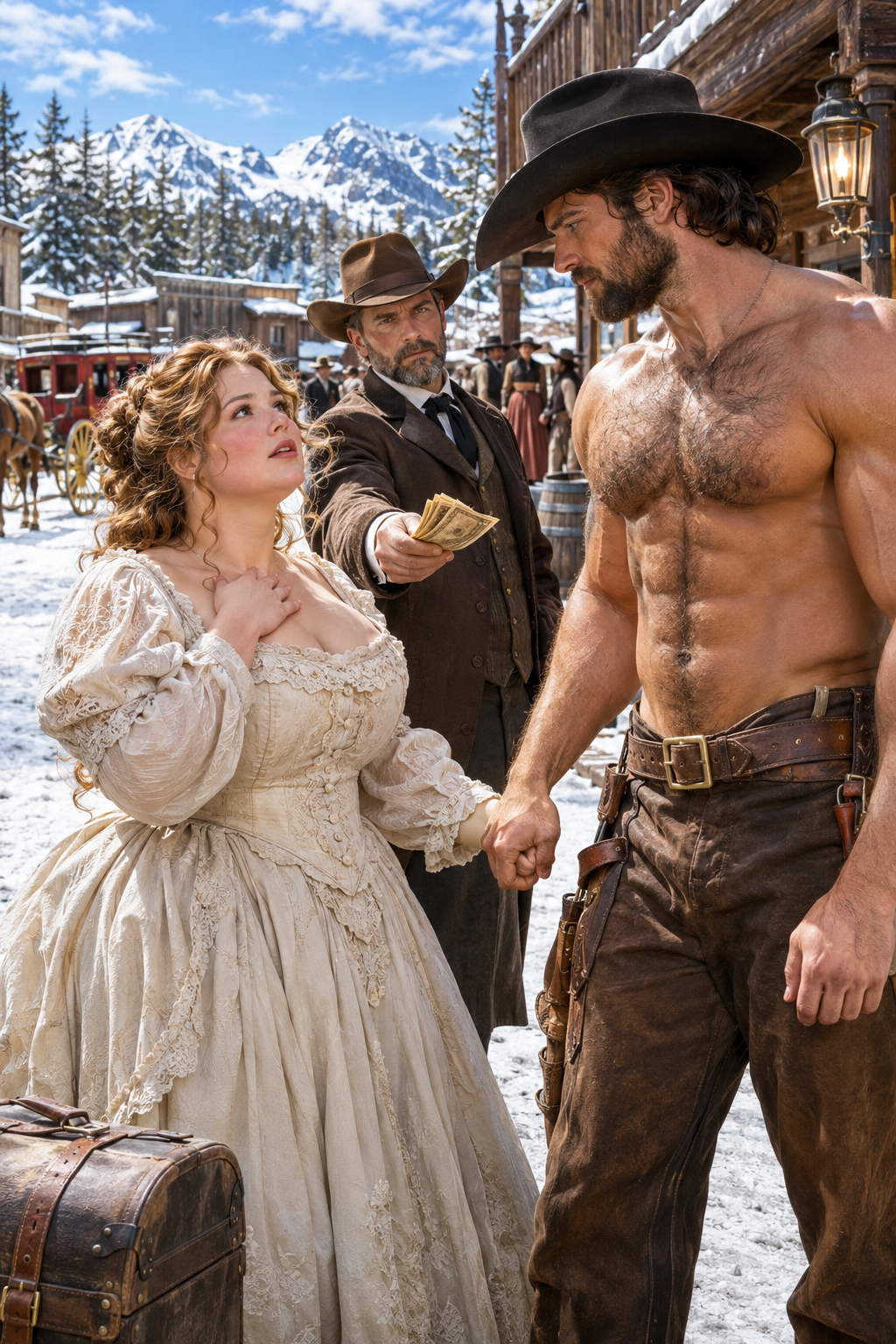
Rachel Foster traveled 2,000 miles to marry a man who took one look at her and called off the wedding. His first words made her wish she had never left Ohio.
Grant rested his elbows on the kitchen table and stared at the ledger as though it contained something far more dangerous than numbers.
“My brother has been borrowing money behind my back for nearly three years,” he said quietly. “At first, I thought it was just a few bad investments. Then he started gambling in Helena. I paid his debts twice because I believed he would change.”
Rachel looked down at the signatures.
“And the cattle?”
“That’s what worries me. Peter has always been careless with his own money. But stealing from this ranch would be something else entirely.”
“Do you think he did?”
Grant didn’t answer immediately.
Through the kitchen window, the Montana evening stretched across the pasture. The mountains were turning purple beneath the sinking sun, and somewhere near the barn, a horse whinnied.
“I think my brother is desperate,” Grant finally said. “And desperate men sometimes convince themselves that the people they hurt will understand.”
Rachel studied his face.
“You’re still trying to protect him.”
“He’s my brother.”
“That doesn’t mean you have to protect him from the consequences of his choices.”
Grant looked at her for a long moment.
“No,” he admitted. “I suppose it doesn’t.”
Rachel opened the ledger again and pointed to the first suspicious entry.
“Look here. On March eighteenth, forty-seven head of cattle were supposedly sold to Silas Boon. The payment was recorded as six hundred and eighty dollars. Two weeks later, the same cattle appear again, with another payment supposedly received.”
Grant leaned closer.
“But we only had one herd of forty-seven yearlings ready for market that spring.”
“Exactly. And neither payment appears in the bank records.”
He straightened slowly.
“How much money are we talking about?”
“I haven’t finished checking everything, but these two transactions alone account for more than thirteen hundred dollars.”
Grant let out a low breath. That was enough money to pay several ranch hands for an entire season.
“And there are other entries,” Rachel continued. “Smaller amounts. Feed purchases that don’t match the supplier’s invoices. Equipment repairs nobody remembers requesting. Cash withdrawals marked as ranch expenses.”
“Peter handled the books while Molly was sick last winter.”
Rachel nodded.
“Then we need to find out what happened before Silas Boon comes looking for something more than money.”
Grant’s expression hardened.
“You think that’s possible?”
“I think a man who hides his transactions is usually hiding his intentions, too.”
For the first time since she had arrived at Blackstone Ranch, Grant reached across the table and placed his hand over hers.
“You’ve done more good here in a week than you realize.”
Rachel felt warmth rise into her cheeks.
“I’ve only been doing my job.”
“No,” he said softly. “You’ve been looking after a place that isn’t even yours.”
Before Rachel could answer, the kitchen door swung open.
Molly stood in the doorway, leaning on her crutch.
“Grant,” she said, her face pale. “There’s a man outside asking for you.”
“Who?”
“Silas Boon.”
Grant rose immediately.
Rachel followed him onto the porch.
A thin man in a black coat sat astride a chestnut horse. His narrow face carried the satisfied expression of someone who believed he had already won an argument.
“Evening, Grant,” Silas said. “I trust your brother told you I might be coming.”
“He didn’t.”
“Well, that’s unfortunate.”
Silas reached into his coat and withdrew a folded document.
“I’ve come to discuss the Blackstone mortgage.”
Grant stepped down from the porch.
“The mortgage was paid off six years ago.”
Silas smiled.
“Your original mortgage was. This is a newer arrangement.”
He handed Grant the paper.
Rachel watched Grant’s eyes move across the page. His jaw tightened with every line.
Then he looked up.
“This is impossible.”
“Not according to the county records.”
“What is it?” Molly asked.
Grant’s voice sounded strained.
“A loan for eight thousand dollars.”
Molly gripped the porch railing.
“Eight thousand?”
“Secured against Blackstone Ranch,” Silas added pleasantly. “Signed by Peter Walker as an authorized representative of the property.”
Rachel felt something cold settle in her stomach.
Grant unfolded the document completely.
“My brother has no authority to mortgage this land.”
“That,” Silas replied, “sounds like a family disagreement.”
“You know perfectly well this ranch belongs to me.”
“I know what the paperwork says. And I know the payment is overdue.”
Silas leaned forward in his saddle.
“You have fourteen days to settle the outstanding balance, interest included. Otherwise, I’ll begin proceedings to recover the property.”
He tipped his hat toward Rachel.
“Good evening, folks.”
As the horse disappeared down the road, Molly sank onto the porch bench.
“Grant, what are we going to do?”
Grant stared at the paper in his hands.
Rachel stepped beside him.
“First, we’re going to find Peter.”
They discovered him the following morning at the Silver Spur Saloon in Mill Creek.
Peter was sitting at a corner table with a half-empty glass of whiskey when Grant entered, Rachel close behind him.
His face drained of color.
“Grant. What are you doing here?”
Grant placed the mortgage paper on the table.
“Explain this.”
Peter glanced at Rachel.
“You brought her?”
“She found the missing money.”
Peter’s expression changed immediately.
“Rachel, I told you those accounts were complicated.”
“They weren’t complicated,” she replied. “They were dishonest.”
Several men at nearby tables turned to listen.
Peter lowered his voice.
“Can we discuss this somewhere private?”
“We can discuss it right here,” Grant said.
Peter looked between them, then rubbed both hands over his face.
“I was going to fix everything.”
“By mortgaging my ranch?”
“I needed money.”
“For what?”
Peter swallowed.
“Gambling debts. Investments. Things that went wrong.”
“Eight thousand dollars?”
“It wasn’t that much originally.”
Rachel pulled a chair away from the table but remained standing.
“How much did you actually borrow?”
Peter hesitated.
“Four thousand.”
“And the rest?”
“Interest. Penalties. Silas kept adding charges.”
Grant stared at him.
“You signed away a ranch that’s been in our family for thirty years.”
“I didn’t think he’d actually take it!”
“Then you don’t know Silas Boon.”
Peter’s eyes shifted toward Rachel.
“This wouldn’t be happening if she hadn’t gone digging through everything.”
Grant slammed his palm against the table.
“Don’t you dare blame her.”
The saloon went silent.
Peter leaned back, suddenly defensive.
“You always think you’re better than me.”
“No,” Grant replied. “I spent years believing you could be better than the choices you were making.”
Peter’s expression twisted.
“And now you’ve got yourself a new charity case to look after.”
Rachel felt the insult strike exactly where Peter intended.
But before Grant could respond, she stepped forward.
“I came to Montana because your letters made me believe you were a decent man,” she said steadily. “I was wrong about that. But I’m not wrong about myself.”
Peter opened his mouth.
Rachel continued.
“You saw my appearance and decided I wasn’t worth marrying. You never stopped to consider that I might possess something you couldn’t measure by looking at me.”
She placed her handwritten calculations on the table.
“Like the ability to recognize a thief.”
Peter looked away.
Rachel turned toward Grant.
“We have fourteen days. Let’s not waste another minute.”
Outside, the morning air was sharp and bright.
Grant walked beside her toward the wagon.
“I’m sorry about what he said.”
“You don’t owe me an apology for your brother.”
“I should have stopped him sooner.”
Rachel paused beside the horses.
“Grant, can I ask you something?”
“Anything.”
“Do you really see me as someone you’ve rescued?”
He looked genuinely startled.
“What?”
“Peter said you bring home injured animals and people who have nowhere else to go.”
Grant’s expression darkened.
“Rachel—”
“I know he said it to hurt me. But sometimes a cruel remark stays with you because you’re frightened there might be a little truth in it.”
Grant took a step closer.
“When I saw you outside that station, I saw a woman who had crossed half the country on a promise and still had enough courage to stand tall when that promise was broken.”
Rachel’s throat tightened.
“I offered you a job because Molly needed help. I offered you a room because decent people don’t leave strangers stranded. And I keep finding reasons to come into the house because I like talking to you.”
She stared at him.
Grant gave a small, almost embarrassed smile.
“I’ve been trying to find the right time to tell you that last part.”
Rachel looked down, smiling despite herself.
For a moment, the trouble hanging over Blackstone Ranch seemed very far away.
Then the courthouse bell rang in the distance.
And reality returned.
Over the next four days, Rachel buried herself in the ranch records.
She examined invoices, receipts, bank statements, cattle brands, and shipping documents. Molly helped by searching through old correspondence, while Grant visited neighboring ranchers who might remember the disputed sales.
The more Rachel uncovered, the more suspicious the mortgage became.
The document claimed Peter had signed as an authorized representative of Blackstone Ranch on June twelfth.
But on that date, Grant had been in Bozeman purchasing breeding stock, and Peter had supposedly been helping him.
Rachel remembered something from her father’s bookkeeping lessons.
“Numbers tell you what happened,” he used to say. “But the papers around them tell you whether someone is lying.”
She began comparing signatures.
Peter’s handwriting was recognizable. He formed his capital P with a large backward loop and crossed his final letters with unusually long strokes.
The signature on the mortgage looked similar.
Almost too similar.
Rachel held the document beside one of Peter’s old letters.
“Grant, come look at this.”
He leaned over her shoulder.
“What am I looking for?”
“The signature on this mortgage is copied from Peter’s handwriting, but the pen never lifts where it normally would. Someone traced it.”
Grant frowned.
“Are you certain?”
“Not yet. But I know how we can find out.”
That afternoon, they visited the county clerk, Mr. Harlan, a gray-haired man who had known the Walker family for decades.
Harlan examined the copy Grant brought and shook his head.
“I remember this mortgage. Silas submitted it himself.”
“Was Peter there?” Rachel asked.
“No, ma’am.”
“Did anyone witness his signature?”
“The document carries a witness mark from a fellow named Amos Pike.”
Grant stiffened.
“Pike works for Silas.”
Harlan nodded uneasily.
“That’s what I understand.”
Rachel leaned forward.
“May we see the original filing and any papers submitted with it?”
Harlan hesitated.
Then he reached beneath the counter and brought out a thick registration book.
“Official records are available for inspection.”
Rachel spent nearly an hour studying the entries.
When she reached the final page, her heart began pounding.
There, beneath the mortgage registration, was a notation showing that the document had been filed on June twenty-first.
Three weeks later, Silas had recorded another claim against the property.
This time, it was not a loan.
It was a conditional agreement transferring ownership of Blackstone Ranch if the debt remained unpaid.
Grant read the entry twice.
“Peter signed this, too?”
Rachel shook her head.
“Look at the witness.”
“Amos Pike.”
“And the date.”
Grant frowned.
“July fourteenth.”
Rachel turned toward Harlan.
“Wasn’t that the day the railroad bridge washed out east of town?”
The clerk blinked.
“Yes, ma’am. Roads were closed for two days.”
“Peter was in Helena that entire week,” Grant said. “I remember because he sent Molly a telegram asking for money.”
Harlan’s face changed.
Rachel met Grant’s eyes.
“Someone was signing documents in Peter’s name while he was miles away.”
They left the courthouse with certified copies of the filings and a new understanding of their enemy.
Peter had stolen money from the ranch.
But Silas Boon had apparently used his dishonesty to create a much larger trap.
That evening, Grant confronted Peter again.
This time, they met inside the Blackstone barn, away from curious ears.
Peter listened as Rachel explained what she had discovered.
At first, he looked confused.
Then his expression turned frightened.
“I never signed a transfer agreement.”
“Did you sign the mortgage?” Grant asked.
Peter lowered his head.
“Yes.”
Rachel’s hopes sank.
“But the amount was four thousand,” Peter continued. “Silas said the land would only be security until I paid him back.”
“Did you read everything?”
“No.”
“Did anyone witness you signing?”
“Amos Pike was there.”
Grant closed his eyes.
Peter suddenly looked younger than his thirty years.
“I knew I was doing wrong,” he whispered. “But I swear I never agreed to give Silas the ranch.”
Rachel unfolded the second filing.
“Then we need you to testify.”
Peter recoiled.
“If I do that, everyone will know what I’ve done.”
Grant stared at him.
“Everyone already knows something is wrong. The question is whether you’re finally willing to tell the truth.”
Peter said nothing.
Rachel watched him struggle between shame and self-preservation.
Then Grant spoke again.
“If we lose Blackstone, Molly loses her home. The men who work here lose their jobs. Families who depend on this ranch lose their wages. This isn’t only about you anymore.”
Peter’s shoulders slumped.
“What do you want me to do?”
“Start by telling us everything.”
For the next two hours, Peter confessed.
He had begun gambling after a failed cattle investment. Silas had offered loans with friendly words and impossible interest. When Peter couldn’t repay them, Silas threatened to expose him publicly.
Peter stole ranch money to make payments.
Then Silas demanded a mortgage.
Peter signed it without informing Grant, believing he could recover his losses before anyone discovered the truth.
But Silas never intended to let him escape the debt.
Rachel listened carefully.
“Did he ever tell you why he wanted Blackstone specifically?”
Peter hesitated.
“Once. He mentioned something about the railroad.”
Grant looked up sharply.
“What railroad?”
“He said the new freight route would make certain properties worth ten times what they were now.”
A silence settled over the barn.
Two months earlier, railroad surveyors had been seen along the northern boundary of Blackstone Ranch.
Grant had thought little of it.
Now everything made sense.
Silas wasn’t simply collecting a debt.
He wanted the land.
The following morning, Rachel sent a telegram to a lawyer in Helena recommended by Mr. Harlan.
His name was Samuel Whitcomb, and he specialized in land disputes.
He arrived at Blackstone three days later carrying a leather briefcase and an expression suggesting he had encountered dishonest businessmen before.
After reviewing the documents, Whitcomb looked at Rachel with approval.
“You’ve identified several serious irregularities.”
“Can we stop Silas?” Grant asked.
“Possibly. But we need proof that the additional transfer agreement was fraudulent, and we must challenge the mortgage’s validity. Peter’s admissions will help, though they also place him in legal jeopardy.”
Peter stared at the floor.
“I understand.”
Whitcomb continued.
“Silas will claim Peter had authority to borrow on behalf of the ranch. We need to establish that he didn’t.”
Grant retrieved the original ranch deed and operating agreements.
“My father left Blackstone to me alone. Peter received money and a smaller parcel near Helena.”
Whitcomb examined the papers.
“Then Silas has a significant problem.”
Rachel felt hope rise.
But Whitcomb wasn’t finished.
“However, if Silas proves Grant previously allowed Peter to act as his financial agent, the court may consider whether he had apparent authority. And if Grant failed to challenge earlier transactions, this could become complicated.”
Grant rubbed his forehead.
“I let Peter handle purchases and routine bills.”
“Then we must distinguish those responsibilities from authority to mortgage the land.”
Rachel leaned forward.
“What if we can show that Silas knew Peter lacked that authority?”
Whitcomb studied her.
“That would be particularly useful.”
Rachel thought about the altered signatures, the false transfer agreement, and the railroad.
Then another memory surfaced.
“Peter, when Silas first offered you the loan, did he ask whether Grant would approve?”
Peter nodded slowly.
“He said Grant would never agree to it.”
Whitcomb sat upright.
“Those exact words?”
“Yes.”
“Can anyone confirm that conversation?”
Peter hesitated.
“Amos Pike was there.”
Rachel’s heart sank.
Amos worked for Silas. He would hardly testify willingly.
But Molly, who had been listening quietly from the doorway, suddenly spoke.
“There’s someone else.”
Everyone turned.
“Mrs. Bellamy,” Molly continued. “She used to work in Silas’s office.”
Whitcomb raised an eyebrow.
“Used to?”
“He dismissed her last month. She came into town crying because he refused to pay her final wages.”
Rachel looked at Grant.
“Then we’d better find Mrs. Bellamy.”
They located her in a small boardinghouse behind the church.
Evelyn Bellamy was a widow in her fifties with tired eyes and ink-stained fingers. At first, she refused to discuss her former employer.
“Silas Boon has friends in high places,” she warned. “I can’t afford trouble.”
Rachel sat opposite her.
“I understand what it’s like to depend on work for your future. But Silas is trying to take a family’s home through documents we believe were falsified.”
Mrs. Bellamy looked toward the window.
“He’s taken homes before.”
Whitcomb leaned forward.
“Have you seen records that might prove it?”
Her hands began trembling.
“I kept copies.”
Nobody spoke.
“I knew something was wrong,” she continued. “The amounts in his private books never matched what he charged borrowers. Sometimes he’d increase a debt after the borrower signed. Sometimes he’d prepare additional papers without telling them.”
“Do you have copies involving Blackstone Ranch?” Rachel asked.
Mrs. Bellamy studied her face.
Then she stood, crossed the room, and retrieved a small wooden box from beneath her bed.
Inside were dozens of folded papers.
She handed Rachel a packet tied with faded blue ribbon.
“I thought someday someone might need these.”
Rachel opened it.
There was Peter’s original loan agreement for four thousand dollars.
There were records of payments he had made.
And there was a handwritten instruction from Silas to Amos Pike.
“Prepare supplemental conveyance. Walker boy unlikely to notice. Secure north acreage before railroad announcement.”
Grant went completely still.
Whitcomb read the note and exhaled.
“This changes things considerably.”
For the first time, Rachel believed they might actually save the ranch.
But Silas Boon learned about their visit before sunset.
That night, a rider approached Blackstone carrying a message.
The paper contained only seven words.
“Withdraw your challenge, or the barn burns.”
Grant read it once and immediately began organizing the ranch hands.
Lanterns were extinguished. Horses were moved to the lower pasture. Two men watched the northern fence while others took positions near the buildings.
Rachel insisted on helping.
“Stay inside,” Grant told her.
“No.”
“Rachel, this could be dangerous.”
“So could letting you face it without enough people watching.”
Grant looked ready to argue.
Then Molly appeared with a shotgun she had inherited from their father.
“I’ll watch the house,” she announced.
Grant sighed.
“I’m beginning to think nobody here listens to me.”
Despite everything, Rachel smiled.
The attack came shortly after midnight.
A horseman approached from the eastern trees, tossed a burning torch onto the hay stacked beside the barn, and galloped away.
Grant and two ranch hands rushed toward the flames.
Rachel was already moving.
She grabbed a bucket from the water trough and threw it against the burning hay.
“Get the horses out!” she shouted.
Smoke poured beneath the barn roof.
Inside, frightened animals kicked against their stalls.
Grant forced open the first gate while Rachel and another hand carried water from the trough. The flames climbed the outer wall.
Then Rachel heard a scream.
Peter.
He had entered the barn to release the final two horses, but a falling beam had trapped him near the rear doorway.
Grant started toward the smoke.
Rachel caught his arm.
“The side door! There’s another entrance!”
They ran around the building.
Grant kicked the smaller door open and disappeared inside.
Seconds passed.
Then a full minute.
Rachel’s heart hammered.
“Grant!”
Through the smoke, she saw him dragging Peter by the shoulders.
She rushed forward, helped pull Peter clear, and stumbled backward as a section of the roof collapsed.
The crash shook the ground.
Grant fell to his knees, coughing.
Rachel dropped beside him.
“Are you hurt?”
He shook his head, struggling for breath.
Peter lay nearby with blood running from a cut above his eyebrow.
He stared at the burning barn, horrified.
“This is because of me.”
Grant said nothing.
Rachel squeezed Grant’s shoulder.
“Everyone’s alive. That’s what matters.”
By dawn, half the barn was destroyed.
But the horses were safe.
And so was the evidence, locked inside Rachel’s desk.
Two days later, Sheriff Thomas Reed arrested Amos Pike after a ranch hand identified his horse and distinctive silver-trimmed saddle near the fire.
Under questioning, Amos confessed that Silas had ordered him to frighten the Walkers into abandoning their legal challenge.
He also admitted witnessing the false signatures on the transfer agreement.
Silas was arrested that afternoon.
The hearing took place six days later in a crowded county courtroom.
Rachel sat beside Grant, her hands folded tightly in her lap.
Peter sat behind them, pale and exhausted.
Silas Boon entered wearing an expensive coat and the confident expression of a man who still believed money could purchase his way out of trouble.
His confidence faded as the evidence was presented.
Whitcomb produced the original loan records.
Mrs. Bellamy testified about the altered documents.
Amos Pike admitted his role.
Peter confessed to stealing ranch funds and signing the unauthorized mortgage.
Then Rachel was called to explain the accounting discrepancies.
She walked to the witness stand beneath the curious eyes of the courtroom.
Silas’s attorney looked her over.
“Miss Foster, you have no formal business education, correct?”
“My father taught me bookkeeping, sir.”
“So you’re merely a woman who helped her father keep household accounts?”
Rachel remained composed.
“My father managed the accounts for a grain company for twenty-six years. He taught me the same methods he used professionally.”
The attorney smiled.
“But you’re not an expert.”
“No, sir. I’m a bookkeeper.”
He pointed toward her calculations.
“Then perhaps you’ve misunderstood these complicated financial arrangements.”
Rachel looked directly at him.
“Two payments cannot represent separate sales of the same cattle when those cattle existed only once. Nor can an additional four thousand dollars appear in a loan agreement without explanation. Those facts don’t require an expert opinion.”
A murmur passed through the courtroom.
The attorney’s smile disappeared.
Rachel continued calmly, explaining each entry and matching it to the original records.
When she finished, the judge leaned forward.
“Miss Foster, did anyone instruct you to investigate these transactions?”
“No, Your Honor.”
“Then why did you?”
Rachel glanced toward Grant.
“Because someone trusted me with his books, and I believed that trust deserved to be honored.”
The judge nodded.
That afternoon, he ruled that the purported transfer agreement had been fraudulently executed and carried no legal force. He also found that Peter had lacked authority to mortgage Blackstone Ranch and that Silas had knowingly participated in the unauthorized transaction.
The claims against the property were set aside.
Blackstone Ranch was safe.
Silas faced criminal charges for fraud and conspiracy, in addition to proceedings arising from the attempted arson.
Peter was not permitted to escape responsibility.
He pleaded guilty to misappropriating ranch funds and agreed to restitution. The court imposed a sentence that included supervised probation and compulsory repayment, taking into account his cooperation and testimony.
Outside the courthouse, Peter approached Rachel.
For once, there was no smugness in his face.
“I owe you more than an apology.”
Rachel waited.
“I judged you the moment you stepped off that train. I thought I was entitled to decide what kind of woman you were based on how you looked.”
He swallowed.
“And when you proved yourself smarter and braver than me, I tried to make you feel small.”
Rachel listened without interrupting.
“I was cruel,” he said. “And you didn’t deserve any of it.”
“No,” Rachel replied quietly. “I didn’t.”
Peter lowered his eyes.
“Can you forgive me?”
Rachel considered the question carefully.
“I hope you become a better man, Peter. But forgiveness doesn’t mean pretending what happened was acceptable.”
He nodded.
“I understand.”
“And if you truly want to change, start by keeping the promises you make from now on.”
Peter looked toward Grant, who stood several feet away.
For the first time, the brothers exchanged a look without anger.
There was still a long road ahead.
But at least the truth was no longer standing between them.
The weeks that followed were the busiest Blackstone Ranch had ever known.
Neighbors arrived with lumber, nails, and teams of horses to rebuild the barn. Men who had once borrowed equipment from Grant came to repay his kindness. Women from town brought bread, stew, and fresh pies.
Even Mrs. Bellamy visited, carrying a basket of biscuits.
Rachel thanked her for her courage.
The widow smiled.
“I learned something from watching you, dear. Being afraid doesn’t mean you have to stay silent.”
Grant offered Mrs. Bellamy a position helping with the ranch’s administrative work during the busy season, and she accepted with tears in her eyes.
Meanwhile, Rachel reorganized Blackstone’s entire bookkeeping system.
Every cattle sale received a numbered receipt.
Every expense required supporting documentation.
Grant learned to review the accounts each Saturday evening.
Molly, whose ankle had finally healed, returned to managing the household and announced that Rachel’s arrival had been the best thing to happen to Blackstone in years.
One evening, as the rebuilt barn stood gleaming beneath the sunset, Rachel found Grant waiting near the pasture gate.
He held a small wooden box.
“I made something for you.”
Rachel smiled.
“You’ve already made me a better wagon step, a wider bench, and a desk with enough room for every ledger in Montana.”
“This one’s different.”
He opened the box.
Inside lay a silver ring set with a small blue stone.
Rachel stopped breathing for a moment.
Grant looked almost nervous.
“When you arrived, I thought I was offering you a place to work,” he began. “But somehow, you turned this ranch into a place that feels more like home than it ever did before.”
Her eyes filled.
“You’ve made me see things differently, Rachel. You’ve made me understand that strength doesn’t always come with a loud voice, and courage doesn’t always look the way people expect.”
He took her hand.
“I don’t want to marry you because you saved Blackstone. And I certainly don’t want to marry you because my brother was foolish enough to turn you away.”
Rachel laughed through her tears.
“I want to marry you because I love the woman who sits across from me at breakfast, argues with me about cattle prices, laughs at Molly’s jokes, and somehow makes every ordinary day worth looking forward to.”
He lowered himself onto one knee.
“Rachel Foster, would you do me the honor of becoming my wife?”
For a moment, Rachel could only stare.
She remembered the train station.
The humiliation.
Peter’s cold eyes.
The long journey from Ohio, and the terrible feeling that she had crossed two thousand miles only to discover she wasn’t wanted.
Now, standing beneath the Montana sky, she understood something she hadn’t known then.
One man’s rejection had never been proof of her inadequacy.
It had simply revealed his inability to recognize her worth.
“Yes,” she whispered.
Grant smiled.
“Was that a yes?”
Rachel laughed.
“Yes, Grant Walker. I’ll marry you.”
He slipped the ring onto her finger and stood, gathering her into his arms.
For the first time in her life, Rachel felt that someone was holding her without expecting her to become smaller.
Their wedding took place six weeks later beneath the cottonwood trees beside Blackstone Ranch.
Molly decorated the tables with wildflowers. The ranch hands wore their best shirts. Mrs. Bellamy baked a magnificent three-tiered cake.
Rachel wore a simple ivory gown that she and Molly had sewn together.
It fitted her beautifully.
She did not try to hide her figure or apologize for the space she occupied.
When Grant saw her walking toward him, his eyes filled with tears.
“You’re beautiful,” he whispered when she reached him.
Rachel smiled.
“And you’re a fortunate man.”
He laughed.
“The most fortunate man in Montana.”
Peter attended the ceremony quietly.
He had begun working on a neighboring ranch, with a portion of his wages going toward restitution. He kept his distance from Rachel out of respect, but when Grant embraced him after the service, both brothers held on a little longer than either expected.
Nothing had been magically repaired.
Trust would take time.
But Peter had finally begun the difficult work of earning it.
A year later, Rachel stood on the porch of Blackstone Ranch with a ledger resting against her arm.
The new barn was full.
The cattle business was thriving.
Molly had opened a small sewing shop in town, and Mrs. Bellamy was helping train two young women in bookkeeping.
Rachel herself had begun teaching evening accounting lessons to women who wanted to earn their own living.
Some were widows.
Some were daughters of ranchers.
Others simply wanted a future that didn’t depend entirely on whether someone chose to marry them.
One afternoon, a shy young woman approached Rachel after class.
“Mrs. Walker, may I ask you something?”
“Of course.”
“Do you really think someone like me can find good work?”
Rachel recognized the uncertainty in her voice.
She remembered carrying her suitcase outside that Montana train station, wondering where she would sleep and whether she had ruined her life.
She closed the ledger.
“Tell me what you can do.”
The young woman looked surprised.
“Not what I look like?”
Rachel smiled gently.
“Your appearance isn’t a measure of your abilities, sweetheart.”
That evening, Grant found Rachel on the porch watching the last sunlight settle over the fields.
He sat beside her on the wide wooden bench he had built during her first week at Blackstone.
“Penny for your thoughts,” he said.
Rachel rested her head against his shoulder.
“I was thinking about the day I arrived.”
Grant kissed her hair.
“The day my brother made the biggest mistake of his life?”
She smiled.
“The day I thought my life had ended before it really began.”
Grant took her hand.
“And now?”
Rachel looked across the land, the barns, the grazing cattle, and the house filled with laughter and love.
“Now I think sometimes the doors that close in our faces are the very ones we were never meant to walk through.”
Grant tightened his arm around her.
Rachel turned the silver ring on her finger, remembering every unexpected turn that had brought her here.
She had traveled west looking for a husband.
Instead, she had found her independence, her courage, a place where her abilities mattered, and finally a love that asked her to change nothing essential about herself.
The man who had rejected her had taught her one painful lesson.
But the man who loved her had helped her discover something far more important.
A person’s worth is not determined by the eyes of someone too shallow to recognize it.
And sometimes, the greatest blessing in life is not being chosen by the person you wanted.
It is discovering that you were already worthy of being loved, respected, and valued exactly as you are.
As the stars appeared over Montana, Rachel slipped her hand into Grant’s.
For the first time, she no longer wondered whether she belonged.
She knew.
And that was the beginning of a happiness no rejection could ever take away.