On the morning of her wedding, Eleanor’s father reminded her that a single word of refusal would cost her younger sister everything.
Eleanor looked at the ledger again. The figures remained perfectly legible, the ink dark against the yellowing paper, but the name beside her father’s signature seemed to belong to another world.
“Who was she?”
The Duke remained by the window. Beyond the glass, rain gathered along the stone balustrade and fell into the darkness below.
“Margaret. My younger sister.”
He returned to the desk and opened the silver miniature. The woman inside had his grey eyes, though hers held a warmth that the artist had somehow preserved.
“She was twenty-three when she died.”
Eleanor glanced between the portrait and the ledger.
“Was my father responsible?”
“I have spent two years trying to answer that question.”
He explained that Margaret had established a charitable fund for families living on the estate. She had managed its accounts herself, visiting tenants and recording every expenditure in her own hand. Eleanor’s father, a trusted financial adviser to the family at the time, had overseen several of its investments.
Then money began to disappear.
Small amounts at first. Payments entered twice. Expenses attributed to repairs that had never been undertaken. By the time Margaret noticed the discrepancies, a considerable portion of the fund had vanished.
“She intended to bring the matter before me,” the Duke said. “She never had the opportunity.”
Margaret’s carriage had overturned on a narrow road during a journey to Ravenshshire. The coachman survived. Margaret did not.
Eleanor listened without moving. She remembered the empty space on the dining room wall, the portrait held beside the dying fire, the Duke’s habit of watching the road whenever rain began to fall.
“An accident?” she asked.
“That was the conclusion.”
He closed the miniature.
“But the documents she was carrying were never recovered.”
The fire shifted in the grate. Eleanor looked down at her father’s letter, its instructions suddenly more disturbing than they had been an hour earlier.
“What does he believe is in this ledger?”
“Evidence that the missing money passed through accounts under his control.”
“Then why have you not exposed him?”
“Because the original authorizations bear my sister’s signature.”
The Duke opened the ledger to another page. Several documents had been carefully folded between its leaves.
“If I accuse your father without establishing how those signatures were obtained, he will place the responsibility upon Margaret. She cannot defend herself.”
Eleanor understood then why the investigation had remained hidden. He was not merely protecting his fortune. He was protecting the memory of someone who had trusted the wrong man.
She looked at the brass key lying between them.
“Did you marry me because of him?”
The Duke’s silence lasted long enough to make her regret the question.
“Initially, I believed the marriage might reveal what he wanted from Ravenshshire.”
Eleanor withdrew her hand from the desk.
He did not attempt to soften the admission.
“But I did not know what he had threatened you with. Had I known, I would never have agreed to those terms.”
She rose and walked toward the fireplace. The warmth touched her face, though her fingers remained cold.
“So I was useful to both of you.”
“No.”
She turned.
“I thought you might be,” he corrected quietly. “There is a difference, though I understand if it offers you little comfort.”
For several moments, neither spoke.
Then the Duke took a document from his drawer and placed it beside the ledger.
It was a copy of their marriage settlement. Attached to it was a separate provision establishing an independent income for Eleanor, one that could not be controlled by either her father or her husband.
“If you wish to leave Ravenshshire, you may. I will make the necessary arrangements.”
She stared at him.
“And my sister?”
“I shall ensure her inheritance remains protected.”
He spoke without hesitation, as though the decision had already been made.
Eleanor studied the document. Her father had never given her anything without attaching a condition. Even his smallest kindnesses had carried the expectation of obedience.
Yet the man standing before her was offering her the freedom to walk away while placing his most vulnerable secrets within her reach.
She folded the settlement carefully.
“I would like to remain.”
The Duke’s expression changed, but only slightly.
“You need not decide tonight.”
“I have decided.”
She returned to the desk and placed her father’s letter beside the open ledger.
“Tell me what you need to prove.”
By morning, the rain had cleared. Pale sunlight entered the library, illuminating stacks of correspondence spread across a long oak table.
Eleanor worked beside the Duke for hours, comparing signatures, dates, and receipts. Her father had insisted that she learn household accounting as a girl, though he had rarely permitted her to question his own expenses.
Now those lessons served a purpose he had never intended.
Shortly before noon, she discovered something curious.
Three payments supposedly authorized by Margaret had been recorded on consecutive Thursdays. Each carried a separate receipt, yet the amounts were identical.
Eleanor placed the documents together.
“Where was your sister during this month?”
The Duke consulted an old appointment book.
“At Ravenshshire. She was recovering from an illness.”
“Was she able to write?”
He looked at her.
“Her right wrist was fractured. She had fallen from her horse.”
Eleanor moved the receipts toward him.
The signatures were elegant, consistent, and remarkably steady.
The Duke picked up one document. Then another.
For the first time that morning, his composure visibly faltered.
“These cannot be hers.”
Eleanor examined the ink more closely. The signatures were almost too similar, each ending with precisely the same flourish.
“Someone copied them.”
The Duke immediately sent for his solicitor.
Before the man arrived, however, another letter was delivered.
Eleanor recognized her father’s handwriting before the servant had finished announcing it.
Inside was a brief instruction.
He expected her at the family residence within two days. Her younger sister, Clara, was to accompany her back to Ravenshshire afterward.
At the bottom, he had added that Clara’s future depended upon Eleanor’s cooperation.
She handed the letter to the Duke.
“He knows I have delayed.”
“Then we should assume he is becoming desperate.”
Eleanor walked to the window. Beyond the gardens, the autumn trees stood motionless beneath a colourless sky.
“He will use Clara against me again.”
The Duke joined her.
“Not if she is beyond his reach.”
They arranged for Clara to be collected under the respectable pretext of an extended visit. The Duke’s solicitor would accompany the carriage and examine the legal documents governing her inheritance.
Eleanor watched the carriage depart the following morning.
She remained at the entrance long after its wheels disappeared beyond the gates.
By evening, it returned without her sister.
The solicitor stepped down first, his expression grave.
“Your father refused permission for Miss Clara to travel.”
Eleanor felt the cold air settle against her skin.
“On what grounds?”
“He claims she is preparing for an engagement.”
She looked at the Duke.
Clara was barely seventeen.
The solicitor removed his hat.
“The proposed marriage appears to involve a creditor of your father’s.”
Eleanor closed her eyes briefly.
Her father had found another transaction to arrange.
She entered the house, retrieved her travelling cloak, and informed the Duke that she intended to leave immediately.
He did not argue.
Instead, he instructed the servants to prepare a second carriage and ordered the solicitor to accompany them.
They reached Eleanor’s childhood home shortly after nightfall.
The windows were brightly illuminated. Music drifted from the drawing room, where several guests had gathered around a table laid with wine and silver.
Her father appeared at the entrance wearing the expression of a man pleasantly surprised.
“My dear Eleanor. You should have announced yourself.”
She removed her gloves.
“Where is Clara?”
His smile diminished.
“Your sister is occupied.”
“With whom?”
He glanced toward the Duke, then stepped aside.
Clara was seated near the piano, her hands clasped tightly around a folded handkerchief. Beside her stood a gentleman considerably older than herself.
When she saw Eleanor, she rose so quickly that her chair scraped against the floor.
“Eleanor.”
Her father interrupted before she could move.
“Your sister has received an excellent proposal.”
Eleanor crossed the room and took Clara’s hand.
“Have you accepted it?”
Clara looked toward their father.
That small movement was answer enough.
“She understands her responsibilities,” he said.
Eleanor turned to face him.
“She understands your threats.”
The conversation around them ceased.
Her father set down his glass.
“You forget yourself.”
“No. I remember exactly what happened the last time I stood in this room.”
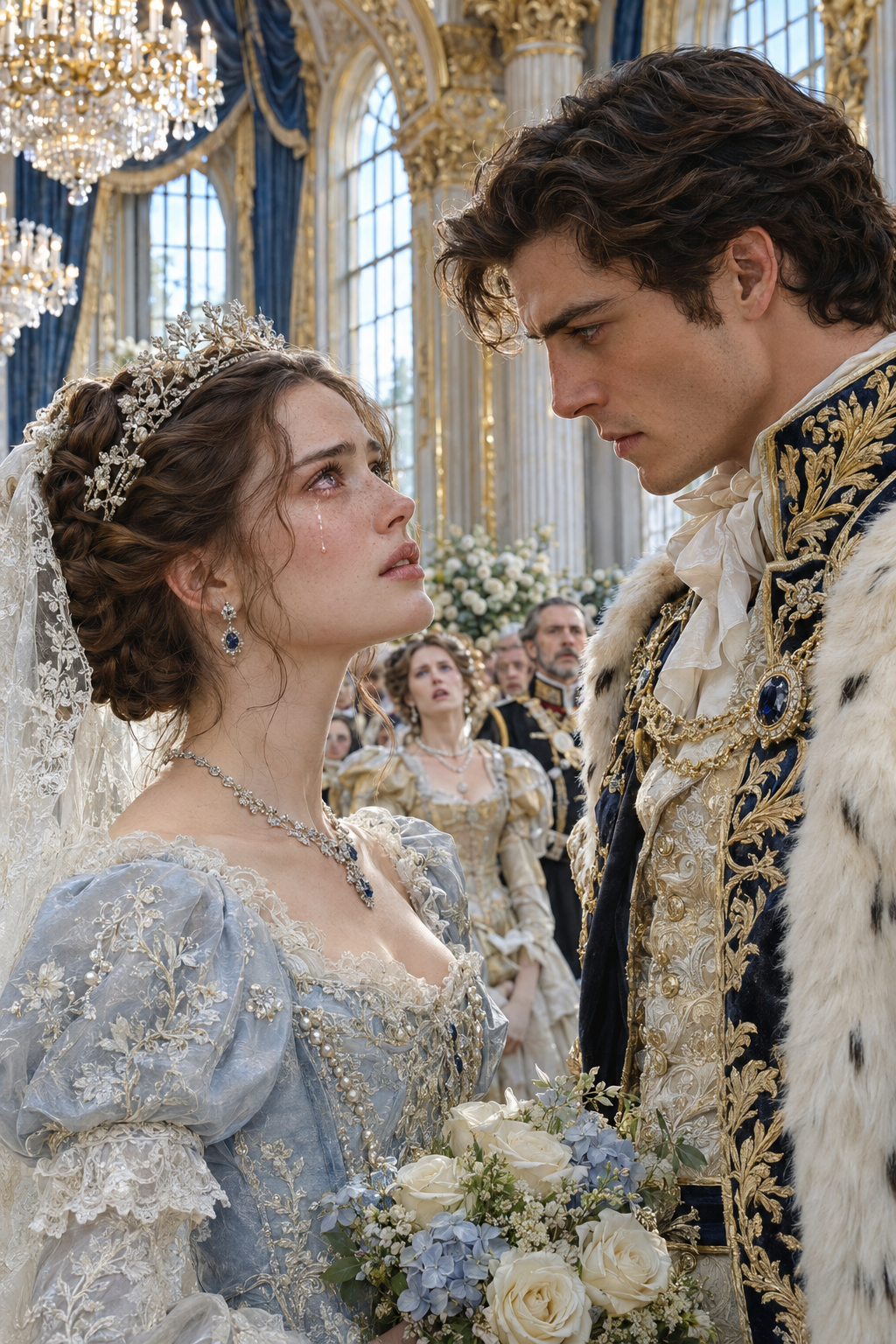
The Duke remained near the doorway, watching without interference.
Eleanor addressed the gentleman beside Clara.
“My sister has not freely consented to this arrangement. I suggest you reconsider your position.”
The man looked from Eleanor to the Duke. Whatever financial advantages he had anticipated suddenly appeared less attractive.
He collected his coat and departed without finishing his wine.
Her father’s face darkened.
“You have no idea what you have done.”
Eleanor tightened her grip on Clara’s hand.
“I believe I am beginning to understand.”
The solicitor stepped forward and requested a private examination of Clara’s inheritance documents.
Her father refused.
The Duke finally spoke.
“Then the matter will be examined through the appropriate legal channels.”
There was no anger in his voice. That seemed to disturb Eleanor’s father more than shouting would have done.
He looked at his daughter.
“Have you forgotten who raised you?”
Eleanor remembered years of carefully measured approval, of footsteps outside her bedroom whenever she had displeased him, of Clara crying silently into her pillow after their father’s reprimands.
“No,” she answered. “That is precisely why I am taking her with me.”
Clara left the house carrying only a small travelling bag.
Inside the carriage, she sat close to Eleanor, watching the familiar windows disappear behind them.
After several miles, she reached into her bag.
“There is something I should show you.”
She produced a bundle of papers wrapped in a faded blue ribbon.
Eleanor recognized the ribbon. It had once belonged to their mother.
“I found them in Father’s desk,” Clara whispered. “He was burning letters yesterday. These were underneath the others.”
The Duke accepted the bundle and unfolded the first document beneath the carriage lantern.
It was a letter addressed to Margaret.
The next contained instructions concerning a transfer of money. Another referred to an appointment on the morning of her fatal journey.
Then he reached a small receipt bearing the name of the coachman who had survived the accident.
His hand became still.
Eleanor leaned closer.
The payment had been issued by her father two days before Margaret’s death.
Beneath the amount, in hurried handwriting, were instructions to retrieve a leather document case from Margaret’s carriage.
The Duke read the receipt again.
Clara watched him anxiously.
“Is it important?”
He folded the paper with extraordinary care.
“Yes.”
The following morning, the solicitor located the former coachman in a village several miles from Ravenshshire.
The man initially refused to speak. He had spent two years living quietly under the weight of a secret that had cost him his employment and nearly his life.
Only when the Duke placed the receipt before him did his resistance collapse.
He admitted that Eleanor’s father had paid him to remove Margaret’s document case during a scheduled stop. Margaret had discovered the theft before the journey resumed.
She demanded that he turn the carriage around.
Frightened of losing his payment and facing exposure, he had driven too quickly along the rain-soaked road. The horses lost their footing near a sharp bend.
The carriage overturned.
He had escaped through a broken door. Margaret had been trapped beneath the wreckage.
When help finally arrived, she was already dead.
The coachman began to weep.
The Duke sat motionless.
Eleanor watched his hand close around the edge of the table until his knuckles whitened.
For two years, he had imagined his sister’s final moments without knowing what had happened. Now the truth was before him, spoken in the trembling voice of a man who could barely meet his eyes.
“Where are the documents?” he asked.
The coachman swallowed.
“I delivered them to the gentleman who paid me.”
The solicitor recorded his statement.
Outside, the Duke stood beneath the bare branches of an elm tree. Eleanor approached slowly, stopping beside him without speaking.
He looked across the fields.
“She must have been terrified.”
Eleanor took his hand.
He did not turn toward her, but his fingers closed around hers.
They remained there until the solicitor called them back to the carriage.
Three days later, Eleanor’s father arrived at Ravenshshire without invitation.
He entered the study carrying a walking stick and wearing a carefully composed expression.
Eleanor was already waiting beside the Duke.
Her father looked at the documents arranged across the desk.
For a moment, his eyes rested upon the coachman’s signed statement.
Then he laughed.
“You intend to ruin a man over the testimony of a servant?”
The Duke did not respond.
The solicitor placed the forged authorizations beside the statement, followed by the recovered correspondence and a record of the missing funds.
The laughter ceased.
Eleanor’s father turned toward her.
“Clara stole those papers.”
“She preserved them.”
“You will destroy your own family.”
Eleanor looked at the man who had once seemed capable of deciding every aspect of her future.
“You were prepared to sacrifice both your daughters to preserve your position.”
His grip tightened around the walking stick.
“Everything I did was for this family.”
“Then why were we always the ones required to pay?”
He opened his mouth, but no answer followed.
Instead, he moved toward the desk.
His gaze settled on the original receipt.
The Duke noticed the movement a fraction too late.
Eleanor’s father seized the paper and lunged toward the fireplace.
Eleanor stepped between him and the flames.
He caught her wrist.
“Move.”
She did not.
The Duke crossed the room, taking hold of his arm before he could wrench Eleanor aside. The receipt slipped from his fingers and fell harmlessly onto the carpet.
The solicitor retrieved it.
For the first time, Eleanor saw genuine fear in her father’s face.
Not regret. Not shame.
Fear of consequences.
The Duke released him.
“You have mistaken restraint for weakness long enough.”
The authorities were informed that afternoon.
In the months that followed, the financial investigation established the full extent of the fraud. Eleanor’s father was prosecuted for forgery and the theft of funds entrusted to his management. His remaining assets were subjected to legal proceedings, and his reputation among the families who had once welcomed him collapsed.
Clara’s inheritance was secured under independent trusteeship.
Margaret’s name was cleared.
When the final judgment arrived, the Duke carried the document into the library and placed it beneath his sister’s miniature portrait.
He stood there for a long time.
Eleanor watched from the doorway.
“Is it enough?” she asked.
He considered the question.
“No.”
He touched the silver frame.
“But it is something she deserved.”
Winter settled over Ravenshshire. Snow softened the gardens, and the great house grew warmer in ways that had little to do with its fireplaces.
Clara filled the music room with hesitant melodies that gradually became confident. She began discussing her future without first searching Eleanor’s expression for permission.
The charitable fund was restored using recovered assets and a substantial contribution from the Duke. Eleanor assumed responsibility for its accounts, ensuring every payment could be independently examined.
Above the dining room fireplace, Margaret’s portrait was returned to its former place.
One evening, the Duke found Eleanor standing beneath it.
“She would have liked you,” he said.
Eleanor smiled faintly.
“I wish I had known her.”
He stood beside her.
“So do I.”
A comfortable silence followed.
Then he reached into his coat and withdrew the marriage settlement he had offered Eleanor months earlier.
“I have instructed the solicitor to make certain your independent income remains yours, whatever you choose.”
She accepted the document.
“Are you expecting me to leave?”
“No.”
His answer came more quickly than either anticipated.
He looked toward the windows, where snow drifted through the darkness.
“But I would rather have you remain because you wish to.”
Eleanor studied him. This was the man she had once believed incapable of tenderness, whose quietness she had mistaken for indifference.
She placed the settlement on a nearby table.
“Then perhaps you should ask me.”
He turned back to her.
“Eleanor, will you stay?”
She reached for his hand.
“Yes.”
He lifted her fingers to his lips, holding them there for a moment longer than courtesy required.
Outside, snow continued falling across the estate.
Months later, when spring returned, Eleanor accompanied Clara into the garden. Her sister had decided to postpone marriage and pursue her education, a choice she announced with the nervous determination of someone still learning that her wishes mattered.
“Do you think Father would have permitted it?” Clara asked.
Eleanor looked toward the house, where the Duke stood speaking with the estate gardener.
“No.”
Clara lowered her eyes.
Eleanor gently touched her arm.
“But your life is not something he was entitled to permit.”
They continued walking beneath the flowering trees.
That afternoon, Eleanor returned to the study where she had first discovered the truth about her marriage. The brass key rested beside an open ledger, no longer concealed within the Duke’s waistcoat.
He looked up as she entered.
“Have you finished the accounts?”
“Almost.”
She placed a fresh document before him. It detailed the establishment of an educational fund for young women whose circumstances had left them financially dependent upon others.
He read it carefully.
“Margaret would approve.”
Eleanor sat beside him.
“I thought she might.”
He signed the document and passed the pen to her.
She remembered another desk, another contract, and the morning she had surrendered her future to protect her sister’s.
How different it felt to hold a pen when no one was threatening to take something away.
She signed her name.
The Duke opened the window, allowing the scent of spring blossoms into the room. Somewhere below, Clara was laughing with one of the gardeners.
Eleanor listened.
She had arrived at Ravenshshire believing that love was another word for obligation, that loyalty meant obedience, and that sacrifice was the only protection she could offer someone she cherished.
She had learned otherwise.
Love did not require a person to surrender their freedom. Loyalty did not demand silence in the presence of wrongdoing. And protecting someone sometimes meant refusing the very person who claimed the right to command them.
The Duke extended his hand toward her.
“Shall we walk?”
Eleanor closed the ledger and rose.
Together, they stepped into the afternoon sunlight, leaving the study door open behind them.
For the first time in her life, the future was not an arrangement someone else had made.
It was hers.
Three years later, on a quiet October morning, a letter arrived at Ravenshshire bearing a familiar signature.
Eleanor recognized her father’s handwriting before she broke the seal.
His sentences were shorter than she remembered. There were no instructions, no references to family obligations, no carefully disguised threats.
He was ill.
He wished to see his daughters.
Eleanor read the letter beside the library window, where autumn sunlight fell across the carpet. Beyond the glass, gardeners were gathering fallen leaves beneath the trees.
The Duke entered carrying two cups of tea.
He noticed the paper in her hand.
“Your father?”
She nodded.
He placed the cups on the table and waited.
“He wants us to visit.”
“Will you?”
Eleanor folded the letter along its original creases.
“I haven’t decided.”
He sat beside her.
“Then there is no need to decide this morning.”
She looked at him, remembering how differently such a conversation would once have unfolded. Her father had always treated hesitation as disobedience. Her husband understood that some decisions required silence.
That afternoon, Eleanor found Clara in the music room, surrounded by books and unfinished correspondence.
Her younger sister had grown into a remarkably independent young woman. She had completed her studies and now helped oversee the educational fund established in Margaret’s memory.
When Eleanor showed her the letter, Clara read it without speaking.
“Do you think he has changed?”
“I don’t know.”
Clara placed the letter on the piano.
“Would it be terrible if I didn’t want to see him?”
Eleanor reached for her hand.
“No.”
They sat together for a while, listening to the wind moving through the garden.
In the end, Eleanor decided to visit alone.
Her father was living in a modest house outside the city, far removed from the grand rooms in which he had once entertained influential guests.
A servant admitted her into a narrow sitting room.
He was seated beside the fireplace, a blanket covering his knees. His hair had turned almost entirely white.
When Eleanor entered, he attempted to stand.
She gestured for him to remain seated.
For a moment, they regarded each other with the awkwardness of strangers.
“You look well,” he said.
“I am.”
“And Clara?”
“She is happy.”
He lowered his eyes.
“Does she intend to marry?”
“When she finds someone she wishes to marry.”
His fingers moved against the blanket, but he offered no objection.
Eleanor took the chair opposite him.
The room smelled faintly of medicine and extinguished candles. On the mantel stood a small portrait of her mother.
Her father followed her gaze.
“She would have been disappointed in me.”
Eleanor said nothing.
He looked toward the fire.
“I believed that preserving our position justified certain decisions.”
“You made those decisions for other people.”
He nodded slowly.
It was the first time she could remember him accepting a criticism without defending himself.
“I cannot undo what happened.”
“No.”
“Can you forgive me?”
Eleanor looked at the hands resting upon his knees. Once, those hands had placed a marriage contract before her and threatened her sister’s future.
She no longer feared them.
“I have spent years learning not to carry what you did to us,” she answered. “But forgiveness does not mean pretending it never happened.”
Her father closed his eyes.
A tear slipped along the side of his face.
Eleanor remained until the afternoon light began to fade. Before leaving, she arranged for his physician to visit regularly and ensured that his household had sufficient provisions.
She did not promise to return.
Nor did she ask Clara to do so.
Some wounds could heal without restoring the relationship that had caused them.
When Eleanor arrived at Ravenshshire that evening, the Duke was waiting beneath the entrance arch.
A little girl stood beside him, holding tightly to two of his fingers.
“Mama!”
Eleanor barely had time to remove her gloves before her daughter rushed into her arms.
Margaret was nearly two years old, with her father’s grey eyes and an extraordinary determination to investigate every forbidden corner of the house.
Eleanor lifted her, breathing in the familiar scent of lavender from her hair.
“Have you been behaving?”
The child shook her head with such solemn honesty that the Duke laughed.
Eleanor looked at him.
Years earlier, she could scarcely have imagined that sound belonging to this house.
Later, after Margaret had fallen asleep, Eleanor joined her husband in the library.
He closed his book.
“How was he?”
“Older.”
The Duke waited.
“And smaller than I remembered.”
She sat beside him, resting her head against his shoulder.
“I thought seeing him would make me feel something different.”
“Did it?”
Eleanor considered the question.
“It made me realize how little of my life belongs to him now.”
The Duke took her hand.
Neither spoke again for some time.
The following spring, Ravenshshire opened its doors to the first group of young women receiving support from Margaret’s educational fund.
Some had lost their parents. Others came from households where their futures had already been arranged without their consent.
Eleanor welcomed each of them personally.
Clara stood beside her, explaining the opportunities available to them with a confidence that would once have seemed impossible.
Among the visitors was a quiet young woman who lingered after the others had departed.
She held an application form between trembling fingers.
“My father says accepting this would disgrace our family.”
Eleanor invited her to sit.
“Is studying what you want?”
The young woman nodded.
“Then we shall begin there.”
She helped her complete the application, taking care not to answer any question on her behalf.
Across the room, the Duke watched Eleanor return the pen to the young woman’s hand.
He remembered the woman who had arrived at Ravenshshire wearing a wedding ring she had never chosen.
She had possessed the same quiet determination then, though she had not yet understood its strength.
That evening, Eleanor and the Duke walked through the gardens with their daughter between them.
Margaret stopped beneath a flowering tree, fascinated by a butterfly resting upon a branch.
The Duke lifted her onto his shoulders.
Eleanor watched their daughter reach toward the blossoms, laughing when the petals scattered around her.
“Do you ever regret it?” she asked.
He glanced down.
“Our marriage?”
She nodded.
He considered his answer before speaking.
“I regret the circumstances that brought you here.”
He reached for her hand.
“Never that you stayed.”
Eleanor smiled.
They continued toward the house as the evening sun turned its windows golden.
Inside, Margaret’s portrait remained above the dining room fireplace. Fresh flowers stood beneath it, and the ledger containing the records of her charitable work rested safely in the library.
The past had not been erased.
It had been given a different place in their lives.
Years afterward, when their daughter was old enough to understand the story of her parents’ marriage, she asked Eleanor whether she had been frightened on the day she arrived at Ravenshshire.
“Very,” Eleanor admitted.
“Even though Papa was there?”
“Especially because I did not know him.”
Margaret frowned.
“Then how did you know you loved him?”
Eleanor looked across the garden, where the Duke was attempting to repair a wooden toy beneath the impatient supervision of their youngest child.
“I discovered that I could disagree with him without being afraid. That I could tell him the truth without being punished. And that he wanted me to be happy, even when my happiness required something different from what he wanted.”
Margaret thought about this.
“Is that what love is?”
Eleanor brushed a strand of hair away from her daughter’s face.
“It is a very good place to begin.”
The dinner bell sounded from the house.
Margaret ran ahead, calling for her father.
Eleanor followed slowly, passing beneath the trees that had stood outside Ravenshshire long before her arrival.
She remembered the rain against the carriage windows, the unfamiliar wedding ring, and the man who had told her she need not pretend to be pleased.
Neither of them had known what their marriage would become.
Her father had believed that wealth could purchase obedience and that fear could guarantee loyalty.
He had been wrong.
The strongest bonds Eleanor had ever known were those she had been free to refuse.
At the entrance, the Duke waited for her with his hand extended.
She took it, just as she had countless times before.
Together, they entered the house, where their children’s laughter filled the corridors and the dining room glowed with candlelight.
Ravenshshire was no longer a monument to grief.
It was a home.
And Eleanor, once sent there as the price of another man’s ambition, had built a life that no bargain could ever have purchased.
THE END.