On nights when storms rolled across America’s back roads, Betsy “Bess” King usually knew exactly what to expect.
The silence outside the freezer lasted long enough for Bess to begin fearing it more than the gunfire.
She stood with her shoulder pressed against the metal wall, feeling the cold seep through her clothes. Her breath floated white in front of her face. Every instinct told her to remain hidden, but another thought kept forcing its way through the fear.
The diner.
Her diner.
Whatever was happening beyond that door was happening inside the last place she still considered home.
Bess finally reached for the handle.
For one second, she could not make herself turn it.
Then she remembered Darwin looking directly at her before sending her toward the back.
“Go.”
It had not sounded like a request.
She opened the door.
The warm air from the kitchen hit her first. Then came the smell.
Smoke. Broken wood. Hot metal. Food scattered across the floor.
The kitchen that had been spotless only minutes earlier looked as if the storm outside had somehow forced its way through the walls.
Bess stepped forward carefully.
A plate she had served earlier lay broken near the counter. One of her coffee mugs had rolled beneath a table. A chair rested on its side beside shattered glass.
The front of the diner had suffered the worst of it.
Rain blew through damaged windows. Water mixed with debris on the floor. The neon glow that had welcomed travelers on Route 28 flickered weakly through the wreckage.
For a moment Bess forgot about the armed men.
She saw only years.
Years of early mornings.
Years of late nights.
Years of standing beside her husband when the diner still belonged to both of them.
After he died, people had sometimes asked why she did not sell the place.
They never understood.
Selling the diner would have felt like losing him twice.
Now Bess stood among the ruins and realized she might lose it anyway.
A movement near the counter pulled her back into the present.
Darwin was alive.
He was leaning heavily against the edge of a booth, his injury clearly taking its toll, but he was on his feet.
Several of his men remained nearby, exhausted and shaken by the fight.
When Darwin saw Bess emerge from the back, something in his expression changed.
He looked almost relieved.
“You stayed in there?”
Bess stared at him.
“You told me to.”
Even in the wreckage, the answer nearly made him smile.
Then she looked around again.
The smile disappeared before it could fully form.
Darwin followed her gaze.
He had spent much of his life looking at destruction. He knew what violence left behind. Broken rooms. Broken cars. Broken men. He had learned to assess damage quickly because survival often depended on knowing what still worked.
But Bess was not assessing damage.
She was mourning.
She walked to the counter and touched the edge where the surface had been split.
Her fingers rested there gently, almost as if she were touching something wounded.
Darwin watched her in silence.
“This was all I had,” she said.
There was no accusation in her voice.
That somehow made the words land harder.
Outside, the storm continued rolling across Route 28 as though nothing important had happened.
Bess picked up one of the fallen coffee mugs.
The handle had broken off.
She looked at it for a few seconds and put it down.
Darwin approached her slowly.
“It can be rebuilt.”
Bess gave a small, tired laugh.
“With what?”
He did not answer immediately.
She turned toward him.
“With what, Darwin? Good intentions?”
His men became very quiet.
They had heard people challenge Darwin Myers before, but usually those people had done it with anger or ambition. Bess sounded different.
She sounded exhausted.
She had fed strangers because they were hungry. She had given them shelter because there was a storm. And now the place she had protected through widowhood, loneliness and long American winters looked as though it might never open again.
Darwin looked around the diner once more.
Then he looked back at her.
“I’ll build you another one.”
Bess shook her head.
“You don’t understand.”
“I understand enough.”
“No, you don’t.”
Her voice grew stronger.
“I don’t want another little room with a stove and a sign out front. This place mattered.”
Darwin absorbed that without argument.
Then he said something she would remember for months.
“I’m not going to build you another diner.”
Bess frowned.
Darwin stepped closer, the storm flashing white through the broken windows behind him.
“I’m going to build you a castle on the ashes.”
Bess stared at him.
Under any other circumstances, the sentence might have sounded ridiculous.
Standing in a ruined roadside diner in the middle of a severe storm, spoken by a wounded mob boss surrounded by armed men, it sounded even more impossible.
“You’ve lost too much blood,” Bess said.
Darwin almost laughed.
“Maybe.”
“Go get yourself patched up.”
“I made you a promise.”
“You don’t even know what you’re promising.”
“Yes, I do.”
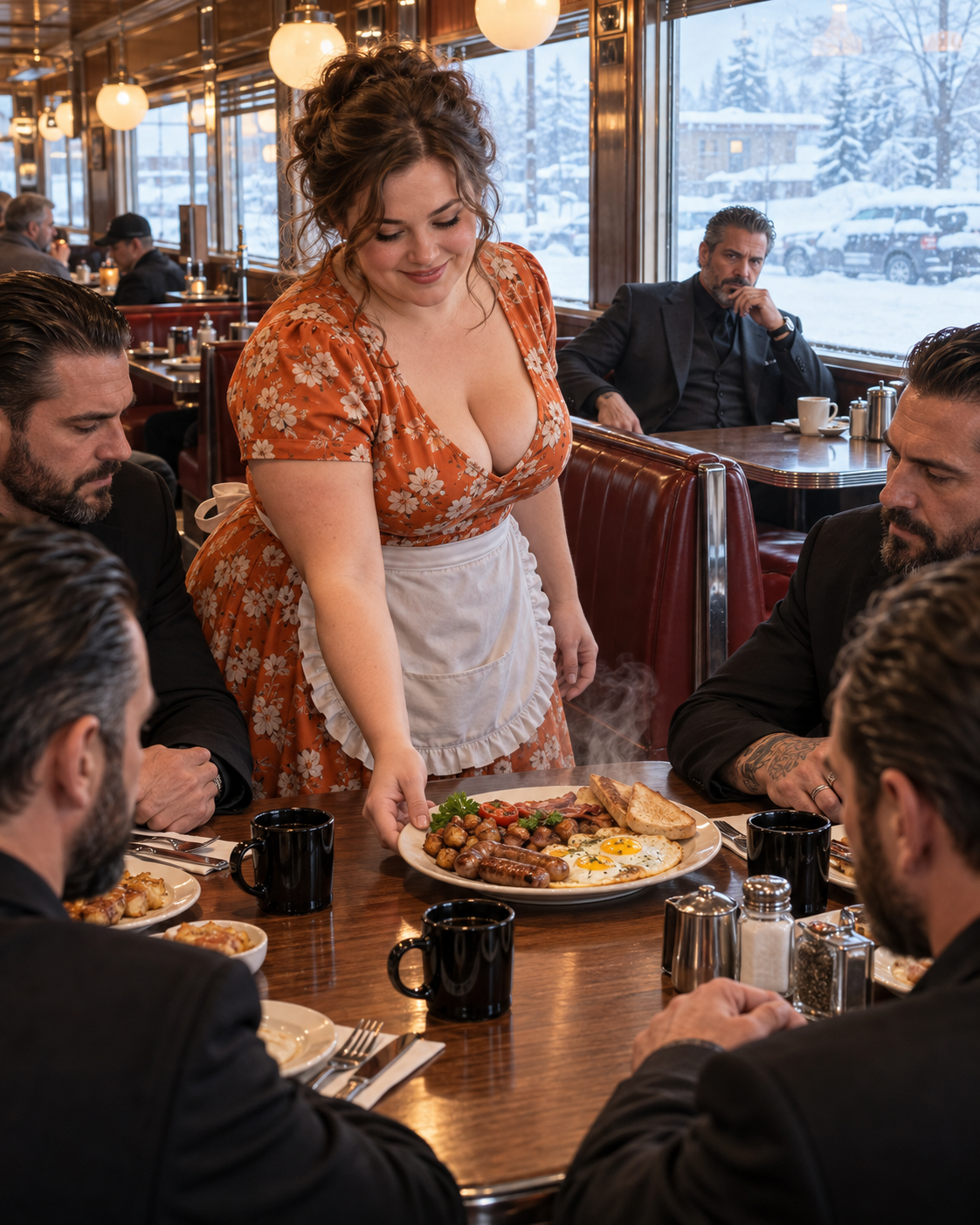
Bess looked at the broken room.
“You won’t remember this tomorrow.”
Darwin’s face became still.
“I remember my debts.”
Bess did not consider what she had done a debt.
She had cooked food.
She had offered shelter.
She had done what seemed necessary because eighteen men had appeared on her doorstep during a storm and one of them had been wounded.
But Darwin saw the night differently.
When danger had followed him to her door, Bess had not demanded to know what helping him might earn her.
She had helped first.
That mattered to a man whose world rarely worked that way.
By morning, the storm had weakened.
The diner had not survived it.
What remained of Bess King’s old life stood damaged beyond anything a mop, hammer or weekend repair could fix.
The Route 28 restaurant that had once glowed through rain and darkness was finished.
Bess stood outside and looked at it for a long time.
Darwin was preparing to leave.
Before he did, he walked toward her.
She did not turn.
“You should go,” she said.
“I will.”
“Your men need you.”
Darwin looked toward the ruined diner.
“So do you.”
Bess finally faced him.
“I survived before you arrived.”
“I know.”
“I’ll survive after you leave.”
“I know that too.”
That answer irritated her more than an argument would have.
Darwin reached into his coat, stopped when he saw the way Bess stiffened, then slowly lowered his hand.
“No tricks,” he said.
“I wasn’t worried.”
“You should be worried more often.”
“And you should get shot less often.”
For the first time since the violence ended, Darwin laughed.
It was brief, but real.
Then his expression softened.
“Castle on the ashes, Bess.”
She folded her arms.
“I’ll believe it when I’m standing inside it.”
Darwin nodded once.
“Then that’s where I’ll see you.”
He left Route 28 with his surviving men.
Bess watched until the vehicles disappeared.
Then she looked back at what remained of the diner.
She expected never to see Darwin Myers again.
In the weeks that followed, life became quieter, but not easier.
The damaged diner could not simply be reopened.
Bess found herself waking at the same hour she always had, only to remember there was no grill to heat, no coffee to brew, no counter waiting for her.
Habit became its own kind of grief.
She missed the smallest things most.
The first hiss of the coffeemaker.
The weight of a spatula in her hand.
The bell above the entrance.
Rain tapping against the windows while she stood safely behind the counter.
She even missed customers leaving crumpled bills beside half-finished cups of coffee.
The diner had given shape to her days.
Without it, time felt larger than it should.
Every now and then, she thought about Darwin’s promise.
A castle on the ashes.
She always dismissed it.
Men said strange things after surviving terrible nights.
Perhaps Darwin had meant it when he said it. That did not mean it would happen.
Then work began on the property.
The remains of the old diner were demolished.
At first Bess reacted with anger.
Watching the final pieces disappear felt brutal.
The building had been damaged, yes, but seeing it completely removed made the loss permanent.
Yet something else started happening almost immediately.
Materials arrived.
Crews appeared.
Foundations were prepared.
The empty space beside Route 28 began changing.
Bess tried to get answers.
What exactly was being built?
Who had approved all this?
Why was nobody asking her what she wanted?
The answers came slowly, and when they did, they only made Darwin’s promise more difficult to dismiss.
The building was for her.
Not a replacement thrown together quickly.
Not an apology disguised as construction.
Something carefully planned was rising where the old diner had stood.
Bess visited often.
At first she remained outside the work area with her arms folded, skeptical of every new wall.
But curiosity gradually defeated resistance.
The structure grew larger.
Stronger.
More elegant than anything she had ever imagined owning.
There would still be a kitchen.
That mattered most.
A serious kitchen.
A place designed for someone who actually cooked rather than someone who merely wanted an impressive restaurant.
There would be space for guests, warm lighting, carefully considered rooms and details that transformed the roadside property into something almost unreal.
And yet, somehow, Bess could still imagine herself inside it.
That surprised her.
She had feared a grand restaurant would feel like somebody else’s dream built over hers.
Instead, little by little, the new place began to feel less like Darwin erasing the diner and more like him refusing to let the story end in ruins.
Months passed.
The scar left by the violent night became something different.
Drivers along Route 28 could see the transformation from the highway.
Where a modest American diner had once stood, a striking new restaurant now rose with a confidence that made people slow down for a second look.
Bess stood outside on the day she was finally allowed to see the finished building.
For several moments she did not move.
The sign caught her eye.
La Fortezza.
The Fortress.
Bess shook her head slowly.
Of course Darwin would name it something like that.
She walked toward the entrance.
The door opened.
Inside, warmth surrounded her.
Everything was new.
Everything was far more luxurious than the diner she had lost.
But it did not feel cold.
That was the first thing she noticed.
Luxury could sometimes make a place feel too perfect to touch.
La Fortezza felt alive.
She walked through the dining area with her hand trailing lightly along the furniture.
She examined every corner like a woman looking for evidence that she had entered someone else’s property by mistake.
Then she reached the kitchen.
That was where she stopped.
For all the beauty outside it, the kitchen was the heart.
Bess stepped inside.
She looked at the work surfaces.
The equipment.
The storage.
The space she would have to move.
She imagined plates lined up during a busy evening. Pots steaming. Orders arriving. Coffee being poured again.
Her eyes burned.
She blinked hard.
She had promised herself she would not cry over a building.
Then she saw something familiar.
Among all the polished newness was one small reminder of the place that had come before.
Not enough to turn La Fortezza into a memorial.
Just enough to tell her that the ashes had not been forgotten.
Bess placed a hand on the counter.
For months, she had imagined what she would say if Darwin ever returned.
Most versions involved accusing him of being arrogant.
Several involved telling him that nobody needed a restaurant this elaborate.
One particularly satisfying version involved informing him that his taste was excessive.
But standing in the finished kitchen, Bess could not remember any of those speeches.
A voice came from behind her.
“So?”
She froze.
She knew the voice immediately.
Bess turned.
Darwin Myers stood in the doorway.
He looked different from the wounded man who had entered her diner through the rain months earlier.
There was no blood on his shirt now.
No storm behind him.
No eighteen armed men crowding the room.
Just Darwin.
For a moment neither spoke.
Then Bess looked around the kitchen.
“This is your idea of a diner?”
“No.”
“I thought so.”
“I told you I wasn’t building another diner.”
Bess narrowed her eyes.
“You always this pleased with yourself?”
“Only when I’m right.”
She pointed toward the doorway.
“I can still throw you out.”
“It’s your restaurant.”
That stopped her.
Not because she had misunderstood what had been built, but because hearing the words aloud made everything suddenly real.
Your restaurant.
Bess looked at him.
“You actually did it.”
Darwin’s expression changed.
The humor disappeared.
“I told you I would.”
“People say things.”
“I’m not people.”
“No,” Bess replied. “You’re certainly something else.”
He smiled.
Bess walked past him into the dining room.
Darwin followed.
She stopped near the center and slowly turned, taking in La Fortezza again.
“Why?”
Darwin knew exactly what she meant.
He could have answered with money.
Debt.
Honor.
Obligation.
All would have been partly true.
None would have been enough.
“You opened your door.”
Bess frowned slightly.
“It was raining.”
“That isn’t what I mean.”
Darwin moved a little closer.
“You had every reason to be afraid of us. You still opened your door.”
“You were hurt.”
“You fed us.”
“You were hungry.”
“You gave us shelter.”
“There was a storm.”
Darwin shook his head.
“You keep explaining it as though anyone would have done the same thing.”
Bess said nothing.
“Most people in my life calculate the price before they offer anything,” he continued. “You didn’t.”
“I didn’t know who you were.”
“You knew enough.”
That was true.
Bess had known enough to be frightened.
She simply had not allowed fear to make the decision for her.
Darwin looked around the restaurant.
“This isn’t payment for a meal.”
“Good, because that would be an expensive plate.”
“It’s not payment for the shelter either.”
“Then what is it?”
Darwin’s gaze returned to her.
“It’s what I said it was.”
“A castle?”
“A castle on the ashes.”
Bess looked toward the windows.
Outside lay Route 28, the same road that had carried a storm, violence and eighteen armed strangers to her door.
She thought about how strange life could be.
One night could destroy a building.
One choice made in the middle of that night could rebuild an entire future.
“I still don’t know what to do with something like this,” she admitted.
“Yes, you do.”
“You’re very sure of me.”
“I watched you cook dinner during a gunfight.”
“It wasn’t during the gunfight.”
“Close enough.”
Bess almost smiled.
Darwin stepped toward the kitchen.
“You cook.”
“That’s your grand advice?”
“It worked before.”
Bess followed his glance.
For months, she had feared that accepting La Fortezza meant admitting the old diner no longer mattered.
Standing there, she finally understood that moving forward did not require pretending the past had never existed.
The old place had been hers.
So was the grief attached to it.
But grief did not have to become the final owner of the land.
Bess walked into the kitchen again.
She picked up a clean pan and tested its weight.
Darwin watched from the doorway.
“You planning to stand there all day?” she asked.
“I was considering it.”
“Then you’ll be in the way.”
He stepped aside.
“Better?”
“Marginally.”
Bess placed the pan down.
“When does this place open?”
“Whenever you say.”
She looked around.
“Tomorrow?”
“If you want.”
Bess shook her head.
“No. Not tomorrow.”
Darwin raised an eyebrow.
She examined the kitchen once more with the practiced attention of someone preparing for work.
“Too much to do.”
There it was.
Not fear.
Not mourning.
Work.
Darwin recognized the change immediately.
Bess was no longer touring La Fortezza.
She was taking possession of it.
She started opening drawers, checking shelves, examining the placement of equipment and muttering about what should be moved.
Darwin leaned against the doorway.
After a few minutes, Bess noticed he was still there.
“What?”
“Nothing.”
“You’re staring.”
“I’ve done that before.”
“I remember.”
She returned to inspecting the kitchen.
Darwin remained silent for a moment.
Then he said, “There is one more thing.”
Bess sighed dramatically.
“If you bought me a second restaurant, I’m going to hit you with this pan.”
“No second restaurant.”
“Good.”
“I’m staying.”
Her hands stopped.
She turned slowly.
“What does that mean?”
“It means what it sounds like.”
“Darwin.”
“I told you that night you wouldn’t have to rebuild alone.”
“You built the whole thing while I complained from the sidewalk.”
“I noticed.”
“And now?”
“Now you have a restaurant to run.”
“I’ve run a restaurant before.”
“I know.”
“So why are you staying?”
Darwin looked at her for a long moment.
The answer did not arrive with the theatrical confidence Bess expected from him.
When he finally spoke, his voice was quieter.
“Because I don’t want you cooking alone anymore.”
Bess did not move.
Months earlier, beneath thunder and flashing highway lights, Darwin had arrived as a wounded stranger surrounded by danger.
She had expected trouble from him.
She had received destruction because of him.
Then, somehow, from that destruction had come La Fortezza.
But the building was not the part that unsettled her most now.
It was the man standing in her kitchen as though the promise had never been about bricks at all.
“You don’t cook,” she said.
“I can learn.”
“You can’t.”
“You haven’t seen me try.”
“I’ve seen enough.”
Darwin smiled.
“So that’s a yes?”
“That is absolutely not a yes.”
“But it isn’t a no.”
Bess picked up a towel and threw it at him.
He caught it.
For the first time since her husband’s death, laughter filled a kitchen that belonged to her without immediately becoming painful.
Bess heard it and went still.
Darwin noticed.
He did not ask what was wrong.
That, strangely, helped.
The laughter faded, but the warmth stayed.
Bess looked around La Fortezza.
A castle on the ashes.
She had thought the promise meant Darwin would replace what had been destroyed.
Now she understood he had done something more difficult.
He had given her a place where memory and possibility could exist together.
The old diner could never return.
Her husband could never return.
The terrible night could not be undone.
None of those truths changed.
But healing, Bess realized, was not the art of making tragedy disappear.
It was learning that something meaningful could still be built after tragedy had finished taking what it could.
She walked toward the front windows.
Route 28 stretched beyond them.
Cars moved along the highway.
Somewhere in the distance, clouds gathered, but they were ordinary clouds this time.
No violent storm.
No approaching headlights carrying danger.
Just another American road leading somewhere.
Darwin came to stand beside her.
“You know,” Bess said, “La Fortezza is a ridiculous name.”
“You like it.”
“I didn’t say that.”
“You didn’t have to.”
She looked at the sign outside.
“The Fortress.”
“Appropriate.”
“For a restaurant?”
“For you.”
Bess turned to him.
Darwin did not smile this time.
She understood.
A fortress was not a place where nothing bad could enter.
Bess knew better than anyone that walls could break and windows could shatter.
A fortress was a place that remained standing because somebody decided there was still something inside worth protecting.
Bess had spent years protecting memories.
Now perhaps it was time to protect a future too.
She returned to the kitchen.
Darwin followed.
“Rule one,” she said.
“There are rules?”
“There are now.”
He nodded solemnly.
“Rule one.”
“Stay out of my way when I’m cooking.”
“Reasonable.”
“Rule two. Nobody with a gun gets to complain about the coffee.”
“Very specific.”
“I’ve had experience.”
“And rule three?”
Bess paused.
She looked at the man who had arrived one stormy night as the most dangerous stranger ever to cross her doorway and returned months later having kept an impossible promise.
“Rule three,” she said, “if you say you’re staying, you stay.”
Darwin’s expression softened.
“That one I can do.”
Bess nodded.
Then she turned toward the stove.
There would be menus to plan.
Tables to prepare.
Food to order.
A thousand details between an empty restaurant and opening night.
The work ahead no longer frightened her.
Work had always been how Bess understood hope.
Outside, travelers continued down Route 28, unaware of everything the building beside the highway had survived before its first meal was ever served.
Soon they would see the lights of La Fortezza in the distance.
They would pull off the road, step inside and find warmth waiting for them.
Some might hear pieces of the story.
A storm.
A ruined diner.
A wounded man.
A promise made among shattered glass.
But Bess knew the real story was simpler.
A door had opened when fear said it should remain closed.
Kindness had been given before anyone asked what it was worth.
And when everything seemed destroyed, someone had remembered.
Months earlier, Bess King believed the ashes on Route 28 marked the end of her life as she knew it.
They did not.
They marked the ground where the next part could begin.
Darwin had promised her a castle.
What he ultimately helped restore was something no building alone could provide: the courage to belong to the future again.
And this time, when Bess lit the kitchen and reached for the first clean pan in La Fortezza, she was not cooking alone.
The first night La Fortezza opened, rain returned to Route 28.
Not the violent storm that had changed Bess King’s life months earlier.
This rain was softer.
Steady.
Almost gentle.
It tapped against the broad windows while headlights passed on the wet highway, turning the road outside into long ribbons of silver.
Inside the restaurant, every table was full.
Bess had expected a modest opening.
A few curious locals.
A handful of travelers who remembered the old diner.
Perhaps some truckers who had been eating her breakfasts for years.
Instead, people kept coming.
Some had heard about the strange new restaurant that had risen where the little diner once stood.
Others simply saw the warm lights from the highway and turned in.
Bess moved through the kitchen with the confidence of someone who had finally returned to the place where she understood herself best.
Orders came in quickly.
Pans hissed.
Plates disappeared through the doors and returned empty.
Coffee flowed steadily.
For the first hour, Darwin attempted to help.
It did not go well.
“You’re holding that wrong,” Bess told him.
Darwin looked at the tray in his hands.
“It’s a tray.”
“And somehow you’re still holding it wrong.”
One of the kitchen workers tried unsuccessfully to hide a smile.
Darwin glanced at him.
The smile vanished.
Bess pointed toward the dining room.
“Go.”
“I’m helping.”
“You’re intimidating my staff.”
“I haven’t said anything.”
“That’s the problem.”
Darwin looked offended.
Bess shoved a fresh pot of coffee toward him.
“Table seven.”
“You trust me with coffee?”
“Not really.”
He took the pot anyway.
As he walked out, Bess watched him for half a second longer than necessary.
Then she returned to the stove.
There had been a time when Darwin Myers entering her diner would have changed the temperature of the entire room.
People would have noticed.
They would have watched him.
They might have whispered.
Tonight, he moved among families, travelers, truck drivers and elderly couples as though he belonged there.
In a strange way, he did.
The night grew busier.
By nine o’clock, Bess had stopped worrying whether the restaurant would succeed.
By ten, she had started worrying whether the kitchen could survive success.
Near midnight, the last table finally left.
The staff cleaned quietly.
The rain continued outside.
Bess stood behind the counter with both hands resting on the polished surface.
The room was empty now.
For the first time all night, La Fortezza was silent.
Darwin approached.
“Well?”
Bess looked around.
“There are three things wrong with the kitchen.”
“Only three?”
“Four if you count you.”
He smiled.
Then he placed something on the counter.
An old coffee mug.
Bess stared at it.
The ceramic was faded.
One side bore a tiny crack near the handle.
She recognized it immediately.
It was from the old diner.
Not one of the broken ones.
One that had somehow survived.
“Where did you get that?”
“One of the men found it after the storm.”
“And you kept it?”
“Yes.”
“For months?”
“Yes.”
Bess picked it up carefully.
The mug felt almost absurdly light considering the weight of memory attached to it.
“I thought everything was gone.”
“Not everything.”
Bess looked down at it.
Her husband had bought dozens of those mugs years earlier because they had been on sale.
She had hated them at first.
Too heavy.
Too plain.
He had said that was exactly why diner customers would love them.
He had been right.
She ran her thumb along the chipped edge.
“You could have given me this sooner.”
“I could have.”
“Why didn’t you?”
Darwin leaned against the counter.
“I thought you needed to see what came next before I handed you what was left.”
Bess raised her eyes.
“That almost sounded wise.”
“Don’t spread it around.”
She smiled.
The front door rattled softly in the wind.
Both of them glanced toward it.
For one brief second, memory pulled the room backward.
Rain.
Darkness.
Men entering.
Blood on the floor.
Bess could almost hear the old storm again.
Darwin noticed the change in her face.
“You all right?”
Bess took a breath.
“Yes.”
This time, she actually meant it.
The door was only a door.
The rain was only rain.
The past had not returned.
She placed the old mug on a shelf behind the counter.
Not hidden.
Not displayed like a sacred object.
Simply there.
Part of the room.
Part of the story.
Then she turned off one set of lights.
The restaurant softened into shadows and warm amber pools.
Darwin followed her toward the kitchen.
“Successful night,” he said.
“Don’t sound surprised.”
“I’m not.”
“You looked surprised when table three ordered dessert twice.”
“That was concern.”
“About what?”
“Structural integrity.”
Bess laughed.
They reached the kitchen.
She began wiping down a surface that had already been cleaned.
Darwin watched.
“You don’t have to do that.”
“I know.”
“You employ people now.”
“I know.”
“You can go home.”
Bess stopped.
Home.
The word felt different than it once had.
For years, home had meant the apartment above memory.
Then it had meant wherever she could sleep while waiting for the diner property to become something again.
Now she was not sure whether home was a house, a kitchen, a restaurant, or simply the place where she no longer felt abandoned by her own life.
Darwin seemed to understand her silence.
He did not press.
Instead, he picked up a towel.
Bess looked at him suspiciously.
“What are you doing?”
“Helping.”
“You don’t know how.”
“I wiped a table earlier.”
“You frightened the people sitting at it.”
“They left a good tip.”
“They were afraid not to.”
Darwin began wiping the counter anyway.
Bess let him.
For several minutes, neither spoke.
It was ordinary work.
That was what made it extraordinary.
No danger.
No promises.
No dramatic declarations.
Just two people cleaning a kitchen after a long night.
Weeks turned into months.
La Fortezza became a landmark on Route 28.
Truckers talked about it.
Travelers recommended it.
Locals brought relatives there.
Some came because the food was excellent.
Others came because they had heard rumors about the woman who owned it and the man who had built it.
Bess refused to confirm most of those rumors.
“If people want a story,” she told Darwin one afternoon, “they can order pie.”
“What kind?”
“Whichever one costs the most.”
Darwin laughed.
The restaurant grew busier.
So did Bess.
For the first time in years, her days were not shaped by surviving loss.
They were shaped by plans.
Menus.
Staff schedules.
New recipes.
Repairs.
Complaints.
Celebrations.
Normal problems.
She loved them.
There was freedom in worrying about burned toast instead of grief.
But Darwin remained difficult to understand.
Some days he disappeared for hours.
Sometimes for longer.
He never told Bess much about where he went.
She never asked for details.
There were pieces of his life she did not want inside La Fortezza.
He seemed to understand that boundary.
No armed meetings.
No whispered business at the tables.
No men arriving to settle dangerous matters over coffee.
La Fortezza became neutral ground because Bess said it would.
Strangely, even Darwin respected that.
Especially Darwin.
Then one winter evening, nearly a year after the storm, he did not come back.
At first Bess noticed only because dinner service ended without him appearing.
That was unusual.
He had developed the irritating habit of arriving near closing and pretending he was there by coincidence.
The next night, he was absent again.
On the third night, Bess asked one of the men who occasionally accompanied him.
“Where is he?”
The man hesitated.
That was enough to make Bess angry.
“Don’t do that.”
“Do what?”
“That thing where everyone looks at me like I’m supposed to understand silence.”
The man glanced toward the door.
“Darwin had business.”
“He always has business.”
“This was different.”
Bess placed both hands on the counter.
“Is he alive?”
“Yes.”
The answer came quickly.
Too quickly.
“Is he hurt?”
A pause.
Bess closed her eyes.
“Of course.”
“He’s alive.”
“You already said that.”
“He didn’t want you involved.”
Bess opened her eyes.
“I wasn’t involved the first time either, and look how that turned out.”
The man did not answer.
“Where is he?”
“I can’t tell you.”
Bess leaned forward.
“You should remember something.”
The man swallowed.
“What?”
“I once fed eighteen armed men in the middle of a storm.”
“Yes, ma’am.”
“Do I look like someone who enjoys being told what she can’t do?”
“No, ma’am.”
“Good.”
Twenty minutes later, Bess was in a car heading away from Route 28.
She hated every second of it.
Not because she was afraid.
Because the situation felt too much like the past trying to repeat itself.
She had spent months building distance from that night.
Now she was driving back toward the kind of world Darwin had promised would never cross La Fortezza’s doors.
The car stopped outside a quiet house far from the highway.
Bess entered without waiting for permission.
Darwin was sitting in a chair near a window.
A bandage covered part of his side.
He looked up.
His face immediately hardened.
“Who brought you here?”
Bess pointed behind her.
“The smart one.”
Darwin looked toward the man at the door.
The man suddenly found the floor very interesting.
“You shouldn’t be here,” Darwin said.
Bess walked closer.
“I’ve heard that before.”
“This isn’t your problem.”
“That one too.”
Darwin tried to stand.
Bess pushed him back into the chair.
He stared at her.
She stared back.
“Sit.”
He sat.
“You’re hurt.”
“I’ve been worse.”
“Congratulations.”
“Bess.”
“No.”
He fell silent.
She studied him.
He looked tired.
Not the kind of tired sleep could fix.
For all his confidence, Darwin had always carried something heavy beneath it.
Bess had sensed it from the beginning.
Tonight she saw it clearly.
“How many times are you planning to nearly die?” she asked.
Darwin looked toward the window.
“As few as possible.”
“That’s not an answer.”
“It’s the only one I have.”
Bess remained standing.
“You built me a future.”
Darwin looked back at her.
“And?”
“And I’m tired of watching you act like you don’t deserve one.”
He said nothing.
That silence told her more than any confession could have.
Darwin Myers understood debts.
Loyalty.
Promises.
Power.
He knew how to protect other people.
He did not know how to imagine himself outside the life that had made him dangerous.
Bess pulled a chair over and sat across from him.
“You once told me most people calculate the price before they give anything.”
“I remember.”
“You do the same thing.”
Darwin frowned.
“No.”
“Yes.”
“With what?”
“With yourself.”
His expression changed.
“You treat your own life like something that can always be spent.”
“Bess—”
“You spend it on your men. On your business. On keeping promises. On paying debts. And every time there’s danger, you decide you’re the easiest thing to lose.”
Darwin looked away.
Bess leaned back.
“That’s cowardly.”
His head turned sharply.
Very few people would have used that word with Darwin Myers.
Bess did.
“Cowardly?”
“Yes.”
“You think I’m afraid?”
“I think staying alive is harder for you than risking your life.”
The room became very still.
Darwin’s anger faded before it fully arrived.
Because somewhere beneath it, he knew she was right.
Bess continued.
“You know how to survive violence. You know how to walk into danger. You know how to rebuild restaurants.”
She nodded toward him.
“But you don’t know what to do when somebody asks you to stay.”
Darwin looked at his hands.
For once, he had no clever answer.
Bess stood.
“I’m going back to La Fortezza.”
He looked up.
“You came all this way to insult me?”
“I came to remind you of rule three.”
Darwin’s expression softened.
“If you say you’re staying,” Bess said, “you stay.”
Then she left.
Three days later, Darwin returned to the restaurant.
He entered just before closing.
Bess saw him from the kitchen and continued stirring a pot.
No greeting.
No dramatic reunion.
Darwin walked to the counter and sat.
After a minute, Bess placed a bowl of soup in front of him.
“I didn’t order.”
“You look terrible.”
“That isn’t on the menu.”
“It is tonight.”
He took the spoon.
Bess returned to the kitchen.
Halfway through the bowl, Darwin said, “I’m changing things.”
She turned.
“What things?”
“My life.”
Bess studied him.
“That sounds vague.”
“It is.”
“I don’t like vague.”
“I know.”
He took another spoonful.
“I can’t change everything overnight.”
“I didn’t ask you to.”
“But I can stop pretending there’s only one ending available to me.”
Bess rested against the counter.
“That sounds slightly less stupid.”
“High praise.”
“Don’t get used to it.”
Over the following months, Darwin kept that promise too.
Not perfectly.
Not quickly.
But deliberately.
He stepped back from parts of his old world that had always demanded blood in exchange for loyalty.
He gave responsibilities away.
He stopped answering every challenge as though his survival depended on winning.
Some people called it weakness.
Darwin discovered he no longer cared.
For a man who had spent much of his life controlling what others feared, that was perhaps the hardest victory.
He began spending more time at La Fortezza.
Not as a boss.
Not as an owner.
Not even as the man who had built it.
Just as Darwin.
He learned how to carry plates without terrifying customers.
Eventually.
He learned how to brew coffee.
Badly.
He learned that Bess had no patience for anyone who entered her kitchen without washing their hands.
And he learned something he had never expected.
Ordinary life required courage too.
Years passed.
The sign outside La Fortezza weathered several winters.
New employees came.
Some stayed.
Some moved on.
Travelers continued stopping along Route 28.
The restaurant became the kind of place people remembered even when they could not remember exactly where along the highway they had found it.
A warm room.
Good food.
A woman behind the counter who seemed to know when someone needed conversation and when they needed silence.
A man who often sat near the corner window and watched the highway with a calmness that had taken him years to earn.
One spring afternoon, a young waitress asked Bess about the old mug on the shelf.
“Why do you keep that ugly thing?”
Bess looked up.
The mug had become even more faded with time.
“History.”
The waitress squinted.
“That?”
“That.”
Darwin, seated nearby, smiled into his coffee.
The waitress shrugged and walked away.
Bess turned to him.
“Don’t.”
“I didn’t say anything.”
“You were thinking loudly.”
He lifted his hands.
Years had added gray to his hair.
Bess had changed too.
Neither pretended otherwise.
That was one of the things she liked most about what they had become.
Nothing needed pretending anymore.
Outside, the afternoon sky began darkening.
A storm was approaching.
Bess noticed before anyone else.
She always did.
The wind bent the trees along Route 28.
Rain began as scattered drops.
Then heavier.
Drivers started pulling into the parking lot.
Within twenty minutes, La Fortezza was nearly full.
Bess stood behind the counter.
For a brief moment, the scene felt familiar enough to hurt.
Wet coats.
Wind against the windows.
Strangers entering from the storm.
Darwin saw her looking outside.
“You okay?”
Bess nodded.
Then the front door opened again.
A young couple hurried inside with a little girl between them.
All three were soaked.
The child looked frightened by the thunder.
The parents looked exhausted.
Bess walked toward them.
“Come in.”
“We’re sorry,” the father said. “We just needed somewhere to get off the road.”
“You found somewhere.”
“We don’t want to be a problem.”
Bess looked at him.
“You hungry?”
The mother began to refuse politely.
Bess had already turned toward the kitchen.
Darwin watched her go.
He knew that walk.
He had seen it years ago.
The walk of a woman who had already decided that shelter came first and explanations could wait.
The little girl sat in a booth.
Thunder shook the windows.
She flinched.
Darwin moved to a nearby table.
“Storms bother you?”
The child nodded.
Darwin looked toward Bess in the kitchen.
“They used to bother me too.”
The girl seemed surprised.
“You?”
“Yes.”
“You don’t look scared.”
Darwin considered that.
“Sometimes not looking scared and not being scared are different things.”
The child thought about it.
Then Bess appeared with hot chocolate.
She placed it in front of the girl.
“Careful. It’s warm.”
The child wrapped both hands around the cup.
Outside, the storm grew stronger.
Inside, La Fortezza grew warmer.
Bess looked around the room.
Travelers.
Families.
Workers.
Strangers.
All waiting out bad weather together beneath the roof that had risen from the remains of her old life.
And suddenly she understood the final meaning of Darwin’s promise.
The castle had never truly been the walls.
It was this.
A place strong enough to hold people when the world outside became frightening.
A place built from loss that refused to become bitter.
A place where kindness could survive what violence had destroyed.
Bess walked toward the front window.
Darwin joined her.
Rain streamed down the glass.
Route 28 had nearly disappeared behind the storm.
“Feels familiar,” he said.
Bess nodded.
“Different ending.”
Darwin looked at her.
“Much better food too.”
She elbowed him lightly.
They stood together in silence.
Behind them came the sounds of plates, voices, chairs and laughter.
Life.
Years earlier, Bess had stood in a freezer believing that everything she loved had been destroyed.
She had believed the silence outside the door meant an ending.
She had been wrong.
Some endings were only places where the next life waited to begin.
She had learned that grief could live beside gratitude.
That courage did not always mean facing danger.
Sometimes courage meant opening the door again after danger had already come through it once.
Darwin had learned something too.
A man could spend his entire life becoming difficult to kill and still never learn how to live.
Living required something else.
It required staying.
Letting people matter.
Accepting that love created vulnerability and choosing it anyway.
The storm continued for another hour.
Then, gradually, the rain softened.
Headlights reappeared on Route 28.
One by one, travelers paid their checks and returned to the highway.
The young family was among the last to leave.
The little girl stopped at the door.
She turned toward Bess.
“Thank you.”
Bess smiled.
“Drive safe.”
The girl looked at Darwin.
“Are you still scared of storms?”
Darwin glanced toward Bess.
“No.”
The child smiled and followed her parents outside.
The door closed.
Bess locked it.
The restaurant became quiet.
Darwin walked toward the kitchen.
“You cooking anything?”
“We just closed.”
“I’m hungry.”
“You’re always hungry.”
“That’s why I stay.”
Bess looked at him.
“Is that the reason?”
Darwin smiled.
“One of them.”
She shook her head and entered the kitchen.
Darwin followed.
Years ago, his promise had sounded impossible.
A castle on the ashes.
In the end, he had kept it.
But the castle was not marble, polished wood, expensive lights or the elegant sign facing Route 28.
It was the second chance that stood beneath them.
It was the old coffee mug on the shelf.
It was laughter after grief.
It was a dangerous man learning peace.
It was a widow discovering that loving the past did not require dying there.
And it was a kitchen glowing late into the night while two people who had once met because of violence now argued over how much salt belonged in a pot of soup.
Outside, the storm moved east.
Inside La Fortezza, the lights remained on.
And Bess King never cooked alone again.
THE END.