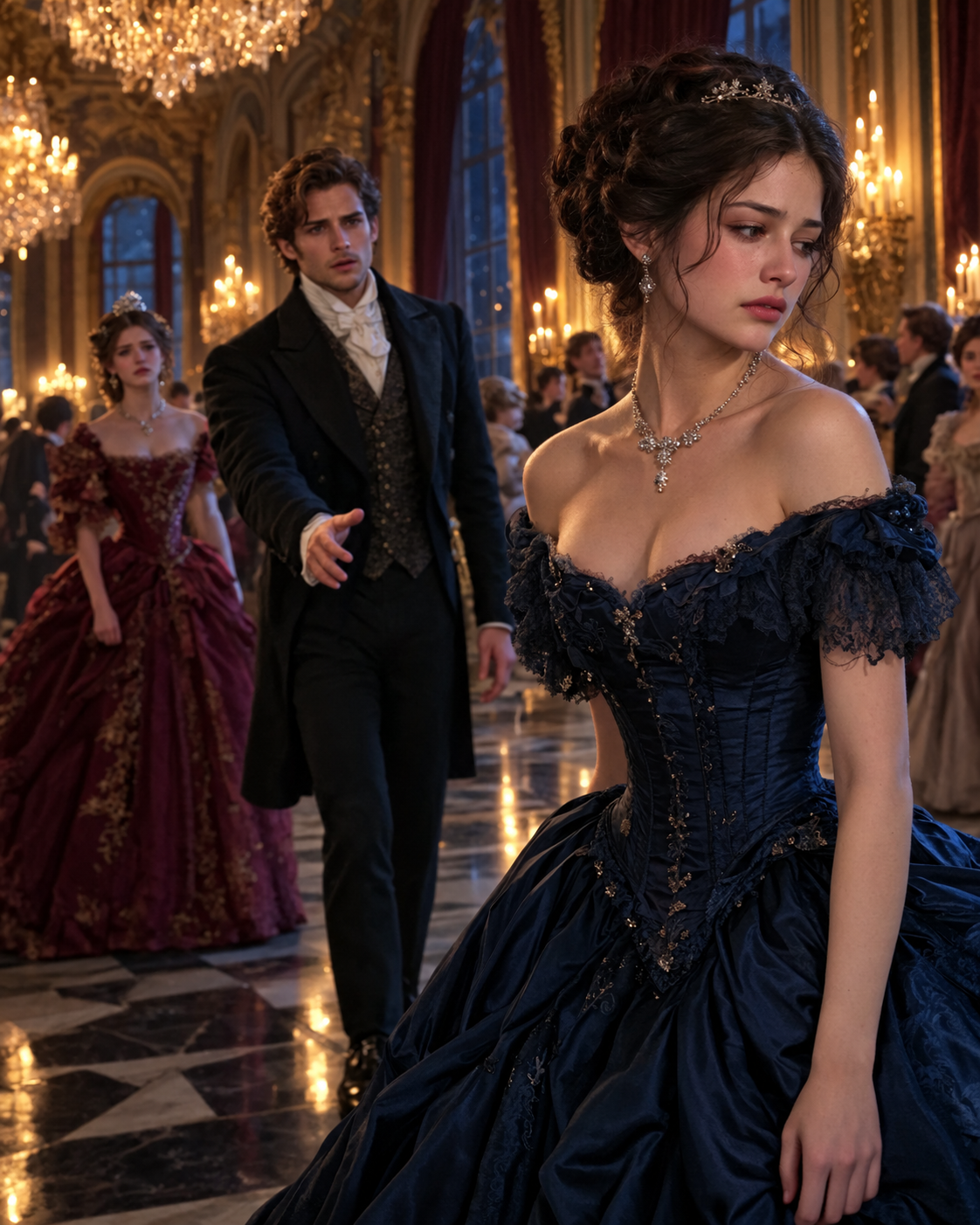
On a glittering winter night in Manhattan, beneath crystal chandeliers and the soft glow of hundreds of candles, the annual Ashworth Winter Ball was supposed to be a celebration of elegance, loyalty, and old New York society.
The morning after the Ashworth Winter Ball arrived beneath a pale gray sky.
Eleanor woke before sunrise in the small guest room of her mother’s country estate, listening to the winter wind move through the bare branches outside. For several moments, she did not remember where she was.
Then she saw the familiar wallpaper.
The old writing desk beside the window.
The framed photograph of her mother on the mantel.
And suddenly, everything returned.
The ballroom.
Reginald.
Vivian.
The ring.
Her own voice saying the words she had spent years refusing to say.
She sat quietly at the edge of the bed.
There was no relief yet.
No triumph.
Only a strange stillness.
For most of her adult life, Eleanor had been taught that a woman in her position was expected to endure gracefully. A marriage was not simply a private relationship; it was an institution, a reputation, a promise to families and friends. In the circles where she had grown up, people could forgive almost anything if it remained behind closed doors.
But Reginald had opened those doors himself.
He had walked into the ballroom with Vivian beside him.
And in doing so, he had made a decision for both of them.
Eleanor had simply made hers in return.
By seven o’clock, the housekeeper, Mrs. Collins, had brought coffee to the breakfast room.
She paused when she saw Eleanor already dressed.
“You’re staying, then?”
Eleanor looked toward the frosted windows.
“I think I am.”
Mrs. Collins smiled gently.
“I always hoped you would.”
Those five words nearly broke Eleanor.
Not because they were cruel.
Because they were kind.
She lowered her eyes to the coffee cup.
“I should have come here sooner.”
Mrs. Collins said nothing.
Sometimes silence was the only answer that did not make a wound deeper.
Over the next few days, Eleanor began sorting through her mother’s estate.
The house stood several hours north of Manhattan, surrounded by fields, old maple trees, and a frozen pond. It had never been fashionable in the way the Ashworth townhouse was fashionable. There were no photographers waiting outside its gates, no society reporters, no endless stream of guests.
There was only space.
And Eleanor discovered that space could be frightening when a person had spent years filling every silence with someone else’s expectations.
Her attorney arrived three days later.
His name was Jonathan Reed, a discreet New York lawyer who had handled her mother’s affairs for years.
He placed a folder on the table.
“The legal separation can be arranged,” he said. “There are financial matters we’ll need to address, property questions, trusts, and certain obligations connected to the marriage.”
Eleanor nodded.
“And Reginald?”
Jonathan hesitated.
“He has already contacted his attorney.”
“Of course.”
“He appears to believe this is temporary.”
Eleanor looked up.
“Does he?”
“That is the impression I was given.”
For the first time since leaving Manhattan, Eleanor smiled.
“Then we should make the situation very clear.”
The legal process began quietly.
There were no press conferences.
No public accusations.
No attempt by Eleanor to destroy Reginald.
She simply asked for what was legally hers and refused to negotiate away her dignity.
Meanwhile, Manhattan began talking.
At first, people assumed Eleanor would return.
Then they assumed Reginald would persuade her.
Then they began asking why Vivian had suddenly stopped appearing beside him.
The answers were less glamorous than the rumors.
Reginald’s affair, once treated as an amusing secret by people who enjoyed gossip, had become considerably less entertaining when it began affecting business relationships and social invitations.
Several families that had once welcomed him warmly became noticeably distant.
A charity board quietly requested that he step back from public events.
Two influential acquaintances stopped returning his calls.
And when a prominent winter gala announced its guest list, Reginald’s name was missing.
Vivian, meanwhile, discovered that being introduced as a duke’s companion was very different from becoming the woman who stood beside him after his wife walked away.
The excitement disappeared.
The attention changed.
And eventually, so did her patience.
One cold February afternoon, Reginald drove to Eleanor’s estate.
He arrived without warning.
Eleanor was in the library, reviewing papers with Jonathan.
When Mrs. Collins announced him, Eleanor closed the folder.
“Would you like me to leave?” Jonathan asked.
“No.”
Reginald entered a moment later.
He looked tired.
Not broken.
Not defeated.
Just tired.
Eleanor noticed the difference.
For years, she had imagined that if this day ever came, she would feel something powerful when she saw him standing there.
Anger.
Vindication.
Perhaps even satisfaction.
Instead, she felt almost nothing.
“Eleanor,” he said.
“Reginald.”
He glanced at Jonathan.
“I came to speak privately.”
“You may speak.”
He took a breath.
“Vivian and I are no longer together.”
Eleanor said nothing.
“I suppose you’ve heard.”
“I have.”
“I made a mistake.”
Eleanor looked at him for a long moment.
“No,” she said softly. “You made a choice.”
His expression tightened.
“That isn’t fair.”
“Perhaps not.”
She folded her hands.
“But it is what happened.”
Reginald walked toward the window.
“I thought you would come back.”
“I know.”
“I thought after some time, you would understand that things had become complicated.”
“They were never complicated to me.”
He turned.
“Then what was I supposed to do?”
Eleanor almost laughed.
The question sounded so strange that she could hardly believe he had asked it.
“You were supposed to be honest.”
Silence filled the room.
Reginald lowered his eyes.
“I still love you.”
Eleanor felt something inside her finally settle.
Not because the words moved her.
Because they no longer had power over her.
“I believe you may love the person you remember me being,” she said. “But I am not her anymore.”
He stared at her.
“Can’t we start over?”
“No.”
The answer was gentle.
That was what made it final.
Reginald left shortly afterward.
Eleanor watched his car disappear down the long driveway.
Then she returned to the library.
Jonathan was standing beside the desk.
“You seem calmer.”
“I am.”
“Are you sure?”
Eleanor looked around the room.
“I think I finally understand something.”
“What?”
“That peace does not always arrive when someone apologizes. Sometimes it arrives when you stop needing the apology.”
Jonathan smiled.
“That sounds like something your mother would have said.”
Eleanor glanced at her mother’s portrait.
“Yes,” she whispered.
Spring came slowly.
The snow disappeared.
The frozen pond began to melt.
And with each passing week, Eleanor changed in ways that even her closest friends noticed.
She began managing the estate herself.
She reopened several neglected rooms and turned one of the old carriage houses into a community arts space. She worked with local organizers to host small exhibitions, winter craft markets, and charity dinners.
For the first time, people knew Eleanor not because she was a duchess, not because she was Reginald Ashworth’s wife, but because of what she was actually doing.
She found herself enjoying conversations that had nothing to do with titles.
Farmers.
Teachers.
Artists.
Small business owners.
Young families from neighboring towns.
Their lives were not perfect.
Neither were hers.
But there was honesty in those conversations that she had missed terribly.
Then, one afternoon in April, Lord Thomas Hale arrived.
He did not arrive with a motorcade.
He drove an old dark sedan himself and carried a box of books under one arm.
Thomas had known Eleanor since childhood.
Their families had spent summers together long before either of them understood the complicated rules of society.
He had always been the quiet one.
The man who listened more than he spoke.
The friend who remembered small details other people forgot.
When Eleanor opened the front door, she stared at him.
“You’re late.”
Thomas smiled.
“I was told there was no hurry.”
“Who told you that?”
“You did.”
“I don’t remember.”
“I do.”
She stepped aside.
“Come in.”
He entered the house.
The box contained books from his late father’s library.
Thomas had heard about Eleanor’s plans for the estate and thought she might want them for the community space.
She opened the box.
Poetry.
History.
Art.
Travel journals.
A few old American novels with cracked spines.
“You brought all these for me?”
“For the house.”
Eleanor looked at him.
“That isn’t the same thing.”
“No,” Thomas said. “It isn’t.”
She smiled.
For several months, their friendship slowly changed.
There was no dramatic confession.
No sudden declaration.
Instead, Thomas became part of Eleanor’s new life in the simplest ways.
He helped repair the greenhouse.
He attended charity dinners without caring who was watching.
He sat beside her on the porch during summer storms.
He listened when she spoke.
And, most importantly, he never tried to tell her what she should become.
One evening in June, they stood beside the pond as the sun disappeared behind the trees.
Thomas was unusually quiet.
“What is it?” Eleanor asked.
“Nothing.”
“That is rarely true with you.”
He laughed.
Then he looked at her.
“I’ve been afraid to say something.”
Eleanor’s heart began beating faster.
“Then perhaps you should say it.”
Thomas took a breath.
“I have loved you for a very long time.”
She did not move.
He continued.
“I never told you because you were married. Then, when your marriage ended, I thought you needed a friend more than you needed another man asking something from you.”
Eleanor looked toward the water.
“Why tell me now?”
“Because I finally realized that being patient should not mean being dishonest.”
She turned back to him.
“And what do you want?”
Thomas smiled faintly.
“A chance.”
The word stayed between them.
Not a demand.
Not a promise.
Just a chance.
Eleanor thought about the ballroom in Manhattan.
The ring.
The humiliation.
The years spent trying to be the woman everyone expected.
Then she thought about the woman standing beside this quiet man by the pond.
She was not the same woman.
“I can’t promise you a perfect life,” she said.
“I don’t want one.”
“I have scars.”
“So do I.”
“I may be afraid sometimes.”
“So may I.”
Eleanor smiled.
“That is a terrible proposal.”
Thomas laughed.
“It wasn’t a proposal.”
“Then what was it?”
“A beginning.”
She looked at him for several seconds.
Then she reached for his hand.
It was a small gesture.
But for Eleanor, it meant everything.
Months later, the legal separation was finalized.
There was no grand announcement.
No newspaper headline that captured what it meant.
Eleanor simply received the documents, signed the final papers, and placed them inside a drawer.
That evening, she walked through the estate alone.
She stopped outside the room where her mother’s portrait hung.
“I’m all right,” she whispered.
For the first time, she knew it was true.
Reginald’s life had changed dramatically.
His social circle had narrowed.
His influence had diminished.
The relationship with Vivian was over.
Some people blamed Eleanor.
Others blamed Reginald.
A few blamed society itself.
But Eleanor refused to spend her new life assigning blame.
She had learned that revenge could keep a person emotionally tied to the very thing they were trying to escape.
She wanted freedom instead.
And freedom, she discovered, was quieter.
It looked like breakfast without fear.
A morning walk without checking who was watching.
A business meeting where her ideas mattered more than her surname.
A home where she could close the door and hear only peace.
It looked like choosing friends because they were loyal, not because they were useful.
It looked like love that did not require her to disappear inside it.
One autumn afternoon, Eleanor hosted the first annual harvest gathering at the estate.
The lawn was filled with families, musicians, local artists, and friends.
There were lanterns hanging from the trees.
Children ran between tables.
Someone played an old guitar near the porch.
Thomas stood beside Eleanor, holding two cups of cider.
She looked across the gathering.
“This is very different from the Ashworth Ball.”
Thomas smiled.
“Less champagne.”
“Definitely.”
“Fewer photographers.”
“Much better.”
He handed her a cup.
Eleanor laughed.
For a moment, she remembered the woman she had been on that winter night in Manhattan.
She could still see the ballroom.
She could still hear the sudden silence when Reginald entered with Vivian.
She could still remember the weight of the ring in her hand.
But the memory no longer hurt in the same way.
It had become a doorway.
Not a wound.
A doorway.
Thomas noticed her expression.
“What are you thinking?”
Eleanor looked at him.
“That sometimes the worst night of your life can reveal a life you never knew was waiting for you.”
He nodded.
“And sometimes,” he said, “the person you lose is not the greatest loss.”
Eleanor raised an eyebrow.
“What is?”
“Losing yourself.”
She smiled.
“That’s exactly what I was thinking.”
The evening continued.
The music grew louder.
The sky darkened.
And somewhere beneath the trees, a group of children began laughing.
Eleanor looked around at the estate that had once seemed like an escape from everything.
Now it felt like home.
She had not rebuilt her life to prove anything to Reginald.
She had not returned to society to show anyone that she was stronger.
She had simply learned that dignity was not about standing perfectly still while someone hurt you.
Sometimes dignity meant walking away.
Sometimes it meant starting over when everyone expected you to remain where you were.
And sometimes it meant allowing yourself to be loved again, not because you needed someone to complete you, but because you had finally learned that you were already whole.
Years later, people would still tell different versions of what happened at the Ashworth Winter Ball.
Some would remember the scandal.
Some would remember Reginald’s fall from society.
Some would remember Vivian.
But those who truly knew Eleanor remembered something else.
They remembered the woman who walked into a ballroom believing she had lost her future…
and walked out carrying it in her own hands.
Because the most important moment of Eleanor’s story was never the moment her husband betrayed her.
It was the moment she stopped allowing his choice to define her.
She discovered that a closed door could sometimes be the beginning of an open road.
And on that road, she found something far more valuable than a title, a perfect reputation, or a marriage preserved for appearances.
She found herself.
Then, when she was finally ready, she found love waiting beside her—not as a rescue, but as a companion.
And perhaps that was the quietest lesson of all:
A person does not always begin again by becoming someone new.
Sometimes, they begin again by finally becoming who they were before the world convinced them they had to be someone else.
For a long time, Eleanor believed that leaving her marriage had been the hardest decision she would ever make.
She was wrong.
The harder decision came afterward.
It was learning how to live without constantly looking over her shoulder.
The first year after her separation had been filled with small victories that nobody in Manhattan would have considered important.
She learned how to manage the estate’s accounts herself.
She learned which fields needed attention after a harsh winter.
She learned the names of nearly every person who worked on the property.
She even learned how to drive an old American roadster that Thomas insisted was “far too stubborn for a woman with your patience.”
Eleanor proved him wrong by driving it directly through a muddy field one afternoon.
Thomas stood at the edge of the road, laughing so hard that he could barely speak.
“You said it was reliable!”
“It is!”
“It stopped.”
“It stopped because you drove it into a pond.”
“It was a puddle.”
“It had ducks.”
She crossed her arms.
“The ducks looked perfectly happy.”
Thomas shook his head.
“I suppose that’s what matters.”
Moments like that became precious to her.
They were ordinary.
And after years of living a life where every moment seemed to belong to an audience, ordinary became a kind of luxury.
But not everything was easy.
There were still nights when Eleanor woke from dreams about the ballroom.
Sometimes she would remember the expression on Reginald’s face when she placed the ring in his hand.
Sometimes she wondered whether she had been too calm.
Whether she should have shouted.
Whether she should have demanded an explanation.
Whether she should have made him understand exactly how deeply he had hurt her.
Thomas never told her what she should have felt.
He simply listened.
One winter evening, Eleanor finally asked him.
“Do you ever think I should have fought harder for my marriage?”
Thomas was sitting beside the fireplace, turning the pages of an old book.
He closed it.
“Do you?”
She looked into the fire.
“Sometimes.”
“Then perhaps you should ask yourself what you were fighting for.”
Eleanor remained silent.
Thomas continued carefully.
“A marriage is worth fighting for when both people are standing on the same side.”
She looked at him.
“And if only one person is?”
“Then they’re not fighting for a marriage anymore.”
“They’re fighting against loneliness.”
Eleanor lowered her eyes.
Thomas reached across the space between them and took her hand.
“You don’t have to spend the rest of your life proving that leaving was the correct decision.”
Her eyes filled with tears.
“I know.”
“No,” he said gently. “I don’t think you do.”
She looked at him.
“You don’t owe anyone a perfect explanation for choosing peace.”
The words stayed with her.
Perhaps because they were exactly what she needed to hear.
The following spring, Eleanor made another decision.
She would no longer allow the Ashworth name to determine what happened to her future.
She formally placed several properties and financial assets into trusts that would benefit local educational and community programs.
She also expanded the arts center on the estate.
What began as a small project became a gathering place for young artists from across the region.
Some came from wealthy families.
Others came from homes where nobody had ever attended a formal exhibition.
Eleanor wanted them all to have the same opportunity.
When a journalist from New York eventually came to write about the project, she asked Eleanor a question that made her uncomfortable.
“Do you consider this a reinvention?”
Eleanor smiled.
“No.”
“What would you call it?”
“Returning.”
The journalist frowned.
“Returning to what?”
“To myself.”
The article appeared two weeks later.
For once, Eleanor did not read every word.
She had learned that other people’s descriptions of her life were rarely as important as the life itself.
Reginald eventually disappeared almost completely from the society pages.
He still had money.
He still had connections.
He still possessed the title that had once opened doors for him.
But titles could not restore trust.
And influence could not recreate affection once people had stopped believing in a person.
Years after their separation, Eleanor received a letter from him.
It was short.
There were no excuses.
No request for reconciliation.
Only an acknowledgment that he had misunderstood what he had possessed until he lost it.
Eleanor read the letter once.
Then she folded it carefully and placed it in a drawer.
She did not hate him.
That surprised her.
She had once believed forgiveness meant forgetting.
Now she understood that sometimes forgiveness simply meant refusing to carry the weight any longer.
She never answered the letter.
She didn’t need to.
Her silence was not punishment.
It was closure.
By then, Eleanor and Thomas had built a life together.
It was not the grand romance that society magazines would have invented.
There were no endless parties.
No elaborate declarations.
No photographers waiting outside their door.
Their love was made of quieter things.
Thomas leaving a cup of coffee beside her desk before she woke.
Eleanor remembering exactly how he liked his tea.
Long drives through the countryside.
Arguments about books.
Laughter in the kitchen.
Rainy afternoons spent reading beside the fireplace.
And the understanding that neither of them had to become smaller for the other to feel important.
One evening, many years after the night at the Ashworth Ball, Eleanor and Thomas returned to Manhattan.
They had been invited to a charity event at the same hotel where everything had changed.
The Astoria Grand looked almost exactly as she remembered it.
The marble staircase.
The chandeliers.
The polished floors.
The enormous ballroom.
For a moment, Eleanor stopped outside the entrance.
Thomas noticed.
“We can leave.”
She shook her head.
“No.”
“You don’t have to prove anything.”
“I know.”
She took his hand.
“I simply want to walk in.”
They entered together.
People recognized her immediately.
Some whispered.
Others approached with smiles.
A few older guests remembered the scandal.
But Eleanor barely noticed.
She was no longer the woman standing near the fireplace waiting to see what her husband would do.
She was simply Eleanor.
When the orchestra began playing, Thomas offered his hand.
“Dance?”
She smiled.
“Here?”
“Why not?”
They stepped onto the floor.
For a few minutes, nothing else mattered.
Not the past.
Not the rumors.
Not the people watching.
Only the music.
Afterward, Eleanor walked toward the balcony.
The city stretched below them, filled with lights.
Thomas stood beside her.
“Do you ever regret leaving?”
She thought about the question.
“No.”
He waited.
“Not even once?”
“I regret that I stayed as long as I did.”
Thomas looked at her.
“But I don’t regret what happened afterward.”
She turned toward the city.
“That night taught me something.”
“What?”
“That losing the life you expected can be terrifying.”
“And?”
“And sometimes the life you never planned is the one that finally feels like yours.”
Thomas smiled.
“That’s a very Eleanor answer.”
She laughed softly.
“What does that mean?”
“It means you’ve finally stopped asking permission to be happy.”
She looked at him.
Then she kissed him.
It was not a kiss for the cameras.
There were no cameras.
It was simply theirs.
When they returned home several days later, Eleanor walked through the estate at sunrise.
The fields were covered in mist.
Birds moved through the trees.
The old house stood quietly behind her.
She stopped near the pond.
The same pond where Thomas had once told her he loved her.
The same place where she had been brave enough to begin again.
She thought about her mother.
About the woman she had been.
About the woman she had become.
And she finally understood something she had spent years trying to explain.
Her story had never really been about Reginald.
It had never truly been about Vivian.
It had never even been about the humiliation at the winter ball.
Those were only the events that forced her to see the truth.
The real story had always been about what happened when Eleanor stopped measuring her worth by someone else’s ability to love her properly.
She had believed she needed to save her marriage.
Then she believed she needed to rebuild her reputation.
Eventually, she discovered she needed to do neither.
She only needed to rebuild herself.
And once she did, everything else found its proper place.
The estate became more than a home.
It became a reminder.
Every spring, new flowers appeared along the driveway.
Every summer, children filled the arts center.
Every autumn, neighbors gathered beneath the trees.
Every winter, Eleanor lit the fireplace and remembered the night when she had once believed her life was ending.
It hadn’t been ending.
It had been changing direction.
One December evening, Eleanor stood before the fireplace and looked at the small framed photograph of her younger self.
Thomas entered carrying two cups of tea.
“You’re thinking again.”
“I always think.”
“Dangerous habit.”
She smiled.
He handed her a cup.
“Happy?”
Eleanor looked at him.
The question was simple.
The answer was even simpler.
“Yes.”
Thomas sat beside her.
Outside, snow began falling over the fields.
Eleanor watched it through the window.
She no longer needed the past to disappear.
She no longer needed Reginald to regret what he had done.
She no longer needed society to understand her choices.
The life she had built was proof enough.
And somewhere far behind her, in a ballroom beneath Manhattan chandeliers, stood the woman who had once believed that dignity meant enduring everything without breaking.
Eleanor finally knew better.
Dignity was not silence.
Dignity was not perfection.
Dignity was knowing when something had ended—and having the courage to walk toward what came next.
She reached for Thomas’s hand.
He squeezed it gently.
Outside, the snow continued to fall.
Inside, the fire burned warmly.
And Eleanor smiled.
Not the careful smile she had worn at the winter ball.
Not the polite smile expected of a duchess.
A real one.
The smile of a woman who had finally stopped living for appearances.
The smile of a woman who had lost a title, a marriage, a social world—and somehow found something much greater in return.
She had found a home.
She had found love.
But most importantly, she had found herself.
And that was the one thing no one could ever take away from her again.
THE END.