On a cold autumn morning in New York, beneath the gray skies hanging over the Hudson Valley, Victoria Ashbourne stood inside a wedding gown that had never been meant for her.
The carriage stopped beneath the stone archway of the Ashbourne estate just as the afternoon bells began to ring across the Hudson Valley.
Victoria was standing in the library when she heard the wheels.
For one strange second, she thought nothing of it. Visitors came and went constantly at Ashbourne House. Lawyers arrived with ledgers. Tenants came with petitions. Business partners crossed the threshold carrying contracts and warnings from Wall Street. Arton’s relatives appeared whenever they wanted something.
But then she heard the hurried footsteps of a footman.
A moment later, the library door opened.
“My lady,” he said carefully, “there is a visitor requesting the duke.”
Victoria looked up from the accounts spread across her desk.
“Who?”
The footman hesitated.
“Lady Rosalind.”
The room seemed to become completely still.
Victoria’s fingers remained on the ledger, but she no longer saw the figures.
Rosalind.
After all these months.
After the disappearance, the letters, the silence, and the life Victoria had slowly built inside a marriage that had never been hers to begin with.
She rose.
“Where is she?”
“In the west drawing room.”
Victoria closed the ledger.
“Has the duke been informed?”
“Yes, Your Grace.”
She nodded.
“Then I suppose we should hear what she has to say.”
When Victoria entered the drawing room, Rosalind was standing beside the fireplace.
She looked nothing like the carefree girl who had disappeared from the family estate in New York.
Her traveling cloak was damp from the autumn rain. Her cheeks were pale. Her eyes were swollen from crying, and one gloved hand trembled around a handkerchief.
For a moment, Victoria felt only shock.
Then came something more complicated.
Pity.
“Victoria.”
Rosalind’s voice broke.
Victoria stopped several feet away.
“You came back.”
“I had nowhere else to go.”
The words struck harder than Victoria expected.
Behind Rosalind stood Lord Witmore, the same man who had once been one of Arton’s most frequent social companions. His expression was solemn, almost protective.
Victoria’s gaze moved from him to her sister.
“What happened?”
Rosalind lowered her eyes.
“He left me.”
Victoria said nothing.
“He promised me everything,” Rosalind whispered. “A new life. A home. Freedom from all of this. But when the money disappeared and the creditors found us, he changed.”
Lord Witmore stepped forward.
“I found her in Boston,” he explained. “She had been abandoned with almost nothing.”
Victoria’s jaw tightened.
Boston.
Only a few hundred miles away, while she had been fighting to keep her family’s estate alive.
“Why did you come here?”
Rosalind looked directly at her.
“Because this is my home.”
“No,” Victoria said quietly. “It was.”
Rosalind flinched.
Before she could answer, another voice came from the doorway.
“Victoria.”
Arton.
He had arrived without either woman noticing.
His coat was still damp from the rain, and his expression had hardened the instant he saw Rosalind.
He did not look surprised.
He looked disappointed.
Rosalind took one uncertain step toward him.
“Arton.”
The duke did not move.
“I was told you were in Boston.”
“I was.”
“Then why are you here?”
Her eyes filled with tears.
“Because I made a mistake.”
Arton’s gaze remained steady.
“You made a choice.”
Rosalind pressed the handkerchief to her lips.
“I was young.”
“So was Victoria.”
Silence.
Victoria looked at her husband.
He had never raised his voice.
He did not need to.
Rosalind’s expression changed.
“Then you admit it?” she asked. “You knew?”
Arton’s eyebrows drew together.
“Knew what?”
“That she wasn’t me.”
Victoria closed her eyes briefly.
There it was.
The question she had feared might eventually return.
Arton looked at Victoria.
“I knew before I married her.”
Rosalind stared at him.
“But you married her anyway.”
“Yes.”
“Why?”
Arton’s answer came without hesitation.
“Because she was honest when everyone else expected her to lie.”
Rosalind’s face crumpled.
“I am your wife.”
“No,” Arton said quietly. “Victoria is.”
The words landed with absolute finality.
Rosalind looked toward her sister as though seeing her for the first time.
“How?”
Victoria did not answer.
Arton did.
“Because a marriage is not a name written on a document. It is the person who stands beside you when everything is collapsing.”
He turned toward the desk.
“Victoria stood beside me.”
Rosalind shook her head.
“But she stole my life.”
Victoria finally spoke.
“No, Rosalind. You gave it away.”
The room fell silent.
Victoria regretted the sharpness immediately, but she did not withdraw the words.
For months, she had protected Rosalind from the consequences of her decisions. She had told herself that family meant forgiveness. She had accepted the gown, the humiliation, the suspicion, and the burden because she believed Rosalind needed another chance.
But Victoria had learned something during those months.
Forgiveness did not mean surrendering everything a person had built.
Rosalind wiped her eyes.
“I only want my place back.”
Arton’s expression hardened.
“You no longer have a place here.”
“Arton—”
“You abandoned the marriage before it began.”
“I didn’t know what I was doing.”
“You knew enough to leave.”
Lord Witmore stepped forward.
“Your Grace, perhaps this can be resolved privately. The original arrangement was between the Ashbourne family and Rosalind. Surely there is a legal path—”
Arton turned toward him.
“There is.”
Witmore stopped.
“She may leave.”
The lord’s face tightened.
“You misunderstand me.”
“No,” Arton said. “I understand perfectly.”
He walked to the fireplace and stood beside Victoria.
“My marriage is valid. My household is stable. My estates are under proper management. My wife has earned the respect of my tenants, my staff, my business partners, and my family.”
His eyes moved toward Rosalind.
“There is nothing left to exchange.”
The last sentence seemed to drain the room of air.
Rosalind stared at Victoria.
“What did you do to him?”
Victoria almost laughed.
“Nothing.”
“Then why is he like this?”
“Because,” Arton answered, “she never tried to change me.”
Victoria turned toward him.
For the first time that afternoon, his expression softened.
She remembered the early days of their marriage.
How awkward they had been.
How carefully she had measured every word.
How she had expected him to punish her once the truth came out.
Instead, he had asked her to review the estate accounts.
Then the household expenses.
Then the shipping contracts.
Then the overdue mortgages.
Within six weeks, Victoria had discovered that the Ashbourne household was not poor.
It was simply badly managed.
Money was leaking from every corner.
Servants were being paid for duties they never performed. Relatives charged personal expenses to the estate. Suppliers inflated invoices. A distant cousin had been quietly selling timber from one of Arton’s Pennsylvania properties.
Victoria had found the pattern.
Arton had given her permission to act.
And she had acted.
By spring, the household had recovered.
By summer, several properties were profitable again.
By autumn, creditors who had once spoken to Arton with thinly veiled contempt were asking for long-term agreements.
Victoria had not become the duchess because she wore the title.
She had become the duchess because she had learned what the title required.
Responsibility.
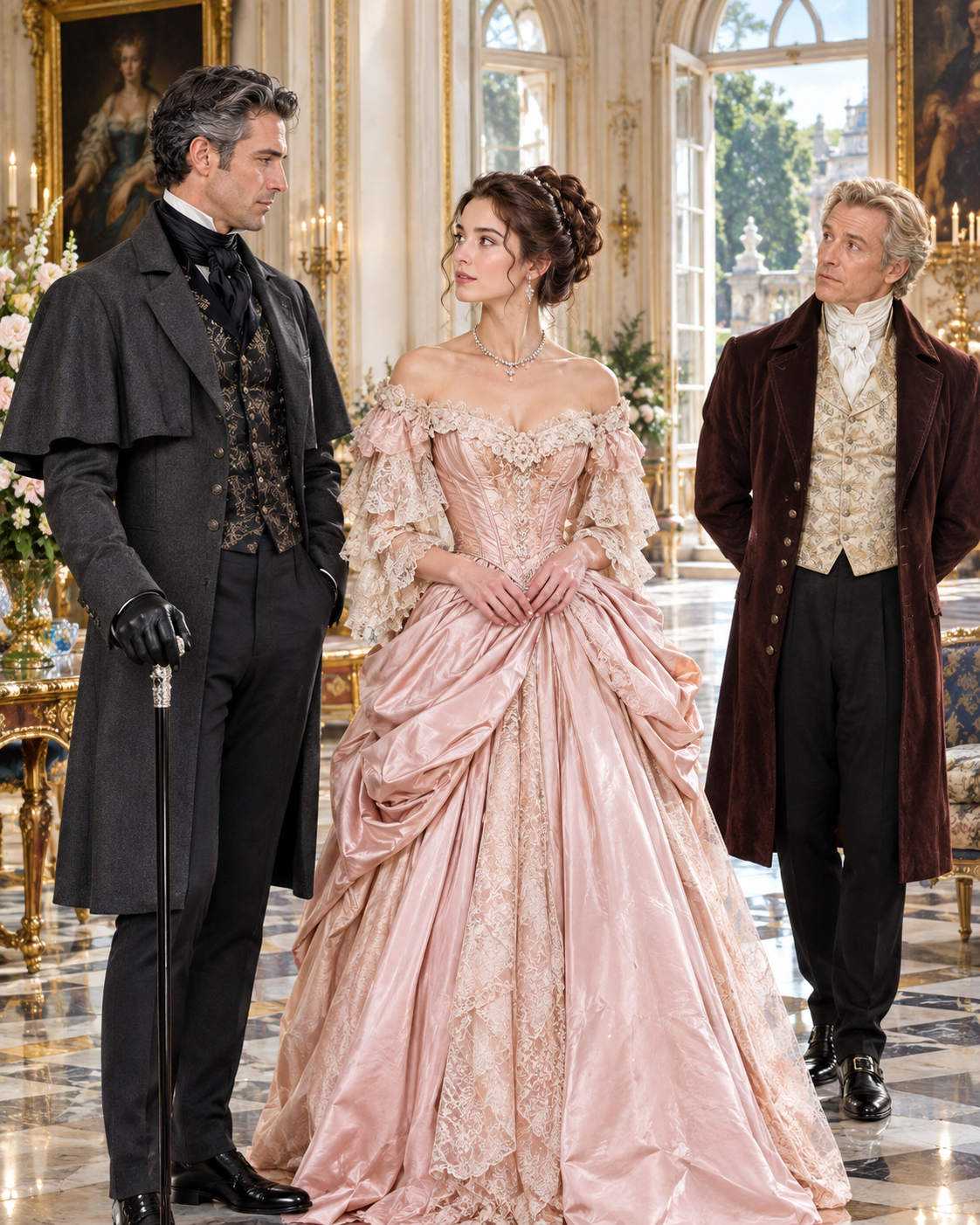
Rosalind looked around the room.
“You love her.”
Arton said nothing.
He simply took Victoria’s hand.
That was answer enough.
Rosalind began crying again.
Victoria expected to feel triumph.
She felt only sadness.
“You should rest,” Victoria said. “The servants will prepare a room.”
Rosalind looked startled.
“You would let me stay?”
“For tonight.”
Arton looked at Victoria.
She gave him a small nod.
It was not weakness.
It was mercy with boundaries.
Rosalind understood the difference.
That evening, Victoria sat alone in the library.
The rain had stopped, leaving the windows covered with small silver trails of water.
She heard Arton enter.
“You were too kind.”
Victoria closed the ledger.
“Perhaps.”
“You did not have to offer her a room.”
“She is my sister.”
“After what she did?”
Victoria looked toward the dark window.
“Being hurt doesn’t make me want to become cruel.”
Arton walked closer.
“That is one of the reasons I love you.”
Victoria looked up.
He rarely said the words.
Not because they were uncertain.
Because Arton treated declarations as promises.
When he finally spoke them, they mattered.
“You love me?”
“I thought I had made that rather obvious.”
“You are not an obvious man.”
“No.”
A faint smile touched his face.
“I am, however, a determined one.”
Victoria laughed softly.
Then her expression became serious.
“Arton, what happens tomorrow?”
“Rosalind leaves.”
“And if she refuses?”
“She won’t.”
“You sound certain.”
“I have something she has never had.”
“What?”
He looked at her.
“Patience.”
Victoria smiled.
The next morning, Rosalind asked to speak with her sister alone.
They met in the small conservatory overlooking the gardens.
The leaves had turned gold and copper.
For several moments, neither spoke.
Finally Rosalind said, “I hated you.”
Victoria did not look surprised.
“I know.”
“I thought you had everything.”
“I didn’t.”
“You had father’s trust.”
“I had his expectations.”
“You were always the responsible one.”
Victoria smiled faintly.
“That isn’t always a gift.”
Rosalind looked down.
“I thought marriage to Arton would trap me.”
“Perhaps it would have.”
“Then why did you stay?”
Victoria considered the question.
“At first? Because I had no choice.”
“And later?”
Victoria looked through the glass at the autumn garden.
“Later, because I discovered that I did.”
Rosalind’s eyes filled with tears.
“What does that mean?”
“It means I stayed because I wanted to.”
The admission was simple.
It was also the truth Rosalind had been avoiding.
She had believed Victoria was living the life that belonged to her.
But Victoria had built something entirely different.
Not a replacement.
Not an imitation.
A life of her own.
“I am sorry,” Rosalind whispered.
Victoria did not immediately answer.
She wanted to say everything would be fine.
She wanted to erase the pain.
But some wounds did not disappear because someone apologized.
“Thank you,” she finally said.
Rosalind looked up.
“That’s all?”
“It is enough for today.”
A small, broken smile appeared.
“I suppose you really have changed.”
Victoria shook her head.
“No. I think I finally stopped being afraid of disappointing everyone.”
That afternoon, Rosalind left Ashborne House.
Lord Witmore accompanied her as far as the railway station, where arrangements had been made for her to return to relatives in Philadelphia.
There was no dramatic farewell.
No shouting.
No public scandal.
Only a carriage disappearing down a wet country road.
Victoria watched from the front steps until it vanished.
Arton stood beside her.
“Are you all right?”
She nodded.
“I think so.”
“You don’t have to forgive her completely.”
“I know.”
“You don’t have to forget.”
“I know.”
“And you don’t have to let her back into your life simply because she is family.”
Victoria turned to him.
“I know.”
Arton smiled.
“Good.”
She raised an eyebrow.
“Why?”
“Because I intend to keep you.”
Victoria laughed.
“You make me sound like one of your estates.”
“Those are replaceable.”
She stared at him.
He calmly continued.
“You are not.”
She tried not to smile.
She failed.
Months passed.
Winter settled over New York.
The Hudson froze along the edges, and snow covered the roads leading toward the Ashbourne estate.
Inside the house, however, life became warmer.
Victoria established a new system for household finances.
She created accounts for every major estate.
She required written approvals for large expenditures.
She opened negotiations with local merchants rather than relying exclusively on distant suppliers.
She also did something Arton considered revolutionary.
She asked the servants what was actually wrong.
Their answers changed the household more than any ledger could have.
A cook who had nearly resigned stayed.
A stable boy received training and eventually became head groom.
Several tenants received more reasonable repayment schedules.
The estate became not merely profitable, but respected.
One evening, Arton found Victoria sitting at the dining room table surrounded by papers.
“You promised me you would stop working after dinner.”
“I promised to try.”
“That is not the same thing.”
“It is the best you are getting.”
He pulled out the chair beside her.
“What is it?”
“A proposal from the Pennsylvania railway company.”
“You are considering it?”
“I am considering whether they are considering us.”
Arton laughed.
“You are impossible.”
“So you keep telling me.”
He looked at the papers.
Then at her.
“Do you remember the first night?”
“Unfortunately.”
“You thought I hated you.”
“I thought you were going to send me home.”
“I considered it.”
Victoria’s expression fell.
“For approximately three seconds.”
She looked at him.
“And then?”
“Then you told me exactly how much money my relatives had wasted that year.”
Victoria laughed.
“I remember.”
“I had never met anyone who could insult my entire household using accounting terminology.”
“I was angry.”
“I know.”
He reached across the table and took her hand.
“That was the moment I realized I could trust you.”
Victoria looked at him.
“Because I insulted your family?”
“Because you were not trying to impress me.”
His thumb brushed the back of her hand.
“You were trying to save what mattered.”
She lowered her eyes.
“And now?”
“Now I know what matters.”
The room was quiet.
Outside, snow began to fall.
Victoria squeezed his hand.
“I never expected any of this.”
“Neither did I.”
“Would you do it again?”
He smiled.
“The marriage?”
“The disaster.”
“The deception?”
“All of it.”
Arton stood and offered her his hand.
“No.”
Victoria looked surprised.
“No?”
“I would not want you to suffer through it again.”
He pulled her gently to her feet.
“But I would choose you again.”
Those words stayed with Victoria long after the candles were extinguished.
Years later, people in New York society would tell the story differently.
Some claimed Victoria had trapped a duke.
Others insisted Arton had rescued a desperate woman.
A few whispered that the entire marriage had begun as a scandal and survived only through stubbornness.
They were all wrong in one important way.
Neither of them had rescued the other.
They had chosen each other.
Victoria had entered Ashborne House wearing another woman’s dress.
She had expected to leave once the crisis ended.
Instead, she found a home.
Arton had expected a decorative wife who understood society’s rules.
Instead, he found an equal who understood something more valuable: the difference between appearance and substance.
And Rosalind, in losing the life she had once believed she wanted, eventually found the freedom to build another.
The lesson was not that love always arrives in the form we expect.
Sometimes it arrives disguised as an obligation.
Sometimes it begins with fear, embarrassment, or a decision made under impossible pressure.
But what matters is what happens afterward.
People reveal themselves not when life is easy, but when the plans collapse.
Victoria did not become powerful because she married a duke.
She became powerful when she realized she had the right to speak, decide, and build a life according to her own judgment.
Arton did not love her because she became the perfect duchess.
He loved her because she never pretended to be someone else.
And that was perhaps the greatest irony of all.
The woman who entered his home pretending to be another bride became the only woman he could never imagine replacing.
For a while, Victoria believed the worst of the Ashbourne family’s troubles had finally passed.
She was wrong.
The trouble began with a letter.
It arrived on a gray morning in February, carried by a messenger who had ridden through a snowstorm from New York City. The envelope bore the seal of a banking house Victoria knew well.
She opened it at breakfast.
By the time she reached the final page, the warmth had left her face.
Arton noticed immediately.
“What is it?”
Victoria folded the letter.
“A loan.”
“Whose?”
“Ours.”
His expression changed.
“I thought the New York debt was settled.”
“So did I.”
She handed him the document.
Arton read it once.
Then again.
“The signature is mine.”
“Yes.”
“But I never authorized this.”
Victoria pointed toward the bottom of the page.
“Look at the date.”
Arton did.
His jaw tightened.
The loan had been taken out nearly two years earlier, shortly before their marriage.
Before Victoria had reorganized the estate.
Before she had discovered how much money had been disappearing.
Before she had understood how deeply someone inside the family had been manipulating the accounts.
“Who knew about this?” Arton asked.
Victoria looked toward the window.
“Someone who knew the household better than any banker.”
He understood immediately.
“Your cousin?”
“Perhaps.”
“He’s been gone from New York for months.”
“That doesn’t mean he stopped working against us.”
The amount was enormous.
If the bank enforced the original agreement, several properties in New York and Pennsylvania could be seized.
The estate would survive.
But barely.
And more importantly, Victoria knew what the debt represented.
Someone had been preparing for their failure long before she became Duchess of Ashborne.
For the first time since their marriage, Victoria felt genuine fear.
Not for herself.
For everything they had built.
Arton reached across the table.
“Don’t look at me like that.”
“Like what?”
“Like the house is already burning.”
Victoria swallowed.
“It might be.”
“Then we’ll put out the fire.”
His confidence was calm, but she knew him well enough to recognize the anger beneath it.
They spent the next three days examining every document in the estate archive.
The library became a battlefield of ledgers, contracts, letters, receipts, and bank statements.
Victoria worked until midnight.
Arton worked beside her.
On the fourth night, she found something.
A payment.
Small enough to be overlooked.
A thousand dollars transferred from an Ashborne account to a private company in New York.
The company no longer existed.
But the name on the original registration did.
Victoria wrote it down.
“Arton.”
He looked up.
“I know this name.”
“Who is it?”
“A lawyer.”
“One of your lawyers?”
“No.”
Arton took the paper.
Then his face went still.
“Lord Witmore.”
Victoria stared at him.
“Rosalind’s companion.”
“Yes.”
Neither spoke.
The implications were enormous.
Witmore had not simply helped Rosalind leave.
He had access to the family.
He knew their financial weaknesses.
He knew which properties were vulnerable.
And he had been close enough to the Ashbourne family to understand exactly where pressure would hurt most.
“Do you think Rosalind knew?” Victoria asked.
Arton shook his head.
“I don’t know.”
“She might have.”
“Or she might have been used.”
Victoria remembered her sister standing in the drawing room, crying, frightened, and ashamed.
For the first time, another possibility entered her mind.
Perhaps Rosalind had not returned merely because she wanted her old life back.
Perhaps she had returned because she had discovered something dangerous.
“She told me she had been abandoned in Boston,” Victoria said.
“Yes.”
“She said Witmore found her.”
Arton’s eyes narrowed.
“What if he didn’t find her?”
Victoria looked at him.
“What if he left her there?”
The next morning, a telegram arrived.
It was from Philadelphia.
Rosalind was asking to see Victoria immediately.
Victoria traveled with Arton.
They found Rosalind in a modest boarding house, far removed from the grand rooms she had once considered ordinary.
She looked older.
Not physically.
Something in her expression had changed.
When she saw Victoria, she stood.
“You found it.”
Victoria stopped.
“Found what?”
Rosalind looked at Arton.
“The debt.”
Silence.
Victoria’s heart began to pound.
“You knew?”
“I suspected.”
“Why didn’t you tell us?”
“Because I was afraid.”
Arton stepped forward.
“Afraid of whom?”
Rosalind looked toward the door.
“Witmore.”
Victoria felt cold.
“Tell us everything.”
Rosalind sat down.
“When I left with the tutor, Witmore was one of the people who helped us leave New York.”
Arton said nothing.
“He gave us money.”
“How much?”
“Not much.”
“Where did it come from?”
Rosalind shook her head.
“I didn’t ask.”
Victoria closed her eyes.
“And later?”
“He began visiting us.”
“Why?”
“At first, he said he was helping.”
“And then?”
Rosalind’s hands tightened around each other.
“He wanted information.”
Victoria’s voice became quiet.
“What kind?”
“Your father’s accounts. The Ashbourne properties. Arton’s business arrangements.”
Arton’s expression became dangerously calm.
“What did you tell him?”
“Nothing important.”
Victoria looked at her.
“Rosalind.”
Her sister began crying.
“I gave him some letters.”
“What letters?”
“I thought they were harmless.”
“Which ones?”
“Old correspondence about the American properties.”
Victoria exchanged a look with Arton.
“Did you sign anything?”
Rosalind hesitated.
That was answer enough.
“What did you sign?”
“A document Witmore told me was permission for him to act on my behalf.”
Arton’s voice hardened.
“It was a power of attorney.”
Rosalind nodded.
“I didn’t understand.”
Victoria sat beside her.
“You need to tell us everything.”
Rosalind wiped her eyes.
“Witmore said that if I ever wanted my marriage restored, I would need proof that Victoria had replaced me unlawfully.”
Victoria stared at her.
“He wanted you to challenge the marriage.”
“Yes.”
“Why?”
“I don’t know.”
Arton answered.
“Because if he could force a dispute over the marriage, he could create uncertainty over the Ashbourne inheritance.”
Victoria understood.
The debt.
The marriage.
The missing money.
Rosalind’s return.
None of it had been random.
Someone had been building a trap.
And the trap had been designed to make the Ashbourne family destroy itself.
They returned to New York that evening.
Arton sent for his attorneys.
Victoria ordered every financial document copied.
For two weeks, they worked in silence.
Then came the confrontation.
Witmore arrived at Ashborne House on a bright March afternoon.
He entered the drawing room wearing the confidence of a man who believed the law was on his side.
He carried a leather portfolio.
“I believe,” he said, “we have matters to discuss.”
Arton stood beside the fireplace.
“We do.”
Witmore glanced at Victoria.
“I regret that this has become necessary.”
Victoria smiled without warmth.
“So do I.”
He opened the portfolio.
“Lady Rosalind has a legitimate claim concerning the circumstances of the original marriage arrangement.”
“She has no claim against my marriage,” Arton replied.
“That remains to be determined.”
“No.”
Arton took one step forward.
“It doesn’t.”
Witmore’s smile disappeared.
“You cannot simply dismiss this.”
“Perhaps not.”
Arton placed several documents on the table.
“But I can expose fraud.”
Witmore stared at the papers.
Victoria watched his expression change.
There it was.
Fear.
“You have no proof.”
Victoria spoke.
“We have bank transfers.”
Witmore said nothing.
“False invoices.”
Silence.
“Copies of correspondence.”
His face hardened.
“And your signature on a power of attorney you used for purposes never authorized by Rosalind.”
Witmore looked toward the door.
Two attorneys entered.
Behind them was a representative from the bank.
Witmore’s confidence collapsed.
“You don’t understand,” he said.
“No,” Victoria answered. “You don’t understand.”
She walked toward him.
“You believed this family was weak because we were divided.”
Witmore stared at her.
“You believed Rosalind could be manipulated because she regretted her choices.”
Victoria stopped directly in front of him.
“You believed Arton would protect his reputation before protecting his wife.”
Her voice became colder.
“And you believed I was still the woman who entered this house frightened and pretending to be someone else.”
Witmore said nothing.
Victoria turned toward Arton.
“Should I continue?”
A faint smile appeared on his face.
“Please.”
She returned her attention to Witmore.
“You made one mistake.”
“What?”
“You underestimated what happens when a family stops fighting itself.”
The legal battle lasted months.
There were hearings.
Depositions.
Financial investigations.
Newspapers in New York carried rumors about the Ashbourne fortune.
Society whispered.
Some claimed Arton had married under false pretenses.
Others insisted Victoria had manipulated the duke.
But the documents told a different story.
The fraudulent transactions were traced.
The debts were challenged.
The power of attorney was invalidated.
Witmore’s scheme collapsed under the weight of evidence.
Rosalind was not blamed for the fraud.
She had been careless.
She had trusted the wrong person.
But she had not orchestrated the deception.
And Victoria refused to let anyone destroy her sister merely to make the story more satisfying.
When the final judgment arrived, the Ashbourne properties remained intact.
That night, Victoria walked alone through the gardens.
Spring had finally arrived.
The snow was gone.
Small flowers had begun appearing beside the stone paths.
Arton found her near the old fountain.
“It’s over.”
Victoria smiled.
“Is it?”
“The lawyers say so.”
“And what do you say?”
He stood beside her.
“I say we survived.”
She looked at him.
“Together.”
“Always.”
Victoria rested her head against his shoulder.
“I used to think survival was enough.”
“And now?”
“Now I think we should learn how to live.”
Arton smiled.
“What would that look like?”
She considered it.
“A quieter house.”
“Impossible.”
“Less ridiculous spending.”
“Reasonable.”
“Fewer relatives interfering.”
“Extremely reasonable.”
“And perhaps…”
She hesitated.
“What?”
“A family of our own.”
Arton became completely still.
Victoria looked at him.
“You don’t have to answer.”
He took her hand.
“I’ve been waiting for you to say that.”
Her eyes widened.
“You have?”
“For nearly a year.”
She laughed.
“Why didn’t you ask?”
“Because I wanted you to choose it.”
The answer touched her more deeply than any declaration could have.
He had learned.
So had she.
Their marriage had begun with a choice neither of them had freely made.
Everything afterward had been different.
That summer, Victoria and Arton left New York for several weeks.
They traveled through the Hudson Valley, visited their Pennsylvania properties, and spent time with tenants whose lives had become intertwined with the Ashbourne estate.
For the first time, Victoria experienced the household without crisis.
There was laughter.
There were long dinners.
There were mornings when no banker waited at the door.
No creditor.
No relative.
No scandal.
Just life.
Rosalind eventually wrote.
Her letter was short.
She had begun working with a women’s charitable organization in Philadelphia.
She wanted to build something independent.
She did not ask to return to Ashborne House.
She did not ask Victoria for money.
She simply wrote:
“I finally understand that being loved does not mean being allowed to return to the past.”
Victoria read the sentence twice.
Then she folded the letter carefully.
Arton watched her.
“Good news?”
Victoria nodded.
“I think she will be all right.”
He kissed her forehead.
“I think you will too.”
Years later, when people asked Victoria how she became Duchess of Ashborne, she sometimes smiled before answering.
The truth was too complicated for a dinner-table story.
She had not been born expecting the title.
She had not pursued it.
She had not even wanted it.
She had entered the marriage because her family was desperate.
She had remained because she discovered something unexpected.
Respect.
Partnership.
Love.
And perhaps most importantly, herself.
Arton had taught her that power did not have to be loud.
Victoria had taught Arton that strength did not have to be cold.
Together, they built a household in which neither partner stood behind the other.
They stood beside each other.
When their first child was born, the entire Ashbourne estate seemed to celebrate.
Victoria held the baby near the window while Arton stood beside her.
He looked down at their daughter with an expression no newspaper would ever capture correctly.
“She has your eyes,” he said.
“Poor child.”
“She has your stubbornness too.”
“Then she will survive anything.”
Arton smiled.
“I hope she never has to.”
Victoria looked down at the sleeping child.
“Neither do I.”
Outside, the Hudson moved beneath the morning sun.
The same river that had witnessed their arrival in New York now reflected the quiet life they had built.
Victoria thought about the girl she had once been.
The practical older sister.
The woman who had stood in a borrowed wedding gown because someone else had run away.
She had believed that day marked the end of her own choices.
She had been wrong.
It had been the beginning.
Not because a duke had chosen her.
But because, eventually, she learned to choose herself.
And Arton?
He never forgot the first moment he saw her standing at the altar.
Everyone else had seen a substitute bride.
He had seen a woman trying desperately to protect everyone she loved.
That was the woman he had married.
That was the woman he had trusted.
That was the woman he loved.
Years after the scandal had faded from memory, Victoria once asked him whether he regretted the day he discovered the truth.
They were sitting together on the veranda at sunset.
Arton thought for a moment.
“Which truth?”
“That I wasn’t Rosalind.”
He smiled.
“I never regretted it.”
“Not even once?”
“Not even for a moment.”
Victoria leaned against him.
“Why?”
He looked toward the horizon.
“Because if you had been Rosalind, I would never have met you.”
Victoria smiled.
“And if I hadn’t taken her place?”
“I would have lost you before I knew you existed.”
She was quiet for a moment.
“Perhaps that means everything happened for a reason.”
Arton shook his head gently.
“I don’t believe that.”
She looked at him.
“No?”
“No.”
He took her hand.
“I believe we made something good out of something that could have destroyed us.”
Victoria smiled.
“That sounds more like you.”
He kissed her hand.
“And I believe that’s the difference between fate and choice.”
The sun disappeared beyond the hills.
The estate grew quiet.
Inside, their daughter began to laugh.
Victoria turned toward the sound.
Arton stood and offered her his hand.
She took it.
Together they walked back into the house.
Not as a duke and the bride who had replaced another woman.
Not as two people trapped by a scandal.
But as two people who had survived deception, debt, betrayal, and fear—and had discovered that love was not about being given the perfect life.
It was about building an honest one.
And somewhere in the old house, the wedding portrait still hung on the wall.
The gown in that painting belonged to Rosalind.
The title belonged to Victoria.
But the life Victoria built afterward belonged to no one but herself.
That was the final lesson she carried with her.
A person may enter your story because circumstances leave no other door open.
But what you become afterward is still yours to decide.
Victoria had entered Ashborne House as a replacement.
She remained there as a choice.
And in the end, she was never the second bride.
She was the only one Arton had ever truly chosen.
THE END.