Oak Haven had always been the kind of small American town where everybody knew who you were, what you owned, and exactly how much trouble you were in.
Martha had chosen the mountain before fear had time to change her mind.
By first light the following morning, Oak Haven was disappearing behind her beneath a pale October mist. Cole rode several yards ahead on a dark bay horse, his broad back cutting a silent shape against the rising sun. Martha followed on an older chestnut mare he had borrowed from the livery stable, her skirts pinned awkwardly around her boots and a canvas bag of food tied behind the saddle.
Nobody had come to wish her luck.
A few curtains had moved as they rode down Main Street. Martha knew people were watching. In a town like Oak Haven, a widow leaving with Cole Callahan would become a scandal before breakfast.
She discovered that she did not care nearly as much as she once would have.
The trail narrowed beyond the last farms, climbing through ponderosa pine and gray rock until the roofs of Oak Haven vanished entirely. The farther they rode, the colder the air became.
Cole did not speak much.
At first Martha took his silence personally.
Then she realized that silence was simply where he lived.
By noon, they stopped beside a creek swollen by autumn rain. Cole dismounted and handed her a tin cup of water.
“You can still turn back,” he said.
Martha accepted the cup. “You paid enough for my pies to save my house.”
“That wasn’t payment for climbing this ridge.”
“No. It was payment for pies.”
Something almost like amusement crossed his face.
“Worst business deal I ever made.”
“You haven’t tasted them yet.”
That earned the smallest twitch at the corner of his mouth.
Martha looked toward the mountains above them. “Tell me the truth. Did my husband steal your map?”
Cole rested one hand on his saddle.
“He took it.”
“That is not the same answer.”
Cole studied her.
“No,” he finally said. “It isn’t.”
The wind moved through the pines.
“Your husband, Samuel, found me three years ago after I’d been shot by claim jumpers. He carried me to shelter and kept me alive. I trusted him after that.”
Martha listened without moving.
“The map belonged to my father,” Cole continued. “It marked an old silver vein he found when I was a boy. We never worked it. Too dangerous. Too many men willing to kill for less.”
“And Samuel?”
“He learned Clemens was buying worthless parcels around the ridge. Said he thought the banker knew something. I gave Samuel the map so he could compare boundaries at the county office.”
Martha’s throat tightened.
“You gave it to him.”
“Yes.”
“So he didn’t steal it.”
“No.”
“Then why did you tell me he did?”
Cole’s jaw hardened.
“Because after Samuel died, the map disappeared. And because men are often most honest when they believe they’ve been insulted.”
Martha stared at him.
“That may be the most irritating thing anyone has ever said to me.”
“I’ve said worse.”
“I believe you.”
They resumed climbing.
By late afternoon, clouds gathered over Dead Man’s Ridge, turning the sky the color of iron. Martha’s legs ached, her hands were blistered by the reins, and twice she nearly asked to stop.
She refused.
Cole noticed.
He noticed everything.
When the trail became too steep, he dismounted and led both horses. When Martha slipped crossing a shelf of shale, his hand shot out and caught her arm before she fell.
For one breath they stood close together.
Martha had spent years being looked at with judgment, pity, or amusement.
Cole looked at her as though her weight were simply part of the fact that she existed, no more remarkable than the color of her hair.
“You all right?” he asked.
“Yes.”
He let go immediately.
For reasons she did not care to examine, she wished he had not.
They reached his cabin near dusk.
It stood in a high valley hidden between two ridges, built of thick logs and stone, larger than Martha expected. A porch faced west toward a sea of pine forests. Behind the cabin rose a cliff streaked with pale mineral veins.
Inside, everything was spare but clean.
A rifle hung above the fireplace.
A cast-iron stove sat in the kitchen.
A narrow bookshelf held a Bible, two battered novels, a medical handbook, and a collection of Shakespeare so worn that the leather had split.
Martha raised an eyebrow.
Cole followed her gaze.
“My mother’s.”
“I didn’t say anything.”
“You were about to.”
“I was about to say I’m impressed you can read.”
He looked at her.
Then Martha laughed.
To her surprise, Cole did too.
It changed his entire face.
For a moment he was not the feared mountain man of Dead Man’s Ridge.
He was simply a lonely man who had forgotten how laughter felt.
That evening Martha baked one of the pies he had bought, warming it in the iron oven until the crust crisped again.
Cole ate two slices in silence.
Then a third.
“Well?” Martha asked.
He stared at the plate.
“I may have cheated you.”
She smiled.
Later, beside the fire, they examined the object Martha had found after Samuel’s funeral.
It was a brass compass case with no compass inside.
Instead, the inner lid contained a strange series of scratches.
Cole held it near the flame.
“Coordinates.”
“You recognize them?”
“My father’s markings.”
Martha’s pulse quickened.
Cole turned the case over.
There, almost invisible beneath years of wear, was a narrow seam.
Using the tip of a knife, he pried open a hidden compartment.
A tiny strip of folded paper slid into his palm.
Martha stopped breathing.
Cole unfolded it.
Only seven words were written there.
J.C. knows. Trust no deed filed after May.
Martha felt the room tilt.
“J.C.,” she whispered.
“Josiah Clemens.”
Cole’s expression darkened.
“My husband knew.”
“He knew something.”
Martha stared into the fire, remembering Samuel during the final month of his life.
He had become restless. He checked the barn door twice every night. Once, she had awakened to find him sitting at the kitchen table with his head in his hands.
When she asked what troubled him, Samuel had smiled and told her not to worry.
She had believed him because love often made people accept answers they should question.
“How did Samuel die?” Cole asked quietly.
Martha swallowed.
“He was found below Miller’s Crossing. His wagon had gone over the edge.”
“Was the horse killed?”
“No. The horse came home.”
Cole looked at her sharply.
“What?”
“The horse came home before anyone found Samuel.”
“A wagon doesn’t go over a cliff while the horse walks away.”
Martha’s skin went cold.
“That was what Clemens said. That Samuel must have unhitched somehow.”
Cole stood.
“We leave at daylight.”
“For where?”
“The claim.”
The next morning they followed the markings from the compass case deeper into the ridge.
The route ended at an abandoned prospecting shack hidden beneath a limestone overhang. Inside were broken tools, rotten blankets, and an old desk.
Cole searched the walls while Martha examined the desk.
One drawer stuck halfway.
She pulled harder.
Nothing.
Then she noticed shallow scratches on the floorboards where someone had moved the desk repeatedly.
“Cole.”
Together they dragged it aside.
Beneath was a loose plank.
Cole lifted it.
Inside the hollow lay an oilcloth bundle.
The original silver map was wrapped inside.
So was Samuel Higgins’s journal.
Martha knew the handwriting immediately.
Her knees weakened.
She sat on the floor and opened it.
The early pages contained ordinary notes about land boundaries, weather, and livestock prices.
Then the entries changed.
Clemens has been filing deeds under false names.
He knows the Callahan vein crosses Higgins land.
Martha turned another page.
Met Clemens at Miller’s Crossing. He offered me five thousand dollars for the map. Told him no.
Another.
He threatened Martha.
Her hands began trembling.
Cole crouched beside her but did not touch her.
The final entry had been written three days before Samuel died.
If anything happens to me, Clemens did it. The map stays hidden until Cole returns. Martha must never be blamed.
Martha pressed one hand to her mouth.
For two years she had believed Samuel’s death was an accident.
For two years Clemens had sat across a polished desk and expressed sympathy while tightening financial pressure on her land.
Not because her farm was valuable by itself.
Because the silver vein ran beneath it.
“He killed him,” she said.
Cole’s voice was low.
“Yes.”
A noise outside stopped them both.
A horse.
Then another.
Cole extinguished the lantern.
“Behind me.”
Martha closed the journal and shoved it inside her coat.
Footsteps approached.
A man called from outside.
“Callahan!”
Cole recognized the voice.
“So do I,” Martha whispered.
Josiah Clemens.
Cole positioned himself beside the door.
Clemens spoke again.
“No sense making this difficult. Hand over the map and Mrs. Higgins walks away.”
Martha almost laughed.
After everything she had learned, he still imagined himself generous.
Cole looked at her.
She whispered, “He doesn’t know about the journal.”
“That’s our advantage.”
The front door burst inward.
Two armed men rushed first.
Cole struck one with the rifle stock and drove the other into the wall.
Martha ducked as a shot exploded through the room.
Wood splintered above her head.
She crawled toward the kitchen side of the shack, searching desperately for anything useful.
Her hand found a cast-iron skillet hanging beside the rusted stove.
Of all things.
A skillet.
She gripped it with both hands.
One of Clemens’s men broke away from Cole and charged toward her.
“Martha!”
The man reached for her.
Martha swung.
The skillet struck his temple with a sound she would remember for the rest of her life.
He collapsed.
Martha stared down at him.
“Well,” she breathed. “That works.”
Cole had no time to answer.
Another man entered through the back.
Cole turned too late.
Martha swung again, catching the attacker across the wrist. His pistol flew across the floor.
Cole finished the fight with one brutal punch.
Then the shack went still.
Outside, a horse galloped away.
“Clemens,” Cole said.
They ran out.
The banker was fleeing down the ridge.
Cole raised his rifle.
Martha touched the barrel.
“Don’t.”
“He murdered Samuel.”
“I know.”
“He’ll come back.”
“Then we make sure he comes back to a courtroom.”
Cole looked at her for a long moment.
Then he lowered the rifle.
They returned to Oak Haven two days later with the journal, the map, and two very bruised hired men tied across spare horses.
The reaction was nothing like Martha had imagined.
At first the town did not believe them.
Josiah Clemens had been their banker for seventeen years. He had financed barns, farms, shops, and church repairs.
Men like Clemens built power by making themselves useful.
That made people slow to believe they could also be dangerous.
But Samuel’s journal led the county sheriff to forged deeds, hidden ledgers, and payments made to men who had worked for Clemens.
One of those men, facing murder charges himself, confessed.
Samuel Higgins had not lost control of his wagon.
He had been stopped at Miller’s Crossing.
Clemens had demanded the map.
Samuel refused.
The argument became violent.
Clemens struck him and ordered his men to send the wagon over the cliff.
But they never found the map because Samuel had already hidden it.
The trial drew people from three counties.
Martha attended every day.
On the morning Clemens was sentenced, he looked at her from across the courtroom.
The charming smile was gone.
For years she had been intimidated by men who spoke as though money gave them authority over everyone around them.
Now Clemens looked very small.
Justice did not bring Samuel back.
Martha discovered that truth quickly.
There was no triumphant moment when grief vanished.
No verdict could return the sound of her husband’s boots by the kitchen door.
But truth changed the shape of grief.
Samuel had not abandoned her to debt through carelessness.
He had died protecting her and refusing to betray a friend.
That mattered.
The forged claims were voided.
The silver vein legally belonged to Cole and Martha through the adjoining Callahan and Higgins parcels.
The discovery made them wealthy.
But wealth created an unexpected problem.
Half of Oak Haven suddenly remembered how much they had always admired Martha’s pies.
Women who once ignored her at the Autumn Jubilee appeared at her door with invitations.
Men who had laughed now tipped their hats.
Martha found this more amusing than flattering.
One afternoon, she stood outside the bakery watching three prominent townspeople argue over who had known all along that she would succeed.
Cole leaned against the porch post.
“You could make them suffer.”
“I considered it.”
“And?”
Martha handed him a pie box.
“I decided charging them double would be more satisfying.”
Cole smiled.
By spring, Martha had paid every legitimate debt on the homestead.
She could have moved into a grand house.
Instead she surprised everyone.
She sold the old farm to a young family for a fair price and returned to Dead Man’s Ridge.
Not because Cole asked her.
He did not.
In fact, he seemed almost afraid to.
The evening before she left Oak Haven, he stood awkwardly on her porch while Martha packed baking tins into crates.
“I suppose you’ll be glad to have your cabin quiet again,” she said.
Cole looked genuinely alarmed.
“No.”
Martha waited.
He cleared his throat.
“I mean, quiet’s fine.”
“Cole.”
“It was fine before.”
“Cole.”
“It is considerably less fine now.”
She folded her arms.
For a man who had faced armed killers without blinking, Cole Callahan looked terrified.
“Martha,” he said, “I have spent most of my life knowing exactly what to do when something threatened me.”
“That sounds useful.”
“It is not useful now.”
She softened.
“What threatens you now?”
He met her eyes.
“You leaving.”
The room became very still.
Martha had once thought love arrived with certainty.
Her marriage to Samuel had been young and easy, built during a season when neither of them understood how harsh life could become.
What she felt for Cole was different.
It had grown through danger, grief, silence, laughter, and the peculiar intimacy of being seen without judgment.
“I’m not leaving,” she said.
Cole stared.
“I bought the old McCrae wagon today.”
“For what?”
“To haul my ovens up the mountain.”
He continued staring.
Martha stepped closer.
“You truly are slow for a man who finds hidden silver.”
Then she kissed him.
They married in June.
The ceremony was held beneath the pines near Cole’s cabin.
The preacher came from Oak Haven.
So did more townspeople than Martha expected.
Some attended from affection.
Others from curiosity.
Martha had learned not to waste too much time distinguishing between the two.
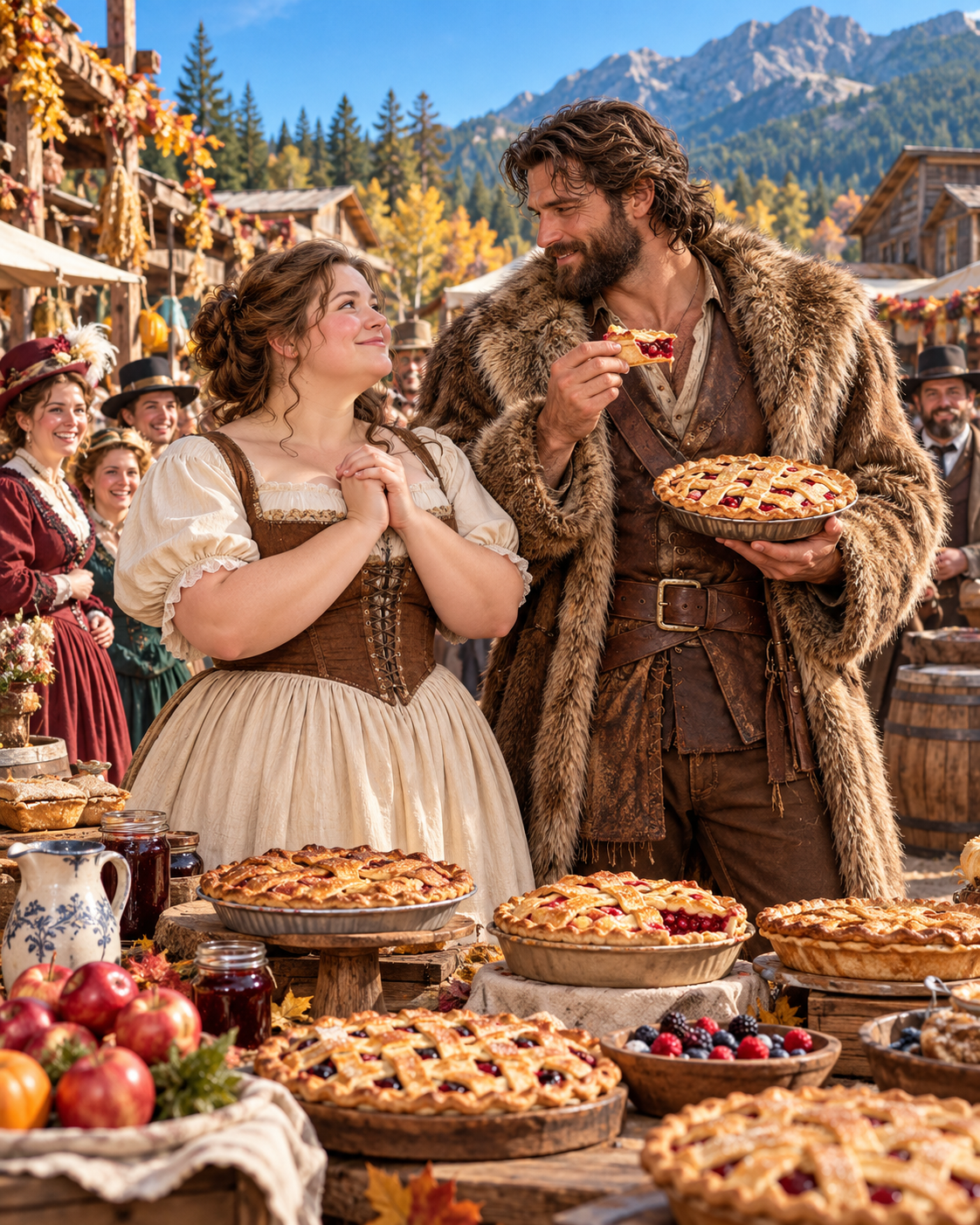
Afterward, she served apple, blackberry, and pecan pies on long wooden tables.
Cole ate four slices.
Marriage did not turn them into different people.
Cole remained quiet.
Martha remained stubborn.
They argued about money, firewood, muddy boots, and whether six pies cooling on a windowsill qualified as “too many pies.”
But their life together became something neither had planned.
Travelers began stopping at the cabin after hearing of the silver strike.
Some were prospectors.
Some were hunters.
Others were families crossing the territory.
Martha fed them.
Cole gave them a place to sleep in the barn.
Soon there were too many visitors for the barn.
So they built two guest rooms.
Then four.
Then a dining room with wide windows overlooking the valley.
Within three years, the Callahan Mountain Lodge stood on the ridge.
Martha ran the kitchen.
Cole guided travelers through the mountains.
Their silver income paid for roads, wages, and supplies, but the lodge became the work they actually loved.
They hired widows, injured miners, immigrants, and anyone Oak Haven tended to underestimate.
Martha knew what it was like to be measured by appearance before anyone discovered what she could do.
She refused to build a life that repeated the cruelty she had survived.
One autumn, nearly five years after the day everyone ignored her pies at the Jubilee, Martha returned to Oak Haven for the festival.
This time she came with Cole and three wagons of food from the lodge.
The square looked almost exactly as she remembered it.
Bunting fluttered overhead.
Children ran between booths.
Roasted corn smoked beside the courthouse.
Martha stopped at the place where her little wooden table had once stood.
A young woman occupied it now.
She was large, nervous, and selling jars of preserves.
People passed without stopping.
Martha watched her straighten the jars for the tenth time, pretending not to notice.
Something tightened in Martha’s chest.
She walked over.
“How much for all of them?”
The young woman blinked.
“All?”
“Every jar.”
The woman stared at Cole.
Then at Martha.
“Why?”
Martha smiled.
“Because sometimes one customer is enough to change the direction of a road.”
She paid a fair price.
Not gold.
She had learned that generosity did not need theater.
Later that afternoon, people crowded around the young woman’s stall because Martha Higgins Callahan had bought from her.
Human nature had not changed much.
But perhaps it could be nudged.
As sunset turned the American foothills copper and gold, Martha and Cole loaded the preserves into their wagon.
Across the square, music started.
Cole offered her his hand.
“You dance?”
“Not well.”
“Neither do I.”
“That has never stopped you from doing anything else badly.”
He gave her the look he reserved for insults he secretly enjoyed.
They joined the dancers anyway.
Martha thought briefly of Samuel.
She thought of the farm.
Of the mountain.
Of Clemens behind bars.
Of the skillet that still hung in the lodge kitchen, dented along one edge.
Most of all, she thought about the woman she had been on that terrible morning years earlier—the woman who had believed the judgment of Oak Haven said something true about her value.
It had not.
People often decide what someone is worth before they know anything about them.
They judge a body, a bank account, a reputation, a job, an accent, a past.
Sometimes an entire town can be wrong at once.
Martha had learned something else too.
Courage rarely felt like courage while it was happening.
Sometimes it felt like embarrassment.
Sometimes it felt like grief.
Sometimes it looked like climbing onto a horse when everyone expected you to stay home.
And sometimes it looked like holding a cast-iron skillet while an armed man ran toward you and deciding that fear was not going to make the next choice.
As the music carried across Oak Haven, Cole drew Martha closer.
The mountains waited beyond the town, dark against the evening sky.
Once, people had whispered that Dead Man’s Ridge was a place where secrets disappeared.
Martha knew better.
Some secrets did not stay buried.
Some truths simply waited for someone brave enough to climb high enough to find them.
And sometimes the life people laughed at from a distance became the very life they wished they had possessed the courage to build.
But the story of Martha Higgins Callahan did not end with a dance beneath the lanterns of Oak Haven.
In the years that followed, people would tell the tale as if everything after Josiah Clemens’s conviction had become easy.
It had not.
Silver could solve many problems.
It could also create new ones.
The first winter after the Callahan Mountain Lodge opened, prospectors began arriving from places Martha had never heard of.
Some came from Colorado.
Some from Nevada.
Some came from mining camps hundreds of miles away carrying picks, rifles, whiskey, and rumors.
They had heard about the silver vein beneath Dead Man’s Ridge.
Rumor, Martha discovered, was faster than any horse.
By January, strangers were sleeping in barns, abandoned shacks, and under wagons near the base of the ridge.
Cole did not like it.
“Too many men asking questions,” he said one evening.
Martha was kneading bread dough in the lodge kitchen.
“You dislike men even when they aren’t asking questions.”
“I dislike them more when they are.”
She smiled.
Cole did not.
He stood at the window looking toward the trail.
Snow fell beyond the glass.
“Someone rode past twice today.”
“Maybe they were lost.”
“They weren’t.”
Martha stopped kneading.
“Who?”
“Don’t know.”
She wiped flour from her hands.
“Do you think they’re after the silver?”
“I think men have killed for less.”
That sentence stayed with her.
The following week, a letter arrived from Oak Haven.
It had been sent by the county clerk.
Martha opened it beside the fireplace.
Her expression changed before she finished reading.
Cole noticed immediately.
“What?”
She handed him the paper.
A mining company calling itself Western Dominion Silver had filed a legal challenge against their claim.
According to the document, Western Dominion possessed an older deed granting mineral rights to nearly half of Dead Man’s Ridge.
The deed carried a date from twenty-two years earlier.
Cole read it twice.
“It’s false.”
“How can you be certain?”
“My father never sold those rights.”
“Can we prove it?”
Cole looked at the fire.
“That’s the problem.”
His father had been dead nearly fifteen years.
Most of the old county records had burned in a courthouse fire.
What remained was incomplete.
Western Dominion’s attorney, however, had papers covered in stamps, signatures, and official seals.
Martha had learned enough about powerful men to know that paper could be made to lie convincingly.
Three days later, representatives from the company arrived.
There were four of them.
The leader was a lawyer named Everett Price.
He was younger than Clemens had been, better dressed, and far more careful.
Price removed his gloves when he entered the lodge and smiled warmly.
“Mrs. Callahan.”
“Martha is fine.”
“Mr. Callahan.”
Cole said nothing.
Price glanced around the lodge.
“Impressive place.”
Martha replied, “People usually say that before they ask for something.”
His smile widened slightly.
“I appreciate directness.”
“So do we.”
Price sat at the long dining table.
“We believe there has been a misunderstanding concerning mineral rights.”
Cole remained standing.
“There hasn’t.”
Price unfolded several documents.
“Western Dominion acquired these rights legally.”
“From whom?”
“A man named Elias Callahan.”
Cole’s eyes sharpened.
“My father.”
“Yes.”
“He couldn’t sign his own name.”
Price paused.
Martha looked at Cole.
Cole continued.
“My father lost two fingers on his right hand in a sawmill accident when I was twelve. After that, he signed everything with an X.”
Price glanced down at the elegant signature written across the deed.
For the first time, his confidence slipped.
“Interesting.”
“Very,” Martha said.
Price gathered the papers.
“You understand this will still need to be settled legally.”
“Then settle it legally.”
He stood.
“I’d hoped we might avoid court.”
Martha folded her arms.
“And what would avoiding court cost us?”
“Half the silver rights.”
Cole laughed once.
It was not a pleasant sound.
Price looked toward him.
“I’m offering peace.”
Cole stepped closer.
“No. You’re offering theft with a handshake.”
Martha touched Cole’s arm.
Not because she disagreed.
Because she understood that men like Price preferred angry opponents.
Anger made mistakes.
She looked directly at the lawyer.
“You can leave now.”
Price put on his gloves.
“This could become expensive.”
Martha smiled.
“So was my first husband’s funeral.”
Price’s expression changed.
Only slightly.
But she saw it.
And suddenly she knew.
This was not merely a business dispute.
Someone connected to Clemens had survived.
Someone knew more than they should.
After the men left, Martha told Cole what she had noticed.
“You think Price knew Samuel?”
“No.”
“Then what?”
“He reacted when I mentioned him.”
“Could mean nothing.”
“It could.”
Cole looked toward the door.
“But you don’t think it does.”
“No.”
The next morning, they rode to Oak Haven.
The town had changed since Clemens’s trial.
His bank had closed.
A new cooperative bank operated from a smaller brick building near the courthouse.
Several families who had nearly lost their farms under Clemens now owned shares in it.
Martha liked that.
What she did not like was the news waiting at the sheriff’s office.
Everett Price had been seen visiting the jail six months earlier.
He had met with Josiah Clemens.
Twice.
“Why?” Martha asked.
The sheriff shook his head.
“Attorney privilege, they claimed.”
“Price wasn’t his trial attorney.”
“No.”
“Then what did they discuss?”
“I don’t know.”
Cole leaned against the desk.
“Where’s Clemens now?”
“Territorial prison.”
Martha looked at the sheriff.
“We need to speak with him.”
The sheriff stared at her.
“Are you sure?”
No.
She was not.
But certainty had never been the requirement for courage.
Three days later, Martha and Cole entered the territorial prison.
The place was colder than she expected.
Stone walls.
Iron doors.
Footsteps echoing down narrow corridors.
When Josiah Clemens was brought into the visiting room, Martha barely recognized him.
The expensive suits were gone.
So was the carefully trimmed beard.
He had lost weight.
His hair had turned nearly white.
Yet his eyes remained the same.
Sharp.
Calculating.
Hungry.
“Well,” he said.
“The mountain widow.”
Cole stiffened.
Martha sat.
“Everett Price.”
Clemens smiled.
No denial.
No confusion.
Just a smile.
“What about him?”
“He visited you.”
“Many people visit me.”
“Not many people leave prison and immediately file claims against land you once tried to steal.”
Clemens leaned back.
“You always were more perceptive than Samuel gave you credit for.”
Cole’s hand tightened on the back of Martha’s chair.
She ignored the insult.
“What did you give Price?”
Clemens said nothing.
Martha leaned closer.
“You’re already in prison.”
“Yes.”
“You can’t spend the silver.”
“No.”
“You can’t own the mountain.”
“No.”
“Then why?”
Clemens smiled faintly.
“Because losing hurts less when the person who beat you loses too.”
Martha felt something cold settle inside her.
“What did you give him?”
Clemens looked at Cole.
“Your father kept more than one map.”
Cole went still.
“What?”
“There are other veins.”
Silence.
Clemens continued.
“Silver. Copper. Maybe gold farther west.”
“Where did you hear that?”
“Samuel.”
Martha’s stomach turned.
Clemens enjoyed seeing it.
“He talked before he died.”
Cole moved so quickly the guard stepped forward.
Martha raised one hand.
Cole stopped.
Barely.
Clemens watched him with satisfaction.
Martha understood then.
He wanted rage.
It was all he had left.
So she denied it to him.
She stood.
“Thank you.”
Clemens blinked.
“For what?”
“For confirming that Price doesn’t have the real information.”
His smile vanished.
Martha turned toward the door.
Clemens called after her.
“You don’t know that.”
She stopped.
“No. But neither does he.”
That was the difference.
Back at Dead Man’s Ridge, Martha and Cole searched through every item Samuel had left behind.
The compass case.
The journal.
The map.
Letters.
Receipts.
Old books.
Nothing.
For three days they found nothing.
On the fourth night, Martha woke before dawn.
Something Samuel had once said returned to her.
Never trust the obvious place.
He had said it while hiding Christmas money from nieces and nephews.
At the time, Martha had laughed.
Now she sat upright.
“Cole.”
He opened his eyes immediately.
“What?”
“The obvious place.”
He frowned.
“What?”
Martha was already getting dressed.
They rode to the old Higgins homestead before sunrise.
The family who had purchased it welcomed them inside.
Martha walked through rooms filled with someone else’s furniture.
It was strange.
The house still carried the shape of her former life but none of its weight.
She went directly to the kitchen.
Samuel had built the pantry shelves himself.
Martha ran her hands beneath them.
Nothing.
Then she remembered.
The flour bin.
Samuel had repaired the floor beneath it the summer before his death.
They moved the bin aside.
One floorboard was slightly narrower than the others.
Cole pried it up.
Underneath lay a small tin box.
Inside were papers wrapped in oilcloth.
More maps.
Survey notes.
And a letter.
Martha opened it.
The letter was addressed to her.
Martha,
If you are reading this, then I failed to come home.
I am sorry for every worry I kept from you.
I told myself silence would protect you.
I see now that love without truth can become another kind of danger.
Cole can be trusted.
Clemens cannot.
The mountain holds more than silver, but wealth is not the reason I hid these records.
The land connects the farms below to the watershed above.
If men destroy the ridge carelessly, they will poison every creek in Oak Haven.
Do not let anyone take the mountain simply because they promise money.
I know people often mistake your kindness for weakness.
They are wrong.
You are the strongest person I have ever known.
Forgive me for realizing too late that strength does not need protecting from the truth.
Samuel.
Martha sat on the kitchen floor.
She read it again.
Then again.
Cole waited in silence.
At last she handed him the letter.
He read it slowly.
“He knew.”
“Yes.”
“About the watershed.”
“Yes.”
Cole looked at the maps.
“If Western Dominion mines the upper ridge hard enough, tailings could reach the creek.”
“And the creek feeds Oak Haven farms.”
Cole nodded.
Martha’s grief changed again.
Samuel had not hidden treasure.
He had hidden responsibility.
That was more difficult.
And perhaps more important.
The legal battle began in spring.
Western Dominion expected Martha and Cole to defend a silver claim.
Instead, Martha attacked the forged deed.
She produced Samuel’s survey notes.
Cole produced records of his father’s injury proving he could not have written the signature.
The county clerk found a tax receipt placing Elias Callahan hundreds of miles away on the date the deed had supposedly been signed.
Then the largest surprise arrived.
One of Everett Price’s clerks came forward.
The young man had discovered correspondence between Price and Clemens discussing forged ownership papers.
Price had promised Clemens a percentage of future mineral profits to be paid to relatives outside prison.
The case collapsed.
Everett Price was arrested for fraud and conspiracy.
Western Dominion withdrew.
But Martha did not stop there.
The company offered her a private settlement.
A very large one.
More money than she and Cole could spend in several lifetimes.
All they had to do was allow controlled mining on the ridge.
Cole left the decision to her.
“You have an opinion,” Martha said.
“I do.”
“Then say it.”
“I’d rather be poor.”
She smiled.
“So would I.”
The following month, they placed most of the upper ridge into a permanent land trust.
Limited mining continued in the safest portion of the original silver vein.
The rest remained protected.
Some people in Oak Haven thought Martha had lost her mind.
“You could have been one of the richest women in the territory,” one merchant told her.
Martha replied, “I already own everything I need.”
“Land?”
“No.”
She looked toward Cole.
“Enough.”
Years passed.
The lodge grew famous.
Not because of silver.
Because of hospitality.
Travelers knew that no one was turned away for lack of money during a storm.
Hungry children were fed.
Injured riders were treated.
Widows looking for work could usually find it.
Former prisoners sometimes worked in the stables if Cole believed they truly wanted another chance.
One of Clemens’s former hired men became their best blacksmith.
People objected at first.
Martha did not care.
“A man is more than the worst thing he has done,” she said.
Cole raised an eyebrow.
“Does that include Clemens?”
“No.”
Cole laughed.
Ten years after the Autumn Jubilee that changed everything, Martha stood on the lodge porch at sunset.
Her hair had begun turning silver at the temples.
Cole’s beard carried more gray than brown.
Below them, lights glowed from guest cabins.
A group of children ran between the trees.
Two belonged to employees.
Three to travelers.
One little girl belonged to Martha and Cole.
Her name was Clara.
They had adopted her after her mother died during a winter crossing.
Clara came running up the steps holding something behind her back.
“Mama.”
“Yes?”
“Papa says I shouldn’t show you.”
Cole appeared behind her.
“I said no such thing.”
“You said she’d be mad.”
“I said she might be.”
Clara revealed a cast-iron skillet.
The old skillet.
The dented one.
Martha stared.
“What are you doing with that?”
“Papa told me you fought three men with it.”
“Two.”
Cole coughed.
“Three, depending on how you count.”
Martha turned toward him.
“You have made this story worse every year.”
“Better.”
“Worse.”
Clara looked delighted.
“Can you teach me?”
“No.”
Her face fell.
Martha took the skillet gently.
“I can teach you to cook with it.”
“That’s not as exciting.”
“It is if you use enough butter.”
Cole laughed.
They went inside together.
The kitchen smelled of apples, cinnamon, woodsmoke, and bread.
Martha began preparing pie dough while Clara stood on a stool beside her.
Outside, snow started falling.
Later that night, after guests had gone to bed, Martha and Cole returned to the porch.
The mountain was quiet.
Oak Haven’s lights could barely be seen far below.
Cole handed her a cup of coffee.
“Regret anything?”
Martha considered.
“Yes.”
He looked at her.
“I regret wasting so many years believing strangers had the right to tell me what I was worth.”
Cole nodded.
“Anything else?”
“I regret hitting that second man with the edge of the skillet.”
Cole stared.
She kept a perfectly straight face.
“Should’ve used the flat side. Easier on the cookware.”
Cole laughed so loudly that the sound rolled down the ridge.
Martha smiled.
She rested her head against his shoulder.
The woman who once stood behind a table of unsold pies had believed she was losing everything.
Her husband was gone.
Her home was nearly gone.
Her dignity felt as though an entire town had taken turns tearing pieces from it.
Yet that day had not been the end.
It had been a doorway.
Through it came grief.
Danger.
Love.
Truth.
And a life she never would have dared imagine.
Martha understood now that humiliation could sometimes be the moment before freedom.
Loss could sometimes uncover what had been hidden.
And rejection did not necessarily mean a person was unwanted.
Sometimes it only meant they were standing among people incapable of recognizing their value.
Years later, when Clara asked Martha what she remembered most about that Autumn Jubilee, she expected to hear about Cole.
Or the gold.
Or the mountain.
Martha surprised her.
“The silence,” she said.
“What silence?”
“The moment everyone stopped laughing when your father walked into the square.”
Clara smiled.
“Because they were scared of him?”
“At first.”
“And later?”
Martha looked toward Cole, who was outside teaching a boy how to repair a saddle strap.
“Later they learned they had been afraid of the wrong person.”
Clara frowned.
“Who should they have been afraid of?”
Martha laughed.
“No one.”
She touched the girl’s cheek.
“That was the lesson.”
Cruelty often grew from fear.
Greed grew from fear.
People mocked what they did not understand because judgment was easier than curiosity.
Clemens had feared losing control.
The townspeople had feared anyone who did not fit neatly into the shape they expected.
Even Martha herself had once feared being seen.
But a life built around fear became very small.
Martha had learned to build something larger.
Years became decades.
Oak Haven grew.
A railroad eventually passed fifteen miles east of town.
Telegraph wires arrived.
New shops opened.
Old families moved away.
New families arrived.
The Autumn Jubilee continued every October.
So did the pies.
When Martha reached seventy, she no longer ran the lodge kitchen every day.
Clara did.
She had grown into a strong woman with Cole’s steadiness and Martha’s refusal to be intimidated by anyone.
One autumn afternoon, a young reporter from a newspaper in Denver traveled to Dead Man’s Ridge.
He wanted to write about the famous silver fortune.
Martha agreed to speak with him.
He sat across from her on the porch with a notebook.
“How much silver did you ultimately remove from the Callahan claim?”
“I don’t remember.”
He blinked.
“You don’t?”
“No.”
“Mrs. Callahan, people say it was worth a fortune.”
“It was.”
“How large a fortune?”
Martha shrugged.
The reporter looked disappointed.
“Then what part of the story do you think people should remember?”
Martha looked across the valley.
Cole had died two winters earlier.
Peacefully.
In his own bed.
His boots beside the door.
She missed him every day.
Grief had returned, but she was no longer afraid of it.
Love had taught her that grief was simply the price of having had something worth missing.
She looked at the young reporter.
“Young man, everyone thinks this is a story about silver.”
“Isn’t it?”
“No.”
“What is it about?”
Martha smiled.
“It is about what happens when someone finally decides not to believe the worst thing other people say about them.”
The reporter stopped writing.
Martha continued.
“There will always be people who measure you badly.”
“By money?”
“By anything convenient. Your face. Your body. Your family. Your work. The place you were born. A mistake you made twenty years ago.”
She folded her hands.
“If you spend your whole life trying to change their minds, they still own your life.”
“So what should you do?”
“Build something they cannot define for you.”
The reporter wrote that down.
Years later, those words appeared in newspapers far beyond Oak Haven.
Martha never saw most of them.
She died in late spring at the age of seventy-eight.
Clara was with her.
So were grandchildren.
Outside the lodge, apple trees Martha had planted decades earlier were blooming.
She was buried beside Cole beneath two tall pines overlooking the valley.
There was no monument to the silver.
No enormous statue.
No grand inscription.
Only two stones.
Cole Callahan.
Martha Higgins Callahan.
Between them, Clara placed an old cast-iron skillet.
The handle had cracked.
The bottom was scarred.
One edge still carried a dent.
Travelers occasionally asked why it was there.
The people of Oak Haven always smiled.
Then they told the story.
They told of the widow no one wanted to buy from.
They told of the mountain man everyone feared.
They told of a cruel banker, a hidden map, a dead husband’s warning, a cabin fight, and silver buried beneath stone.
But the oldest residents always added something at the end.
They said that the treasure was never really the silver.
The treasure was what Martha discovered after she stopped asking the town for permission to believe in herself.
And for generations afterward, whenever someone in Oak Haven was dismissed too quickly, judged too harshly, or laughed at for being different, someone would inevitably say:
“Remember Martha Higgins.”
Because one autumn morning, an entire town decided what she was worth.
And an entire town was wrong.
THE END.