Nineteen starving cowboys showed up at Rebecca Hayes’s farm on a freezing January morning. And the man who once doubted she could survive on her own was standing at the front of them.
Daniel slowly pulled the folded letter from his coat pocket.
For several seconds, he said nothing. The wind pushed against the smokehouse walls, making the old boards creak. Rebecca stood perfectly still, watching the man she had spent months trying to understand.
“Where did you get that?” she asked.
Daniel looked toward the farmhouse, where nineteen exhausted cowboys were waiting for food and one injured man was fighting to stay conscious.
“Your grandfather gave it to me,” he finally answered.
Rebecca felt her stomach tighten.
“My grandfather died before I came to Pine Hollow.”
“I know.”
“Then why are you carrying his letter?”
Daniel unfolded the paper, but he didn’t hand it over.
“Because he made me promise something. And I haven’t kept that promise.”
Rebecca reached for the letter.
Daniel hesitated.
That small movement hurt more than she expected.
“Don’t do this again,” she whispered. “Don’t decide what I deserve to know.”
He lowered his eyes and placed the paper in her hand.
The handwriting was unmistakable. Her grandfather had always written his capital letters with long, uneven strokes. She remembered seeing them on birthday cards and the few letters he had sent her when she was younger.
At the top was a date from the previous spring.
Rebecca began reading.
Daniel,
If anything happens to me, I need you to look after the smokehouse until Rebecca comes. She won’t want anyone taking care of her. That’s one thing she got from me.
Rebecca swallowed.
The next lines were harder to read because the ink had faded.
There are things about this land she doesn’t know. Things I should have told her myself. When the time is right, show her what I left behind.
The letter ended with a sentence that made Rebecca’s fingers go cold.
And whatever you do, don’t let the people of Pine Hollow forget what happened here thirty years ago.
Rebecca looked up.
“What happened thirty years ago?”
Daniel’s expression changed.
Before he could answer, the farmhouse door flew open.
“Mr. Cooper!” a cowboy shouted. “Samuel’s not waking up!”
Daniel ran.
Rebecca followed, still clutching the letter.
Inside, the farmhouse had become crowded and painfully warm. Men sat along the walls, their faces hollow with hunger. Two had removed their boots to reveal swollen, blistered feet. Another was coughing so badly that he could barely speak.
Samuel Price lay on Rebecca’s narrow bed.
His breathing was shallow, and his right leg had swollen beneath his trousers.
Rebecca pushed through the crowd.
“Everyone back. Give him room.”
She examined his leg carefully. The swelling was severe, and the skin around his ankle was turning dark.
“Did anyone clean this wound?” she asked.
A young cowboy named Thomas shook his head.
“We tried, ma’am. But the water froze, and we couldn’t keep a fire going.”
Rebecca looked at Daniel.
“He needs a doctor.”
“The nearest one is in Mill Creek,” Daniel said. “Twenty-three miles away.”
“Then somebody has to go.”
Daniel glanced toward the window. Snow was blowing sideways across the yard.
“No horse will make that trip tonight.”
Rebecca knew he was probably right.
She had survived one winter storm already. She understood what those winds could do to a man caught in the open.
Still, she refused to accept that Samuel had to suffer without help.
“Boil water,” she ordered. “Find every clean cloth you can. And somebody bring in more firewood.”
The men moved immediately.
Six months earlier, these same people had laughed at her little homestead.
Now nobody questioned a single instruction.
Rebecca worked beside Samuel for nearly an hour. She cleaned the wound, wrapped it, and made sure his injured leg was supported.
When she finally stepped away, Daniel was standing near the doorway.
“Will he live?” he asked.
“I don’t know.”
Daniel closed his eyes.
Rebecca noticed how deeply those three words affected him.
“Samuel has a wife,” he said quietly. “And two boys. The youngest just turned four.”
Rebecca looked back at the injured man.
“Then we’d better make sure he gets home.”
But there was another problem waiting outside.
Food.
Nineteen starving men could eat in one evening what Rebecca had carefully saved for weeks.
And her smokehouse held more than her own supplies.
Three families had trusted her with meat they couldn’t safely preserve themselves. Widow Martha Ellis had brought two hams in December. The Miller family had left several pieces of pork. Old Mr. Jenkins had paid Rebecca to cure enough beef to help him through February.
Those people were counting on her.
If she fed Daniel’s men everything, she would be breaking her promises to the very neighbors who had finally learned to trust her.
Rebecca stood in the kitchen, staring at the empty cooking pot.
Daniel approached her.
“I have money,” he said. “Whatever you need.”
She turned sharply.
“Do you think money can make a pig appear in the middle of January?”
“No. That’s not what I meant.”
“Then stop offering it like it fixes everything.”
Daniel stepped back.
For a moment, Rebecca regretted her tone.
Then she remembered the nineteen men sitting in her house, and the families who would go hungry if she made the wrong decision.
“I can’t feed everyone without taking food that belongs to other people,” she admitted.
Daniel rubbed his forehead.
“I understand.”
“No,” Rebecca said. “I don’t think you do.”
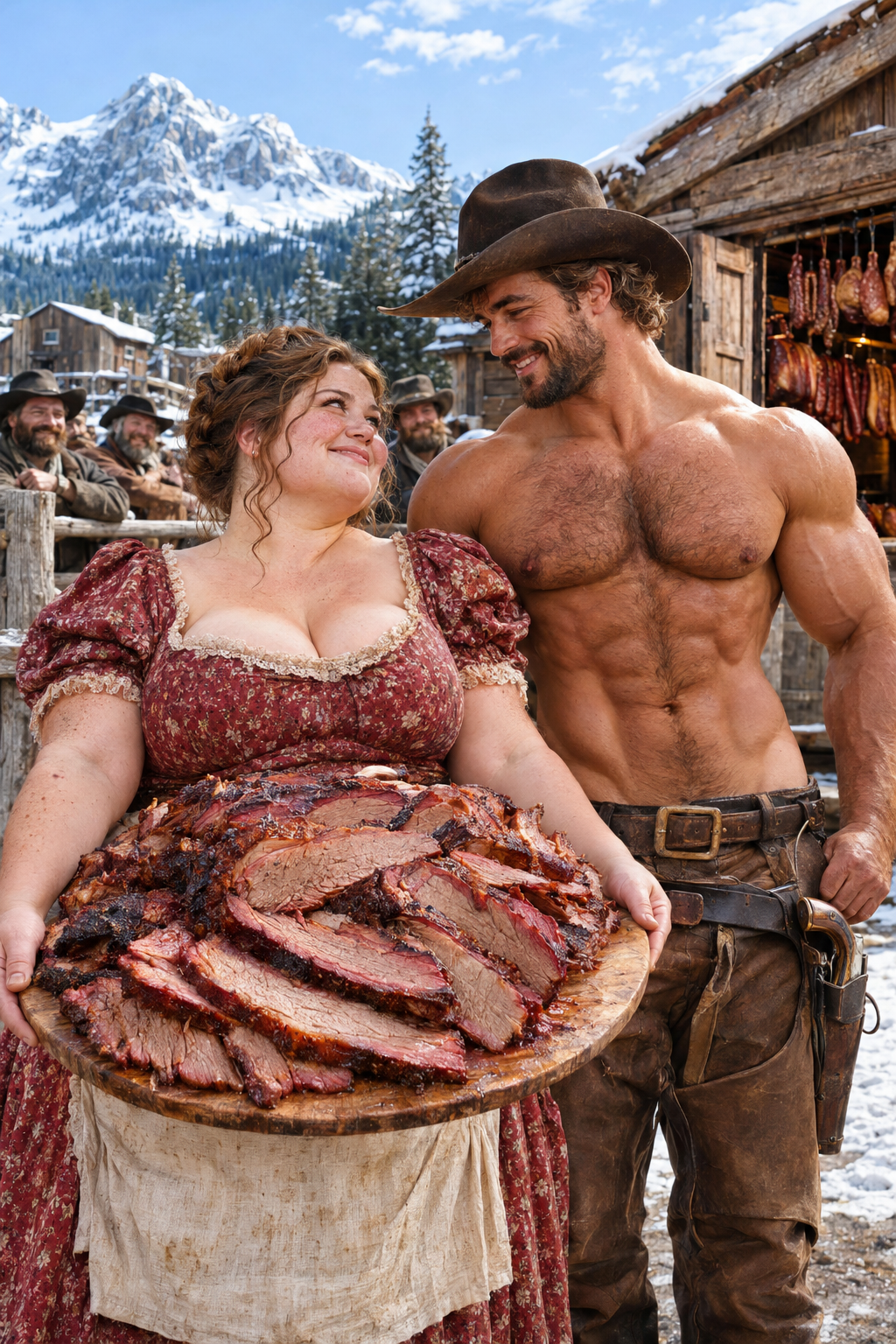
He looked at her.
“If I open that smokehouse, I may be choosing who eats next month and who doesn’t.”
The room fell silent.
Then a small voice came from behind them.
“Rebecca?”
Molly stood in the doorway, holding her favorite blue blanket.
Rebecca knelt.
“What is it, sweetheart?”
Molly looked at the hungry men.
“Grandpa used to say you can’t eat tomorrow’s breakfast today.”
Daniel gave a tired smile.
“That’s right.”
“But he also said you don’t let somebody starve while you’re saving food.”
Rebecca stared at the little girl.
Molly continued, “Couldn’t everybody just have a little?”
It was such a simple question.
And yet it made Rebecca realize something she had been too frightened to consider.
She didn’t have to solve the entire winter that night.
She only had to keep those men alive until morning.
Rebecca stood.
“Daniel, get your strongest men.”
He straightened.
“What are we doing?”
“We’re making soup.”
Within minutes, the farmhouse came alive.
Rebecca took one smoked ham from her own supply, cut it into small pieces, and dropped it into a huge iron pot with dried beans, onions, and the last of her potatoes.
She added water and let everything simmer.
The smell spread through the house.
Men who had barely spoken lifted their heads.
One cowboy started crying.
He tried to hide it by rubbing his face, but Rebecca saw.
“Smells like my mother’s kitchen,” he whispered.
Rebecca pretended not to notice his tears.
When the soup was ready, she served Samuel first, helping him swallow a few spoonfuls while he was awake enough to manage them.
Then she filled nineteen bowls.
Not one man complained about the small portions.
They ate slowly, carefully, as though each spoonful was something precious.
Daniel waited until everyone else had been served.
Rebecca noticed.
She handed him the final bowl.
“What about you?” he asked.
“I ate earlier.”
It was a lie.
Daniel knew it.
He placed the bowl between them.
“Then we’ll share.”
For the first time that evening, Rebecca almost smiled.
They sat together near the kitchen stove, passing the bowl back and forth.
Outside, the storm grew stronger.
Inside, the men finally began to rest.
But Rebecca’s mind kept returning to her grandfather’s letter.
Thirty years ago.
Something had happened on this land.
Something Daniel knew.
And something he had deliberately kept from her.
When the house became quiet, she found him in the barn checking the horses.
“We’re finishing that conversation,” she said.
Daniel didn’t pretend to misunderstand.
“I figured we would.”
Rebecca held up the letter.
“What happened here thirty years ago?”
Daniel leaned against an empty stall.
“There was a winter worse than this one.”
“Go on.”
“Three feet of snow fell in two days. The creek froze. Roads disappeared. Ranchers lost cattle, and families ran out of food.”
Rebecca waited.
“Your grandfather was one of the few men who had prepared properly. He’d filled that smokehouse before the first storm.”
“Did he help them?”
Daniel nodded.
“He fed nearly forty people.”
Rebecca felt a small warmth in her chest.
That sounded like the grandfather she remembered.
But Daniel wasn’t finished.
“After the storm, some people accused him of keeping more than his share. They said he had charged desperate families too much for food.”
Rebecca frowned.
“Did he?”
“No.”
“Then why did they say it?”
Daniel looked away.
“Because somebody needed to blame him.”
“Who?”
Daniel’s jaw tightened.
“My father.”
Rebecca stared at him.
Daniel continued before she could speak.
“My father owned the largest ranch in the county. He had promised his workers enough supplies to survive winter, but he hadn’t stored nearly enough. When the storm came, he sent them to your grandfather.”
“And my grandfather fed them.”
“Yes.”
“Then why would your father blame him?”
“Because when the storm ended, everyone learned how badly my father had failed his men.”
Rebecca slowly lowered the letter.
“So he ruined my grandfather’s reputation to protect his own?”
Daniel nodded.
“People believed him because he had money and influence. Your grandfather had six acres and a smokehouse.”
Rebecca felt anger rising through her chest.
All those years, her grandfather had lived alone.
He had rarely visited family gatherings. He had never spoken much about Pine Hollow.
Now she began to understand why.
“Did your father ever apologize?”
“No.”
“Did anyone?”
Daniel shook his head.
Rebecca turned toward the barn door.
“Then why didn’t you tell me when I arrived?”
“Because I was ashamed.”
She looked back.
“Of what?”
“That I knew the truth and stayed quiet.”
The confession hung between them.
Daniel took a breath.
“When your grandfather got sick, he asked me to come see him. He told me he didn’t want his granddaughter inheriting the bitterness that had followed him for thirty years.”
Rebecca’s eyes filled.
“He said you would have enough trouble making a life here without carrying an old fight.”
“Then why write the letter?”
“Because he also believed the truth should come out someday.”
Rebecca stared at Daniel.
“And you decided someday wasn’t now.”
“I thought I was protecting you.”
She gave a bitter laugh.
“You keep saying that.”
Daniel looked wounded, but he didn’t argue.
Rebecca stepped closer.
“When you sent men to follow me, you called it protection. When you kept this letter, you called it protection. But every time you protect me, you take away my right to choose.”
Daniel lowered his head.
“You’re right.”
She hadn’t expected him to say that.
He continued, “I spent my whole life watching my father make decisions for everyone around him. I swore I’d never become that kind of man.”
He looked directly at her.
“And somehow, I started doing the same thing.”
Rebecca’s anger softened, but it didn’t disappear.
“Then stop.”
“I will.”
For a long moment, neither spoke.
Then Daniel reached into his coat again.
“There’s something else.”
Rebecca stiffened.
He pulled out a small brass key.
“Your grandfather gave me this too.”
Rebecca stared at it.
“What does it open?”
“I don’t know.”
She narrowed her eyes.
“Daniel.”
“I’m telling you the truth. He said it belonged to something inside the smokehouse, but he wouldn’t tell me where.”
Rebecca took the key.
It was old, with a strange square-shaped head.
She had cleaned every visible corner of that smokehouse.
She had replaced broken shelves, repaired the chimney, and scrubbed the floor.
She had never found a locked door.
Then she remembered something.
The back wall.
Behind the largest curing rack was a section of wood that didn’t match the rest.
She had assumed her grandfather had repaired it years earlier.
Rebecca turned toward the barn door.
“Come with me.”
They crossed the yard through the blowing snow.
Inside the smokehouse, Rebecca lit a lantern and moved toward the rear wall.
Daniel helped her pull the heavy rack aside.
There, almost hidden beneath years of dust, was a narrow iron plate.
And in its center was a keyhole.
Rebecca’s heart began pounding.
She inserted the brass key.
It turned.
A small wooden panel swung inward.
Behind it was a shallow compartment containing an oilcloth bundle.
Rebecca carefully lifted it out.
Inside were three notebooks, several yellowed receipts, and a sealed envelope with her name written across the front.
She recognized her grandfather’s handwriting again.
Her hands trembled.
Daniel stood silently beside her.
Rebecca opened the envelope.
My dear Rebecca,
If you’re reading this, then you’ve found what I couldn’t bring myself to explain while I was alive.
I always hoped you would come to Pine Hollow because you wanted to, not because you felt you owed an old man anything.
This land never made me rich. But it taught me something that took me most of my life to understand.
Having enough means very little if you can’t help someone who has nothing.
Rebecca paused, wiping her eyes.
Then she continued.
The winter everyone remembers was not the winter I lost my reputation. It was the winter I learned who my neighbors truly were.
Some were frightened. Some were selfish. Some were generous beyond reason. I made mistakes too.
But I kept records because someday I wanted the truth to be known.
Rebecca opened the first notebook.
Page after page listed names, dates, and amounts of food.
Forty-two people had received meat during that terrible winter.
Beside most names, her grandfather had written the same two words.
No charge.
Rebecca turned another page.
There were notes about deliveries made during the storm, supplies shared, and families who had promised to repay him.
Then she found a name that made her stop.
Cooper Ranch.
Below it was a long list of meat and supplies.
At the bottom, her grandfather had written:
Payment received: $0.
Rebecca looked at Daniel.
“Your father never paid him?”
Daniel shook his head.
“I didn’t know that.”
She turned another page.
There was a signed receipt from Daniel’s father acknowledging the food had been delivered.
And underneath it, a note in her grandfather’s handwriting.
He asked me to keep quiet. Said his men would lose their jobs if anyone knew the truth.
Rebecca stared at those words.
Her grandfather hadn’t simply fed the people who needed him.
He had protected the man who later destroyed his reputation.
“Why would he do that?” she whispered.
Daniel looked at the floor.
“Because he cared more about the workers than winning an argument.”
Rebecca closed her eyes.
For thirty years, her grandfather had carried the blame for another man’s failure.
And now she was standing in the same smokehouse, facing almost the same impossible choice.
Outside, nineteen hungry men were depending on her.
Inside, the evidence of an old injustice lay in her hands.
Rebecca opened the second notebook.
It contained recipes, curing methods, and detailed instructions for preserving meat through long winters.
The third notebook was different.
It listed names of people who had helped her grandfather after the storm.
Some had brought firewood.
Others had shared grain, repaired fences, or cared for sick neighbors.
One entry was underlined.
The food I gave away came back to me in ways I never expected.
Rebecca sat on an overturned crate.
Daniel crouched beside her.
“Rebecca?”
She looked at him.
“Your father took my grandfather’s reputation. But my grandfather still wrote down the good things people did.”
Daniel nodded slowly.
“He was a better man than my father.”
Rebecca touched the old notebook.
“He wasn’t perfect. But he knew what mattered.”
For several minutes, they sat without speaking.
Then a scream came from the farmhouse.
Both jumped to their feet.
They ran across the yard.
Inside, Samuel was struggling to breathe.
His face had turned gray, and his wife’s name escaped his lips in a broken whisper.
Rebecca rushed to his bedside.
“Samuel, can you hear me?”
His eyes opened slightly.
“Tell Anna…”
“You’re going to tell her yourself,” Rebecca said firmly.
He tried to smile.
Then his eyes closed.
Daniel grabbed Rebecca’s arm.
“He’s burning up.”
Rebecca touched Samuel’s forehead.
His fever was worse.
She knew the wound could be infected, and that no amount of soup or clean bandages could replace proper medical care.
“We need Dr. Bennett,” she said.
Daniel looked toward the window.
“The storm—”
“I know about the storm.”
She stood and faced the room.
“Does anyone know a shorter way to Mill Creek?”
An older cowboy named Elias raised his hand.
“There’s an old logging trail through the eastern ridge. Cuts six miles off the trip.”
“Can a horse get through?”
“Maybe. But the trail crosses a frozen creek.”
Rebecca thought quickly.
Her grandfather’s notebooks contained more than recipes.
She remembered seeing a hand-drawn map tucked between two pages.
She hurried to the kitchen and opened the third notebook.
There it was.
A narrow trail marked in pencil, with a note beside it.
Winter crossing dangerous. Use the upper bridge.
Rebecca studied the map.
“The old bridge,” she whispered.
Elias leaned over her shoulder.
“That bridge washed out years ago.”
Rebecca shook her head.
“Not the lower bridge. There’s another one farther north.”
Elias stared at the drawing.
“I’ve lived here forty years. Never heard of it.”
“Then maybe my grandfather knew something we don’t.”
Daniel took the notebook.
“I’ll go.”
Rebecca looked at him.
“You don’t even know where the trail begins.”
“Then show me.”
She shook her head.
“No. I’m coming.”
Daniel opened his mouth, then stopped.
Rebecca watched him carefully.
For once, he didn’t tell her what she could or couldn’t do.
Instead, he asked, “Are you sure?”
“Yes.”
He nodded.
“Then we’ll go together.”
They prepared two horses and gathered blankets, lanterns, rope, and enough food for the journey.
Before leaving, Rebecca placed Molly in Elias’s care.
“Keep the fire going,” she told him. “Watch Samuel closely. If he wakes, give him water only when he can swallow safely.”
Molly hugged her tightly.
“Please come back.”
Rebecca kissed the little girl’s forehead.
“We’ll do everything we can.”
The storm struck them the moment they left the barn.
Snow whipped across the fields, hiding the familiar fences.
Daniel rode ahead, breaking a path through the drifts.
Rebecca followed with the notebook tucked inside her coat.
For nearly two hours, they struggled through the darkness.
Twice, Daniel’s horse stumbled.
Once, Rebecca nearly fell when her saddle shifted.
They reached the eastern ridge shortly before dawn.
Below them lay a narrow creek, covered in snow and ice.
Rebecca searched for the crossing marked on her grandfather’s map.
“There,” she said.
A wooden bridge stretched between two rocky banks, almost hidden beneath fallen branches.
It was old.
But it was standing.
Daniel dismounted and tested the first boards.
They creaked under his weight.
“Too dangerous for the horses.”
Rebecca studied the creek.
“We can lead them across one at a time.”
Daniel looked doubtful.
But he didn’t argue.
He tied a rope around his waist and secured the other end to a tree.
Then he carefully stepped onto the bridge.
Halfway across, a board cracked.
Rebecca gasped.
Daniel dropped to one knee, grabbing the railing.
For a terrible moment, he hung above the frozen water.
“Daniel!”
“I’m all right!”
He pulled himself up and crawled toward the far bank.
Rebecca’s hands shook as she watched.
When he finally reached solid ground, she almost cried with relief.
But their troubles weren’t over.
The horses refused to cross.
Rebecca tried coaxing hers forward, but the animal pulled back, terrified by the unstable boards.
Daniel looked toward the rising sun.
“We’re losing time.”
Rebecca stared at the bridge.
Then she made a decision.
“We leave the horses.”
Daniel frowned.
“Rebecca, that’s miles of walking.”
“And Samuel may not have miles of time.”
They secured the horses in a sheltered stand of trees and crossed the bridge on foot, moving slowly around the broken boards.
By midmorning, they reached Mill Creek.
Dr. Bennett was preparing to leave his office when they arrived.
He listened to Rebecca’s description of Samuel’s condition, then immediately gathered his medical bag.
“That sounds like a serious infection,” he said. “We need to get back.”
The doctor had a small sled built for winter travel.
With two strong horses pulling it, they returned by a longer but safer road that had been partially cleared by local farmers.
By the time they reached Rebecca’s farm, the afternoon sky was darkening.
Samuel was still alive.
But barely.
Dr. Bennett examined him while Rebecca heated water and prepared clean cloths.
The doctor worked for nearly an hour, treating the wound and stabilizing Samuel as best he could.
When he finally emerged, Daniel stood.
“Well?”
Dr. Bennett removed his glasses.
“He’s very sick. The infection is serious, and his leg has suffered a bad injury.”
“Will he survive?”
“I’ve done what I can. He needs close care, and the next day will tell us a great deal.”
Rebecca leaned against the wall.
She had spent the entire night fighting to bring help.
Now all she could do was wait.
But the storm had finally begun to weaken.
And with the clearer weather came a new possibility.
Rebecca gathered the cowboys around the kitchen table.
“We can’t keep nineteen men here until spring,” she said. “But we may be able to get help from town.”
Daniel looked at her.
“People are struggling everywhere.”
“I know.”
She placed her grandfather’s notebooks on the table.
“Thirty years ago, this community survived because people shared what they had. Not because one person fed everyone.”
Elias opened the notebook and studied the names.
“My father is in here,” he said suddenly.
Rebecca looked up.
Elias pointed to a line.
“Thomas Whitaker. That’s my father.”
His voice broke.
“He told me a man saved our family during the big winter. Said he brought meat through the snow when my mother was sick.”
Elias looked around the room.
“He never told me that man was Rebecca’s grandfather.”
Another cowboy leaned forward.
“My grandmother used to talk about him too.”
Daniel stood silently.
Rebecca looked at the men.
“Then let’s find out whether Pine Hollow remembers how to help its own.”
The following morning, Daniel and several cowboys rode into town.
Rebecca stayed with Samuel and the others.
She didn’t know what would happen.
Some families had little food left.
Others still remembered the old accusations against her grandfather.
And Daniel’s father had been respected for decades.
By noon, a wagon appeared on the road.
Then another.
And another.
Rebecca stepped outside.
Martha Ellis climbed down from the first wagon, carrying a basket of bread.
“I heard you’ve got hungry men,” she said.
Rebecca stared.
“Martha, your smoked hams are still safe. I haven’t touched them.”
“I know, honey.”
Martha smiled.
“That’s why I brought something of my own.”
Behind her, the Millers arrived with sacks of beans and flour.
Mr. Jenkins brought dried apples, cornmeal, and a small barrel of preserved vegetables.
A farmer named Henry Brooks brought two chickens.
By sunset, twelve families had delivered supplies.
Some brought food.
Others brought firewood, blankets, or clean clothes.
Nobody had enough to give away carelessly.
But together, they had more than enough to keep the stranded men fed until they could safely return home.
Rebecca stood in her yard, watching neighbors unload their wagons.
Her eyes filled with tears.
Then she noticed Daniel approaching with the town sheriff and three older ranchers.
His expression was serious.
“Rebecca,” he said, “there’s something we need to discuss.”
The sheriff held up one of her grandfather’s notebooks.
“Daniel showed us the records.”
Rebecca stiffened.
“Without asking me?”
Daniel looked at her.
“I told them what happened. But the notebook is yours, and I should have asked before taking it.”
He paused.
“I’m sorry.”
Rebecca studied his face.
He wasn’t making excuses.
He wasn’t asking her to be grateful.
He was admitting his mistake.
The sheriff stepped forward.
“I remember that winter. I was only a boy, but I remember hearing terrible things about your grandfather.”
He looked ashamed.
“We believed the wrong man.”
One of the older ranchers removed his hat.
“Your grandfather fed my brothers. My father always said we owed him our lives.”
Another man spoke.
“And we let people call him a thief.”
Rebecca felt tears sliding down her cheeks.
For thirty years, her grandfather had carried a reputation he didn’t deserve.
Now, standing in the yard of his little homestead, she watched the truth finally return.
The sheriff cleared his throat.
“We’d like to make a public statement. Set the record straight.”
Rebecca looked at Daniel.
He nodded once.
“It’s your decision.”
She turned back to the sheriff.
“Then tell the truth. All of it. Including that my grandfather helped people who couldn’t repay him.”
The sheriff nodded.
“We will.”
That evening, Samuel opened his eyes.
Rebecca was sitting beside him when he whispered, “Am I home?”
She smiled through her exhaustion.
“Not yet. But you’re getting closer.”
He looked confused.
“Where’s Daniel?”
“Outside.”
Samuel swallowed.
“Tell him…”
Rebecca leaned closer.
“Tell him what?”
“Tell him I owe him a horse.”
Rebecca laughed.
It was the first real laugh she’d managed in days.
“You can argue about horses when you’re stronger.”
Samuel smiled faintly and closed his eyes again.
Dr. Bennett examined him the following morning.
The fever had begun to ease.
His leg still needed careful treatment, but the doctor was cautiously hopeful.
Rebecca walked outside and found Daniel sitting on the smokehouse steps.
He looked exhausted.
She sat beside him.
“Samuel’s improving.”
Daniel closed his eyes.
“Thank God.”
They watched the morning sunlight spread across the snow.
After a while, Daniel spoke.
“I’ve been thinking about my father.”
Rebecca waited.
“He built a huge ranch. Owned more land than anyone around. But when trouble came, people remembered what he failed to do.”
Daniel looked toward the smokehouse.
“Your grandfather had six acres. And thirty years later, people still remember the lives he saved.”
Rebecca smiled sadly.
“He probably never imagined we’d be sitting here talking about him.”
“Maybe not.”
Daniel reached into his coat and pulled out another folded paper.
Rebecca raised an eyebrow.
“Another secret letter?”
He almost smiled.
“No. This one’s from me.”
She took it carefully.
Inside was a simple proposal.
Daniel wanted to help establish a community food reserve, using his ranch’s storage buildings and livestock resources.
Families could contribute what they could afford.
Rebecca would oversee the curing and preservation process, but only if she wanted the responsibility.
Any family facing hunger during a hard winter could request help.
No one would be turned away because they lacked money.
Rebecca read every line.
Then she looked up.
“Why put me in charge?”
“Because you know how to make food last. And because people trust you.”
She studied him.
“And what happens when I disagree with you?”
Daniel smiled.
“Then I listen.”
Rebecca laughed softly.
“That would be a change.”
“I know.”
He grew serious.
“Rebecca, I don’t want to own your smokehouse. I don’t want to manage your land. I don’t want to make decisions for you.”
He paused.
“I just want to build something good with you.”
Rebecca looked toward the farmhouse.
Molly was standing in the doorway, waving both arms.
The little girl had become part of her life in ways Rebecca hadn’t expected.
And Daniel…
He was stubborn, proud, and sometimes far too certain that he knew what was best.
But he was also learning.
Just as she was.
Rebecca folded the paper.
“I’ll help,” she said.
Daniel’s face brightened.
“But there are conditions.”
“Of course there are.”
“Every family gets a voice. Nobody gets special treatment because they own more land. And the records stay open so everyone knows where the food goes.”
Daniel nodded.
“Agreed.”
“And one more thing.”
He waited.
“You never send men to follow me again.”
Daniel held up both hands.
“Never.”
Rebecca smiled.
“Then we have a deal.”
Over the next several weeks, Pine Hollow changed.
The nineteen cowboys slowly recovered their strength.
Some returned to their families as soon as the roads were safe.
Others stayed to help repair fences and rebuild the woodpile they had emptied during the storm.
Samuel Price remained under Dr. Bennett’s care until he was strong enough to travel.
When his wife, Anna, finally arrived with their two boys, she ran into the farmhouse and dropped to her knees beside his bed.
Samuel reached for her hand.
Rebecca quietly stepped outside.
She didn’t need to hear their reunion.
The sound of Anna crying with relief told her everything.
Before leaving, Samuel insisted on speaking to Rebecca.
“I don’t know how to repay you,” he said.
Rebecca shook her head.
“You don’t owe me anything.”
He looked at her for a long moment.
“Then promise me something.”
“What?”
“If you ever need help, you’ll ask.”
Rebecca hesitated.
Samuel smiled.
“You’re good at taking care of people. Maybe it’s time you let people take care of you too.”
Those words stayed with her.
Spring arrived slowly that year.
The snow melted.
The creek began to run again.
Grass appeared between the rocks on Rebecca’s six acres.
And the old smokehouse, once the subject of every joke in Pine Hollow, became the center of something much bigger.
Families brought meat to preserve.
Young ranch hands came to learn her grandfather’s methods.
Women exchanged recipes and helped prepare food for the community reserve.
Rebecca kept careful records in a new notebook, placing it beside her grandfather’s three old ones.
On the first page, she wrote:
No one should have to face winter alone.
One warm afternoon in May, Daniel arrived with Molly and a small wooden sign.
Rebecca watched as they carried it toward the smokehouse.
“What’s that?” she asked.
Molly grinned.
“It’s a surprise!”
Daniel held the sign against the wall.
Carved into the wood were the words:
HAYES COMMUNITY SMOKEHOUSE
In honor of a man who believed that having enough meant having something to share.
Rebecca covered her mouth.
For a moment, she couldn’t speak.
Daniel looked uncertain.
“If you don’t like it, we can—”
“It’s beautiful,” she whispered.
Molly threw her arms around Rebecca’s waist.
“Does that mean we can put it up?”
Rebecca laughed through her tears.
“Yes, sweetheart. We can put it up.”
Daniel secured the sign above the door.
Then he stepped back beside Rebecca.
“Your grandfather would be proud.”
She looked at the little building.
Its roof was straight.
Its chimney was strong.
Its shelves were full again.
And its doors were open to the community that had once dismissed it.
“I think he’d be proud of all of us,” she said.
Daniel took her hand.
This time, Rebecca didn’t pull away.
He looked at her carefully.
“Can I ask you something?”
She smiled.
“You just did.”
He laughed.
Then his expression softened.
“Would you consider letting Molly and me be part of your life? Not because you need us. Not because I think I can protect you from everything.”
He squeezed her hand gently.
“But because I love you. And because I think we could build a good life together.”
Rebecca looked at him.
For months, she had been afraid that loving Daniel would mean surrendering the independence she had fought so hard to earn.
But standing there, she finally understood something.
Love wasn’t supposed to make her smaller.
The right kind of love gave her room to grow.
She stepped closer.
“I love you too,” she whispered.
Daniel smiled.
Molly looked between them.
“Does this mean Rebecca’s going to be my family?”
Rebecca knelt and opened her arms.
“If you’ll have me.”
Molly hugged her so tightly that Rebecca nearly lost her balance.
“I already do.”
Daniel wrapped his arms around both of them.
And for the first time since arriving in Pine Hollow, Rebecca felt something she hadn’t expected to find.
Not just independence.
Not just respect.
Home.
That summer, the town held its first community harvest gathering on Rebecca’s land.
Long tables stretched across the yard.
Families brought bread, vegetables, smoked meat, and homemade pies.
Children ran between the trees.
Music floated through the warm evening air.
The sheriff stood to make a short speech.
He told the story of Rebecca’s grandfather and the winter when he had fed his neighbors without asking for payment.
He admitted that the town had allowed a powerful man’s lies to bury the truth.
Then he turned toward Rebecca.
“Your grandfather deserved our thanks while he was alive. We cannot give him that now. But we can make sure his kindness is never forgotten.”
The crowd stood and applauded.
Rebecca looked down at her grandfather’s old notebook, which she had brought outside for the occasion.
Its pages were worn.
Its cover was cracked.
But the words inside had survived thirty years of silence.
Daniel stood beside her, holding Molly’s hand.
Rebecca thought about the day she first arrived.
The laughter.
The doubts.
The broken smokehouse.
The lonely evenings when she wondered whether she had made a terrible mistake.
She remembered the January morning when nineteen starving men appeared at her door.
She had believed she faced a choice between saving strangers and protecting her future.
But the storm had taught her something different.
She didn’t have to carry the entire burden alone.
And neither did anyone else.
When the applause faded, Rebecca stepped forward.
“My grandfather once wrote that the food he gave away came back to him in ways he never expected,” she said.
Her voice trembled, but she continued.
“I used to think being strong meant never needing help. I thought if I worked hard enough, I could handle anything by myself.”
She looked toward the families gathered around her.
“But this winter taught me that strength isn’t just what we can survive alone. Sometimes, it’s what we’re willing to face together.”
Martha Ellis wiped her eyes.
Elias nodded.
Daniel smiled.
Rebecca looked at the smokehouse.
“Six acres may not seem like much. But my grandfather made them enough to save lives. And this town has shown me that when people share what they have, even a little place can make a big difference.”
She closed the notebook.
“That’s the kind of place I want Pine Hollow to be.”
The gathering continued long after sunset.
As lanterns glowed across the yard, Rebecca stood beside the smokehouse and watched her neighbors laughing together.
Molly ran toward her with a piece of pie.
“Rebecca! Papa says you have to try this!”
Rebecca accepted the plate.
“Does he?”
Molly nodded seriously.
“He says it’s the best pie in the county.”
Rebecca glanced at Daniel.
He shrugged.
“I may have said that.”
She laughed.
Then she looked up at the wooden sign above the smokehouse door.
For thirty years, her grandfather’s kindness had been hidden beneath someone else’s lies.
Now his name stood proudly where everyone could see it.
Rebecca realized that the most valuable thing he had left her wasn’t the land, the smokehouse, or even the secret notebooks.
It was an example of how to live.
A reminder that dignity doesn’t come from owning the most.
That courage doesn’t always mean standing alone.
And that generosity, when shared by an entire community, can turn a desperate winter into the beginning of something beautiful.
Years later, people in Pine Hollow would still tell the story of the nineteen starving cowboys who arrived at Rebecca Hayes’s door.
Some would remember the storm.
Others would remember Samuel Price and the dangerous journey to find a doctor.
But the oldest residents would always end the story the same way.
They would point toward the little smokehouse on six rocky acres and say:
“That place taught us something we should never have forgotten.”
Because a person’s true wealth isn’t measured by how much they can keep for themselves.
It’s measured by how much good they leave behind in the lives of others.
The years that followed brought changes Rebecca Hayes could never have imagined when she first arrived in Pine Hollow.
She and Daniel married the following spring in a small ceremony beside the smokehouse. Molly stood between them, holding a bunch of wildflowers she had picked that morning.
There were no expensive decorations or grand promises. Just family, neighbors, and the people who had stood together through the hardest winter anyone could remember.
When Daniel slipped the ring onto Rebecca’s finger, he whispered, “I promise I’ll never try to make your world smaller.”
Rebecca smiled through her tears.
“And I promise I’ll remember that being independent doesn’t mean I have to face everything alone.”
Their marriage wasn’t perfect. They disagreed about money, work, and how much responsibility Rebecca should take on at the community smokehouse.
But they learned to listen before making decisions.
Daniel never again confused love with control. And Rebecca slowly learned that accepting help didn’t make her weak.
Molly grew up calling Rebecca her mother, not because anyone asked her to, but because that was what Rebecca had become.
The little girl who once stood in a doorway wondering whether nineteen hungry men would die eventually became a young woman who knew how to cure meat, keep careful records, and recognize when a neighbor needed help.
Years later, when Molly asked why Rebecca had given away food during that terrible winter, Rebecca took her into the smokehouse.
She showed her the old notebooks, the faded letter, and the wooden sign above the door.
“I was afraid,” Rebecca admitted. “I thought helping those men might cost us everything.”
Molly looked surprised.
“But you helped them anyway.”
Rebecca nodded.
“Because I realized something important. Fear can tell you what you might lose. But it can’t always tell you what you might gain.”
As the years passed, the community food reserve grew. Farmers contributed grain after good harvests. Ranchers donated meat. Families volunteered their time.
When storms came, nobody waited until their neighbors were starving before offering help.
And when Rebecca and Daniel grew old, they watched a new generation take responsibility for the place they had built together.
One autumn evening, Rebecca sat on the porch with Daniel, watching the sun disappear behind the hills.
The smokehouse chimney was sending a thin trail of smoke into the evening sky.
Daniel reached for her hand.
“Do you ever wish you’d inherited something bigger?” he asked.
Rebecca looked across the six rocky acres.
She remembered the laughter when she first arrived, the cold January morning, the frightened men, and the grandfather whose kindness had outlived his reputation.
Then she looked at the man beside her.
“No,” she answered softly. “I inherited exactly what I needed.”
Daniel kissed her hand.
They sat together until the first stars appeared.
And long after Rebecca and Daniel were gone, the Hayes Community Smokehouse continued serving Pine Hollow.
Above its door, Molly placed a second wooden sign.
It carried a sentence Rebecca had written in her grandfather’s notebook many years earlier:
“No one should have to face winter alone.”
Those words became more than a promise about food.
They became a promise about how people should treat one another.
Because the greatest inheritance isn’t always money, property, or land.
Sometimes, it’s the courage to do what’s right when doing nothing would be easier.
Sometimes, it’s the wisdom to forgive without forgetting the lessons of the past.
And sometimes, it’s a small act of kindness that grows into something powerful enough to change an entire community.
Rebecca Hayes arrived in Pine Hollow with six rocky acres and a broken smokehouse.
She left behind something far greater.
A legacy that proved you don’t have to be wealthy to make a difference. You only have to care enough to help when someone needs you.
And that was the real treasure her grandfather had left her.
THE END.