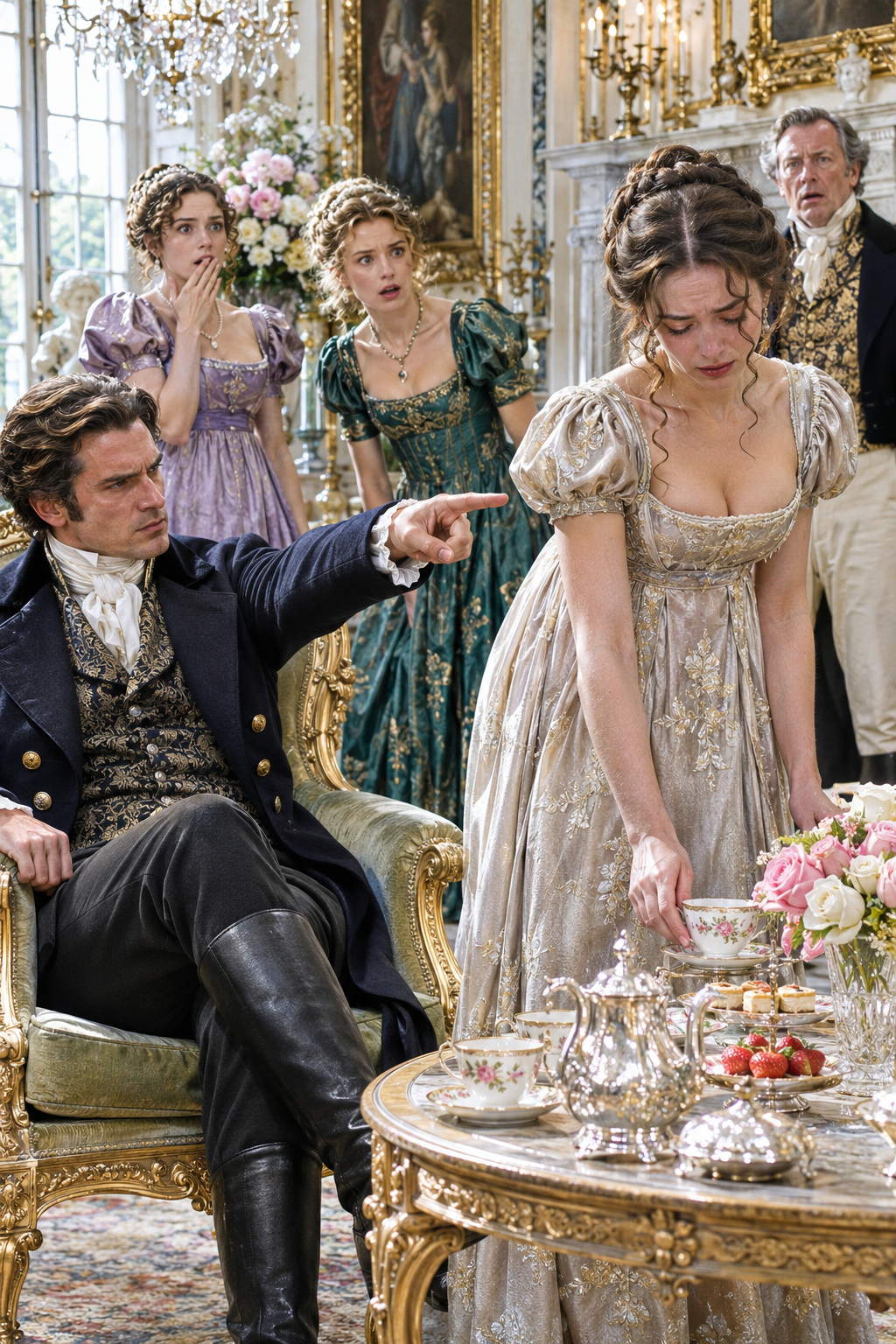
“Neither of your daughters will do,” the Duke of Aldridge announced, setting down his teacup.
Sebastian stopped at the sight of Hazel standing outside her new bedroom, her traveling gloves still clutched in her hands.
“Is something wrong, Duchess?”
Hazel glanced toward the distant corridor.
“I was merely wondering whether your rooms are so far away because you dislike company, or because you dislike me.”
The housekeeper went perfectly still.
Sebastian’s expression darkened.
“Mrs. Finch, you may leave us.”
The older woman curtsied and disappeared down the staircase.
For several moments, husband and wife stood facing each other beneath the flickering candlelight.
“You have been here less than an hour,” Sebastian said. “And already you are asking questions.”
“I have been married for three days, Your Grace. I thought I might be permitted one.”
His jaw tightened, but something almost resembling amusement crossed his face.
“My rooms are separate because I sleep poorly.”
“Then perhaps you require better pillows.”
“It is not a matter of pillows.”
“Then I shall not trouble you with further suggestions.”
Hazel turned toward her bedroom.
“Good night, Your Grace.”
“Hazel.”
She stopped.
It was the first time he had spoken her Christian name.
“You need not call me Your Grace when we are alone.”
She looked back at him.
“Then you must stop calling me Duchess as though it were an accusation.”
For a heartbeat, Sebastian appeared utterly astonished.
Then he gave a quiet, reluctant laugh.
It was a beautiful sound.
And it vanished almost immediately.
“Good night, Hazel.”
“Good night, Sebastian.”
She entered her room without seeing the way he remained in the corridor, staring at her closed door.
That night, Hazel discovered that Stonely Hall possessed many secrets.
The first came shortly after midnight.
She woke to the sound of a man screaming.
It was not a scream of anger.
It was the terrible, broken cry of someone who believed he was dying.
Hazel sat upright.
The sound came again, distant but unmistakable.
She slipped from her bed, wrapped herself in a dressing gown, and opened her door.
The corridor was dark.
At its far end, beneath a narrow strip of candlelight, stood Mrs. Finch.
The housekeeper looked alarmed.
“Your Ladyship, please return to bed.”
“Someone is suffering.”
“His Grace has nightmares. We are accustomed to them.”
“Then perhaps you should not be.”
Before Mrs. Finch could stop her, Hazel walked toward Sebastian’s rooms.
The door stood slightly ajar.
Inside, Sebastian thrashed beneath tangled sheets, his face glistening with sweat.
“No,” he whispered. “Thomas, get down!”
Hazel approached carefully.
“Sebastian.”
His eyes flew open.
In one violent movement, he seized her wrist.
“Who sent you?”
His voice was harsh and unfamiliar.
Hazel did not struggle.
“No one. You were having a nightmare.”
His breathing came in ragged bursts.
Slowly, recognition returned.
He released her as though her skin had burned him.
“Leave.”
“You are trembling.”
“I said leave!”
The force of his voice made her flinch.
Sebastian saw it.
Something shattered behind his eyes.
“Forgive me,” he whispered.
Hazel remained beside the bed.
“I shall leave if you truly wish it. But I will not pretend you are well simply because everyone else finds that more convenient.”
He stared at her.
No one had spoken to him that way since the war.
Finally, he turned his face toward the window.
“I watched my younger brother die.”
Hazel’s breath caught.
“Thomas?”
Sebastian nodded.
“He was nineteen. He followed me into battle because he believed I could protect him.”
His hands curled into fists.
“I ordered the advance. The enemy was waiting. By the time I realized, half my men were dead.”
“Sebastian—”
“I carried Thomas from the field. He died before we reached the surgeons.”
Silence settled between them.
Hazel sat carefully in the chair beside his bed.
“My mother died when I was fourteen,” she said softly. “For years, I believed that if I had noticed her illness sooner, she might have lived.”
Sebastian looked at her.
“Did you?”
“No. But guilt is a remarkably persuasive liar.”
He closed his eyes.
She remained until his breathing grew steady.
When she finally rose, his hand reached out and caught hers.
“Stay,” he murmured.
Hazel sat down again.
And for the first time in three years, the Duke of Aldridge slept without waking in terror.
By morning, however, Sebastian had retreated behind his familiar walls.
At breakfast, he spoke politely about the weather and informed Hazel that the library was hers to use.
He made no mention of the night.
Hazel did not press him.
Instead, she began exploring her new home.
Stonely Hall contained forty-three rooms, three neglected gardens, an abandoned conservatory, and a library large enough to make her forget every unpleasant moment of her childhood.
But beneath its grandeur lay an unsettling sadness.
Servants lowered their voices whenever Sebastian approached.
Several rooms remained locked.
And in the portrait gallery, a young man with laughing blue eyes stood beside Sebastian in military uniform.
Thomas Whitmore.
Hazel studied the portrait for a long time.
“You look like someone who made everyone laugh,” she whispered.
“He did.”
She turned.
Sebastian stood behind her.
“Thomas could make a bishop laugh during a funeral.”
Hazel smiled faintly.
“Then I think I should have liked him.”
“He would have adored you.”
The words escaped before Sebastian could stop them.
Their eyes met.
For one fragile moment, the distance between them disappeared.
Then a footman entered carrying a sealed letter.
Sebastian read it.
His face changed.
“Who delivered this?”
“A messenger from London, Your Grace.”
Sebastian folded the paper sharply.
“Have my horse prepared.”
Hazel watched him.
“Is something wrong?”
“Nothing that concerns you.”
He left before she could answer.
But the letter had fallen briefly against the table, and Hazel had glimpsed one sentence written in a hurried hand.
The past has not remained buried, Aldridge.
Three days later, the first stranger arrived.
He was a thin gentleman named Mr. Vale, with silver spectacles and an unpleasant smile.
Sebastian received him privately.
Their conversation lasted less than twenty minutes.
Yet Hazel, passing the study, heard raised voices.
“You cannot silence me forever,” Vale declared.
“I have paid you enough.”
“Not nearly enough to purchase the truth.”
A chair scraped violently.
“Get out of my house!”
Vale emerged moments later, his expression triumphant.
He paused when he noticed Hazel.
“Ah. The new duchess.”
She inclined her head.
“And you are?”
“A man who knows considerably more about your husband than you do.”
“Then I pity you. Knowledge appears to have made you disagreeable.”
His smile vanished.
“Be careful, Your Grace. Some marriages are built upon graves.”
He departed, leaving Hazel with a cold sensation beneath her ribs.
That evening, Sebastian did not come to dinner.
Nor the following evening.
On the third night, Hazel found him in the library, surrounded by papers and an untouched glass of brandy.
“You are avoiding me,” she said.
“I am occupied.”
“With what?”
“Matters you would not understand.”
Hazel placed her book on the desk.
“I have spent my life being told what I cannot understand. I had hoped marriage might introduce some variety.”
Sebastian looked exhausted.
“Hazel, please.”
“Who is Mr. Vale?”
The change in his expression was immediate.
“Stay away from him.”
“Why?”
“Because I said so.”
She stiffened.
“I am your wife, Sebastian. Not one of your soldiers.”
His face hardened.
“And I am asking you to trust me.”
“Trust cannot survive where truth is forbidden.”
For a long moment, he said nothing.
Then he rose and walked past her.
“Good night.”
Hazel remained in the library, fighting the humiliating sting of tears.
She had not expected love.
But she had begun to hope for friendship.
And somehow, that small hope hurt more than she had imagined.
The following morning brought an unexpected visitor.
Charlotte Abernathy arrived in a hired carriage, wearing a traveling dress that had clearly seen better days.
Mrs. Finch attempted to turn her away.
But Hazel heard the commotion and hurried downstairs.
“Charlotte?”
Her eldest sister looked pale and frightened.
“Hazel, I must speak with you.”
Mrs. Finch glanced uneasily toward the staircase.
“His Grace gave explicit instructions—”
“I know,” Hazel interrupted. “But this is my home as well.”
She led Charlotte into the morning room.
The moment the door closed, Charlotte burst into tears.
“Father has been arrested.”
Hazel stared.
“For what?”
“Fraud. He borrowed money against properties he did not own. Someone has brought the documents before a magistrate.”
“But Sebastian settled his debts.”
“Not these debts.”
Charlotte twisted her gloves.
“There is something else.”
Hazel waited.
“Father knew the duke before he came to our house.”
A chill crept through her.
“What do you mean?”
Charlotte swallowed.
“Three years ago, Father supplied horses and provisions to the army. There was an investigation after a disastrous campaign. Father was questioned.”
Hazel’s thoughts returned to Thomas’s portrait.
“What investigation?”
“I do not know everything. But Father received money to keep silent.”
“From whom?”
Charlotte looked directly at her.
“Your husband.”
Hazel felt the room tilt.
Before she could speak, the door opened.
Sebastian stood on the threshold.
His gaze moved from Charlotte to Hazel.
Then his expression became terrifyingly still.
“I believe,” he said quietly, “that I made my conditions perfectly clear.”
Charlotte shrank back.
Hazel rose.
“My sister came because our father has been arrested.”
“I am aware.”
“You knew?”
“Yes.”
“And you intended to tell me when?”
“When it became necessary.”
Hazel felt something inside her break.
“Am I your wife, Sebastian, or merely another secret you intend to keep?”
His face tightened.
“Charlotte, leave us.”
“No,” Hazel said.
Both of them turned toward her.
“She is my guest. She will leave when she chooses.”
Sebastian stared at her.
Then he looked away.
“Very well.”
He walked out.
Charlotte watched him disappear.
“Hazel, I am frightened of that man.”
Hazel looked toward the empty doorway.
“So am I,” she whispered.
But what frightened her most was not Sebastian’s anger.
It was the possibility that she had begun to love him.
That afternoon, Hazel went searching for answers.
She found them in a locked cabinet inside the old estate office.
The key had been left among a collection of household keys, and the lock yielded after several attempts.
Inside lay military correspondence, invoices, and a leather-bound journal bearing Thomas Whitmore’s initials.
Hazel knew she should not read it.
Yet the first page she opened contained her father’s name.
Lord Abernathy delivered the replacement horses today. Several are lame. Sebastian has demanded an inspection, but Colonel Ashcombe insists we march before dawn.
She turned another page.
The supply wagons are delayed again. Abernathy claims the roads are impassable. I do not believe him.
Then came the final entry.
I have discovered why our supplies never arrived. Ashcombe has been selling military stores through Abernathy. Sebastian must be told. If anything happens to me, the evidence is beneath the chapel floor.
Hazel’s hands began trembling.
The journal slipped from her fingers.
Thomas had discovered corruption.
And then he had died.
A floorboard creaked behind her.
“Your Grace.”
Mr. Vale stood in the doorway.
Hazel stepped backward.
“How did you enter?”
“The servants are easily persuaded when one carries the proper credentials.”
He held up a folded document.
“I am investigating your husband’s crimes.”
“Then why are you in my home without permission?”
Vale smiled.
“Because your husband has concealed evidence of treason.”
Hazel tightened her grip on the journal.
“What do you want?”
“The book.”
“No.”
His smile faded.
“Do not make this difficult.”
He advanced.
Hazel snatched a brass candlestick from the desk.
“Another step, Mr. Vale, and you will discover how little I care for good manners.”
He stopped.
Then, unexpectedly, he laughed.
“You truly have no idea what sort of man you married.”
“I know exactly what sort of man he is.”
“Do you? Then ask him why your father was paid. Ask him why Thomas Whitmore’s death was declared an accident of battle rather than murder.”
Hazel went cold.
“Murder?”
Vale lunged.
She struck his wrist with the candlestick.
He cried out, and the journal fell between them.
Hazel ran.
She reached the main corridor before Vale caught her sleeve.
The fabric tore.
Then a voice thundered from the staircase.
“Take your hands off my wife.”
Sebastian stood below, a pistol in his hand.
Vale released her immediately.
“Your Grace, I can explain—”
“On your knees.”
The command was so cold that even Hazel shivered.
Vale obeyed.
Sebastian summoned two footmen.
“Confine him in the cellar. Send for the magistrate.”
As the servants dragged Vale away, he shouted over his shoulder.
“You cannot protect her from the truth, Aldridge!”
Sebastian lowered the pistol.
Hazel stood motionless.
“Was Thomas murdered?”
His face lost all color.
“Where did you hear that?”
She held out the journal.
Sebastian looked at it as though she had placed his brother’s body in his hands.
For several seconds, he could not speak.
Then he sank into a chair.
“Yes.”
The single word changed everything.
Sebastian told her the story slowly.
Colonel Ashcombe had sold army provisions to private merchants, leaving British soldiers without sufficient food, ammunition, or healthy horses.
Lord Abernathy had assisted him.
Thomas discovered the scheme and threatened to expose them.
The following morning, Ashcombe ordered Thomas’s unit into an exposed valley, claiming enemy forces had withdrawn.
They had not.
Sebastian had commanded the larger advance, believing the intelligence genuine.
By the time he realized the deception, Thomas was dying.
“Afterward,” Sebastian said, “I found evidence that Ashcombe deliberately sent him into danger.”
“Why did you not expose him?”
“I tried.”
His voice cracked.
“Ashcombe had powerful friends. The documents vanished. Witnesses changed their statements. And your father swore Thomas had misunderstood the supply accounts.”
Hazel sat beside him.
“Then why pay my father?”
“I did not pay him to remain silent. I purchased the documents he still possessed. He threatened to destroy them unless I settled his debts.”
Hazel stared.
“And our marriage?”
Sebastian looked at her with unbearable shame.
“I intended to bring him under my control. I knew he would sacrifice one of his daughters to secure his fortune.”
Her heart seemed to stop.
“So you chose me.”
“At first, yes.”
Hazel stood.
Every tender moment suddenly felt poisoned.
“The tea. Our conversations. The night I sat beside you. Was any of it real?”
Sebastian rose desperately.
“Hazel—”
“Answer me.”
“I noticed you before I knew who you were. I thought you were different. And I was right.”
“But you married me because of my father.”
His silence answered.
Hazel backed away.
“You should have told me.”
“I feared you would refuse.”
“Then you knew I deserved the choice.”
Tears blurred her vision.
“You saved me from a family that treated me as a possession, only to use me for your own purposes.”
She turned and left.
Sebastian did not follow.
For once, he understood that pursuing her would be another act of selfishness.
Hazel spent the night in the conservatory, sitting beneath a broken glass roof while rain whispered against the panes.
By dawn, she had made her decision.
She would leave Stonely Hall.
Not because she hated Sebastian.
But because she could not remain where love and deception had become impossible to distinguish.
She instructed Mrs. Finch to prepare a carriage.
The housekeeper looked heartbroken.
“His Grace has suffered terribly, Your Ladyship.”
“So have I.”
Mrs. Finch lowered her eyes.
“Yes, ma’am.”
Hazel packed only her books, a few dresses, and her mother’s small silver locket.
As she descended the staircase, Sebastian waited in the entrance hall.
He looked as though he had not slept.
“Where will you go?”
“To my mother’s cousin in Bath.”
He nodded.
“I shall arrange an allowance.”
“I do not want your money.”
“Then take the carriage, at least.”
Hazel looked at him.
“Why did you forbid my family from visiting?”
Sebastian hesitated.
“Because I knew what they had done to you. I thought if I removed them from your life, you might finally be free.”
“And yet you never asked whether I wished to be free of them.”
His expression crumpled.
“No.”
Hazel stepped closer.
“I could have loved you, Sebastian.”
He closed his eyes.
“I know.”
She swallowed.
“Perhaps I already do.”
He looked at her sharply.
But she had already turned away.
The carriage was waiting.
Hazel climbed inside without looking back.
She had traveled barely two miles when the first gunshot sounded.
The horses reared.
The carriage lurched violently.
A masked rider emerged from the trees, followed by two others.
The coachman shouted.
Another shot cracked through the morning air.
The carriage overturned.
Hazel struck her head against the wooden frame.
For several terrible moments, everything went black.
When she regained consciousness, rough hands were dragging her from the wreckage.
“Where is the journal?” a man demanded.
Hazel struggled.
“I do not have it!”
“Search her belongings.”
One of the riders tore open her traveling case.
Books scattered across the muddy road.
The masked leader seized her chin.
“Your husband should have learned to leave the dead alone.”
Hazel recognized the voice.
Colonel Ashcombe.
She had heard him speak once, years earlier, at a gathering in London.
“You killed Thomas,” she whispered.
The man’s eyes narrowed.
“He was a foolish boy who mistook righteousness for intelligence.”
Hazel felt a surge of fury.
“And you mistook cowardice for power.”
He struck her.
She fell against the carriage wheel.
“Take her,” he ordered.
“We shall see how much Aldridge values his pretty little duchess.”
They bound her wrists and forced her onto a horse.
By evening, Hazel was imprisoned in an abandoned hunting lodge deep within the hills.
Ashcombe had made one fatal mistake.
He believed Hazel knew nothing.
But she remembered Thomas’s final words.
The evidence is beneath the chapel floor.
There was only one chapel on the Whitmore estate.
The ruined chapel beyond Stonely’s eastern woods.
And if Ashcombe was desperate enough to abduct her, then whatever lay beneath those stones could still destroy him.
That night, he entered her room carrying a letter.
“You will write to your husband.”
Hazel looked up.
“What shall I say?”
“That he must bring Thomas’s journal and every document in his possession. Alone.”
“And afterward?”
Ashcombe smiled.
“You will both be free.”
She did not believe him.
Nevertheless, she took the pen.
She wrote exactly what he dictated.
Then, while he turned to speak with his accomplice, she added six small words beneath her signature.
Remember where Thomas hid the truth.
Ashcombe glanced at the letter.
He saw nothing suspicious.
But Hazel knew Sebastian would understand.
At Stonely Hall, the duke had been searching frantically since the shattered carriage was discovered.
When Ashcombe’s message arrived, Sebastian read it twice.
Then he noticed Hazel’s final sentence.
His hands began shaking.
Thomas’s journal.
The chapel.
For the first time since his brother’s death, hope pierced his grief.
He summoned Mrs. Finch and his most trusted steward.
“Send for Magistrate Harcourt. Tell him Colonel Ashcombe is alive and holding my wife.”
The steward hesitated.
“Your Grace, the colonel has influential friends.”
“Then we shall give them evidence they cannot bury.”
Sebastian rode to the ruined chapel beneath a moonless sky.
He remembered playing there with Thomas as children.
His brother had always insisted that the loose stone beneath the altar concealed treasure.
Sebastian had laughed at him.
Now he knelt and lifted it.
Beneath lay a rusted iron box.
Inside were account books, signed receipts, military orders, and a letter written in Ashcombe’s own hand.
The documents revealed everything.
Payments.
False intelligence.
Stolen provisions.
And a direct order ensuring Thomas’s unit would be sent into an ambush.
Sebastian sat among the ruins, holding the letter.
For three years, he had believed his brother died because of his failure.
Now he understood that Thomas had died because he had tried to protect others.
The distinction did not erase Sebastian’s grief.
But it gave that grief a purpose.
At dawn, he rode toward the hunting lodge.
Alone, as instructed.
Or so Ashcombe believed.
Hazel heard the horses before she saw them.
She rushed to the window.
Sebastian stood in the courtyard, holding a leather satchel.
Ashcombe emerged with a pistol.
“You came.”
“Release my wife.”
“The documents first.”
Sebastian threw the satchel onto the ground.
Ashcombe opened it.
Inside lay Thomas’s journal and several folded papers.
He smiled.
“Sentiment has made you foolish, Aldridge.”
“No,” Sebastian replied. “It made me patient.”
Ashcombe looked up.
A whistle sounded from the woods.
Then another.
Armed constables emerged between the trees.
Ashcombe seized Hazel, dragging her from the doorway with his pistol pressed against her temple.
“One step closer and she dies!”
Sebastian froze.
Hazel could feel the weapon trembling.
Ashcombe was frightened.
And frightened men were dangerous.
“Let her go,” Sebastian said.
“Order them back!”
Sebastian slowly raised his hand.
The constables stopped.
Ashcombe began retreating toward his horse, pulling Hazel with him.
She stumbled.
His grip tightened.
Then she saw something glinting beside the stable door.
A loose horseshoe.
Hazel remembered the coachman struggling in the mud during her journey to Derbyshire.
She remembered Sebastian’s surprise when she had offered to help.
And she remembered that courage did not always arrive with a sword.
Sometimes it arrived as a simple refusal to remain helpless.
She drove her heel into Ashcombe’s foot.
As he cried out, she twisted beneath his arm and seized the horseshoe.
She struck his wrist.
The pistol fired.
Sebastian staggered.
Blood spread across his coat.
“Sebastian!”
Hazel screamed.
The constables rushed forward.
Ashcombe attempted to flee, but a rider intercepted him before he reached the woods.
Hazel ran to her husband.
He had fallen against the stone wall.
Blood soaked his shoulder.
She dropped to her knees.
“No. No, you cannot—”
Sebastian opened his eyes.
“Hazel.”
“Do not speak.”
“You are safe?”
“Yes.”
He smiled faintly.
“Good.”
His eyes closed.
For one dreadful instant, Hazel believed she had lost him.
Then his fingers tightened around hers.
“Still here,” he whispered.
She burst into tears.
“You insufferable man.”
His mouth curved.
“I have been called worse.”
She pressed her forehead against his.
“You are not permitted to die. Not before I have finished being angry with you.”
“Then I suspect,” he murmured, “I shall live forever.”
The surgeon later declared the wound serious but survivable.
Sebastian was carried home.
Hazel remained beside him through three days of fever.
She changed his bandages, cooled his forehead, and read aloud when the pain prevented him from sleeping.
On the fourth morning, he woke to find her asleep in the chair beside his bed.
He watched her for a long time.
Then he whispered her name.
Hazel stirred.
“You are awake.”
“I am.”
“Does it hurt?”
“Only when I breathe.”
She frowned.
“Then stop making jokes.”
He smiled.
She reached for his hand.
But Sebastian gently withdrew it.
Her expression fell.
“Hazel, you owe me nothing.”
She stared at him.
“You nearly died.”
“That does not erase what I did.”
He struggled to sit upright.
“I married you without telling you the truth. I made decisions about your life because I believed I knew what was best. I was wrong.”
Hazel remained silent.
“I love you,” he continued, his voice breaking. “But I will not ask you to stay because of gratitude, pity, or obligation.”
He reached toward the bedside table.
There lay a folded document.
“I have arranged a settlement in your name. Enough for you to live wherever you choose. You may leave this house, and I will never interfere.”
Hazel looked at the paper.
Then she looked at him.
“You foolish, impossible man.”
Sebastian blinked.
“I beg your pardon?”
“You are still trying to decide what freedom should look like for me.”
His eyes widened.
Hazel leaned closer.
“I do not want to leave because you have finally learned to let me.”
“Then why would you stay?”
“Because I love you.”
Sebastian stopped breathing.
She smiled through her tears.
“Not because you are a duke. Not because you rescued me. And certainly not because you have made this marriage easy.”
He gave a shaky laugh.
“I have done rather poorly at that.”
“Spectacularly.”
She took his hand.
“I love the man who cannot sleep because he mourns his brother. The man who places a cloak beside me rather than admitting he is concerned. The man who is learning that love requires honesty more than protection.”
Sebastian’s eyes filled.
“I do not deserve you.”
“Perhaps not,” she said gently. “But love is not a prize awarded to the deserving. It is a promise made by two imperfect people willing to become better.”
He drew her hand to his lips.
“Then I promise to spend the rest of my life earning your trust.”
Hazel kissed his forehead.
“And I promise to tell you whenever you are behaving like an arrogant fool.”
“That may become a full-time occupation.”
“I have always wanted meaningful work.”
Their laughter filled the room.
And for the first time in years, Stonely Hall no longer seemed like a house built around sorrow.
The trial began six weeks later.
Colonel Ashcombe stood accused of corruption, conspiracy, kidnapping, and murder.
Mr. Vale, whose blackmail had financed his comfortable lifestyle, agreed to testify in exchange for a reduced sentence.
Lord Abernathy was brought from prison under guard.
Hazel attended the proceedings beside Sebastian.
Her father looked older than she remembered.
When he saw her, he lowered his eyes.
The evidence was overwhelming.
Thomas’s documents proved the stolen supplies had endangered hundreds of soldiers.
The forged intelligence orders established Ashcombe’s responsibility for the ambush.
And Lord Abernathy’s testimony confirmed the conspiracy.
Ashcombe was convicted and sentenced to death, a punishment later commuted to lifelong imprisonment.
Lord Abernathy received a prison sentence for his part in the fraud.
After the hearing, Hazel’s father asked to speak with her.
Sebastian offered to accompany her.
She shook her head.
“This is something I must do myself.”
They met in a small chamber beside the courtroom.
Lord Abernathy stared at his daughter.
“You look well.”
“I am.”
He swallowed.
“I suppose your husband has treated you kindly.”
“He has learned to.”
Her father nodded awkwardly.
Then he said the words Hazel had never expected to hear.
“I am sorry.”
She remained still.
“For what?”
He looked confused.
“For everything, I suppose.”
Hazel felt a familiar ache.
“Everything is a very convenient word, Father. It allows you to apologize without remembering what you did.”
His face reddened.
“I provided for you.”
“You provided a roof. You did not provide kindness.”
He looked away.
“You always were difficult.”
Hazel smiled sadly.
“No. I was quiet. You simply mistook my silence for agreement.”
For a long moment, neither spoke.
Then her father lowered his head.
“I failed you.”
“Yes,” Hazel whispered. “You did.”
She could not yet forgive him.
But she no longer needed his approval.
And that, she discovered, was its own kind of peace.
Outside the courthouse, Charlotte and Rosalind waited.
Their fashionable gowns were gone, replaced by modest dresses.
Without their father’s fortune, they had been forced to confront a world that did not reward them merely for being beautiful.
Charlotte approached first.
“I owe you an apology.”
Hazel studied her.
“For coming to Stonely?”
“For all the years before it.”
Rosalind began crying.
“We were cruel to you.”
“Yes,” Hazel said.
Neither sister protested.
That honesty softened something inside her.
Charlotte explained that she had found employment as a companion to an elderly widow.
Rosalind was teaching music to children.
For the first time, they spoke about work with something resembling pride.
Hazel listened.
Then she embraced them.
Their relationship would not mend in a single afternoon.
But it could begin.
And sometimes a beginning was enough.
By autumn, Stonely Hall had changed beyond recognition.
The curtains were opened.
The gardens were restored.
Music returned to the drawing room.
Sebastian commissioned a memorial for Thomas, not as a symbol of military glory, but as a tribute to the courage of a young man who had refused to remain silent in the face of wrongdoing.
Hazel established a school for the children of soldiers and estate workers.
Sebastian insisted on financing it.
She insisted on managing it herself.
Their first argument about the matter ended with Sebastian surrendering after Hazel pointed out that he knew considerably more about cavalry formations than teaching children to read.
He kissed her in the middle of the library.
She accused him of attempting to distract her.
He admitted the charge.
And she forgave him immediately.
One evening, nearly a year after their marriage, Sebastian found Hazel sitting in the conservatory.
The broken glass had been replaced.
Roses climbed the walls.
Sunlight spilled across the stone floor.
She held a small parcel wrapped in blue ribbon.
“What is that?” he asked.
“A present.”
“For me?”
“For both of us, I hope.”
He untied the ribbon.
Inside lay a pair of tiny knitted shoes.
Sebastian stared.
Then he looked at Hazel.
“Are you—”
She nodded.
His face transformed.
The proud, guarded Duke of Aldridge sank to his knees before his wife.
He placed one trembling hand against her stomach.
“A child?”
“Our child.”
For several moments, he could not speak.
Then tears slipped down his cheeks.
Hazel touched his hair.
“Are you happy?”
He looked up at her.
“I never imagined I could be this happy again.”
She knelt beside him.
“Then perhaps you should become accustomed to it.”
He gathered her into his arms.
And beneath the autumn sunlight, they remained together, two people who had found their way through grief, betrayal, and fear toward something neither had believed possible.
Years later, when their daughter Eleanor asked how her parents had fallen in love, Sebastian always gave the same answer.
“Your mother made me a cup of tea.”
Eleanor would wrinkle her nose.
“That is not very romantic, Papa.”
Hazel would laugh.
“Your father was a terribly difficult gentleman.”
“Was he handsome?”
“Unfortunately.”
Sebastian would pretend to be offended.
“And what did you say to him, Mama?”
Hazel would smile at her husband.
“I told him he looked like a man who preferred things as they are.”
Eleanor would consider this solemnly.
“And was he?”
Sebastian would look at Hazel, his eyes filled with the quiet affection of a man who had finally learned how to live.
“No, my darling,” he would answer. “I thought I was. But your mother taught me that some things are worth changing.”
And when Eleanor grew older, Hazel told her the rest of the story.
She told her that kindness was not weakness, that silence was not always peace, and that a woman should never confuse being chosen with being valued.
She explained that forgiveness could be offered without surrendering dignity, and that love did not require a person to disappear into someone else’s wishes.
Most importantly, she taught her daughter that no title, fortune, or grand declaration could replace the simple courage of telling the truth.
Because Hazel had once entered Stonely Hall as a frightened young bride who believed her only worth lay in saving her family.
She had nearly lost herself trying to understand a man who was hiding from his own past.
But in the end, she had discovered something far more precious than becoming a duchess.
She had discovered her own voice.
And Sebastian, who had once believed that love meant protecting someone from every painful truth, had learned that real love meant standing beside them when the truth was hardest to bear.
Their marriage had not begun with romance.
It had begun with a bargain.
But it endured because two wounded hearts chose honesty over fear, courage over pride, and forgiveness over resentment.
And that was the lesson their children carried long after the halls of Stonely had filled with laughter:
A beautiful life is not built by finding someone who never makes mistakes.
It is built by finding the courage to acknowledge those mistakes, repair what can be repaired, and love without taking away another person’s freedom.
For the greatest gift Sebastian ever gave Hazel was not his name, his fortune, or his protection.
It was the day he finally opened his hands and allowed her to choose.
And the greatest gift Hazel gave Sebastian was not that she stayed.
It was that, when she was truly free to leave, she chose to love him anyway.
The years that followed brought happiness to Stonely Hall, but happiness, Hazel discovered, was not the absence of hardship. It was the knowledge that hardship no longer had to be faced alone.
On a cold December morning, nearly twenty years after their unusual wedding, a letter arrived bearing the seal of the Crown.
Sebastian read it beside the fireplace while Hazel worked on a small embroidery frame.
His expression grew solemn.
“What is it?” she asked.
He lowered the letter.
“They have finally agreed to restore Thomas’s military honors. His name will be entered into the official record, and his courage publicly recognized.”
Hazel set aside her embroidery.
For a moment, neither spoke.
Then she crossed the room and placed her hand over his.
“He would have been proud of you.”
Sebastian shook his head.
“No, my love. He would have been proud of us.”
The following spring, the family traveled to London for the ceremony.
Their daughter Eleanor, now a spirited young woman with her mother’s quiet determination, stood beside her younger brother, William.
As Thomas Whitmore’s name was read aloud, Sebastian bowed his head.
Hazel felt his fingers tighten around hers.
There had been a time when remembering Thomas brought him nothing but torment.
Now, though grief remained, it was accompanied by gratitude.
The young man who had died defending the truth would no longer be remembered merely as another casualty of war.
His courage had finally been given its rightful place in history.
After the ceremony, Eleanor approached her father.
“Papa, do you still miss Uncle Thomas?”
“Every day.”
“Does it ever stop hurting?”
Sebastian considered the question.
“No, sweetheart. But eventually, the love becomes greater than the pain.”
Eleanor looked thoughtful.
“Then perhaps grief is simply love that has nowhere left to go.”
Sebastian stared at his daughter.
Then he smiled through unexpected tears.
“You sound remarkably like your mother.”
“That,” Hazel said, joining them, “is the finest compliment you could have given her.”
That evening, they returned to Stonely Hall.
The house glowed with candlelight, and laughter echoed through the corridors that had once been silent.
Before retiring, Sebastian asked Hazel to accompany him to the conservatory.
The roses were blooming beneath the glass ceiling.
He took her hands.
“Do you remember the first evening you arrived here?”
“Perfectly. You were cold, mysterious, and extraordinarily rude.”
“I was terrified.”
Hazel blinked.
“Of me?”
“Of what you might become to me.”
He smiled faintly.
“I had survived a war, buried my brother, and convinced myself that loving someone meant eventually losing them. Then you arrived with your books, your stubbornness, and your dreadful habit of telling me the truth.”
“My most charming quality.”
“Undoubtedly.”
He drew her closer.
“I thought I was rescuing you from an unhappy life. But you were the one who rescued me from mine.”
Hazel touched his cheek.
“We rescued each other, Sebastian. And we learned that neither of us needed rescuing as much as we needed understanding.”
He kissed her forehead.
Outside, rain began falling softly across the Derbyshire hills, just as it had on the evening of her arrival.
But the house was no longer cold.
And the silence was no longer lonely.
Many years later, when Sebastian’s hair had turned silver and Hazel’s hands had grown delicate with age, they still began every morning together in the library.
He read the newspaper.
She read her novels.
Between them sat a silver teapot and two porcelain cups.
One morning, Sebastian watched his wife pour his tea.
“You still never add sugar.”
Hazel smiled.
“You still do not need it.”
He reached across the table and took her hand.
“Do you ever regret marrying me?”
She pretended to consider.
“Well, you snore, you are impossibly stubborn, and you have never learned to put your books back on the proper shelves.”
“A devastating assessment.”
“But no,” she whispered. “Not for a single moment since we learned to love each other properly.”
Sebastian brought her hand to his lips.
“And if you could return to that afternoon at your father’s house?”
Hazel looked into the eyes of the man who had become her closest friend.
“I would tell that frightened young woman one thing.”
“What would you tell her?”
“That being unwanted by the wrong people does not mean you are unworthy of love.”
Sebastian’s eyes softened.
“And what would you tell the arrogant duke?”
Hazel laughed.
“I would tell him that a wife is not something one acquires with a fortune.”
“Quite right.”
“And that if he wishes to win a woman’s heart, he must first learn to listen.”
Sebastian nodded gravely.
“A difficult lesson.”
“But one you mastered eventually.”
He leaned forward and kissed her.
Beyond the windows, the gardens stretched toward the hills, bright with morning sunlight.
Somewhere downstairs, their grandchildren were laughing.
The house that had once held only memories of death now overflowed with life.
And Hazel understood, with the peaceful certainty that comes only after years of loving and being loved, that the most extraordinary part of her story had never been marrying a duke.
It had been discovering that she deserved a love in which she could remain entirely herself.
For titles could be inherited.
Fortunes could disappear.
Beauty could fade.
Even the grandest houses would one day crumble.
But the kindness two people gave each other, the truths they dared to speak, and the freedom they allowed one another would endure in the lives they touched.
And so the Duke and Duchess of Aldridge grew old together, not because their love had been perfect, but because they had never stopped choosing to make it worthy of the promise they had made.
For true love is not the moment someone chooses you above everyone else. It is the lifetime in which they continue to respect, cherish, and choose you, even after they have seen every imperfect part of who you are.
And in the quiet warmth of Stonely Hall, where a simple cup of tea had once begun an extraordinary story, Hazel and Sebastian found their greatest happiness in something wonderfully ordinary.
They had found a home in each other.
THE END.