My uncle dragged me onto the Oak Haven auction platform, called me worthless, and sold me to a ruthless rancher whose missing fortune concealed a terrible betrayal.
The rider stopped beneath the iron archway of Red Creek Ranch, and for one terrible moment, I forgot how to breathe.
Even from my office window, I recognized the silver watch chain hanging across his dark vest, the same distinctive chain Callahan had once shown me in a faded photograph of his younger brother.
Nathaniel Montgomery had supposedly died seven years earlier in a mining accident near Silverton, Colorado.
Yet the man dismounting in our courtyard looked very much alive.
Samuel Whitcomb stood beside me, his face drained of color as he examined the withdrawal authorization still trembling between my fingers.
“Mrs. Montgomery, I believe you should remain inside until we understand why he’s here.”
I barely heard him.
My thoughts had already traveled backward through every conversation Callahan and I had shared about his family, every moment when his voice had grown quiet at the mention of Nathaniel.
He had told me his brother was buried beneath a cottonwood tree overlooking the western pasture.
I had placed flowers there myself.
Now I watched a stranger wearing a dead man’s belongings walk toward my front door.
Before Samuel could stop me, I hurried downstairs.
Callahan was already standing in the entrance hall when the first knock sounded.
His expression frightened me more than the visitor.
He looked like a man watching a ghost emerge from the grave.
“Don’t open it, Mabel.”
I stopped with my hand inches from the brass doorknob.
“Why?”
Callahan swallowed.
“Because I don’t know what he’s become.”
I opened the door anyway.
The man standing outside was tall and lean, with dark hair streaked prematurely gray and a narrow scar crossing his left eyebrow.
His eyes were unmistakably Montgomery eyes.
But unlike Callahan’s, they carried the exhausted emptiness of someone who had spent years expecting death.
“Hello, brother,” he said quietly.
Callahan gripped the doorframe.
“Nathaniel.”
Neither man moved.
Then Nathaniel looked past his brother and found me.
“You must be Mabel Abernathy.”
“Montgomery,” I corrected.
Something flickered across his face.
“Then I suppose my brother finally did one thing right.”
Callahan stepped forward, but Nathaniel raised a trembling hand.
“I didn’t come for a reunion.”
He reached inside his coat and withdrew a narrow leather book wrapped in oilcloth.
“I came because Horace Bell intends to have your wife arrested before sundown.”
The silence that followed seemed to swallow the entire house.
I took the book from him and recognized my father’s handwriting immediately.
It was the missing ledger.
The one containing seven years of stolen property transfers, fraudulent loans, and secret payments made through Bell’s bank.
My father had written every transaction in careful black ink, preserving copies of signatures and recording the names of families whose homes had been taken.
But the final pages contained something far more disturbing.
They documented payments to hired men following three suspicious deaths.
One name appeared beside a sum of five hundred dollars.
Thomas Abernathy.
My father.
I stared at the entry until the letters blurred.
“Are you telling me my father was murdered?”
Nathaniel lowered his eyes.
“Your father discovered too much, Mabel.”
I remembered the terrible winter when Father had fallen ill, how Uncle Vernon had insisted it was fever and refused to summon another physician.
I remembered my father’s shaking hands and his desperate attempt to tell me something before he died.
He had whispered that I must never trust the men who came carrying papers.
For years, I believed he had been confused by illness.
Now I understood that he had been trying to warn me.
Callahan pulled out a chair, but I remained standing.
“Who killed him?”
Nathaniel hesitated.
“Bell ordered it, but Vernon arranged the circumstances.”
The room seemed to collapse around me.
My uncle had not merely stolen my inheritance.
He had helped destroy the man who loved me most.
I wanted to scream, but no sound came.
Instead, I opened the ledger again and forced myself to examine the evidence.
There were payments, dates, and initials, but nothing directly identifying the person who had administered whatever had killed my father.
Nathaniel explained that he had worked for Bell years earlier, before discovering that the bank’s profits depended upon forged debts and stolen land.
When he attempted to expose the scheme, Bell accused him of stealing bank funds and threatened to imprison him.
Nathaniel fled to Colorado, where an explosion at a mining camp allowed him to disappear under another name.
Callahan had received word of his supposed death and never learned otherwise.
“Why return now?” I asked.
“Because Bell found me.”
Nathaniel’s voice cracked.
“He offered to erase the charges if I signed a statement accusing you of stealing the ledger and falsifying your father’s will.”
I looked toward Samuel.
The attorney’s expression confirmed what I already suspected.
Bell was preparing to transform me from the rightful owner of Oak Haven’s most valuable properties into a criminal defendant.
If he succeeded, he could freeze my assets, cripple our cooperative, and force desperate merchants back into his control.
Nathaniel had refused.
That refusal had nearly cost him his life.
He rolled back his sleeve, revealing a fresh bandage wrapped around his forearm.
“Two men followed me from Silverton.”
Callahan’s jaw tightened.
“Where are they?”
“One turned back near the river crossing, but the other may still be coming.”
I closed the ledger.
For the first time since discovering my inheritance, I felt something stronger than fear.
I felt anger sharpen into purpose.
“Then we have very little time.”
I asked Samuel to prepare certified copies of every document and instructed our bookkeeper, Mrs. Eleanor Price, to record the ledger’s contents in duplicate.
Callahan wanted to send armed riders after Bell immediately.
I refused.
“That is exactly what he wants,” I told him.
“If you threaten the commissioner, he will call you a violent rancher protecting a dishonest wife.”
Callahan studied me for a long moment.
Then he nodded.
“What do you need?”
It was such a simple question.
Yet after years of men deciding my future without consulting me, those four words nearly broke my heart.
“I need you to trust me.”
He answered without hesitation.
“I do.”
By noon, I had summoned the owners of twelve businesses that depended upon Red Creek’s supply network.
They gathered in our dining room beneath the enormous portrait of Callahan’s grandfather, their faces lined with suspicion and worry.
Among them were the town’s baker, blacksmith, mill operator, freight contractor, and three widows who had rebuilt their livelihoods after the blizzard.
I placed my father’s ledger on the table.
Then I told them what had happened.
At first, nobody spoke.
When I explained that Bell’s bank had used fraudulent debts to seize property, old Mr. Hensley, the mill operator, began shaking.
“My brother lost his farm that way.”
Mrs. Abigail Turner, who operated the boardinghouse, covered her mouth.
“They took my husband’s shop three weeks after his funeral.”
I opened the ledger to the corresponding entries.
Both properties appeared there.
So did the names of eighteen other families.
One by one, the people around my table realized that their private tragedies had been parts of the same deliberate scheme.
I had expected outrage.
What I had not expected was grief.
Mrs. Turner began crying quietly.
Mr. Hensley stared at the floor.
And I understood that Bell had stolen far more than money.
He had stolen years of work, family homes, and the futures people had imagined for their children.
“I cannot promise that every loss can be repaired,” I told them.
“But I can promise that none of us will face him alone.”
That afternoon, we established an independent committee to document every fraudulent seizure.
Each merchant signed a sworn statement describing their dealings with Bell’s bank.
Samuel arranged for the evidence to be delivered to the territorial district attorney in Cheyenne.
Meanwhile, I made one decision that surprised even Callahan.
I ordered Red Creek to continue honoring every legitimate supply agreement, regardless of what happened to my personal property.
“The county must not starve because one corrupt man wants revenge,” I explained.
Callahan smiled faintly.
“Your father would have been proud.”
The words pierced me.
I turned away before he could see my tears.
For the next three days, our ranch became a place of relentless activity.
Riders carried messages between settlements.
Merchants arrived with receipts hidden in flour sacks and beneath wagon seats.
Former bank employees brought copies of suspicious transfers.
A retired county clerk revealed that Bell had repeatedly altered tax records after courthouse hours.
With every new document, the scheme became clearer.
Bell had created false debts against struggling landowners, seized their properties through manipulated proceedings, and transferred the assets to companies controlled by himself and Vernon.
When families resisted, he threatened them with foreclosure, imprisonment, or financial ruin.
My father’s investigation had endangered everything.
And the marriage arranged to humiliate me had accidentally placed his evidence within reach of the one woman Bell had underestimated.
On the fourth morning, the sheriff arrived.
He brought six deputies and a warrant bearing Commissioner Bell’s signature.
“Mabel Montgomery,” he announced, “you are charged with theft of banking records, conspiracy to defraud creditors, and obstruction of county business.”
Callahan moved toward him.
I touched my husband’s arm.
“Let him finish.”
Sheriff Amos Fletcher looked uncomfortable.
He had eaten at our table during the blizzard.
His youngest daughter had survived on medicine delivered by our wagons.
Yet he held the warrant as though it were an order he dared not question.
“Mrs. Montgomery, I’m sorry.”
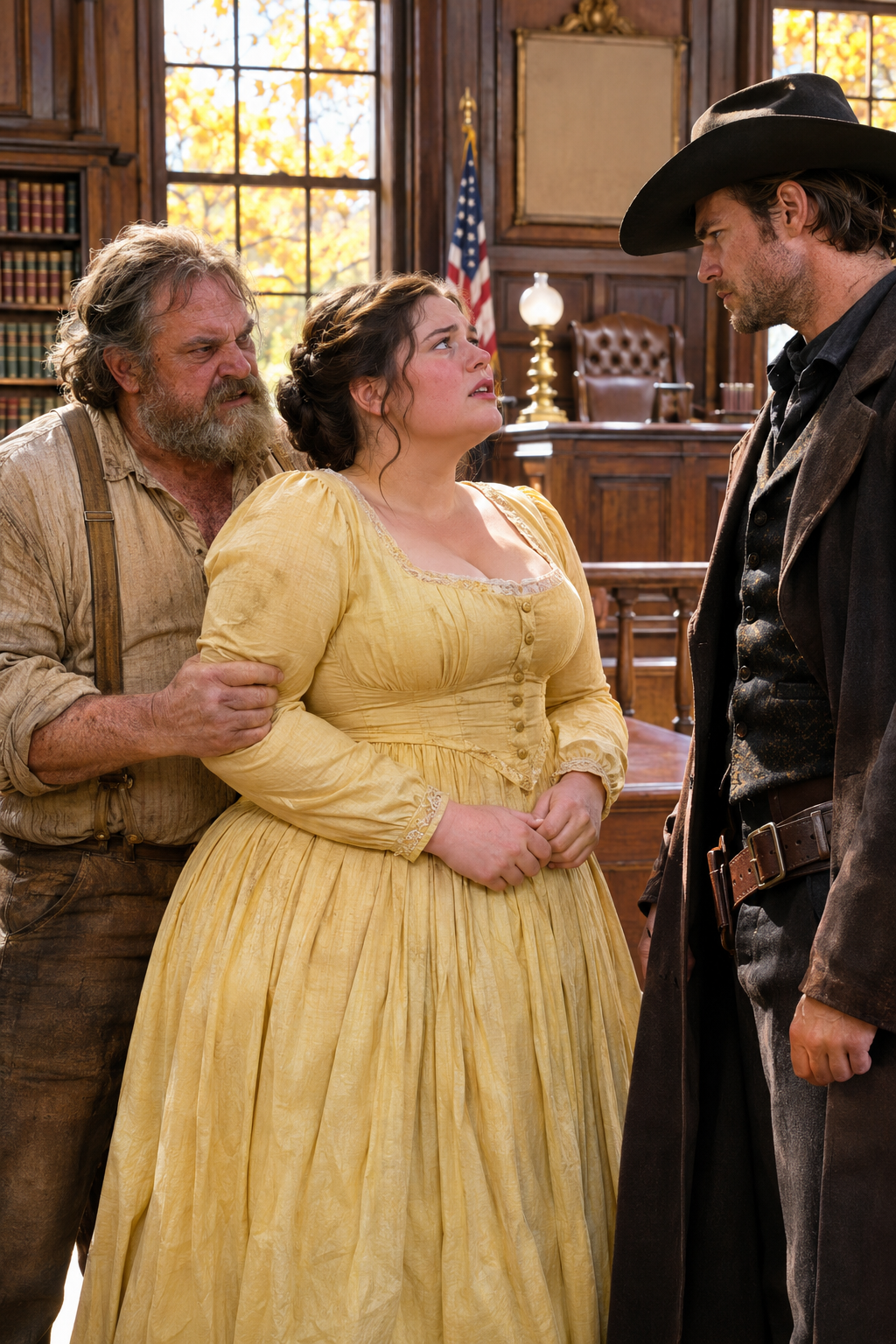
I studied the paper.
The warrant claimed authority from a county proceeding, but Samuel had already warned me that Bell might attempt something similar.
I asked the sheriff whether a judge had personally examined the evidence.
He hesitated.
“Commissioner Bell assured me the papers were proper.”
“Then you should know that Commissioner Bell is named in a formal complaint already submitted to the territorial authorities.”
Samuel stepped forward and handed him a certified copy.
The sheriff read it slowly.
I watched the struggle on his face.
He was not an evil man.
He was a frightened one.
And frightened men sometimes became useful instruments for people without consciences.
“Amos,” I said gently, “you have a choice.”
He looked up.
“You can help Bell conceal these crimes, or you can ensure the evidence reaches a court that has no reason to protect him.”
For several seconds, he said nothing.
Then he folded the warrant.
“I’ll take this to Judge Whitcomb in Cheyenne for review.”
Samuel corrected him quietly.
“My brother is the judge, Sheriff, and he has already requested the original records.”
The sheriff exhaled.
“Then I reckon my duty is clear.”
He left without arresting me.
But that evening, Bell struck back.
Someone set fire to our eastern grain warehouse.
I woke to shouting outside the bedroom window and saw orange flames rising against the black sky.
Callahan was already pulling on his boots.
I followed him downstairs, my heart pounding as men rushed toward the burning building.
The warehouse contained enough grain to feed hundreds of people through another difficult winter.
If it burned completely, Bell would have achieved what his forged warrant could not.
He would have destroyed the cooperative’s ability to survive without his bank.
I ran toward the stables, where our freight wagons stood loaded with empty barrels.
“Bring the water wagons to the eastern wall!” I shouted.
The ranch hands obeyed while Callahan organized men to pull sacks from the building’s unburned western section.
Smoke rolled across the yard.
Horses screamed in their stalls.
For one horrifying moment, I saw Callahan disappear behind a collapsing section of roof.
I tried to run toward him.
Nathaniel caught my shoulders.
“You cannot help him if you die in there.”
I fought against his grip until Callahan emerged carrying an injured stable boy.
His coat was scorched, and blood ran down his forehead.
But he was alive.
We fought the fire until sunrise.
Half the grain was lost.
The rest survived because the men had followed the emergency storage plan I had introduced after the blizzard.
When the final flames died, I stood among the smoking ruins, exhausted and shaking.
Callahan approached with his injured hand wrapped in cloth.
“I’m sorry,” he whispered.
I looked at the blackened warehouse.
“For what?”
“For bringing this danger into your life.”
I turned toward him.
“No, Callahan.”
My voice trembled.
“The danger was here long before I married you.”
He reached for my hand, then stopped, remembering the distance I had placed between us.
I closed that distance myself.
For a moment, I rested my forehead against his chest and listened to his heartbeat.
“I am still angry with you,” I whispered.
“I know.”
“But I am more frightened of losing you than I am of discovering another painful truth.”
His arms tightened around me.
“I will never hide anything from you again.”
I wanted to believe him.
This time, I decided that belief would be something we built through actions rather than promises.
The fire changed everything.
By morning, the townspeople knew that someone had tried to destroy the food stores that had saved their children.
Families arrived with buckets, tools, blankets, and whatever provisions they could spare.
Mrs. Turner brought bread.
Mr. Hensley offered his mill at no charge.
Even men who had once mocked me in the courthouse square worked beside our ranch hands to clear the wreckage.
Watching them, I understood something that Bell never had.
Power built upon fear required constant threats.
Power built upon trust could survive a fire.
Two days later, the territorial marshal arrived with investigators and a court order securing Bell’s financial records.
They found evidence linking the commissioner to the fraudulent transfers, but the investigation into my father’s death remained incomplete.
Vernon had disappeared.
Bell claimed he knew nothing about the warehouse fire.
Then Nathaniel remembered something.
During his years working for the bank, Bell had kept a private correspondence book recording payments too dangerous to enter into ordinary accounts.
He had hidden it inside a locked compartment beneath his office floor.
The investigators searched the bank again.
This time, they found it.
The book contained payments to Silas Granger, records of illegal property seizures, and instructions concerning the destruction of Red Creek’s warehouse.
It also contained a letter from Vernon.
The letter described my father’s worsening condition and requested payment for ensuring that he would never testify.
I read those words in Samuel’s office while Callahan sat beside me.
There was no dramatic revelation.
No sudden scream.
Only a terrible emptiness opening inside my chest.
For years, I had wondered whether I could have done something to save Father.
I had blamed myself for failing to recognize how ill he had become.
Now I knew that the person responsible had been sitting at our dinner table, pretending to mourn him.
I placed the letter down carefully.
“Find Vernon.”
The marshal promised that he would.
Three days later, my uncle was arrested near the Nebraska border while attempting to travel under another name.
He was returned to Oak Haven in irons.
When I saw him again, he looked smaller than I remembered.
His expensive coat was dirty.
His face was unshaven.
But the cruelty in his eyes remained unchanged.
He demanded to speak with me before his hearing.
Against Callahan’s advice, I agreed.
We met in the sheriff’s office with Samuel present.
Vernon looked me up and down.
“Well, you’ve certainly learned to dress above your station.”
Once, those words would have sent me shrinking into myself.
Now they sounded pitiful.
“You stole my inheritance,” I said.
He shrugged.
“Your father never understood how to manage money.”
“You helped kill him.”
For the first time, his expression faltered.
He looked toward Samuel.
“That is a serious accusation.”
“It is supported by your own letter.”
I placed a copy before him.
His hands began trembling.
He tried to explain that Bell had manipulated him, that he had never intended my father to die, and that everything had spiraled beyond his control.
Perhaps some of it was true.
But I remembered my father’s final days.
I remembered Vernon’s indifference to his suffering.
And I remembered every year afterward, when my uncle had punished me for the very poverty he had created.
“Did you ever love me?” I asked.
The question escaped before I could stop it.
Vernon stared at me.
For a moment, I thought he might finally offer something resembling remorse.
Instead, he looked away.
“You were an expense I never wanted.”
The words struck an old wound.
But they did not reopen it.
I realized that I had spent years waiting for kindness from someone who considered kindness a weakness.
His inability to love me was not proof that I was unworthy of love.
It was proof of what he had allowed himself to become.
I stood.
“Then you will never have to concern yourself with me again.”
I walked out without looking back.
The territorial proceedings continued through the summer.
Bell was removed from office and indicted on charges connected to fraud, conspiracy, and the destruction of property.
Vernon faced charges arising from the fraudulent transfers and my father’s death, while investigators pursued the men who had carried out the poisoning.
Silas Granger’s testimony helped establish how the stolen cattle money had financed Bell’s operations.
Not every accusation resulted in an immediate conviction.
Some witnesses had died.
Some records were missing.
But the financial evidence was overwhelming.
Bell’s network collapsed, and the courts began restoring property to its rightful owners.
My father’s estate was finally recognized.
The land beneath Oak Haven’s commercial district belonged to me, subject to existing lawful leases and the rights of its occupants.
The news spread faster than any cattle drive.
People who had once laughed at my marriage now waited outside my office seeking meetings.
Bankers offered partnerships.
Merchants requested loans.
Politicians suddenly remembered how to pronounce my name respectfully.
I could have demanded enormous rents.
I could have taken revenge upon every person who had humiliated me.
Instead, I gathered the tenants and merchants inside the courthouse where my uncle had once offered me as payment for his debt.
The room was crowded.
I recognized many of the faces.
Some belonged to people who had laughed that terrible afternoon.
Others belonged to families whose children we had fed during the blizzard.
I stood before them wearing a dark blue dress that fitted my full figure beautifully.
For once, I had chosen it because I liked how I looked.
Not because it concealed my body.
Not because it made me appear smaller.
I placed my father’s restored deed on the table.
“Most of the land beneath your businesses belongs to my estate,” I began.
Uneasy whispers filled the room.
“I know some of you fear that I intend to collect everything I can.”
I looked toward Mr. Hensley.
His hands were clasped tightly in his lap.
“I know what it means to live at the mercy of someone who controls your home.”
The room fell silent.
“So I will not become another Horace Bell.”
I announced that existing lawful leases would be honored and that future rents would be assessed fairly and transparently.
A portion of the estate’s income would support a community grain reserve, emergency medical supplies, and a fund for families facing genuine hardship.
The cooperative would remain open to independent merchants under published terms, with elected representatives reviewing its accounts.
No family would be forced to surrender its home merely because a powerful man wanted its land.
When I finished, nobody spoke.
Then Mrs. Turner rose from her seat.
She crossed the courthouse floor and took my hands.
“Your father would have been proud of you.”
That was when I finally cried.
Not the desperate tears I had shed after my wedding.
Not the lonely tears of a girl who believed herself unwanted.
These were tears for everything that had been stolen and everything that could still be restored.
By autumn, Oak Haven County had changed.
The cooperative opened a permanent grain depot near the railroad.
The mill expanded.
Several displaced families recovered their property through court proceedings, while others received settlements funded from assets seized during the fraud investigation.
We established a schoolroom for children living too far from town to attend regularly.
I hired Mrs. Turner to supervise the boardinghouse kitchen attached to the depot, where travelers could purchase inexpensive meals and hungry families could receive assistance without public humiliation.
Nathaniel remained at Red Creek while the old charges against him were formally dismissed.
He and Callahan spent long evenings repairing their relationship, sometimes arguing, sometimes laughing, and sometimes sitting together without speaking.
I understood that healing could not be rushed.
I was learning the same lesson in my own marriage.
Callahan never again entered my office without knocking.
He consulted me on every major ranch decision.
And when he disagreed, he spoke to me as an equal rather than attempting to protect me from choices that belonged to me.
One evening, nearly a year after our courthouse wedding, he asked me to walk with him to the cottonwood tree overlooking the western pasture.
The false grave marker had been removed.
In its place stood a simple wooden bench.
The sunset painted the hills copper and gold.
Callahan seemed unusually nervous.
“Mabel, there’s something I need to ask you.”
I smiled faintly.
“That sounds dangerous.”
He took both my hands.
“When we married, you had no choice.”
The wind moved softly through the grass.
“I cannot undo that day,” he continued.
“But I can give you the choice you should have had from the beginning.”
He reached into his coat and withdrew a folded document.
It was a legal agreement releasing me from any financial obligations connected to our marriage and acknowledging my independent ownership of my inheritance.
Samuel had prepared it at Callahan’s request.
“You are free to leave,” Callahan said.
“You can take your property, your earnings, and everything you’ve built.”
His voice broke.
“And if you choose to stay, I want it to be because you love me, not because you owe me anything.”
I stared at the document.
For so much of my life, freedom had seemed like something other people possessed.
Now the man I loved was placing it into my hands.
I thought about the frightened young woman who had arrived at Red Creek believing she was worth less than eight thousand dollars.
I thought about my father, who had tried to protect my future.
I thought about the winter storm, the burning warehouse, and the thousands of small decisions that had brought us here.
Then I folded the document and placed it safely in my pocket.
“I am keeping this,” I said.
Callahan nodded, though pain crossed his face.
“Of course.”
I stepped closer.
“Because I want you to understand that I am staying by choice.”
He looked at me.
“And because I love you, Callahan Montgomery.”
He pulled me into his arms so gently that my heart ached.
When he kissed me, there was no debt between us.
No bargain.
No frightened girl being handed over to a stranger.
There were only two imperfect people who had learned that love without honesty could become another kind of prison.
We returned to the ranch beneath a sky filled with stars.
The following spring, we held another wedding.
Not because the first marriage was invalid, but because I wanted a day that belonged to us.
The ceremony took place beneath the cottonwood trees.
Nathaniel stood beside Callahan.
Mrs. Turner arranged the flowers.
Samuel witnessed our vows.
And when the minister asked whether I freely accepted Callahan as my husband, I answered loudly enough for everyone to hear.
“I do.”
Years passed, and Red Creek prospered.
People began calling me the Matriarch of Red Creek Ranch.
Some used the title affectionately.
Others spoke it with a little fear.
I did not mind either way.
I had learned that being respected mattered far more than being universally liked.
The county’s new leaders understood that I would challenge dishonest contracts, defend struggling families, and refuse special privileges to anyone seeking to profit from desperation.
Yet I never forgot the woman I had been.
Whenever a frightened girl came to my office believing herself too poor, too plain, or too unimportant to deserve a future, I invited her to sit beside my desk.
I showed her the account books.
I taught her how to calculate interest, recognize dishonest terms, and protect the money she earned.
Sometimes I told her about my father.
Sometimes I told her about the blizzard.
But I always told her one thing.
“Never let another person decide what your life is worth.”
On the tenth anniversary of our marriage, Callahan found me standing on the porch overlooking the valley.
The ranch buildings glowed beneath the evening sun.
Wagons moved along the road toward Oak Haven, carrying grain from the cooperative depot.
Beyond them stretched the land that had once seemed like the boundary of my prison.
Callahan wrapped his arms around my waist.
“What are you thinking about?”
I leaned against him.
“The day my uncle brought me to the courthouse.”
His embrace tightened.
“I wish I could erase it.”
I shook my head.
“Sometimes I do too.”
Then I watched the distant wagons disappear into the golden light.
“But if I erased every painful thing that happened to me, I might forget how much courage it took to become the woman I am.”
Callahan kissed my temple.
“You were always that woman, Mabel.”
I smiled.
“No.”
I turned to face him.
“I was always worthy of becoming her.”
That night, I opened my father’s old ledger one final time.
Inside the front cover, beneath his careful handwriting, I discovered a sentence I had overlooked for years.
It was written in the same faded ink he had used when teaching me arithmetic at our kitchen table.
“My dearest Mabel, wealth is not measured by what a person can take, but by what they have the courage to protect.”
I traced the words with my fingertips.
Then I closed the book and placed it beside the window, where the morning sun would find it.
My father had left me land, money, and evidence that eventually exposed the men who destroyed him.
But his greatest inheritance had never been recorded on any deed.
He had taught a lonely little girl to trust her mind when the world told her she was worthless.
And that lesson had carried me farther than any fortune.
Outside, the lights of Red Creek Ranch shone against the darkening hills.
For the first time in my life, I did not wonder whether I belonged somewhere.
I knew.
I had built a home where nobody’s value depended upon their beauty, their wealth, or another person’s approval.
And the girl who had once been offered as payment for a debt had become a woman no amount of money could ever buy.
THE END.