My brother slapped me outside the Silver Creek courthouse, then smiled as the sheriff approached, knowing the forged insanity papers concealed his theft of our ranch.
The footsteps outside our cottage stopped, and Nathaniel’s hand tightened around mine as the three riders gathered beneath the snow-covered porch.
I could barely breathe after hearing his warning, because I had spent my entire life believing Charles was the worst danger my family had ever faced.
“What do you mean, someone far worse?” I whispered, staring into my husband’s frightened eyes.
Nathaniel glanced toward Judge Bennett, who stood beside the window with the expression of a man recognizing an old nightmare.
“Your father discovered something about the people financing Charles,” Nathaniel answered quietly.
Before he could explain, a heavy fist struck our wooden door.
“Open up, Hayes,” a man shouted from outside. “We know the judge is in there.”
Judge Bennett turned pale, and I watched him instinctively reach toward the sealed testament on our table.
Nathaniel pushed the iron box into my hands and pointed toward the narrow passage behind our kitchen.
“There’s a cellar beneath the woodshed, Eleanor, and I need you to take the judge there.”
“I’m not leaving you alone.”
He held my face between his rough hands, and for the first time, I saw how much fear he had been hiding.
“Then trust me enough to survive this.”
Another blow shook the door, scattering dust from the frame.
Judge Bennett caught my arm, and together we hurried through the passage as Nathaniel lifted the heavy iron poker from beside the fireplace.
We had barely reached the cellar steps when the front door crashed open.
“Where’s the girl?” someone demanded.
I recognized the voice immediately, and the realization nearly sent me stumbling into the darkness.
It belonged to Deputy Thomas Rourke, the same man who had stood beside Charles when my brother tried to have me committed.
Judge Bennett pressed a finger against his lips as we crouched beneath the cellar’s low wooden ceiling.
Above us, boots scraped across the kitchen floor.
“You’re trespassing,” Nathaniel said calmly. “Get out of my house.”
Rourke laughed, but there was something nervous beneath the sound.
“We only want the papers, Hayes, and nobody needs to get hurt.”
“Then you should have knocked like gentlemen.”
A loud crash followed, and I heard furniture overturning against the floor.
I tried to stand, but Judge Bennett caught my wrist.
“Your husband knows what he’s doing,” he whispered.
Then came a sound I would remember for the rest of my life.
A gunshot.
My heart seemed to stop.
“Nathaniel!” I screamed before I could control myself.
The cellar door flew open moments later, and I prepared myself to see one of Charles’s men standing above us.
Instead, Nathaniel appeared with blood running down his left arm.
“Get outside,” he ordered. “They’re coming around the back.”
I climbed the stairs so quickly that the iron box almost slipped from my hands.
Beyond the woodshed, the night stretched across the frozen fields beneath a pale winter moon.
Nathaniel helped the judge into an old supply wagon while I stared at the blood soaking his sleeve.
“You’re hurt.”
“Just a scratch,” he answered, although his clenched jaw told a different story.
The wagon jolted forward as bullets struck the fence behind us.
I crouched beside Nathaniel while he guided the horses through the narrow creek road, choosing the darkness between the trees instead of the main trail.
Behind us, angry voices faded into the wind.
For nearly an hour, nobody spoke.
When we finally reached the abandoned Miller farm, Nathaniel stopped the wagon beneath a collapsed barn.
Judge Bennett climbed down first and hurried toward the farmhouse.
Only then did Nathaniel let go of the reins.
His face had turned dangerously pale.
“Nathaniel?”
He tried to answer, but his body swayed.
I caught him before he fell.
For one terrible instant, I imagined myself standing over another man who had promised to protect me and had paid for that promise with his life.
“Don’t you dare leave me,” I whispered as I pressed my shawl against his bleeding arm.
He opened his eyes and managed a weak smile.
“You’re beginning to sound like my wife.”
“You foolish man,” I sobbed. “I am your wife.”
His smile disappeared, replaced by an expression so tender that I almost forgot the danger surrounding us.
“Then I suppose I’d better stay.”
Inside the farmhouse, Judge Bennett found an old lantern and a tin of medical supplies left behind by the previous owners.
The bullet had torn through Nathaniel’s upper arm without striking the bone, but the wound was deep.
I cleaned it while he sat silently beneath the lantern light.
When my hands began to shake, he gently caught my fingers.
“Look at me, Eleanor.”
I raised my eyes.
“I’m still here.”
Those three words broke something inside me that months of cruelty had failed to destroy.
I leaned against his chest and cried without trying to hide it.
Nathaniel held me carefully with his uninjured arm.
For a few precious moments, the world beyond those walls no longer existed.
Then Judge Bennett placed the sealed testament on the table.
“We need to talk about your father before those men find us.”
I wiped my cheeks and sat beside Nathaniel.
The judge removed a folded letter from inside the testament, its edges worn from years of careful handling.
“Your father wrote this shortly before his death, Eleanor.”
I recognized the handwriting immediately.
The letters were steady at first, but they grew uneven toward the bottom of the page.
“My dearest Ellie,” I read aloud, and my voice broke at the childhood nickname I had not heard in years.
“If you are reading this, then I have failed to protect you from a danger I brought into our family.”
I stopped and looked at Judge Bennett.
“What danger?”
He lowered himself into the chair opposite me.
“Twenty-three years ago, your father entered a business partnership with a man named Silas Mercer.”
The name meant nothing to me, but Nathaniel’s expression darkened.
“Mercer owns the largest private lending company in the county,” he said.
Judge Bennett nodded.
“He also owns half the debts that keep Silver Creek’s farmers awake at night.”
My father had always warned me against men who made fortunes from other people’s desperation.
I could not imagine him working with someone like that.
“Why would Father trust him?”
“Because Mercer wasn’t always the man he became,” the judge replied.
He explained how Father and Mercer had purchased land together when Silver Creek was little more than a collection of cabins beside the river.
Their partnership had prospered until Father discovered Mercer was falsifying debts and forcing struggling families to surrender their property.
When Father threatened to expose him, Mercer disappeared from the partnership and began building his own financial empire.
“But he never forgave your father,” Judge Bennett continued.
I looked down at the letter.
“Then why wait so many years?”
“Because he finally found a way to take everything without appearing to steal it.”
Nathaniel leaned forward despite the pain in his arm.
“Charles.”
The judge nodded grimly.
“Mercer lent your brother money, encouraged his gambling, and helped him forge documents against your inheritance.”
My brother had believed he was becoming a powerful man.
In reality, he had been digging a grave for our entire family.
I remembered Charles returning from town with expensive coats, polished boots, and stories about important business associates.
Father would listen without smiling, then retreat to his office for hours.
At the time, I thought he was disappointed in his son.
Now I understood he had been afraid.
“Did Charles know Mercer wanted the ranch?” I asked.
“He knew about the debt,” Judge Bennett said. “But I doubt he understood what was hidden beneath the land.”
The words made Nathaniel straighten.
“What do you mean, beneath it?”
The judge reached for the iron box.
“That is what your father wanted you to discover.”
The lock was unlike anything I had ever seen, with a narrow opening shaped like a tiny horseshoe.
Nathaniel studied it beneath the lantern.
“I made this,” he said quietly.
I turned toward him.
“Then you can open it.”
He shook his head.
“Your father asked me to build it with a special mechanism, but he kept the key.”
For several minutes, Nathaniel examined the ironwork while the judge searched Father’s letter for clues.
Then I noticed a sentence written beneath the signature.
“Ellie, remember where we buried the summer.”
The words struck me with such force that I nearly dropped the page.
When I was seven, Father had given me a little silver horseshoe for my birthday.
We called it my lucky summer because he had found it during our happiest season together.
After my mother died, I wore it on a ribbon around my neck.
I had stopped wearing it years later, but I never traveled without it.
Slowly, I reached beneath my dress and pulled out the small silver charm.
Nathaniel stared at it.
“Your father made you the key.”
My hands trembled as I slipped the horseshoe into the lock.
A soft click echoed through the room.
Inside the box lay a leather ledger, a bundle of letters, and a folded survey map.
There was also a small photograph of my father standing beside a young Silas Mercer.
Their arms rested across each other’s shoulders, and both men were smiling.
I wondered how two people could begin as friends and end as enemies capable of destroying generations.
Judge Bennett opened the ledger.
As he turned its pages, his expression changed from concern to disbelief.
“These are the original transaction records,” he murmured. “Mercer transferred debts onto farmers who never borrowed from him.”
Nathaniel examined the survey map.
Beneath Father’s ranch, an extensive network of underground springs had been marked in blue ink.
The map showed that the springs flowed toward several surrounding properties and could supply water to much of the valley.
“Water rights,” Nathaniel whispered.
Judge Bennett looked up.
“Mercer has been purchasing dry farmland for years, and controlling these springs would give him power over nearly every rancher in Silver Creek.”
I suddenly understood why my inheritance mattered so much.
The ranch was not simply valuable land.
It was the last obstacle standing between Mercer and the livelihoods of hundreds of families.
The judge turned another page and found a handwritten statement signed by my father.
He read it slowly, his voice growing heavier with every sentence.
“On the evening of November seventeenth, Silas Mercer threatened to destroy my daughter unless I surrendered the ranch’s mineral and water rights.”
I stared at the date.
Father had died three days later.
The room became unbearably quiet.
Then Nathaniel touched the final page of the ledger.
There, beneath several financial entries, was a familiar signature.
Charles Whitmore.
My brother had signed documents authorizing the transfer of properties he did not yet own.
The man who had called me insane was preparing to sell away the future of our entire valley.
“We have to take this to the authorities,” I said.
Judge Bennett closed the ledger.
“The county sheriff has accepted Mercer’s money for years.”
“Then we’ll go to the state capital.”
“Mercer has friends there too.”
I felt despair rising inside me.
“Does he own everyone?”
Nathaniel reached across the table.
“No,” he said firmly. “Not everyone.”
The following morning, we traveled north to the mining town of Ashford, where Judge Bennett knew a federal land investigator named Daniel Price.
Price had once examined fraudulent property claims involving Mercer, but his investigation had ended when two witnesses vanished.
He listened to our story without interrupting.
When the judge placed Father’s ledger before him, Price’s expression hardened.
“I’ve been looking for this evidence for eleven years.”
For the first time, I began to believe we might win.
Price arranged protection and sent copies of the records to a federal prosecutor.
He also warned us that Mercer would become more dangerous once he realized the ledger was beyond his reach.
“Men like him aren’t frightened by losing money,” Price said. “They’re frightened by losing control.”
Nathaniel and I stayed in a boardinghouse while the investigation began.
Every evening, he walked with me beneath the gas lamps along Ashford’s quiet streets.
We spoke about ordinary things because the extraordinary ones had become too painful.
He told me how he had learned blacksmithing from his father and how he secretly enjoyed carving wooden birds.
I told him about the orchard I wanted to plant beside our future home.
One evening, he stopped outside a bakery and bought me a small honey cake.
“I remembered you said your father brought these home on Sundays.”
I stared at the cake, unable to speak.
Charles had spent years making me feel foolish, inconvenient, and incapable of deciding anything for myself.
Nathaniel remembered things I said when I thought nobody was listening.
“Why are you so kind to me?” I asked.
He looked almost embarrassed.
“Because you deserve kindness.”
I smiled through sudden tears.
“And because,” he added softly, “I think I’ve been falling in love with you.”
The town seemed to grow silent around us.
He looked away.
“I know that wasn’t our agreement.”
I took his hand.
“Agreements can change.”
He turned back toward me.
“Are you certain?”
“For the first time in my life,” I whispered, “I am.”
When he kissed me beneath the bakery’s golden light, I felt no fear and no obligation.
I felt chosen.
Not for my inheritance, my family name, or the land beneath my feet.
Simply for myself.
But happiness had barely found us when the past came knocking again.
Three days later, Judge Bennett received a telegram from Silver Creek.
The message was brief.
Charles had been arrested.
And Silas Mercer had disappeared.
Price suspected Mercer was fleeing the territory, but something about the news troubled me.
Charles had never been brave enough to accept punishment alone.
If he had been abandoned, he would be desperate.
And desperate men were often more dangerous than cruel ones.
I insisted on returning to Silver Creek.
Nathaniel objected at first, but I reminded him that our marriage had begun with a promise to stand together.
He studied me for a long moment.
Then he nodded.
“Together.”
When we arrived, the town felt different.
People who once crossed the street to avoid me now greeted me with awkward smiles.
Some apologized for believing Charles.
Others pretended they had never doubted me.
I accepted their words without forgetting the silence that had surrounded me on the courthouse steps.
At the jail, Charles sat behind iron bars with his expensive coat wrinkled and his hair uncombed.
He looked smaller than I remembered.
“Eleanor,” he said, rising quickly. “Thank God you’re here.”
I stood beside Nathaniel without approaching the bars.
“What do you want, Charles?”
His eyes moved toward my husband.
“Tell him to leave.”
“No.”
For a moment, the old arrogance returned to his face.
“You were always stubborn.”
“And you were always willing to punish me for it.”
He looked down.
“Mercer told me Father intended to disinherit me.”
“Did you believe him?”
Charles swallowed.
“I wanted to.”
Those four words revealed more about my brother than years of arguments ever had.
“Did you help Mercer kill Father?” I asked.
His face collapsed.
“No, Ellie, I swear I didn’t know what he was planning.”
He gripped the bars.
“I forged your signatures, and I helped him steal the money, but I didn’t kill Father.”
“Then tell me what happened.”
Charles began to cry.
He told us Mercer had arrived at the ranch on the night Father died, demanding the iron box and the water-rights documents.
An argument followed.
Charles had been drinking in the study when he heard a struggle upstairs.
By the time he reached Father’s office, Mercer was standing beside the desk.
Father was lying on the floor, barely conscious.
“Mercer told me he’d suffered a seizure,” Charles whispered.
I felt Nathaniel’s hand tighten around mine.
“Did you call a doctor?”
Charles covered his face.
“No.”
The answer struck harder than I expected.
“Why?”
“Because Mercer said he’d expose everything I’d stolen if I interfered.”
I stared at my brother through the bars.
“You let him die?”
Charles began sobbing.
“I was afraid.”
I remembered the helplessness of standing on the courthouse steps while he smiled at the men carrying restraints.
“You knew exactly what fear felt like,” I said quietly. “And you used it against me anyway.”
He reached toward me.
“Please forgive me.”
I stepped back.
“Tell the truth in court, Charles. That’s what you can do for Father now.”
As we left the jail, I realized I did not hate him as fiercely as I once had.
But I no longer mistook pity for forgiveness.
That evening, we returned to Nathaniel’s cottage.
The broken window had been repaired, and the forge smelled of coal and warm iron.
For a little while, I allowed myself to imagine that the worst was behind us.
Then we found a letter slipped beneath our door.
It contained only seven words.
“Come to the ranch, or Bennett dies.”
Beneath the message lay Judge Bennett’s pocket watch.
Nathaniel immediately reached for his coat.
I caught his arm.
“Mercer wants the original documents.”
“He already knows Price has copies.”
“Then he wants something else.”
I looked toward the dark hills beyond Silver Creek.
“He wants the key to the springs.”
We rode to the ranch beneath a moonless sky, leaving a message for Daniel Price with Nathaniel’s apprentice.
The house where I had grown up stood silent among the cottonwood trees.
Its windows were dark except for one yellow light burning in Father’s old office.
Inside, Silas Mercer waited beside the fireplace.
He was taller than I expected, with silver hair, elegant clothes, and the calm expression of a man accustomed to being obeyed.
Judge Bennett sat tied to a chair near the desk, a bruise darkening his cheek.
“Miss Whitmore,” Mercer said pleasantly. “Your father would be disappointed by your stubbornness.”
I stood beside Nathaniel and refused to lower my eyes.
“My father would be disappointed you were still breathing free air.”
Mercer smiled.
“I see you’ve inherited his manners.”
His gaze shifted toward Nathaniel.
“And you’ve married the blacksmith who witnessed his final moments.”
Nathaniel moved slightly in front of me.
“Let the judge go.”
“Once Eleanor signs the transfer.”
Mercer placed a document on the desk.
It surrendered the ranch and all associated water rights to his company.
I stared at the paper.
“You really believe I’ll sign that?”
Mercer withdrew a pistol and pointed it at Judge Bennett.
“I believe you’ll do what your father refused.”
The room seemed to narrow around the weapon.
For years, I had imagined courage as something loud and fearless.
But standing there, I understood that courage often meant being terrified and choosing not to surrender.
“Give me the pen,” I said.
Nathaniel turned toward me sharply.
“Eleanor.”
I met his eyes.
He saw something in my expression and fell silent.
Mercer pushed the document toward me.
I took the pen, then looked at the signature line.
“This transfer isn’t valid.”
His smile faded.
“What?”
“Father’s ranch is held under a trust agreement requiring an independent witness for any transfer of its water rights.”
Judge Bennett raised his head.
Mercer glanced toward him.
“She’s bluffing.”
“No,” the judge whispered. “She’s correct.”
I had discovered the provision while reading Father’s papers in Ashford.
Mercer had spent decades studying our family fortune, yet he had overlooked the safeguard Father left within the original deed.
“You need a witness who isn’t benefiting from the transaction,” I continued. “And a legal officer must certify my consent.”
Mercer’s jaw tightened.
“Then Bennett will certify it.”
I shook my head.
“Not while you threaten him with a gun.”
For the first time, anger cracked his polished expression.
He crossed the room and seized my wrist.
“You foolish girl, do you think legal words can protect you from me?”
Nathaniel lunged forward, but Mercer swung the pistol toward his chest.
“Another step, blacksmith, and she becomes a widow.”
I froze.
Then I heard something outside.
The faint creak of wagon wheels.
Nathaniel heard it too, but he kept his expression perfectly still.
Mercer dragged me toward the desk.
“Sign your name.”
I looked into the face of the man who had destroyed my father, corrupted my brother, and poisoned my hometown.
Then I slowly placed the pen down.
“No.”
Mercer’s hand struck my face.
Pain exploded across my cheek, and I staggered against the desk.
Before he could raise the pistol again, Nathaniel hurled the iron poker he had carried beneath his coat.
It struck Mercer’s wrist with a sharp crack.
The gun fired into the ceiling.
Judge Bennett threw himself sideways, tipping his chair into Mercer’s legs.
I grabbed the fallen pistol and scrambled backward.
Mercer recovered quickly, reaching beneath his coat for a second weapon.
“Don’t!” I shouted.
He stopped when he saw the pistol pointed at his chest.
My hands shook so violently that I could barely keep it steady.
“You’re just like your father,” Mercer sneered. “Too weak to finish what you start.”
For one terrible moment, I wanted to pull the trigger.
I wanted every frightened night, every bruise, and every stolen year to become his punishment.
Then I remembered Father’s hands guiding mine as a little girl learning to plant seeds.
“Strength isn’t always what you can destroy, Ellie,” he used to tell me. “Sometimes it’s what you refuse to become.”
I lowered the pistol slightly but kept Mercer in sight.
“No,” I whispered. “I’m stronger than you think.”
The office door burst open.
Daniel Price entered with four armed officers, followed by Nathaniel’s apprentice, who had guided them through the old orchard road.
Mercer attempted to flee through the window, but two officers seized him before he reached the sill.
As they forced his hands behind his back, his magnificent composure finally vanished.
“You have no idea who you’re dealing with!” he screamed.
Price fastened the restraints.
“Actually, Mr. Mercer, we’ve been investigating you for eleven years.”
When the officers led him away, I collapsed against Nathaniel.
He wrapped his arms around me and held me while the sound of Mercer’s protests disappeared into the night.
I had survived.
But survival did not feel like victory.
It felt like finally being allowed to breathe after holding my breath for an entire lifetime.
The following months were filled with testimony, court hearings, and revelations that shook Silver Creek.
Mercer’s financial records exposed years of fraudulent loans, stolen property, and bribery.
Charles confessed his involvement and testified about the night Father died.
The court found Mercer guilty of murder and multiple financial crimes, while Charles received a prison sentence for fraud and conspiracy.
The ranch was legally restored to me, along with the water rights Father had struggled to protect.
Judge Bennett recovered from his injuries and remained one of our closest friends.
Many families who had lost their farms began filing claims to recover their property.
But the most difficult decision came when Charles sent me a letter from prison.
He wrote about our childhood, the summers by the creek, and the times Father had carried us both home after long days in the fields.
At the end, he wrote that he did not deserve forgiveness, but he hoped I might someday remember him as more than the man he had become.
I cried while reading it.
Nathaniel sat beside me without offering advice.
“Do you think I should forgive him?” I asked.
He considered the question carefully.
“I think you should decide what forgiveness means for you.”
I folded the letter.
“I don’t know whether I can ever trust him again.”
“You don’t have to.”
I looked at him.
“Can I forgive him without letting him hurt me again?”
Nathaniel brushed a tear from my cheek.
“Yes, Eleanor. You can.”
That night, I wrote Charles a reply.
I told him I remembered the boy who used to lift me over muddy streams and share his Christmas oranges with me.
I also told him that the man he had become had caused suffering that apologies alone could never repair.
I would not erase the past, but I would not spend the rest of my life imprisoned by hatred either.
For the first time, I understood that forgiveness did not mean reopening a door to someone who had repeatedly tried to destroy me.
Sometimes forgiveness meant leaving the door closed and walking away without carrying the key like a burden.
Spring arrived slowly that year.
The snow melted from the hills, and the creek began singing beneath the willow trees.
Nathaniel and I moved into the ranch house, though he continued working at his forge in town.
Together, we repaired the fences, restored the orchard, and opened the ranch’s water channels to neighboring farms under agreements that protected everyone’s access.
I could have become wealthy by controlling the water.
Instead, I chose to make sure no one could use it to control my neighbors again.
Some people called me foolish.
Others called me generous.
I simply remembered what happened when one powerful man believed everything had a price.
One evening, Nathaniel found me standing beside Father’s grave beneath the old oak tree.
I had brought fresh flowers and a small wooden bird Nathaniel had carved.
For a long time, I stood silently, looking at the name carved into the stone.
“I used to think you abandoned me,” I whispered. “I didn’t understand how hard you fought to stay.”
A warm breeze moved through the grass.
I knelt and placed the bird beside the flowers.
“You can rest now, Papa. I’m safe.”
When I stood, Nathaniel was waiting a few steps away.
He offered his hand, but he did not reach for mine until I chose to take it.
That small kindness still touched me more deeply than grand declarations ever could.
We walked toward the house together while the evening sunlight turned the fields gold.
“There’s something I want to ask you,” he said.
I smiled.
“That sounds serious.”
He stopped beneath the apple trees we had planted that morning.
“When we married, we made an agreement to protect each other.”
I nodded.
“And we kept it.”
“Yes,” he said softly. “But I’ve been wondering whether you’d consider making another agreement.”
He reached into his pocket and removed a simple silver ring he had shaped himself.
My breath caught.
The ring I wore belonged to his first wife, and although I had treasured it, I knew it carried memories that had never been mine.
Nathaniel gently took my hand.
“I’ll always honor the woman I lost,” he said. “But loving you has taught me that honoring the past doesn’t mean refusing the future.”
Tears blurred the orchards around us.
“I don’t want a marriage built on fear anymore, Eleanor.”
He slipped the new ring onto my finger beside the old one.
“I want to spend the rest of my life choosing you, even on days when there’s nothing left to protect us from.”
I laughed through my tears.
“You know we’re already married.”
He smiled.
“Then I’m a fortunate man asking his wife to marry him again.”
I wrapped my arms around his neck.
“Yes, Nathaniel Hayes. A thousand times, yes.”
We renewed our vows that summer in the same little chapel where our marriage of convenience had begun.
This time, the benches were filled with friends, neighbors, and families whose land had been returned.
Judge Bennett stood beside the minister, smiling through tears.
Nathaniel held my hands as though they were the most precious things he had ever touched.
And when he kissed me, the applause sounded like rain after a long drought.
Years later, people would tell our children that their mother had saved the family ranch from a powerful criminal.
They would speak of my courage, my brother’s betrayal, and the blacksmith who stood against men wealthier than himself.
But I always told them a different part of the story.
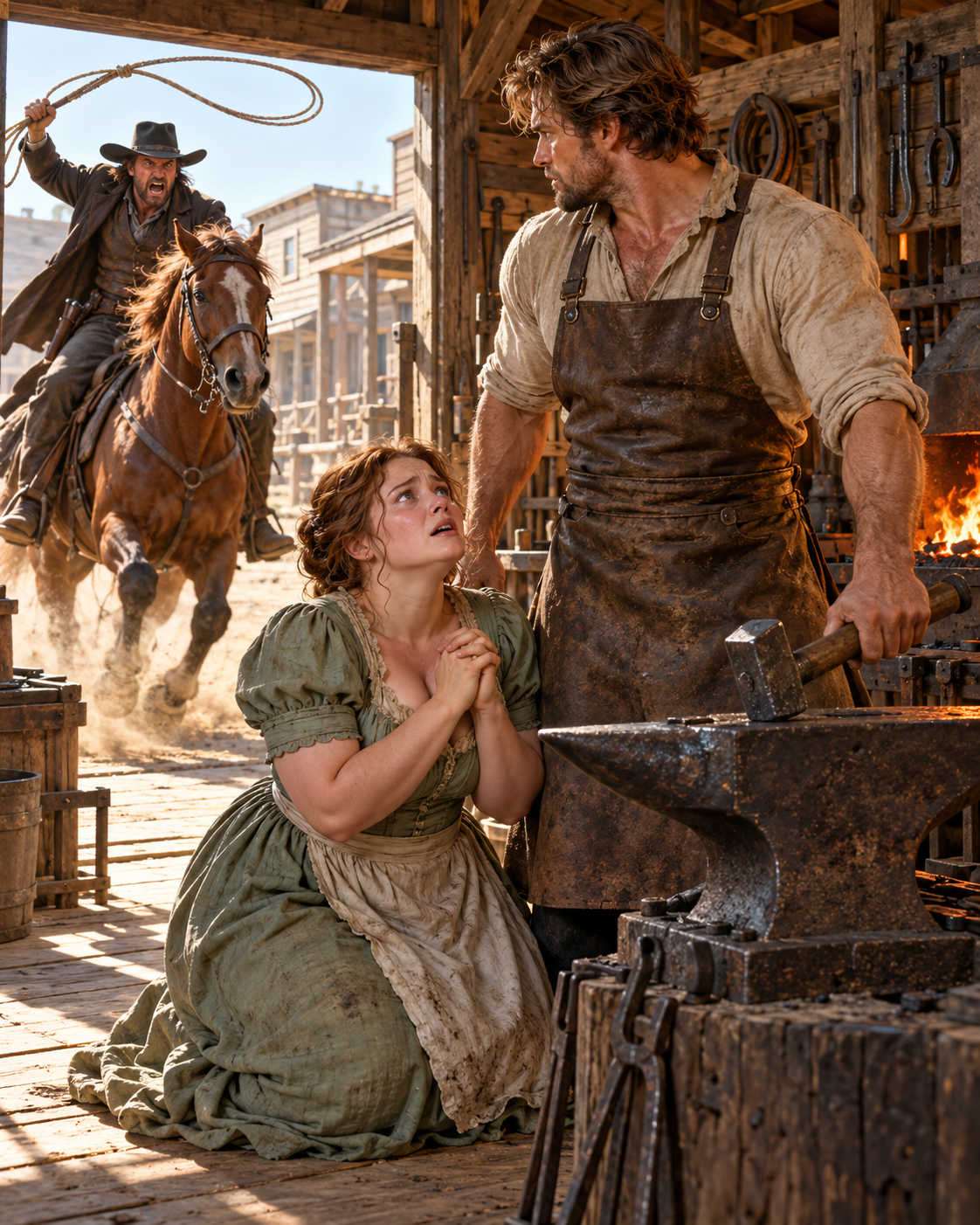
I told them about a frightened woman entering a forge with blood on her lip and asking a stranger to marry her.
I told them about a man who listened when everyone else had already decided she was worthless.
And I told them that love had not arrived as a dramatic rescue, but as warm bread beside a breakfast cup, a hand offered without demands, and the freedom to make my own choices.
One autumn afternoon, our little daughter asked why I kept two wedding rings in a velvet box beside my bed.
I lifted the older ring, remembering the woman Nathaniel had loved before me.
“Because someone can be gone and still deserve a place in our hearts,” I explained.
Then I showed her the ring her father had made.
“And because our hearts can grow large enough to love again.”
She considered this with the serious expression children wear when discovering something important.
“Did Papa save you, Mama?”
I looked through the window.
Nathaniel was teaching our young son how to guide a hammer safely against warm iron.
His hair had begun to silver at the temples, and his laughter carried across the yard.
I smiled.
“Your father helped me find the courage I already had.”
My daughter climbed into my lap.
“And did you save him?”
I kissed her forehead.
“We helped each other come home.”
That evening, as the sun disappeared beyond the hills of Silver Creek, Nathaniel joined me on the porch.
He took my hand, his fingers still rough from years of honest work.
“Are you happy?” he asked.
I rested my head against his shoulder.
For so long, happiness had seemed like something other people were allowed to possess.
I had mistaken silence for peace, obedience for safety, and my brother’s approval for love.
But the life we had built had taught me something I wished every frightened heart could understand.
No inheritance was worth surrendering my dignity, and no family bond gave another person the right to destroy my freedom.
Real love never required me to become smaller so someone else could feel powerful.
It made room for me to stand taller.
“Yes,” I whispered, watching our children chase fireflies through the grass. “I finally am.”
Nathaniel kissed my hair, and together we watched the first stars appear above the land my father had fought to preserve.
Once, I had run through Silver Creek believing I had lost everything.
I had walked into a blacksmith’s forge with nothing but fear, a wounded heart, and one desperate question.
I never imagined that the quiet man who answered would teach me the difference between being rescued and being respected.
And I never imagined that the greatest inheritance my father left me would not be the ranch, its wealth, or even its precious water.
It would be the courage to choose my own life.
Because sometimes the people who share our blood are the ones who wound us most deeply, while someone who begins as a stranger becomes the family our hearts were searching for all along.
And sometimes, when everything familiar has been taken away, life is not ending at all.
It is finally beginning.
THE END.