Molly Parker had traveled all the way to Montana to marry a man she’d never met. But when George Talbot saw her step off the stagecoach, he looked her up and down and said, “You’re not the woman I expected.”
Molly looked at Ben, waiting for an answer.
The silence stretched until even the ticking clock above Helen’s kitchen stove seemed unbearably loud.
Ben stared at the folded document, his face hardening.
“Where did you get that?” he asked.
George Talbot smiled with the satisfaction of a man who had been waiting for precisely that question.
“From the county records. Public information, Hayes. Though I imagine you’ve worked rather hard to keep it private.”
Molly unfolded the paper.
It was a mortgage agreement, dated nearly four years earlier. At the bottom, beneath a staggering debt of twelve thousand dollars, stood a signature.
Benjamin Hayes.
Her eyes moved toward the name of the creditor.
Pine Hollow Banking and Trust.
“That’s your signature?” she asked.
Ben nodded.
“And the debt?”
“Mine.”
George leaned against the doorway.
“An interesting discovery, isn’t it? Your helpful cowboy owes the very bank he’s accusing of dishonesty. Perhaps he’s hoping to make his obligations disappear by creating a scandal.”
“That isn’t what I’m doing,” Ben said.
“Then explain why you’ve been collecting private account books.”
Ben took a step forward, but Molly raised her hand.
“I’d like to hear his answer.”
Something flickered across Ben’s face. Hurt, perhaps, or the realization that he had given her every reason to doubt him.
“My father borrowed that money to save our ranch after three terrible winters,” he said. “When he died, I inherited the debt. I’ve been paying it ever since.”
“Yet the balance hasn’t decreased,” George added smoothly. “A remarkable coincidence.”
Molly looked down at the document again.
There was something peculiar about the figures.
The original loan had been twelve thousand dollars, but the current balance was listed as seventeen thousand four hundred.
“How much have you paid?” she asked.
“Nearly nine thousand.”
“And your interest rate?”
“Six percent.”
Molly’s stomach tightened.
Even allowing for missed payments and additional charges, the numbers demanded an explanation.
George noticed her expression.
“Careful, Miss Parker. Arithmetic can be dangerous when one doesn’t understand the circumstances.”
She folded the document carefully.
“Then I suppose we should understand them.”
For the first time, George’s smile disappeared.
He straightened his coat.
“I came here to offer you a warning. Pine Hollow is a respectable town. People who spread accusations without proof rarely remain welcome.”
His gaze shifted toward Helen.
“And Mrs. Foster, I believe your next mortgage payment is due Friday.”
Helen’s fingers tightened around her apron.
George placed his hat on his head.
“Good day.”
When the door closed, Ben released a breath.
“There’s something I should have told you.”
Molly turned toward him.
“Then tell me now.”
Ben pulled out a chair but remained standing.
“My father didn’t die believing the bank was honest. He thought someone had changed the terms of his loan. He tried to challenge them, but the bank claimed his original papers had been lost in a fire.”
“What happened?”
“He rode to Helena to speak with a lawyer. On the return journey, his horse was found near a ravine.”
Helen covered her mouth.
“Ben…”
“They called it an accident,” he continued. “Maybe it was. But two days before he died, he told me he’d discovered something that could ruin half the powerful men in Pine Hollow.”
Molly felt the room grow colder.
“Did he say what?”
Ben shook his head.
“Only that he had hidden proof somewhere safe.”
“And you never found it?”
“I’ve spent four years looking.”
Molly studied him.
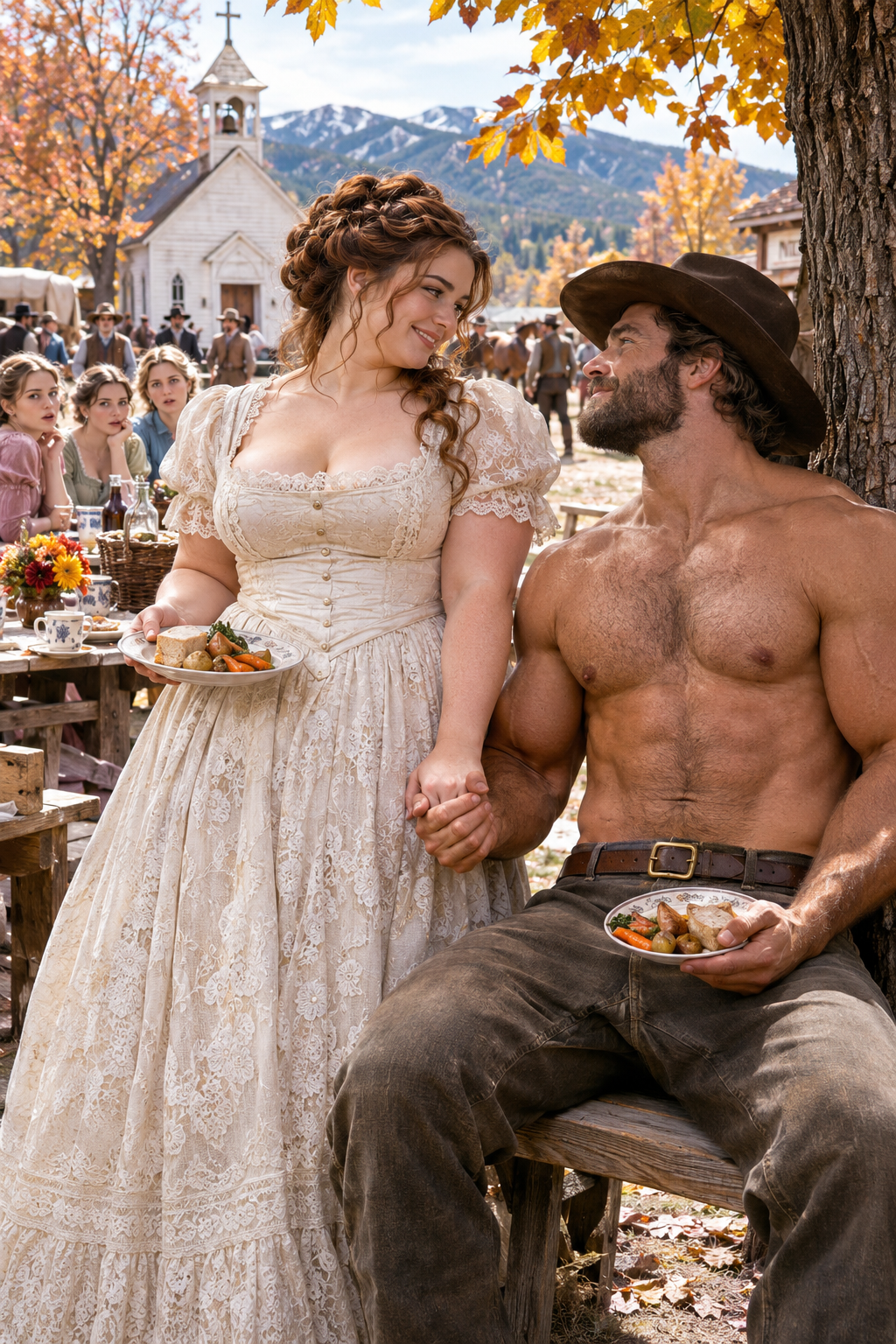
There was exhaustion in his eyes, but beneath it lay something stronger than bitterness.
A stubborn determination that reminded her of her own father.
“Then we’ll look together,” she said.
Ben stared at her.
“You barely know me.”
“I know you brought those account books because you wanted to help people. And I know George Talbot didn’t come here out of concern for my reputation.”
Helen rose slowly.
“Then we have until Friday.”
Molly looked toward the ledger.
“Perhaps less.”
That evening, she spread the accounts across Helen’s dining table.
Three ranch families, two widows, and Helen herself had suffered unexplained increases in their debts.
The charges varied, but the pattern remained consistent.
Every suspicious entry had been approved by a clerk named Edwin Marsh.
And every altered account belonged to someone who owned valuable property.
Molly drew a line beneath the figures.
“Ben, who buys land when people cannot pay their mortgages?”
“The bank usually auctions it.”
“Who attends those auctions?”
Ben frowned.
“George Talbot. Sometimes a few other merchants.”
“And who wins?”
He thought for a moment.
“Mostly George.”
Molly put down her pencil.
There it was.
Not proof, but a motive.
Someone was inflating debts until struggling families lost their homes. Then George purchased the properties for a fraction of their value.
“How many farms has he bought?”
“Seven in the last two years.”
“Then we need the auction records.”
Ben looked toward the darkened window.
“The county office closes at five.”
“Then we’ll be there when it opens.”
But before morning arrived, someone tried to burn Helen’s boarding house down.
Molly woke to the smell of smoke.
At first, she thought the kitchen stove had been left burning. Then she heard Helen coughing in the hallway.
“Fire!”
Molly threw off her blanket.
Orange light danced beneath her bedroom door.
She grabbed her suitcase and rushed into the corridor, where smoke rolled along the ceiling.
Helen stood near the staircase, struggling to breathe.
“The back door!” Molly shouted.
They stumbled through the kitchen, but flames had already swallowed the wooden porch.
Molly seized a heavy chair and smashed the side window.
“Climb through!”
Helen hesitated.
“I can’t—”
“You can!”
Molly pushed the chair beneath the opening and helped the older woman climb.
A burning beam crashed behind them.
Molly scrambled through the window just as the kitchen ceiling gave way.
They landed in the cold grass.
Across the street, someone shouted for water.
Within minutes, townspeople rushed toward the flames carrying buckets.
Ben appeared on horseback, leaped from the saddle, and ran straight toward Molly.
“Are you hurt?”
She shook her head, coughing.
“Helen needs help.”
Ben wrapped his coat around the older woman’s shoulders.
Then he looked at the house.
His expression changed.
“That fire started at the back porch.”
“How do you know?”
“Because I can smell kerosene.”
Molly followed his gaze.
Near the fence lay a broken lantern.
Its glass was shattered, but the metal frame was unmistakably clean.
Someone had brought it there deliberately.
By sunrise, half the boarding house was destroyed.
Helen stood before the blackened walls, tears sliding silently down her cheeks.
“My husband built this place,” she whispered. “Every room.”
Molly slipped an arm around her.
“We’ll rebuild it.”
Helen shook her head.
“With what money?”
Molly had no answer.
Then Ben stepped forward.
“You’ll stay at my ranch.”
Helen began to protest.
“There’s room,” he insisted. “And nobody is going to throw either of you out.”
Molly looked at the ruined house.
Among the ashes were her dresses, her mother’s Bible, and the small collection of letters she had carried from Pennsylvania.
Everything she had brought west was gone.
Except her father’s silver pocket watch, which she had placed beneath her pillow.
She reached into her nightdress pocket and felt its familiar weight.
For the first time since George had rejected her, she understood how quickly a person could lose everything.
And how dangerous it was to depend upon the mercy of powerful men.
By afternoon, they reached Ben’s ranch.
The Hayes property lay beneath the mountains, surrounded by golden grass and weathered fences.
It was beautiful, though painfully neglected.
Several barns needed repairs, and the house showed signs of years without a woman’s care.
Ben seemed embarrassed.
“It isn’t much.”
Molly looked toward the mountains.
“It’s more beautiful than any place I’ve ever lived.”
He smiled faintly.
For three days, they worked.
Helen organized the kitchen while Molly continued examining the surviving account books.
Ben rode into town, gathering information from families who had lost property.
Each evening, he returned with another terrible story.
A widow forced from her orchard.
A farmer whose interest payments had mysteriously doubled.
A young couple who lost their land only weeks before their first child was born.
Molly recorded every detail.
Then, on Thursday evening, Ben returned with news.
“Edwin Marsh is leaving town.”
Molly looked up.
“When?”
“Tomorrow morning. The stagecoach driver says he bought a ticket to Denver.”
“Then he knows we’re close.”
“Or someone wants him gone.”
Molly closed her notebook.
“We need to speak to him tonight.”
Ben shook his head.
“Talbot has men watching the bank.”
“Then we’ll have to be clever.”
An hour later, Molly entered Pine Hollow wearing one of Helen’s old dresses and a bonnet that concealed most of her face.
Ben remained outside town with the horses.
Molly walked toward the bank, carrying a covered basket.
At the rear entrance, she found Edwin Marsh locking a door.
He was a thin man with nervous eyes and ink stains on his fingers.
“Mr. Marsh?”
He turned sharply.
“Bank’s closed.”
“I’m not here to make a deposit.”
His gaze moved toward her face.
Recognition struck.
“You.”
Molly stepped closer.
“I know about the altered accounts.”
He backed away.
“I don’t know what you’re talking about.”
“I know you approved the false charges. I know the debts were increased before the properties were auctioned. And I know you’re leaving tomorrow.”
Marsh’s face drained of color.
“Keep your voice down.”
“Then tell me who ordered you to do it.”
He glanced toward the street.
“You don’t understand.”
“Help me understand.”
Marsh swallowed.
“I have a wife and two daughters.”
“So do some of the people you’ve helped destroy.”
His eyes filled with sudden anguish.
“I never wanted any of this.”
“Then stop it.”
He shook his head.
“Talbot doesn’t forgive betrayal.”
Molly felt her pulse quicken.
“So it is Talbot.”
Marsh closed his eyes.
The admission had escaped before he could stop it.
“He owns the bank president,” he whispered. “Not officially. But Mr. Whitcomb owes him everything. Talbot chooses which properties he wants, and Whitcomb makes sure the owners cannot pay.”
“And the original loan documents?”
“Locked in the bank’s private records room.”
“Can you get them?”
Marsh stared at her.
“If I do, they’ll kill me.”
Molly’s courage faltered.
She had expected dishonesty, perhaps even intimidation.
But murder?
Before she could answer, footsteps sounded around the corner.
Marsh seized her arm.
“Go!”
A voice rang out.
“Edwin?”
George Talbot appeared beneath the gas lamp.
His eyes moved from Marsh to Molly.
Then he smiled.
“Miss Parker. You do have a remarkable talent for appearing where you don’t belong.”
Molly forced herself to remain calm.
“I was asking Mr. Marsh about Mrs. Foster’s account.”
“At this hour?”
“Numbers don’t become less important after sunset.”
George’s smile sharpened.
“Neither does a woman’s reputation.”
He stepped closer.
“You should have accepted my rejection gracefully. Instead, you’ve made yourself a nuisance.”
Molly lifted her chin.
“You rejected me because I wasn’t the wife you wanted.”
“No,” George said softly. “I rejected you because I recognized what you were.”
She frowned.
“A woman who notices things. A woman who asks questions. I wanted someone obedient, not someone who might examine my business.”
The truth struck harder than she expected.
He had not rejected her because she was unworthy.
He had rejected her because she was dangerous to him.
George leaned closer.
“Leave Pine Hollow by tomorrow, and I’ll pay your passage east.”
“And if I refuse?”
His eyes became cold.
“Ask Mrs. Foster what happens when people refuse me.”
Molly felt fear crawl along her spine.
But she remembered Helen standing before the ashes of her home.
“No,” she said.
George blinked.
“No?”
“I won’t leave.”
For a moment, neither man spoke.
Then George turned toward Marsh.
“Come with me.”
Marsh obeyed.
Molly watched them disappear into the darkness.
She hurried toward the waiting horses, unaware that someone had followed her.
Ben listened without interrupting as she described the conversation.
When she finished, he gripped the reins so tightly his knuckles whitened.
“We should go to the sheriff.”
“Will he help?”
Ben hesitated.
That was answer enough.
“The sheriff’s brother works for Talbot,” he admitted.
Molly stared toward town.
“Then we need someone outside Pine Hollow.”
“The territorial marshal is in Helena. Three days away.”
“Too far.”
Ben looked at her.
“Not necessarily.”
He explained that a federal land investigator was expected in Pine Hollow on Saturday to review disputed railway boundaries.
“If we can show him the records, he can bring in the proper authorities.”
“But Helen’s payment is due tomorrow.”
“I know.”
Molly considered the problem.
Then her eyes widened.
“Your father’s hidden evidence. Where did he keep his important things?”
“In his desk.”
“And you’ve searched it?”
“A hundred times.”
“What about his account books?”
Ben frowned.
“They’re in the attic.”
“Bring them down.”
They returned to the ranch after midnight.
Ben carried a dusty wooden chest into the kitchen.
Inside lay old receipts, cattle records, maps, and letters written in his father’s careful handwriting.
Molly examined each document.
At the bottom of the chest, she discovered a narrow leather notebook.
Most pages contained ordinary ranch expenses.
But several entries had been circled.
Beside them were names.
George Talbot.
Charles Whitcomb.
Edwin Marsh.
And one more.
Sheriff Daniel Briggs.
Molly felt her breath catch.
“Ben, look.”
He leaned over her shoulder.
The final page contained a message written only days before his father’s death.
“If anything happens to me, remember that the truth is not in the numbers they show, but in the numbers they hide.”
Beneath it was a strange sequence.
17-4-9.
Ben stared.
“I’ve seen that before.”
“Where?”
“My father carved those numbers into the old grain shed. I thought they marked a construction date.”
They rushed outside with a lantern.
The shed stood beyond the barn, its roof sagging beneath years of snow and wind.
Ben found the numbers carved into a wooden support.
Molly examined the boards.
“Seventeen, four, nine,” she murmured. “Perhaps measurements?”
Ben counted seventeen floorboards from the entrance.
The fourth board was loose.
Beneath it lay a small iron box.
His hands trembled as he lifted it.
Inside were the original mortgage agreements, a list of fraudulent land purchases, and several signed letters between Talbot and Whitcomb.
One letter authorized the deliberate inflation of loan balances.
Another described payments made to Sheriff Briggs.
And the final document carried a handwritten instruction.
“Hayes must be stopped before he reaches Helena.”
Ben sank onto an overturned barrel.
For four years, he had wondered whether his father’s death had been an accident.
Now he knew.
Molly knelt beside him.
“I’m sorry.”
Ben stared at the paper.
“He knew they were coming for him.”
His voice broke.
“He knew, and he still tried to protect those families.”
Molly placed her hand over his.
“Then we finish what he started.”
Ben looked at her, grief and gratitude mingling in his eyes.
For a moment, the distance between them seemed to disappear.
Then a horse neighed outside.
Ben stood immediately.
Through the shed window, three riders approached the house.
One carried a rifle.
“Get down,” Ben whispered.
A gunshot shattered the lantern.
Darkness swallowed the shed.
Molly screamed as glass struck the floor.
Ben pulled her behind a stack of grain sacks.
Outside, a man shouted.
“Hayes! Come out!”
Sheriff Briggs.
Ben reached for his revolver.
Molly grabbed his arm.
“Don’t.”
“They’ll burn us out.”
“Then we need another way.”
She remembered the narrow opening beneath the shed where Ben had repaired the foundation.
“Can we crawl through there?”
Ben nodded.
“But the box—”
“I have it.”
They slipped beneath the floorboards while Briggs and his men approached the entrance.
Molly crawled through cold mud, clutching the evidence against her chest.
Behind her, Ben followed.
They emerged beyond the fence and hurried toward the creek.
A shot rang out.
Ben stumbled.
Molly caught him.
“You’re hurt!”
“Just my shoulder.”
Blood soaked his sleeve.
They reached the trees as flames erupted from the grain shed.
The men had set it on fire.
Molly helped Ben onto a horse, then climbed behind him.
Together, they rode into the mountains.
By dawn, Ben was feverish.
Molly found shelter in an abandoned trapper’s cabin and cleaned his wound with water from a nearby stream.
The bullet had passed through his shoulder, but he had lost considerable blood.
“You should leave me,” he murmured.
“Absolutely not.”
“They’ll come looking.”
“Then they’d better bring breakfast.”
Despite the pain, he laughed.
Molly tore strips from her underskirt and bound his wound.
For hours, she sat beside him, listening to the wind.
At sunset, Ben opened his eyes.
“Why did you stay?”
She looked at him.
“Because you needed me.”
“You could have gone back east.”
“To what?”
He said nothing.
Molly watched the fading light.
“I spent years believing marriage would give me a place in the world. When George rejected me, I thought it meant I had failed.”
Ben reached for her hand.
“You didn’t fail.”
“I know that now.”
She smiled sadly.
“He was looking for a woman he could control. I was looking for someone who would finally choose me.”
“And what are you looking for now?”
Molly considered the question.
“A life where I don’t have to become smaller to belong.”
Ben squeezed her hand.
“Then I hope you find it.”
She looked into his eyes.
“I think I already have.”
He leaned toward her.
Their kiss was gentle, uncertain, and filled with everything neither had dared to say.
But the following morning brought danger.
A rider appeared outside the cabin.
Molly reached for Ben’s revolver.
Then she recognized Edwin Marsh.
He dismounted, pale and trembling.
“I’ve been looking everywhere.”
Ben struggled to stand.
“Why?”
Marsh pulled a packet from his coat.
“Because Talbot is preparing to sell every remaining disputed property tomorrow. Including your ranch and Mrs. Foster’s boarding house.”
Molly stared at him.
“Tomorrow?”
“At noon.”
“The investigator arrives Saturday.”
“Talbot knows. He’s moving before anyone can stop him.”
Marsh handed her the packet.
“These are copies of the bank’s private ledgers. I took them before leaving.”
“Why would you risk that?”
His eyes filled with tears.
“Because my daughters asked me why Mrs. Foster’s house burned. They used to visit her for cookies.”
He swallowed.
“I couldn’t tell them the truth.”
Ben examined the documents.
“Will you testify?”
Marsh hesitated.
Then nodded.
“Yes.”
They returned to Pine Hollow shortly before noon the next day.
The town square was crowded.
A wooden platform had been erected outside the courthouse, where George Talbot stood beside Sheriff Briggs and bank president Whitcomb.
Helen waited among the townspeople, her face pale.
When she saw Molly and Ben, she rushed forward.
“Thank heaven!”
Molly embraced her.
“We have proof.”
Helen looked at Ben’s bandaged shoulder.
“What happened?”
“Later,” Molly whispered. “First, we save your home.”
George noticed them approaching.
His expression darkened.
“Well,” he announced loudly, “it seems our missing troublemakers have returned.”
Sheriff Briggs stepped down from the platform.
“Benjamin Hayes, you’re under arrest for assaulting an officer and stealing bank property.”
Ben stood still.
Molly stepped between them.
“Then you’ll have to arrest me too.”
George laughed.
“Gladly.”
“Before you do,” Molly said, raising the iron box, “perhaps everyone should see what your bank has been hiding.”
A murmur spread through the crowd.
Whitcomb went white.
George’s smile vanished.
“Those documents are stolen.”
“They belonged to Thomas Hayes,” Molly replied. “And they show that your bank has been falsifying debts for years.”
“Ridiculous.”
Molly opened the first ledger.
“Mrs. Foster borrowed eight hundred dollars. According to her original agreement, she has already repaid six hundred and seventy. Yet your bank claims she owes more than eleven hundred.”
Helen gasped.
Molly continued.
“The Miller family paid three thousand dollars toward their mortgage. Your records acknowledge only seventeen hundred.”
Faces turned toward Whitcomb.
“And the Wilson orchard was seized after someone added fourteen hundred dollars in false penalties.”
George stepped forward.
“These accusations are meaningless without verification.”
“Then let’s verify them.”
A new voice came from behind the crowd.
A gray-haired man wearing a dark traveling coat approached the platform.
He carried a leather case stamped with the seal of the federal land office.
“Arthur Bell,” he introduced himself. “Federal land investigator.”
George froze.
“You’re not expected until tomorrow.”
“My schedule changed.”
Bell looked toward Molly.
“I received a message from Mrs. Foster yesterday concerning suspected land fraud. I thought it wise to arrive early.”
Helen smiled faintly.
Molly stared at her.
“You sent for him?”
“That cowboy of yours isn’t the only one who knows how to ask for help.”
Bell examined the documents.
Then he turned toward Edwin Marsh.
“Are you prepared to swear these records are authentic?”
Marsh stepped forward.
His hands shook.
“I am.”
Whitcomb suddenly pushed through the crowd.
“He’s lying!”
Marsh faced him.
“You made me change those accounts. Talbot chose the properties, and you approved the figures.”
George reached inside his coat.
Ben saw the movement.
“Gun!”
The square erupted.
George seized Molly by the arm and pressed a revolver against her side.
“Nobody moves!”
The crowd fell silent.
Ben stepped forward.
“Let her go.”
George dragged Molly backward toward a waiting horse.
“You should have left when I offered you the chance,” he hissed.
Molly’s heart hammered.
But her eyes remained fixed on Ben.
He was injured.
If he tried to draw his gun, George would shoot him.
She needed another way.
George pulled her closer.
“You’ve ruined everything.”
“No,” Molly said quietly. “You ruined it yourself.”
Then she drove the sharp heel of her boot into his foot.
George cried out.
His grip loosened.
Molly twisted away as the revolver fired.
The bullet struck the courthouse sign.
Ben lunged forward, knocking George to the ground.
The gun skidded across the dirt.
Sheriff Briggs reached for his own weapon.
But three ranchers seized his arms.
“Not this time, Sheriff,” one growled.
Within moments, George and Briggs were restrained.
The crowd stood stunned.
Molly sank onto the courthouse steps, trembling.
Ben hurried to her.
“Are you hurt?”
She shook her head.
He wrapped his good arm around her.
For several seconds, neither spoke.
Then Molly began to laugh.
It was a shaky, disbelieving sound.
Ben looked bewildered.
“What’s funny?”
She wiped her eyes.
“I traveled two thousand miles to marry a respectable merchant.”
Ben smiled.
“And?”
“And apparently, I ended up arresting him.”
The laughter spread through the crowd.
Even Helen joined in.
But the consequences were serious.
Over the following weeks, federal investigators uncovered a network of fraudulent mortgages, illegal land seizures, and bribery.
George Talbot, Charles Whitcomb, and Sheriff Briggs were arrested and later convicted.
Edwin Marsh testified against them.
Because he had participated in the fraud, he still faced punishment, but his cooperation helped restore dozens of stolen properties.
The investigation also established that Thomas Hayes had been deliberately ambushed on his journey to Helena.
For Ben, the truth brought sorrow rather than triumph.
One evening, Molly found him standing beside his father’s grave.
He held the old notebook in his hands.
“I used to think finding the truth would make me feel better,” he said.
Molly stood beside him.
“Does it?”
“Not the way I expected.”
He looked toward the mountains.
“I still miss him.”
“Of course you do.”
Ben placed the notebook beside the headstone.
“But at least now people know what he tried to do.”
Molly took his hand.
“And because of him, families are getting their homes back.”
Ben nodded.
For the first time in years, his grief no longer seemed tangled with uncertainty.
Winter arrived early that year.
Snow covered the hills, and Pine Hollow slowly began rebuilding.
Helen’s boarding house was restored through donations from the families she had sheltered over the years.
The Wilsons recovered their orchard.
The Millers returned to their farm.
And Ben’s ranch was finally cleared of its fraudulent debt.
But perhaps the greatest change came from a small office Molly opened beside the general store.
On its window, she painted three simple words.
PARKER ACCOUNTING SERVICES.
At first, only a few people came.
Then farmers began arriving with receipts.
Widows brought mortgage agreements.
Young couples asked her to explain contracts before they signed them.
Molly never turned anyone away because they lacked money.
She charged those who could afford her services and helped others without payment.
Soon, people traveled from neighboring towns to seek her advice.
One afternoon, Helen visited carrying a basket of fresh bread.
“Business seems good,” she observed.
Molly smiled.
“Better than I ever imagined.”
Helen glanced toward the window.
Outside, Ben stood tying his horse.
“And how are things with that handsome cowboy?”
Molly blushed.
“Helen.”
“What? I’m an old woman, not a blind one.”
Before Molly could answer, Ben entered.
He removed his hat and greeted Helen, who suddenly remembered an urgent appointment elsewhere.
Molly watched her leave.
“She’s becoming impossible.”
Ben grinned.
“I think she’s wonderful.”
He placed a small wooden box on Molly’s desk.
“What’s this?”
“Something I’ve wanted to give you for a while.”
Inside lay a silver ring with a tiny blue stone.
It had belonged to his mother.
Molly looked up.
Ben’s expression grew serious.
“When you arrived in Pine Hollow, someone told you that you weren’t the woman he expected.”
Molly felt tears gathering.
Ben took her hand.
“I don’t want a woman who agrees with everything I say. I don’t want someone who hides her intelligence or makes herself smaller to please me.”
He knelt beside her chair.
“I want the woman who stood up to the most powerful man in town. The woman who saved my life, helped me find the truth about my father, and taught me that courage doesn’t always come with a gun.”
His voice softened.
“I love you, Molly Parker. And if you’ll have me, I’d like to spend the rest of my life proving that you never have to earn your place beside me.”
Molly stared at him through her tears.
For a moment, she remembered the dusty street where George Talbot had humiliated her.
She remembered standing alone with a suitcase, believing her future had ended.
How strange that the worst moment of her life had led her here.
“Ben,” she whispered, “there’s something you should know.”
His smile faltered.
“What?”
“I’m keeping my accounting office.”
He laughed.
“I’d be disappointed if you didn’t.”
“And I intend to make my own decisions.”
“I wouldn’t dream of stopping you.”
“And sometimes I’ll disagree with you.”
“Sometimes?” he teased.
Molly laughed through her tears.
Then she leaned forward and kissed him.
“Yes,” she whispered. “I’ll marry you.”
They were married the following spring beneath an old cottonwood tree on the Hayes ranch.
Helen stood beside Molly, holding a bouquet of wildflowers.
The families whose homes had been saved gathered beneath the branches.
Edwin Marsh’s wife attended with their daughters, grateful that her husband had finally chosen to tell the truth.
There were no expensive decorations or grand speeches.
Only laughter, music, good food, and the quiet happiness of people who understood what it meant to be given another chance.
When the ceremony ended, Ben took Molly’s hand.
“Any regrets?”
She looked toward the mountains, where sunlight spilled across the valleys.
“Only one.”
His expression changed.
“What is it?”
“I wish my father could have seen this.”
Ben squeezed her hand.
“I think he’d be proud.”
Molly touched the silver pocket watch hanging from a chain around her neck.
Her father had once told her that numbers revealed more than money.
They revealed choices, promises, and the truth people sometimes tried to hide.
She finally understood.
A person’s worth could never be measured by appearance, wealth, or the approval of someone who refused to see them clearly.
It was measured in honesty, courage, kindness, and the willingness to stand for what was right.
Years later, people in Pine Hollow still told the story of the mail-order bride who arrived with nothing and helped bring down the town’s most powerful men.
But Molly never considered that her greatest achievement.
Her greatest achievement was the life she built afterward.
A home filled with love.
A business built on trust.
A community where struggling families knew they could ask for help without shame.
And a marriage in which two people stood beside each other as equals.
Sometimes, when the stagecoach rolled into town, Molly would pause outside her office and remember the frightened young woman who had stepped down into the dust with a suitcase and a heart full of hope.
She wished she could tell that younger version of herself something.
Not that everything would be easy.
Not that pain would disappear.
But that rejection was not always a closed door.
Sometimes it was the hand of fate turning you away from a life too small for the person you were meant to become.
And the man who once declared she wasn’t the woman he expected had been right about one thing.
Molly Parker was not the woman he expected.
She was far more than he could ever have imagined.
And in the end, the greatest fortune she found in Montana was not the ranch, the business, or even the love of a good man.
It was the discovery that she had possessed something valuable all along.
Her own worth.
And once she understood that, no one could ever take it away from her.
THE END.