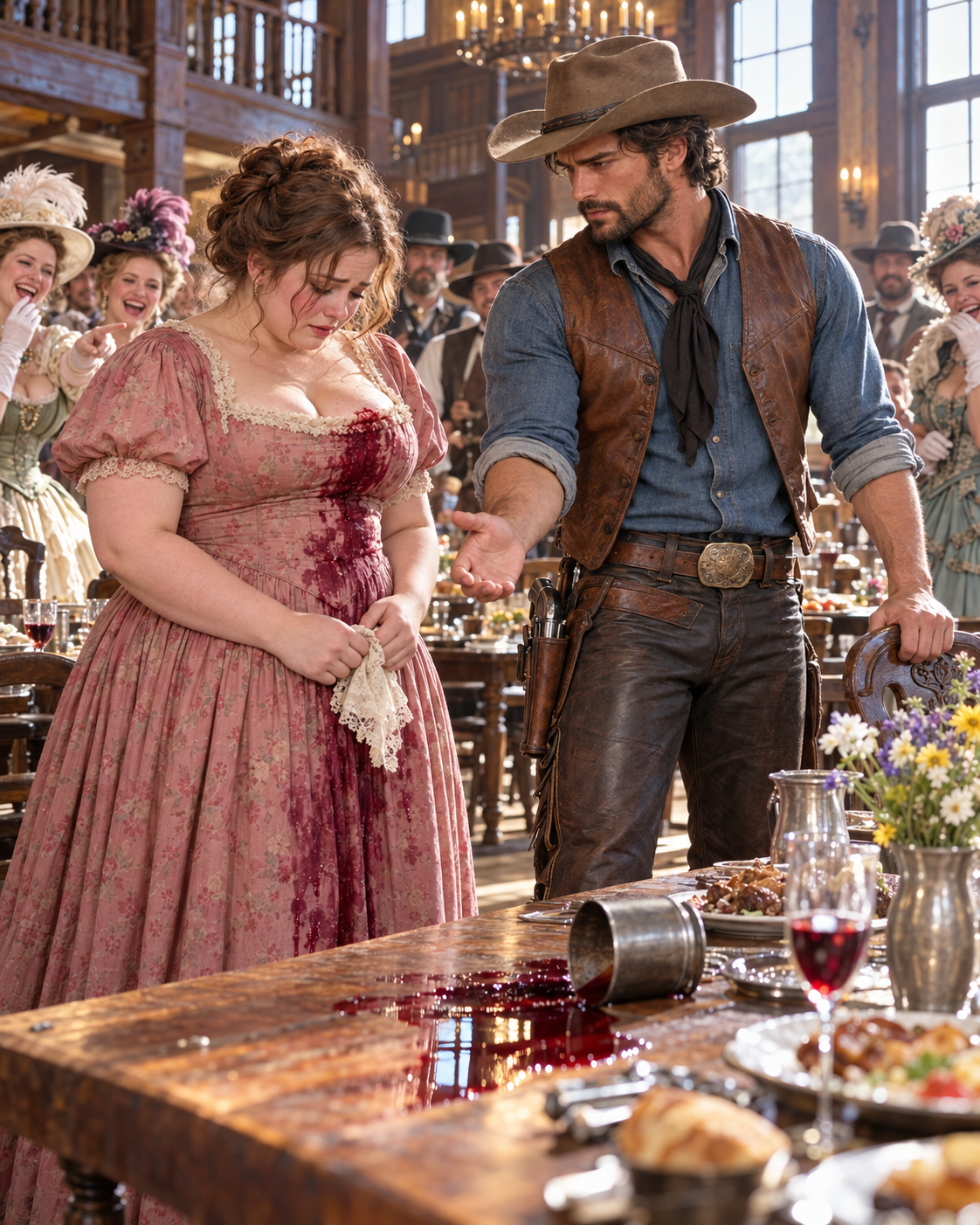
Loretta Carmichael poured red wine down my dress at the Wyoming town jubilee, laughing as everyone watched, unaware her family’s darkest secret was about to destroy them.
The stranger stood beside his black carriage, holding a silver locket identical to the one my mother had given me before she disappeared.
For a moment, I forgot how to breathe.
The Wyoming sunlight caught the silver in his hand, revealing the same delicate engraving of two intertwined roses that I had traced with my fingers since childhood.
“Wyatt,” I whispered, “how can he have another one?”
My husband didn’t answer immediately.
He was watching the stranger with the expression I had seen only once before, when Harlan Carmichael had threatened to steal everything we owned.
“Stay behind me, Clara.”
But I had spent too many years hiding behind other people’s decisions.
I stepped toward the window instead.
The stranger looked directly at me, and something changed in his face.
He removed his hat slowly.
Then he pressed the silver locket against his chest.
Margaret grabbed my arm.
“Don’t let him inside.”
“Who is he?” I demanded.
Her voice dropped to a terrified whisper.
“His name is Nathaniel Whitmore, and he is your mother’s younger brother.”
My heart seemed to stop.
I had an uncle.
An entire family had existed somewhere beyond the lonely walls of my childhood, while I believed my mother was buried beneath the frozen Wyoming earth.
“Then why are you afraid of him?”
Margaret’s eyes filled with tears.
“Because he was the last person to see your mother before she vanished again.”
Three heavy knocks shook the front door.
“Margaret!” the stranger called.
“I know Clara Dawson is inside, and I need to speak with her before it’s too late.”
Wyatt reached beneath his coat and checked the revolver at his hip.
I caught his wrist.
“No more secrets, Wyatt.”
He looked at me, and the memory of our first terrible betrayal passed silently between us.
Then he nodded.
“Together.”
We opened the door.
Nathaniel Whitmore was a tall man in his early forties, with gray beginning to touch his dark hair.
His expensive coat could not conceal the exhaustion in his face.
But it was his eyes that nearly broke me.
They were my mother’s eyes.
The same deep brown eyes I remembered watching over me whenever thunder frightened me as a little girl.
He looked at my face and swallowed painfully.
“Eleanor’s daughter.”
I wanted to believe the tenderness in his voice.
I also wanted to strike him for every birthday my mother had missed.
“Where is she?”
Nathaniel glanced toward the street.
“Inside, please. Someone followed my carriage from the railway station.”
Margaret shook her head.
“You have no right to come here after what your family did.”
“My family is dead, Margaret, and the people responsible are still very much alive.”
A sharp wind swept across the porch.
Somewhere down the street, a horse whinnied.
Wyatt stepped aside, but kept himself between Nathaniel and me.
The moment the door closed, my uncle placed the locket on a nearby table.
“Open it, Clara.”
My fingers trembled as I lifted the tiny clasp.
Inside were two miniature photographs.
One showed my mother as a young woman.
The other showed a little girl with pale curls and a ribbon tied beneath her chin.
Me.
I stared at the image until tears blurred everything.
“She carried this with her?” I whispered.
“Every day,” Nathaniel answered.
“Even when they took everything else.”
I looked up sharply.
“Who took her?”
He lowered himself into a chair, suddenly appearing much older.
“Our father, Judge Augustus Whitmore, controlled half the banks and cattle interests in southern Wyoming.”
Margaret turned away from the fireplace.
“And he believed his daughter had disgraced the family by marrying a ranch hand.”
“My father was a good man,” I said.
“He was,” Nathaniel replied.
“That’s why Eleanor loved him.”
For the first time, I heard someone speak about my parents’ marriage without pity or shame.
It made the next words even harder to bear.
“Our father ordered the marriage destroyed, but Eleanor refused to abandon her husband or child.”
Nathaniel stared at his hands.
“Then Augustus found a physician willing to certify that she was mentally unfit.”
I felt cold spread through my body.
“She wasn’t ill.”
“No.”
“Then why didn’t anyone stop him?”
My uncle’s face twisted.
“Because a wealthy man’s signature carried more weight than a woman’s voice.”
Silence filled the room.
Outside, carriage wheels rattled over the cobblestones.
I remembered the people of Silver Creek laughing when Loretta ruined my dress.
I remembered how easily everyone believed a poor cook deserved humiliation.
And suddenly I understood that my mother had faced the same cruelty on a far grander scale.
“They locked her away,” Nathaniel continued.
“Then they told your father she had died of fever.”
“Did you know?”
The question escaped before I could stop it.
Nathaniel looked directly at me.
“Yes.”
That single word struck harder than anything else he had said.
I backed away.
“You knew she was alive?”
“I was seventeen, Clara.”
“You were old enough to speak.”
He closed his eyes.
“Yes.”
The room seemed to narrow around us.
“I spent my entire childhood crying for her, and you knew?”
Nathaniel’s voice broke.
“I have no excuse for what I allowed.”
I wanted to throw the locket against the wall.
Instead, I held it so tightly that its edges dug into my palm.
Wyatt stepped beside me.
“Clara doesn’t need more explanations unless they tell us where Eleanor is now.”
Nathaniel reached into his coat.
He withdrew a folded railway map marked with several circles.
“Your mother escaped the institution eight months ago with Margaret’s help.”
Margaret nodded quietly.
“She was weak, but her mind was clear.”
“She found me in Cheyenne,” Nathaniel continued.
“By then our father had died, and I had begun uncovering the accounts he left behind.”
He paused.
“That’s when we discovered Harlan Carmichael had been helping him for years.”
My stomach tightened.
The Carmichael name had already stolen too much from my life.
“Harlan was arrested.”
“Yes, but his arrest frightened men far more powerful than he ever was.”
Nathaniel unfolded another paper.
It showed a list of land deeds, payments, and names.
At the bottom was a signature I recognized from the fraudulent agreement against Willow Creek.
Harlan Carmichael.
Beside it was another name.
Silas Vane.
“Who is he?” Wyatt asked.
Nathaniel’s expression darkened.
“A territorial land commissioner who has been taking money to transfer water rights and abandoned properties into private hands.”
Wyatt examined the paper.
“Vane signed the agreement accepting the grazing land I transferred to the territory.”
My heart sank.
The sacrifice Wyatt had made to prove his love had placed him directly inside the corrupt man’s reach.
Nathaniel nodded.
“And Eleanor discovered that Vane intended to use your ranch to conceal a much larger theft.”
Before he could explain, glass shattered somewhere behind the house.
A gunshot cracked through the drawing room.
The bullet struck the fireplace, sending fragments of stone across the carpet.
Wyatt pulled me to the floor.
“Stay down!”
Margaret screamed as another shot broke the window above us.
Nathaniel drew a revolver from his coat.
From outside came the sound of running footsteps.
Wyatt crawled toward the window and fired once into the air.
The footsteps retreated.
Then we heard a horse galloping away.
For several seconds, none of us moved.
My heart hammered so violently I could feel it against the floorboards.
Wyatt helped Margaret to her feet.
“Is everyone hurt?”
We shook our heads.
Then I noticed the small piece of paper lying beneath the broken window.
It had been tied around a stone.
Wyatt unfolded it.
His face changed.
I took it from him.
Only nine words were written across the page.
“Stop looking for Eleanor, or Clara will bury Wyatt.”
I read the threat twice.
Then I looked at my husband.
He had sacrificed half his ranch to free our marriage from a lie.
Now someone was threatening to take his life because of another family’s secrets.
“No,” I whispered.
Wyatt touched my cheek.
“Clara—”
“No more running because powerful men think fear belongs to them.”
I stood up, my knees trembling but my voice steady.
“We find my mother, and we end this.”
That evening, Nathaniel finally told us where Eleanor had gone.
She was hiding under the name Mrs. Ellis at a remote mission house near the Laramie River.
He had arranged to meet her there three days earlier.
But she never appeared.
Instead, a boy delivered a message saying she had found proof that Silas Vane was planning to seize the public watershed and sell its grazing privileges back to struggling ranchers.
The papers Wyatt had signed were legitimate.
The fraud lay in Vane’s attempt to alter the territory’s records after the transfer.
“Where would she find the original records?” Wyatt asked.
Nathaniel pointed toward an old station marked on the railway map.
“The abandoned survey office at Red Willow Crossing.”
I recognized the place.
My father had once taken me there when I was seven.
He told me the creek running behind the building belonged to no man who could hold the rain in his hands.
At the time, I thought he was only teaching me about water.
Now I wondered whether he had been trying to teach me something about freedom.
We left Cheyenne before dawn.
Margaret remained behind to contact a federal marshal Nathaniel trusted.
Wyatt rode beside our carriage, carrying a rifle across his saddle.
Nathaniel drove while I held my mother’s letters in my lap.
I read them as the sun rose over the plains.
Some were filled with desperate pleading.
Others described the little things she remembered about me.
The way I refused to sleep without my blue blanket.
The way I called every yellow flower a little sun.
The way I once tried to feed a biscuit to a newborn calf.
And in one letter, written during the darkest years of her imprisonment, I found words that broke me.
“My darling Clara, if someday you believe I abandoned you, remember that a mother’s absence is not always a mother’s choice.”
I pressed the page against my lips.
For twenty-three years, I had wondered why I wasn’t worth staying for.
Now I understood that someone had taken away her choice.
By late afternoon, we reached Red Willow Crossing.
The abandoned survey office stood beside a dry road, its windows boarded and its roof sagging beneath years of neglect.
No smoke rose from the chimney.
No horses waited outside.
Wyatt dismounted slowly.
“Someone’s been here recently.”
He pointed toward fresh wagon tracks in the dust.
Nathaniel moved toward the back entrance while Wyatt and I approached the front.
The door hung open.
Inside, maps and torn papers covered the floor.
A wooden chair lay broken near a cold stove.
Then I saw something caught beneath a table leg.
A faded blue ribbon.
I recognized it immediately.
My mother used to tie ribbons like that in my hair.
Beside it lay a small, bloodstained handkerchief embroidered with the letter E.
My legs weakened.
“Mother?”
Only the wind answered.
I searched the adjoining room and found a narrow staircase leading down into darkness.
Wyatt caught my arm.
“Let me go first.”
We descended carefully into a cellar smelling of damp earth and old timber.
At the bottom, a thin strip of daylight fell through a window.
Someone was sitting against the far wall.
A woman.
Her silver-streaked hair hung loosely around her face.
Her dress was torn.
One wrist was wrapped in a bloody cloth.
She raised her head when she heard us.
And the world stopped.
I knew that face.
Time had carved lines into it.
Suffering had stolen the softness I remembered.
But nothing could erase those eyes.
“Clara?”
Her voice was barely a whisper.
I dropped to my knees.
“Mother?”
She stared at me as though she were afraid I would disappear.
Then she lifted a trembling hand toward my face.
“My little girl.”
I crawled across the cold floor and fell into her arms.
For one terrible, beautiful moment, I was seven years old again.
I buried my face against her shoulder and sobbed.
She smelled of dust, lavender, and something familiar that memory had guarded more faithfully than grief.
“I’m sorry,” she whispered into my hair.
“I’m so sorry, darling.”
I shook my head.
“You came back.”
“I tried every day.”
She held my face between her hands.
“Look at you.”
I laughed through tears.
“I’m not little anymore.”
“No,” she said, studying me with wonder.
“You’re everything I prayed you would become.”
Then her eyes moved toward Wyatt.
“And who is this?”
I reached for his hand.
“My husband.”
For a moment, her face filled with sorrow.
“I missed your wedding.”
“You missed many things,” I whispered.
The truth hurt us both.
But I held her hand tighter.
“There’s still time for new memories.”
She began crying again.
Above us, a floorboard creaked.
Wyatt turned sharply.
“Someone’s here.”
A man’s voice echoed down the staircase.
“How touching.”
Silas Vane descended slowly, holding a revolver in his right hand.
He wore a dark waistcoat and polished boots, looking more like a respectable banker than a man who had ordered people hunted across the territory.
Behind him came two armed riders.
Nathaniel appeared at the cellar entrance with his hands raised.
One of the men had taken his revolver.
Vane smiled at my mother.
“Eleanor, you’ve caused an extraordinary amount of inconvenience.”
Wyatt stepped in front of us.
Vane’s gun shifted toward his chest.
“Don’t be foolish, Mercer.”
My mother’s fingers tightened around mine.
“He’s looking for the ledger,” she whispered.
Vane heard her.
“Precisely.”
He moved closer.
“Your mother discovered records that belong to the territorial office, Mrs. Mercer.”
“Records proving you stole from people,” I answered.
He chuckled.
“Such unpleasant language from a boarding house cook.”
The insult struck an old wound.
For an instant, I was standing beneath the jubilee lanterns again, wine soaking through my mother’s dress while people laughed.
Then I looked at the woman beside me.
My mother had been imprisoned because someone powerful decided she had no right to choose her own life.
I had spent years accepting humiliation because I believed respect belonged only to the wealthy.
Not anymore.
“My name is Clara Mercer,” I said, “and you don’t frighten me as much as you think.”
Vane’s smile vanished.
He pointed his revolver at Wyatt.
“Then perhaps your husband can teach you caution.”
I felt Wyatt prepare to move.
But before he could, my mother spoke.
“The ledger isn’t here.”
Vane turned toward her.
“Where is it?”
She lifted her chin.
“Somewhere you cannot reach.”
He grabbed her injured wrist.
She cried out.
Something inside me snapped.
I lunged forward and struck his arm with the heavy iron lantern sitting beside the wall.
The gun discharged.
Its explosion filled the cellar.
Wyatt slammed into Vane, sending them both crashing against a stack of crates.
Nathaniel tackled one rider while the other fled up the staircase.
I dragged my mother behind a thick wooden support.
Another shot rang out.
Wyatt staggered backward.
Blood appeared along his left sleeve.
“Wyatt!”
“I’m all right!” he shouted, though his face had gone pale.
Vane scrambled toward the stairs.
Then a commanding voice thundered from above.
“Federal marshal! Drop your weapons!”
Boots pounded across the floor.
Within moments, armed men surrounded the staircase.
Vane froze with one foot on the bottom step.
The marshal descended, his badge catching the dim light.
“Silas Vane, you’re under arrest for conspiracy, fraud, and attempted murder.”
Vane stared in disbelief.
Then he turned toward Nathaniel.
“You brought them here?”
Nathaniel wiped blood from his mouth.
“No.”
A small voice answered from the stairwell.
“I did.”
Margaret appeared behind the marshal.
Her gray hair was windblown, and her expression was fierce.
“I sent the warning message to the marshals when Nathaniel first told me where you were going.”
She looked at my mother.
“I should have protected you years ago, Eleanor.”
My mother began to cry.
“You already have.”
As the marshals led Vane away, I knelt beside Wyatt.
His sleeve was soaked with blood.
My hands trembled as I pressed my handkerchief against the wound.
“Don’t you dare leave me,” I whispered.
He managed a weak smile.
“I promised you a lifetime, Clara.”
“Then you had better keep your word.”
A marshal examined his arm and assured us the bullet had passed through the flesh without striking the bone.
I had never been so grateful to hear anything.
But our ordeal wasn’t finished.
The missing ledger still had to be found.
And my mother insisted on showing us where she had hidden it.
She led us behind the cellar’s old stone fireplace, where one loose brick concealed a narrow opening.
Inside lay a leather-bound account book wrapped in oilcloth.
Its pages documented years of illegal land transfers, stolen bank deposits, bribed officials, and forged medical declarations.
One entry carried my mother’s name.
Beside it was a payment authorized by Judge Augustus Whitmore to have her declared insane.
I looked at Nathaniel.
He couldn’t meet my eyes.
Then my mother turned another page.
There was my father’s signature.
For a moment, I felt the ground disappear beneath me.
“No.”
My mother touched my hand.
“Clara, listen to me.”
“He signed something.”
“He did.”
My voice broke.
“Was he part of it?”
She shook her head.
“He signed an agreement under threat that they would take you away forever.”
The document stated that my father would never attempt to contact Eleanor again in exchange for retaining custody of me.
He had believed she was alive at first.
Only later had he been told she died inside the institution.
“He tried to find me,” my mother whispered.
“When he learned the truth, they threatened you again.”
I stared at the signature of the man who had raised me alone.
All those years, I had believed his silence meant he was simply too heartbroken to speak about my mother.
Now I understood that his silence had been born from fear.
I wanted to be angry.
Part of me was.
But another part remembered his tired hands warming mine beside winter fires.
He had been a frightened man trying to protect his child against enemies who owned judges, doctors, and banks.
He had made mistakes.
Terrible ones.
Yet love and fear had existed together inside him.
That was the tragedy of it.
Back in Cheyenne, the investigation spread far beyond Silver Creek.
The seized ledger connected Vane and Harlan Carmichael to a network of fraudulent mortgages and land seizures throughout the territory.
Several officials resigned.
Others were arrested.
The court reviewed the forged records used to imprison my mother, and the false declaration against her was formally set aside.
The territory also confirmed Wyatt’s public grazing transfer and rejected Vane’s altered claims.
The land remained public, with its watershed protected from the private schemes that had nearly destroyed so many ranching families.
Some of the cattlemen who once resented Wyatt’s decision began thanking him.
But Wyatt never called himself a hero.
He only said, “Water ought to keep people alive, not give one man power over everyone else.”
Meanwhile, my mother faced a different kind of struggle.
Freedom did not erase twenty-three years of captivity.
She sometimes woke screaming.
She could not bear the sound of a key turning in a lock.
And there were mornings when she sat beside the window for hours, afraid that someone would arrive and take her away again.
I had imagined our reunion would restore everything we lost.
Instead, I learned that love could bring someone home without instantly healing what had happened to them.
One evening, I found her standing outside the boarding house kitchen, watching me prepare supper.
“May I help?” she asked.
I handed her a wooden spoon.
She smiled faintly.
“I used to cook with your father.”
“He told me your biscuits were better than mine.”
She laughed.
“That man never could tell a convincing lie.”
For a moment, our laughter filled the room.
Then she began crying.
“I should have been here to teach you.”
I set down the dough.
“Then teach me now.”
So she did.
We made biscuits together, spilling flour across the table and arguing gently over how much butter belonged in the mixture.
It was an ordinary evening.
Yet it became one of the most precious nights of my life.
There were still difficult conversations ahead.
My mother wanted to know about every year she had missed.
I told her about my father’s death, about the cruel names people called me, and about the jubilee where Loretta Carmichael ruined my blue dress.
Her face hardened.
“Did no one defend you?”
I glanced toward Wyatt, who was repairing a kitchen chair with his injured arm resting in a sling.
“He did.”
My mother studied him for a long moment.
Later, when she thought I couldn’t hear, she spoke to him quietly.
“You broke my daughter’s heart once.”
Wyatt lowered his gaze.
“Yes, ma’am.”
“Why should I trust you not to do it again?”
He didn’t make excuses.
“Because I know what I nearly lost, and because Clara deserves the truth even when it makes me look small.”
My mother was silent.
Then she said, “Good. Never confuse protecting her with deciding for her.”
Wyatt nodded.
“I won’t.”
I stood in the hallway, tears slipping down my cheeks.
Those words meant more than any promise of wealth or protection.
Because I had spent my whole life watching powerful people decide what women deserved.
My mother deserved freedom.
I deserved honesty.
And neither of us should have been forced to beg for either.
By autumn, our boarding house had grown into something I never imagined.
Women who had been dismissed from respectable establishments found work in my kitchen.
Widows rented rooms without being charged outrageous prices.
Young girls whose families couldn’t afford schooling learned reading and arithmetic in the dining room after supper.
Wyatt helped repair the building and brought produce from the ranch, but he never tried to take charge.
When townspeople asked whether he permitted me to operate such a business, he answered, “Clara doesn’t need my permission to be capable.”
My mother became our bookkeeper.
Nathaniel returned to Cheyenne, determined to use his remaining inheritance to compensate families harmed by his father’s schemes.
He knew money could never restore the years he had helped steal.
But it was a beginning.
And Margaret stayed with us.
She said she had spent enough of her life keeping secrets inside grand houses.
She preferred a kitchen where people told the truth.
One cold November morning, a carriage stopped outside our boarding house.
Loretta Carmichael stepped into the snow.
Her fashionable clothes were gone.
She wore a simple brown coat and carried a battered suitcase.
For a moment, I remembered the laughter beneath the jubilee lanterns.
I remembered wine soaking into my mother’s lace.
Loretta stood on the doorstep, unable to meet my eyes.
“I heard you were hiring.”
I could have closed the door.
A part of me wanted to.
After all, this was the woman who had humiliated me when I had nothing but one beautiful dress and a little hope.
“Why would you come here?” I asked.
Her lips trembled.
“My father’s property was seized, and nobody in town will employ me.”
I waited.
She looked down at her gloved hands.
“I know what I did to you.”
“Do you?”
Her eyes filled with tears.
“I thought being important meant making other people feel small.”
I said nothing.
She swallowed.
“I was wrong.”
For a long moment, the only sound was the winter wind brushing against the porch.
Then I opened the door wider.
“We start work before sunrise, and everyone cleans their own messes.”
Loretta stared at me.
“You’re giving me a job?”
“I’m giving you a chance to earn one.”
She nodded, crying openly now.
I didn’t embrace her.
Forgiveness was not the same as pretending cruelty had never happened.
But I had learned that a person’s worst mistake did not always have to become the final chapter of their life.
That Christmas, snow covered Silver Creek beneath a sky filled with stars.
Our boarding house glowed with lamplight.
Inside, women laughed around long tables while children played beside the stove.
My mother sat near the fireplace, mending a small blue dress we had sewn together for the orphaned daughter of one of our workers.
Wyatt came through the door carrying a bundle wrapped in brown paper.
“I found something for you,” he said.
I opened it slowly.
Inside lay a length of pale blue silk, soft as a spring morning.
My throat tightened.
“It’s beautiful.”
He smiled.
“I thought perhaps you’d like another dress.”
I looked at the fabric and remembered the girl I had been at the jubilee.
She had believed beauty could be destroyed with a glass of wine.
She had believed respect could be taken away by laughter.
And she had believed love was something she had to earn by being useful.
I pressed the silk against my chest.
Then I shook my head gently.
“Not a dress, Wyatt.”
He looked puzzled.
“What would you like instead?”
I glanced around the room.
At the women working with dignity.
At my mother laughing beside Margaret.
At Loretta carefully serving supper to a family that had once been too poor to enter her father’s home.
“Let’s make curtains for the schoolroom.”
Wyatt looked at me for a moment.
Then he laughed softly and kissed my forehead.
“Whatever you wish, Mrs. Mercer.”
I smiled.
“Clara.”
His eyes warmed.
“Always Clara.”
Later that night, when everyone had gone to bed, my mother joined me on the porch.
The snow lay untouched beneath the moon.
For a while, we stood silently, watching our breath drift into the cold air.
Then she placed something in my hand.
It was her silver locket.
The one Nathaniel had carried to Cheyenne.
“I want you to have this.”
“But it’s yours.”
She closed my fingers around it.
“I carried it through every terrible year because it reminded me that somewhere in this world, a little girl deserved to know she was loved.”
My eyes filled.
“And now?”
She smiled through her own tears.
“Now I don’t need a photograph to remind me.”
She touched my cheek.
“You’re right here.”
I embraced her beneath the winter stars.
For twenty-three years, I had mourned a woman who was still alive.
For years, my mother had loved a daughter she couldn’t reach.
And for much of my life, I had believed my worth was measured by the cruelty of people who never bothered to know me.
But standing there, surrounded by the life we had fought to build, I finally understood something my father had tried to teach me beside Willow Creek.
No one owns the rain.
No one owns another person’s dignity.
And love, when it is true, does not demand that someone surrender their freedom in exchange for being cherished.
Sometimes justice arrives too late to return what was stolen.
Sometimes forgiveness takes years.
And sometimes the deepest wounds never disappear completely.
But a wounded heart can still build a beautiful life.
The following spring, we planted a small garden beside the boarding house.
My mother insisted on yellow flowers.
Wyatt built wooden benches beneath the cottonwoods.
And I placed a simple sign above the front door.
It read, “The Dawson House — Everyone Deserves a Place at the Table.”
On the morning we opened the garden to the town, I wore a new pale blue dress that my mother and I had sewn together.
There were no jewels around my neck.
Only her little silver locket.
Wyatt offered me his arm as the church bells rang in the distance.
“Ready, Clara?”
I looked at my mother smiling in the sunshine.
At the women who had found work, friendship, and safety beneath our roof.
At the children running through the flowers.
And finally, at the man who had learned that love was not about possessing someone, but choosing them freely every day.
I took his hand.
“Yes,” I whispered.
“For the first time in my life, I truly am.”
And when the doors opened, I did not step forward as the town’s forgotten cook, or as the wealthy rancher’s wife, or even as the daughter of a once-powerful family.
I stepped forward as Clara Dawson Mercer, a woman who had learned that her dignity had never depended on anyone else’s approval.
The same town that once laughed while wine dripped from my ruined dress now gathered around a table I had built with my own hands.
But the sweetest part was not their applause.
It was my mother’s hand resting proudly in mine.
Because the greatest victory was never making those who humiliated me regret their cruelty.
It was reaching a place where their cruelty no longer defined my life.
And as the morning sunlight filled our little garden, I thought of every woman who had ever been called worthless, forgotten, or unlovable.
I wished I could tell her what it had taken me so long to understand.
Your worth does not begin when someone finally recognizes it, and your life does not end when someone fails to see it.
Sometimes the bravest thing a broken heart can do is refuse to become cruel in return.
And sometimes, after all the darkness, the most extraordinary ending is simply this.
You are free.
You are loved.
And at last, you are home.
THE END.