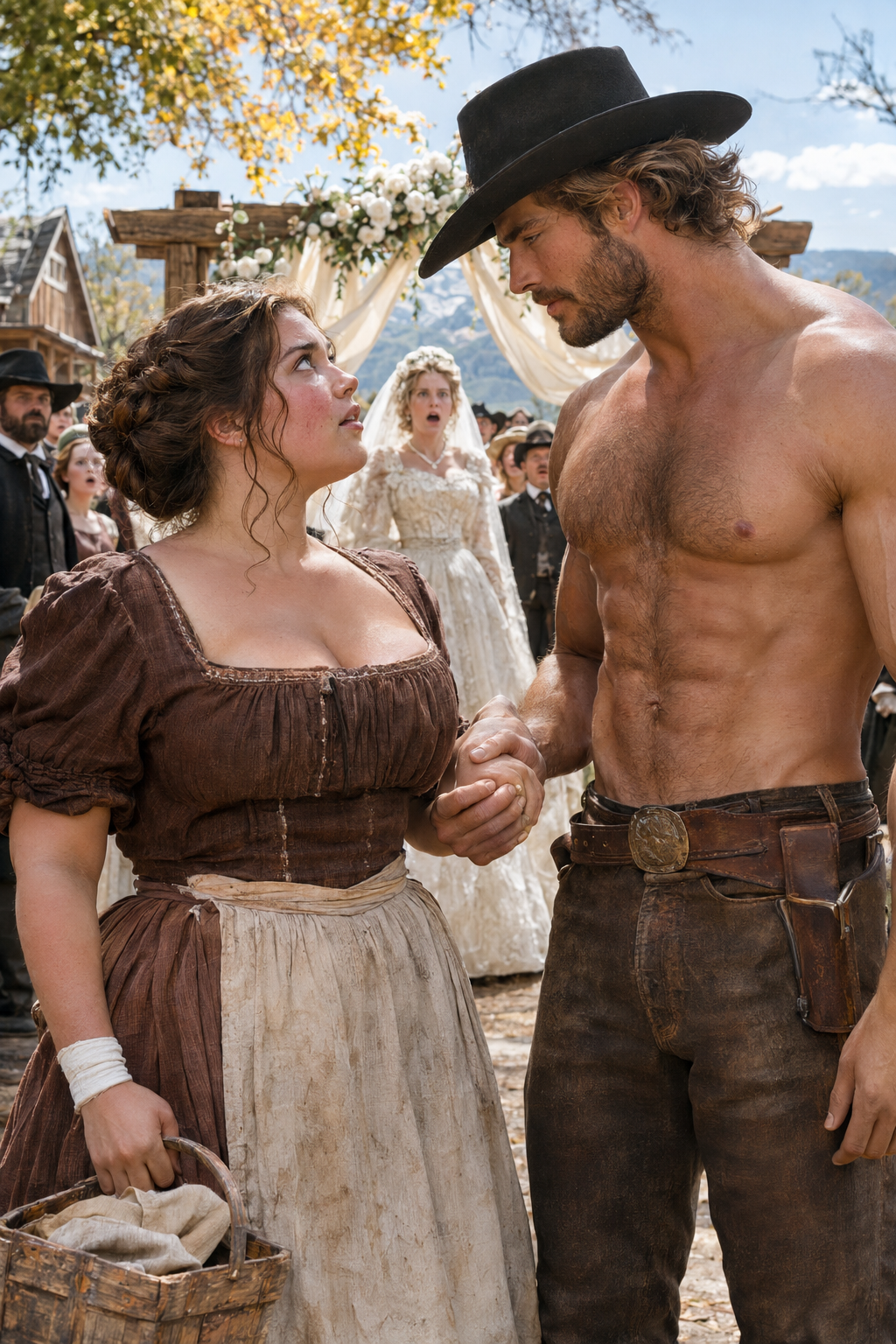
Jonathan Hail stopped his own wedding just as the preacher asked him to take his bride’s hand.
“Four years ago,” Jonathan began, his voice carrying through the crowded chapel, “I brought a woman into my home because I needed someone to cook my meals and keep my house in order. I paid her wages, gave her a room behind the kitchen, and believed that was the full measure of what I owed her.”
Caroline gripped the strap of her leather bag.
“Jonathan, this isn’t necessary.”
He continued as though he hadn’t heard her.
“Three winters ago, when the blizzard took half my cattle and left us stranded for eleven days, Caroline kept every man on this ranch alive. She melted snow for drinking water, stretched our food until there was almost nothing left, and gave up her own meals without telling anyone.”
Several ranch hands lowered their heads.
“Two years ago, when young Samuel broke his leg beneath a fallen horse, she rode fourteen miles through a thunderstorm to fetch the doctor. Last spring, when the kitchen caught fire, she went back inside because she knew little Tommy was trapped in the pantry.”
Jonathan’s voice roughened.
“That’s how she burned her hands.”
A murmur passed through the guests.
Caroline looked down at the scars she had spent years trying to hide.
Beatrix crossed her arms.
“Very touching, Jonathan. Shall we give her a medal?”
Jonathan turned toward her.
“No. We should give her something she’s never received in this house.”
“And what might that be?”
“Respect.”
The word landed harder than a shout.
Beatrix’s cheeks flushed.
“My family did not travel two hundred miles to watch you embarrass me over a kitchen maid.”
“Then perhaps your family should hear why she’s leaving.”
Caroline’s stomach tightened.
She knew what was coming.
And she feared it more than anything.
Jonathan held up her resignation letter.
“She wrote that she no longer felt welcome here. That she wished me happiness in my marriage, but could not remain where her presence had become a burden.”
Beatrix laughed sharply.
“How dramatic.”
Jonathan reached into his other pocket.
This time he withdrew a small, cream-colored envelope.
Caroline recognized the handwriting on its front.
Beatrix recognized it too.
Her smile disappeared.
“Where did you get that?”
“It was left beneath Caroline’s door.”
“That’s private correspondence.”
“Then perhaps you shouldn’t have signed it with my name.”
The silence that followed was absolute.
Jonathan unfolded the letter and read aloud.
“Your services at High Meadow Ranch will no longer be required following my marriage. You are to depart immediately after the wedding celebrations and refrain from troubling the new mistress of this household.”
He lowered the page.
“My name appears at the bottom. But I never wrote this.”
Beatrix stared at him.
Then she lifted her chin.
“I was protecting our future.”
“By forging my signature?”
“By removing a problem you were too sentimental to recognize.”
Caroline’s eyes filled with tears.
She had believed Jonathan wanted her gone.
For three nights, she had lain awake wondering what she had done wrong.
Now the truth stood before her, dressed in white silk and diamonds.
Jonathan looked at Beatrix with an expression that had grown terribly still.
“What problem, exactly?”
Beatrix’s lips trembled with anger.
“A woman who behaves as though she belongs to you.”
Gasps rose from the congregation.
Caroline stepped backward.
“That isn’t true.”
“Isn’t it?” Beatrix snapped. “You know how he takes his coffee. You know when his shoulder pains him. You sit beside his bed when he’s ill. You make decisions about his ranch without being asked.”
“Because someone had to,” Caroline whispered.
Beatrix turned to the guests.
“You see? She thinks herself indispensable.”
Jonathan took one deliberate step forward.
“She is.”
Beatrix went white.
He looked toward the preacher.
“Reverend, there will be no wedding today.”
The words seemed to shake the building.
Beatrix staggered against a pew.
Her father, Senator Arthur Langley, rose from the front row.
“Now see here, Hail. You cannot humiliate my daughter because of some misunderstanding.”
Jonathan faced him.
“This is not a misunderstanding.”
“You gave your word.”
“And I intended to keep it,” Jonathan replied. “Until I discovered what keeping it would cost someone innocent.”
Arthur’s expression darkened.
“You would throw away an advantageous marriage for a cook?”
Jonathan’s answer came without hesitation.
“I would rather spend my life alone than build a marriage on cruelty.”
Beatrix ripped the veil from her hair.
“You’ll regret this.”
Perhaps he would have answered, but Caroline had already opened the back door.
The cold autumn wind swept inside.
She slipped through it unnoticed by everyone except Jonathan.
He followed her immediately.
Outside, the morning sun illuminated the golden hills surrounding High Meadow Ranch.
Caroline walked quickly toward the stable.
Jonathan caught up with her near the watering trough.
“Caroline.”
“Please leave me alone.”
“I need to explain.”
“No, you don’t.”
She turned, tears shining on her cheeks.
“You have already done enough.”
Jonathan stopped.
“I thought you would be relieved.”
“Relieved?” Her voice broke. “You’ve ruined your wedding in front of a hundred people. By tomorrow, everyone in three counties will say it happened because of me.”
“Let them.”
“You can afford to say that. I cannot.”
He fell silent.
Caroline looked toward the sprawling ranch house.
“For four years, this was the only place where I ever felt safe. And now I won’t even be able to walk through town without people whispering.”
“Then stay here.”
“And become what? The woman everyone thinks stole another woman’s husband?”
“You stole nothing.”
“Then why did you stop the wedding?”
Jonathan opened his mouth.
For the first time that morning, words failed him.
Caroline gave a sad smile.
“That is what I thought.”
She continued toward the stable.
Jonathan watched her disappear through the wooden doors, knowing he had saved her from one humiliation only to place her in the path of another.
But before he could follow, a horse thundered into the yard.
It was Daniel Price, his ranch foreman.
His face was pale.
“Boss, we’ve got trouble.”
Jonathan turned.
“What kind?”
Daniel glanced toward the chapel.
“The kind that could cost us everything.”
He pulled a folded telegram from his pocket.
“The bank sent notice. Our loan’s been called in.”
Jonathan stared at him.
“That loan isn’t due for another eighteen months.”
“Apparently, the terms have changed.”
Jonathan unfolded the telegram.
His blood ran cold.
The First Territorial Bank demanded repayment of forty thousand dollars within thirty days.
Failure would result in the seizure of High Meadow Ranch.
At the bottom was a name Jonathan knew far too well.
Arthur Langley.
The senator had used his influence with the bank before.
Jonathan simply had never imagined he would use it against him.
Behind them, the chapel doors burst open.
Beatrix emerged with her father.
Arthur walked toward Jonathan wearing a satisfied smile.
“A regrettable business development,” he said.
Jonathan crushed the telegram in his fist.
“You planned this.”
“I prefer to call it preparation.”
“You had the bank amend the loan before the ceremony?”
Arthur shrugged.
“A prudent father protects his daughter from disappointment.”
Beatrix looked between them, suddenly uncertain.
“Father, what have you done?”
“Secured our interests, my dear.”
Jonathan took a step toward him.
“You’re threatening to take my ranch because I refused to marry your daughter?”
Arthur’s smile vanished.
“You publicly disgraced my family. Every action has consequences.”
“And so does extortion.”
“Careful, Hail. Accusations require proof.”
Arthur leaned closer.
“Thirty days. Unless, of course, you reconsider.”
Jonathan looked toward the stable.
Caroline stood in its doorway.
She had heard everything.
And the look in her eyes frightened him more than the telegram.
It was the expression of someone who had just made a terrible decision.
That afternoon, Caroline packed the last of her belongings.
She did not join the angry conversations in the ranch house or listen to the departing guests.
Instead, she sat at the small desk in her room and removed a tarnished silver locket from her neck.
Inside were two faded portraits.
One showed her mother.
The other showed a man she had spent most of her life believing was dead.
Her father, Elias Foster.
Once, he had been a prosperous cattle broker.
Then came accusations of fraud, missing money, and a scandal that destroyed his reputation.
He died in a prison infirmary when Caroline was seventeen.
Her mother followed him to the grave two years later.
Caroline had spent the years afterward working wherever she could, carrying a surname that made decent employment difficult.
She had never told Jonathan.
He knew she had suffered.
He did not know how much.
From beneath her mattress, she withdrew a bundle of yellowed papers.
They were the last documents her father had given her before his arrest.
For years, she had been unable to understand them.
But one name appeared again and again.
Arthur Langley.
And now that name threatened the only home she had ever loved.
Caroline unfolded a document marked with an official seal.
Her father’s handwriting filled its margins.
“Ask who profited,” he had written. “The numbers will tell the truth.”
She read until dusk.
Then, suddenly, she noticed something she had overlooked for eleven years.
A transfer of twenty-eight thousand dollars had been authorized on the same day her father was arrested.
The recipient was a company called Western Development Holdings.
Its registered director was Arthur Langley.
Caroline’s heart began pounding.
She turned another page.
Then another.
The truth emerged gradually, like bones rising from disturbed earth.
Her father had not stolen the missing money.
He had discovered someone else stealing it.
And the person responsible had possessed enough power to send an innocent man to prison.
A knock interrupted her thoughts.
“Caroline?”
Jonathan stood outside.
She hurriedly folded the papers.
“Come in.”
He entered carrying a covered plate.
“You missed supper.”
“I’m not hungry.”
“Mrs. Keller made chicken stew. She says you taught her the recipe.”
Caroline almost smiled.
“She uses too much pepper.”
“She said you’d say that.”
For a moment, the old warmth returned.
Then Jonathan noticed her open bag.
“You’re still leaving.”
“I think I must.”
He set down the plate.
“The bank is my problem, not yours.”
“I know.”
“Then don’t let Langley drive you away.”
Caroline looked at him.
“Do you remember the first evening I came here?”
Jonathan nodded.
“You arrived during a rainstorm.”
“You gave me dry clothes and a room. You didn’t ask about my family or why I needed work so badly.”
“You looked as though you’d had enough questions.”
“I had.”
Her voice softened.
“You were the first person in years who treated me as though my past didn’t matter.”
Jonathan moved closer.
“Your past never mattered to me.”
“It might now.”
She held out the documents.
He studied the first page, then the next.
His expression changed.
“Elias Foster?”
“My father.”
Jonathan looked up sharply.
“Caroline, I remember that case.”
“Everyone remembers it.”
“He was accused of stealing investments from the railroad expansion fund.”
“He was framed.”
Jonathan examined the papers again.
“Arthur Langley controlled that fund.”
“Yes.”
A long silence settled between them.
Then Jonathan said quietly, “This could destroy him.”
“If it’s real.”
He looked at her.
“Do you believe it?”
“I believe my father died telling the truth.”
Jonathan carefully returned the documents.
“Then we find someone who can prove it.”
For the first time since the wedding, hope stirred in Caroline’s chest.
But hope was a dangerous thing.
It made people forget how cruel the world could be.
Three days later, the first disaster struck.
Someone opened the northern pasture gates during the night.
Nearly two hundred cattle escaped into the hills.
By the time Jonathan’s men recovered them, twelve animals were missing and six had fallen into a ravine.
The following morning, the grain barn caught fire.
Caroline was awake when she smelled smoke.
She sounded the alarm, and the ranch hands raced outside.
Jonathan fought beside them, carrying buckets until his clothes were blackened and his arms trembled.
They saved the horses.
They lost the winter feed.
As dawn broke over the smoking ruins, Daniel found an empty kerosene tin behind the barn.
“This was no accident,” he said.
Jonathan already knew.
Arthur Langley was tightening the noose.
That evening, Jonathan received another visitor.
It was Beatrix.
She arrived alone, dressed in a plain traveling coat, her face drawn from sleepless nights.
Jonathan met her on the porch.
“If you’ve come to ask me to reconsider, the answer is no.”
“I haven’t.”
She looked toward the charred barn.
“My father did this.”
Jonathan said nothing.
“I heard him speaking with his attorney. He said you would come crawling back once the ranch began to starve.”
“Can you testify to that?”
Beatrix swallowed.
“He’s my father.”
“And Caroline is an innocent woman whose life he’s already helped destroy.”
Beatrix flinched.
“What do you mean?”
Jonathan hesitated.
Then he told her about Elias Foster.
As he spoke, Beatrix slowly sank onto the porch bench.
“No,” she whispered. “That cannot be true.”
“Look at the records.”
“My father told me Foster had stolen from dozens of families.”
“Maybe he did. Or maybe your father needed someone to blame.”
Beatrix covered her mouth.
For the first time, Jonathan saw something beneath her arrogance.
Fear.
She had spent her entire life protected by her father’s wealth.
Now she was beginning to understand what that protection had cost others.
“I didn’t know,” she said.
Jonathan answered quietly.
“You knew about the letter you forged.”
Tears slipped down her cheeks.
“Yes.”
“You knew you were hurting Caroline.”
“Yes.”
“Then begin with what you did know.”
Beatrix lowered her head.
“I was jealous of her.”
Jonathan remained silent.
“You looked at her in ways you never looked at me,” she confessed. “I thought if she left, you might finally love me.”
“I should never have proposed while my heart was uncertain.”
“No,” Beatrix whispered. “You shouldn’t have.”
She rose.
“I cannot promise I’ll betray my father.”
Jonathan nodded.
“But I won’t defend him anymore.”
She departed before sunset.
Neither knew that her carriage was being watched.
Two nights later, Caroline traveled to Millbrook to meet a retired bank clerk named Walter Finch.
His name appeared on several of her father’s documents.
Jonathan insisted on accompanying her.
They found Finch living in a narrow cottage beyond the railway station.
The old man opened his door only a few inches.
When Caroline introduced herself, he nearly dropped his lantern.
“Elias Foster’s daughter?”
“Yes.”
Finch looked anxiously down the road.
“You shouldn’t have come.”
“Please,” Caroline said. “My father died in prison. I need to know why.”
The old man’s eyes filled.
“I tried to help him.”
“Then help me.”
Finch let them inside.
For nearly an hour, he examined the documents.
Finally, he removed his spectacles.
“Your father discovered that Langley was diverting railroad investments into private land purchases. When he threatened to expose it, Langley arranged for the missing funds to appear in your father’s accounts.”
Caroline struggled to breathe.
“Can you prove it?”
Finch nodded slowly.
“I kept copies of the original ledgers.”
Jonathan leaned forward.
“Where are they?”
“In a locked strongbox at the old railway office.”
“Then we’ll retrieve them tonight.”
Finch shook his head.
“Not tonight. The office is watched.”
A horse whinnied outside.
Everyone froze.
Footsteps sounded on the porch.
Then came a violent crash.
The front door burst inward.
Two masked men entered with revolvers.
Jonathan shoved Caroline behind the table.
One man struck him across the temple with a pistol.
He collapsed against the wall.
Caroline screamed.
The second man seized Finch.
“Where are the ledgers?”
“I don’t know what you’re talking about!”
The man tightened his grip.
Caroline snatched the lantern and hurled it toward the intruders.
Glass shattered.
Flames spread across the rug.
The men stumbled backward.
Jonathan, bleeding from his forehead, lunged at the nearest attacker.
They crashed through the doorway.
Caroline dragged Finch toward the kitchen as smoke filled the cottage.
Outside, a gunshot split the darkness.
Then another.
Caroline rushed through the back door and found Jonathan kneeling beside the garden fence.
Blood darkened his sleeve.
“Jonathan!”
“It’s my shoulder,” he gasped. “Go!”
She refused.
Together, they stumbled toward the horses.
Behind them, Finch’s cottage burned.
The old man escaped through the orchard, but the attackers vanished with the strongbox key he had carried in his coat.
By sunrise, Finch was safely hidden at High Meadow Ranch.
Jonathan’s wound was painful but not fatal.
Caroline cleaned it with trembling hands.
“You could have been killed,” she whispered.
“So could you.”
“Why did you come?”
Jonathan caught her wrist gently.
“Because I couldn’t bear the thought of losing you.”
She looked at him.
The words hung between them.
Then he added, “Not because I need someone to cook my meals. Not because you’ve saved this ranch a hundred times.”
“Then why?”
“Because somewhere between the first winter you spent here and the last spring we shared, this place stopped feeling like home unless you were in it.”
Caroline’s eyes glistened.
“Jonathan, I’m not a woman of your standing.”
“I know your standing.”
He touched her scarred hand.
“You’ve stood beside dying men, frightened children, and people who had nowhere else to turn. I’ve never known anyone who stood taller.”
She began to cry.
Jonathan drew her close.
For a moment, neither spoke.
But outside the bedroom window, a rider approached at full speed.
It was Beatrix.
And she carried news that changed everything.
“My father knows about Finch,” she announced.
Jonathan rose from the bed despite Caroline’s protest.
“How?”
“His men followed you.”
Beatrix placed a small key on the table.
“He believes he has the only key to the railway strongbox. I took it from his desk.”
Caroline stared at her.
“Why would you do that?”
Beatrix’s eyes filled.
“Because I found my mother’s letters.”
She drew a shaking breath.
“Before she died, she discovered what my father had done to Elias Foster. She begged him to confess. He threatened to have her declared insane if she spoke.”
Caroline felt the room spin.
“My father died believing no one knew the truth.”
“My mother knew,” Beatrix whispered. “And her silence haunted her.”
She looked directly at Caroline.
“I cannot undo what I did to you. But I can stop helping him.”
Jonathan took the key.
“We’ll go to the railway office.”
“No,” Beatrix said. “You’ll never get there. My father has men watching every road.”
“Then what do you suggest?”
“Let him believe you’ve surrendered.”
An hour later, Arthur Langley received a message from High Meadow Ranch.
Jonathan Hail was prepared to negotiate.
The senator arrived the following afternoon in a polished black carriage.
He entered the ranch house with the confidence of a man who believed victory had already been secured.
Jonathan waited in his study.
Caroline stood near the fireplace.
Arthur barely acknowledged her.
“Well, Hail. Have you finally come to your senses?”
“I’ve considered your proposal.”
“And?”
“I want the loan restored to its original terms.”
Arthur smiled.
“Marry my daughter, and I may consider it.”
“First, I want to know what happened to Elias Foster.”
The senator’s smile disappeared.
“I beg your pardon?”
“Twenty-eight thousand dollars disappeared from the railroad fund. Foster took the blame. Yet the money went to Western Development Holdings.”
Arthur’s face hardened.
“You’ve been speaking to the wrong people.”
“I’ve been reading the right documents.”
The senator glanced toward Caroline.
“So that’s what this is about.”
He stepped closer.
“Your father was a thief, girl.”
Caroline’s hands curled into fists.
“No.”
“He died where thieves belong.”
Jonathan moved between them.
“Enough.”
Arthur laughed bitterly.
“You think a few old papers will change anything? I own half the judges in this territory.”
“Perhaps,” Jonathan said.
“But you don’t own everyone.”
The study door opened.
Beatrix entered, followed by Walter Finch, Reverend Matthews, and Sheriff Thomas Reed.
Arthur spun around.
“What is this?”
Finch raised a leather-bound ledger.
“The original accounts, Senator.”
The old clerk had used Beatrix’s key to recover the records that morning, accompanied by the sheriff’s deputies.
Arthur’s expression turned murderous.
“You stole government property.”
“No,” Finch replied. “I preserved evidence of fraud.”
The sheriff stepped forward.
“Senator Langley, I have a warrant for your arrest.”
Arthur reached inside his coat.
Jonathan saw the movement first.
“Gun!”
The senator drew a small revolver.
He aimed at Finch.
Caroline moved before she could think.
She shoved the old clerk aside.
The gun fired.
A burning pain tore through her side.
She fell against the desk.
Jonathan roared and struck Arthur with enough force to send the revolver skidding across the floor.
The sheriff and his deputies restrained the senator.
But Jonathan saw only Caroline.
He dropped beside her.
Blood spread across her dress.
“Stay with me,” he whispered.
Caroline tried to smile.
“Did we get him?”
“Yes.”
“Then don’t look so frightened.”
He pressed his hand against the wound.
“Someone get the doctor!”
Caroline caught his sleeve.
“Jonathan.”
“Don’t talk.”
“If I don’t make it—”
“You will.”
“Promise me something.”
His eyes filled with tears.
“Anything.”
“Don’t let them remember my father as a criminal.”
Jonathan bent his forehead against hers.
“I swear it.”
She closed her eyes.
For one terrible moment, he thought she was gone.
Then her fingers tightened around his hand.
The doctor arrived within the hour.
The bullet had passed through Caroline’s side without striking a vital organ, but she had lost a frightening amount of blood.
For three days, fever kept her hovering between consciousness and darkness.
Jonathan scarcely left her bedside.
He fed her broth when she could swallow.
He changed the cool cloths on her forehead.
And each night, when the ranch grew silent, he sat beside her and spoke of the future he had never dared imagine.
He told her about the orchard he wanted to plant.
The schoolhouse he hoped to build for the ranch workers’ children.
The small house overlooking the eastern meadow, where the morning light turned the grass silver.
And he told her that none of those dreams meant anything unless she could share them.
On the fourth morning, Caroline opened her eyes.
Jonathan was asleep in the chair beside her.
His hand still held hers.
She watched him for several minutes.
Then she whispered, “You look terrible.”
Jonathan woke so suddenly that the chair nearly overturned.
“Caroline?”
“Have you been sleeping at all?”
He laughed.
Then tears filled his eyes.
He kissed her hand.
“Welcome home.”
She smiled faintly.
“I thought I was already home.”
Six weeks later, Arthur Langley was convicted of fraud, conspiracy, and attempted murder.
The original railroad accounts exposed a network of stolen investments stretching back more than a decade.
Several officials who had protected him were removed from office.
The bank’s unlawful demand against High Meadow Ranch was withdrawn, and Jonathan’s loan was restored.
More importantly, the territorial court formally overturned Elias Foster’s conviction.
His name was cleared.
On the day the ruling arrived, Caroline stood beside her father’s grave, holding the official document.
For years, she had imagined this moment.
She thought she would feel triumph.
Instead, she felt sorrow for all the years that could never be returned.
Jonathan stood quietly beside her.
“He should have lived to see this,” she whispered.
“Yes,” Jonathan answered.
“He should have.”
Caroline knelt and placed a small bundle of wildflowers on the grave.
“You were right, Papa,” she said softly. “The numbers told the truth.”
A breeze moved through the grass.
She closed her eyes.
For the first time since childhood, remembering her father did not fill her with shame.
It filled her with pride.
When she rose, Jonathan offered his arm.
She took it.
But before they reached the horses, he stopped.
“Caroline, there’s something I’ve wanted to ask you.”
She looked up.
“Another question about the kitchen?”
“No.”
He reached into his pocket.
Her heart gave a strange little leap.
Jonathan withdrew a small velvet box.
Inside lay a simple gold ring.
No diamonds.
No elaborate setting.
Just a delicate band engraved with tiny meadow flowers.
“I bought this the day after you woke from your fever,” he said. “Then I realized I had no right to ask you until you were free to choose.”
Caroline stared at him.
“I thought you were going to ask me to stay.”
“I am.”
He lowered himself onto one knee.
“But not as my cook. Not because you feel indebted to me. And not because anyone believes you should be grateful.”
His voice trembled.
“I am asking you to stay because I love you, Caroline Foster. I love your stubborn heart, your courage, your laughter, and every scar that tells the story of what you’ve survived.”
Tears rolled down her cheeks.
“I have spent years thinking I wasn’t worthy of a man like you.”
Jonathan shook his head.
“Then we’ve both wasted too much time believing the wrong things.”
Caroline laughed through her tears.
“Yes.”
Jonathan blinked.
“Yes?”
“Yes, Jonathan Hail. I will marry you.”
He rose and gathered her carefully into his arms.
Their kiss was gentle, filled not with the urgency of forbidden love, but with the peace of two people who had finally found their way home.
The following spring, High Meadow Ranch hosted another wedding.
There were no senators, no expensive imported flowers, and no guests who measured a person’s worth by the quality of their clothes.
The ranch hands built an arch from fresh willow branches.
Mrs. Keller baked the wedding cake, though Caroline insisted on helping with the icing.
Children gathered wildflowers from the fields.
And when the bride appeared, wearing a simple ivory dress she had sewn herself, every man in the yard removed his hat.
Caroline walked down the aisle with Daniel Price, who had proudly offered to stand in for the father she had lost.
Beatrix Langley sat quietly among the guests.
She had returned most of the jewelry her father had purchased with stolen money and had begun using her remaining inheritance to support families ruined by his schemes.
When Caroline approached, Beatrix stood.
Their eyes met.
Caroline gave her a small, sincere smile.
It was not forgiveness given cheaply.
It was forgiveness earned through change.
Reverend Matthews waited beneath the willow arch.
Jonathan stood beside him, wearing the same dark suit he had worn on the morning of his first, disastrous wedding.
Only this time, his hands trembled.
When Caroline reached him, she smiled.
“Nervous, Mr. Hail?”
“Terrified.”
“Thinking of running?”
“Not unless you’re coming with me.”
The guests laughed.
Then the reverend opened his Bible.
When he asked Jonathan to take his bride’s hand, the rancher hesitated.
Caroline raised an eyebrow.
“Jonathan?”
He looked down at her scarred fingers.
Then he took both her hands in his.
“I spent a long time looking at these hands without understanding what they meant,” he said quietly.
“They aren’t very pretty,” Caroline whispered.
Jonathan lifted them to his lips.
“They’re the most beautiful hands I’ve ever seen.”
And this time, when the reverend asked whether anyone objected to the marriage, no one spoke.
Only the wind answered, rustling through the willow branches.
Years afterward, people still told the story of the rancher who stopped his wedding to follow a servant through the back door.
Some called it scandalous.
Others called it romantic.
But those who knew Jonathan and Caroline understood something deeper.
Jonathan had not become a better man simply because he had fallen in love.
He became a better man when he learned to recognize the dignity of someone the world had taught him to overlook.
And Caroline had not found happiness because a wealthy rancher chose her.
She found it because she finally understood that her worth had never depended on anyone choosing her at all.
Together, they built a home where every worker was treated with fairness, every child was given a chance to learn, and no one was ever made to feel ashamed of honest labor.
Above the kitchen doorway, Caroline hung a small wooden sign.
Jonathan had carved the words himself.
It read:
“A person’s worth is measured not by the hands they have, but by the kindness of the work those hands have done.”
And whenever a stranger asked about the scars on Caroline’s fingers, she no longer tried to hide them.
She simply smiled.
Because the very marks she once believed made her unworthy of love had become reminders of the courage, sacrifice, and compassion that had carried her through life’s darkest storms.
In the end, High Meadow Ranch was saved not by wealth, influence, or a powerful marriage, but by the truth an ordinary woman refused to abandon.
And the greatest lesson of all was one Jonathan never forgot:
Sometimes, the person who changes your life is not the one standing beside you beneath an altar of roses.
Sometimes, it is the quiet soul walking toward the back door, carrying everything they own, believing nobody will notice when they are gone.
The wisest thing you may ever do is recognize their worth before that door closes forever.