In the quiet hills of New England, where old estates still carried the names of families who had shaped generations of American society
The most important line in her father’s ledger had been waiting there all along.
Beatrice kept her eyes on the open book while the silence around the table grew heavier. The old study of Windham House seemed suddenly smaller than it had moments before. Rain tapped against the tall windows, and beyond the glass, the bare branches of the elm trees bent beneath the November wind.
Lady Constance was the first to break the silence.
“You cannot possibly mean that you intend to refuse.”
Beatrice slowly lifted her gaze.
“I mean precisely that.”
Across the table, the attorney representing the creditors shifted uncomfortably. He had expected an easy signature, a frightened young woman, and an estate that would pass quietly into the hands of those waiting to claim it.
Instead, Beatrice placed one finger against the paragraph she had discovered.
“My father left a condition,” she said. “The sale of the principal estate cannot be completed without my written consent.”
Lady Constance gave a sharp laugh.
“A technicality.”
“No,” Beatrice replied. “A legal condition.”
The door opened before Lady Constance could answer.
The Duke of Montgomery entered without hurry.
He had been standing outside long enough to hear the final exchange.
His dark coat was still damp from the rain, and a pair of leather gloves rested in one hand. He looked first at Beatrice, then at the ledger, and finally at Lady Constance.
“Perhaps,” he said calmly, “we should allow Miss Windham to finish.”
Lady Constance’s expression tightened.
“You were supposed to settle this matter.”
“I was.”
“And?”
The Duke glanced toward Beatrice.
“It appears the matter is not settled.”
Beatrice felt something strange then—not triumph, exactly, but the first fragile sensation that perhaps she had not been entirely powerless after all.
She turned another page.
“There is more.”
Lady Constance went pale.
Beatrice had spent the previous night reading until dawn. The first clause had been difficult enough to understand, but beneath it lay a series of handwritten notes in her father’s unmistakable script.
They referred to debts.
Payments.
Transfers.
And one particular account that had never appeared in the official household records.
Beatrice placed the ledger in the center of the table.
“This account was funded from my mother’s personal inheritance.”
Lady Constance stiffened.
“That is absurd.”
“My father wrote the account number himself.”
“He made mistakes in his final years.”
“Perhaps,” Beatrice said quietly. “But then why does the bank record attached to this page carry your signature?”
The attorney leaned forward.
Lady Constance did not move.
The Duke’s expression changed almost imperceptibly.
“Where did you find that?” he asked.
“In the old accounting cabinet.”
“That cabinet was locked.”
“It was.”
Beatrice looked directly at her stepmother.
“Fortunately, I found the key.”
For the first time, Lady Constance looked frightened.
It was only for a second, but Beatrice saw it.
And once she saw it, she understood something important.
Fear had been living in this house long before she had learned to recognize it.
Lady Constance rose abruptly.
“This is ridiculous. I will not sit here and be accused by a girl who knows nothing about business.”
Beatrice stood as well.
“I know enough to ask where my mother’s jewelry went.”
The room fell silent.
Lady Constance’s lips parted, but no answer came.
Beatrice continued.
“The necklace. The emerald bracelet. The diamond earrings. The sapphire brooch my grandfather gave her. They were listed in my mother’s inventory after her death.”
“They were sold.”
“To whom?”
Lady Constance looked away.
“You were a child. You remember nothing.”
“I remember my mother wearing them.”
“And?”
“I remember you telling me they would remain in the family.”
Lady Constance’s face hardened.
“Sentiment will not save this estate.”
“No,” Beatrice said. “But evidence might.”
The Duke finally stepped toward the table.
“Miss Windham, what exactly are you proposing?”
Beatrice looked at him.
“My consent has value.”
“So it does.”
“I will give it.”
Lady Constance exhaled in relief.
“But not for free.”
The Duke’s eyebrow lifted.
Beatrice reached into a drawer and removed a folded sheet of paper.
“I want my mother’s jewelry returned. I want the bank draft issued from the account that was funded with her inheritance. And I want a ticket to Bath.”
Lady Constance stared at her.
“A ticket?”
“Yes.”
“To Bath?”
“Yes.”
The demand sounded almost absurd compared with the size of the estate’s debts.
But Beatrice had chosen it carefully.
She did not want another house.
She did not want revenge.
She wanted a beginning.
She wanted enough money to stand independently and enough distance to breathe.
Most importantly, she wanted to leave without asking permission.
Lady Constance’s voice dropped to a whisper.
“You would destroy your father’s estate for these things?”
“No,” Beatrice said. “You destroyed my father’s estate long before I found this ledger.”
The Duke turned toward the attorney.
“Can the transfer proceed without her signature?”
“No.”
“Can her consent be obtained by force?”
“Absolutely not.”
“Then we have our answer.”
Lady Constance looked at him in disbelief.
“You cannot seriously support this.”
“I am not supporting her,” the Duke replied. “I am enforcing the law.”
The distinction was simple.
It was also devastating.
Lady Constance sank back into her chair.
“What proof do you have that the jewelry still exists?”
Beatrice hesitated.
“I do not know that it does.”
The Duke looked at her sharply.
“Then you are making a demand without certainty.”
“I know.”
“And if she has already sold it?”
“Then I will ask for its value.”
The Duke regarded her for a long moment.
Something almost like amusement appeared in his eyes.
“You have learned quickly.”
“I had to.”
The negotiations lasted until midnight.
Every hour brought another revelation.
A missing payment was traced to an account in Lady Constance’s name.
A carriage purchased after Beatrice’s mother died appeared in the household records under a false description.
Several valuable pieces of jewelry had been sent to a private dealer in Boston.
And the bank draft Beatrice had requested had never been deposited.
Lady Constance had kept it hidden.
When the attorney finally found the supporting documents, the room became utterly still.
Beatrice looked at the papers but did not smile.
She had imagined this moment many times.
She had imagined herself feeling victorious.
Instead, she felt tired.
Very tired.
The Duke noticed.
“You should rest.”
“I have rested enough.”
“That is not what I meant.”
Beatrice looked toward him.
“You think I should stop?”
“I think you should understand that winning a battle does not mean you must remain on the battlefield.”
His words stayed with her.
By dawn, an agreement had been drafted.
Lady Constance would surrender the jewelry that remained in her possession and compensate Beatrice for the pieces that had been sold.
The bank draft would be transferred into Beatrice’s name.
A first-class railway ticket to Bath would be purchased immediately.
And Beatrice would sign the necessary consent for the sale of the estate.
But there was one final condition.
She would not be forced to leave empty-handed.
The Duke insisted that the settlement be witnessed and recorded.
Lady Constance signed.
Her hand shook as she did so.
Beatrice watched the pen move across the page.
For years, that woman had made her feel as though every decision in her life belonged to someone else.
Now, with a single signature, Lady Constance was returning something she had never truly owned.
Choice.
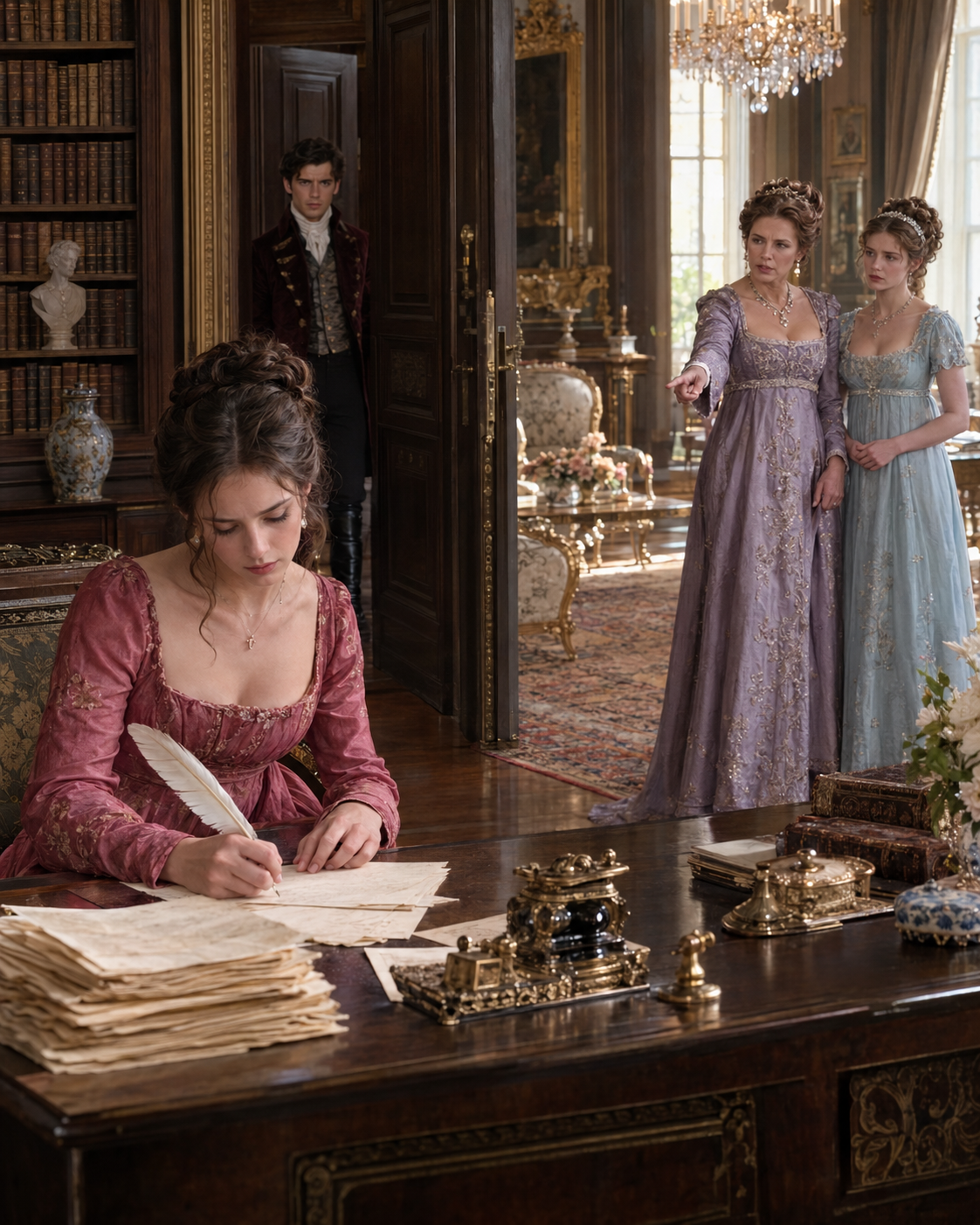
When the last document was signed, the Duke closed the folder.
“It is done.”
Beatrice looked at the papers.
“Is it?”
“Yes.”
She slowly exhaled.
Then Lady Constance spoke.
“You think this makes you free?”
Beatrice turned.
“No.”
Lady Constance smiled bitterly.
“You will discover that money does not buy happiness.”
“Perhaps not.”
“Then what have you gained?”
Beatrice looked toward the window.
The rain had stopped.
“I have gained the right to find out for myself.”
Lady Constance had no answer.
Three days later, Beatrice stood at the railway station with a single traveling case beside her.
The jewelry was secured in a small locked box.
The bank draft was hidden safely among her papers.
The ticket to Bath rested inside her glove.
For the first time in years, nobody had chosen where she would go.
She had chosen it herself.
The Duke accompanied her to the platform.
Beatrice had expected a formal farewell.
Instead, he said, “You should be careful.”
She smiled faintly.
“I thought you were going to congratulate me.”
“I would rather remind you that freedom requires responsibility.”
“That sounds less pleasant.”
“It usually is.”
She laughed.
It was the first genuine laugh she had given him.
The Duke looked toward the waiting train.
“What will you do in Bath?”
“I don’t know.”
“That concerns me.”
“Why?”
“Because you have spent so much time fighting for the right to leave that you may not have considered what comes after.”
Beatrice looked down at her ticket.
He was right.
For years, her life had been defined by escape.
Escape from her stepmother.
Escape from poverty.
Escape from humiliation.
But freedom was not simply the absence of a prison.
It required a destination.
“I will find something useful to do,” she said.
“I believe you will.”
The train whistle sounded.
Beatrice stepped toward the carriage, then paused.
“Your Grace?”
“Yes?”
“Why did you help me?”
He was silent for a moment.
“Because your father’s papers made the truth clear.”
“That is not the whole reason.”
“No.”
She waited.
The Duke looked at her steadily.
“You reminded me of someone who once believed that having no power meant having no choices.”
“And what happened to her?”
“She learned otherwise.”
Beatrice smiled.
“Then perhaps I will too.”
She boarded the train.
As the carriage began to move, she watched the Duke disappear behind a veil of steam.
For the first time, she did not wonder whether he would follow.
She knew she would be all right if he did not.
That realization mattered more than she could explain.
Bath was not the paradise she had imagined.
It was noisy.
Expensive.
Unfamiliar.
There were days when Beatrice regretted leaving.
There were mornings when she woke frightened by the knowledge that every decision was now hers.
But she discovered something unexpected.
Freedom was not always comfortable.
Sometimes it was frightening.
Sometimes it was lonely.
Sometimes it required making mistakes without anyone else to blame.
Yet it was hers.
She rented a modest house on a quiet street and began managing the money she had recovered.
She refused several marriage proposals that were clearly motivated by her inheritance.
She began corresponding with a small charitable society that provided assistance to women who had been left without financial support.
And slowly, almost without realizing it, she built a life that belonged to her.
Months passed.
Then a letter arrived from New England.
The Windham estate had been sold.
The debts were settled.
Lady Constance had left the property.
The jewelry had been appraised, and the proceeds from the missing pieces had been added to Beatrice’s account.
There was another detail.
Her father’s remaining personal papers had been transferred to her.
Among them was a letter she had never seen.
It had been written several years before his death.
Beatrice opened it with trembling hands.
“My dear Beatrice,” it began.
“If you are reading this, then circumstances have probably forced you to become stronger than I ever wished you to be. I fear that I failed you by trusting appearances and delaying difficult decisions. There are things a father believes he can repair tomorrow. Sometimes tomorrow does not come.”
Beatrice stopped reading.
Tears blurred the page.
Her father had not known what would happen.
He had not known that the ledger would save her.
He had not known that Lady Constance would eventually be exposed.
But he had known one thing.
His daughter deserved the truth.
The final lines were simple.
“Do not spend your life trying to prove that you were wronged. Build a life so honest and meaningful that the wrong done to you becomes only one chapter in a much larger story.”
Beatrice read the sentence twice.
Then she folded the letter.
For the first time, she understood that freedom was not about making Lady Constance suffer.
It was not about humiliating the people who had underestimated her.
It was not even about recovering every penny that had been taken.
Those things mattered.
But they were not the end.
The end was becoming someone who no longer needed permission to live.
Years later, people in Bath would know Beatrice as a woman of remarkable composure.
They would hear that she had once inherited a troubled estate in America.
They would hear rumors about a powerful duke, a bitter stepmother, and a hidden fortune.
Some stories would be accurate.
Others would not.
But the truth was much quieter.
A young woman had discovered one forgotten clause in an old ledger.
That clause had opened a door.
She had been brave enough to walk through it.
And that was the part people often misunderstood.
The document had not saved Beatrice by itself.
The jewelry had not saved her.
The bank draft had not saved her.
Even the Duke had not saved her.
Those things gave her an opportunity.
She was the one who chose what to do with it.
Years after leaving Windham House, Beatrice returned once to New England.
The estate was no longer hers.
The great rooms had been emptied.
The gardens were overgrown.
The place looked smaller than she remembered.
She stood beneath the old elm trees and thought about the girl she had once been.
That girl had believed that losing everything meant having nothing left.
Now Beatrice understood the opposite.
Sometimes losing what controls you is the beginning of discovering who you are.
She took the old ledger from her traveling case.
The pages were worn now.
The crucial clause was still there.
She touched the ink with one finger.
Then she closed the book.
She did not need it anymore.
The law had given her a door.
Courage had helped her open it.
But the life beyond that door had been built one decision at a time.
As she walked away from the old estate, the afternoon sun broke through the clouds.
Beatrice did not look back.
She had spent enough of her life waiting for someone else to decide her future.
Now, finally, the future belonged to her.
And perhaps that was the greatest inheritance her father had ever left behind.
Not a house.
Not jewels.
Not money.
But the knowledge that even when the world tells you that you have no choice, there may still be one small decision that remains entirely yours.
Sometimes it is hidden in a document.
Sometimes it is buried beneath years of fear.
And sometimes it is simply the courage to say, “No.”
Beatrice had discovered hers just in time.
From that day forward, she stopped measuring her life by what had been taken from her.
She measured it by what she chose to build.
And that was worth far more than any estate.
The letter remained in Beatrice’s hands long after she had finished reading it.
Outside the window, the evening light faded over the rooftops of Bath, turning the glass a soft shade of gold. The house was quiet. There were no raised voices in the hallway, no footsteps belonging to someone coming to demand an explanation, no locked doors and no instructions about where she was permitted to go.
For the first time, silence did not frighten her.
It comforted her.
She placed her father’s letter beside the old ledger and sat back in her chair.
There was one sentence she could not stop thinking about.
Build a life so honest and meaningful that the wrong done to you becomes only one chapter in a much larger story.
For years, Beatrice had believed her story began with loss.
Now she wondered whether it had actually begun with choice.
The following morning, she made a decision.
She would not simply preserve the money she had recovered.
She would use part of it to create something her mother would have been proud of.
A small foundation.
Not grand enough to attract newspapers or politicians, but practical enough to help women who found themselves in circumstances similar to those she had once endured.
Widows.
Orphans.
Women abandoned without property or legal protection.
People who possessed little more than a name and a promise that tomorrow might somehow be better.
Beatrice knew how dangerous such promises could be.
So she wanted to offer something more useful.
Education.
Legal assistance.
Temporary housing.
A chance to become financially independent.
The first year was difficult.
Some people told her she was wasting money.
Others suggested that women who had fallen into poverty had only themselves to blame.
Beatrice listened politely and continued anyway.
She had learned long ago that people who had never been trapped were often the quickest to explain why the prisoner should simply walk away.
But Beatrice knew better.
Sometimes the door was locked.
Sometimes the key belonged to someone else.
And sometimes the first step toward freedom was discovering that the lock could be challenged.
Her foundation grew slowly.
Then came the unexpected letter.
It was from the Duke of Montgomery.
Beatrice stared at his name for several moments before opening it.
He wrote from New York.
The letter was brief.
He had heard about her work.
He had also received word that a group of investors intended to establish a charitable hospital in Boston.
They wanted Beatrice to consider contributing.
At the bottom of the letter was a sentence that made her smile.
“You once told me that you did not know what you would do with your freedom. It appears you have answered the question.”
She read the line twice.
Then she wrote back.
She agreed to meet him.
Several weeks later, Beatrice returned to New England.
The journey stirred memories she had spent years putting into their proper place.
When she arrived in Boston, the city seemed larger than she remembered.
Busy streets surrounded her.
Carriages passed in both directions.
Merchants called from storefronts.
People hurried along the sidewalks with no knowledge that a woman stepping from a railway carriage was carrying an entire lifetime of memories beneath her calm expression.
The Duke was waiting outside the station.
He looked almost exactly as she remembered.
Perhaps a little older.
Perhaps less amused.
But unmistakably himself.
“You came,” he said.
“I said I would.”
“I was not certain.”
“Then you have learned very little about me.”
He smiled.
“I suppose I have.”
They walked together through the city.
Their conversation was easy at first.
They spoke about the hospital project, the foundation, and the changing financial conditions in New England.
But eventually, the conversation became personal.
“Do you ever regret leaving?” he asked.
Beatrice considered the question.
“Sometimes.”
He glanced at her.
“That is not the answer I expected.”
“I regret the pain.”
She paused.
“I do not regret choosing my own life.”
He nodded.
“And Windham House?”
“I have no desire to own it again.”
“Why?”
“Because I spent too many years believing that house represented everything I had lost.”
She looked toward the crowded street.
“It was only a house.”
The Duke was silent.
Then he asked, “And Lady Constance?”
Beatrice stopped walking.
“What about her?”
“She left America.”
“I know.”
“Do you know where she went?”
“Yes.”
He looked surprised.
“She wrote to me.”
“Why?”
“She wanted money.”
Beatrice gave a small laugh.
“Of course she did.”
“She asked whether you would provide assistance.”
“I did.”
The Duke frowned.
“You did?”
“I sent enough for her to live modestly for a year.”
“Why?”
“Because I no longer want her suffering to determine who I become.”
The Duke studied her face.
“You have changed.”
“No,” Beatrice said quietly. “I think I have finally become myself.”
That evening, they attended a private dinner with several members of the hospital committee.
During the meal, an elderly banker raised a concern.
“Miss Windham, your proposal is admirable, but charitable institutions require discipline. Sentiment alone cannot sustain them.”
Beatrice smiled.
“I agree.”
The man looked surprised.
“You do?”
“Absolutely. That is why I brought financial projections.”
She handed him a folder.
The table grew quiet as he examined the figures.
The Duke watched without interfering.
After several minutes, the banker looked up.
“You have considered every expense.”
“I had to.”
“And the long-term funding?”
“Secured.”
“By whom?”
“By me.”
The banker leaned back.
“I see.”
Beatrice folded her hands.
“I am not asking anyone to rescue these women. I am asking you to help build a system in which they can rescue themselves.”
No one spoke for several seconds.
Then the elderly banker nodded.
“I believe we can work with that.”
The hospital project was approved.
Months later, construction began.
Beatrice visited often.
She insisted on speaking with the women who would eventually use the facility.
She listened to their stories.
She learned their names.
She remembered details.
And every time someone asked why she cared so much, she gave the same answer.
“Because someone once cared enough to leave me a door.”
Not everyone understood.
But she no longer needed everyone to understand.
Her life had become quieter.
More purposeful.
And, unexpectedly, happier.
She continued corresponding with the Duke.
Their letters became more frequent.
At first, they discussed business.
Then books.
Then music.
Then small details that had no practical purpose at all.
The kind of details people share only when they have begun to matter to one another.
A year passed.
Then another.
One spring morning, Beatrice received a letter unlike the others.
The Duke had written only a few lines.
He wanted to see her.
Not in a committee room.
Not at a business dinner.
Not because of an estate or a contract.
Just her.
She traveled to New York.
He met her in Central Park.
The trees were beginning to bloom.
For a while, neither spoke.
Then the Duke said, “I have been thinking about the first day we met.”
“I remember it well.”
“You were angry.”
“I had reason to be.”
“You were frightened.”
“I was.”
“And yet you stood your ground.”
Beatrice smiled.
“I was terrified.”
“I know.”
She looked at him.
“You knew?”
“From the beginning.”
“Then why did you not say so?”
“Because I suspected you would have hated me for noticing.”
She laughed.
“That is probably true.”
The Duke took a slow breath.
“There is something I would like to ask you.”
Beatrice looked at him.
He reached into his coat.
For one brief moment, she thought he was holding another legal document.
Then she saw the small box in his hand.
Her expression changed.
“You cannot be serious.”
“I am.”
He opened the box.
Inside was a ring.
Simple.
Elegant.
Nothing like the extravagant jewelry Lady Constance had once hidden away.
“This belonged to my grandmother,” he said. “She gave it to my mother. My mother gave it to me.”
Beatrice looked at the ring but did not immediately take it.
“What happens if I say no?”
“Then I will accept your answer.”
“And the hospital?”
“Will continue.”
“The foundation?”
“Will continue.”
“My work?”
“Will continue.”
“My independence?”
He smiled.
“I would expect nothing less.”
Beatrice looked at him for a long moment.
Then she placed her hand in his.
“Yes.”
The word was quiet.
But it carried more weight than any signature she had ever written.
They married the following autumn in a small ceremony.
There were no extravagant celebrations.
No attempt to impress society.
Only close friends, a few relatives, and several women from Beatrice’s foundation who had become part of her life.
She did not abandon her work after marriage.
The Duke did not ask her to.
Instead, he supported it.
Together, they expanded the foundation across several American cities.
Years later, when historians wrote about the charitable reforms of that period, Beatrice’s name appeared in places she never expected.
She never cared much for recognition.
She cared about results.
A woman finding employment.
A widow keeping her home.
A girl receiving an education.
A family escaping debt.
Those were the victories that mattered.
One winter evening, many years after the events at Windham House, Beatrice returned to her study.
The old ledger sat on a shelf.
She had kept it all these years.
Her husband entered quietly.
“You are still keeping that?”
“Yes.”
“Why?”
She touched the worn cover.
“Because I want to remember.”
“Remember what?”
“That freedom can begin with something very small.”
He looked at the ledger.
“A line in a book.”
“A line in a book.”
“And you?”
Beatrice smiled.
“I was the person who finally read it.”
He kissed her forehead.
Then he left her alone.
Beatrice opened the ledger one final time.
The crucial clause was still visible.
The ink had faded slightly.
She ran her finger beneath the words.
Once, that sentence had represented a lifeline.
Now it represented something else.
Proof.
Proof that the smallest overlooked detail could matter.
Proof that knowledge could become power.
Proof that a person who understood her rights could stand where fear had once told her to kneel.
She closed the book.
There was no bitterness in her heart anymore.
Not toward Lady Constance.
Not toward her father.
Not even toward the years she had lost.
Those years had shaped her.
They had taught her caution, courage, patience, and compassion.
But they no longer owned her.
Beatrice walked to the window.
Snow was falling over the garden.
She watched the flakes disappear into the darkness.
Then she thought of the girl she had once been.
A frightened young woman standing in an old American estate with no idea what the future held.
That girl had believed freedom would feel like victory.
She had been wrong.
Freedom felt quieter than that.
It felt like waking up and knowing that the day belonged to you.
It felt like making a decision without fear of punishment.
It felt like helping someone else without needing anything in return.
It felt like being able to forgive without forgetting.
And most of all, it felt like no longer measuring your worth by what someone else had taken from you.
Beatrice had not inherited freedom.
She had built it.
Piece by piece.
Choice by choice.
Day by day.
And that was the true meaning of her father’s final gift.
The ledger had shown her the way out.
But she had been the one brave enough to walk through the door.
Years later, when a young woman from the foundation asked Beatrice how she had managed to change her life, Beatrice did not tell her about the Duke.
She did not tell her about the jewelry.
She did not tell her about the bank draft.
She simply answered:
“Learn what is yours. Protect it. And when the moment comes, do not be afraid to choose your own future.”
The young woman asked, “Even if everyone tells you that you cannot?”
Beatrice smiled.
“Especially then.”
Outside, the bells of the city began to ring.
Beatrice turned back toward her work.
There would always be another letter to answer.
Another woman who needed help.
Another difficult decision waiting to be made.
And she welcomed it.
Because her story had never truly been about an estate, a fortune, or a powerful man who arrived at precisely the right moment.
It had been about a woman discovering that she was not as powerless as she had been taught to believe.
The estate was gone.
The jewels were gone.
The old bitterness was gone.
But what remained was far more valuable.
A life chosen freely.
A purpose built with courage.
And a legacy that could continue long after the names in an old ledger had faded.
Beatrice closed the study door and walked down the hallway.
She did not look back.
She no longer needed to.
Her past had finally become what it should have been all along:
not a prison,
but a chapter.
And the story that followed belonged entirely to her.
THE END.