In the heart of nineteenth-century America, where old money carried more weight than a woman’s dreams, Ara Vance had learned one painful truth: a beautiful title could still leave a woman feeling completely alone.
The first winter after Ara opened the school arrived early in Virginia.
By December, frost covered the iron gates of Blackwood Manor, and the long road leading to the estate disappeared beneath a thin veil of snow.
Inside the great house, however, something had changed.
Ara was no longer waiting by the drawing-room window for Alexander to return.
She no longer asked the servants whether he had arrived.
She no longer rearranged her evenings around a husband who rarely bothered to tell her when he would be home.
Instead, her days belonged to her school.
Every morning, a carriage carried her into town, where the former warehouse she had purchased had been transformed into a bright, orderly academy.
There were classrooms with tall windows, a small library, a sewing room, and a kitchen where the girls learned practical skills alongside reading, arithmetic, and bookkeeping.
Ara had given the school her name, but she refused to make it a monument to herself.
She wanted it to become a place where young women could discover that their futures did not have to be decided by the circumstances of their birth.
The first time Alexander visited, he had expected to see a charitable project that would eventually lose momentum.
Instead, he found thirty-two students.
Then forty.
Then nearly fifty.
He stood in the doorway one afternoon and watched Ara move among them.
She was explaining a lesson to a girl named Margaret, who had been unable to afford formal schooling before Ara offered her a place.
Ara’s face was different when she was there.
Lighter.
Warmer.
Alive.
Alexander realized, with an uncomfortable ache, that he had never seen his wife look at him that way.
“You have been busy,” he said.
Ara turned.
“I have.”
Nothing more.
No accusation.
No attempt to impress him.
That somehow unsettled him more than anger would have.
He glanced around the room.
“You built all this?”
“Not alone.”
Her eyes moved toward the teachers.
“They helped.”
Alexander looked at her again.
“And you are happy?”
Ara hesitated for only a moment.
“Yes.”
The answer struck him with surprising force.
He had spent years assuming that Ara’s unhappiness was simply the natural consequence of a marriage neither of them had chosen.
Now he understood something far more troubling.
Her happiness existed perfectly well without him.
Before he could say anything else, a familiar voice came from behind him.
“Your Grace.”
Lord Henry Ashford entered carrying several books beneath one arm.
He smiled when he saw Ara.
“I found the accounting manuals you requested.”
Ara’s expression softened.
“Thank you, Henry. I was beginning to think the publisher had forgotten us.”
“Not likely. I reminded him twice.”
Henry placed the books on the table.
Alexander watched the exchange in silence.
There was nothing improper about it.
That was precisely what made it difficult.
Henry respected Ara.
He listened when she spoke.
He noticed what she needed.
And, unlike Alexander, he did not seem afraid of showing her that he valued her.
During the following weeks, Henry became a regular visitor.
He helped secure donations.
He spoke to merchants who agreed to provide supplies at reduced prices.
He even arranged for several young women to receive apprenticeships with businesses in Richmond.
Alexander began hearing his name everywhere.
Henry Ashford had done this.
Henry had arranged that.
Henry had spoken to someone.
Henry had visited the school.
At first, Alexander told himself he was simply concerned about appearances.
Then he caught himself asking the same question whenever Ara returned home.
“Was Ashford there?”
Ara would remove her gloves and look at him calmly.
“Sometimes.”
“Sometimes?”
“He helps with the school.”
“I see.”
But he did not see.
Not at all.
One evening, Alexander found Ara in the library.
She was reading correspondence by the fire.
He stood in the doorway longer than necessary.
“Did Ashford visit today?”
Ara lowered the letter.
“Yes.”
“What did he want?”
“To discuss the new apprenticeship program.”
Alexander’s jaw tightened.
“I could help with that.”
Ara looked at him.
“You could.”
The words were polite.
But something in her expression made him uncomfortable.
“Then perhaps I should.”
“If you wish.”
He waited for gratitude.
It never came.
Instead, Ara returned to her letter.
Alexander left the room with an unfamiliar frustration burning in his chest.
He had spent years being indifferent to the things Ara wanted from him.
Now he was beginning to understand what it felt like to want something from her and receive nothing in return.
That realization should have made him ashamed.
Instead, it made him afraid.
The fear became impossible to ignore at a winter charity ball in Washington.
The Blackwoods were expected to attend, and Ara had accepted because several prominent families had agreed to support the school.
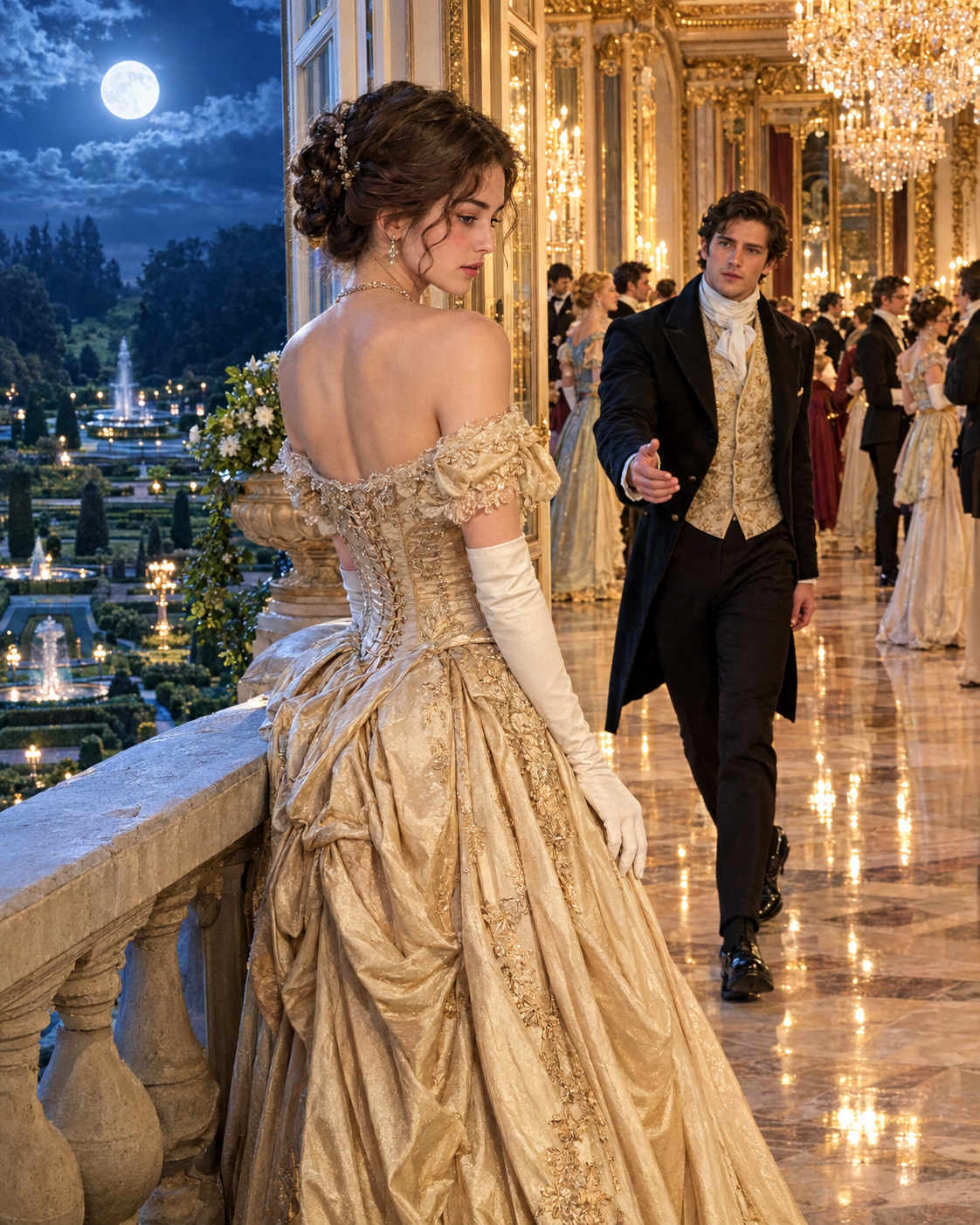
The ballroom glittered beneath hundreds of gas lamps.
Music filled the air.
Politicians, businessmen, old families, and ambitious young heirs moved between tables and conversation circles.
Ara entered wearing a deep blue gown that seemed almost black beneath the chandeliers.
Alexander saw heads turn.
For years, he had been so accustomed to Ara that he had forgotten the effect she could have on a room.
Henry did not forget.
He approached her with a smile.
“You look beautiful.”
Ara smiled.
“Thank you.”
Alexander watched from across the ballroom.
Lady Cecily appeared beside him.
“You seem distracted.”
“I am not.”
Cecily followed his gaze.
“Ah.”
Alexander looked at her.
“What?”
She smiled faintly.
“Nothing.”
But the word carried a meaning he did not like.
Later, Henry asked Ara to dance.
She accepted.
Alexander felt something twist sharply inside him.
It was ridiculous.
He had danced with Cecily countless times.
He had ignored Ara’s loneliness for years.
Yet watching another man place his hand at Ara’s waist made it suddenly difficult to breathe.
When the dance ended, Alexander crossed the ballroom before he had fully decided to do so.
“Ara.”
She turned.
“Alexander.”
“I need to speak with you.”
“About?”
“Privately.”
Ara glanced toward Henry.
“I’ll see you later.”
Henry nodded.
Alexander led her toward a quiet corridor.
For several seconds, neither spoke.
Then Alexander said, “You seem very comfortable with Ashford.”
Ara’s expression became still.
“I am.”
“He seems particularly interested in you.”
“Perhaps.”
“You don’t find that inappropriate?”
“No.”
The simplicity of her answer stunned him.
“Ara, you are my wife.”
She looked directly at him.
“Am I?”
The question was quiet.
But Alexander felt as though she had struck him.
“You know what I mean.”
“No,” she said. “I know what the papers say. I know what society calls me. I know what our marriage requires legally. But I have spent a long time wondering what I am to you.”
Alexander opened his mouth.
Nothing came.
Ara looked away.
“I used to hope you would answer that question for me.”
Her voice remained calm.
“I don’t anymore.”
Then she walked away.
Alexander stood alone in the corridor.
For the first time in his life, he understood that silence could be more devastating than any accusation.
The next morning, he went to see Lady Cecily.
He found her in her family’s drawing room, sorting correspondence.
“You were right,” he said.
She looked up.
“About what?”
“I was a fool.”
Cecily studied him for a long moment.
“That is unusually honest of you.”
“I thought Ara would always be there.”
Cecily placed the letter aside.
“She probably thought the same thing.”
Alexander sat down.
“I don’t know how to fix this.”
“Then start by understanding what you broke.”
He looked at her.
Cecily’s expression softened.
“You never loved me, Alexander.”
He frowned.
“What?”
“You admired the version of yourself you could be around me. We had history. Familiarity. It was easy.”
She paused.
“But Ara frightened you.”
“Why?”
“Because you actually loved her.”
Alexander went completely still.
Cecily continued quietly.
“And loving someone gave her the power to hurt you. So you chose distance instead.”
The truth landed with brutal clarity.
Alexander remembered the beginning of their marriage.
He had been twenty-eight, already carrying the weight of his family’s expectations.
Ara had entered Blackwood Manor as a young woman who had lost control of her future because of her family’s debt.
He had told himself that keeping his distance would protect them both.
He had convinced himself that affection would make the arrangement more painful.
So he had built walls.
Then he had lived behind them so long that he forgot he was the one who built them.
When Alexander returned home that evening, Ara was preparing to leave for the school.
“May I come with you?” he asked.
She looked surprised.
“Why?”
“I want to see what you do.”
“You’ve already seen it.”
“I want to understand it.”
Ara studied him.
For a moment, he expected her to refuse.
Instead, she nodded.
“Very well.”
It was not forgiveness.
But it was the first door she had left unlocked.
Alexander began visiting the school.
Not once.
Not for appearances.
Regularly.
He learned the names of the students.
He listened to their concerns.
He repaired a broken fence himself when the contractor failed to arrive.
He arranged heating supplies before the next cold spell.
When Ara thanked him, he simply said, “You shouldn’t have to do everything alone.”
She looked at him for a long time.
“No,” she said. “I shouldn’t.”
Weeks passed.
Alexander never asked her to forgive him.
That mattered.
He began understanding that an apology was not a key that could unlock everything at once.
Trust had been damaged slowly.
It would have to be rebuilt slowly too.
One afternoon, Margaret came running into the schoolroom with a letter in her hand.
“Your Grace! I was accepted!”
Ara smiled.
“Accepted where?”
“The apprenticeship in Richmond!”
The girl threw her arms around Ara.
Alexander watched from the doorway.
Ara laughed.
A genuine, unguarded laugh.
Something inside him softened.
He realized then that his love for her could no longer be about possessing her.
If he truly loved Ara, he had to want her happiness even if that happiness eventually existed without him.
That was the moment he stopped trying to win her back.
And strangely, it was also the moment Ara began to believe that perhaps he could.
Spring came to Virginia.
The school expanded into another building.
More donations arrived.
The girls began teaching younger children on weekends.
Ara became known beyond Washington and Richmond as a woman who had built something meaningful from a life that had once been chosen for her.
Alexander never tried to stand in front of her achievements.
He stood beside them.
When newspapers praised the Duchess of Blackwood, he was proud.
When society criticized her independence, he defended her.
And when someone suggested that a duchess should spend more time managing her household and less time educating young women, Alexander calmly replied that his wife had brought greater honor to the Blackwood name than any formal ceremony ever could.
Ara heard about the comment later.
She did not mention it.
But that evening, she left a cup of tea on his desk without being asked.
Alexander stared at it for several seconds.
It was such a small gesture.
Yet he understood its meaning.
Months later, on a warm evening in June, Ara stood outside the school as the final students left for summer.
Alexander approached her.
“I have something to say.”
Ara smiled faintly.
“You always say that before saying something difficult.”
“This time, I hope it isn’t difficult for you.”
He took a breath.
“I love you.”
Ara’s smile disappeared.
Not because she was angry.
Because the words carried the weight of everything that had happened before them.
Alexander continued.
“I think I have loved you for years. I was simply too afraid of what loving you meant.”
He looked at her.
“I thought distance would protect me. Instead, it hurt you.”
Ara said nothing.
“I cannot ask you to forget that.”
He swallowed.
“And I cannot promise that I will suddenly become the perfect husband. But I can promise that I will spend the rest of my life trying to become a better one.”
Ara looked toward the school.
“Why now?”
“Because I finally understand that you were never something I was entitled to keep.”
He paused.
“You were someone I was supposed to choose.”
Her eyes filled with tears, though she quickly looked away.
“And if I don’t choose you?”
“Then I will still be grateful that you taught me what love should have looked like.”
Silence settled between them.
Then Ara stepped closer.
“I don’t want the man you were.”
“I know.”
“I don’t want promises made because you’re afraid of losing me.”
“I know.”
“I want a husband who chooses me when nobody is watching.”
Alexander nodded.
“Then let me prove it.”
Ara looked at him for a long moment.
“One day at a time.”
“One day at a time.”
She reached for his hand.
It was not a grand declaration.
There were no witnesses.
No applause.
No society pages waiting to record the moment.
Just two people standing outside a school in Virginia, finally meeting each other without the walls they had spent years hiding behind.
Their marriage did not become perfect overnight.
There were still misunderstandings.
Still difficult conversations.
Still old wounds that sometimes reopened.
But now they talked.
Alexander learned to listen before defending himself.
Ara learned that accepting love did not mean surrendering her independence.
They became partners rather than strangers sharing a title.
Years later, the school had grown into one of the most respected institutions for young women in the region.
At its anniversary celebration, Ara stood before hundreds of guests.
Alexander sat among them, not beside her, because he knew the moment belonged to her.
She spoke about opportunity, courage, and the importance of giving young women the freedom to imagine a life beyond what others expected of them.
When she finished, the room rose in applause.
Alexander stood last.
Not because he was slow.
Because he had been watching her.
The woman who had once waited by a window for his attention now stood beneath the same Virginia sky, surrounded by students whose futures had changed because she refused to surrender her own.
After the celebration, they walked together through the quiet grounds.
“You know,” Ara said, “I never imagined this when I first came to Blackwood.”
“What did you imagine?”
“Survival.”
Alexander looked at her.
“And now?”
Ara smiled.
“Living.”
He took her hand.
There were many things their marriage had once been.
An arrangement.
A debt.
A duty.
A beautiful name covering an empty room.
But love had taught them something neither had understood at the beginning.
A marriage could not be saved by titles, appearances, or promises made at the right moment.
It was saved by the small choices made every day.
By listening.
By showing up.
By respecting another person’s dreams.
By admitting when pride had caused harm.
And, most importantly, by understanding that love was never about owning another person’s heart.
It was about becoming worthy of being trusted with it.
Ara had stopped waiting for Alexander to love her.
And that was exactly when he finally learned how.
Their second chance did not erase the past.
It gave the past a different meaning.
The cold years became a reminder of what silence could destroy.
The school became proof of what courage could build.
And their marriage became something neither of them had been given at the altar.
It became something they chose, again and again, every single day.
Years passed, but Ara never forgot the woman she had once been.
Sometimes, on quiet evenings when the last carriage had disappeared down the road and the halls of Blackwood Manor had fallen silent, she would stand beside the same window where she had once waited for Alexander.
The view had not changed much.
The Virginia hills still stretched beyond the gardens.
The old oak trees still stood along the drive.
The wind still moved through the branches in the same restless rhythm.
But Ara was no longer waiting.
That difference meant everything.
One autumn afternoon, nearly a decade after the opening of the school, Ara received a letter that made her hands tremble.
It was from Margaret.
The girl who had once arrived at the school with nothing but a worn dress and a determination to learn had become a teacher herself.
She had married a kind man, but more importantly, she had built a life that belonged entirely to her.
The letter announced that Margaret had opened a small school of her own in Pennsylvania.
At the bottom of the page, she had written a sentence that stayed with Ara long after she finished reading.
You taught me that my circumstances were not the same thing as my destiny.
Ara pressed the letter against her heart.
Alexander found her there.
“Good news?”
She handed him the letter.
He read it silently.
Then he smiled.
“You must be proud.”
“I am.”
He returned the letter.
“She learned from you.”
Ara shook her head.
“No. She learned from herself. I only gave her a door.”
Alexander looked at his wife with the same quiet admiration that had replaced the uncertainty of their early marriage.
“And she walked through it.”
Ara smiled.
“Exactly.”
Their relationship had changed in ways neither of them could have predicted.
Alexander no longer treated her independence as something that threatened him.
Ara no longer mistook his quiet nature for indifference.
They had learned each other’s language.
His was often found in actions rather than words.
Hers was often found in honesty rather than silence.
There were evenings when they disagreed.
There were mornings when old habits returned.
Sometimes Alexander became too protective.
Sometimes Ara became too determined to carry every burden herself.
But they had learned to recognize those moments before they became walls.
“Tell me,” Alexander would say.
And Ara had learned that those three words were more powerful than any grand declaration.
Tell me.
Not defend yourself.
Not explain yourself.
Not be quiet.
Tell me.
And she did.
Likewise, when Alexander struggled to speak about his fears, Ara no longer assumed silence meant rejection.
She waited.
She listened.
And slowly, the man who had once hidden behind emotional distance learned that vulnerability did not make him weak.
It made him honest.
One spring morning, the school celebrated its tenth anniversary.
The grounds were filled with former students, teachers, families, and supporters.
There were speeches beneath white tents.
Children ran between the gardens.
Older women who had once believed education was beyond their reach sat proudly beside daughters and granddaughters.
Ara stood near the entrance as the guests arrived.
She wore a simple cream-colored dress.
There was no need for extravagant jewelry.
No need to remind anyone that she was a duchess.
Her work had already made her name mean something.
Alexander approached from behind.
“You’ve been standing here for an hour.”
Ara glanced at him.
“And you’ve been watching me for an hour.”
“I have.”
“Why?”
He smiled.
“Because I still can’t believe how much you’ve done.”
She raised an eyebrow.
“After ten years?”
“Especially after ten years.”
She laughed softly.
Then she noticed a young woman standing nervously near the gate.
The girl could not have been more than seventeen.
Ara immediately walked toward her.
“Are you looking for someone?”
The girl nodded.
“I was told to come here. My father says I should learn bookkeeping, but I’m afraid I won’t be good enough.”
Ara smiled.
“Being afraid doesn’t mean you aren’t capable.”
The girl looked uncertain.
“How do I know?”
Ara glanced briefly toward the school.
“You don’t.”
The girl frowned.
“You don’t?”
“No. Not yet.”
Ara offered her hand.
“That’s why you come inside and find out.”
The girl took it.
Alexander watched them disappear through the doors.
He felt the familiar warmth in his chest.
He had once thought Ara’s strength was something that made her difficult to love.
Now he understood it was one of the reasons he loved her so deeply.
That evening, after the celebration ended, Ara and Alexander walked through the gardens.
The sky above Virginia had turned deep violet.
Lanterns glowed along the path.
For a while, neither spoke.
Then Alexander said, “Do you ever regret it?”
Ara looked at him.
“Regret what?”
“Us.”
She stopped walking.
He immediately knew from her expression that the question mattered.
“I regret the years we lost,” she said.
Alexander lowered his gaze.
“So do I.”
“But I don’t regret what we became.”
He looked at her.
“Why?”
“Because I don’t think I would be the woman I am without everything that happened.”
She paused.
“And you wouldn’t be the man you are.”
Alexander smiled sadly.
“That sounds almost like forgiveness.”
“It isn’t.”
His smile faded.
Ara stepped closer.
“It’s something better.”
“What?”
“Understanding.”
For a moment, the garden was completely silent.
Then Alexander took her hand.
“I used to think love meant finding someone who made life easy.”
“And now?”
“Now I think love means finding someone whose life you are willing to understand.”
Ara smiled.
“That’s a much harder definition.”
“I’ve always preferred difficult lessons.”
She laughed.
He squeezed her hand.
They continued walking.
Neither of them knew what the future would bring.
There would be more years.
More students.
More difficult decisions.
Perhaps more losses.
Perhaps unexpected joys.
But they no longer feared the uncertainty.
They had already survived the greatest danger to their marriage.
Not another person.
Not scandal.
Not society.
Not even the coldness of their beginning.
The greatest danger had been the belief that love could survive without being expressed.
They had learned otherwise.
A heart could wait for only so long.
A marriage could endure only so much silence.
And sometimes the person standing beside you was not the person you were meant to possess, but the person you were meant to continually choose.
Ara had once entered Blackwood Manor believing that her life had been decided by a debt she did not create.
She had believed her title was a cage.
She had believed her husband’s indifference was something she simply had to endure.
Then she stopped waiting.
She built a school.
She built a purpose.
She built a life.
And somewhere along the way, she discovered something even more important.
She did not need Alexander to save her.
He needed to learn how to stand beside her.
That difference changed everything.
Years later, when people told the story of the Duchess of Blackwood, they often spoke about her school.
They spoke about the hundreds of young women who had passed through its doors.
They spoke about her influence in Virginia and beyond.
They spoke about the remarkable marriage between Ara and Alexander Blackwood, a union that had survived years of distance and somehow become one of genuine devotion.
But the truth was simpler.
Ara had saved herself first.
Alexander had finally learned that loving her meant respecting the woman she had become.
And together, they built something that neither duty nor wealth could have created for them.
A home.
Not merely a mansion.
Not merely a title.
A home in which both of them could finally breathe.
On the final evening of another summer, Ara returned to Blackwood Manor after a long day at the school.
Alexander was waiting in the garden.
He had two cups of tea on the table.
She looked at him and smiled.
“You waited.”
“I did.”
“How long?”
“Not long.”
She laughed.
“You’ve become a terrible liar.”
“I learned from experience.”
She sat beside him.
For a while, they watched the sunset spread across the Virginia countryside.
Then Alexander reached for her hand.
Ara rested her head against his shoulder.
No grand confession followed.
No dramatic promise was necessary.
They had already made the promise in a thousand ordinary ways.
In every conversation.
Every compromise.
Every difficult morning.
Every evening when one of them stayed instead of walking away.
The woman who had once waited by the window had finally stopped waiting.
And the man who had once been too afraid to love her had finally learned that love was not something to hide behind pride.
It was something to practice.
Every day.
For the rest of their lives.
And that became the real legacy of the Duchess of Blackwood.
Not the title.
Not the estate.
Not the wealth.
But the lesson she left behind for every young woman who entered her school:
Your beginning may be chosen for you.
Your circumstances may be beyond your control.
But your future does not belong to anyone else.
You may choose what kind of life you build.
You may choose when to stop waiting.
And when love finally comes, it should never ask you to become smaller.
It should give you room to become more fully yourself.
Ara had once feared that she would spend her entire life being a stranger inside her own marriage.
Instead, she became the author of her own life.
And, in the end, Alexander did not become the man who rescued the Duchess of Blackwood.
He became the man who finally understood that she had never needed rescuing.
She had only needed someone brave enough to walk beside her.
And this time, he did.
THE END.