In the grand world of 19th-century America, where family names could open doors and fortunes could quietly decide the fate of a marriage, Margaret Thorne had learned one lesson very early: being underestimated could be a dangerous kind of freedom.
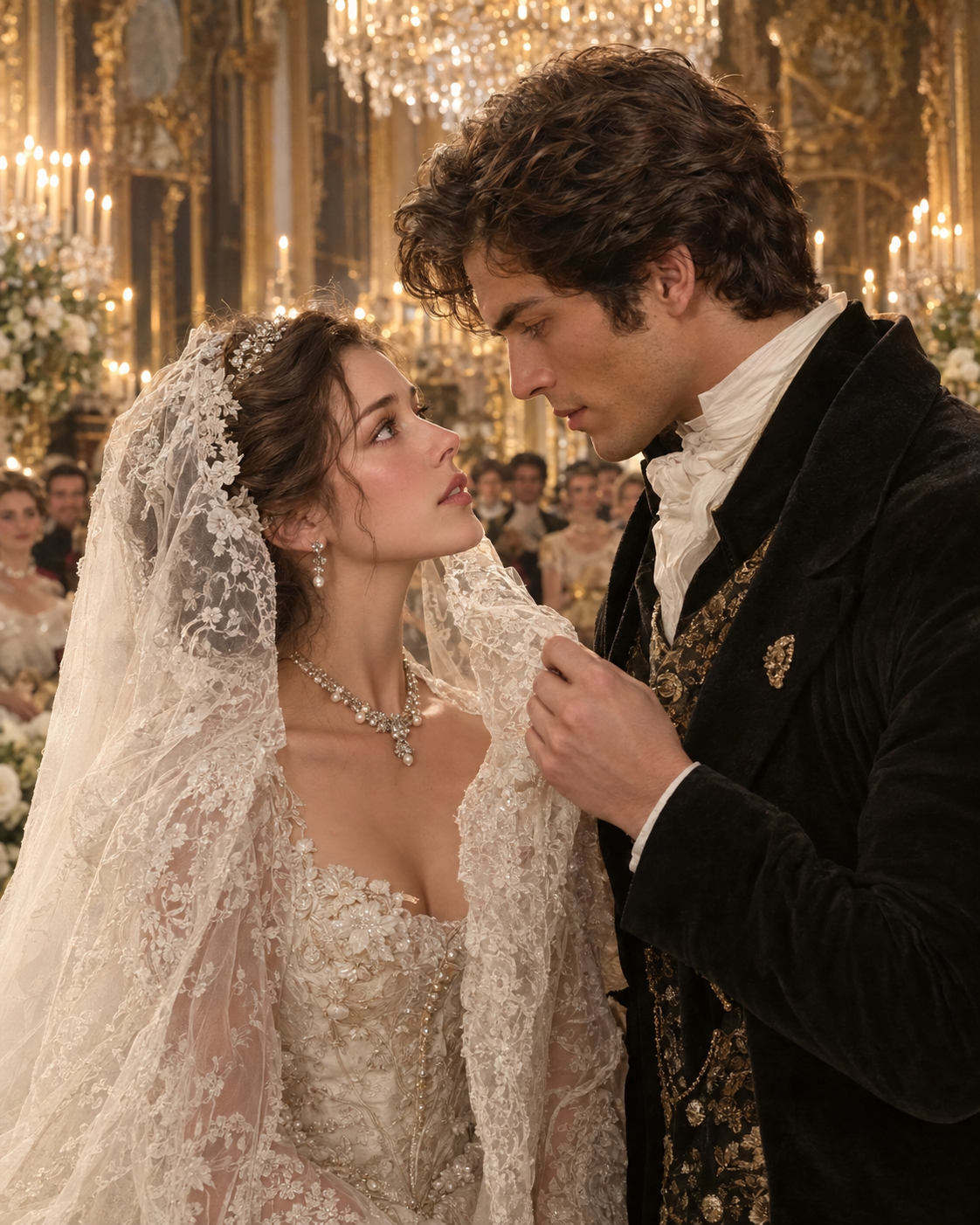
The wedding reception had barely begun when Thomas Ashford realized that every person in the room was watching Margaret.
Not because she had done anything dramatic.
Not because she had spoken out of turn.
Simply because the woman beneath the veil was not the woman he had been prepared to meet.
For weeks, Thomas had imagined a very different bride.
His future wife, according to the Thorne family, was tall in an unfortunate way, plain in appearance, awkward in company, and so lacking in social confidence that she would be grateful simply to become a duchess.
He had accepted those descriptions because they suited his circumstances.
The Ashford estate was in serious financial trouble.
Several American investments had failed.
Debts had accumulated.
Property taxes had increased.
And the annual expenses required to maintain the Ashford name were becoming impossible to meet.
Margaret’s dowry was substantial enough to give him breathing room.
That was the reason he had agreed to the marriage.
Nothing more.
At least, that was what he had told himself.
But now Margaret stood beside him beneath the chandeliers of the reception hall, her posture graceful and composed, her expression calm while whispers moved through the gathering like wind through dry grass.
Thomas glanced toward her.
She noticed.
“You are staring,” she said quietly.
“I was told you would be difficult to look at.”
For the first time that evening, the corner of Margaret’s mouth lifted.
“And I was told you would be unpleasant to speak with.”
Thomas almost laughed.
Instead, he studied her carefully.
“You were warned about me?”
“Repeatedly.”
“And yet you married me.”
“So did you.”
That answer stayed with him.
It was the first sign that Margaret Thorne was not going to behave like the obedient bride he had expected.
During dinner, Thomas watched her speak with several guests.
She was not loud.
She did not dominate conversations.
But whenever she answered a question, people listened.
She understood agricultural markets.
She knew the difference between an investment that was temporarily struggling and one that was fundamentally unsound.
She could discuss shipping costs, crop prices, banking arrangements, and land values without once appearing impressed by her own knowledge.
Thomas began to wonder how much of the story about her had been deliberately constructed.
The answer came sooner than he expected.
Three days after the wedding, Margaret asked to see the estate accounts.
Thomas looked up from his desk.
“No.”
She remained standing across from him.
“You did not even ask why.”
“I know why.”
“Then you know I can help.”
Thomas leaned back.
“I have accountants.”
“Yes.”
“Advisers.”
“Yes.”
“Stewards.”
“Several.”
“And yet you are asking for the accounts.”
“I am not asking for them,” Margaret said. “I am telling you that I need to see them.”
He stared at her.
For a moment, neither spoke.
Then Thomas noticed something in her expression.
It was not arrogance.
It was certainty.
“Why?”
“Because your estate is losing money faster than a respectable agricultural property should.”
Thomas frowned.
“How would you know that?”
“Your steward mentioned it at breakfast.”
“He did?”
“Not directly.”
Margaret crossed the room and placed a small notebook on his desk.
“He complained that the harvest was poor. Then he complained that transportation costs had increased. Then he complained that labor had become expensive. Three explanations for one problem.”
Thomas opened the notebook.
Inside were figures.
Carefully organized figures.
Dates.
Names.
Expenses.
Comparisons.
He looked up.
“How long have you been doing this?”
“Since I was sixteen.”
“Why?”
“My father believed girls should understand enough arithmetic to manage household expenses.”
Thomas looked at the pages again.
“And you did more than that.”
“Yes.”
“Why didn’t anyone know?”
Margaret’s expression changed.
“Because I was encouraged not to speak.”
Thomas understood immediately.
Her family had not merely underestimated her.
They had trained her to underestimate herself.
The realization disturbed him.
Over the following week, Margaret examined the estate records.
She found discrepancies almost immediately.
A shipment of grain had been recorded at one price in the estate ledger and another price in the merchant’s receipt.
Several repairs had been charged twice.
A group of workers appeared on payroll records, but no one at the estate could remember seeing them.
Thomas initially resisted the conclusion.
“This could be incompetence.”
“It could.”
“You think it is theft.”
“I think we should find out.”
They began quietly.
Margaret asked questions.
Thomas watched.
They visited warehouses without warning.
They examined contracts.
They compared invoices with bank records.
Slowly, a pattern emerged.
Money was leaving the Ashford estate through small transactions that appeared harmless individually.
Together, they represented a fortune.
The person signing many of the documents was Thomas’s senior estate manager, Edwin Hale.
Hale had served the Ashford family for twelve years.
Thomas trusted him completely.
When Thomas confronted him, Hale appeared offended.
“I have devoted my life to this estate.”
Margaret sat silently beside her husband.
Hale turned toward her.
“With respect, Your Grace, these matters are complicated. Perhaps Her Grace has misunderstood the records.”
Margaret looked at him.
“No.”
The room became silent.
She slid three documents across the table.
“These invoices carry different prices.”
Hale glanced down.
She continued.
“The merchants confirm the lower amount. Your records show the higher amount.”
Hale swallowed.
“That is an accounting error.”
“Then why does the difference appear in twenty-three transactions?”
He had no answer.
Thomas felt something cold settle in his chest.
He had trusted this man.
Worse, he had almost allowed himself to believe Margaret was interfering where she did not belong.
Hale was dismissed within the month.
A formal investigation followed.
The losses were substantial, but not enough to destroy the estate.
Margaret had found the leak before it became fatal.
Thomas never forgot that.
Neither did the people around him.
Word spread through their social circle.
The supposedly plain, inconvenient bride had saved the Ashford estate.
But Margaret did not enjoy the attention.
She had learned too early that praise could become another form of control.
Instead, she asked Thomas for something unexpected.
“I want my own account.”
Thomas looked at her.
“Your dowry already belongs to you.”
“On paper.”
He understood.
She wanted control.
Independent control.
“No one in my family has ever allowed me to manage my own money,” she said.
“Then they were wrong.”
“I need more than your agreement.”
“What do you need?”
“A legal arrangement that prevents anyone from accessing my funds without my permission.”
Thomas was silent.
Then he nodded.
“You shall have it.”
Margaret studied him.
“You are not going to argue?”
“I have learned that arguing with you is expensive.”
She smiled.
“That is the first sensible thing you have said all week.”
Their relationship changed after that.
Not suddenly.
Not dramatically.
But steadily.
They began working together.
Thomas learned that Margaret preferred strong coffee, disliked elaborate parties, and could become terrifyingly quiet when she was angry.
Margaret learned that Thomas carried guilt about his father’s failures and had spent years trying to preserve a family name he had never truly wanted.
They began having conversations that had nothing to do with money.
They talked about books.
Politics.
Industry.
The changing American economy.
The future.
One evening, Thomas found Margaret sitting alone in the library.
A letter lay open before her.
He recognized the handwriting.
Her mother.
Margaret folded the letter.
“My family wants to visit.”
Thomas sat across from her.
“Do you want them here?”
“No.”
“Then they should not come.”
She looked at him.
“You make it sound simple.”
“It is simple.”
“My father will say the marriage has changed me.”
Thomas smiled faintly.
“Has it?”
“Yes.”
“How?”
Margaret thought about it.
“I no longer believe everything they tell me.”
Thomas nodded.
“Good.”
Her family arrived two weeks later.
The meeting was cordial at first.
Her mother commented on the size of the house.
Her father asked about the estate.
Then came the questions.
“How much influence does Margaret have over your finances?”
Thomas answered calmly.
“Enough.”
Her father frowned.
“That seems unwise.”
“It has proven quite wise.”
Margaret remained silent.
Her father turned toward her.
“We are only concerned for you.”
She looked at him.
“Were you concerned for me when you told me no man would want me unless I made myself useful?”
Her mother’s face tightened.
“That is not what we said.”
“You told me I was too tall.”
Silence.
“You told me I was too plain.”
Another silence.
“You told me I should be grateful for any respectable man willing to overlook my appearance.”
Thomas’s expression hardened.
Margaret continued.
“And you told me that if I ever married, I should never expect to have control over money because I was incapable of understanding it.”
Her father looked toward Thomas.
“You must understand that she has always been sensitive.”
Thomas leaned forward.
“No. She has been accurate.”
The room became completely still.
Her father looked stunned.
Thomas continued.
“Your daughter identified financial irregularities in my estate that three professional advisers failed to find.”
Margaret’s father said nothing.
“She saved this family from serious losses.”
Margaret’s mother looked at her daughter differently then.
Not with affection.
With calculation.
That was when Margaret finally understood something.
They had never truly believed she was incapable.
They had simply benefited from convincing her that she was.
She stood.
“I think we have finished.”
Her father tried to stop her.
“Margaret.”
She turned.
“I am not angry anymore.”
He looked surprised.
“That is all you have to say?”
“No.”
She paused.
“I am finished trying to become the daughter you wanted.”
Then she walked away.
Thomas followed.
They reached the corridor before he spoke.
“You were very brave.”
Margaret shook her head.
“No. I was very tired.”
He looked at her.
“Tired of what?”
“Being afraid that if I told the truth, I would lose everyone.”
Thomas was quiet.
“And now?”
“Now I know that keeping people who require me to lie about myself is not the same as being loved.”
Thomas stopped walking.
Margaret turned toward him.
He took her hand.
Not as a duke taking possession of his duchess.
As a man taking the hand of the woman he had come to respect.
“I did something wrong too,” he said.
She waited.
“When I married you, I thought your value was the money attached to your name.”
Margaret looked at him carefully.
“You did.”
“I was wrong.”
“Yes.”
He almost smiled.
“You could at least pretend to forgive me.”
“I will consider it.”
He laughed.
It was the first time they had laughed together without either of them feeling guarded.
Months passed.
The estate recovered.
The missing funds were partly restored.
New accounting procedures were introduced.
Margaret established an independent investment fund using a portion of her dowry.
She began advising Thomas on agricultural improvements and commercial investments.
They did not agree on everything.
That mattered.
For the first time in her life, Margaret could disagree with someone without fearing punishment.
And for the first time in his life, Thomas had someone beside him who did not flatter him simply because of his title.
Their marriage became a partnership.
Not because the original arrangement had been romantic.
It had not.
Not because Thomas had suddenly become the perfect husband.
He had not.
And not because Margaret forgot what her family had done.
She never did.
Their marriage became real because both of them chose to make it honest.
One spring morning, Thomas entered the library and found Margaret studying several documents.
“What are you doing?”
“Looking at an investment opportunity.”
“Is it good?”
“I don’t know yet.”
Thomas pulled out a chair.
“Then let’s find out.”
She looked at him and smiled.
Years earlier, she had entered his life as a stranger beneath a veil.
He had expected a wife he could understand through numbers.
Instead, he had discovered a woman whose worth could never be measured by a dowry, a face, or a family name.
Margaret had spent years believing she needed to prove herself.
Eventually, she learned something more important.
She did not need to become valuable.
She had always been valuable.
The tragedy was that the people closest to her had taught her to doubt it.
The fortune they built together became more than money.
It became evidence of what could happen when two people stopped trying to control each other and started telling the truth.
Thomas had married Margaret because he needed her dowry.
Margaret had married Thomas because circumstances left her few choices.
But somewhere between the wedding veil and the estate ledgers, between suspicion and trust, their arrangement changed into something neither had expected.
Choice.
And that was the greatest freedom Margaret ever gained.
Not the title.
Not the wealth.
Not even the independence of controlling her own fortune.
It was the knowledge that she could finally stand in a room, speak her mind, disagree, walk away, or stay—and none of those choices depended on whether someone else thought she was beautiful enough, useful enough, obedient enough, or worthy enough.
She was enough before the wedding.
She was enough when her family lied about her.
She was enough when Thomas misunderstood her.
And she was enough long before anyone finally noticed.
That was the lesson she carried with her for the rest of her life.
Sometimes people diminish you because your confidence would make you harder to control.
Sometimes they call you difficult when you simply refuse to be silent.
And sometimes the greatest turning point in your life begins when you stop asking others to confirm your worth.
Margaret Thorne had once believed her future would be decided by the people who underestimated her.
Instead, she built that future herself.
And the man who had first married her for her money eventually became the person who understood why no amount of money could ever measure her true worth.
Their story did not begin with love.
It began with necessity, deception, and two strangers standing beneath a wedding veil.
But it became something stronger because, in the end, neither of them remained the person they had been when they entered that room.
Thomas learned that a marriage could not survive on possession.
Margaret learned that independence did not mean refusing to trust another person.
Together, they discovered that respect was not something one spouse granted the other.
It was something two people built, decision by decision, truth by truth.
And perhaps that was why the marriage survived when the original bargain should have failed.
The dowry may have saved the Ashford estate.
But honesty saved the marriage.
For a long time after that, Margaret thought the hardest part of her new life would be learning how to trust Thomas.
She was wrong.
The harder part was learning how to trust herself.
It was easy to believe in herself when she was examining a ledger and every number proved her right. It was easy when she discovered a dishonest contract or challenged an adviser who had assumed she would remain silent.
But confidence was different when there were no figures to support it.
There were evenings when Margaret still heard her mother’s voice in her head.
Too tall.
Too plain.
Too serious.
Too difficult.
Too much.
The words had been repeated so often that they had become echoes, even after the people who spoke them were no longer in the house.
Thomas noticed those moments.
He never tried to tell her that she should simply forget.
Instead, he learned to sit beside her.
Sometimes they talked.
Sometimes they did not.
That, Margaret discovered, was another kind of trust.
The following autumn, Thomas received an invitation to a large gathering in New York.
It was the kind of event where reputations were made and fortunes were quietly negotiated beneath polite conversation.
Margaret had once dreaded such rooms.
Now she entered them differently.
She no longer wondered whether people thought she was attractive enough.
She wondered whether they were worth listening to.
Thomas noticed the change immediately.
“You are smiling,” he said as they entered the ballroom.
“I am?”
“Yes.”
“Perhaps I am enjoying myself.”
“That would be a first.”
She glanced at him.
“Do not ruin it.”
He laughed.
During dinner, an investment opportunity was presented to Thomas by several prominent businessmen.
The proposal involved rail transportation and land development.
The returns appeared impressive.
Thomas was interested.
Margaret was not.
After they returned home, Thomas placed the documents on the library table.
“You disliked the proposal.”
“I disliked the numbers.”
“They looked strong.”
“They were designed to look strong.”
Thomas studied her.
“What did you see?”
“Projected profits based on land that has not yet been acquired.”
“That is common.”
“Not when the projections assume a purchase price that is already outdated.”
He leaned over the documents.
She pointed to a column.
“This is where the problem begins.”
Thomas read it twice.
Then he looked at her.
“You are right.”
“I know.”
He smiled.
“You have become very confident.”
Margaret closed the folder.
“No. I have become very tired of being wrong only because other people insist I am.”
Thomas sat beside her.
“That is confidence.”
“No.”
She looked toward the window.
“That is survival.”
He reached for her hand.
“Then perhaps we should call it both.”
The investment was rejected.
Months later, the company behind it collapsed after its financial assumptions were exposed.
Thomas never forgot how close they had come to another disaster.
Neither did Margaret.
By then, people had begun seeking her advice directly.
At first, she refused.
She believed they wanted the novelty of a duchess who understood finance.
Then she realized something.
Women across their social circle were being told the same things she had once been told.
They were expected to manage households without understanding the money supporting them.
They were expected to trust husbands, fathers, brothers, and advisers without asking questions.
They were praised for obedience and criticized for curiosity.
Margaret decided to change that wherever she could.
She began quietly teaching women how to read contracts, understand household accounts, evaluate investments, and recognize financial manipulation.
She never called it a movement.
She simply called it common sense.
Thomas supported her completely.
One afternoon, he entered the room where Margaret was speaking to a group of young women.
A ledger lay open before each of them.
One woman looked nervous.
“I am afraid I will misunderstand something.”
Margaret smiled.
“You will.”
The young woman blinked.
Margaret continued.
“So will I. The important thing is that we ask questions before someone convinces us that we are too foolish to understand.”
Thomas remained in the doorway.
He remembered another woman who had once stood beneath a wedding veil believing she had very little power.
Now that same woman was teaching others how to recognize theirs.
After the meeting, Thomas approached her.
“You know,” he said, “my mother would have adored you.”
Margaret smiled.
“Would she?”
“She hated dishonest accountants.”
“That is a good quality.”
“She also hated dishonest husbands.”
Margaret raised an eyebrow.
“Then I hope you are behaving yourself.”
“I am terrified not to.”
She laughed.
Their happiness was never perfect.
There were disagreements.
There were difficult seasons.
There were moments when old wounds returned.
But they learned to face them without turning silence into punishment.
When Margaret was angry, she said so.
When Thomas was afraid, he admitted it.
When either of them made a mistake, the other did not use it as a weapon.
That was perhaps the greatest difference between their marriage and the relationships Margaret had witnessed growing up.
Neither person had to become smaller for the other to feel powerful.
Years later, Thomas found the original marriage agreement locked away in an old drawer.
He read it once more.
The language was cold.
Formal.
Transactional.
The dowry.
The obligations.
The conditions.
The expectations.
Everything had been calculated.
Nothing had mentioned love.
Thomas carried the document to Margaret.
She was sitting near the fireplace with a book.
“What is that?”
“The beginning of our marriage.”
She looked at the papers.
“No,” she said. “That was the beginning of our arrangement.”
Thomas smiled.
“Fair enough.”
He sat beside her.
“What should we call what came after?”
Margaret thought for a moment.
“A choice.”
He nodded.
“That sounds right.”
She took the agreement from his hands and placed it on the fire.
Thomas watched the paper curl.
The words disappeared slowly.
Neither of them spoke.
They did not need to.
The document had once represented the terms under which they were expected to live.
Now it represented everything they had outgrown.
Margaret leaned against him.
“Do you ever regret it?”
“The marriage?”
“The way it began.”
Thomas thought carefully.
“Yes.”
She looked at him.
“I regret that I did not know you before I judged you.”
Margaret smiled.
“I regret believing my family knew me better than I knew myself.”
He took her hand.
“Perhaps we cannot change how it began.”
“No.”
“But we changed what it became.”
“Yes.”
Outside, evening settled over the American countryside.
The estate was no longer drowning in debt.
The accounts were stable.
The workers were paid fairly.
The property was being restored.
Margaret’s investments had grown.
Her independent fortune belonged entirely to her.
And Thomas had stopped thinking of that independence as something that threatened him.
He understood now that loving someone did not mean possessing their future.
It meant making room for it.
Margaret looked toward the window.
“Do you remember the first thing you said to me after lifting my veil?”
Thomas smiled.
“I said I had been lied to.”
“You did.”
“And you told me I had been warned about you.”
“You had.”
“What would you say now if we were standing there again?”
Margaret considered the question.
“I would tell you that you have no idea who you are marrying.”
Thomas laughed softly.
“And now?”
“Now you do.”
He looked at her.
“Yes.”
He did.
Not because he knew everything about her.
He never would.
People were not ledgers that could be completely understood.
They changed.
They surprised one another.
They carried memories that could not always be explained.
But he knew the important things.
He knew she valued honesty more than comfort.
He knew she would rather hear an unpleasant truth than a beautiful lie.
He knew she was stronger than the family who had tried to control her.
And he knew that the woman he had once believed he was marrying for money had given him something no fortune could purchase.
Trust.
Margaret had also learned something about Thomas.
He had not been the villain she once feared he might become.
He had been a frightened man making selfish choices in a difficult situation.
The difference was that when confronted with the truth, he had chosen to change.
That mattered.
People were not defined only by the mistakes they made.
They were also defined by what they did after those mistakes were exposed.
Years passed.
Their names became respected throughout their circle.
But Margaret never became interested in being admired.
She preferred being useful.
Thomas never again allowed an adviser to tell him that his wife should stay out of financial matters.
When someone attempted it, he would simply say,
“If you have a problem with her understanding the accounts, perhaps you should find another account to manage.”
The answer usually ended the conversation.
And whenever Margaret heard someone describe her as fortunate because she had married a powerful man, she smiled.
They never understood.
Her greatest fortune had not been marrying a duke.
It had been discovering that she did not need a title to have a voice.
She had once entered a marriage because she believed she had no better choice.
She stayed because she eventually discovered she had one.
That distinction mattered.
Choice was what transformed their marriage.
Choice was what gave her independence.
Choice was what allowed Thomas to become something better than the man who had first agreed to marry a stranger for her dowry.
And choice was what made their story worth remembering.
Long after the first wedding photographs had faded and the old rumors had disappeared, Margaret would sometimes walk through the estate gardens in the early morning.
The same grounds that had once seemed like a symbol of everything she had been forced to accept now felt like something entirely different.
Not a prison.
Not a reward.
A home.
She would think about the girl she had once been.
The girl who had stood in front of a mirror listening to relatives explain why no one would choose her.
She wished she could go back and tell that girl one thing.
You were never the problem.
The problem was that you believed people who needed you to doubt yourself.
Margaret could not change the past.
But she could change what happened next.
And she did.
That became the legacy of the Ashford marriage.
Not the restored fortune.
Not the title.
Not the beautiful estate.
Not even the financial success that eventually followed.
The real legacy was quieter.
A woman who had been taught to make herself smaller learned to take up space.
A man who had been taught that money gave him control learned that partnership required equality.
And two people who had entered a marriage for completely different reasons discovered that love was not something guaranteed by a wedding ceremony.
It was something earned afterward.
Day by day.
Truth by truth.
Choice by choice.
Margaret never forgot the veil.
She simply stopped allowing it to define the woman beneath it.
And perhaps that was the most fitting ending of all.
The world had spent years trying to decide what Margaret Thorne was worth.
Her family had measured her by appearance.
Society had measured her by marriage.
Thomas had once measured her by her dowry.
But Margaret eventually stopped accepting other people’s measurements.
She decided for herself.
And once she did, no one could make her feel small again.
The marriage that began as a financial bargain became a partnership.
The partnership became trust.
And the trust became love.
Not the kind of love found in fairy tales, where everything is perfect from the beginning.
A better kind.
The kind that survives uncomfortable truths.
The kind that allows two people to grow.
The kind that does not demand surrender, but invites understanding.
And when Margaret finally looked back on the strange chain of events that had brought her to Thomas Ashford, she no longer saw the wedding as the day her life was decided for her.
She saw it as the day her life began to change.
Because sometimes the door that opens through necessity leads somewhere unexpected.
Sometimes the person who underestimates you becomes the person who learns to respect you.
And sometimes the greatest victory is not proving your enemies wrong.
It is becoming so certain of your own worth that their opinion no longer determines how you see yourself.
Margaret had not needed the world to discover that she was beautiful.
She had needed to discover that beauty was never the measure of her value.
She had not needed her family to admit that they were wrong.
She had needed to stop waiting for their permission to become who she already was.
And she had not needed Thomas to rescue her.
She needed him to meet her as an equal.
In the end, that was exactly what he did.
And that was why their marriage endured.
Not because fate had chosen them.
Not because money had bound them.
Not because society expected them to remain together.
But because, after everything had been stripped away, they looked at one another and chose again.
And again.
And again.
That was their real wedding.
Not the ceremony beneath the chandeliers.
Not the veil.
Not the signatures on the marriage contract.
But every honest choice they made afterward.
That was how a bargain became a partnership.
That was how a stranger became a companion.
And that was how Margaret Thorne finally understood that the life she had once feared would be chosen for her could, in the end, become a life she chose for herself.
THE END.