In the glittering world of American wealth, where Manhattan penthouses overlook the city skyline and powerful families build their empires along the shipping docks of New York Harbor, some daughters are raised to inherit fortunes.
Denim Nelson stared at the mysterious photograph on his phone, his expression slowly changing from suspicion to disbelief.
The image showed a beautiful young woman standing outside a waterfront mansion in Newport, Rhode Island, holding a newborn baby wrapped in a white blanket.
Behind her stood a younger Charles Edwards, his familiar smile completely absent.
But it wasn’t Charles who made Denim’s blood run cold.
It was the woman holding the child.
Her face was almost identical to Belle’s.
The same gentle brown eyes, the same delicate features, and the same small birthmark near her left eyebrow.
Beneath the photograph, someone had written a name in faded blue ink.
Eleanor Whitmore — August 14, 2003.
Denim immediately turned his phone away from Belle.
For the first time that evening, the powerful man who had built his reputation upon anticipating every possible threat found himself completely unprepared.
“Jonathan,” he said quietly, “I need you to verify something.”
His attorney approached the desk, and Denim showed him the photograph.
Jonathan’s expression changed almost instantly.
“Where did you get this?”
“An anonymous message.”
Jonathan studied the image before opening his briefcase again.
“Mr. Nelson, there’s something in the Edwards financial records you should know.”
Belle looked between the two men, her heart beginning to pound.
“Why are you both looking at me like that?”
Denim hesitated.
He had promised Belle that no one would make decisions about her life without her knowledge.
Hiding the photograph would mean breaking that promise before their new relationship had even begun.
So he placed his phone on the desk and gently slid it toward her.
“Belle, I think there’s something about your family that you deserve to know.”
She picked up the phone.
For several seconds, she simply stared.
Then her lips parted.
“That’s my mother.”
Denim leaned forward.
“You recognize her?”
Belle nodded slowly.
“I’ve seen her picture before. Once, when I was little. I found it inside an old jewelry box in the attic.”
Her voice grew quieter.
“My father told me she was a distant relative. He took the picture away and said I wasn’t allowed to ask questions.”
Jonathan exchanged a troubled glance with Denim.
“Belle,” the attorney asked carefully, “what were you told about your birth mother?”
Belle lowered the phone.
“That she died when I was born.”
“And her name?”
“Margaret Edwards.”
Jonathan shook his head.
“According to the records we uncovered, Charles Edwards married Margaret six years before your birth. But there is no official record showing Margaret was your biological mother.”
The room seemed to tilt beneath Belle’s feet.
For twenty-three years, she had believed the Edwards family was the only family she had ever known.
They had reminded her constantly that she was lucky to have a roof over her head.
They had made her feel indebted for every meal, every dress, and every moment of attention.
And now two strangers on a photograph were threatening to unravel everything she believed about herself.
“Who is Eleanor Whitmore?” she whispered.
Jonathan opened another folder.
“She was the only daughter of Arthur Whitmore, founder of Whitmore Atlantic Holdings, one of the most influential private maritime investment firms on the East Coast.”
Denim’s eyes narrowed.
He knew the name.
Everyone involved in American shipping knew the Whitmore name.
Before Charles Edwards became a powerful businessman, the Whitmores controlled valuable shipping interests from Boston to Savannah.
But their empire had collapsed after a devastating financial scandal more than two decades earlier.
Arthur Whitmore had died shortly afterward.
His daughter Eleanor disappeared from public life.
And much of the family’s commercial property had eventually passed into the hands of a little-known executive.
Charles Edwards.
Denim slowly stood.
“Jonathan, tell me this isn’t what I think it is.”
The attorney closed the folder.
“I’m afraid we need to investigate how Charles acquired those assets.”
Belle stared at them.
“Are you saying my father stole everything?”
“We don’t know yet,” Jonathan answered.
“But we have enough discrepancies to demand answers.”
Before anyone could speak again, Denim’s phone rang.
His security chief, Marcus Cole, was calling.
“Boss, we’ve got a problem.”
Denim moved toward the window.
“What happened?”
“Someone broke into the records warehouse in Brooklyn twenty minutes ago. They were looking for the Edwards files.”
“Did they get anything?”
“No. But one of the intruders left something behind.”
Marcus paused.
“A photograph of Belle.”
Denim’s expression hardened.
“Increase security around the estate. Nobody gets near her without authorization.”
He ended the call and turned around.
Belle had heard enough to understand that the danger surrounding her was growing.
“Is someone trying to hurt me?”
Denim approached her slowly.
“Someone is trying to keep the past buried.”
She looked at the photograph again.
“Then I want to know what they’re hiding.”
For the first time since she had arrived at his estate, Belle’s voice did not tremble.
And Denim realized something important.
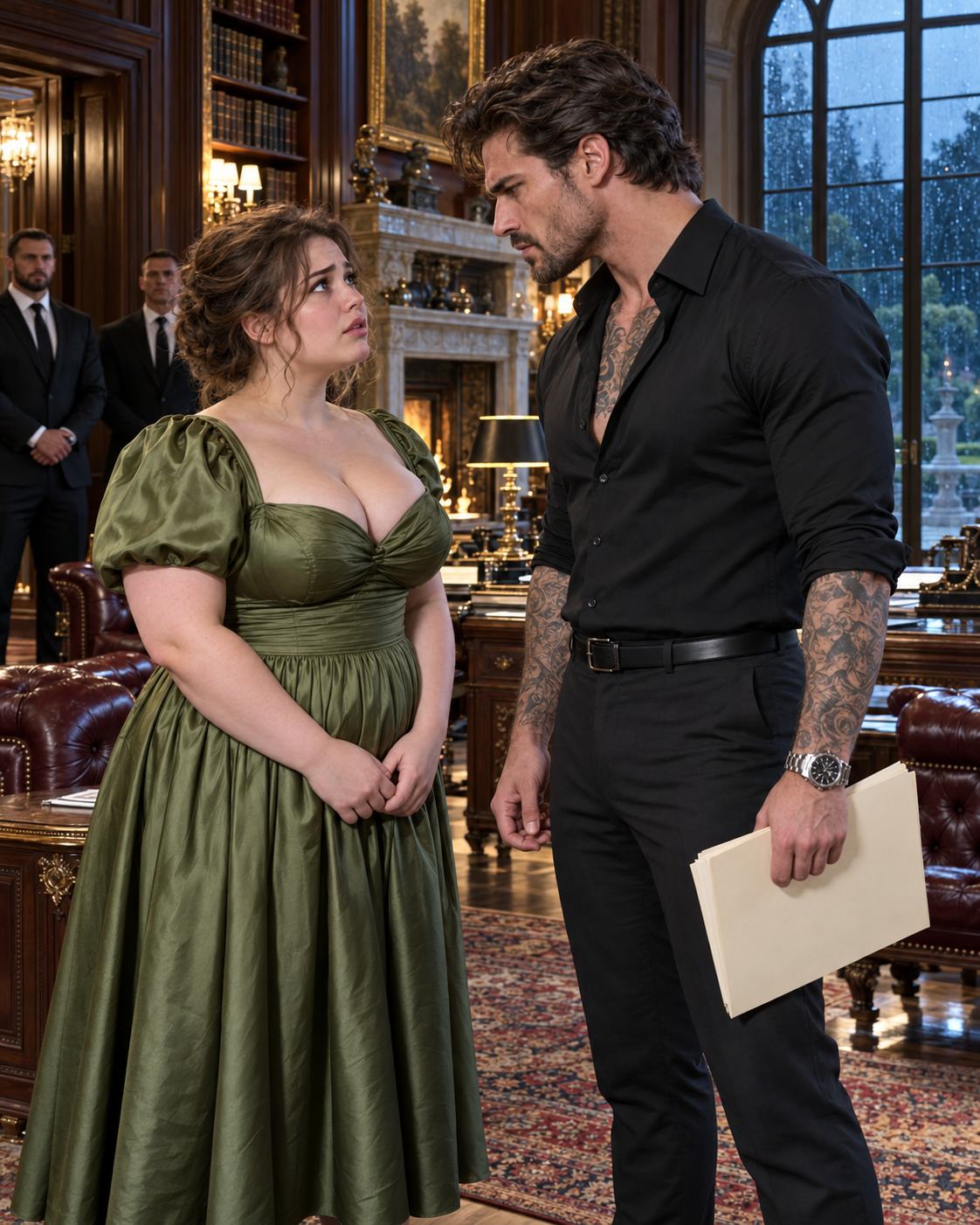
The woman her family had dismissed as weak possessed more courage than any of them understood.
Across Manhattan, Charles Edwards was raising his champagne glass when his longtime financial adviser approached him.
“Sir, there’s an urgent matter.”
Charles frowned.
“Not now, Richard.”
“It’s about Denim Nelson.”
The mention of that name immediately changed his expression.
He excused himself from the dinner party and followed Richard into his private study.
“What has he done?”
Richard placed a document on the desk.
“His attorneys have initiated proceedings to enforce the debt agreements. The banks have received formal notices, and several of our accounts are under review.”
Charles snatched the papers away.
“That’s impossible. We had an arrangement.”
Richard swallowed.
“The arrangement was never legally finalized, sir.”
Charles slammed his fist against the desk.
“I sent him the girl!”
His wife, Patricia Edwards, appeared in the doorway.
“Lower your voice. The guests can hear you.”
Charles turned toward her.
“That useless daughter of yours has somehow convinced Nelson to come after us.”
Patricia folded her arms.
“Then bring her home.”
“Do you think it’s that simple?”
“It always has been,” Patricia replied coldly.
“Belle has spent her whole life begging for our approval. Tell her you’re sorry, and she’ll believe you.”
Charles considered the suggestion.
Then he smiled.
It was the smile of a man who had never understood the difference between love and manipulation.
“Perhaps you’re right.”
But as he reached for his phone, another message appeared.
It contained a photograph of Eleanor Whitmore.
And beneath it were six words.
“I know what happened in Newport.”
Charles went pale.
For the first time in twenty-three years, the past had found him.
The following morning, Belle awakened in a bedroom overlooking the Hudson River.
Sunlight spilled across the polished hardwood floors, and a tray of breakfast rested beside a vase of white roses.
For a few peaceful seconds, she forgot everything.
Then she remembered the photograph.
Her family.
The mysterious woman.
And the possibility that her entire childhood had been built upon lies.
A gentle knock sounded.
“Come in.”
Denim entered carrying two cups of coffee.
He wore a charcoal-gray sweater instead of his usual tailored suit, making him look unexpectedly ordinary.
“I thought you might want company.”
Belle managed a small smile.
“Do you always bring coffee to women you’re supposed to terrify?”
“Only the ones who keep surprising me.”
He placed the cup beside her.
Neither spoke for a moment.
Then Belle asked the question that had been troubling her all night.
“Why are you doing all this for me?”
Denim sat in the chair across from her.
“Because what happened to you was wrong.”
“That doesn’t explain why you care.”
He considered his answer carefully.
“My mother raised me in a small apartment in Queens. She worked two jobs, and people with money treated her as though she were invisible.”
Belle listened silently.
“When she became sick, the people who had benefited from her kindness disappeared. I learned early that power means very little if you only use it for yourself.”
His expression softened.
“I’ve made choices I’m not proud of, Belle. Some of them hurt people. I can’t pretend otherwise.”
“Then why should I trust you?”
It was a question few people dared ask Denim Nelson.
But he didn’t appear offended.
“You shouldn’t trust me because I’m powerful. You should trust me only if my actions give you a reason.”
Belle looked down at her coffee.
“And the marriage?”
Denim paused.
“The marriage your family proposed was never something you truly chose.”
Her eyes filled with tears.
“You mean you don’t want me?”
“No,” he replied immediately.
“I mean you deserve the freedom to decide whether you want me.”
The words struck her more deeply than any extravagant declaration could have.
For years, Belle had been told what to wear, where to stand, when to speak, and how grateful she should feel for being tolerated.
No one had ever offered her the right to choose.
Until now.
Later that afternoon, Jonathan arrived with unexpected news.
He had located an elderly woman living in Providence, Rhode Island.
Her name was Clara Bennett.
Twenty-three years earlier, she had worked as Eleanor Whitmore’s private nurse.
And when Jonathan contacted her, she had said something extraordinary.
“I’ve been waiting a very long time for someone to ask about that baby.”
Belle insisted on meeting her.
Despite Denim’s concerns, they traveled to Providence the next morning with a small security team.
Clara lived in a modest white house with blue shutters on a quiet residential street.
When she opened the door, her hands flew to her mouth.
“Oh, my goodness.”
Her eyes immediately filled with tears.
“Eleanor?”
Belle shook her head.
“My name is Belle.”
Clara reached toward her face, then stopped, suddenly embarrassed.
“I’m sorry, dear. You look so much like your mother.”
Inside the house, photographs covered the walls.
Clara brought them into a small sitting room and opened an old wooden chest.
From beneath neatly folded blankets, she retrieved a silver baby bracelet.
The name engraved on it was not Belle.
It was Isabella Eleanor Whitmore.
Belle touched the bracelet with trembling fingers.
“Isabella?”
Clara nodded.
“That was the name your mother gave you.”
Then the elderly woman began telling a story that had remained hidden for more than two decades.
Eleanor Whitmore had fallen in love with Daniel Bennett, a young maritime engineer who worked for her father’s company.
Daniel came from a working-class family, and Arthur initially disapproved of the relationship.
But Eleanor refused to abandon him.
Eventually, her father accepted their marriage.
When Eleanor became pregnant, Arthur began restructuring his estate.
He wanted his grandchild to inherit a significant portion of Whitmore Atlantic Holdings.
Charles Edwards, then the company’s ambitious chief financial officer, discovered the plan.
According to Clara, he had spent years quietly gaining control over the Whitmore family’s finances.
He knew the new inheritance arrangements would limit his influence.
And he was furious.
A few months later, Arthur Whitmore suffered a fatal heart attack.
Within weeks, allegations of financial wrongdoing devastated the family’s company.
Daniel died in a boating accident off the Rhode Island coast.
And Eleanor, heavily pregnant and overwhelmed by grief, became increasingly isolated.
“She was frightened,” Clara whispered.
“She kept saying someone was watching the house.”
Belle felt Denim’s hand gently cover hers.
“What happened after I was born?”
Clara’s eyes clouded.
“Your mother made me promise to protect you.”
She explained that Eleanor had uncovered documents suggesting Charles had manipulated company accounts and arranged unauthorized transfers.
Before she could take the evidence to federal investigators, she disappeared.
Charles told everyone Eleanor had abandoned her child.
Soon afterward, he assumed guardianship of the baby through arrangements Clara had never fully understood.
“I tried to find you,” Clara said.
“But Charles told me you had been adopted by a loving family overseas.”
Tears rolled down her cheeks.
“I never believed him.”
Belle struggled to breathe.
“Is my mother dead?”
Clara shook her head.
“I don’t know, sweetheart.”
Then she reached into the chest again.
“But she left something for you.”
It was a small envelope, yellowed with age.
Across the front, in elegant handwriting, were the words:
For my daughter, when she’s old enough to understand.
Belle opened it carefully.
Inside was a handwritten letter.
My beautiful Isabella,
If you’re reading this, it means life has taken us somewhere I never wanted us to go.
There may be people who tell you that you’re unwanted, inconvenient, or difficult to love.
Never believe them.
You were loved before you opened your eyes.
You were cherished before you took your first breath.
And nothing anyone says about your appearance, your worth, or your place in this world can change that.
You belong to yourself before you belong to anyone else.
Remember that, my darling girl.
Love, Mom.
Belle pressed the letter against her chest.
For twenty-three years, she had searched for proof that she deserved love.
Now she was holding it.
Denim quietly stepped outside, giving her and Clara time together.
But when he reached the front porch, Marcus approached him.
“We found something.”
Denim turned.
“What?”
“The anonymous messages came from a prepaid phone purchased near a private medical facility in Connecticut.”
“Who’s using it?”
Marcus hesitated.
“That’s the strange part. We obtained information from someone who recognized the photograph.”
Denim waited.
“The woman in that picture may still be alive.”
Three days later, Jonathan uncovered the final missing piece.
A woman named Elaine Porter had been admitted to a long-term care residence in Connecticut in 2004.
Her admission paperwork had been signed by a representative connected to an Edwards-controlled company.
The woman’s original identity documents were missing.
But archived medical notes referenced a distinctive birthmark and an earlier hospitalization in Newport.
Belle stared at the report.
“Are you saying Elaine Porter could be my mother?”
Jonathan nodded cautiously.
“We have reason to believe so. But we need confirmation.”
Denim looked at Belle.
“We can investigate this without you going there.”
She shook her head.
“No.”
Her voice was steady.
“If she’s my mother, I’ve already lost twenty-three years with her.”
The following morning, they arrived at the quiet Connecticut residence.
Belle’s heart hammered as a nurse guided them down a peaceful corridor.
At the end of the hallway, sunlight poured into a room filled with books and watercolor paintings.
A slender woman with silver-streaked brown hair sat beside the window.
She was reading.
When the nurse announced visitors, the woman looked up.
And the book slipped from her hands.
Her eyes locked onto Belle.
For several seconds, she seemed unable to speak.
Then she whispered a name that made Belle’s entire world stop.
“Isabella?”
Belle took one step forward.
The woman began crying.
“My baby.”
No DNA test had yet confirmed what both women already felt.
But when Belle crossed the room and embraced her, something inside her finally began to heal.
Eleanor Whitmore was alive.
She had spent years under an assumed identity after suffering a serious injury and prolonged medical complications.
According to the available records, Charles’s associates had arranged her care while withholding information about her daughter.
Over time, Eleanor had recovered enough to question her circumstances.
But her attempts to locate Isabella had repeatedly failed.
A sympathetic staff member had eventually helped her send the anonymous messages after recognizing Charles Edwards in a news article.
The photograph was Eleanor’s desperate attempt to reach someone who might finally listen.
As Belle held her mother, Denim stood quietly in the doorway.
He had negotiated multimillion-dollar contracts and faced men who believed fear was the ultimate form of power.
Yet nothing had ever moved him quite like the sight of a daughter finding the mother she had believed was dead.
That evening, the truth began unraveling faster than Charles Edwards could control.
Jonathan submitted the newly discovered records to the appropriate authorities.
Investigators reopened questions surrounding Whitmore Atlantic Holdings, the old financial scandal, and Eleanor’s disappearance.
A court authorized measures to preserve disputed records and assets while the claims were examined.
And Denim’s attorneys continued enforcing the separate debt agreements the Edwards family had signed.
Charles’s empire was now facing pressure from every direction.
But the most devastating blow arrived when he learned Eleanor was alive.
He called Belle repeatedly.
She ignored him.
Then Patricia began sending messages.
“Belle, sweetheart, please come home.”
“We’re still your family.”
“Your father never meant to hurt you.”
Belle read the messages sitting beside Eleanor in the estate’s garden.
For once, they did not make her feel guilty.
Instead, they made her angry.
Not the helpless anger she had known as a child.
A clearer, steadier anger.
The kind that came from finally understanding what she deserved.
“Do you want to respond?” Denim asked.
Belle considered the question.
“Yes.”
She typed only one sentence.
“You don’t get to call me family only when you need something.”
Then she blocked the number.
Two weeks later, Charles Edwards arrived unexpectedly at Denim’s Manhattan headquarters.
He was no longer wearing the arrogant smile Belle remembered.
His expensive suit was wrinkled, and dark circles shadowed his eyes.
Denim agreed to meet him in a conference room with Jonathan present.
Charles entered with forced confidence.
“Nelson, we need to discuss this situation like reasonable businessmen.”
Denim remained seated.
“Then start by being honest.”
Charles spread his hands.
“Whatever Belle told you, she’s always been overly sensitive.”
Denim’s expression turned cold.
“Choose your next words carefully.”
Charles swallowed.
“I raised that girl. I fed her. I gave her everything.”
“You gave her a roof and convinced her it was a privilege to exist beneath it.”
“She’s ungrateful.”
Denim rose slowly.
“No, Charles. She’s finally free.”
Charles stared at him.
“You think you’re better than me?”
Denim met his gaze.
“I know I’ve done things I regret. The difference is that I’m willing to answer for them.”
Jonathan placed a folder between them.
Inside were authenticated financial records, court filings, and documents relating to the ongoing investigations.
Charles scanned the first page.
His face drained of color.
“You can’t prove all of this.”
“That’s for the courts to determine,” Jonathan replied.
“But the records are preserved, the investigators have been notified, and your creditors are enforcing their rights.”
Charles slammed the folder shut.
“What do you want?”
Denim’s voice remained calm.
“Nothing that belongs to you unlawfully.”
“And Belle?”
“Belle is not a bargaining chip.”
For the first time, Charles understood that the woman he had spent years humiliating would no longer be available for him to control.
He left without another word.
Over the following months, the Edwards family’s fortune collapsed under the weight of lawful debt enforcement, asset recovery proceedings, and revelations about the Whitmore estate.
Independent investigators confirmed major financial misconduct involving Charles and several former executives.
The courts determined that significant holdings had been wrongfully diverted from the Whitmore family.
Charles’s creditors also established their rights over the ships, terminals, and commercial properties pledged as security.
Under an approved series of settlements and transfers, Denim acquired the remaining shipping interests and placed them into a legally protected ownership structure benefiting Belle alone.
The recovered Whitmore inheritance was restored to its rightful beneficiaries, with Eleanor voluntarily arranging for her daughter to receive the controlling family interest.
When the final paperwork was completed, Belle became the sole owner of the consolidated maritime holdings.
No relative could override her decisions.
No husband could claim her property through the marriage.
And no member of the Edwards family retained a right to control her inheritance.
The family mansion on Fifth Avenue was among the properties surrendered during the proceedings.
When the lawful transfer was finalized, Charles, Patricia, and the other occupants received formal notice to vacate.
The news spread throughout New York’s business community.
The daughter they had treated as an embarrassment now owned the empire they had valued above her.
But Belle had little interest in celebrating their humiliation.
She was occupied with something far more important.
Learning how to live.
For the first time, she could enter a restaurant without wondering whether people were ashamed to be seen with her.
She could choose a dress because she liked it.
She could laugh without someone telling her to lower her voice.
And she could look into a mirror without automatically searching for everything her family had taught her to hate.
Denim never pressured her to change her appearance.
He admired the way her eyes brightened when she spoke about books, her compassion toward strangers, and her quiet determination to make other people feel seen.
One evening, Belle found him standing on the terrace overlooking Manhattan.
The Hudson River shimmered beneath the distant city lights.
“Do you ever regret what you’ve done?” she asked.
Denim turned.
“Which part?”
“Giving me control of everything.”
He smiled faintly.
“It was never supposed to be payment for marrying me, Belle.”
She stepped closer.
“Then what was it?”
“An opportunity for you to have the choices you were denied.”
Belle studied him.
“And what happens if I decide I don’t want to be married to you?”
Denim answered without hesitation.
“Then I’ll respect your decision.”
Her eyes filled with tears.
“You really mean that?”
“Every word.”
She reached for his hand.
“Then I think I’d like to choose you.”
Denim became completely still.
“Belle…”
“Not because you rescued me. Not because you’re wealthy or powerful. And certainly not because my family wanted to use me.”
She smiled through her tears.
“I choose you because you listened when no one else would.”
For the first time in his adult life, Denim Nelson found himself unable to speak.
Belle laughed softly.
“That’s a rare sight.”
He drew her into his arms.
“Very rare.”
Their relationship did not become perfect overnight.
Denim still carried the weight of his dangerous past.
Belle still struggled with the scars left by years of emotional mistreatment.
They disagreed.
They made mistakes.
They learned that love required far more than dramatic promises or expensive gifts.
It required patience.
Honesty.
Accountability.
And the willingness to change.
Denim gradually separated himself from the criminal networks that had once defined his reputation, cooperating with legal counsel to restructure his legitimate businesses and address unresolved obligations.
Belle insisted that any future they built together had to rest upon something stronger than fear.
And Denim, who had once believed power meant controlling every outcome, began to understand that real strength sometimes meant surrendering control.
Six months later, Belle walked into the boardroom of Edwards Maritime Holdings.
Only the company no longer carried that name.
A new sign gleamed above the entrance.
WHITMORE ATLANTIC GROUP.
The board members rose as she entered.
Belle wore a beautifully tailored emerald-green dress.
Her hair fell softly over her shoulders.
She was still the same woman her relatives had mocked for her size.
She had not transformed herself into someone else’s idea of beauty.
She had simply stopped apologizing for being herself.
At the head of the table, she opened her first official meeting as chairwoman.
“Before we discuss quarterly revenue,” she began, “I want to announce something important.”
Several executives exchanged curious glances.
Belle continued.
“For decades, this company measured success by the number of ships it owned and the profits it generated.”
She looked around the room.
“Those things matter. But so do the people who keep those ships moving.”
She announced the creation of a major employee assistance and education fund for dockworkers, warehouse employees, and their families.
She introduced new workplace protections, transparent promotion standards, and scholarships for young people who had grown up facing economic hardship.
And she established the Eleanor Whitmore Foundation, dedicated to supporting women recovering from financial exploitation and emotional abuse.
A senior director raised his hand.
“Ms. Whitmore, these programs will require a significant investment.”
Belle nodded.
“I know.”
“Some shareholders may question whether the benefits justify the expense.”
Belle looked directly at him.
“Then we’ll explain that a successful company should be measured by more than what it takes from people.”
The room fell silent.
Then, one by one, the executives began nodding.
Denim watched from the back of the room, a quiet smile crossing his face.
He had seen businessmen command respect through threats.
He had seen powerful families demand loyalty through money.
But Belle was doing something entirely different.
She was earning respect through conviction.
That afternoon, Belle received one final letter from Charles Edwards.
He had been convicted of financial crimes connected to the Whitmore holdings and was awaiting sentencing on the remaining matters.
The letter contained several pages of explanations.
He blamed business partners.
He blamed unfortunate circumstances.
He even blamed Denim.
Only near the end did he finally acknowledge what he had done to Belle.
“I never believed you would become someone important.”
Belle read the sentence twice.
Then she folded the letter.
Eleanor, sitting across from her, watched quietly.
“Are you all right?”
Belle nodded.
“Yes.”
“Do you want to write him back?”
Belle thought for a moment.
Then she took out a clean sheet of paper.
She wrote:
“Charles,
For most of my life, I believed being loved was something I had to earn by becoming smaller, quieter, and easier to ignore.
You taught me to question my worth.
But you never had the authority to define it.
I won’t spend the rest of my life trying to convince you that I matter.
I already know.
I hope one day you understand what you lost.
Belle.”
She sealed the letter.
And with that simple gesture, something inside her finally settled.
A year after the night she had arrived at Denim’s estate in a borrowed wedding dress, Belle stood on a cliff overlooking the Atlantic Ocean in Newport, Rhode Island.
Below her, waves rolled against the rocky shoreline.
The same coast where her mother had once dreamed of raising her.
The same place where her family’s stolen history had begun.
But today, the house was filled with laughter.
Eleanor was arranging flowers near the garden terrace.
Clara Bennett sat beside a group of old friends, telling stories about Belle’s first days as a baby.
Marcus was pretending not to cry while adjusting his tie.
And Denim Nelson stood beneath a white floral arch, waiting.
There were no elaborate business negotiations.
No desperate debts.
No family schemes.
No frightened bride being offered as payment.
This time, Belle had chosen every detail herself.
She wore a flowing ivory gown that embraced her figure beautifully.
No one had demanded that she lose weight.
No one had suggested hiding her arms or changing her body.
And when she looked at herself in the mirror that morning, she had smiled.
Not because she had finally become worthy of love.
But because she understood she always had been.
As Belle approached the altar, Denim’s eyes filled with tears.
He reached for her hands.
“I have faced dangerous men without fear,” he whispered, “but somehow you’re the one person who makes my heart forget how to behave.”
Belle laughed.
“That sounds like a serious problem.”
“The best one I’ve ever had.”
When it was time for their vows, Denim spoke first.
“Belle, I cannot promise that our lives will always be easy.”
He paused, his voice thick with emotion.
“But I promise never to make you feel small so that I can feel powerful.”
A tear slipped down Belle’s cheek.
“I promise to listen when you’re hurting, to respect you when we disagree, and to stand beside you without ever standing in your way.”
Then Belle took a breath.
“Denim, when I first met you, I thought my life was ending.”
She smiled gently.
“I was wrong.”
“You showed me kindness when I expected cruelty. You gave me room to choose when everyone else had made choices for me.”
Her voice grew stronger.
“But the greatest gift you gave me wasn’t money, protection, or even love.”
She looked directly into his eyes.
“It was the chance to discover that I could build a life I was proud of.”
The guests wiped away tears.
“And today, I’m not marrying you because I need someone to save me.”
She squeezed his hands.
“I’m marrying you because I’ve learned how to stand on my own, and I want to walk beside you.”
When they exchanged rings, the Atlantic breeze carried the sound of applause across the garden.
And when Denim kissed Belle, there was no frightened silence.
Only joy.
Later that evening, as the sun sank beneath the horizon, Belle stepped away from the celebration and walked toward the edge of the terrace.
Eleanor joined her.
For a moment, mother and daughter watched the ocean together.
“I used to imagine what your life might have been,” Eleanor said softly.
Belle turned toward her.
“I used to imagine what it would feel like to have a mother who loved me.”
Eleanor’s eyes filled.
“I’m so sorry I wasn’t there.”
Belle took her hand.
“You didn’t choose to leave me.”
“No,” Eleanor whispered.
“But I missed so much.”
Belle leaned her head against her mother’s shoulder.
“Then we’ll make new memories.”
Behind them, laughter drifted from the wedding reception.
Denim was speaking with Marcus near the garden, looking happier than anyone had ever seen him.
Eleanor smiled.
“He loves you very much.”
Belle watched her husband for a moment.
“I know.”
Then she looked toward the ocean again.
“But I’ve learned something even more important.”
“What’s that, sweetheart?”
Belle’s smile was peaceful.
“That being loved by someone else should never require me to stop loving myself.”
Eleanor kissed her forehead.
And together, they returned to the celebration.
Years later, people throughout the American shipping industry would still tell stories about Belle Whitmore Nelson.
Some would remember how she became the sole owner of an enormous maritime empire.
Others would recall the astonishing downfall of the Edwards family.
Business magazines would write about her leadership, her charitable foundation, and the extraordinary transformation of a company once ruled by greed.
But Belle never believed those accomplishments were the most important parts of her story.
Her greatest victory was not watching the people who hurt her lose their fortune.
It was waking up each morning without believing their cruelty had been justified.
It was learning to accept compliments without suspicion.
It was making decisions without constantly seeking permission.
It was finding the courage to walk away from people who offered affection only when they wanted something.
And it was discovering that kindness and strength were never opposites.
One autumn afternoon, Belle visited a scholarship ceremony organized by her foundation in Brooklyn.
Among the recipients was a shy young woman who had overcome years of bullying and family hardship.
After the ceremony, the young woman approached Belle.
“Mrs. Nelson, can I ask you something?”
“Of course.”
The girl hesitated.
“How did you become so confident?”
Belle considered the question.
Once, she might have answered by talking about Denim’s protection or the wealth she had inherited.
But now she knew better.
“I didn’t wake up one morning and suddenly stop being afraid,” she said.
“I learned that being afraid doesn’t mean you have to believe every cruel thing someone tells you.”
The girl looked down.
“Sometimes I feel like I’ll never be good enough.”
Belle gently took her hands.
“Good enough for whom?”
The question seemed to surprise her.
Belle smiled.
“People who benefit from making you feel worthless will always find another reason to criticize you.”
She paused.
“So don’t build your life around earning their approval.”
The girl’s eyes filled with tears.
“Then what should I do?”
“Build a life you can respect. Surround yourself with people who treat you with dignity. And when someone tries to convince you that you’re difficult to love, remember that their inability to appreciate you is not proof that you lack value.”
The girl hugged her.
Belle held her tightly.
And in that moment, she understood how far she had come.
Once, she had been the frightened young woman standing inside a stranger’s mansion, expecting to be rejected.
Now she was helping another young woman recognize the worth that had always belonged to her.
That evening, Belle returned home to find Denim waiting in the garden.
He stood beneath the same white roses he had ordered for her on their first morning together.
“How was your day, my queen?” he asked.
Belle smiled.
“Wonderful.”
He offered his hand.
She took it.
And as they walked beneath the warm lights of their home, Belle thought about the strange path that had brought her there.
Her family had sent her away believing they were disposing of something worthless.
They had hoped a feared man would humiliate her.
They had treated her marriage as a cruel joke and her future as an acceptable sacrifice.
Instead, their betrayal had revealed secrets they could no longer hide.
Their greed had cost them the empire they worshipped.
And the daughter they had underestimated had grown into a woman whose strength they had never imagined.
But Belle no longer needed their downfall to prove that she had won.
Her happiness was not measured by their suffering.
It was measured by the peace she had finally found.
Denim stopped beneath the garden lights and kissed her forehead.
“What are you thinking about?”
Belle looked at him with a quiet smile.
“How different everything became.”
“Would you change any of it?”
She considered the question.
“I would change the pain if I could.”
Then she looked toward the house, where Eleanor’s laughter could be heard through an open window.
“But I wouldn’t change the woman I’ve become.”
Denim pulled her gently into his arms.
And Belle rested her head against his chest, listening to the steady rhythm of his heart.
She had arrived in his world believing she was unwanted.
She had once mistaken cruelty for truth and obedience for love.
Now she knew that neither wealth nor beauty nor another person’s approval determined her worth.
She was Belle.
She was Isabella.
She was a daughter, a leader, a wife, and a woman with a future entirely her own.
And above all, she was free.
Because the most beautiful revenge is not taking everything from those who hurt you. It is becoming so secure in your own worth that they can never take anything essential from you again.
THE END.