In the bitter winter of 1887, on the windswept American frontier, a young woman walked into a blizzard carrying nothing but a worn shawl, a broken heart, and a secret the entire town had already condemned her for.
The three knocks came again, louder this time, cutting through the howling wind like a warning Clara Whitmore had spent weeks trying to escape.
Wade Callahan lifted the shotgun from its place beside the door, his expression hardening beneath the flickering lantern light.
“Stay with the children,” he whispered, moving carefully toward the entrance.
But Clara had already recognized the voice calling from the darkness, and the sound made her blood run colder than the blizzard outside.
“Clara Whitmore! I know you’re in there!”
It was her older brother, Thomas, the same man who had thrown her belongings onto the muddy street and told her never to darken their family’s doorway again.
Wade glanced over his shoulder and immediately noticed the terror spreading across her face.
“You know him?”
Clara nodded, gripping the edge of the cradle as though it were the only solid thing remaining in her world.
“He’s my brother.”
Wade slowly lowered the shotgun, though he kept it within reach.
When he opened the door, a furious blast of snow swept across the floorboards, revealing Thomas Whitmore standing beneath the porch roof with his coat covered in ice.
His horse stood trembling near the fence, and his face carried the same expression Clara remembered from the night her family cast her out.
“There you are,” Thomas growled, pushing past Wade without invitation.
His eyes swept across the room, settling on Clara beside the cradle.
“So the rumors were true.”
Clara straightened, forcing herself to stand despite the exhaustion pulling at every muscle.
“What are you doing here, Thomas?”
He laughed bitterly.
“Father heard you’d gone wandering after some widower, and now half the town is talking about it.”
Wade stepped between them.
“This woman came through a blizzard to help my children, and you’ll speak to her respectfully under my roof.”
Thomas stared at him with open contempt.
“You don’t know what kind of woman you’ve taken in.”
Wade’s jaw tightened.
“I know she walked ten miles through snow when everyone else stayed warm beside their fires.”
Thomas looked momentarily unsettled, but his anger quickly returned.
“Clara, get your things. You’re coming with me.”
“No,” she answered.
The word surprised even her.
For most of her life, Clara had obeyed her family without question, believing that kindness meant accepting whatever others demanded.
But something had changed between the moment she stepped into the storm and the moment she held little Grace against her heart.
Thomas moved closer.
“Father has arranged for you to stay with distant relatives in Missouri, where nobody knows about your disgrace.”
Clara felt the familiar humiliation rising in her chest.
“You mean where nobody will know about my baby.”
Thomas said nothing.
Wade looked from one sibling to the other, finally understanding the cruelty behind Clara’s frightened silence.
“She isn’t going anywhere tonight,” he said.
Thomas turned toward him.
“You have no right to interfere in family business.”
Wade opened the door again.
“And you have no right to come into my home and threaten someone under my protection.”
For a moment, the two men stood facing each other while the wind roared beyond the doorway.
Then Thomas pointed toward Clara.
“You’ll regret this. Both of you.”
He stormed outside, disappearing into the swirling snow.
Wade shut the door and slid the heavy iron bolt into place.
Clara remained motionless beside the cradle.
“I’m sorry,” she whispered.
Wade turned toward her.
“For what?”
“For bringing trouble into your home.”
He looked toward his sleeping children.
“Miss Whitmore, trouble came into this house the day their mother died. Tonight, you brought something we desperately needed.”
Clara’s eyes filled with tears.
Wade did not ask her to explain the past.
Instead, he placed another log on the fire and quietly made certain the guest room was warm.
By morning, the blizzard had buried the ranch beneath nearly three feet of snow.
The fences had vanished beneath white drifts, and the road toward town was completely impassable.
Clara woke to the sound of a baby crying.
For one terrible instant, she forgot where she was and reached toward the empty space beside her bed.
Then she remembered Grace and Samuel.
She hurried into the nursery, where Wade stood helplessly holding Samuel against his shoulder.
The baby was crying weakly, his tiny face flushed and his breathing uneven.
“He’s burning up,” Wade said.
Clara touched Samuel’s forehead and immediately felt the heat.
Her stomach tightened.
“We need to cool the room a little and keep him comfortable.”
Wade stared toward the window.
“The doctor is twelve miles away.”
Clara looked at the towering snowdrifts.
“And the roads are gone.”
They spent the morning caring for Samuel, taking turns holding him, feeding him when he could manage it, and watching every breath.
By afternoon, his fever worsened.
Wade paced the kitchen like a trapped animal.
“I should’ve gotten help sooner.”
Clara shook her head.
“You couldn’t have known.”
“My wife would have known.”
The words fell heavily between them.
Wade stopped pacing, suddenly ashamed.
Clara looked down at Samuel.
“Perhaps she would have. But you’re here, Wade, and he needs you now.”
It was the first time she had spoken his given name.
He noticed.
So did she.
Neither mentioned it.
That evening, Wade saddled his strongest horse, determined to reach the doctor despite the storm.
Clara followed him into the barn, where icy wind slipped between the wooden boards.
“You can’t ride through that,” she pleaded.
“I can’t stand here and watch my son die.”
Clara caught his sleeve.
“And what happens to your children if you don’t come back?”
Wade turned away, his face twisted by grief.
“I already buried their mother.”
Clara stepped closer.
“I know what it’s like to lose a child. I won’t pretend your fear is foolish.”
He stared at her, unable to answer.
“But we need you alive,” she continued. “Both of them do.”
For a long moment, only the horses stirred in their stalls.
Finally, Wade removed the saddle.
They returned to the house together.
Through the night, Clara remained beside Samuel while Wade kept the fire burning and brought clean cloths and fresh water.
Near dawn, the baby finally began breathing more easily.
His fever had eased.
Clara held him close, afraid to believe what she felt.
“Wade,” she whispered.
He looked up from his chair.
“He’s better.”
Wade crossed the room and touched his son’s cheek.
When Samuel opened his eyes and made a small, hungry sound, the rancher sank to his knees.
He covered his face with both hands.
Clara watched silently as a man who had endured drought, cattle losses, and his wife’s funeral finally allowed himself to weep.
She knelt beside him, resting a hand on his shoulder.
For the first time, Wade did not pull away from comfort.
Three days later, the sky cleared.
Sunlight spread across the frozen Montana plains, turning the snow into a thousand glittering diamonds.
Wade hitched the wagon and traveled toward town for supplies.
Clara remained at the ranch with the twins, who were beginning to grow stronger.
When he returned that afternoon, his expression was troubled.
“What happened?” she asked.
Wade unloaded a sack of flour before answering.
“Your brother’s been talking.”
Clara lowered her eyes.
“What has he said?”
“That I brought you here for reasons no decent man would admit.”
A painful silence filled the kitchen.
“And what did you say?”
Wade turned toward her.
“I told them you saved my children’s lives.”
Clara wanted to believe that truth would be enough.
But she knew the town better than he did.
Within a week, the rumors had spread from the general store to the church pews.
Some claimed Clara had deliberately sought out a lonely widower.
Others whispered that Wade had forgotten his wife before the earth above her grave had settled.
When the traveling preacher, Reverend Harlan, visited the ranch, he arrived wearing an expression of grave concern.
“Mr. Callahan,” he began, “there are questions about the propriety of your household.”
Wade stood beside the kitchen table.
“My household contains two infants who needed care and a woman brave enough to provide it.”
The reverend cleared his throat.
“Nevertheless, appearances matter.”
Clara stood quietly near the stove.
She had heard those words before.
Appearances mattered more than hunger, grief, or human kindness.
Wade looked directly at the preacher.
“Then perhaps this town ought to concern itself less with appearances and more with what is right.”
Reverend Harlan departed without finishing his tea.
That evening, Clara announced that she should leave.
Wade found her folding the few dresses she owned.
“Where would you go?”
“I don’t know.”
“Then why leave?”
She looked toward the nursery.
“Because your children deserve a good name.”
Wade leaned against the doorframe.
“They deserve someone who loves them.”
Clara’s hands stopped moving.
“And you think the town will ever allow them to forget who I am?”
He approached slowly.
“I don’t care what the town thinks.”
“But someday Grace and Samuel will.”
Wade had no answer.
Clara returned to folding her clothes, blinking against tears.
Then a small cry came from the nursery.
She instinctively moved toward the sound.
Wade watched her go and understood something that frightened him more than any winter storm.
He could not imagine the house without her.
The following morning, a wagon appeared on the eastern trail.
It belonged to Martha Bennett, the elderly widow who ran the town’s boardinghouse.
Martha was known for her sharp tongue, practical wisdom, and complete disregard for gossip.
She entered the ranch carrying a basket of bread and preserved peaches.
“I hear you’ve been causing a scandal,” she announced.
Clara flushed.
Martha waved a dismissive hand.
“Good. This town has grown far too comfortable judging people it barely understands.”
Wade almost smiled.
Over coffee, Martha explained that Thomas had been spreading another rumor.
He claimed Clara had stolen money from her father’s household before leaving.
Clara went pale.
“That’s a lie.”
Martha nodded.
“I suspected as much.”
Wade set down his cup.
“How much?”
“Forty dollars.”
Clara stared at the table.
“My father gave Thomas forty dollars the night he sent me away. I heard them arguing about it.”
Martha’s expression changed.
“Then I believe we ought to have a conversation with your family.”
Clara shook her head.
“They’ll never admit it.”
Martha reached across the table and took her hand.
“Child, sometimes the truth needs someone stubborn enough to stand beside it.”
Two days later, Clara traveled into town with Wade and Martha.
It was the first time she had returned since her family cast her out.
The wooden sidewalks were crowded with shoppers, ranch hands, and women carrying market baskets.
Conversation stopped when they stepped down from the wagon.
Clara felt every stare.
Wade offered his arm.
She hesitated, then accepted it.
They entered the general store, where Thomas stood speaking with the owner, Mr. Ellison.
At the sight of Clara, his face darkened.
“What are you doing here?”
Martha stepped forward.
“Correcting a lie.”
Several customers turned to listen.
Thomas laughed.
“You’d best be careful, Mrs. Bennett.”
She looked unimpressed.
“Young man, I was surviving winters in Montana before you learned to button your coat.”
Wade placed a handwritten note on the counter.
“Mr. Ellison, you keep account books for the Whitmore family, don’t you?”
The shopkeeper nodded cautiously.
“Most families in town.”
“Then perhaps you remember a forty-dollar payment made to Thomas shortly before Clara left home.”
Thomas stiffened.
“That’s private business.”
Mr. Ellison opened a ledger beneath the counter.
He studied several entries, then frowned.
“I remember the transaction. Mr. Whitmore withdrew forty dollars against his account.”
Clara felt her knees weaken.
Wade placed a steadying hand beneath her elbow.
Thomas stepped forward.
“That proves nothing.”
“No,” Martha agreed. “But it proves the money wasn’t missing when Clara left.”
The shopkeeper looked up.
“Mr. Whitmore said it was for Thomas’s travel expenses.”
A murmur moved through the store.
Thomas’s face turned crimson.
He seized his hat and pushed toward the door.
Before leaving, he turned on Clara.
“You’ve embarrassed this family enough!”
For the first time, Clara met his anger without shrinking.
“No, Thomas. I spent my whole life carrying embarrassment that never belonged to me.”
He stared at her.
Then he left.
The store remained silent.
Clara looked around at the people who had whispered about her for weeks.
Some lowered their eyes.
Others looked uncomfortable.
Nobody apologized.
Martha gently squeezed her hand.
“Come along, dear. We have better things to do than wait for these people to discover their manners.”
Outside, Wade helped Clara into the wagon.
“You were brave in there.”
She shook her head.
“I was terrified.”
“Most brave people are.”
As the wagon rolled toward the ranch, Clara realized something had shifted.
The town had not welcomed her back.
Her family had not forgiven her.
But for the first time, she had defended herself.
And that felt like the beginning of freedom.
Spring arrived slowly across the Montana Territory.
The snow retreated from the valleys, exposing dark earth and the first stubborn shoots of prairie grass.
Cattle wandered toward fresh grazing grounds, and the frozen creek began running again.
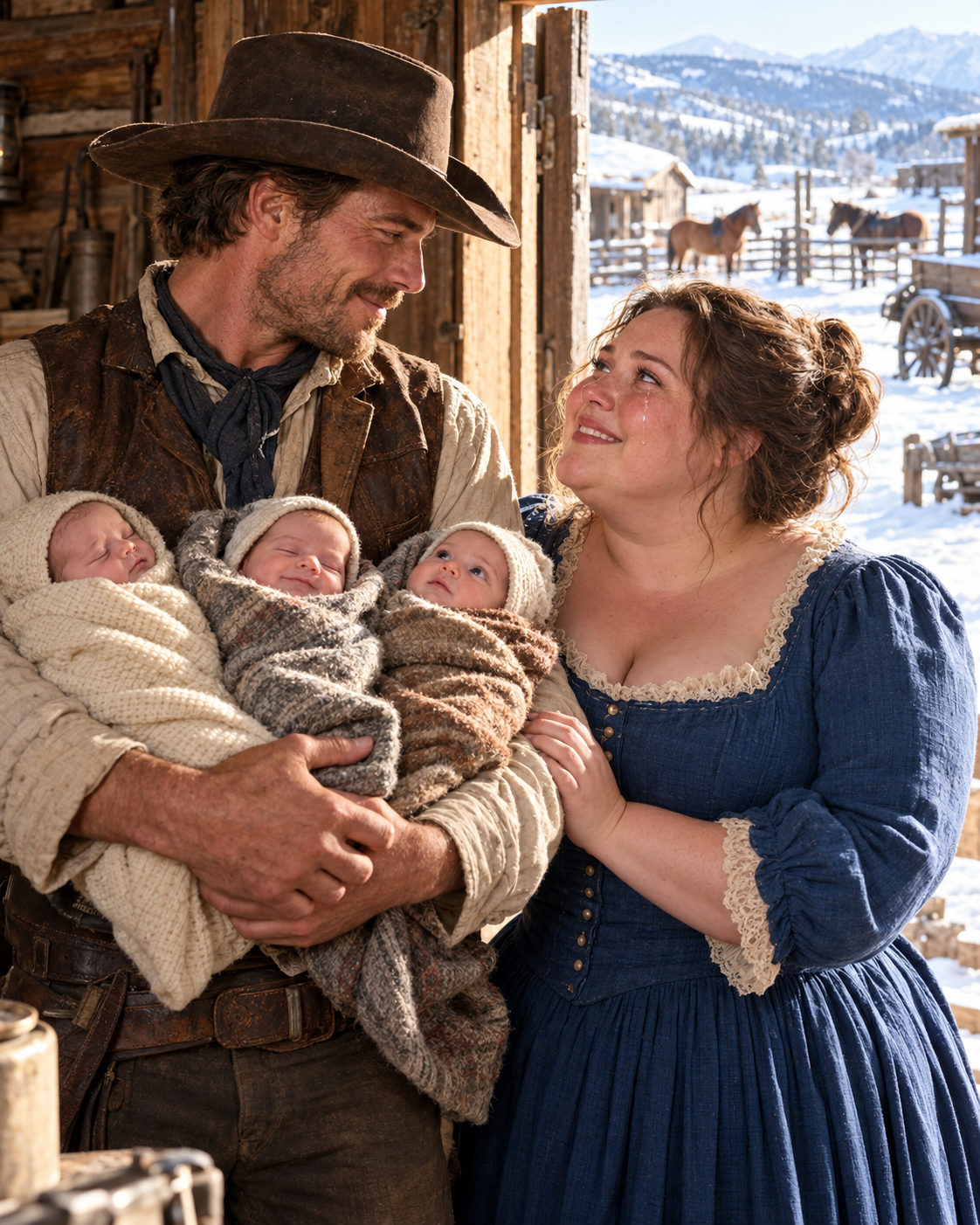
Inside Callahan Ranch, Grace and Samuel grew round-cheeked and lively.
Grace developed a habit of grabbing Wade’s beard, while Samuel laughed whenever Clara sang an old lullaby beside the fire.
Their laughter transformed the house.
Wade began repairing things he had neglected after his wife’s death.
He replaced broken windowpanes, repaired the nursery shelves, and planted a small vegetable garden behind the kitchen.
Clara noticed he had also started leaving fresh wildflowers beside his late wife’s photograph.
One evening, she found him standing near the mantel.
“Her name was Elizabeth,” he said quietly.
Clara joined him.
“She was beautiful.”
Wade nodded.
“She loved this place, even when the winters nearly drove us mad.”
He smiled sadly.
“She used to say the land was stubborn because it wanted us to become stubborn enough to deserve it.”
Clara studied the photograph.
“I wish I could have known her.”
Wade looked at her.
“I think she would have liked you.”
The words warmed Clara more deeply than he could have imagined.
For months, she had feared that caring for Elizabeth’s children meant occupying a place that did not belong to her.
But Wade had never asked her to replace his wife.
And somehow, that made the affection growing between them feel less frightening.
Their peaceful days did not last.
In late April, heavy rains swept across the foothills, turning the creek into a violent torrent.
One afternoon, while Wade was inspecting a damaged fence, a ranch hand raced toward the house shouting that the lower pasture was flooding.
Clara hurried outside and saw water spilling beyond the creek banks.
The small bridge leading toward the main road had already disappeared beneath the rising current.
Wade returned on horseback, drenched and covered in mud.
“We have to move the cattle to higher ground.”
Clara looked toward the barn.
“What about the horses?”
“Jim and I will handle them.”
Then he paused.
“If the water reaches the house, take the children upstairs.”
Clara nodded, trying to hide her fear.
For hours, Wade and his ranch hands struggled against the storm.
Lightning cracked above the hills, and muddy water rushed through the lower pasture.
At dusk, Jim appeared at the kitchen door.
“Mr. Callahan’s horse slipped near the creek!”
Clara’s heart seemed to stop.
“Where is he?”
“Down by the cottonwoods.”
Without another word, she grabbed her coat.
Jim tried to stop her, but Clara was already running through the rain.
She found Wade beside a fallen tree, struggling to free his leg from beneath a heavy branch.
His horse stood nearby, trembling.
“Wade!”
He looked up in disbelief.
“You shouldn’t be here!”
Clara dropped to her knees in the mud.
“Then you’ll have to complain after we get you home.”
With Jim’s help, she lifted the branch enough for Wade to pull himself free.
His leg was badly bruised, but he could stand.
As they struggled toward higher ground, a sudden surge of water swept across the trail.
Clara slipped.
For one terrifying moment, the current caught her feet.
Wade seized her wrist.
“Hold on!”
She clung to him as Jim grabbed the back of Wade’s coat.
Together, they fought their way onto solid ground.
Only when they reached the barn did Clara begin to shake.
Wade pulled her close, holding her as though the world might collapse if he let go.
“I thought I’d lost you,” he whispered.
Clara buried her face against his wet coat.
“You nearly did.”
He drew back just enough to look into her eyes.
“Clara, I can’t keep pretending you mean nothing more to me than someone helping with the children.”
Her heart pounded.
“Wade…”
“I don’t know when it happened. Maybe when you walked through that door. Maybe when you sat beside Samuel all night. But somewhere along the way, you became the person I look for whenever I come home.”
Tears mingled with rain on Clara’s cheeks.
For a moment, she wanted to believe that happiness could finally be hers.
Then the old fear returned.
“What if people never stop talking?”
Wade gently brushed a wet strand of hair from her face.
“Then they’ll have plenty to talk about.”
He kissed her forehead.
It was a quiet gesture, filled with more tenderness than any promise Clara had ever received.
But she still could not bring herself to answer him.
Three weeks later, Clara received a letter.
It arrived in an envelope bearing her father’s handwriting.
She stood beside the kitchen window for nearly an hour before opening it.
Inside was a short message explaining that her mother had fallen ill and wished to see her.
There was no apology.
No acknowledgment of what had happened.
Only a request that Clara return before it was too late.
Wade found her sitting at the table with the letter trembling in her hands.
“My mother’s sick.”
He read the message and sat beside her.
“Do you want to go?”
Clara swallowed.
“I don’t know.”
“You don’t owe them anything.”
“I know.”
He waited.
“But she’s still my mother.”
The next morning, Wade drove her into town.
He offered to accompany her inside, but Clara shook her head.
“This is something I need to face myself.”
The Whitmore house looked exactly as she remembered.
White curtains hung in the windows, and her mother’s rosebushes stood beside the porch.
Yet as Clara stepped through the gate, she realized she no longer felt like a frightened girl returning home.
She felt like a woman choosing whether to enter.
Her father opened the door.
His expression hardened immediately.
“I didn’t think you’d come.”
Clara met his gaze.
“Neither did I.”
He stepped aside.
Upstairs, her mother lay beneath a quilt, pale and weakened by a lingering illness.
When she saw Clara, tears filled her eyes.
“My girl.”
Clara approached the bed slowly.
Her mother reached for her hand.
“I’ve wanted to see you.”
Clara sat beside her.
“Then why didn’t you come when I needed you?”
The question filled the room with silence.
Her mother began crying.
“I was afraid of what people would say.”
Clara looked toward the window.
“So was I.”
Her mother tightened her grip.
“I should have protected you.”
“Yes,” Clara whispered. “You should have.”
For a long time, neither spoke.
Then her mother asked about the ranch, the children, and Wade.
Clara answered honestly.
She described Grace’s mischievous smile and Samuel’s laughter.
She spoke of Wade’s quiet kindness and the warmth slowly returning to his home.
At last, her mother asked, “Are you happy there?”
Clara considered the question.
“I think I’m learning how to be.”
Her mother closed her eyes.
“Then don’t let our mistakes take that away from you.”
It was not enough to erase the past.
But it was the first honest acknowledgment Clara had received from her family.
Before leaving, she kissed her mother’s forehead.
Outside, Wade waited beside the wagon.
He did not ask whether her family had apologized.
He simply offered his hand.
Clara took it.
That evening, as the sun sank behind the distant mountains, Wade found Clara sitting beneath the cottonwood tree near the house.
She was holding a small silver locket.
“My baby’s name was Rose,” she said.
Wade sat beside her.
Clara opened the locket, revealing a tiny pressed flower.
“I never told anyone her name. They acted as though she had never existed.”
Wade looked at the flower.
“Rose Whitmore,” he said softly.
Clara nodded, tears slipping down her cheeks.
“She was real, Wade. Even if she never took a breath.”
He reached for her hand.
“Of course she was.”
Clara began to cry, but this time she did not try to hide it.
Wade held her until the stars appeared.
Then he said something she would remember for the rest of her life.
“Loving Grace and Samuel doesn’t mean loving Rose any less.”
Clara looked at him.
“And loving you doesn’t mean forgetting Elizabeth.”
Wade’s eyes filled.
“No,” he whispered. “It doesn’t.”
They sat together beneath the darkening sky, two people who had spent months believing grief was a wall between them.
Now they understood it could also be a doorway.
Summer brought golden grass, warm winds, and long evenings beneath the endless Montana sky.
One Sunday afternoon, Wade asked Clara to walk with him toward the small hill overlooking the ranch.
Grace and Samuel remained with Martha Bennett, who had become an enthusiastic honorary grandmother.
At the top of the hill stood a newly planted rosebush beside a simple wooden bench.
Clara stopped in surprise.
“Wade, what is this?”
He took off his hat.
“I thought Rose deserved a place here, too.”
Clara covered her mouth.
Beside the rosebush stood a small marker bearing her daughter’s name.
There were no dates, only three carefully carved words.
Forever Our Rose.
Clara knelt beside it, touching the letters with trembling fingers.
No one had ever done anything so kind for the child she had lost.
When she turned, Wade was standing behind her with a small ring resting in his open palm.
It was simple silver, with a tiny blue stone that caught the afternoon sunlight.
“I can’t promise life will always be easy,” he said.
Clara rose slowly.
“I know.”
“And I can’t promise there won’t be more winters, more hardship, or more people who think they know our business.”
A tear slipped down her cheek.
“But I can promise that you will never have to face those things alone again.”
Wade took a breath.
“Clara Whitmore, would you become my wife?”
For a moment, she could only stare at him.
She thought of the night her brother threw her belongings into the street.
She remembered the bitter cold, the cruel whispers, and the desperate walk through the blizzard.
She remembered arriving at a strange ranch, convinced she had nothing left to give.
And she remembered two tiny babies whose need had called her back toward life.
“Yes,” she whispered.
Wade smiled.
“Yes?”
Clara laughed through her tears.
“Yes, Wade Callahan. A thousand times, yes.”
He slipped the ring onto her finger and gathered her into his arms.
Their wedding took place beneath the cottonwood trees in September 1887.
There were no elaborate decorations, no expensive flowers, and no grand celebration.
Martha baked the wedding cake.
Jim and the ranch hands arranged benches beneath the trees.
Grace and Samuel wore matching white outfits sewn by Clara’s mother, who had recovered enough to attend.
Even Reverend Harlan came, looking noticeably humbled.
Not everyone from town appeared.
Thomas Whitmore stayed away.
Clara’s father attended only briefly and spoke little.
But Clara no longer measured her worth by the people who refused to celebrate her happiness.
She stood beneath the autumn sunlight wearing a modest ivory dress, holding Wade’s hands as they exchanged their vows.
When the preacher declared them husband and wife, Grace began laughing from Martha’s lap.
The sound spread through the gathered guests, turning the solemn moment into one filled with warmth.
Wade kissed Clara gently.
And for the first time in years, she felt no need to apologize for being happy.
The following winter came early.
Snow once again covered the Montana plains, and bitter winds swept across the pastures.
But Callahan Ranch was no longer a house defined by absence.
There were children’s toys near the hearth, fresh bread cooling on the kitchen table, and laughter drifting through the rooms.
On Christmas Eve, Wade found Clara sitting beside the fireplace with Grace asleep against her shoulder and Samuel curled peacefully in her lap.
He placed a small wooden box beside her.
“Another surprise?” she asked.
He smiled.
“Just something I thought you should have.”
Inside was a hand-carved ornament shaped like a rose.
On the back, Wade had engraved four names.
Elizabeth.
Rose.
Grace.
Samuel.
Clara stared at the ornament, unable to speak.
Wade knelt beside her.
“I wanted our family to remember everyone who helped bring us here.”
She looked into his eyes.
“Even those we lost?”
“Especially those we lost.”
Clara leaned forward and kissed him.
Outside, the same winter winds that had once threatened to swallow her life howled across the frozen fields.
But inside, the fire burned brightly.
Years passed, and the Callahan children grew beneath the wide Montana sky.
Grace became fearless and outspoken, forever challenging the rules of a world that expected little girls to remain quiet.
Samuel developed his father’s patience and his mother’s gentleness, often bringing injured birds and abandoned animals home to be cared for.
The ranch prospered slowly through hard work, droughts, harsh winters, and occasional setbacks.
Clara never forgot the women who arrived in town carrying the same shame and desperation she had once endured.
With Wade’s encouragement, she opened a small room beside the ranch house where struggling mothers could rest, eat, and receive help without being questioned about their past.
Martha brought blankets.
The local doctor donated supplies.
Eventually, even Reverend Harlan began visiting with food and firewood.
People started calling it Rose’s Room.
Clara never asked them to use the name.
But whenever she heard it, she smiled.
One spring afternoon, many years after that terrible winter, a young woman arrived at the ranch carrying a crying infant.
Her coat was torn, and her face was pale with fear.
“I’m sorry to trouble you,” the stranger whispered. “They told me you sometimes help women who have nowhere else to go.”
Clara, now older, with silver beginning to thread through her dark hair, opened the door wider.
Behind her, the farmhouse glowed with lamplight, and the sound of family laughter drifted from the kitchen.
“You’ve come to the right place,” she said gently.
The young woman began to cry.
“I don’t have any money.”
Clara smiled.
“Neither did I when I first came here.”
She took the woman’s cold hand and led her inside.
From the doorway, Wade watched his wife wrap a warm blanket around the frightened stranger.
He remembered the winter of 1887, the starving twins, and the trembling woman who had appeared through a blizzard when hope seemed almost gone.
He remembered believing that everything precious in his life had already been buried.
But the years had taught him otherwise.
Sometimes, love did not arrive as a grand promise or a sudden miracle.
Sometimes, it came wearing a threadbare coat, carrying its own sorrow, and asking only for the chance to help.
That evening, as snow began falling softly beyond the windows, Wade joined Clara beside the fireplace.
Grace and Samuel, now nearly grown, were helping the young mother settle into Rose’s Room.
Clara rested her head against Wade’s shoulder.
“Do you ever think about that first night?” she asked.
He smiled.
“Every time it snows.”
“I thought I was walking toward the end of my life.”
Wade took her hand.
“And I thought mine had already ended.”
They watched the flames flicker in the hearth.
Then Wade kissed her forehead.
“Funny how wrong we both were.”
Clara looked toward the hallway where the young mother’s baby had finally stopped crying.
She remembered the words she had spoken years before, when Wade asked why she had crossed the blizzard to save children who were not her own.
Because she knew what it felt like when nobody came.
Now, so many winters later, she finally understood the deeper truth.
She had not only saved two children that night.
They had helped save her.
And together, they had built a home where no one needed to earn kindness by proving they deserved it.
Outside, winter continued its quiet journey across the American frontier.
Inside, another frightened soul had found shelter.
And on the hill overlooking the ranch, beneath the snow-covered branches of a little rosebush, the name of a child who had lived only briefly remained carved into wood.
Rose Whitmore had never taken a breath in this world.
Yet through her mother’s love, she had become part of a legacy that would touch lives for generations.
Because a person’s worth is never determined by the judgment of a town, the mistakes of a family, or the tragedies they have survived.
Sometimes the greatest purpose grows from the deepest sorrow, and sometimes the road that looks like the end of everything is the very road that leads us home.
THE END.