In New York City, people learned quickly not to stare when Dominic Russo walked into a room.
Beatrice had already known the answer.
What she did not know was whether Dominic Russo would believe it.
The sirens grew louder somewhere beyond the shattered storefront, but Dominic seemed not to hear them. He remained crouched behind the heavy cutting table, one hand pressed against the shallow wound across his palm, his eyes fixed on Beatrice.
“You said someone put it there deliberately,” he said.
“Yes.”
“Matteo?”
“He may have sewn it in.”
“That isn’t what I asked.”
Beatrice looked at him.
Dominic had spent most of his life in rooms where hesitation meant weakness. He could recognize it instantly.
“You think somebody told him to do it.”
“I think Matteo is part of this,” Beatrice answered. “But I don’t think he designed it.”
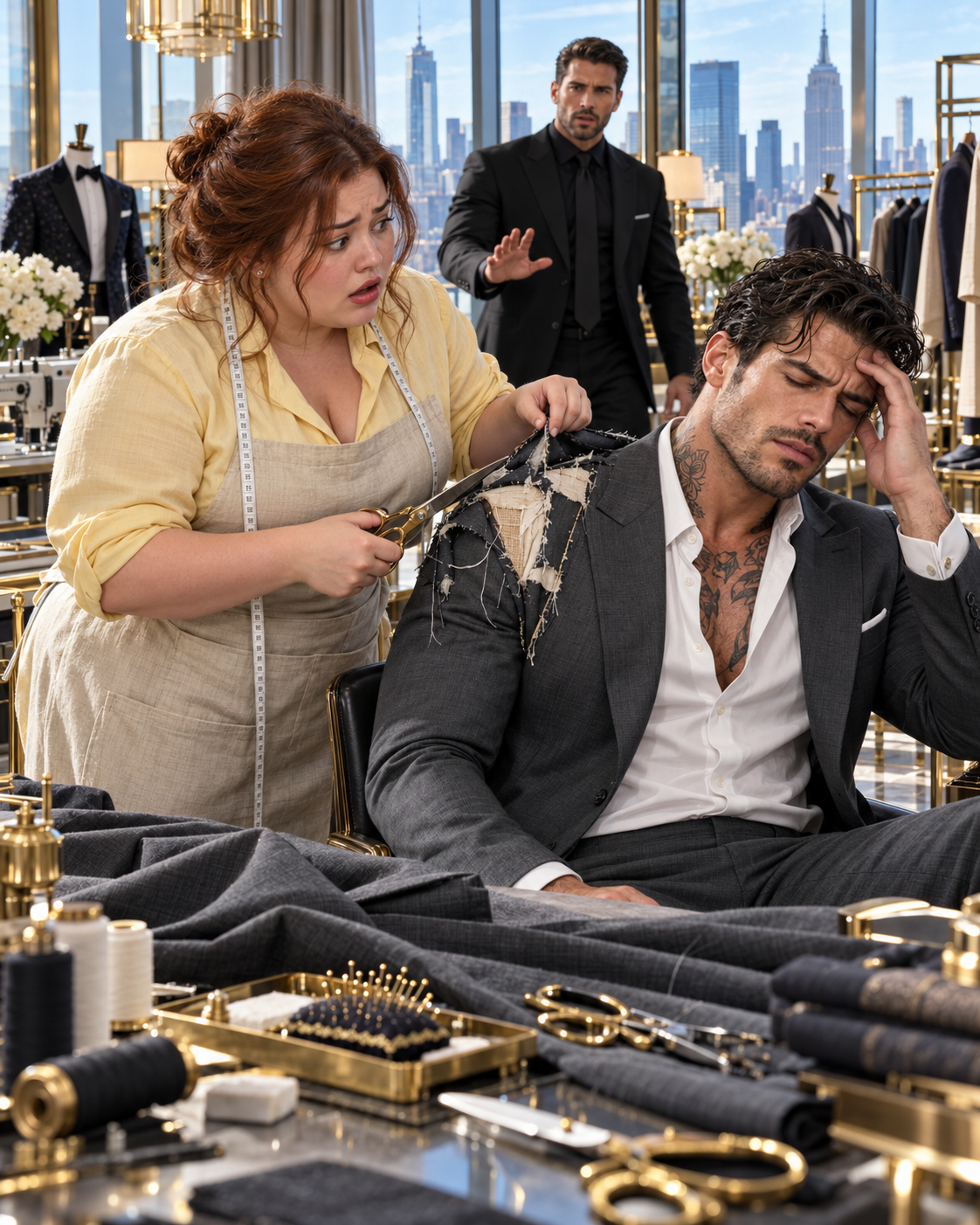
Dominic stared at the ruined collar.
For years, Matteo had stood behind him with measuring tape draped around his shoulders, complaining about New York humidity, politicians, cheap imported wool, and men who gained ten pounds but blamed the jacket.
He had been familiar.
Predictable.
Safe.
That suddenly made him terrifying.
Dominic reached into his coat and pulled out his phone.
Beatrice caught his wrist.
“Don’t.”
His gaze dropped to her hand.
Few people touched Dominic Russo without permission.
Even fewer lived comfortably after doing it.
Beatrice released him.
“If the person behind this knows I found the mesh, they’re expecting you to react,” she said. “Calling Matteo tells them exactly what you know.”
Dominic slowly lowered the phone.
Another distant siren cut through the afternoon.
“Then tell me what I know.”
Beatrice inhaled.
“The material in your collar is consistent with deliberate heavy-metal exposure. Based on your symptoms and how long they’ve continued, thallium is the most likely explanation.”
Dominic said nothing.
“It can mimic other illnesses. The symptoms can come and go. If someone controlled the amount carefully enough, they could keep you sick without necessarily killing you immediately.”
“Ten years?”
“Yes.”
The word landed harder than the gunfire had.
Ten years meant birthdays.
Christmas dinners.
Meetings.
Funerals.
Weddings.
Ten years meant someone had watched Dominic suffer and chosen to continue.
He stood.
“We’re leaving.”
“Where?”
“Somewhere nobody knows you exist.”
“That seems unlikely now.”
For the first time, something almost resembling grim amusement crossed his face.
“You’re learning.”
They slipped out through the rear of the tailoring shop before police vehicles reached the block.
Dominic’s driver was nowhere in sight.
That bothered him more than he admitted.
A black sedan waited half a street away, but Dominic ignored it and flagged down a yellow cab instead.
The driver glanced into the rearview mirror and recognized him.
His eyes widened.
Dominic leaned forward.
“Today, you didn’t.”
The driver nodded rapidly and pulled into traffic.
Beatrice sat beside Dominic as Manhattan slid past them in streaks of glass, brick, steam and October rain.
“Where are we going?”
“To see Matteo.”
“You just agreed not to contact him.”
“I’m not contacting him.”
“That distinction would be more comforting if I didn’t know who you were.”
Dominic looked out the window.
“You don’t know who I am.”
“I know enough.”
“No,” he said quietly. “You know what newspapers say.”
Beatrice almost laughed.
“You think newspapers are exaggerating?”
“I think everybody exaggerates.”
He glanced at her.
“Even people hiding in tailor shops.”
That silenced her.
Dominic had noticed more than she expected.
“You knew?”
“I knew you weren’t an apprentice.”
“How?”
“You look at stains before you look at seams.”
Beatrice turned toward the rain-covered window.
Years earlier, she had testified in cases that made powerful men angry. One investigation had ended with threats, surveillance, and enough political pressure to convince her that disappearing was healthier than proving a point.
So she had become smaller.
Quieter.
Beatrice Clark, apprentice tailor.
It had worked until Dominic Russo brought in a charcoal-gray suit.
The cab crossed downtown before stopping near a narrow brick building on a quiet side street.
Matteo lived above an old bakery whose neon sign flickered even in daylight.
Dominic climbed the stairs first.
His hand never moved far from the weapon beneath his coat.
The apartment door was unlocked.
Inside, classical music played softly.
A pot of coffee sat cold on the kitchen counter.
Matteo sat at the dining table.
He was alive.
Barely.
His face was bruised, one eye swollen nearly shut. His hands rested palms-down on the table as if he had been ordered not to move.
When he saw Dominic, tears filled his eyes.
“Dom.”
Dominic closed the door behind them.
“Who did this?”
Matteo tried to speak.
Nothing came out.
Beatrice moved closer and noticed the trembling.
Fear, not injury.
“Matteo,” she said, “we know about the collars.”
His face collapsed.
Dominic looked away for half a second.
That was all the confirmation he needed.
“You poisoned me.”
“No.”
Matteo’s voice cracked.
“No, Dominic. Please.”
“You put it in my clothes.”
“Yes.”
The admission filled the apartment.
Dominic moved so quickly Beatrice barely saw it. One moment he stood near the door. The next his fist slammed onto the table beside Matteo’s hand.
“Ten years.”
Matteo sobbed.
“I had no choice.”
“Everyone has a choice.”
“They had my daughter.”
Dominic froze.
Matteo’s daughter lived in Connecticut with her husband and two young children.
Dominic knew their names.
He had attended her wedding.
“Who?”
Matteo looked toward the window.
His fear became something deeper.
Ancient.
Familial.
“He said you would never understand.”
Dominic leaned closer.
“Who?”
Matteo whispered the name.
“Carmine.”
For a moment, Dominic did not react.
Beatrice knew Carmine Falcone only from what little she had heard in the shop.
Dominic’s uncle.
His late mother’s older brother.
A man who had helped raise Dominic after his father died.
A man photographed beside him at charity dinners, funerals and courthouse steps.
Matteo wiped his face with shaking fingers.
“He said it wasn’t supposed to kill you. Not at first.”
Dominic’s voice became almost gentle.
“What was it supposed to do?”
“Make you weak.”
Matteo looked down.
“Make you unpredictable. Sick. Make people wonder if you could still lead.”
Beatrice understood immediately.
The poison had never been only about murder.
It was about succession.
If Dominic died suddenly, suspicion would spread through the organization.
But if he deteriorated over years—missing meetings, losing his temper, appearing exhausted, forgetting details—people might begin looking for stability elsewhere.
Toward Carmine.
Matteo continued.
“He said when the time came, the dose would change.”
Dominic stepped backward.
His face had gone strangely blank.
That expression frightened Beatrice more than rage would have.
“Why now?” she asked Matteo.
He looked at her.
“Because Carmine heard Dominic was changing doctors.”
Dominic glanced at her.
“I wasn’t.”
Matteo nodded toward Beatrice.
“Maybe somebody saw him coming to the shop more often. Maybe they thought something had changed.”
Beatrice remembered Dominic’s recent fittings.
Three visits in two weeks.
Coincidence had looked like investigation.
Carmine had panicked.
The sniper attack proved it.
“We need to go,” she said.
Dominic remained still.
“Dom,” Matteo whispered.
Dominic looked at him.
“I’m sorry.”
For ten years Matteo had helped poison him.
Yet in that apartment, Dominic saw not a mastermind but a frightened old man whose family had been used as leverage.
Forgiveness did not appear on his face.
Neither did execution.
“Leave New York tonight,” Dominic said.
Matteo stared.
“Take your daughter. Take everyone.”
“Dominic—”
“If you’re here tomorrow, I can’t protect you.”
Matteo began to cry again.
Dominic turned away.
They had nearly reached the stairs when his legs buckled.
Beatrice caught his shoulder.
“Dominic?”
“I’m fine.”
“You’re not.”
A tremor moved through his hands.
Sweat appeared across his forehead despite the cold hallway.
Beatrice checked his pulse.
Fast.
Irregular.
“How long since you wore one of Matteo’s treated suits?”
“This morning.”
“How long did you wear it?”
“Couple hours.”
She studied his pupils.
Something had changed.
Withdrawal from repeated toxic exposure was not simple, and neither was whatever else his body had been enduring for years.
“You need a hospital.”
“No hospitals.”
“You could die.”
“That would make Carmine’s afternoon easier.”
She hated that he had a point.
Dominic called the only person he said he still trusted: Gabriel Moretti, a warehouse manager who had known him since childhood.
Gabriel sent a van.
Forty minutes later, they reached an abandoned meatpacking warehouse near the river, a place scheduled for demolition and forgotten by everyone except men who preferred privacy.
The building smelled of rust, cold concrete and old machinery.
Dominic worsened quickly.
His muscles cramped.
His breathing became shallow.
Beatrice ordered Gabriel to find bottled water, clean blankets and the medical kit kept in the van.
“What do you need?” Gabriel asked.
“A real emergency room.”
Dominic, lying on an old office sofa, opened one eye.
“No.”
Beatrice leaned over him.
“You do understand that stubbornness is not a treatment plan?”
“It’s worked so far.”
“It has absolutely not worked so far.”
Gabriel almost smiled.
Dominic noticed.
“Don’t encourage her.”
But minutes later he stopped joking.
His body had endured years of intermittent poisoning, stress, medication and untreated complications.
Beatrice focused on keeping him stable while she calculated the limited options available until they could safely move.
She had once spent her life interpreting toxicology reports after damage had already been done.
Now the patient was alive in front of her.
And somewhere in the city, the man responsible believed Dominic would soon be dead.
That gave Beatrice an idea.
“Does Carmine know you’re here?”
Dominic shook his head.
“Can we make him think you’re dying?”
Gabriel stared at her.
Dominic opened his eyes.
“What are you suggesting?”
“That we give him what he’s been waiting ten years to hear.”
An hour later, one of Gabriel’s men placed a carefully chosen phone call.
Dominic had collapsed.
Doctors could not be involved.
His breathing was failing.
The warehouse was in chaos.
The message travelled through the organization exactly as Dominic expected.
Too quickly.
Within thirty minutes, Gabriel’s phone rang.
Carmine.
Dominic listened from across the room.
Gabriel answered.
“Yeah?”
A pause.
“No. It’s bad.”
Another pause.
“Near the river.”
Beatrice watched Dominic.
His face had become stone.
Gabriel hung up.
“He’s coming.”
“Of course he is,” Dominic said.
“Why would he come himself?” Beatrice asked.
Dominic looked at her.
“Because men like Carmine don’t trust history to happen unless they watch it.”
The warehouse fell silent.
Rain tapped against the high windows.
Beatrice moved through the building, studying doors, old ventilation ducts and abandoned cleaning supplies left behind years ago.
She understood chemicals better than guns.
That did not mean she wanted to turn chemistry into a weapon.
But Carmine would not come alone.
She found enough industrial residue and cleaning agents to create a dangerous irritant reaction if mixed incorrectly.
She did not explain the procedure to Gabriel.
She only told him which area of the warehouse everyone needed to avoid and how to open the loading doors immediately afterward.
“This will not give us much time,” she said.
“How much?”
“Enough if nobody decides to be heroic.”
Dominic managed to stand.
“You’re talking to the wrong family.”
Headlights appeared outside.
One vehicle.
Then another.
Then three more.
Carmine had brought an army.
The first men entered through the loading bay.
They moved quietly, weapons raised.
Gabriel’s people stayed hidden.
Carmine came last.
He was in his sixties, silver-haired, impeccably dressed, carrying no visible weapon.
He walked into the warehouse like a man arriving late to dinner.
“Dominic?”
No answer.
Carmine moved deeper inside.
“Gabriel?”
Still nothing.
Then Dominic stepped into view at the far end of the floor.
For the first time in many years, Carmine Falcone looked genuinely surprised.
“Nephew.”
“Uncle.”
Carmine smiled.
“I heard you were sick.”
“I’ve been sick for ten years.”
The smile vanished.
Carmine looked around.
His gaze landed on Beatrice.
Recognition came immediately.
“So this is the tailor.”
“Former toxicologist,” Beatrice said.
Carmine sighed.
“That explains the inconvenience.”
Dominic took another step.
“Why?”
Carmine’s face softened in a way that almost looked paternal.
“Because you were never supposed to inherit everything.”
Dominic said nothing.
“Your father built half of it,” Carmine continued. “Your mother protected the other half. Then everybody decided the boy should sit in the chair.”
“The boy was thirty-eight.”
“You were still a boy to me.”
“And poisoning me made you a man?”
Carmine’s jaw tightened.
“I kept this family alive before you knew what it cost.”
Dominic laughed once.
There was no humor in it.
“You spent ten years waiting for me to become weak enough to steal what you thought belonged to you.”
“I spent ten years trying to avoid a war.”
“You started one inside my bloodstream.”
Several of Carmine’s men shifted uneasily.
That was the moment Beatrice understood Dominic’s real advantage.
Some of these men had served him for years.
They had been told Carmine was rescuing the organization from an unstable leader.
They had not been told why that leader was unstable.
Carmine noticed their hesitation.
“Enough.”
His hand moved slightly.
The gunmen raised their weapons.
Beatrice acted.
A harsh chemical odor spread through the section of the warehouse where Carmine’s men had gathered.
Within seconds, coughing erupted.
Eyes burned.
Men stumbled backward, suddenly unable to see clearly or coordinate.
“Doors!” Beatrice shouted.
Gabriel’s people opened the loading bays, flooding the warehouse with cold river air.
Dominic’s men emerged from cover.
The fight was brief and chaotic.
Weapons hit concrete.
Men shouted.
Some fled.
Others surrendered the moment they realized Carmine’s position had collapsed.
Carmine ran.
Dominic followed him through an old refrigeration corridor toward the river exit.
Beatrice chased after them, arriving just as Carmine reached a locked steel door.
He turned.
Dominic stood ten feet away.
Carmine finally drew a pistol.
His hand shook.
Dominic’s did not.
“Move away,” Carmine told Beatrice.
She stayed where she was.
“Beatrice,” Dominic said quietly.
This time, she listened.
She stepped aside.
Carmine stared at his nephew.
“I changed your diapers.”
Dominic’s expression flickered.
“I taught you to drive.”
Nothing.
“I stood beside you when your father died.”
Dominic lowered his weapon by an inch.
For one desperate second, Carmine thought memory had saved him.
Then Dominic said, “That’s why it worked.”
Carmine frowned.
“I trusted you enough not to look.”
The words struck deeper than any accusation.
Carmine’s pistol moved.
A shot echoed through the corridor.
Beatrice flinched.
When she looked again, Carmine was on the floor.
Dominic remained standing.
His face showed no triumph.
Only exhaustion.
Minutes later, Gabriel entered.
“It’s over.”
Dominic looked toward his uncle.
“No,” he said. “Now it starts.”
Beatrice understood what he meant.
Removing Carmine did not erase ten years.
There would be questions.
Loyalties would change.
Men would choose sides.
Police would investigate the warehouse.
And Dominic’s body still carried the consequences of what had been done to him.
By dawn, arrangements had been made.
Dominic was taken to a private medical facility outside Manhattan under a name that would not immediately attract attention.
This time, Beatrice insisted on real physicians.
He did not argue.
Much.
Testing confirmed what she had suspected.
Long-term thallium exposure had contributed to the years of neurological pain and systemic illness.
Recovery would not be immediate.
Some damage might remain.
But for the first time in a decade, Dominic knew what he was fighting.
Carmine’s death caused exactly the instability he had once claimed he wanted to prevent.
Yet something unexpected happened.
Matteo disappeared from New York with his family before sunrise.
Gabriel quietly produced evidence of Carmine’s secret alliances.
Several senior figures who had believed Dominic was becoming incapable discovered why.
The organization did not collapse.
It reorganized around the truth.
Weeks passed.
Beatrice returned to the tailoring shop only once.
The broken window had been boarded up.
Glass still glittered in the cracks of the wooden floor.
On the cutting table sat Dominic’s charcoal suit, sealed inside a clear evidence bag.
She stared at it for a long time.
Such an ordinary object.
Wool.
Thread.
Buttons.
A collar.
Ten years of suffering had been hidden inside something designed to make a man look powerful.
“You planning to finish the alterations?”
Dominic’s voice came from behind her.
Beatrice turned.
He looked thinner.
Paler.
But he was standing without assistance.
“You’re supposed to be resting.”
“I rested yesterday.”
“That is not how recovery works.”
“I’m finding that out.”
He walked toward the table and looked at the suit.
“Burn it.”
“No.”
He raised an eyebrow.
“It’s evidence.”
“For who?”
“For you.”
Dominic considered that.
Beatrice removed her apron.
“I’m leaving New York.”
“Because of Carmine?”
“Because hiding stopped working.”
He nodded as if he had expected the answer.
“Where will you go?”
“I don’t know.”
“That sounds inconvenient.”
“It sounds free.”
Dominic looked around the ruined shop.
“You saved my life.”
“I diagnosed you.”
“You also nearly got killed.”
“That part was less intentional.”
A faint smile appeared.
Then Dominic grew serious.
“You could have walked away when you opened that collar.”
“Yes.”
“Why didn’t you?”
Beatrice thought about the question.
Years earlier, fear had driven her out of forensic work.
She had told herself she was choosing peace.
Perhaps she had.
But peace bought by refusing to look at what was in front of you could become another kind of prison.
“Because once you know someone is being poisoned,” she said, “you don’t get to pretend you never saw it.”
Dominic looked at the evidence bag.
“That rule apply to everything?”
“I think it should.”
For a moment, neither spoke.
Outside, Manhattan continued as if nothing extraordinary had happened.
A bus hissed at the curb.
A man argued into his phone.
Someone carried coffee across the street.
Millions of lives moved past one another, each containing secrets invisible to everyone else.
Dominic reached into his coat.
Beatrice tensed.
He noticed.
“You really do know me only from newspapers.”
He removed an envelope and placed it on the table.
“What’s this?”
“Enough money to start over.”
“I don’t want your money.”
“I know.”
“Then why bring it?”
“Because people should have the option to refuse things.”
The sentence surprised her.
Maybe Dominic had learned something too.
Beatrice left the envelope unopened.
He did not push it toward her again.
At the door, she stopped.
“What happens now?”
“With what?”
“With you.”
Dominic glanced toward the street.
“I get better.”
“And after that?”
He thought for a long time.
For most of his life, power had meant knowing who feared him.
Carmine had believed power meant controlling people patiently enough that they never realized they were being controlled.
Matteo had learned what happened when fear removed every apparent choice.
Beatrice had learned that survival without purpose could eventually become another form of surrender.
Dominic finally answered.
“I decide what I want to keep.”
“And what you don’t?”
“I stop pretending I inherited it just because it was worth having.”
Beatrice nodded.
It was not redemption.
Men like Dominic Russo did not become different people because one conspiracy ended.
But perhaps change rarely arrived like lightning.
Perhaps sometimes it began with the discovery that the person you trusted most had been poisoning you, and the uncomfortable realization that surviving should mean more than simply returning to the same chair afterward.
Three months later, Beatrice Clark stood inside a small forensic consulting office in Boston.
Her real name was painted on the glass.
For the first time in years, she did not flinch when she saw it.
On her desk sat a package with no return address.
Inside was a perfectly tailored charcoal-gray jacket.
New.
Untreated.
Safe.
A small card rested in the pocket.
Only six words were written on it.
“Some alterations are worth making twice.”
Beatrice laughed despite herself.
Then she turned the card over.
There was nothing else.
No threat.
No favor requested.
No debt mentioned.
She hung the jacket beside the door and returned to the case file on her desk.
In New York, Dominic’s migraines slowly became less frequent.
The organization around him changed too, though not because fear disappeared overnight.
He began removing the men whose loyalty depended entirely on intimidation and promoting the few who had told him uncomfortable truths before they became disasters.
People noticed.
Some called it weakness.
Others called it maturity.
Dominic called it maintenance.
He never wore one of Matteo’s old suits again.
But he kept the poisoned collar.
Not on display.
Not as a trophy.
Locked inside a safe.
A reminder.
Because the most dangerous betrayals rarely arrive carrying weapons.
Sometimes they arrive dressed as loyalty.
Sometimes they sit beside you at family dinners.
Sometimes they measure your shoulders, adjust your collar and ask whether the fabric feels comfortable.
And sometimes the difference between surviving and disappearing is one person willing to notice that a detail everyone else accepts as normal does not belong there.
For Beatrice, that lesson brought her back to the life she had abandoned.
For Dominic, it changed the way he understood power.
And for both of them, the truth hidden inside an ordinary New York suit proved something neither would forget:
The things that destroy us slowly are often the hardest to see—but once they are seen clearly, continuing to ignore them becomes a choice.
The things that destroy us slowly are often the hardest to see—but once they are seen clearly, continuing to ignore them becomes a choice.
For Dominic Russo, that choice became harder with every passing month.
Recovery did not happen the way movies promised.
There was no morning when he opened his eyes and suddenly felt like the man he had been before the poisoning.
Some days, he woke without pain.
Other days, the old pressure returned behind his eyes and stayed until sunset, reminding him that ten years could not be erased by discovering the truth.
His hands occasionally trembled when he was tired.
His balance sometimes failed him for half a second.
He hated those moments most.
Not because they hurt.
Because they reminded him that Carmine had succeeded in leaving something behind.
At first, Dominic tried to hide every symptom.
Then one morning, Gabriel found him gripping the edge of his desk after a wave of dizziness.
“You planning to pretend I didn’t see that?” Gabriel asked.
“Yes.”
“Good plan.”
Dominic sat down.
Gabriel placed a cup of coffee on the desk.
“You know what Beatrice would say.”
“That I should see a doctor.”
“No. She’d say you’re an idiot.”
Dominic looked at him.
Gabriel shrugged.
“She’d probably say both.”
Against his will, Dominic smiled.
That became the strange legacy Beatrice left in New York.
People around Dominic began telling him things they would once have been afraid to say.
Not because he had become harmless.
He had not.
But Carmine’s betrayal had taught Dominic something fear had prevented him from understanding for years.
When everyone around you is terrified of giving you bad news, bad news does not disappear.
It simply arrives too late.
So Dominic changed the rules.
Not all at once.
Not dramatically.
He still ran his world with the discipline that had made his name feared from Brooklyn to the Bronx.
But he stopped confusing obedience with loyalty.
When Gabriel disagreed with him, Dominic listened.
When one of his captains warned that a plan was reckless, Dominic asked why instead of assuming the warning was weakness.
When someone made a mistake, he judged the mistake before judging the person.
The change unsettled people.
Some preferred the old Dominic.
The old Dominic had been easier to predict.
Anger had rules.
Fear had rules.
A man who started thinking before striking was more difficult to understand.
One evening, nearly six months after Carmine’s death, Dominic sat alone in his office overlooking Manhattan.
Rain moved across the windows.
Below him, the city glowed in endless rectangles of white, red and gold.
On his desk rested the poisoned collar inside a sealed evidence container.
He had taken it out of the safe.
He did that occasionally.
Not because he enjoyed looking at it.
Because he never wanted to forget how ordinary evil had looked.
A piece of fabric.
A hidden mesh.
A familiar tailor.
A trusted uncle.
Nothing about it had looked like danger.
That was the lesson.
Dominic heard the office door open.
Gabriel stepped inside.
“You have a visitor.”
“At this hour?”
“She said you’d make an exception.”
Dominic looked up.
A woman stepped into the doorway.
Beatrice Clark.
For several seconds, neither of them spoke.
She looked different.
Not dramatically.
But she carried herself differently.
Her hair was shorter.
Her clothes were simple but precise.
There was no tailor’s apron.
No attempt to disappear.
Dominic leaned back in his chair.
“Boston get tired of you already?”
“Boston is considering it.”
Gabriel grinned.
“I’ll leave you two to insult each other.”
When the door closed, Dominic looked at Beatrice again.
“What are you doing in New York?”
“I had a consultation.”
“You came here for a consultation?”
“I came here because I was already in New York.”
“That sounded almost believable.”
Beatrice noticed the evidence container.
“You still have it.”
“I told you I would.”
“I thought you might eventually realize keeping poisoned clothing in your office is strange.”
“It’s sealed.”
“That wasn’t my point.”
Dominic gestured toward the chair.
She sat.
For a moment, they simply looked at the collar.
Then Beatrice asked, “How are the migraines?”
“Better.”
“That wasn’t a medical answer.”
“You’re not my doctor.”
“I’m the reason you have one.”
“Unfortunately.”
She studied him.
“You look healthier.”
“You look less like a tailor.”
“I was a terrible tailor.”
“You ruined three jackets.”
“Two.”
“Three.”
“The third one was already ugly.”
Dominic gave a short laugh.
The ease of the conversation surprised both of them.
They had met under violence, fear and poison.
They had spent more time running from death than learning anything ordinary about each other.
Now the danger was gone, and ordinary conversation felt almost unfamiliar.
Beatrice leaned forward.
“I spoke to Matteo.”
Dominic’s expression changed.
“Where?”
“I’m not telling you.”
“I wasn’t asking for an address.”
“Yes, you were.”
Dominic said nothing.
“He and his family are safe,” Beatrice continued. “He wanted you to know.”
Dominic looked toward the window.
“Does he still make suits?”
“No.”
“Good.”
“He repairs antique furniture.”
Dominic frowned.
“That seems random.”
“He says wood is easier than people.”
“That sounds like Matteo.”
Beatrice hesitated.
“He still feels guilty.”
“He should.”
“Yes.”
Dominic looked at her.
She did not soften the truth.
That was one of the things he respected most about her.
“But guilt and responsibility are not the same thing,” she said.
“He poisoned me.”
“He did.”
“For ten years.”
“Yes.”
“Then what distinction are you making?”
Beatrice folded her hands.
“He is responsible for what he did. Carmine is responsible for coercing him. You are responsible for what you choose to do with what happened.”
Dominic stared at the evidence container.
“And what am I supposed to do with it?”
“I don’t know.”
“That’s helpful.”
“I’m a toxicologist, not a priest.”
He almost smiled.
Then she said, “But carrying it forever is still carrying it.”
The words stayed between them.
Dominic understood exactly what she meant.
The poisoned collar had begun as evidence.
Then it became a reminder.
But somewhere along the way, it had also become an altar to betrayal.
Carmine was dead.
Matteo was gone.
The plot was over.
Yet every time Dominic opened the safe and looked at the collar, he allowed Carmine one more moment inside his life.
“Why did you come here?” he asked.
Beatrice did not answer immediately.
Then she reached into her bag and placed something on his desk.
An envelope.
The same envelope Dominic had offered her months earlier.
Untouched.
Unopened.
He recognized it instantly.
“You kept that?”
“Yes.”
“Why?”
“I wasn’t ready to return it.”
“What changed?”
“I stopped being angry that you offered it.”
Dominic raised an eyebrow.
“You were angry?”
“I thought you were trying to put a price on what I did.”
“I wasn’t.”
“I know that now.”
She pushed the envelope toward him.
“I also know why you offered it.”
Dominic waited.
“Because money is the language you trust when gratitude feels dangerous.”
That struck closer than he liked.
“You came from Boston to psychoanalyze me?”
“No.”
“Good.”
“I charge more for that.”
He shook his head.
Beatrice stood.
“I came to give that back. And to see whether you were still alive.”
“And?”
“You appear stubbornly alive.”
“I’ll take that as a diagnosis.”
She reached the door.
“Beatrice.”
She turned.
Dominic looked down at the collar.
“What would you do with it?”
She understood.
“I’d destroy it.”
“As evidence?”
“The evidence has already done its job.”
“As a reminder?”
“You don’t need an object to remember.”
He stared at the container.
“Maybe I do.”
“No,” she said quietly. “You needed it to remember when you were afraid you might forget. That’s different.”
Dominic looked at her for a long time.
Then he pressed the intercom.
“Gabriel.”
A moment later, Gabriel answered.
“Yeah?”
“Bring me the incineration case from storage.”
Silence.
“The what?”
“The metal disposal case.”
“Oh.”
Another pause.
“Should I ask?”
“No.”
“Perfect.”
Beatrice smiled.
Twenty minutes later, Dominic stood in a secured industrial yard behind one of his legitimate warehouses.
The rain had stopped.
The city smelled washed and cold.
Gabriel placed the sealed collar inside a controlled disposal unit used for contaminated materials.
Dominic watched through the protective glass.
For ten years, the fabric had carried poison against his skin.
For six months, it had carried anger inside his mind.
Now, under controlled heat, it blackened.
The stitching curled.
The mesh disappeared.
The collar became ash.
Dominic expected to feel something dramatic.
Relief.
Victory.
Maybe grief.
Instead, he felt tired.
Then strangely light.
“That’s it?” Gabriel asked.
Dominic nodded.
“That’s it.”
Beatrice stood beside him.
“No speech?”
“Were you expecting one?”
“You enjoy speeches.”
“I enjoy other people listening.”
“That’s not the same thing.”
Dominic looked through the glass one last time.
“My uncle spent ten years trying to weaken me.”
Beatrice waited.
“He almost succeeded.”
“Almost.”
Dominic shook his head.
“No. He did succeed.”
She looked at him.
“He made me sick. He made me suspicious. He changed the way people saw me. Pretending he failed just because I survived would be lying.”
Beatrice nodded slowly.
Dominic continued.
“But he doesn’t get the rest.”
“The rest of what?”
“My life.”
That was the only speech he gave.
Two years passed.
New York forgot Carmine Falcone faster than Carmine would have believed possible.
Cities were cruel that way.
Men spent lifetimes convincing themselves they were permanent, then traffic moved past their funerals before the flowers wilted.
Dominic remained.
But the empire around him changed.
Some businesses were sold.
Others became legitimate.
Old alliances quietly ended.
Men who had spent decades preparing for wars that never came found themselves learning ordinary accounting.
Gabriel joked that Dominic was becoming respectable.
Dominic threatened to fire him every time he said it.
Neither man took the threat seriously.
Beatrice’s consulting practice grew.
Police departments called.
Attorneys called.
Hospitals called.
Families called when they believed someone they loved had been exposed to something nobody else could explain.
She took the complicated cases.
The quiet ones.
The ones hidden beneath ordinary appearances.
One winter morning, she received a package from New York.
Inside was a suit jacket.
Not charcoal this time.
Navy blue.
Perfectly tailored.
Beatrice examined the collar automatically.
Nothing hidden.
Nothing unusual.
She laughed.
A card rested inside.
“You checked the collar first, didn’t you?”
There was no signature.
There did not need to be.
She placed the card on her desk.
Years later, when young forensic investigators asked Beatrice about the strangest case of her career, she never told them Dominic Russo’s name.
She never mentioned Carmine.
She never explained how close she had come to dying in a Manhattan tailor shop.
Instead, she gave them one lesson.
“Never let familiarity do your thinking for you.”
The students usually looked confused.
So she explained.
“A familiar object can hide something dangerous. A familiar person can lie. A familiar symptom can have an unfamiliar cause. The moment you decide you already know what you’re looking at, you stop seeing what is actually there.”
One student once asked, “Did that lesson save someone?”
Beatrice thought about a charcoal-gray suit.
A shattered shop window.
A frightened old tailor.
An abandoned warehouse.
A powerful man lying on an old sofa, finally learning that the pain he had accepted for ten years had a name.
“Yes,” she said.
“More than one person.”
On the tenth anniversary of the day Beatrice opened Dominic’s collar, she returned to Manhattan.
Not because of danger.
Not because of work.
Because Dominic had invited her to dinner.
The restaurant overlooked the East River.
There were no armed men at the table.
No whispered meetings.
No emergency exits being watched.
Just Dominic, Gabriel, Beatrice and a bottle of wine Dominic complained was overpriced.
“You own three restaurants,” Gabriel reminded him.
“That’s why I know.”
Beatrice laughed.
Dominic looked older.
So did she.
The difference was that neither of them was hiding it anymore.
Halfway through dinner, Gabriel lifted his glass.
“To Matteo.”
Dominic looked at him.
“What?”
“He turned eighty last week.”
Beatrice smiled.
“You remembered.”
“I remember everything.”
Dominic shook his head.
“That is demonstrably false.”
Gabriel ignored him.
“To Matteo.”
After a moment, Dominic raised his glass.
“To choices,” Beatrice said.
Gabriel nodded.
Dominic looked at the two of them.
Then he raised his glass slightly higher.
“To noticing.”
They drank.
Outside, New York continued moving.
Ferries crossed the dark river.
Headlights streamed across bridges.
Somewhere, a tailor closed a shop.
Somewhere, a doctor delivered difficult news.
Somewhere, someone ignored a small detail because it seemed too ordinary to matter.
And somewhere else, someone stopped long enough to look twice.
Dominic had once believed power meant being the person nobody dared to betray.
He learned that such a person did not exist.
Beatrice had once believed safety meant becoming invisible.
She learned that invisibility could not protect a person from everything.
Matteo had once believed survival meant obeying the person holding the threat.
He learned that fear could explain a choice without erasing its consequences.
And Carmine had believed patience could turn betrayal into destiny.
In the end, all his patience accomplished was giving the truth more time to be discovered.
After dinner, Dominic and Beatrice stepped outside.
The October air was cold.
Nearly identical to the afternoon they had first run from the shattered tailoring shop.
Dominic adjusted the collar of his coat.
Beatrice noticed.
He caught her looking.
“What?”
“Nothing.”
“You’re checking it.”
“Professional habit.”
“It’s been ten years.”
“Exactly.”
Dominic laughed.
A cab pulled toward the curb.
Before Beatrice climbed inside, Dominic spoke.
“Do you ever think about what would have happened if you hadn’t opened the collar?”
She considered it.
“Yes.”
“And?”
“You would probably be dead.”
Dominic nodded.
“And you?”
“I might still be hiding in that shop.”
“Which is worse?”
Beatrice smiled.
“That depends on who you ask.”
She opened the cab door.
“Good night, Dominic.”
“Good night, Doctor Clark.”
She paused.
It was the first time he had called her that without sarcasm.
Then she got inside.
The taxi moved into Manhattan traffic.
Dominic remained on the sidewalk until the yellow car disappeared around the corner.
For years, both of them had measured survival by what they had escaped.
Carmine.
The poison.
The bullets.
The warehouse.
The past.
Eventually, they learned a harder truth.
Survival is not only about escaping what almost destroyed you.
It is about deciding what deserves to exist after it.
Fear can survive.
Anger can survive.
Suspicion can survive.
Or something better can.
A career reclaimed.
A life rebuilt.
A friendship born in the least likely place.
A man learning that strength does not require blindness.
A woman learning that being seen does not always mean being endangered.
The poison had entered Dominic’s life through something almost invisible.
So had the thing that ultimately saved him.
One woman noticed.
One question was asked.
One seam was opened.
And everything hidden beneath it finally came into the light.
Sometimes lives change because of enormous events everyone can see coming.
And sometimes they change because somebody notices one tiny thing that does not belong.
That was how Dominic Russo’s poisoning ended.
Not when Carmine died.
Not when the gunfire stopped.
Not even when the poisoned collar became ash.
It ended years later, on an ordinary New York night, when Dominic adjusted a clean collar without fear, Beatrice rode away without needing to hide, and neither of them looked over their shoulder.
For the first time, the past was behind them.
And this time, they let it stay there.
THE END.