In a luxury hotel in the heart of Manhattan, where every ballroom was dressed to perfection and every executive meeting carried the quiet pressure of millions of dollars, Natalie Brooks had learned one rule: never let anyone see how close you were to breaking.
The following morning, the Manhattan hotel seemed unchanged from the outside.
The revolving doors turned beneath the brass-framed entrance. Black SUVs stopped along the curb. Bell attendants greeted guests with practiced smiles, and the lobby smelled faintly of polished wood, fresh flowers, and expensive coffee.
But inside, something had shifted.
Natalie felt it the moment she walked through the employee entrance.
People were speaking more quietly.
Two executives stood near the elevators, ending their conversation as soon as she approached. Someone from accounting hurried past her without making eye contact. Even the receptionist, who usually greeted Natalie with a cheerful wave, offered only a nervous smile.
Natalie tightened her grip around her folder.
She had spent most of the previous night wondering whether she had said too much.
Not because she regretted defending Harold.
Because of the stranger behind the partition.
She had assumed he was a maintenance technician. She remembered his quiet presence, the occasional sound of movement on the other side, and the strange patience with which he had listened while she unloaded months of frustration.
The thought made her cringe.
She had complained about Victoria.
She had talked about confidential financial records.
She had practically confessed that she suspected someone inside the hotel was manipulating the accounting system.
And she had done it all to a complete stranger.
Or so she thought.
“Ms. Brooks.”
Natalie looked up.
Victoria Crane stood at the end of the corridor.
Her tailored gray suit was immaculate. Her dark hair was pulled back tightly, and her expression was composed in the way Natalie had come to recognize as a warning.
“Conference room three. Nine o’clock.”
Natalie glanced at the clock.
It was 8:57.
“Am I being asked to attend?”
Victoria’s smile was thin.
“You’re being required to attend.”
She turned and walked away.
Natalie followed three minutes later.
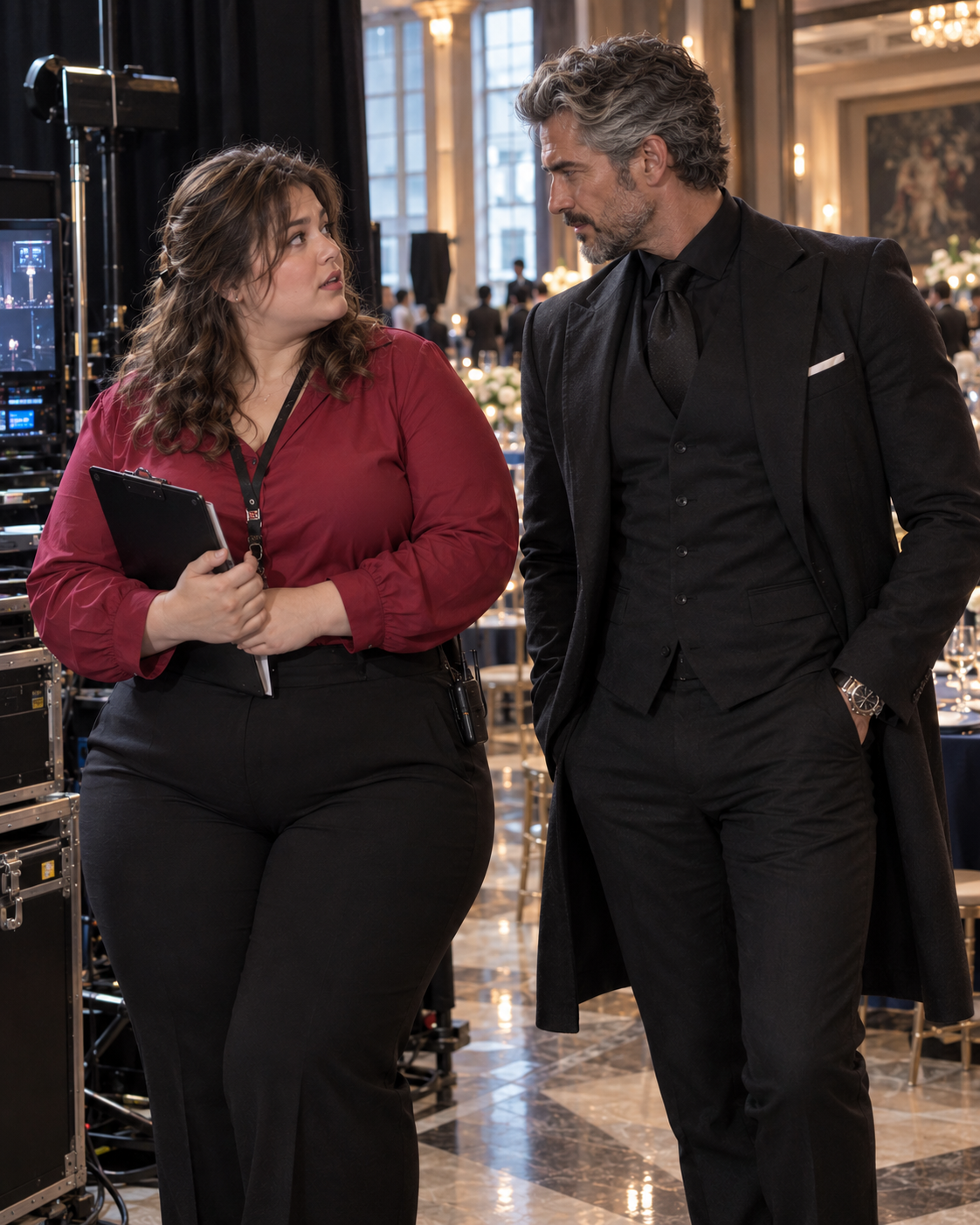
Conference Room Three was smaller than the executive boardroom, but it was still intimidating. Floor-to-ceiling windows overlooked Midtown Manhattan. A long walnut table occupied the center of the room, surrounded by leather chairs.
Harold Bennett was already there.
He looked exhausted.
Beside him sat two members of the finance department.
At the far end of the table sat Victoria.
And next to her was a man Natalie had never seen before.
He wore a dark navy suit and had a calm, unreadable expression.
Natalie’s stomach tightened.
She knew that face.
Not personally.
But she had seen it in framed photographs in the hotel’s private executive corridor.
Roman Duca.
The owner.
The man whose name appeared nowhere on ordinary employee directories.
The man whose presence at the hotel was rare enough to become the subject of quiet speculation.
Natalie stopped just inside the doorway.
Roman looked directly at her.
For half a second, neither of them moved.
Then recognition passed between them.
His eyes changed slightly.
Natalie’s face went pale.
The partition.
The voice.
The quiet man who had listened to everything.
It was him.
Roman did not react.
That somehow made it worse.
“Ms. Brooks,” Victoria said sharply. “Please sit.”
Natalie took the empty chair beside Harold.
She could feel Roman’s attention without looking at him.
Victoria opened a folder.
“We’re here because discrepancies have been discovered in several vendor accounts over the last two quarters.”
Harold lowered his eyes.
Victoria continued.
“Those irregularities were processed through accounts associated with Mr. Bennett’s department.”
Harold finally spoke.
“I’ve explained that I did not authorize those transfers.”
“Yes,” Victoria replied. “You have.”
Her tone carried an implication that made the room feel colder.
Natalie looked at the documents.
The numbers were familiar.
Too familiar.
She had seen some of them before.
Not the entire records, but enough to recognize the pattern.
Three vendors.
Four payments.
Similar amounts.
Different dates.
And something else.
A notation hidden in the internal reference field.
Natalie leaned closer.
Her pulse quickened.
“May I ask a question?”
Victoria sighed.
“This isn’t an event planning meeting, Natalie.”
“I know.”
Roman remained silent.
Natalie pointed toward one line.
“These transactions were supposedly approved by Harold?”
“That is what the records indicate.”
“But the approval codes are wrong.”
The finance manager frowned.
“What do you mean?”
Natalie reached for another page.
“Harold’s approval code has six characters. These entries use seven.”
Silence filled the room.
Harold looked at her.
Victoria’s expression barely changed.
“Perhaps you’ve misunderstood the system.”
“I’ve used the system for three years.”
“That doesn’t make you an accounting specialist.”
“No,” Natalie said quietly. “But I know what a valid approval code looks like.”
Roman finally spoke.
“Let her finish.”
His voice was calm.
Victoria turned toward him.
“Mr. Duca, with respect—”
“Let her finish.”
The second time was softer.
It was also unmistakably final.
Natalie swallowed.
She continued.
“These payments weren’t approved using Harold’s credentials. Someone copied his name onto the records after the transactions were created.”
The finance manager began comparing the documents.
Harold leaned forward.
“That’s what I’ve been trying to tell everyone.”
Victoria closed the folder.
“Or this is an attempt to divert attention from Mr. Bennett’s responsibility.”
Natalie looked at her.
“No.”
The word came out before she could stop it.
Victoria’s eyebrows rose.
Natalie felt fear climb through her chest, but something stronger pushed it back.
“No,” she repeated. “Because there is another problem.”
Roman watched her carefully.
Natalie turned toward the finance manager.
“Check the timestamps.”
The man pulled out his laptop.
Natalie pointed to the first transaction.
“Harold’s account supposedly approved this at 7:42 p.m.”
She pointed to the second.
“This one at 8:03.”
Then the third.
“8:19.”
She looked at Harold.
“You were at the charity gala that night.”
Harold blinked.
“Yes.”
“You gave the keynote at six-thirty. I remember because I helped organize the event.”
The finance manager searched the hotel calendar.
“You were right,” he said.
He turned the laptop around.
“There is a recorded departure from the gala at 9:11.”
Harold stared at the screen.
Victoria’s voice became sharper.
“People can leave a gala.”
Natalie nodded.
“Of course. But the security footage shows Mr. Bennett speaking onstage at 8:15.”
The room went silent.
Harold looked stunned.
Victoria said nothing.
Natalie could hear her own heartbeat.
She had crossed the line.
There was no going back.
Roman leaned back in his chair.
“Bring me the access logs.”
One of the finance executives immediately made a call.
Ten minutes later, the records arrived.
The person who had entered the accounting office during the disputed transactions had used a temporary executive access card.
Not Harold’s.
Not Natalie’s.
And not a maintenance credential.
A temporary card issued to Victoria’s office.
The atmosphere changed instantly.
Victoria stood.
“This proves nothing.”
Roman looked at the document.
“Sit down, Victoria.”
She stared at him.
For the first time, Natalie saw something beneath Victoria’s polished composure.
Fear.
Real fear.
But Victoria recovered quickly.
“You’re making an accusation based on incomplete information.”
Roman nodded.
“That’s why we’re going to complete the information.”
The meeting lasted another two hours.
They traced payment records.
Compared timestamps.
Reviewed access logs.
Checked vendor registrations.
And slowly, the shape of the scheme became visible.
The three vendors were connected through a holding company registered outside New York.
The holding company had no meaningful operations.
Its invoices were inflated.
Payments were routed through several accounts.
And someone had been using Harold’s name to make the transactions appear legitimate.
But there was still one question.
Who had created the false approval records?
The answer came from an unexpected place.
An archived system log showed that the approval templates had been edited from a workstation inside Victoria’s office.
Natalie looked at Harold.
His eyes filled with disbelief.
Victoria shook her head.
“This is ridiculous.”
Roman remained calm.
“You’ll have an opportunity to respond.”
“I don’t need an opportunity. I need you to stop this.”
Roman’s expression hardened.
“You’ve had several opportunities.”
Victoria looked around the room.
Nobody met her eyes.
She sat down slowly.
For the first time since Natalie had known her, Victoria looked small.
Not powerful.
Not untouchable.
Just afraid.
By late afternoon, an outside compliance team had been called in.
The hotel temporarily suspended the disputed vendor accounts.
Harold’s access was restored.
Natalie’s name was formally removed from an internal review that Victoria had initiated weeks earlier.
The evidence was enough to clear Harold of responsibility.
But the discovery did not feel like a victory.
Not yet.
Natalie left the conference room alone.
She walked through the service corridor and stopped beside the same partition.
The place looked ordinary.
A metal cart.
A stack of folded linens.
A small maintenance panel.
She touched the edge of the partition.
“You could have told me.”
Roman’s voice came from behind her.
She turned.
He stood several feet away.
“I didn’t know what I was supposed to say,” he admitted.
“You could have said, ‘I’m not a technician.’”
A faint smile appeared on his face.
“That would have been accurate.”
Natalie folded her arms.
“You heard everything.”
“Yes.”
“My complaints about Victoria.”
“Yes.”
“My concerns about Harold.”
“Yes.”
“And all the things I said about this hotel.”
Roman looked at her.
“Especially those.”
Natalie exhaled.
“You knew who I was.”
“I knew your name.”
“But you didn’t know me.”
“No.”
That answer surprised her.
It was honest.
“I don’t like being watched,” she said.
“I wasn’t watching you.”
“You were listening without telling me who you were.”
“You were speaking because you believed you were safe.”
Roman paused.
“I didn’t want to take that away from you.”
Natalie looked down.
For several seconds, neither spoke.
Then she said, “You could have used what I said against Victoria immediately.”
“I could have.”
“But you didn’t.”
“No.”
“Why?”
Roman’s answer was simple.
“Because I wanted evidence, not assumptions.”
Natalie looked at him again.
That was the first thing he had said that made her trust him even slightly.
“Harold deserved that.”
“Yes.”
She nodded.
Then she stepped away from the partition.
“I need some time.”
Roman did not stop her.
“Take it.”
For the next several weeks, the hotel underwent an internal investigation.
Victoria resigned before the investigation was formally completed.
The outside compliance report documented unauthorized transactions, manipulated approval records, and serious failures in internal oversight.
Harold’s name was cleared.
He returned to work, but he was different.
More cautious.
More deliberate.
One afternoon, he called Natalie into his office.
“You saved me,” he said.
Natalie shook her head.
“You helped save yourself.”
“I didn’t have the information.”
“You had the truth.”
Harold smiled sadly.
“Sometimes the truth needs someone brave enough to carry it into the right room.”
Natalie never forgot those words.
But something else had changed.
Her relationship with Roman became complicated.
He never pressured her.
Never appeared unexpectedly at her desk.
Never used his position to create a reason for contact.
Instead, he sent one brief message through the proper professional channel.
If she ever wanted to discuss event operations independently, he would be willing to meet.
Nothing more.
No hidden invitation.
No pressure.
No expectation.
Natalie ignored the message for three days.
Then she accepted.
They met in a quiet café near Bryant Park.
Roman arrived without an entourage.
No assistants.
No executives.
Just a notebook and two cups of coffee.
“You don’t look like a hotel owner,” Natalie said.
“What does a hotel owner look like?”
“More intimidating.”
He laughed.
“I’ll work on that.”
She smiled despite herself.
They talked for two hours.
Not about romance.
Not about the partition.
Not even much about Victoria.
They talked about events.
About clients.
About logistics.
About how many talented people inside large companies never received the chance to make decisions of their own.
Roman asked questions.
Natalie answered.
He listened.
This time, she knew exactly who was listening.
Months passed.
Natalie began to realize something she had tried very hard to ignore.
The hotel had taught her how capable she was.
But it had also taught her how easily talent could become trapped inside a system that did not recognize it.
One Friday afternoon, she handed in her resignation.
Harold was the first person she told.
He hugged her.
“You’re going to build something.”
“I hope so.”
“You will.”
Natalie left the hotel with one cardboard box.
Inside were photographs, notebooks, event schedules, a small award, and the name badge she had worn on her first day.
She kept the badge.
Not because she wanted to return.
Because she wanted to remember where she had started.
Her new business began in a small rented office in Brooklyn.
There was one desk.
One secondhand printer.
A coffee machine that worked only when it wanted to.
And Natalie.
For the first few weeks, nothing happened.
Then one client called.
Then another.
A nonprofit needed a fundraising dinner.
A technology company needed a product launch.
A family wanted a wedding that felt elegant without feeling artificial.
Natalie took every project seriously.
She remembered what it felt like to be the person behind the scenes.
The person everyone called when something went wrong.
Her business grew.
Not overnight.
Not magically.
Slowly.
Through referrals.
Through long nights.
Through mistakes.
Through learning.
A year later, Natalie had six employees.
Two years later, she had clients across several states.
And one of her largest contracts came from a company that had once competed directly with Roman’s hotel.
Roman heard about it through the industry.
He called her.
“Congratulations.”
“Thank you.”
“You’re difficult to compete with.”
“That’s the nicest complaint I’ve ever received.”
He laughed.
There was a pause.
Then he said, “I’d like to discuss a partnership.”
Natalie became cautious.
“What kind?”
“A legitimate one.”
She smiled.
“That’s reassuring.”
“Your company handles independent event production. My hotels need outside event specialists. You keep your business. We create a preferred partnership.”
Natalie considered it.
“And if I say no?”
“Then I say congratulations again and continue being your client when appropriate.”
She laughed.
“Still trying to prove you’re not intimidating?”
“Apparently.”
They met again.
This time, everything was documented.
Contracts were reviewed.
Responsibilities were clear.
Money was transparent.
There were no favors hidden behind personal relationships.
Natalie appreciated that.
The partnership became successful.
But the professional relationship gradually became something else.
Roman started asking her to dinner.
Not business dinners.
Real ones.
The first time, Natalie hesitated.
“I don’t want my company connected to this.”
“It doesn’t have to be.”
“And I don’t want anyone thinking I built my business because of you.”
“You didn’t.”
She studied his face.
“How do you know?”
“Because I watched you build it.”
She smiled.
“That sounded dangerously close to watching again.”
“I deserved that.”
She laughed.
The dinner happened.
Then another.
Then another.
Nothing moved quickly.
They learned each other’s habits.
Roman discovered Natalie hated overly formal restaurants.
Natalie discovered Roman secretly loved baseball and kept an old glove in his apartment.
They argued about movies.
They disagreed about business.
They learned how to apologize.
And somewhere between one ordinary evening and the next, the distance between them disappeared.
Years later, Natalie occasionally returned to the hotel for major events.
The lobby looked almost exactly the same.
The flowers changed.
The furniture changed.
The staff changed.
But the partition was still there.
One afternoon, she stood beside it and smiled.
Roman found her there.
“Thinking about the past?”
“A little.”
“Regrets?”
Natalie shook her head.
“No.”
She looked at him.
“If I hadn’t mistaken you for a technician, I might never have told anyone what was happening.”
Roman nodded.
“If I hadn’t listened, I might never have understood what was happening.”
Natalie smiled.
“Funny how a misunderstanding can sometimes open the right door.”
Roman took her hand.
“But only if someone is brave enough to walk through it.”
Natalie looked toward the corridor where everything had begun.
The hotel had once represented the limits of her world.
Now it was simply one place among many she had learned to move through without fear.
She had discovered that speaking up did not always guarantee safety.
It did not guarantee success.
It did not guarantee that powerful people would listen.
But silence guaranteed something else.
It guaranteed that the truth would remain where it was.
Hidden.
Natalie had not become successful because Roman had rescued her.
She had become successful because, when the moment came, she chose to trust the evidence, defend someone who could not defend himself, and eventually trust herself enough to leave a place that no longer fit the person she had become.
Harold once told her that truth sometimes needed someone brave enough to carry it into the right room.
Natalie eventually learned another lesson.
Sometimes the right room is not a conference room.
Sometimes it is a tiny office in Brooklyn.
Sometimes it is a difficult conversation.
Sometimes it is a new beginning.
And sometimes, unexpectedly, it is a quiet moment beside a partition where you thought nobody important was listening.
Five years after Natalie left the hotel, the city outside her office window looked different.
Manhattan was still loud.
Still restless.
Still full of people rushing toward meetings, chasing opportunities, and pretending they had everything under control.
But Natalie no longer felt like she was chasing anything.
Her company had grown into one of New York’s most respected independent event firms.
She had a team she trusted.
Clients who respected her judgment.
And, most importantly, she had built the kind of workplace she once wished existed for her.
On a rainy Thursday afternoon, Natalie received an unexpected email.
It was from Harold Bennett.
He was retiring.
His message was short, warm, and characteristically modest.
He invited her to a small dinner with a few former colleagues.
Natalie accepted.
When she arrived at the restaurant, Harold was standing near the window.
He looked older, but happier.
“You actually came,” he said.
“You invited me.”
“I wasn’t sure you’d be too busy.”
Natalie smiled.
“I’m busy. I’m not too busy for you.”
Harold hugged her.
During dinner, they talked about everything except work.
Then, near the end of the evening, Harold became quiet.
“You know,” he said, “I used to think the worst thing that happened to me was being accused of something I didn’t do.”
Natalie listened.
“I was wrong,” he continued. “The worst thing would have been believing the accusation.”
Natalie lowered her glass.
Harold smiled.
“You didn’t let me do that.”
“You wouldn’t have let yourself.”
“Maybe.”
He looked at her.
“But you reminded me.”
The words stayed with Natalie long after dinner ended.
A week later, she received another unexpected message.
This time from Roman.
There was no business proposal.
No client request.
Just four words.
Dinner this Friday?
Natalie smiled at her phone.
She typed a response.
Yes. But you choose the restaurant.
His reply arrived almost immediately.
That’s dangerous.
She laughed.
Some things had not changed.
That Friday, Roman arrived at the restaurant carrying a small envelope.
Natalie raised an eyebrow.
“What is that?”
“Something I should have given you years ago.”
Inside was a photograph.
It showed the old hotel corridor.
The partition was visible in the background.
Natalie stared at it.
“Where did you get this?”
“Security archive.”
“You kept this?”
“I found it recently.”
She turned the photograph over.
There was a handwritten sentence on the back.
You were right to speak.
Natalie looked up.
Roman shrugged.
“I wanted you to have it.”
She smiled.
“You know, most people give flowers.”
“I considered flowers.”
“And?”
“I thought you’d prefer evidence.”
She laughed.
“Definitely.”
They sat together quietly for a moment.
Then Natalie folded the photograph and placed it carefully inside her bag.
She had once thought that night behind the partition was the moment her life changed.
Now she understood it differently.
It wasn’t the partition.
It wasn’t Roman.
It wasn’t even the investigation.
It was the moment she stopped assuming that being quiet was the same thing as being safe.
The moment she decided that facts mattered more than fear.
The moment she realized that protecting someone else’s reputation could also mean protecting her own integrity.
Outside, the rain had stopped.
The streets of Manhattan reflected the lights of passing cars.
Roman reached across the table.
Natalie took his hand.
Neither of them needed to say what came next.
They had spent years learning that the strongest relationships were not built on secrets or power.
They were built on honesty.
Choice.
And the freedom to walk away.
Natalie looked through the restaurant window at the city.
She remembered the woman she had been five years earlier.
Exhausted.
Frustrated.
Afraid of losing a job she had worked so hard to keep.
She wanted to tell that woman something now.
You were never trapped.
You were only standing at a door you hadn’t opened yet.
And sometimes, the most important door in your life does not look important at all.
Sometimes it is a hotel partition.
A difficult conversation.
A resignation letter.
A small office with one desk.
A person who chooses to listen.
Or simply the courage to tell the truth when telling the truth feels expensive.
Natalie smiled.
Then she turned back toward Roman.
“Ready?”
He nodded.
“Always.”
They stepped outside together.
The city moved around them.
Cars passed.
People hurried beneath umbrellas.
Lights flickered across the wet pavement.
And somewhere behind them, in a luxury hotel in Manhattan, the old partition remained exactly where it had always been.
But Natalie no longer needed to look back.
Because she had finally learned the difference between being heard and being understood.
And more importantly, she had learned that sometimes the life waiting on the other side of fear is not something someone gives you.
It is something you choose to build yourself.
THE END.