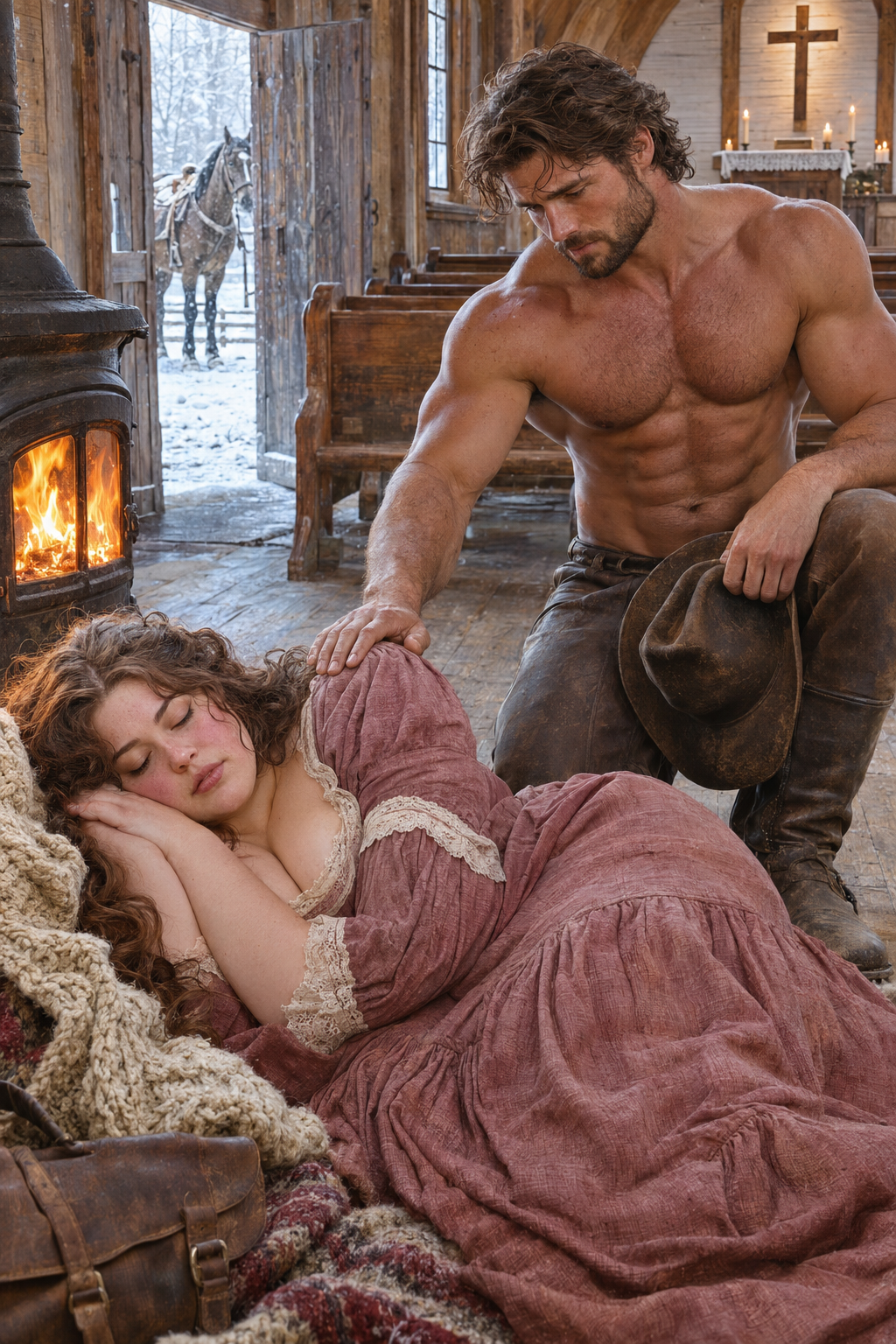
“If you’re running from the law, you picked the wrong chapel,” the towering stranger said.
Grant followed Hannah’s terrified gaze toward the window. For one brief moment, something dangerous flashed across his face.
“Do you know him?”
Hannah nodded, barely able to breathe.
“I saw him outside Mrs. Whitmore’s bedroom. He was carrying something wrapped in a handkerchief.”
Another knock shook the door.
“Dawson! I know you’re in there!”
Grant lowered his voice. “Mrs. Bell, take Hannah into the pantry. Don’t come out until I say.”
“But—”
“Trust me.”
There was something in his expression that silenced her objections.
Mrs. Bell hurried Hannah through the kitchen and into a narrow pantry behind the staircase. Through a crack in the wooden door, Hannah could see the entrance hall.
Grant opened the front door.
A tall, narrow-faced man stood on the porch, snow clinging to his dark hat. His mustache was neatly trimmed, but his eyes moved restlessly over Grant’s shoulder.
“Evening, Dawson.”
“Evening, Mercer.”
Hannah’s blood turned cold.
Grant knew him.
The visitor removed his hat. “I’m looking for a young woman. Brown hair, green eyes. Answers to Hannah.”
“Why?”
“She’s wanted for theft.”
“By whom?”
“Mr. Whitmore of Cheyenne.”
Grant leaned against the doorframe. “Funny. I thought sheriffs handled criminals.”
Mercer’s smile vanished.
“There’s a substantial reward.”
“Then I suggest you keep looking.”
Mercer glanced toward the kitchen.
“Mind if I warm myself? Nearly froze riding up here.”
“I do mind.”
For several seconds, neither man moved.
Then Mercer smiled again.
“You’re making a mistake, Dawson. Whitmore doesn’t appreciate interference.”
“Tell Whitmore I don’t appreciate strangers threatening me on my own porch.”
Grant shut the door.
But Hannah heard something that frightened her more than Mercer’s threats.
Before leaving, Mercer had whispered, “You couldn’t save your brother. Don’t make the same mistake twice.”
Grant stood motionless long after the hoofbeats disappeared.
When Hannah emerged, his face looked older.
“What did he mean about your brother?”
Grant stared into the fire.
“My younger brother, Thomas, worked for Whitmore five years ago. He discovered something he wasn’t supposed to see.”
“What happened?”
“They accused him of stealing money from the company. He was arrested, disgraced, and sentenced to prison.”
Hannah pressed a hand against her mouth.
“Was he innocent?”
“Completely.”
“Where is he now?”
Grant’s answer came quietly.
“He died before I could prove it.”
The kitchen seemed to grow colder.
Mrs. Bell lowered her eyes, and Hannah understood that this was a grief the household had carried for years.
Grant turned toward her.
“Whitmore destroyed my brother because Thomas discovered he was stealing from his own investors. I spent years trying to prove it, but every witness disappeared or changed their story.”
“Then why would he accuse me?”
“That’s what we’re going to find out.”
Hannah reached into her pocket and placed the silver button on the table.
“Perhaps Thomas left you a clue. And perhaps someone has finally made a mistake.”
For the first time that evening, Grant looked at her with something beyond pity.
He looked at her with hope.
The next morning, the blizzard weakened enough for the ranch hands to clear a path toward the barn.
Hannah rose before sunrise, determined to earn her place. She kneaded bread, carried firewood, and helped Mrs. Bell prepare breakfast for twelve hungry men.
But her thoughts remained in Cheyenne.
She remembered the Whitmore mansion, with its polished floors and expensive chandeliers. She remembered Mrs. Whitmore’s trembling hands and the strange argument she’d overheard three nights before the theft.
“You promised me nobody else would suffer,” Mrs. Whitmore had cried.
Her husband had answered, “Then learn to keep your mouth shut.”
At the time, Hannah assumed it concerned some private family trouble.
Now she wasn’t so certain.
That afternoon, Grant found her washing dishes.
“There’s something I need to show you.”
He led her into his study, where a large wooden chest stood beneath the window.
Inside were old letters, newspaper clippings, and a photograph of two young men standing beside a horse.
Grant pointed to the younger one.
“Thomas.”
Hannah studied the smiling face.
“He looks like you.”
“He was better than me. Kinder. More willing to believe people could change.”
Grant opened a worn leather notebook.
“Thomas kept records of Whitmore’s business transactions. Most were destroyed after his arrest. This is all I managed to recover.”
Hannah turned the pages carefully.
Numbers filled the margins, along with names and dates.
Then she noticed something peculiar.
“These initials. E.W. They appear beside almost every payment.”
“Edward Whitmore.”
“No. Look.”
She pointed toward an entry dated five years earlier.
“E.W. received the money, but another E.W. authorized the transfer. Your brother used different handwriting for them.”
Grant leaned closer.
One set of initials had been written in ordinary ink. The other was surrounded by a tiny square.
“Elizabeth Whitmore,” Hannah whispered.
Grant frowned.
“His wife?”
“She managed the household accounts. But before her marriage, she worked as a bookkeeper for her father’s bank.”
Grant looked astonished.
“How do you know that?”
“Servants hear things nobody bothers to hide.”
For the first time, he smiled.
“Then perhaps I’ve been searching for answers in the wrong places.”
Their discovery might have remained only a suspicion if Mrs. Bell hadn’t entered carrying an unexpected visitor’s message.
A young stable boy had arrived from town with a sealed envelope.
There was no signature.
Inside, written in hurried handwriting, were seven words.
“Ask Hannah what she saw beneath the staircase.”
Hannah felt the room tilt.
Beneath the staircase.
She remembered that night.
After Mrs. Whitmore’s argument with her husband, Hannah had gone downstairs to fetch fresh candles. Passing the staircase, she’d heard a metallic scraping sound.
She had stopped.
Through the darkness, she saw Mercer kneeling beside a loose floorboard.
He was placing something beneath it.
When he noticed her, he stood quickly and claimed he’d dropped his watch.
“I thought nothing of it,” Hannah whispered. “Until now.”
Grant gripped the letter.
“Whoever sent this knows what happened.”
“And knows I’m here.”
Their eyes met.
Someone inside the Whitmore household was trying to help them.
Or someone was leading them into a trap.
That night, Grant insisted the ranch doors remain locked.
Hannah lay awake listening to the wind. Around midnight, she heard footsteps outside her bedroom.
Her heart hammered.
The handle turned.
She sat upright.
“Who’s there?”
No answer.
The handle turned again.
Hannah grabbed the heavy iron candlestick beside her bed.
Suddenly, a muffled cry sounded in the hallway.
She opened the door to find Grant pinning a stranger against the wall.
The intruder wore a scarf over his face and carried a knife.
“Who sent you?” Grant demanded.
The man struggled.
Grant twisted his wrist until the knife clattered onto the floor.
“Whitmore?” Grant asked.
The stranger spat at his boots.
“You’re already dead, Dawson. You just don’t know it.”
Before Grant could question him further, the man struck his forehead against Grant’s face, broke free, and hurled himself through the nearby window.
Glass shattered.
By the time Grant reached the yard, the intruder had disappeared into the snow.
But he’d left something behind.
A small leather pouch.
Inside was a folded photograph.
Hannah stared at it.
The photograph showed Thomas Dawson standing outside the Whitmore mansion.
Beside him stood Elizabeth Whitmore.
And in her arms was a baby.
On the back, someone had written:
“Thomas knew the child wasn’t Whitmore’s.”
Grant read the words twice.
Then he sat down heavily.
“Good Lord.”
Hannah looked between him and the photograph.
“What does this mean?”
Grant’s voice shook.
“Thomas wrote to me shortly before his arrest. He said he’d discovered a secret that could destroy Whitmore’s marriage. I thought he meant the stolen money.”
He looked at the baby.
“Maybe he meant something else.”
By morning, the photograph had changed everything.
Grant wanted to ride immediately to Cheyenne, but Hannah stopped him.
“If Whitmore framed your brother to protect that secret, he’ll do worse to protect it now.”
“Then what do you suggest?”
“We find out who the child is.”
Mrs. Bell studied the photograph in silence.
Then her expression changed.
“I know that baby.”
Both turned toward her.
“Mrs. Bell?”
She sat slowly.
“Before I came here, I worked as a midwife. Elizabeth Whitmore gave birth to a daughter six years ago. The child was said to have died of fever.”
Grant frowned.
“Thomas was arrested five years ago.”
Mrs. Bell nodded.
“But that child didn’t die.”
Hannah’s breath caught.
“How can you be certain?”
“Because I was the one who carried her away.”
The room fell silent.
Mrs. Bell clasped her hands.
“Elizabeth begged me to save the girl. Whitmore had discovered she wasn’t his child. He threatened to kill her if Elizabeth didn’t surrender every document proving his financial crimes.”
“Who was the father?” Grant asked.
Mrs. Bell looked directly at him.
“Thomas.”
Grant staggered backward.
“My brother had a daughter?”
Mrs. Bell began to cry.
“They loved each other before Elizabeth married Whitmore. Her father forced the marriage to settle his debts. Thomas never knew about the baby until years later.”
“Where is she?” Grant demanded.
Mrs. Bell covered her face.
“At the St. Agnes orphanage outside Cheyenne. Her name is Clara.”
Grant stood so abruptly that his chair fell.
“All these years…”
His voice broke.
“All these years, my brother had a child, and nobody told me.”
“I promised Elizabeth I’d keep her safe,” Mrs. Bell whispered. “Whitmore’s men were watching everyone connected to Thomas.”
Grant turned away, struggling to control himself.
Hannah approached him.
“Grant, listen to me. Clara is alive. That means there’s still someone you can save.”
He looked at her.
And slowly, his anger gave way to determination.
They planned to leave for Cheyenne at dawn.
But dawn brought another disaster.
The barn was burning.
Flames roared through the roof while terrified horses screamed inside.
Grant raced toward the doors, followed by the ranch hands.
Hannah grabbed blankets and buckets while Mrs. Bell organized a line from the well.
Through the smoke, Hannah heard a child’s voice.
“Help!”
She froze.
A small boy stood trapped behind a fallen beam.
It was Peter, the youngest ranch hand’s son, who’d been sleeping in the loft after helping his father care for a sick mare.
Without thinking, Hannah wrapped a wet blanket around herself and rushed inside.
Heat struck her face like an open furnace.
She crawled beneath the smoke, found Peter, and pulled him toward the door.
A burning timber crashed behind them.
Hannah stumbled.
Her ankle twisted beneath her.
For one terrible moment, she couldn’t stand.
Then strong arms lifted them both.
Grant.
He carried Peter under one arm and supported Hannah with the other, pushing through the flames just as the roof began collapsing.
They fell into the snow.
Behind them, the barn surrendered to the fire.
Grant held Hannah’s face between his hands.
“Are you hurt?”
“My ankle. Peter—”
“He’s safe.”
His voice trembled.
“Don’t ever frighten me like that again.”
Hannah stared at him.
There was no hiding what she’d seen in his eyes.
He cared for her.
Not because she was helpless.
Not because he pitied her.
But because somewhere between their shared grief and their stubborn search for justice, she’d become important to him.
Then a ranch hand shouted from the ruins.
“Mr. Dawson! We found something!”
Near the rear fence lay a broken lantern and fresh hoofprints.
The fire had been deliberately set.
And nailed to the fence was a message.
“Next time, it will be the house.”
Grant’s expression hardened.
“Whitmore wants us frightened.”
Hannah gripped his sleeve.
“Then let’s give him something to fear.”
Two days later, they reached Cheyenne under heavy gray skies.
Hannah wore a borrowed blue dress and a bonnet that concealed most of her face.
Grant had arranged for an old friend, Sheriff Nathan Cole, to meet them privately.
Unlike the official who’d accepted Whitmore’s accusation, Cole served a neighboring county and had no financial ties to the businessman.
He listened carefully as they explained everything.
“The button, the photograph, the hidden floorboard,” Cole repeated. “It’s suspicious. But suspicion won’t put Whitmore behind bars.”
“What will?” Hannah asked.
“Documents. Witnesses. Something he can’t buy his way out of.”
Grant placed Thomas’s notebook on the table.
Cole studied it.
“These records might be useful if we find the original ledgers.”
Hannah straightened.
“Then we know where to look.”
That evening, Hannah returned to the Whitmore mansion.
Not as a frightened servant.
As a woman determined to reclaim her name.
She entered through the servants’ passage while Grant and Cole waited nearby.
The household was strangely quiet.
She found the staircase and knelt beside the loose floorboard.
Her fingers trembled as she lifted it.
Beneath lay a narrow tin box.
Inside were bank receipts, signed statements, and a bundle of letters.
Hannah opened the first letter.
It was written by Thomas Dawson.
“If anything happens to me, Elizabeth, remember that the truth belongs to our daughter.”
Tears blurred Hannah’s vision.
She unfolded another paper.
There, in Whitmore’s handwriting, was an order authorizing the transfer of stolen investor funds into a private account.
The documents proved Thomas had been framed.
Then a familiar voice spoke behind her.
“I wondered how long it would take you.”
Hannah turned.
Elizabeth Whitmore stood in the hallway.
She looked pale and exhausted.
“Mrs. Whitmore.”
Elizabeth’s eyes filled with tears.
“I sent the letter to the ranch. I hoped you’d understand.”
“Why didn’t you tell the truth years ago?”
“Because I was a coward.”
Her voice cracked.
“Edward threatened Clara. Every time I tried to speak, he reminded me he knew where she was.”
Hannah held out the documents.
“Then help us stop him.”
Elizabeth reached for them.
But before her fingers touched the papers, a gun clicked behind them.
“How touching.”
Edward Whitmore stepped from the shadows.
Mercer stood beside him.
Whitmore smiled coldly.
“My wife and my dishonest little maid, conspiring together.”
Hannah backed toward the staircase.
“It’s over, Mr. Whitmore.”
He laughed.
“Over? My dear girl, I own the judge, the prosecutor, and half the men who wear badges in this town.”
Elizabeth stepped forward.
“Edward, please.”
“Quiet.”
He aimed the pistol at Hannah.
“Give me the box.”
Hannah’s mind raced.
If she surrendered the evidence, Thomas would remain disgraced, Clara would remain in danger, and her own future would disappear.
But if she refused, Whitmore might kill them both.
She slowly raised the box.
“All right.”
Whitmore extended his hand.
Hannah stepped closer.
Then she hurled the box down the staircase.
Papers scattered through the air.
Whitmore shouted and lunged after them.
At that instant, Elizabeth seized his gun arm.
A shot exploded.
The bullet struck the chandelier.
Glass rained across the hallway.
Hannah grabbed Elizabeth and pulled her behind the staircase.
Mercer rushed toward them.
But before he reached the women, the front door burst open.
Grant entered with Sheriff Cole.
“Drop your weapon!”
Mercer reached for his pistol.
Grant struck him with a heavy wooden chair.
The man collapsed.
Whitmore turned his gun toward Grant.
“Another Dawson,” he sneered. “I should have finished your family years ago.”
Grant stopped.
For a moment, Hannah feared he’d lose control.
Whitmore smiled.
“Your brother begged me to spare the child. Did you know that?”
Grant’s face drained of color.
“He offered to confess to anything if I’d leave her alone.”
Hannah saw Grant’s hand tighten around the revolver he’d drawn.
“Grant,” she whispered.
Whitmore continued.
“He died believing nobody would ever know the truth.”
Grant raised his weapon.
The room seemed to hold its breath.
Then Hannah stepped beside him.
“Thomas died protecting someone he loved. Don’t let this man turn you into someone Thomas wouldn’t recognize.”
Grant looked at her.
His hand trembled.
Slowly, he lowered the revolver.
Sheriff Cole stepped forward and arrested Whitmore.
For the first time in years, the powerful businessman had nothing left to say.
But their victory was not yet complete.
As Cole gathered the scattered documents, Elizabeth suddenly cried out.
“Clara!”
Everyone turned.
“What about her?” Grant demanded.
Elizabeth gripped his arm.
“Edward sent two men to the orphanage this morning. He said the child was being moved somewhere nobody would ever find her.”
Grant ran for the door.
Hannah followed, despite her injured ankle.
They rode through the darkening streets toward St. Agnes.
When they arrived, the orphanage gates stood open.
A frightened nun met them outside.
“Two men took Clara an hour ago. They said they had papers signed by her mother.”
“Which direction?” Grant asked.
“North. Toward the railway station.”
Grant turned his horse without another word.
Hannah climbed into the saddle behind him.
The wind whipped against her face as they raced through the outskirts of Cheyenne.
Ahead, a train whistle pierced the evening.
They reached the station as the final passengers boarded.
Grant searched the platform.
Then Hannah saw her.
A little girl in a red wool coat, clutching a rag doll.
Two men were pulling her toward the last carriage.
“There!”
Grant leaped from his horse.
One man drew a knife.
Grant struck his wrist, sending the weapon beneath the train.
The second man grabbed Clara and climbed aboard.
The train began moving.
Hannah ran along the platform.
“Clara!”
The child turned.
Her frightened blue eyes met Hannah’s.
“Jump!” Hannah shouted.
The man tightened his grip.
Hannah caught the railing and hauled herself onto the moving carriage.
Pain shot through her injured ankle.
She nearly fell.
But she seized the man’s coat and pulled with all her strength.
He stumbled.
Clara broke free.
Hannah wrapped her arms around the girl.
Then the man shoved them toward the open doorway.
The ground rushed beneath them.
Suddenly, Grant appeared alongside the carriage on horseback.
“Hannah!”
She held Clara tightly.
Grant reached up.
“Give her to me!”
Hannah lowered the child into his arms.
Then her own foot slipped.
For one terrifying second, she hung above the tracks.
Grant caught her wrist.
With a desperate pull, he dragged her from the carriage.
They tumbled into the snow beside the railway.
The train thundered away.
For several moments, nobody spoke.
Then Clara began crying.
Grant gathered her against his chest.
“You’re safe now, sweetheart.”
The little girl studied his face.
“Are you my papa?”
Grant’s eyes filled with tears.
“No, darling.”
He brushed snow from her hair.
“I’m your uncle.”
Clara frowned.
“What’s an uncle?”
Grant laughed through his tears.
“Someone who should have found you a long time ago.”
She touched his cheek.
“Will you leave me too?”
His voice broke.
“Never.”
Hannah turned away to hide her tears.
But Grant reached for her hand.
“Neither of us will.”
The following weeks brought a reckoning Cheyenne would remember for years.
Whitmore’s financial records revealed a network of fraud, bribery, and stolen investments stretching across three counties.
Several officials resigned before investigators could question them.
Others were arrested.
Mercer confessed to planting the empty velvet case beneath Hannah’s bed, stealing the brooch, and helping Whitmore destroy evidence.
The brooch itself was recovered from a locked drawer in Whitmore’s private office.
Elizabeth testified against her husband, acknowledging her years of silence and revealing the threats that had kept her obedient.
Her testimony helped expose the crimes, though it could not erase the suffering her silence had caused.
Thomas Dawson’s conviction was formally overturned.
His name was cleared.
And Hannah received a public apology from the very people who’d once refused to hear her defense.
One afternoon, the newspaper editor offered to publish her account.
“You could become quite famous,” he told her.
Hannah considered the offer.
Then she shook her head.
“I don’t want fame. I want people to remember that an accusation isn’t proof, and that a poor person’s word deserves to be heard.”
The editor wrote down every word.
Meanwhile, Clara settled into life at Mercy Ridge.
She chased chickens, named every horse, and followed Grant everywhere.
At night, she sometimes woke crying from dreams she couldn’t explain.
Hannah would sit beside her, telling gentle stories until she fell asleep.
One evening, Clara asked, “Was my father a good man?”
Hannah glanced toward Grant, who stood quietly in the doorway.
“Yes,” she answered. “He was a very good man.”
“Then why did he go away?”
Hannah brushed a curl from the girl’s forehead.
“Sometimes good people are hurt by people who make terrible choices. But your father loved you, even when he couldn’t be with you.”
Clara thought about that.
“Do you think he can see me?”
Hannah smiled softly.
“I think he’d be very proud of you.”
Grant turned away, wiping his eyes.
Spring arrived slowly in Wyoming.
The snow melted from the hills, revealing green grass and wildflowers.
The burned barn was rebuilt with help from neighboring ranchers.
Hannah continued working alongside Mrs. Bell, though Grant repeatedly insisted she no longer needed to earn her room.
“I like working,” she told him.
“Then at least let me pay you properly.”
“You already do.”
“Not nearly enough.”
She laughed.
“You argue terribly, Mr. Dawson.”
“So I’ve been told.”
Their affection grew in quiet moments.
A shared cup of coffee before sunrise.
A walk through the meadow.
The way Grant always noticed when Hannah was tired, and the way she could recognize his sadness even when he said nothing.
But neither spoke of love.
Hannah feared that gratitude might be mistaken for affection.
Grant feared that asking her to stay would make her feel obligated.
Then one morning, a letter arrived from Denver.
A respectable family had read Hannah’s story and offered her a position as head housekeeper, with excellent wages and a home of her own.
It was everything she’d once dreamed of.
Independence.
Security.
A future untouched by scandal.
Grant read the letter silently.
“You should take it,” he said.
Hannah looked up.
“Do you want me to?”
His expression tightened.
“What I want shouldn’t matter.”
“But it does.”
Grant stared out the window.
“I brought you here because you needed shelter. I won’t turn that kindness into a debt you feel obliged to repay.”
Hannah’s eyes stung.
“And what if I don’t want to leave?”
He turned toward her.
“Then I’d ask you to stay.”
“As your housekeeper?”
Grant stepped closer.
“No.”
His voice softened.
“As the woman I love.”
Hannah’s breath caught.
He continued before courage deserted him.
“I loved you when you stood in that burning barn and refused to abandon a frightened child. I loved you when you faced Whitmore without surrendering your dignity. And I loved you when you reminded me that justice isn’t the same as revenge.”
A tear slipped down Hannah’s cheek.
“Grant…”
“I don’t need an answer today. Take the position if it’s what you want. I’ll never stand between you and your freedom.”
Hannah looked at the letter.
Then she folded it carefully.
“For most of my life, I thought having a home meant finding somewhere nobody could throw me out.”
She stepped closer.
“But you taught me something different.”
“What’s that?”
“A home is where you can tell the truth without being afraid.”
Grant took her hands.
“And is this your home?”
Hannah smiled through her tears.
“It has been since the night you opened your door.”
He kissed her gently, with the tenderness of a man who had spent years believing happiness belonged to other people.
Outside, Clara spotted them through the window.
She ran into the kitchen shouting, “Mrs. Bell! Uncle Grant’s kissing Hannah!”
Mrs. Bell dropped her wooden spoon.
“Well, it’s about time!”
Their laughter filled the house.
They married beneath the same chapel roof where Grant had first found Hannah.
The building had been repaired, its broken windows replaced and its altar restored.
Neighbors filled the wooden pews.
Clara carried wildflowers down the aisle, proudly announcing that she was responsible for making everyone look beautiful.
Elizabeth attended quietly, having begun the difficult work of rebuilding her relationship with her daughter. Clara was learning to know her mother at her own pace, surrounded by people who would protect her.
When Hannah reached the altar, Grant took her hand.
“Still running from the law?” he whispered.
She smiled.
“Not anymore.”
“Good. Because I was hoping you’d stay.”
“Forever sounds about right.”
Years later, travelers passing through Mercy Ridge would hear the story of the woman who arrived in a blizzard with nothing but a ruined reputation and a silver button.
They would hear how a rancher searching for justice found love, how a forgotten child found her family, and how the truth finally defeated a powerful man’s lies.
But Hannah remembered something different.
She remembered a cold chapel, a stranger’s coat around her shoulders, and the simple kindness that had given her the courage to survive another day.
She and Grant eventually established a small refuge beside the restored chapel, offering food, temporary shelter, and help to travelers who had nowhere else to turn.
Above its entrance, Hannah placed a wooden sign.
It read, “No one should have to prove their worth before receiving kindness.”
And whenever someone arrived frightened, hungry, or ashamed, Hannah welcomed them inside.
She never asked what rumors followed them.
She never assumed that hardship meant guilt.
She offered a warm meal, a safe place to rest, and the chance to tell their own story.
Because she had learned that a reputation could be stolen, a fortune could disappear, and even justice could arrive years too late.
But compassion, freely given, could restore something far more precious than money or status.
It could restore a person’s belief that they deserved a future.
And sometimes, the smallest act of mercy could become the beginning of an entirely new life.
THE END.