“I wish I had never married you.”
“If this letter has been found, then someone I trusted has betrayed both my family and the people of Norchester.”
Peter stood motionless beside his father’s desk.
Outside, rain battered the windows of the old study. The fire had nearly burned out, but he barely noticed the cold.
He read the first sentence again.
Then his eyes moved to the next.
“The money intended for the protection of Belle Meadow has been stolen. I have reason to believe that my brother-in-law, Lord Edmund, is responsible.”
Peter felt the floor shift beneath him.
Lord Edmund had been Lady Regina’s husband.
The man Peter remembered as a cheerful gentleman who brought him wooden horses and silver coins when he was a child.
The man whose death had left Regina a grieving widow.
And now, according to his father’s letter, a thief.
Peter sank into the chair.
The letter continued.
His father had established a permanent agreement granting the villagers access to Belle Meadow’s spring and grazing fields. He had also reserved money from the estate’s income to maintain the paths, fences, and water channels.
But shortly before his death, he discovered that thousands of pounds had disappeared from those accounts.
Lord Edmund had been responsible for supervising certain estate payments.
When questioned, he claimed the missing money was a bookkeeping mistake.
Peter’s father had not believed him.
“I intended to bring the matter before my solicitor,” the letter said. “But my health has weakened, and I fear the documents may disappear before I can act. I have hidden the original agreement here until I can place it in safer hands.”
Peter lowered the paper.
His father had died unexpectedly before taking that final step.
And the documents had remained hidden for years.
Until now.
A terrible thought entered Peter’s mind.
Matilda had been right.
Not partly right.
Not simply concerned about the villagers.
She had been right about the agreement, the missing payments, and the danger of trusting Regina without asking questions.
He had called his wife disloyal for trying to protect something his own father had considered sacred.
Then he had driven her away.
Peter closed his eyes.
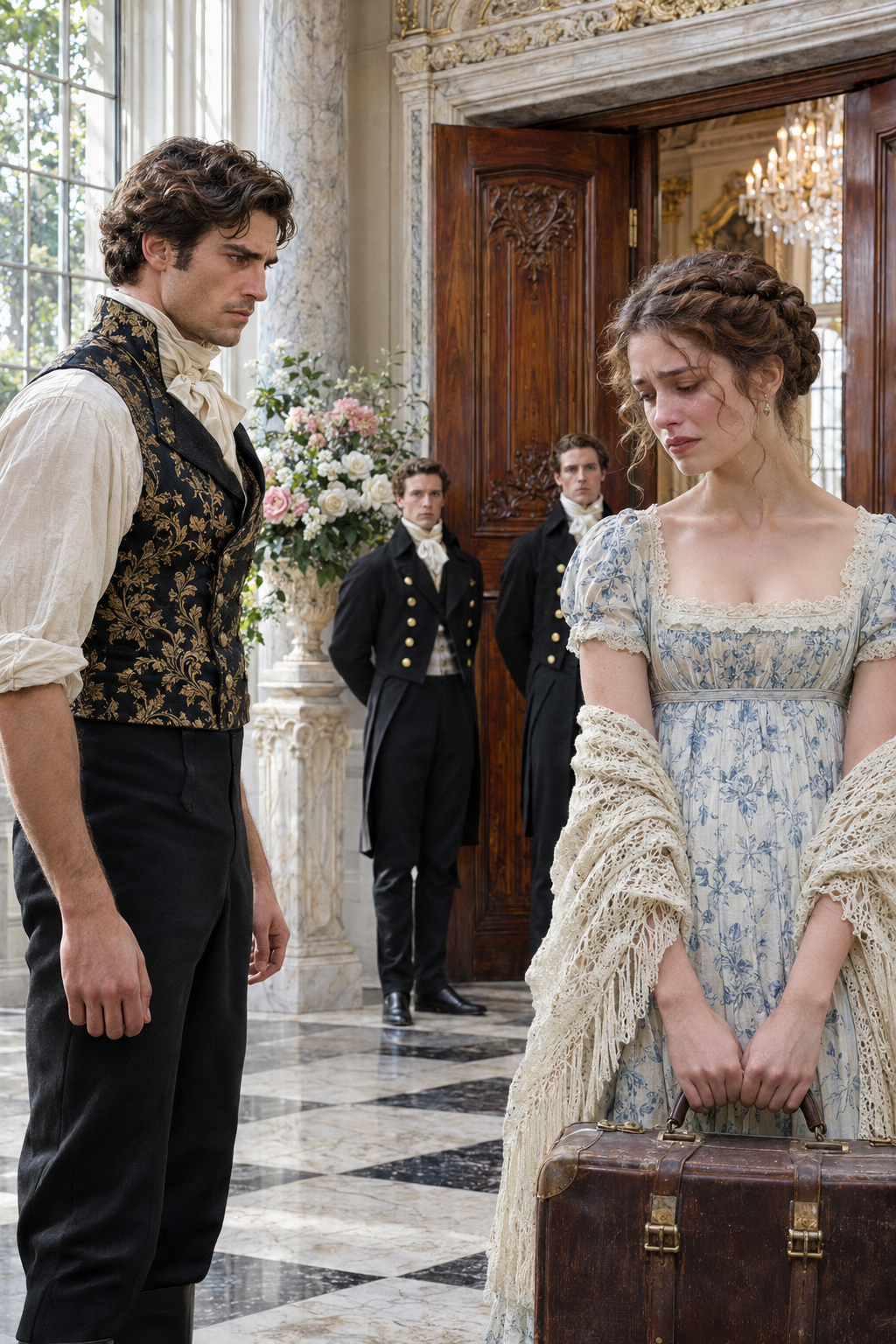
He could still see Matilda standing in his study, holding those papers while six servants watched.
He could still hear himself saying he wished he had never married her.
At the time, he had wanted to wound her.
Now he would have given anything to take those words back.
A knock sounded at the door.
“Your Grace?”
It was Bennett, the elderly butler.
Peter quickly folded the letter.
“Come in.”
Bennett entered carrying a fresh candle.
“I noticed your light was still burning, sir.”
Peter studied the old man’s face.
“Bennett, how long have you served this family?”
“Forty-two years, Your Grace.”
“Then perhaps you can answer something. Did my father ever speak to you about Belle Meadow?”
Bennett’s expression changed.
“Yes, sir.”
“Tell me everything.”
The butler hesitated.
“Your father was particularly fond of the meadow. He used to say that the spring belonged to the village as surely as the church bell belonged to the parish.”
“Did you know about a written agreement?”
“I knew he signed something with the village representatives. I wasn’t present, but I remember the day.”
Peter leaned forward.
“What happened?”
“Your father came home from the church looking very pleased. He said no family should lose its livelihood simply because a duke needed money.”
Bennett looked toward the window.
“After he died, Lady Regina told us the agreement had never been completed.”
Peter’s fingers tightened around the letter.
“Did you believe her?”
The butler was silent for a moment.
“I believed her because I thought she was speaking for you, sir.”
The answer struck Peter harder than an accusation.
People had trusted Regina because Peter had trusted her.
And Peter had trusted her because questioning her had seemed like questioning his own family.
“How many others knew about this?” he asked.
“Not many. Some of the older villagers, perhaps. And Mr. Hargreaves, the steward.”
Peter’s head snapped up.
“Hargreaves?”
“Yes, Your Grace.”
The steward had assured Peter that no binding agreement existed.
He had repeated Regina’s words almost exactly.
Peter rose.
“Send for him.”
“At this hour, sir?”
“Immediately.”
Bennett bowed and left.
Peter remained beside the desk, staring at the hidden compartment.
For the first time, he understood that the greatest danger to an estate was not always a shortage of money.
Sometimes it was the people entrusted to manage it.
***
Mr. Hargreaves arrived twenty minutes later, wearing a hurriedly buttoned coat.
“You sent for me, Your Grace?”
Peter placed the old ledgers on the desk.
“I have questions about the village maintenance accounts.”
The steward glanced at the books.
“I believe Lady Regina has already explained—”
“I am not asking Lady Regina.”
Hargreaves swallowed.
Peter opened a ledger to a marked page.
“Money was allocated to maintain Belle Meadow. Yet the payments disappeared. Why?”
“I would need time to examine the figures.”
“You have managed these accounts for fifteen years.”
“Some older records may have been misplaced.”
“Then explain why several pages were removed.”
The steward’s face lost its color.
Peter continued.
“And explain why you assured me no agreement existed between my father and the villagers.”
Hargreaves said nothing.
Peter took the original agreement from the compartment and laid it before him.
The steward stared.
“Where did you find that?”
The question was enough.
Peter felt a slow, cold anger rise inside him.
“You knew.”
Hargreaves looked toward the door.
“Your Grace, I was following instructions.”
“Whose?”
The steward’s lips trembled.
“Lady Regina’s.”
Peter waited.
“She said the estate could not afford the obligations,” Hargreaves finally admitted. “She ordered me to stop the payments and remove any references that might interfere with future leases.”
“And you obeyed?”
“She threatened to have me dismissed. I have a wife and three children.”
Peter looked at the man standing before him.
“Do you know how many families depend on that spring?”
Hargreaves lowered his head.
“Yes, Your Grace.”
“Did you think about their children?”
The steward’s eyes filled with shame.
Peter wanted to shout.
Instead, he spoke quietly.
“You will surrender your keys and all financial records in your possession. You are dismissed from your position, effective immediately.”
“Please, sir—”
“You may provide a full written account to my solicitor. Any decision about further action will depend on the truth of that account.”
Hargreaves bowed his head.
When he left, Peter felt no satisfaction.
Punishing a dishonest steward would not repair years of neglect.
Nor would it bring Matilda home.
But it was a beginning.
***
Lady Regina came downstairs the following morning dressed in dark green silk.
She entered the breakfast room with the confident expression of someone who had spent years believing the household belonged to her.
“Peter, darling, I hear you kept poor Hargreaves awake half the night.”
Peter sat at the table with his father’s letter beside his untouched breakfast.
“Sit down, Aunt.”
Regina gave a small laugh.
“You sound terribly serious.”
“Sit down.”
Something in his voice made her obey.
Peter pushed the letter across the table.
“I found this in Father’s desk.”
Regina looked at the handwriting.
Her smile disappeared.
“Where?”
“In a hidden compartment.”
She reached for the paper, but Peter placed his hand over it.
“Before you read it, I want an answer.”
Regina lifted her chin.
“What answer?”
“Did you know Edmund stole money from the village funds?”
The room became silent.
For several seconds, Regina did not move.
Then she looked away.
“My husband is dead, Peter.”
“That was not my question.”
“Whatever Edmund did, he suffered enough.”
“The villagers suffered too.”
Regina’s eyes flashed.
“You have no idea what it means to keep a family respectable!”
Peter stared at her.
She stood abruptly.
“Edmund made mistakes. He gambled. He borrowed money. He was desperate. But you cannot imagine what society would have done to us if those debts became public.”
“So you hid the theft?”
“I protected this family!”
“You protected yourself.”
Regina flinched.
Peter placed another document on the table.
“Sir Lucius is prepared to pay an unusually large sum for Belle Meadow. Why?”
Regina said nothing.
“What does he have over you?”
Her expression collapsed.
She lowered herself slowly into the chair.
“Edmund owed him money.”
“How much?”
“More than I could repay.”
Peter waited.
“After Edmund died, Sir Lucius came to me with notes bearing my husband’s signature. He threatened to expose everything.”
“And the lease?”
“He promised to settle the matter if I persuaded you to grant him Belle Meadow.”
Peter looked toward the garden.
Sir Lucius had presented himself as a generous investor willing to rescue an old estate.
In truth, the offer had been tied to Regina’s private debts.
“Why destroy the village records?”
“Because the agreement would have prevented the lease!”
Her voice broke.
“I had no choice.”
Peter turned back to her.
“You had choices. You could have told Father. You could have told me. You could have faced the consequences.”
Regina began crying.
“I have loved you since you were a boy.”
Peter felt the familiar pull of that sentence.
For years, Regina had used her affection as proof that her advice must be right.
But love did not excuse deception.
“And Matilda?” he asked.
Regina looked up.
“What about her?”
“You knew she was telling the truth.”
Regina wiped her eyes.
“She was becoming difficult.”
“You watched me humiliate my wife.”
“I was afraid she would ruin everything.”
Peter stood.
“She was trying to save what was right.”
Regina opened her mouth, but he continued.
“You will leave Norchester today. You will not manage another estate account, and you will make no further decisions in my name.”
“Peter, this has been my home for years.”
“I know.”
His voice softened, but his decision did not.
“That is what makes your betrayal so painful.”
Regina stared at him.
Then, for the first time in Peter’s memory, she seemed like an ordinary frightened woman instead of the powerful aunt who always knew best.
He arranged for her to stay with relatives while his solicitor examined the debts and missing funds.
He did not know whether he would ever forgive her.
But he knew that allowing her to remain in control would only create another injustice.
***
Sir Lucius arrived that afternoon in a polished black carriage.
He entered Peter’s study smiling.
“My dear Duke! I trust we are finally ready to sign.”
Peter gestured toward a chair.
“There will be no lease.”
Sir Lucius stopped smiling.
“I’m afraid I don’t understand.”
“Belle Meadow is protected by a binding agreement made by my father.”
The older man shrugged.
“Surely such arrangements can be reconsidered.”
“Not by pretending they never existed.”
Sir Lucius studied Peter carefully.
“Your estate is in considerable difficulty.”
“I am aware.”
“You need my money.”
“Not on these terms.”
Sir Lucius rose.
“You are making an expensive mistake.”
Peter looked directly at him.
“I have already made an expensive mistake. I trusted people who valued money more than honor.”
The man’s expression hardened.
“Lady Regina assured me—”
“Lady Regina no longer represents this estate.”
For a moment, Sir Lucius appeared ready to argue.
Then he adjusted his gloves.
“I hope you will not regret this decision.”
Peter opened the door.
“I have enough regrets already.”
When the carriage disappeared down the drive, Peter finally allowed himself to sit.
He had rejected the easiest financial rescue available.
The estate was still struggling.
Repairs were needed. Tenants expected support. Creditors were waiting.
Doing the right thing had not made those problems vanish.
But for the first time in months, Peter could look at his father’s portrait without feeling ashamed.
***
The next morning, Peter visited the village.
He did not announce his arrival.
He walked through the narrow streets in an ordinary dark coat, accompanied only by Bennett.
People stopped talking when they recognized him.
A farmer touched his cap without smiling.
A woman holding a basket turned away.
Peter understood why.
For months, rumors had spread that he intended to sell the villagers’ future to Sir Lucius.
And he had done nothing to correct them.
Near the church, he found an elderly farmer repairing a broken gate.
“Mr. Fletcher?”
The man straightened.
“Your Grace.”
“I’ve come to speak about Belle Meadow.”
Fletcher’s expression tightened.
“Then perhaps you should speak to the families who’ll suffer when we lose it.”
“I intend to.”
The farmer looked surprised.
Peter glanced at the damaged gate.
“Why hasn’t this been repaired?”
“Because the maintenance money stopped years ago.”
“Did you complain?”
“Many times.”
“To whom?”
“Your steward. Then Lady Regina.”
“And what were you told?”
“That the duke had more important expenses.”
Peter felt shame burn through him.
“My father never intended that.”
Fletcher studied his face.
“We know what your father intended, sir. We were beginning to wonder whether his son cared.”
Peter accepted the words without defending himself.
“You were right to wonder.”
The farmer slowly set down his hammer.
Peter continued.
“I found the original agreement. The village’s rights will be honored. The missing payments will be investigated, and maintenance will begin again.”
Fletcher stared at him.
“You mean we can keep the spring?”
“Yes.”
“And the grazing fields?”
“Yes.”
The old man removed his cap.
For a moment, he seemed unable to speak.
Then he said, “Her Grace told us you were a better man than you believed.”
Peter’s throat tightened.
“Matilda said that?”
Fletcher nodded.
“She came here before she left. She told us not to lose hope.”
Peter looked away.
Even after he had refused to believe in her, Matilda had continued believing he might do what was right.
That kindness hurt more than anger.
***
Two days later, the village church was filled.
Farmers stood beside shopkeepers. Mothers held children on their laps. Elderly villagers leaned on walking sticks.
Peter stood near the altar holding the original agreement.
His solicitor had inspected the document and confirmed that the village rights remained legally binding.
Now Peter intended to make the truth public.
“My father made a promise to this village,” he began.
The room became quiet.
“He promised that Belle Meadow’s spring and grazing fields would remain available to the families who depended on them.”
He paused.
“That promise was hidden from me. But I must also admit that I failed to investigate when people questioned what I had been told.”
Several villagers exchanged glances.
Peter continued.
“My wife brought those concerns to me. I refused to listen.”
His voice nearly broke.
“I cannot undo that failure. I can only begin correcting it.”
He raised the document.
“This agreement will be honored. The proposed lease has been canceled. Repairs to the spring, water channels, fences, and paths will begin without delay.”
A murmur spread through the church.
Peter waited until it faded.
“I will also establish clear accounts for the maintenance funds, with village representatives allowed to review them.”
Mr. Fletcher slowly stood.
“Your Grace, does that mean we won’t have to beg the estate whenever something breaks?”
Peter shook his head.
“No. The village will receive what was promised.”
A woman near the front began crying quietly.
An elderly man whispered a prayer.
Then Fletcher bowed his head.
“Thank you, Your Grace.”
Peter looked around the room.
“I am not asking you to thank me for finally doing what I should have done from the beginning.”
No one spoke.
“But I hope, in time, my actions will give you reason to trust me again.”
After the service, villagers surrounded him with questions.
Peter answered each one.
Some were grateful.
Others remained cautious.
He accepted both.
Trust, he was beginning to understand, could not be restored by a single speech.
It had to be earned through ordinary decisions, day after day.
***
That evening, Peter returned to Norchester House and went directly to Matilda’s room.
Everything was exactly as she had left it.
A shawl rested over a chair.
A half-read book lay beside the bed.
Fresh flowers, placed there by a maid, stood on the dressing table.
Peter opened a drawer and found a small notebook.
He recognized Matilda’s handwriting.
Inside were careful records of village families, repairs needed at the spring, and questions about missing estate payments.
But between the pages, he found something else.
A list titled, “Things Peter worries about but will not say.”
He read it slowly.
The first entry mentioned the estate’s debts.
Another concerned the failing roof over the west wing.
A third referred to his fear of disappointing his dead father.
Peter’s hands began trembling.
He had believed Matilda did not understand the pressures he carried.
Yet she had noticed every one of them.
Beneath the list, she had written:
“He thinks he must solve everything alone. I wish he knew marriage means I am willing to carry some of the weight.”
Peter sat on the edge of her bed.
He remembered the countless evenings when Matilda had asked whether something troubled him.
He had always answered that everything was under control.
Then he had resented her for not understanding.
But how could she help with burdens he refused to share?
He closed the notebook carefully.
For the first time, he understood that his marriage had not broken during one terrible argument.
It had been weakening each time pride mattered more to him than honesty.
And when Matilda finally challenged him, he had treated her courage like betrayal.
Peter covered his face.
He had saved Belle Meadow.
But he might already have lost the woman who taught him why it mattered.
***
The following morning, Bennett brought him a letter from Matilda’s cousin, Eleanor.
It was brief.
Matilda was staying at a small cottage near Ashcombe, several hours away.
She was safe.
She did not wish to receive visitors who intended to pressure her into returning.
Peter read the letter carefully.
Then he asked Bennett to prepare his horse.
“Shall I arrange a carriage for Her Grace, sir?”
Peter shook his head.
“No.”
Bennett looked puzzled.
“Then what shall I prepare?”
“Only my horse and a small traveling bag.”
“Will you be bringing the duchess home?”
Peter looked at the wedding ring resting in his palm.
“I don’t know.”
It was the first time he had admitted the truth without trying to control the outcome.
***
The journey to Ashcombe was cold and wet.
Peter rode through fields covered in mist, past stone cottages and narrow country lanes.
As the hours passed, he thought about what he would say.
At first, he imagined explaining everything.
The hidden letter.
Regina’s deception.
The missing money.
Sir Lucius’s threats.
But each time he rehearsed the story, he heard an uncomfortable truth beneath it.
He was still searching for reasons Matilda should understand his behavior.
He wanted to show her how completely he had been misled.
Yet none of those explanations changed what he had chosen to say to her.
Regina had lied.
But Peter had delivered the cruelty himself.
By the time he reached Ashcombe, he had stopped preparing excuses.
Instead, he found a quiet room at the village inn and asked for paper.
He began a letter.
“My dearest Matilda,
“I have spent days discovering how thoroughly I was deceived. But the worst thing I discovered was not what others had hidden from me. It was how easily I hurt you when you tried to tell me the truth.”
He paused.
Then he continued.
“You warned me that innocent people would suffer. I accused you of disloyalty. You asked me to examine the records. I chose to protect my pride.”
His pen slowed.
“I told you I wished I had never married you.
“That was the cruelest lie I have ever spoken.
“I cannot ask you to forget it simply because I regret it.”
Peter looked at the ring beside the paper.
“I have found Father’s agreement. Belle Meadow is safe. Regina has left the estate, Hargreaves has been dismissed, and Sir Lucius will not receive the lease. I have spoken publicly to the villagers and promised to restore the funds and repairs.”
He stopped again.
Those were important things.
But they were not reasons Matilda owed him forgiveness.
So he added:
“I tell you this because you deserve to know your efforts were not wasted, not because I expect a reward.
“You were right when I refused to listen. You were brave when I was afraid. And you were kind when I gave you little reason to be.
“I love you, Matilda. But I understand that love without respect is not enough.
“If you never return to Norchester, I will still honor the promises I made to the village. I will still do the work I should have done long ago.
“I will not come to your door demanding an answer.
“I will remain at the village inn for a few days. If you wish to speak with me, I will listen. If you do not, I will respect your decision.
“Whatever you choose, I hope you find peace.
“Peter.”
He read the letter twice.
Then he folded it and placed Matilda’s wedding ring inside a small velvet pouch.
***
Eleanor answered the cottage door late that afternoon.
Her expression hardened when she saw him.
“Your Grace.”
“Miss Eleanor.”
“Matilda does not want a confrontation.”
“Neither do I.”
Eleanor folded her arms.
“Then why are you here?”
Peter held out the letter and pouch.
“I hoped you might give these to her.”
She looked at them but did not reach forward.
“Do you expect her to forgive you because you’ve written an apology?”
“No.”
“Do you expect her to come home because you’re a duke?”
“No.”
Eleanor studied him.
“What exactly do you expect?”
Peter looked down.
“Nothing. I would only like her to know the truth.”
Eleanor took the items.
“She has been very unhappy.”
“I know.”
“No,” Eleanor said firmly. “I don’t think you do.”
Peter accepted the rebuke.
Eleanor continued.
“She cried the first night. The next morning, she was ashamed of crying. She said she should have known better than to expect you to believe her.”
Peter felt as though someone had struck him.
“She should never have felt ashamed.”
“Then perhaps you should have told her that before she left.”
“I should have.”
Eleanor’s expression softened slightly.
“Where are you staying?”
“At the inn.”
“And if she refuses to see you?”
“I’ll leave when my visit has served its purpose.”
“What purpose?”
“To make sure she knows she is free to choose.”
Eleanor looked at him for another long moment.
Then she stepped back and closed the door.
Peter remained outside only long enough to hear the latch settle.
He did not knock again.
***
Inside the cottage, Matilda sat beside the fireplace mending a small tear in her traveling cloak.
She looked up when Eleanor entered.
“Who was it?”
Eleanor placed the letter on the table.
“Peter.”
Matilda’s needle stopped.
For several seconds, she stared at the folded paper.
“Is he outside?”
“He has gone.”
“Did he ask to see me?”
“No.”
Matilda looked surprised.
Eleanor sat beside her.
“He asked me to give you this.”
Matilda picked up the velvet pouch first.
When she opened it, her wedding ring slipped into her palm.
Her breath caught.
She remembered the morning she had removed it.
At the time, she had believed leaving it behind was the only way to make Peter understand how deeply he had wounded her.
Now the ring seemed heavier than she remembered.
She opened the letter.
Eleanor quietly left the room.
Matilda read every word.
Then she began again.
When she reached the sentence about love without respect, her eyes filled with tears.
She had waited so long for Peter to understand that one truth.
Marriage had never meant agreeing with everything he said.
It had meant being trusted enough to disagree when something mattered.
For years, she had tried to support him.
She had listened to his worries, defended him when others criticized his decisions, and searched for ways to help the struggling estate.
Yet when she challenged someone he trusted, he treated her as an enemy.
She set the letter down.
Her heart still loved him.
That was the painful part.
Love had not disappeared when she walked away.
But neither had the memory of his words.
Eleanor returned carrying tea.
“Well?” she asked gently.
Matilda looked at the ring.
“He says he has changed.”
“Perhaps he has.”
“How can I know?”
Eleanor sat beside her.
“You cannot know from a letter.”
Matilda looked toward the window.
“Then what should I do?”
Eleanor reached for her hand.
“Whatever allows you to respect yourself tomorrow.”
Matilda said nothing.
Outside, the rain began again.
***
For the next two days, Peter remained at the village inn.
He did not send another letter.
He did not ask the innkeeper whether anyone from the cottage had been seen nearby.
Instead, he spent his mornings walking along the river and his evenings writing instructions to his solicitor about the estate’s accounts.
On the third morning, a messenger arrived from Norchester with several documents requiring his signature.
Peter reviewed them carefully.
One concerned the village maintenance fund.
Another proposed selling a small collection of unused estate furnishings to help finance urgent repairs.
There would be sacrifices.
But no sacrifice seemed as great as the harm caused by pretending a problem did not exist.
He signed the papers.
That afternoon, the innkeeper approached him.
“Your Grace, there’s a lady downstairs asking for you.”
Peter’s heart began pounding.
“Did she give her name?”
“No, sir.”
Peter rose so quickly that his chair scraped against the floor.
Then he stopped.
He took a breath and walked downstairs.
Matilda stood beside the window.
She wore a simple blue dress and held her gloves tightly in both hands.
For a moment, neither spoke.
Peter had imagined this meeting a hundred times.
Now every prepared sentence disappeared.
“Matilda,” he said softly.
She looked at him.
“You seem tired.”
“I haven’t slept particularly well.”
“Neither have I.”
Peter gestured toward a quiet table.
“Would you like to sit?”
She nodded.
They sat opposite each other.
For several seconds, the only sound was the fire crackling in the hearth.
Finally, Matilda spoke.
“I read your letter.”
“Thank you for reading it.”
“I was glad to hear about Belle Meadow.”
Peter nodded.
“The villagers have their rights back. Repairs are being arranged.”
“And Lady Regina?”
“She has left Norchester. My solicitor is examining the missing money and the debts.”
Matilda looked down at her gloves.
“I never wanted your family destroyed.”
“I know.”
“I only wanted you to listen.”
Peter’s eyes filled.
“I know that now.”
She looked directly at him.
“Do you?”
He did not rush to answer.
Instead, he said, “I think I am beginning to understand how often I made you feel alone, even while we were living under the same roof.”
Matilda’s lips trembled.
“I was alone, Peter.”
He lowered his head.
“I am sorry.”
She drew a careful breath.
“When you said you wished you had never married me, I believed you.”
Peter looked up.
“I know.”
“And something inside me broke.”
“I wish I could undo it.”
“But you can’t.”
“No.”
Matilda studied him for a long moment.
Then she took the ring from her pocket and placed it on the table between them.
Peter stared at it.
“I haven’t put it back on,” she said.
“I understand.”
“I still love you.”
His breath caught.
“But I don’t know whether I can trust you again.”
Peter looked at her.
“Then I won’t ask you to trust me today.”
A tear slipped down Matilda’s cheek.
“What are you asking?”
“Only that you believe I am willing to earn it, even if it takes a very long time.”
She wiped her face.
“And if I decide not to return?”
Peter’s voice was quiet.
“Then I will respect you enough to let you go.”
Matilda looked away.
For the first time since leaving Norchester, she felt that Peter was listening without waiting for his turn to argue.
It did not erase her pain.
But it made room for something she had not expected.
Hope.
After a while, she stood.
“I need more time.”
“Take all the time you need.”
She picked up the ring.
Peter rose but did not reach for her.
At the doorway, Matilda turned back.
“Peter?”
“Yes?”
“Please keep your promises to the village.”
“I will.”
“Even if I never come home?”
“Especially then.”
She looked at him for a long moment.
Then she gave a small nod and left.
Peter remained standing until the door closed.
He did not know what she would decide.
And for once, he understood that not knowing was something he had to accept.
***
Spring arrived slowly that year.
At Norchester, workmen repaired the paths leading to Belle Meadow. New fences were installed, damaged water channels cleared, and the spring once again flowed freely toward the village.
Peter attended meetings with the farmers himself.
He listened when they complained.
He admitted when the estate could not afford something immediately.
And when he made a promise, he wrote it down and kept it.
Several weeks after their meeting at the inn, Matilda received a letter from Mr. Fletcher.
He described the repairs and thanked her for standing up for the village.
At the bottom, he added:
“His Grace comes every Thursday. He listens more than he speaks now. I believe your courage helped him become the man his father hoped he would be.”
Matilda read the letter beside her cottage window.
She smiled through her tears.
Not because Peter had become perfect.
But because he was doing the work even when she was not there to see it.
A week later, she traveled to Norchester.
She did not send word ahead.
When she reached Belle Meadow, she found Peter standing beside the repaired spring, speaking with a young farmer about the water channel.
His boots were muddy.
His coat was old.
He was listening carefully.
Then he turned and saw her.
For a moment, neither moved.
Matilda walked toward him.
“Peter.”
“Matilda.”
She looked at the flowing water.
“It looks beautiful.”
“The villagers helped restore it.”
“And you listened to them?”
He smiled faintly.
“I am learning.”
Matilda reached into her pocket.
Peter’s gaze fell to her hand.
She held the wedding ring between her fingers.
“I cannot promise everything will be easy,” she said.
“I wouldn’t believe you if you did.”
“I may still be angry sometimes.”
“You have every right.”
“And if I return, I will never again accept being treated as though my voice doesn’t matter.”
Peter looked directly into her eyes.
“Then I must make certain you never have reason to feel that way again.”
Matilda took his hand.
“I want to try.”
Peter’s face changed.
“Are you certain?”
“I’m certain I want to try. That is all I can promise today.”
He nodded.
“That is more than I deserve.”
Matilda gently placed the ring in his palm.
“Will you help me put it on?”
His hands trembled as he slipped it onto her finger.
There was no cheering crowd.
No grand ceremony.
Only two people standing beside a spring that had almost been taken from the village, trying to rebuild something they had nearly lost.
Peter kissed her hand.
“Welcome home,” he whispered.
Matilda looked at him with quiet determination.
“Then let us make it a better home than the one I left.”
And together, they walked toward the village.
In the years that followed, Peter never forgot the day Matilda left her wedding ring behind.
He kept his father’s letter in the estate archives, along with the original agreement protecting Belle Meadow, where future generations could examine them.
But the lesson that changed his life was not written in either document.
He had learned that trust should never demand silence, that loyalty does not mean blind agreement, and that admitting a mistake matters only when behavior changes afterward.
Matilda had learned something just as important: forgiveness could be offered freely, but it did not require her to surrender her dignity.
Their marriage was not healed by one apology or one romantic moment.
It grew stronger through difficult conversations, honest decisions, and the daily choice to treat each other with respect.
And whenever Peter heard the church bells drifting across Belle Meadow, he remembered the truth that had nearly cost him everything:
Sometimes the person brave enough to tell you that you are wrong is the very person who loves you most.
And if pride makes you silence that voice, you may lose something far more precious than the argument you were so determined to win.
Months passed, and Norchester slowly began to change.
The estate was still burdened by debt, but Peter no longer treated every financial problem as a personal failure. He invited Matilda to review important decisions with him, and together they found ways to reduce expenses without taking away the villagers’ livelihoods.
Some evenings, they disagreed.
But Peter no longer raised his voice to silence her.
Instead, he listened.
One autumn afternoon, a letter arrived from the solicitor handling Lady Regina’s affairs. The investigation had uncovered enough evidence to establish how the village maintenance funds had been misused. Some of the missing money would be recovered from assets connected to Lord Edmund’s estate.
Peter read the letter in silence before handing it to Matilda.
“Does this mean everything is finally settled?” she asked.
“Legally, perhaps,” he replied. “But I think the damage will take much longer to repair.”
Matilda placed her hand over his.
“Then we keep repairing it.”
Several weeks later, Regina requested permission to visit Norchester.
Peter was reluctant, but Matilda encouraged him to hear what his aunt wished to say.
When Regina arrived, she looked older than he remembered. Gone were the expensive jewels and commanding expression. She sat quietly in the drawing room, turning a handkerchief between her fingers.
“I came to apologize,” she said.
Peter did not answer immediately.
“I was afraid of losing everything,” Regina continued. “My position, my home, the respect of people who knew me. I told myself that protecting our name justified what I was doing.”
“And the villagers?” Peter asked.
Regina lowered her eyes.
“I convinced myself their suffering mattered less than my disgrace.”
Matilda watched her carefully.
“Fear can explain a decision,” she said, “but it cannot make that decision right.”
Regina nodded through her tears.
“I know that now.”
Peter agreed to maintain limited contact with his aunt, but he did not restore her former authority. Her apologies would not erase her responsibility, and the investigation would continue.
For the first time, Regina accepted that forgiveness and trust were not the same thing.
Winter brought heavy snow to Norchester.
One evening, Peter and Matilda sat beside the fireplace while the wind pressed against the windows.
On the table between them lay a new document.
It established a permanent village committee responsible for overseeing Belle Meadow’s maintenance funds alongside the estate.
Peter had asked Matilda to sign it with him.
She examined the final page.
“You could have signed this alone,” she said.
“I could have.”
“Then why ask me?”
Peter smiled.
“Because the last time I believed I knew everything, I almost lost you.”
Matilda laughed softly.
“That’s a rather expensive way to learn a lesson.”
“The most expensive lesson of my life.”
He reached for her hand.
“But also the most important.”
The following spring, the villagers gathered at Belle Meadow to celebrate the completed restoration of the spring.
Children ran across the grass. Farmers brought baskets of bread and cheese. Music floated through the warm afternoon air.
Mr. Fletcher approached Peter and Matilda carrying a small wooden plaque.
“We thought the two of you should see this,” he said.
The plaque had been placed beside the stone path leading to the spring.
Its inscription read:
“BELLE MEADOW — PROTECTED FOR THE PEOPLE OF NORCHESTER, IN HONOR OF A PROMISE KEPT.”
Matilda touched the carved letters.
Peter stood beside her, remembering the day he had nearly signed away the land.
He had once believed that being a duke meant never appearing weak, never admitting uncertainty, and never allowing anyone to challenge his judgment.
Now he knew better.
A title could give a man authority.
Money could give him comfort.
But neither could make him worthy of another person’s trust.
That had to be earned.
As the celebration continued, Matilda slipped her hand into his.
“Do you ever wonder what would have happened if I hadn’t found those records?” she asked.
Peter looked across the meadow.
“I try not to.”
“Why?”
“Because I know exactly what might have happened.”
He turned toward her.
“The village would have lost its rights. Regina’s deception might never have been discovered. And I would have remained a proud, foolish man who believed everyone else was wrong.”
Matilda smiled sadly.
“You weren’t foolish because you trusted your aunt, Peter.”
“Then why?”
“Because you refused to consider that someone you loved could be mistaken.”
He nodded.
“And because I forgot that you were someone I loved, too.”
Matilda rested her head against his shoulder.
For a while, they watched the children playing beside the restored spring.
Then Peter spoke quietly.
“I made you a promise when we married. I promised to stand beside you.”
“You did.”
“I thought that meant protecting you from the world.”
“And now?”
“Now I understand that sometimes it means having the courage to stand beside you when you tell me something I don’t want to hear.”
Matilda tightened her hand around his.
“That,” she whispered, “is the husband I always hoped you would become.”
Years later, the people of Norchester would still tell the story of Belle Meadow.
Some remembered the duke who nearly leased away their spring.
Others remembered the duchess who refused to abandon their rights.
But the oldest villagers remembered something even more important.
They remembered that one woman’s courage had saved a community, and that one man’s willingness to change had saved a marriage.
Peter and Matilda never pretended their life together was perfect.
They still faced difficult decisions, painful disagreements, and moments when old habits threatened to return.
But they had learned to confront those moments together rather than turn against each other.
And every spring, when the meadow filled with flowers and the water ran clear, they walked the same path where Matilda had once offered him a second chance.
Not because the past had been forgotten.
But because they had chosen to build something better from it.
In the end, Peter learned that the strongest marriages are not those without disagreements. They are those in which both people feel safe enough to speak the truth, humble enough to admit their mistakes, and committed enough to change.
And Matilda proved that love does not require a person to remain silent, accept cruelty, or surrender self-respect.
Because real love is not measured by how tightly we hold on to someone. It is measured by how carefully we treat their heart when they trust us enough to place it in our hands.