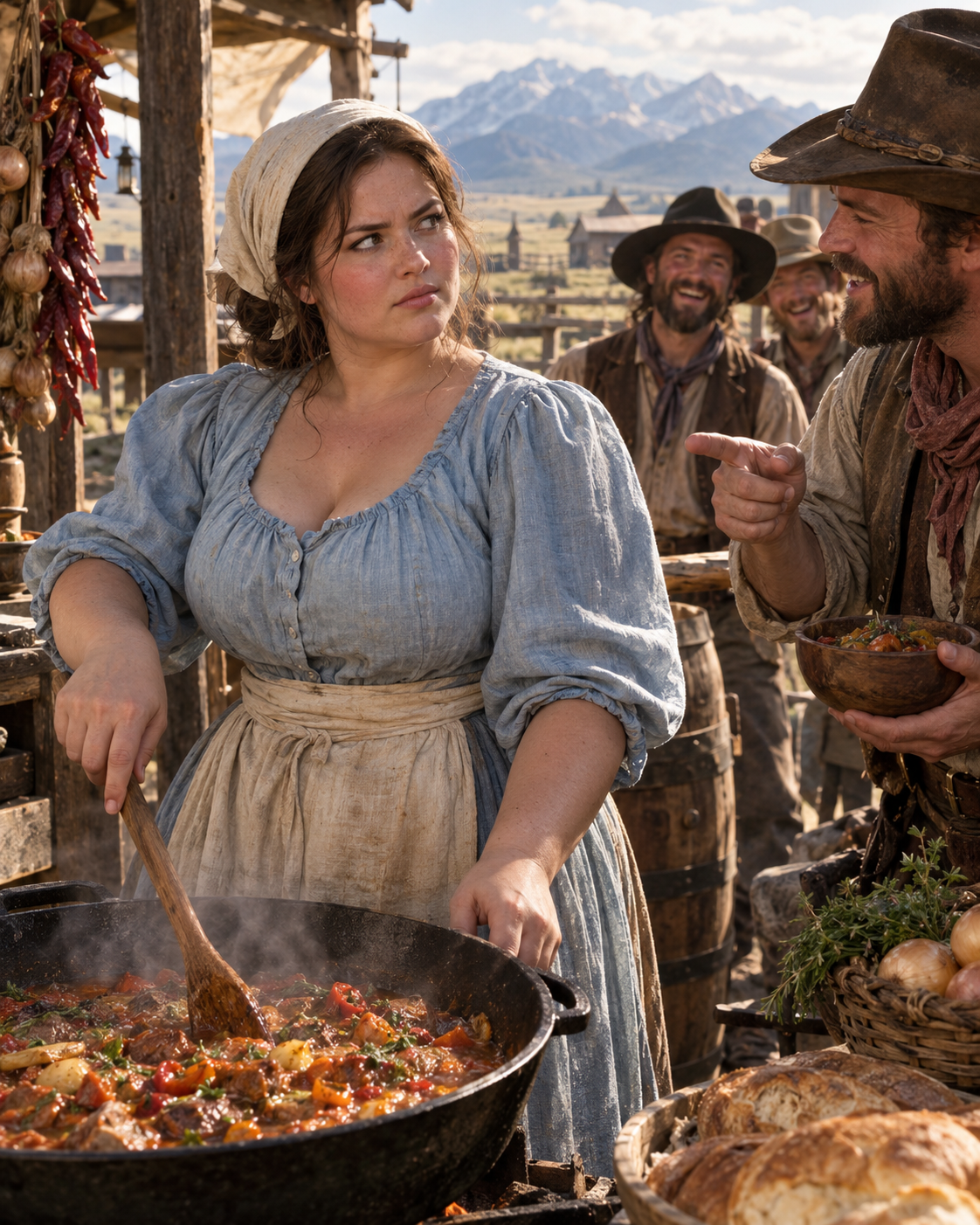
I watched twenty-three exhausted cowboys laugh at Maggie Bell’s twelve-cent stew in Dust Creek, until I discovered the humble kitchen was hiding a truth none of us expected.
The fire cracked between us.
For a moment, neither of us spoke.
“What happened to your grandfather?” I asked.
Maggie stared into the flames.
“His name was Samuel Bell. He owned this land before Harvey Collins ever came to Dust Creek.”
I waited.
“He wasn’t rich,” she continued. “He had forty acres, a small house, and a kitchen much like mine. He fed travelers, miners, cowboys—anyone who could pay a few cents. Sometimes, if they couldn’t pay, he fed them anyway.”
“That sounds like you.”
“It was more than that.”
Her fingers tightened around the paper I had given her.
“Twenty years ago, a group of men came through Dust Creek. They were looking for silver. Harvey was one of them.”
I felt something cold move through me.
“Harvey was a prospector?”
“He was a nobody,” Maggie said. “A hungry man with a borrowed horse and a talent for convincing people to trust him.”
“What changed?”
“They found something.”
She looked toward the darkness beyond the kitchen.
“Not silver.”
I waited for her to continue.
“Gold?”
She shook her head.
“A water vein.”
I frowned.
“That doesn’t make sense.”
“It does in Dust Creek.”
She pointed toward the dry hills beyond town.
“There’s hardly a drop underground for miles. But my grandfather found a deep underground spring beneath this land. A powerful one. Enough water to turn Dust Creek from a dying settlement into a place worth owning.”
I understood immediately.
Harvey Collins had not become wealthy because he was lucky.
He had become wealthy because he controlled water.
Maggie continued quietly.
“My grandfather refused to sell.”
“Why?”
“Because he knew what Harvey would do with it. He wanted the water shared. Harvey wanted to own every acre that touched it.”
“And then?”
“My grandfather died.”
The words landed heavily.
“How?”
“They called it an accident.”
“What kind?”
“He fell from the old mine bridge.”
I looked at her.
“You don’t believe it.”
“No.”
“Why not?”
“Because my grandfather wasn’t careless.”
Her voice remained calm, but something in her eyes had changed.
“And because the night before he died, he told my mother that if anything happened to him, she should never trust Harvey Collins.”
I looked toward the crooked sign.
“Does anyone else know?”
“My mother did.”
“What happened to her?”
“She disappeared.”
I stared at Maggie.
“Disappeared?”
“She left Dust Creek three years later. She never came back.”
“And you stayed?”
“I was eight.”
She looked down at the pot.
“My grandfather raised me. This kitchen was the only home I knew.”
A gust of wind pushed smoke across us.
“Why keep the kitchen?”
“Because he left me something.”
“What?”
Maggie hesitated.
“His recipe.”
I almost laughed, but her expression stopped me.
“That’s it?”
“Not exactly.”
She lifted the lid from the pot.
Steam rolled into the night.
“My grandfather wrote the recipe down. But he hid a message inside it.”
My heart began beating faster.
“What message?”
“I don’t know.”
“You don’t know?”
“He told me that when I was old enough, I would understand.”
She reached beneath the wooden table and pulled out a small tin box.
The lid was rusted.
She opened it.
Inside lay a folded piece of yellow paper.
“I’ve carried this for twenty years.”
She handed it to me.
The handwriting was old and uneven.
I read the first line.
When the water runs dry, trust the men who still know how to share.
I looked at Maggie.
“What does that mean?”
“I don’t know.”
I read further.
There was no map.
No confession.
No accusation against Harvey.
Only a list of ingredients.
Beef.
Onion.
Salt.
Beans.
Potatoes.
Marrow.
And beside each ingredient, a number.
I looked again.
“These aren’t measurements.”
“No.”
“They’re distances?”
“I thought so.”
I studied the numbers.
Then I realized what I was seeing.
“They’re dates.”
Maggie nodded.
“My grandfather’s death was June 14, 1906.”
I looked at the list.
There was a six.
A fourteen.
A zero.
A six.
My skin prickled.
“Your grandfather hid a date inside the recipe.”
“And there are seven more.”
I looked at her.
“Then we find out what they mean.”
Before she could answer, we heard hoofbeats.
Maggie closed the tin box.
I reached for my pistol.
Three riders emerged from the darkness.
Harvey Collins was in front.
He stopped his horse several yards from the fire.
“Cole Harrison,” he called.
“I wondered when you’d become involved.”
I stepped between him and Maggie.
“Come to collect the land?”
Harvey smiled.
“I’m here to offer you a warning.”
“Try me.”
“You’ve got twenty-four men, six wagons, and a long trail ahead of you.”
His eyes moved toward Maggie.
“Don’t let one woman’s trouble become twenty-four men’s trouble.”
Gus stepped from behind the kitchen.
“She feeds twenty-four men better than you ever could.”
Harvey ignored him.
“You’ll be gone in two days.”
“Maybe.”
“And when you leave, Maggie will still be here.”
His voice hardened.
“You can’t protect her forever.”
Maggie stood.
“I don’t need him to protect me.”
Harvey looked at her.
“Your grandfather said the same thing.”
The entire camp went silent.
I took one step forward.
“What did you just say?”
Harvey’s face remained still.
But for the first time, I saw fear behind his eyes.
“I said good night.”
He turned his horse.
“Harvey.”
He stopped.
“What happened to Samuel Bell?”
Harvey looked over his shoulder.
“Ask the dead.”
Then he rode away.
None of us spoke for several seconds.
Gus finally broke the silence.
“Well, boss.”
He swallowed.
“I believe we’re officially involved.”
I looked at Maggie.
She nodded.
“We leave at dawn.”
I shook my head.
“No.”
She frowned.
“We have cattle waiting.”
“The cattle can wait.”
“Cole—”
“I came here looking for an answer.”
I looked toward the dark hills.
“I’m not leaving without it.”
The next morning, I divided the men into three groups.
Gus stayed with Maggie.
Two riders went to the old mine bridge.
Another pair searched the records at the church.
I took Maggie to the Collins ranch.
Harvey wasn’t there.
His foreman tried to stop us.
I told him we wanted to see the old land records.
He laughed.
“Harvey doesn’t keep papers lying around for strangers.”
“Then call him.”
“He’s gone to town.”
I walked inside anyway.
The foreman reached for his rifle.
I stopped.
“You can either let us look, or you can explain to a judge why you prevented us from examining records connected to a disputed property.”
He stared at me.
“You ain’t a lawyer.”
“No.”
I smiled.
“But I’ve spent twenty years around men who think a gun makes them right.”
He lowered his hand.
The records were in a locked cabinet.
Maggie found the key hidden beneath an old ledger.
Inside were deeds, leases, water rights, and tax documents.
Then she found something strange.
A land transfer dated six months after her grandfather’s death.
Samuel Bell’s forty acres had been transferred to Harvey Collins for one dollar.
“One dollar,” Maggie whispered.
I examined the signature.
“It isn’t your grandfather’s.”
“No.”
“How do you know?”
She pointed to the bottom of the page.
“My grandfather signed his name Samuel Bell.”
The signature said S. Bell.
“That proves nothing.”
“It does.”
She looked at me.
“He couldn’t write.”
I stared at her.
“What?”
“He could read. He could count. But he never learned to write. Every legal document he signed carried his mark.”
My pulse quickened.
Someone had forged the deed.
We searched deeper.
Then I found an old envelope tucked beneath the bottom drawer.
Inside was a letter.
It was from the county clerk.
The letter was dated three days before Samuel died.
It said that the county had rejected Harvey Collins’s request to purchase the Bell property because Samuel had refused to sell.
But beneath the letter was another document.
A survey.
It showed an underground water channel running directly beneath the Bell property.
At the end of the survey was a note.
Water source extends north beneath Collins property. Ownership disputed.
I looked at Maggie.
“He knew.”
She nodded.
“He knew the water was there.”
“And your grandfather wouldn’t sell.”
“He wouldn’t.”
I folded the survey.
“We need proof of what happened next.”
A gunshot cracked outside.
Maggie screamed.
I pulled her down.
Another shot shattered the window.
The foreman ran for the back door.
I grabbed Maggie’s arm.
“Stay here.”
“No.”
“Maggie—”
“I know this land better than you.”
She pulled me toward a narrow passage behind the cabinet.
“There.”
A hidden door.
We slipped through just as another bullet tore through the wall.
The passage led underground.
It was narrow, damp, and almost completely dark.
Maggie held a lantern.
“What is this?”
“My grandfather built it.”
“Where does it go?”
“To the spring.”
We walked for several minutes.
Then we heard water.
Not a trickle.
A river.
We stepped into a cavern.
Clear water rushed through a channel beneath the earth.
I stared.
“Dear God.”
Maggie lifted the lantern.
Along the cavern walls were wooden support beams.
Old mining equipment lay abandoned near the water.
Then she saw something.
A rusted metal box.
Her hands shook as she opened it.
Inside was a revolver.
A watch.
And a journal.
She picked up the watch.
“My grandfather’s.”
I opened the journal.
The first pages were ordinary notes about weather, cattle, and the kitchen.
Then the handwriting became frantic.
June 12.
Harvey came again.
June 13.
He offered money. I refused.
June 14.
If I do not return, the water belongs to everyone.
I turned the page.
Nothing.
The next page had been torn out.
Maggie whispered, “That’s where it ends.”
“No.”
I turned the book upside down.
A folded sheet fell from the binding.
I opened it.
There were names.
Three of them.
Harvey Collins.
Elias Crane.
Walter Pike.
And beneath them:
They pushed me.
My breath stopped.
Maggie covered her mouth.
“He knew.”
A noise came from the tunnel.
We froze.
Someone was coming.
I extinguished the lantern.
Three men entered the cavern.
Harvey was among them.
“Give me the journal, Margaret.”
His voice echoed through the chamber.
Maggie gripped my arm.
Harvey continued.
“You were never supposed to find this place.”
I whispered into her ear.
“When I tell you, run toward the water.”
She shook her head.
Harvey stepped closer.
“You’ve caused enough trouble.”
I stepped into the darkness.
“Funny.”
Harvey stopped.
“You always did have a problem with witnesses.”
He raised his pistol.
“So did your grandfather.”
The men spread out.
I fired first.
The cavern exploded with sound.
One man dropped his weapon.
Gus appeared behind them with two cowboys.
Apparently, he had followed us.
“Boss!”
Harvey fired.
The bullet struck the stone beside my head.
I tackled him.
We crashed into the water.
The current dragged us both several feet.
Harvey punched me.
I hit him back.
Then I felt his hand reach for my throat.
“You don’t understand!” he shouted.
“I own this town!”
“No.”
I grabbed his coat.
“You only convinced everyone you did.”
The water surged beneath us.
A hidden channel pulled at my legs.
Harvey slipped.
His fingers caught a rock.
For one second, I could have let go.
I thought of Samuel Bell.
I thought of Maggie.
I thought of all the men Harvey had frightened into silence.
Then I reached down and grabbed Harvey’s wrist.
“Give me your hand.”
He stared at me.
“Why?”
“Because I’m not you.”
I pulled him up.
Gus and the others dragged us onto the stone bank.
Harvey lay coughing.
Maggie stood over him holding the journal.
“You killed my grandfather.”
Harvey said nothing.
“You killed him for water.”
Still nothing.
Then one of the captured men broke.
“It wasn’t supposed to happen.”
Harvey looked at him.
The man trembled.
“Harvey pushed him.”
The cavern went silent.
“Elias was there,” the man continued. “Walter too. We all saw it.”
Harvey closed his eyes.
“You idiot.”
“And you forged the deed afterward,” I said.
The man nodded.
Maggie took a slow breath.
“Why?”
Harvey looked at her.
“Because your grandfather wouldn’t sell.”
His voice was suddenly smaller than I had ever heard it.
“I offered him money. More than the land was worth.”
“He refused.”
“He said water was a gift from God.”
Harvey laughed bitterly.
“He believed people could share something without fighting over it.”
Maggie looked at the rushing water.
“He was right.”
Harvey looked away.
The truth finally existed outside his control.
We brought him back to town.
The county sheriff arrived that afternoon.
The journal, the forged deed, the survey, and the witnesses were enough to reopen the old case.
Harvey Collins was arrested before sunset.
But Dust Creek had another problem.
The water.
For twenty years, Harvey had controlled it.
The town’s wells were restricted.
Families paid him.
Farmers paid him.
Even travelers paid him.
Maggie stood before the townspeople the next morning with her grandfather’s journal in her hands.
“This water belongs to no man,” she said.
Nobody spoke.
Then an old miner stepped forward.
“My family has been paying Collins for fifteen years.”
Maggie nodded.
“So has mine.”
Another man raised his hand.
“What happens now?”
Maggie looked at me.
I expected her to look frightened.
She didn’t.
“We build a community water system.”
Someone laughed nervously.
“With what money?”
I stepped forward.
“With ours.”
Twenty-three cowboys stood behind me.
Gus grinned.
“We’ve got wages.”
The men agreed.
We sold one of the spare wagons.
Another man donated lumber.
The blacksmith donated pipe.
The church organized food.
Within weeks, Dust Creek changed.
The water flowed freely.
Gardens appeared where there had once been dry dirt.
Children played beside the new well.
And Maggie’s kitchen became the center of town.
Her crooked sign stayed exactly where it was.
Son of a what stew?
12 cents. Ask your grandmother.
People came from miles away to taste it.
But Maggie never raised the price.
When I asked her why, she smiled.
“Because twelve cents reminds people that something valuable doesn’t have to be expensive.”
“You could make a fortune.”
“I already did.”
She looked around the kitchen.
“What do you mean?”
She nodded toward the well.
“I got my grandfather’s wish.”
I stayed in Dust Creek after the cattle drive ended.
At first, I told myself it was because the town needed someone to help organize the water cooperative.
Then I told myself I was waiting for another trail contract.
Eventually, I stopped lying to myself.
One evening, I found Maggie sitting beside the fire.
She handed me a bowl.
“Dinner.”
I tasted it.
The same smoky flavor.
The same tender beef.
The same mysterious warmth.
“What did you put in it?”
She smiled.
“That’s a family secret.”
I laughed.
“Still hiding things from me?”
“Only the important ones.”
I looked at the crooked sign.
Then at the well beyond it.
Then at the woman who had taught twenty-three exhausted cowboys that dignity could survive poverty, that kindness could be stronger than wealth, and that a kitchen could become a fortress without ever firing a shot.
“Maggie.”
“Yes?”
“I think I owe your grandfather something.”
She raised an eyebrow.
“What?”
“A thank-you.”
“For what?”
“For leaving behind a recipe.”
She laughed softly.
“He left more than that.”
I looked at the town.
“He left a lesson.”
She nodded.
“What lesson?”
I thought about the water beneath the earth.
About Harvey Collins.
About a man who had tried to own what everyone needed.
And about Maggie, who had refused to let hunger turn her cruel.
“That the things that keep us alive aren’t really ours to own.”
Maggie was quiet for a moment.
Then she said, “My grandfather used to say something else.”
“What?”
“Never measure a person’s worth by what they can afford to give you.”
She looked at the twelve-cent stew.
“Measure it by what they give when they can’t afford anything.”
Years later, people still told stories about Harvey Collins.
Some remembered him as the richest man in Dust Creek.
Others remembered him as the man who tried to own the water.
But nobody remembered his wealth for very long.
They remembered the well.
They remembered the kitchen.
They remembered the woman who fed hungry men for twelve cents.
And every year, when the first cold wind came down from the hills, Maggie would light the old iron stove and make the same stew.
Sometimes there would be ten people around her table.
Sometimes fifty.
Nobody paid more than twelve cents.
If someone tried to leave extra money, she pushed it back.
“If you have more,” she’d say, “give it to someone who has less.”
One winter evening, an old cowboy asked her why she kept the price so low after all those years.
Maggie looked toward the well.
“Because once, someone tried to make a fortune by owning what everyone needed.”
She stirred the pot.
“I’d rather become rich by making sure nobody goes hungry.”
I stood beside her, older now, my hair more gray than brown.
I had spent my life believing a man’s worth was measured by what he could control.
Land.
Cattle.
Money.
Men.
Maggie taught me otherwise.
A man’s worth, I learned, was measured by what remained of his humanity when he had nothing left to gain.
The fire burned low.
The twelve-cent stew simmered quietly.
Outside, the water kept flowing through Dust Creek.
Nobody owned it.
Everyone needed it.
And because one stubborn woman refused to surrender the smallest thing she had, an entire town learned that sometimes the greatest inheritance isn’t land, gold, or money.
Sometimes it is a simple lesson passed from one generation to the next:
What keeps us alive should never be used to keep others on their knees.
That was the truth hidden inside Maggie Bell’s little kitchen.
And that was the secret my twenty-three cowboys had tasted before any of us understood what it meant.
That was the secret my twenty-three cowboys had tasted before any of us understood what it meant.
But there was one thing Maggie had never told me.
Not even after all those years.
I discovered it on the coldest night Dust Creek had ever known.
The snow began after sunset.
At first, it came down softly, almost beautifully, covering the roofs and fences in a thin white layer. By midnight, the wind had become violent enough to shake the wooden walls of every house in town.
I was sitting beside the kitchen stove when Maggie suddenly stood.
“What is it?” I asked.
She was staring toward the window.
“The well.”
I followed her gaze.
Through the blowing snow, I could barely see the town well.
Then I saw the lantern.
Someone was out there.
I grabbed my coat.
Maggie caught my arm.
“Cole.”
“I’ll be back.”
“No.”
Her voice was different.
Not frightened.
Certain.
“There shouldn’t be anyone there.”
I looked at her.
“What do you mean?”
She reached beneath the counter and pulled out the old metal box that had belonged to her grandfather.
The same box.
The same rusted hinges.
The same secret she had carried since childhood.
She opened it.
Inside was the old journal.
But beneath the journal was something I had never seen before.
A small brass key.
Maggie held it in her palm.
“I found this years ago.”
“You never told me.”
“I didn’t know what it opened.”
She looked toward the window again.
“Until tonight.”
A gust of wind rattled the walls.
I took the key.
“What does it open?”
“The old water gate.”
My stomach tightened.
“What water gate?”
She pointed toward the hills.
“There is another tunnel beneath Dust Creek.”
We left immediately.
The storm swallowed us the moment we stepped outside.
I shouted for Gus.
Within minutes, he and six other men joined us.
We followed Maggie through the snow toward the abandoned mine.
The entrance had been sealed for years.
But behind a pile of rotten boards, Maggie found a narrow iron door.
The brass key fit perfectly.
The door opened with a long metallic groan.
Cold air rushed out.
We descended.
For several minutes, nobody spoke.
Then we heard it.
Water.
But this time it wasn’t flowing peacefully.
It was roaring.
We reached a cavern where an enormous wooden gate blocked part of the underground river.
And someone had damaged it.
One of the support beams had been cut nearly in half.
Gus stared at it.
“Who would do that?”
I looked at Maggie.
She was pale.
“Someone wants the town to lose its water.”
A crack echoed through the cavern.
The beam moved.
Just an inch.
But it was enough.
“If that breaks,” I said, “the river will flood the lower tunnel.”
“And the well?”
Maggie nodded.
“It will run dry.”
A voice came from the darkness.
“Exactly.”
We turned.
Three men stepped from behind the rocks.
The man in front was someone I recognized.
Elias Crane.
One of Harvey Collins’s old associates.
He was older now, thinner, but the hatred in his eyes hadn’t changed.
“You,” Maggie whispered.
Elias smiled.
“Your grandfather should have sold.”
Gus raised his rifle.
Elias lifted his hand.
“Shoot me, and this gate comes down.”
Everyone froze.
He pointed toward the damaged beam.
“One bullet in the wrong place, and half this mountain collapses.”
I studied him.
“What do you want?”
“What Harvey wanted.”
“The water.”
“No.”
Elias laughed.
“Harvey wanted money.”
He looked at Maggie.
“I want control.”
“You’re too late.”
“Am I?”
He pulled a folded document from his coat.
“A company from Denver has offered a fortune for the water rights beneath Dust Creek.”
Maggie stared at the paper.
“They can’t own it.”
“They can if the town signs.”
“And if we refuse?”
Elias glanced toward the damaged gate.
“Then there won’t be a town worth owning.”
The wind screamed through the tunnel.
For the first time in years, I felt something I had almost forgotten.
Fear.
Not fear for myself.
Fear of losing everything people had built together.
Maggie stepped forward.
“You’ve spent your whole life trying to own what other people need.”
Elias smiled.
“And you’ve spent yours pretending kindness is enough.”
She looked at him.
“It was enough to defeat Harvey.”
His smile disappeared.
I noticed the beam again.
There was something wrong.
The damage wasn’t fresh.
The wood around the cut was dark.
Burned.
I stepped closer.
“Gus.”
He understood immediately.
He moved toward the wall.
I whispered, “The beam isn’t holding the gate.”
Gus examined it.
Then he grinned.
“No.”
He pointed beneath the water.
“There are chains.”
Three enormous iron chains disappeared beneath the surface.
The wooden beam was a distraction.
Elias had expected us to believe the gate was about to fall.
It wasn’t.
I looked at Maggie.
She understood too.
“Keep him talking,” I whispered.
She nodded.
“What happens if we don’t sign?”
Elias lifted the document.
“Then you lose everything.”
Maggie took another step toward him.
“My grandfather lost everything and still died free.”
Elias’s expression hardened.
“You sound just like him.”
“That was the idea.”
I moved toward the chains.
Slowly.
Quietly.
One of Elias’s men noticed.
“Hey!”
I fired at the lantern beside him.
Darkness swallowed the cavern.
Gus fired immediately.
Someone screamed.
The tunnel erupted into chaos.
I dove into the water.
The current nearly tore me away.
I grabbed the first chain.
It was enormous.
I followed it toward the gate.
Above me, I heard Maggie shouting.
Then a gunshot.
Then another.
I reached the mechanism.
The chain had been locked with a steel pin.
I pulled.
Nothing.
I pulled again.
Still nothing.
Then I noticed the lock.
A small brass keyhole.
The same size as the key Maggie had found.
I shouted toward the bank.
“Maggie!”
She appeared above me.
“What?”
“The key!”
She threw it.
I caught it.
My fingers were numb.
The current pushed me against the stone.
I forced the key into the lock.
It turned.
The chain released.
The gate began to rise.
Water exploded through the opening.
I was swept backward.
“Maggie!”
She reached for me.
I grabbed her wrist.
For one terrifying second, neither of us could hold on.
Then Gus grabbed Maggie.
Another cowboy grabbed me.
Together, they dragged us from the water.
The gate slammed open.
The river thundered through the tunnel.
Elias and his men fled.
But the floodwater chased them.
We heard shouting in the darkness.
Then silence.
We climbed out just before dawn.
Dust Creek was still standing.
The well was still flowing.
But Elias Crane was gone.
For three days, we searched the hills.
On the fourth morning, we found him half a mile from the old mine.
Alive.
Broken.
His men had abandoned him.
He was taken to the county jail.
The Denver company withdrew its offer when the town produced Samuel Bell’s original survey and the water covenant we discovered behind the old gate.
The covenant changed everything.
Samuel had written it twenty years earlier.
The water beneath the Bell property was to remain open to every household in Dust Creek, forever.
He had never completed the legal filing because he died before he could.
But now the town had proof.
Maggie signed the document first.
Then every family in Dust Creek signed beneath her name.
The water could never again belong to one man.
Years passed.
The story of the old mine became something parents told their children.
Some said the mountain itself had protected Samuel Bell.
Others said Maggie had outsmarted the men who wanted the water.
Gus always claimed he had saved my life.
He told the story differently every year.
But Maggie knew the truth.
None of us had saved Dust Creek alone.
The town had saved itself.
People had finally learned that when everyone protects only their own little piece, a stronger man can take everything.
But when people stand together, even the richest man in the valley has limits.
One spring morning, I found Maggie sitting outside the kitchen.
Her hair had turned silver.
The crooked sign still hung above the door.
The words were faded now.
Son of a what stew?
12 cents. Ask your grandmother.
I sat beside her.
“You know,” I said, “we could replace that sign.”
She looked at me.
“Why?”
“It’s falling apart.”
“So am I.”
I laughed.
“You’re not falling apart.”
She raised an eyebrow.
“You’ve known me too long to lie that badly.”
We sat quietly.
Children were playing near the well.
Farmers were bringing horses to drink.
Someone was repairing a fence.
The town was alive.
Maggie handed me a bowl.
I tasted the stew.
After all those years, it still tasted the same.
“Still twelve cents?”
“Still twelve cents.”
“You’re terrible at business.”
“I own the kitchen.”
“You own more than the kitchen.”
She looked at me.
“What do I own?”
I nodded toward the town.
“The trust of an entire place.”
She smiled.
“That doesn’t belong to me either.”
I understood.
That was Maggie’s greatest lesson.
She had never wanted to possess the things she loved.
She wanted to keep them alive.
That evening, an old man came to the kitchen.
He was carrying a little boy.
The boy looked exhausted.
The man placed three coins on the table.
“I’ve only got enough for one bowl.”
Maggie looked at the child.
Then she pushed the coins back.
“Two bowls.”
The old man shook his head.
“I can’t.”
“You can.”
She filled two bowls.
The little boy ate so quickly that tears came to his eyes.
I watched Maggie.
She didn’t say anything.
She simply returned to the stove.
I remembered what her grandfather had written.
When the water runs dry, trust the men who still know how to share.
For years, I had thought he meant water.
I finally understood that he had meant everything.
Food.
Money.
Knowledge.
Courage.
Hope.
A person could survive without wealth.
A town could survive without gold.
But neither could survive when people stopped caring whether the person beside them lived or died.
That night, after the old man and the boy left, Maggie closed the kitchen.
She stood beneath the crooked sign.
“Cole?”
“Yes?”
“Do you remember the first time you tasted the stew?”
“I remember.”
“You looked terrified.”
“I wasn’t terrified.”
“You were.”
“I thought you had poisoned me.”
She laughed.
“You ate three bowls.”
“I was willing to die happy.”
She shook her head.
Then she looked toward the well.
“Do you ever wonder what would have happened if you had kept riding that day?”
I thought about it.
“I’d probably still be chasing cattle.”
“And me?”
“You’d still be here.”
She smiled.
“Maybe.”
I took her hand.
“Or maybe I finally found what I was looking for.”
She looked at me.
“And what was that?”
“A place where I didn’t have to keep riding.”
For a long moment, she said nothing.
Then she leaned against my shoulder.
The fire crackled behind us.
The town grew quiet.
And beneath our feet, the underground river continued its endless journey through the darkness.
It had been there before us.
It would remain after us.
No man had created it.
No man could take credit for it.
It simply flowed.
Giving.
Moving.
Sharing.
Like time.
Like life.
Like kindness.
Years later, when I was too old to ride cattle trails anymore, I would sometimes sit outside that little kitchen and watch strangers arrive in Dust Creek.
They always noticed the sign.
They always laughed.
And someone would always explain the story.
They would tell them about the twenty-three cowboys who mocked a twelve-cent stew.
They would tell them about Harvey Collins.
They would tell them about Samuel Bell.
They would tell them about the hidden spring beneath the town.
But Maggie’s name was always the last one spoken.
Because she was the one who understood the secret none of us had seen.
The secret wasn’t in the recipe.
It wasn’t in the mine.
It wasn’t even in the water.
It was in the choice a person made when nobody was watching.
You could use what you had to become powerful.
Or you could use it to make someone else’s life a little easier.
You could build walls around your fortune.
Or you could build a table and invite people to sit.
You could spend your life asking what you could take.
Or you could ask what you could give.
Maggie chose the table.
Samuel chose the water.
And, eventually, I learned to choose them too.
The twelve-cent stew was never really twelve cents.
It cost Maggie years of work.
It cost Samuel his life.
It cost Dust Creek the courage to stand against men who believed everything had a price.
And it gave us something money could never buy.
A reason to trust one another.
A reason to stay.
A reason to believe that a small act of kindness could survive long after the person who offered it was gone.
The last time I saw Maggie before she died, she was sitting beside the old iron pot.
Her hands were weak.
Her hair was completely white.
But her eyes were still the same.
She looked at me and whispered, “Cole.”
I took her hand.
“I’m here.”
“Is the well still running?”
“Yes.”
“Are people still allowed to use it?”
“Everyone.”
She smiled.
“Good.”
Those were the last words she ever spoke to me.
She died before sunrise.
Dust Creek buried her beside Samuel Bell.
The whole town came.
Farmers.
Children.
Blacksmiths.
Merchants.
Old cowboys.
People who had never known her personally.
People who had eaten her stew only once.
People who had never tasted it at all.
Everyone came.
Because Maggie Bell had taught the town something simple.
A person’s life isn’t measured by how much land they leave behind.
It is measured by how many lives are better because they were here.
After the funeral, I walked back to the kitchen alone.
The old sign was still hanging above the door.
I touched it.
The paint had almost disappeared.
But the words were still there.
Son of a what stew?
12 cents. Ask your grandmother.
I smiled through my tears.
Then I lit the fire.
For the first time in my life, I cooked the stew myself.
It wasn’t as good as Maggie’s.
Not even close.
But I made enough for everyone.
Nobody paid.
That became the new tradition.
Every year, on the anniversary of Maggie’s death, Dust Creek opened the kitchen.
Anyone could eat.
Anyone could bring food.
Anyone could sit at the table.
And if someone asked why the town still served a stew that cost twelve cents when it could easily charge more, we gave them the same answer.
Because some things become worthless the moment you put a price on them.
Water.
Dignity.
Kindness.
A place at the table.
And sometimes, if you’re lucky, a stranger who sees the good in you before you can see it yourself.
That is what Maggie gave us.
Not wealth.
Not land.
Not a secret fortune.
Something better.
She taught us that survival isn’t always about becoming strong enough to stand alone.
Sometimes survival means having the courage to leave the door open.
To share the fire.
To pass the bowl.
And to trust that when your own hands become too tired to carry everything, someone else will carry it for you.
I spent most of my life riding through dust, chasing cattle, counting miles, and believing the trail would eventually lead me somewhere important.
I was wrong.
The most important place I ever reached was a little kitchen in Dust Creek.
And the greatest treasure I ever found was a woman who charged twelve cents for a bowl of stew but gave away lessons worth more than all the gold beneath the mountain.
The well still runs beneath Dust Creek.
The water still rises from the earth.
Children still drink from it.
Farmers still fill their buckets.
Travelers still stop beside the old kitchen.
And every once in a while, when the wind comes down from the hills and the fire burns low, I swear I can smell Maggie’s stew again.
Smoky.
Rich.
Warm.
Familiar.
Like home.
Then I remember the truth she taught me.
What keeps us alive should never be used to keep others on their knees.
What we have should not always be measured by what it can earn.
And the smallest kindness, offered at the right moment, can become something powerful enough to outlive us all.
So if you ever pass through Dust Creek, look for the old well.
Sit beside it.
Drink the water.
And if you see a crooked wooden sign hanging above a little kitchen, don’t laugh at the twelve-cent stew.
Sit down.
Take the bowl.
And remember the woman who taught an entire town that the richest person isn’t the one who owns the most.
It is the one who leaves the most behind in the hearts of others.
Because in the end, the stew was never twelve cents.
The stew was a promise.
A promise that nobody had to face hunger alone.
A promise that no man should own what everyone needs to live.
A promise that kindness, once shared, does not become smaller.
It becomes a river.
And like the water beneath Dust Creek, it keeps flowing.
Long after the fire goes out.
Long after the sign falls.
Long after the last cowboy leaves the trail.
Long after we are gone.
THE END.