I watched them chain Vero to the slaughter post at Ashfen Outpost while Commander Harlan called him a coward, but I knew the truth they were about to bury forever.
The knocking came again.
Once.
Then silence.
I froze with one hand still resting against Vero’s bandage.
The stable had gone completely dark. Not dim. Not shadowed. Dark enough that I could hear my own breathing.
Vero’s eye remained fixed on the door.
His nostrils flared.
A low vibration rolled through his chest.
“Easy,” I whispered.
He did not move.
That frightened me more than anything else.
Vero was never still when danger approached. He always paced, shifted, listened. Now he lay motionless, staring at the door as if he recognized the presence on the other side.
I reached slowly for the knife at my belt.
Another knock.
Three seconds passed.
Then a voice came through the wood.
“Doctor?”
Captain Cade.
I exhaled.
“Come in.”
The door opened a fraction, and Cade slipped inside with a lantern in one hand and his sword drawn in the other.
His face was pale.
“You’re alive,” I said.
“So are you.”
He shut the door quickly.
“What happened to the lights?”
“They were extinguished throughout the outpost.”
“By whom?”
Cade shook his head.
“That’s what I’m trying to find out.”
He raised the lantern.
Its light fell across Vero’s body.
Then it stopped on the brass tag in my hand.
Cade’s expression changed.
“Where did you get that?”
“It was under his harness.”
He stepped closer.
“Let me see.”
I handed it to him.
Cade turned the tag over several times, rubbing his thumb across the blackened metal.
“You’ve seen this before?”
“No.”
“Then why do you look like you have?”
He stared at the engraved words.
PROPERTY OF ASHFEN.
“I’ve seen the mark.”
“Where?”
“On the old quarry ledgers.”
My stomach tightened.
“The ones Oddson found?”
Cade nodded.
“Not in the training records. In the ownership records.”
He lowered his voice.
“Ashfen wasn’t originally a military outpost.”
I stared at him.
“What was it?”
Cade looked toward the stable door before answering.
“A prison.”
The word seemed to make the air colder.
“That makes no sense.”
“It didn’t to me either.”
He opened the door again and checked the yard.
“No guards.”
“Where is everyone?”
“Sleeping quarters are empty.”
“Empty?”
“I checked the barracks. The soldiers are there, but every lamp is out. No one remembers hearing an order to extinguish them.”
A terrible thought entered my mind.
“Drugged?”
“Possibly.”
I looked at Vero.
His eye was still open.
Cade followed my gaze.
“We need Oddson.”
“I’ll wake him.”
“No.”
Cade’s hand closed around my arm.
“Don’t leave this stable.”
“Why?”
“Because whoever turned off the lights wanted the outpost blind.”
He looked again at Vero.
“And I don’t think they came for us.”
A sound came from beneath the floor.
A faint metallic scrape.
Vero’s head lifted.
His claws dug into the straw.
Cade drew his sword.
“Did you hear that?”
I nodded.
The scraping came again.
Closer.
Then something struck the wooden floor beneath us.
Once.
Twice.
Three times.
Vero growled.
I backed toward the wall.
“There’s something underneath.”
Cade crouched and pressed his ear against the boards.
His face hardened.
“There’s a tunnel.”
I remembered the brass tag.
Property of Ashfen.
Not belonging to Vero.
Belonging to the place.
“Help me move him,” I whispered.
Cade looked at Vero’s injured wing.
“He can’t walk far.”
“He doesn’t have to.”
We moved the straw aside.
Beneath it, the floorboards were scarred with old scratches.
Cade wedged his sword beneath one plank and forced it upward.
The board came loose.
Cold air rose from the darkness.
A narrow stone stairway descended beneath the stable.
The smell that came from below was old dust, wet earth, and something metallic.
Blood.
Vero suddenly pushed himself upright.
Pain tore a sound from his throat.
“Don’t,” I said.
He ignored me.
He lowered his head toward the opening.
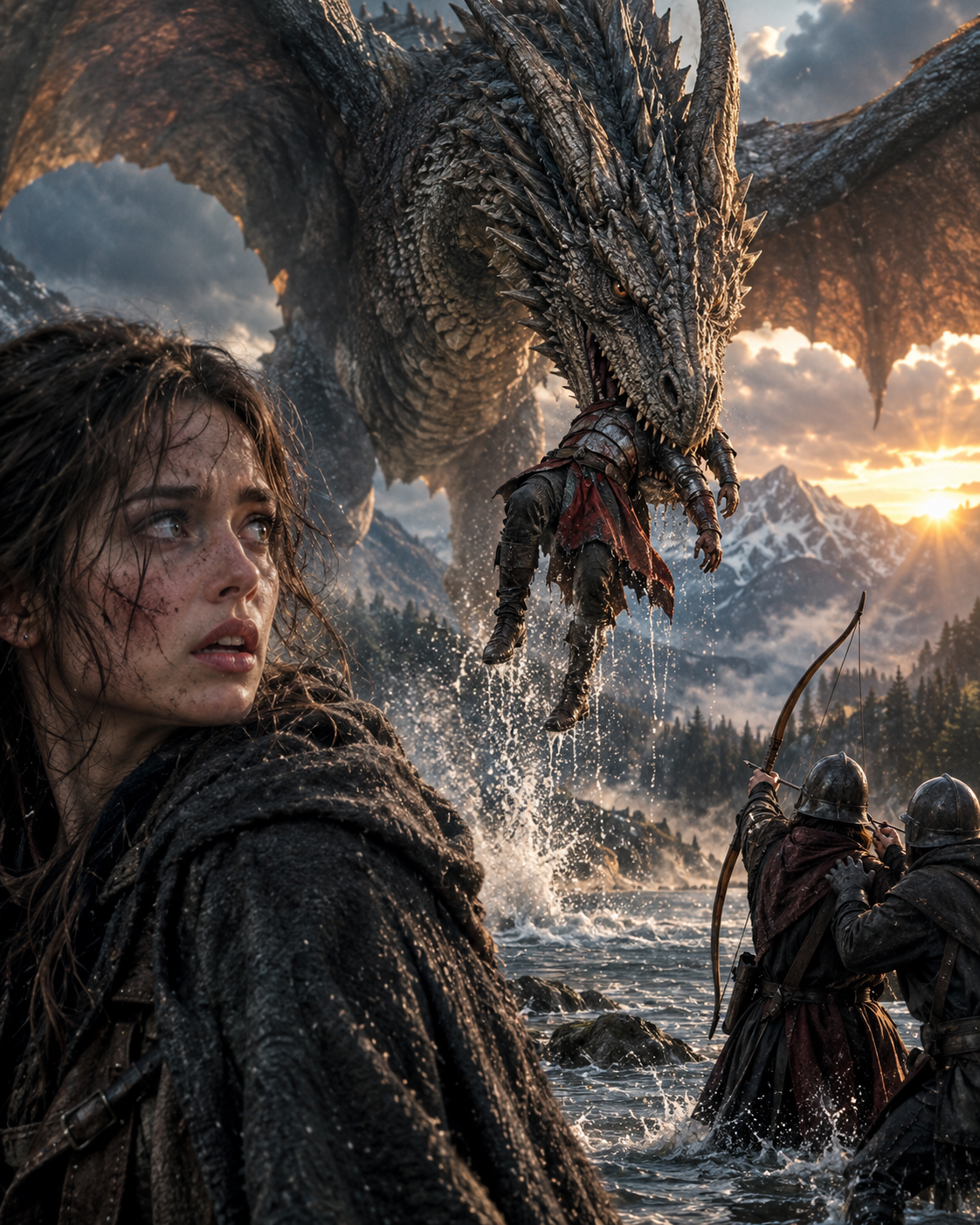
Then he stepped forward.
His injured wing dragged behind him.
Cade grabbed his harness.
“You’re staying here.”
Vero turned and stared at him.
For a moment, neither moved.
Then Vero gently pulled against the harness.
Not toward the stairs.
Toward the door.
He wanted us to follow.
Cade looked at me.
“He’s done this before.”
“What?”
“Found people.”
We descended.
The tunnel was narrow enough that Cade had to turn sideways in places.
Vero could barely fit.
The walls were carved from stone, and rusted rings had been hammered into them at regular intervals.
Some still held scraps of chain.
At the bottom, the passage opened into a chamber.
I stopped.
There were cages.
Dozens of them.
Some were large enough for a drake.
Others were barely big enough for a person.
Every cage door was open.
On the walls hung old military diagrams.
Rescue routes.
Mine shafts.
Collapse zones.
And beside them were drawings of shale drakes.
Not weapons.
Rescue animals.
I walked closer.
One illustration showed a drake carrying a miner from a collapsed tunnel.
Another showed one digging through rubble.
A third showed a drake standing beside a field hospital.
Beneath it, someone had written:
THEY FIND WHAT WE CANNOT.
Cade lifted a dusty folder from a table.
“These records are older than the outpost.”
He opened it.
Inside were lists of names.
Hundreds of them.
Workers.
Soldiers.
Prisoners.
Children.
And next to each name was a single word.
RECOVERED.
I felt sick.
“What happened here?”
Cade turned another page.
At the bottom was a sentence written in faded ink.
THE ASHFEN PROJECT WILL PRODUCE ANIMAL PARTNERS CAPABLE OF LOCATING SURVIVORS UNDER ANY CONDITIONS.
“Project?” I whispered.
Cade nodded.
“Someone wasn’t just training drakes.”
He pointed to another document.
“They were studying them.”
A noise echoed from the far end of the chamber.
Vero immediately turned.
His ears flattened.
Then he limped toward a second corridor.
“Wait,” Cade said.
Vero kept going.
We followed.
The corridor ended at an iron door.
Behind it came a faint scratching sound.
I unlocked it.
Inside was a small room.
An old man sat against the wall.
His wrists were chained.
His hair was white.
His uniform had rotted almost completely away.
But I recognized the insignia.
Ashfen.
He looked at Vero.
For the first time since we entered the tunnel, his expression changed.
“Number Seven,” he whispered.
Vero froze.
I looked at Cade.
“Number Seven?”
The old man smiled sadly.
“They gave them numbers because names made it harder to kill them.”
Cade stepped forward.
“Who are you?”
The old man looked at the brass tag in my hand.
“That belonged to his first handler.”
“His handler?”
“Her name was Mara.”
He closed his eyes.
“She refused to let them turn the drakes into weapons.”
“Where is she?”
The old man’s silence answered first.
“Dead?”
He nodded.
“They executed her after she opened the rescue pens during the Ashfen evacuation.”
I looked at Vero.
He had lowered his head.
His breathing had become slow.
“Does he remember her?”
“Every day.”
The old man reached toward him.
Vero stepped closer.
The old man’s trembling fingers touched his snout.
“He was the smallest of them.”
“Smallest?”
“He was barely old enough to work.”
I remembered the enormous creature beside me.
The scars across his body.
The torn harness.
The way he carried men without looking at their uniforms.
“He learned from her,” the old man said.
“Learned what?”
“That the person in the rubble was more important than the person shouting orders.”
Cade went completely still.
“Who built this place?”
The old man laughed quietly.
“Everyone.”
“What?”
“Engineers. Officers. Scientists. Merchants. The Crown. They all wanted one thing.”
He looked at me.
“A creature that could find a survivor.”
Then his eyes shifted toward Vero.
“They got something they never expected.”
“What?”
“A creature that decided every survivor mattered.”
A distant bell rang above us.
Once.
Then again.
Cade’s face changed.
“The alarm.”
We hurried back toward the stairs.
“Someone has entered the outpost.”
“How many?”
“I don’t know.”
Vero moved faster than I had seen him move since the river.
At the top, the stable door was open.
Snow blew inside.
Outside, shadows moved between the buildings.
Soldiers.
But they weren’t wearing Ashfen colors.
They wore dark coats without insignia.
Cade pulled me behind the wall.
“Special retrieval unit.”
“Retrieval of what?”
He looked at Vero.
I understood.
“How many?”
“At least twelve.”
A voice shouted from the yard.
“Secure the drake!”
Vero growled.
The soldiers raised crossbows.
I stepped in front of him.
“He’s injured!”
A bolt struck the wooden wall beside my head.
Cade fired first.
The stable erupted into chaos.
Two attackers fell.
Another rushed through the door.
Vero moved.
Even wounded, he was enormous.
He slammed his shoulder into the man and sent him crashing through the doorway.
But more were coming.
Cade shouted for the outpost guard.
No one answered.
The soldiers had already taken control of the barracks.
“We can’t hold them here,” Cade said.
“Then where?”
Vero turned toward the old tunnel.
Cade understood.
“The quarry.”
We ran.
Snow swallowed our footprints almost immediately.
Behind us came shouting and boots.
Vero limped beside us, his injured wing dragging through the snow.
We reached the abandoned quarry.
The old stone walls rose around us.
Cade stopped.
“We need somewhere defensible.”
I pointed toward the collapsed shaft.
“There’s an old rescue tunnel underneath.”
We entered just as the attackers reached the quarry.
Inside, the darkness closed around us.
Vero suddenly stopped.
He lowered his head.
His nostrils flared.
“What is it?” I whispered.
He walked toward a wall.
Then he began scratching.
Stone fell away.
Behind it was another passage.
A passage no one had mentioned in the records.
Cade lifted his lantern.
The walls were covered in names.
Thousands of them.
At the end of the passage stood a massive iron door.
And on that door was the same brass mark.
PROPERTY OF ASHFEN.
Cade pushed it open.
Beyond was a cavern.
I stared.
There were dozens of empty harnesses hanging from the walls.
Old medical equipment.
Rescue ropes.
Food stores.
And in the center of the cavern, carved into the stone, were the words:
NO SOLDIER LEFT BENEATH THE EARTH.
“Why hide this?” I asked.
The old man, whom Cade had somehow managed to bring with us, answered from behind.
“Because Ashfen wasn’t built to make weapons.”
He coughed.
“It was built to rescue people.”
A gunshot echoed through the tunnel.
The attackers had found us.
Cade raised his sword.
“We need another exit.”
The old man shook his head.
“There isn’t one.”
Then Vero walked toward the far wall.
He placed his injured shoulder against it.
“Vero, no.”
He pushed.
The stone cracked.
Again.
Another crack.
Then the entire wall collapsed.
Cold daylight poured through.
We stumbled into a narrow ravine behind the quarry.
The attackers emerged from the tunnel behind us.
“Stop!”
Cade turned.
There were eight of them.
Their commander stepped forward.
He held a sealed document.
“By order of High Command, the drake is to be surrendered.”
Cade laughed bitterly.
“High Command already spared him.”
“The previous order was issued under incomplete information.”
“What information?”
The commander looked at me.
“The information that he was never Crown property.”
I felt the brass tag in my pocket.
“Then whose property was he?”
The commander didn’t answer.
The old man did.
“The people of Ashfen.”
Silence.
The commander looked furious.
“You don’t understand what you’re interfering with.”
“No,” I said.
“I think we finally understand.”
He raised his weapon.
Then Vero stepped between us.
The commander hesitated.
Vero was exhausted.
Bleeding.
One wing broken.
Yet he stood there.
Not attacking.
Just standing.
The commander lowered his weapon slightly.
“Why does it keep doing that?”
I answered.
“Because you keep asking it to choose who deserves to live.”
The commander stared at Vero.
“That’s not what it was trained for.”
“No,” I said.
“That’s what it learned.”
A horn sounded in the distance.
Then another.
This time, Ashfen soldiers appeared on the ridge.
Captain Cade had managed to rally them.
Behind them came Master Stein.
His arm was still bandaged from the river rescue.
He walked forward and stood beside Vero.
“I owe this creature my life,” Stein said.
The commander looked at him.
“So do half the men in your outpost.”
Stein nodded.
“And now they know it.”
One by one, soldiers stepped forward.
Some had scars Vero had carried them home with.
Some had signed the petition.
Others had never spoken about what happened on the battlefield.
Now they stood together.
Not as officers.
Not as enemies.
Just survivors.
The commander looked around and realized he no longer controlled the situation.
He lowered his weapon.
“Who gave you permission to defy High Command?”
Cade answered.
“No one.”
Then he smiled.
“We’re doing it anyway.”
The commander left before sunset.
The sealed order remained unopened.
For three days, Ashfen waited for retaliation.
None came.
Instead, a delegation arrived.
Not soldiers.
Quarry workers.
Engineers.
Old families from the valley.
They carried boxes of documents recovered from abandoned archives.
Among them was a complete record of the Ashfen project.
It explained everything.
The drakes had been bred and trained to rescue miners after collapses.
When the Crown discovered their abilities, it purchased the program and converted the creatures into military assets.
Their rescue instincts became a problem.
They refused to abandon wounded enemies.
They left formations to search for survivors.
They carried civilians from battlefields.
They disobeyed orders that required them to ignore people in danger.
So the army began labeling them defective.
Most were destroyed.
Vero was the last.
I read the records in silence.
At the bottom of the final page was Mara’s name.
Under it were three handwritten words.
HE CHOSE MERCY.
I found Vero outside the stable.
Snow had begun to fall again.
His wing was healing badly, but he could stand.
I sat beside him.
“You remember her, don’t you?”
His eye closed.
His head rested against my shoulder.
For the first time, I understood what the brass tag really meant.
PROPERTY OF ASHFEN.
It wasn’t ownership.
It was a promise.
A promise that the creature who had spent his life carrying others home would finally have a home of his own.
Months passed.
The war eventually moved north.
Ashfen became something different.
The old rescue tunnels were reopened.
The soldiers turned the abandoned quarry into a medical station.
Enemy prisoners were allowed to work alongside our engineers.
The first time someone questioned the arrangement, Master Stein simply pointed toward Vero’s stall.
“Ask the drake which uniform he prefers.”
No one did.
Captain Cade remained in the army, though he stopped caring about promotions.
Oddson became keeper of the rescue animals.
And I continued serving as field surgeon.
But Vero’s new classification became more than a line on a military document.
Other outposts requested rescue drakes.
The old Ashfen training manuals were copied.
The creatures were no longer taught merely to obey.
They were taught to recognize life.
To find the trapped.
To carry the wounded.
To return when others could not.
Years later, people would tell the story differently.
Some would say Vero had been a legendary war beast.
Others would call him a hero.
A few would insist he had been nothing more than an animal following instinct.
I never argued with any of them.
Because I had learned something in that frozen yard.
Heroism is often invisible when we measure it by obedience.
Sometimes the person who refuses to follow the line is the one who sees the people standing outside it.
Vero never understood our uniforms.
He never understood our borders.
He never cared who had given the order.
He understood only one thing.
Someone was hurt.
Someone was trapped.
Someone needed to be brought home.
One spring morning, I found the brass tag hanging above his stall.
I had polished it until the blackened surface shone.
The words were still there.
PROPERTY OF ASHFEN.
But beneath them, I had added three more.
NO ONE LEFT BEHIND.
Vero watched me finish.
Then he nudged my shoulder with his scarred snout.
I laughed.
“You know, you were supposed to die here.”
He blinked.
“Remember?”
He gave a quiet rumble.
“I suppose you never cared much for orders.”
He lowered his head.
Outside, the first group of children from the valley had gathered by the fence.
They had come to see the rescue drake.
One little boy pressed his hands against the wood.
“Is he dangerous?”
I looked at Vero.
His enormous head rested gently against the fence.
“He can be,” I said.
The boy stepped back.
I smiled.
“But only when someone tries to hurt the people he loves.”
The boy considered this.
Then he reached through the fence.
Vero lowered his snout until the child’s hand touched his nose.
The boy laughed.
And for a moment, the old battlefield felt impossibly far away.
Years earlier, I had watched soldiers chain Vero to a slaughter post because they believed courage meant standing exactly where you were told.
They had mistaken obedience for bravery.
They had mistaken compassion for weakness.
They had mistaken a rescuer for a coward because he refused to leave the wounded behind.
But Vero had never been afraid of the battlefield.
He had been afraid of something much simpler.
That someone might die alone.
And perhaps that was the lesson Ashfen had been trying to teach us all along.
The worth of a life does not come from the uniform it wears.
Courage does not always roar, charge, or obey.
Sometimes courage turns around.
Sometimes it crosses the river again.
Sometimes it carries an enemy through the water because, in that moment, there is no enemy.
There is only a person who needs to go home.
Vero never asked anyone to remember his name.
He never asked for medals.
He never asked to be called a hero.
He simply kept doing what he had always done.
Find the wounded.
Carry them home.
And because one creature refused to accept that some lives mattered less than others, an entire army slowly learned to question the orders that told them otherwise.
That was Vero’s real legacy.
Not the battles he survived.
Not the soldiers he carried.
Not even the execution he escaped.
It was the quiet change he left behind in everyone who had once watched him and called him a coward.
Because once you have been saved by someone you were taught to hate, it becomes much harder to believe that hatred is a command you must obey.
And once you understand that, you can never look at the battlefield the same way again.
Years later, when Ashfen Outpost had become a permanent rescue station, I found an old copy of the first execution order in the archive.
Commander Harlan’s signature was still visible at the bottom.
The reason for execution was written in a single sentence.
FAILURE TO MAINTAIN COMBAT FORMATION.
I turned the page over.
On the back, someone had written a correction.
FAILURE TO ABANDON THE WOUNDED.
There was no signature.
There didn’t need to be.
I knew who had written it.
Not Vero.
He could never hold a pen.
It had been written by one of the soldiers he carried from the river.
A man who had once worn the enemy’s uniform.
A man who had survived because a creature branded a coward had refused to leave him behind.
I placed the paper back in the archive.
Then I walked outside.
Vero was waiting beneath the old stable roof.
His scars had faded with time.
His wing never fully recovered, but he could still run.
When he saw me, he raised his enormous head.
I held out my hand.
“Come on,” I said.
“There are people who need us.”
Vero stood.
And together, we walked toward the valley.
Not toward a battlefield.
Not toward an army.
Not toward an order.
Toward home.
Toward home.
For a while, that was all there was.
The valley opened beneath us in a sweep of green and silver, the snow retreating from the hills as spring finally took hold.
Vero walked slowly.
His old injury made one side of his body stiff, and his damaged wing rested lower than the other, but he no longer dragged it through the dirt.
Every few steps, children ran along the fence beside him, laughing whenever he turned his head.
The war had ended three years earlier.
Ashfen was no longer an outpost.
It was a rescue station now.
The old slaughter yard had been torn down.
The execution post had been cut into pieces and burned.
Where soldiers had once gathered to watch condemned creatures die, there now stood a stone memorial.
There were no generals carved into it.
No kings.
No battle victories.
Only names.
The names of people Vero had carried home.
Twenty-seven names from my first records.
Then hundreds more.
Soldiers.
Miners.
Farmers.
Prisoners.
Children.
People whose names had once meant nothing to the army because they had belonged to the wrong side of a battlefield.
At the bottom of the memorial were five words:
EVERY LIFE WAS WORTH BRINGING HOME.
I had thought that would be the end.
I should have known better.
Nothing involving Vero ever ended quietly.
The first sign came in early summer.
A messenger arrived from the northern border carrying a sealed letter.
He was young.
Too young, I thought, to look as frightened as he did.
Captain Cade met him at the gate.
I was inside the infirmary, changing the dressing on an old miner’s hand, when I heard shouting outside.
Then a bell rang.
Once.
Twice.
Three times.
Emergency.
I ran outside.
Cade was already mounting his horse.
“What happened?”
He handed me the letter.
The seal belonged to the Crown.
I broke it open.
The message contained only six lines.
A landslide had buried an entire military convoy in the northern pass.
Thirty-one people were trapped beneath the mountain.
The rescue crews had failed to locate them.
Another storm was coming.
They had requested Vero.
I looked toward the stable.
Vero was asleep in the sun.
“No.”
Cade frowned.
“No?”
“He can’t do this anymore.”
I pointed toward his damaged wing.
“He nearly died the last time.”
“He isn’t a machine.”
“I know.”
“Then why are you saying no?”
“Because he’s old.”
Cade was silent.
Vero was indeed old.
Not by human standards, perhaps, but by the standards of his kind, he had already lived far beyond what the original Ashfen records had predicted.
His scales had dulled.
His movements were slower.
The scars along his neck had become pale lines.
Even his eyes seemed quieter.
“I won’t send him into another disaster,” I said.
Cade nodded.
“I agree.”
The messenger stared at us.
“But there are thirty-one people under that mountain.”
I looked at him.
“And if we send Vero?”
“Then maybe thirty-one people live.”
“And if he doesn’t come back?”
The messenger lowered his eyes.
No one answered.
That evening, I sat beside Vero’s stall.
He was awake.
I was reading the letter again.
“You heard them talking, didn’t you?”
His eye opened.
“You always hear everything.”
He lifted his head.
I folded the paper.
“You don’t have to go.”
Vero stared at me.
“They have other rescue drakes now.”
He looked toward the valley.
“They’ve trained them because of you.”
His ears moved.
“You’re allowed to stay.”
He stood.
Slowly.
Painfully.
Then he walked to the stable door.
I followed.
Outside, the northern sky was dark.
Thunder rolled beyond the mountains.
Vero stopped at the gate.
He looked back at me.
I knew that look.
“No.”
He took one step.
“Vero.”
Another step.
“You can’t.”
He stopped.
For a long moment, we simply looked at each other.
Then he lowered his head and touched my chest with his snout.
The same gesture he had made the night before his execution.
The same gesture he had made after the river.
The same gesture he had made every time he was about to leave.
I closed my eyes.
“You’re going.”
He breathed against my coat.
I laughed despite the tears in my eyes.
“Of course you are.”
We left before dawn.
Cade came with us.
So did six rescue teams.
The northern road took two days.
The mountain was worse than the reports had suggested.
Half the slope had collapsed.
The convoy had disappeared beneath twenty feet of stone and frozen mud.
Rescuers had been digging for fourteen hours.
They had found six survivors.
They had also found eleven bodies.
Twenty people were still missing.
The storm would arrive before midnight.
We began searching.
Vero moved among the debris.
He ignored the shouting.
Ignored the machinery.
Ignored the food placed before him.
He walked slowly across the mountain.
Every few yards, he stopped.
He pressed his snout against the ground.
Then he moved again.
The rescuers watched him.
Some were skeptical.
Some had heard the stories.
One young soldier whispered,
“That’s the coward?”
An older man beside him answered,
“That’s the creature who saved my brother.”
The young soldier said nothing after that.
Vero stopped near a wall of broken stone.
He scratched once.
Then twice.
He began digging.
“Here!”
The rescue crews rushed forward.
They cleared the rocks.
A voice came from underneath.
Faint.
Alive.
One survivor.
Then another.
Then another.
We found eight people in that section.
Vero had located an air pocket no human instrument had detected.
He kept searching.
The storm arrived.
Snow covered the mountain.
Visibility dropped to almost nothing.
The commanders ordered the rescue suspended.
“No,” I said.
“We can’t continue.”
Cade looked at me.
“You mean Vero can’t continue.”
I nodded.
Vero was already walking away.
Into the snow.
“Vero!”
He didn’t stop.
Cade cursed.
“Follow him.”
We did.
The snow swallowed us within seconds.
Vero disappeared.
I screamed his name.
Nothing.
Then we heard something.
A deep, distant sound.
Not a roar.
A call.
Vero was beneath us.
Cade dropped to his knees and started digging.
We followed.
Three feet.
Five.
Seven.
Then we struck metal.
A vehicle.
The convoy’s command wagon had fallen into a hidden ravine beneath the snow.
Inside were twelve people.
Alive.
Barely.
Vero had found them.
We spent hours cutting through the wreckage.
One by one, we pulled them out.
The last person was a child.
A little girl no older than eight.
She had been traveling with her father when the mountain collapsed.
She was unconscious.
Vero lowered his head beside her.
I checked her pulse.
Weak.
But there.
“We have her.”
Vero didn’t move.
He watched me carry her away.
Then he turned.
Something was wrong.
I noticed it when he tried to take a step.
His front leg buckled.
“Vero?”
He collapsed.
We carried him down the mountain.
The storm lasted until morning.
When the clouds finally broke, thirty-one people were alive.
Every one of them had been accounted for.
Vero was the last casualty.
Not dead.
But close.
We returned to Ashfen two weeks later.
Vero slept most of the journey.
His breathing was shallow.
His heart was weak.
I refused to leave his side.
On the third night, his condition worsened.
I knew what was happening.
His body was tired.
Too tired.
Cade stood beside me.
“Can you save him?”
I stared at the creature who had survived rivers, arrows, collapsing tunnels, battlefields, and an execution order.
“I don’t know.”
Vero opened his eye.
I took his paw.
“Stay.”
His eye closed.
“Please.”
Nothing.
“Just this once.”
His breathing slowed.
I pressed my forehead against his.
“You’ve spent your entire life bringing everyone else home.”
My voice broke.
“Let someone bring you home.”
For several seconds, there was no answer.
Then his chest rose.
Once.
Twice.
Again.
I laughed through my tears.
Cade turned away.
He was crying too.
Vero survived.
But something changed after that night.
He stopped going into the field.
He stopped climbing mountains.
He stopped swimming rivers.
He became a quiet old creature who spent his days lying beneath the apple trees outside the infirmary.
Children visited him.
Survivors visited him.
Soldiers visited him.
Enemies visited him.
People brought flowers.
Letters.
Small gifts.
One woman traveled for six days just to place her hand against his head.
“My father told me you carried him from the river,” she said.
Vero closed his eye.
“I was too young to remember.”
She smiled.
“But I remember what he told me.”
She placed a small wooden carving beside him.
It was a crude figure of a drake carrying a person.
“I thought you should have it.”
Vero nudged it gently.
Years passed.
The rescue station grew.
More drakes were trained.
The Crown eventually abolished the military use of rescue animals.
No one could claim the creatures as property anymore.
They belonged to the communities they served.
The old brass tag was placed in a glass case inside the Ashfen archive.
Not as proof of ownership.
As a reminder of what happened when people forgot the difference between owning something and understanding it.
Then, one autumn morning, I woke before sunrise.
I knew before anyone told me.
The infirmary was too quiet.
I walked outside.
Vero was beneath the apple tree.
He was lying on his side.
His eyes were closed.
For one terrible moment, I couldn’t breathe.
I knelt beside him.
“Vero?”
Nothing.
I touched his neck.
His heartbeat was slow.
Very slow.
But there.
He opened his eye.
I laughed.
“You frightened me.”
His tail moved once.
Barely.
I sat beside him.
The leaves fell around us.
“I suppose you’ve decided to retire.”
His eye closed again.
“Fair enough.”
I stayed there until sunset.
That night, I told him stories.
I told him about the river.
About the first time Cade defended him.
About Oddson’s terrible cooking.
About the children who had learned to climb the fence just to touch his nose.
I told him about every person who had survived because of him.
I told him his name had traveled farther than any army.
At dawn, his breathing changed.
I knew.
I put my hand against his head.
“You can rest.”
His eye opened.
For the last time, he looked at me.
There was no fear in it.
Only peace.
His breath left him slowly.
And did not return.
The valley was silent.
I stayed beside him for a long time.
When the others came, no one spoke.
We buried him beneath the apple tree.
Not in the military cemetery.
Not beneath a monument.
There was no uniform.
No weapon.
No medal.
Only his brass tag.
The one that had once said:
PROPERTY OF ASHFEN.
We placed it beside him.
Then Master Stein stepped forward.
He was an old man by then.
His hair had turned completely white.
He placed his hand on the grave.
“I spent years believing courage meant obeying orders,” he said.
His voice shook.
“Then a creature I called defective taught me otherwise.”
Captain Cade stood beside him.
Oddson stood behind them.
Children gathered at the edge of the field.
Former soldiers.
Former prisoners.
Miners.
Farmers.
People from both sides of the old war.
Everyone who had once been divided by uniforms stood together now.
No one gave a speech about victory.
There had been enough speeches about victory.
Instead, we remembered the people who had been carried home.
That became the tradition at Ashfen.
Every year, on the first day of winter, we gathered beneath the apple tree.
We read the names.
Not the names of generals.
Not the names of kings.
The names of ordinary people.
The wounded.
The lost.
The forgotten.
The ones who had almost disappeared beneath rivers, mountains, battlefields, and history.
And at the end, we said the same words.
“No one left behind.”
Years later, when I was too old to work in the infirmary, a young doctor asked me why Vero had been so different.
I showed her the first execution order.
She read it.
Then she looked at the memorial outside.
“He was classified as a failure.”
“Yes.”
“Why?”
“Because he kept leaving his position.”
She frowned.
“Where did he go?”
I smiled.
“Wherever someone needed him.”
She was quiet for a moment.
“Do you think he understood what he was doing?”
I looked toward the apple tree.
“I think we were the ones who didn’t understand.”
That was the truth.
We had spent years trying to teach Vero how to become a better soldier.
In the end, he taught us how to become better people.
He never learned our hatred.
He never learned our borders.
He never learned that one life could be worth more than another because of a uniform.
And perhaps that was why he saved so many.
Because he had never been taught to look away.
The world remembered Vero as a rescue drake.
Some remembered him as a war hero.
Some remembered him as the creature who survived an execution.
But I remembered him differently.
I remembered the morning when iron chains scraped across frozen stone.
I remembered the soldiers watching in silence.
I remembered Commander Harlan calling him a coward.
And I remembered the enormous creature lowering his head, not because he was afraid, but because he was tired of watching people die.
Years later, I finally understood something.
A coward runs away from danger.
Vero ran toward it.
But courage was never the most important thing about him.
The most important thing was that he refused to decide who deserved to be saved.
That decision had always belonged to us.
And every time we chose otherwise, he reminded us what that choice cost.
The final lesson of Ashfen was not written in any military manual.
It was not carved into the memorial.
It lived in the empty stall where Vero had slept for so many years.
It was simple.
When someone is drowning, you do not stop to ask which side of the river they came from.
When someone is buried beneath the rubble, you do not ask which uniform they wore.
When someone is hurt, you do not first decide whether they deserve your hand.
You help.
Because the moment we begin measuring the value of a human life before offering help, we have already lost something more important than the battle we were trying to win.
On the anniversary of Vero’s death, I returned to the apple tree alone.
Snow covered the ground.
I brought the brass tag with me.
For years, I had kept it in the archive.
That morning, I carried it to his grave.
I placed it against the stone.
Then I turned it over.
The old words were still visible.
PROPERTY OF ASHFEN.
I took a small piece of chalk from my pocket.
Beneath them, I wrote three words.
NEVER AGAIN AN OWNER.
Then I added three more.
ALWAYS A GUARDIAN.
The wind came down from the mountains.
Snow moved across the grave.
For a moment, I could almost hear the slow rhythm of Vero’s breathing.
Almost feel his scarred snout against my shoulder.
Almost hear the old stable door creaking open.
I smiled.
“Go home, Vero.”
The valley remained silent.
But somewhere beyond the trees, a rescue bell began to ring.
Once.
Twice.
Then again.
A new emergency.
A new life in danger.
I turned toward the sound.
There were younger drakes now.
Faster ones.
Stronger ones.
Creatures trained according to the lessons Vero had left behind.
They ran toward the mountains.
Not because someone ordered them to.
Because someone was waiting.
I watched them disappear into the snow.
Then I understood why Vero’s story had never truly been about surviving an execution.
It had never been about one creature proving a commander wrong.
It had never even been about war.
It was about what happens when one act of compassion becomes impossible to ignore.
One rescue became a record.
The record became a petition.
The petition became a law.
The law became a tradition.
And the tradition became a generation of people who no longer asked whether the wounded deserved to be saved.
They simply went.
That was Vero’s legacy.
Not a statue.
Not a medal.
Not a story told to make children admire a hero.
It was a choice.
Repeated by thousands of people who had learned from one old drake that mercy was not weakness.
That refusing an order could sometimes be the bravest thing a person could do.
That an enemy could become a friend the moment you pulled them from the water.
And that sometimes the creature everyone calls defective is the one who sees the world most clearly.
I walked away from the grave as the snow began to fall harder.
Behind me stood the apple tree.
Beneath it rested the last rescue drake of Ashfen.
Ahead of me was the valley.
People were already moving through it.
Doctors.
Rescuers.
Children.
Farmers.
Soldiers.
Former enemies.
All heading toward the same place.
Home.
And for the first time in my life, I understood what Vero had been trying to show us from the beginning.
Home was never a place.
It was the promise that someone would come back for you.
Even when the river rose.
Even when the mountain collapsed.
Even when the battlefield told you to leave the wounded behind.
Someone would come.
Someone would search.
Someone would carry you through the darkness.
And as long as there was someone willing to do that, no one was truly lost.
No one was truly forgotten.
No one was truly alone.
That was the final command Vero left behind.
Not written by a king.
Not issued by a commander.
Not stamped into an execution order.
It lived in every hand that reached for another.
Every door opened in the middle of a storm.
Every rescuer who stepped into dangerous water.
Every person who refused to ask whether another life was worth saving.
Find the wounded.
Carry them home.
And never leave anyone behind.
THE END.