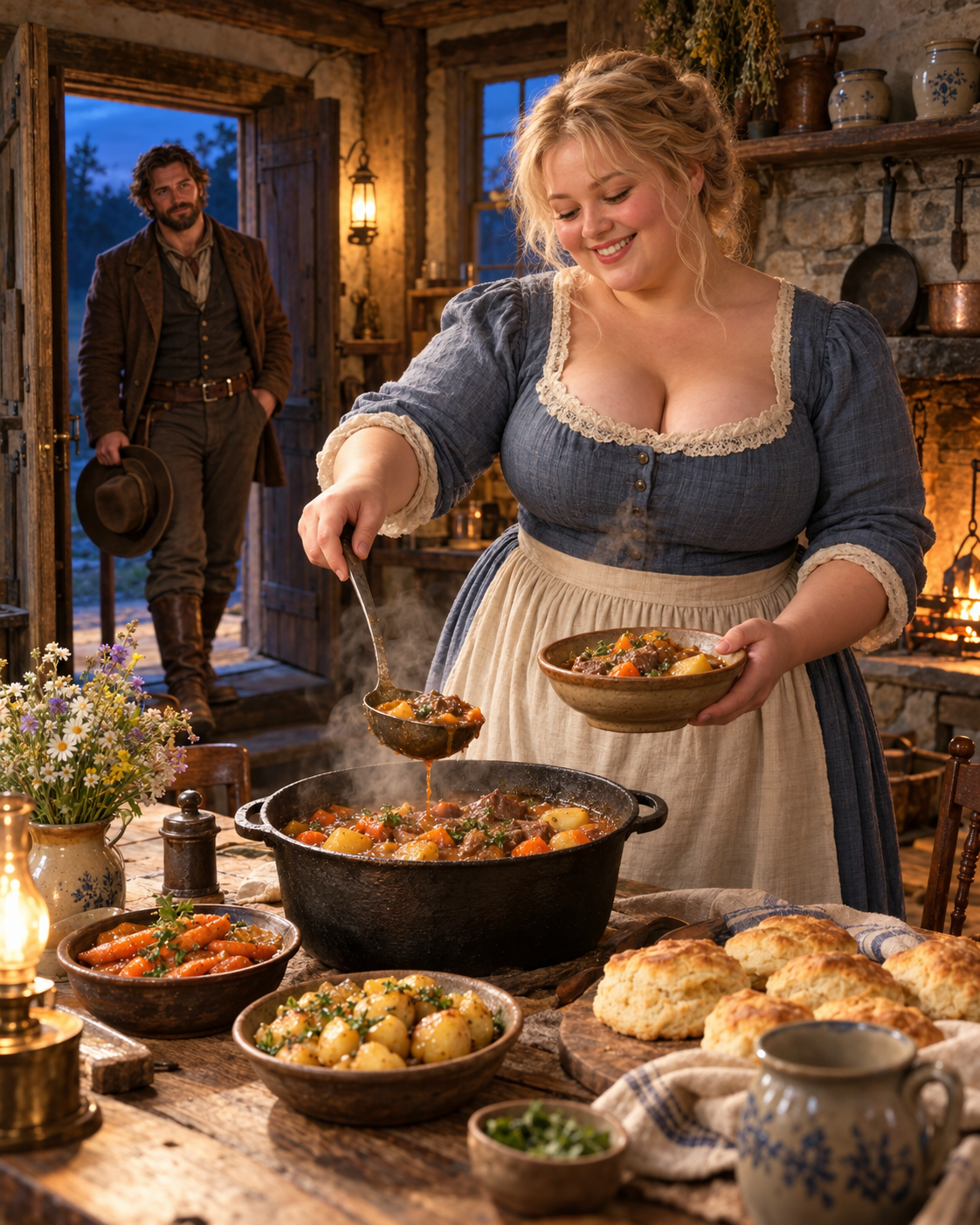
I walked into my ranch kitchen before twelve men and accused a stranger of taking over my home, but her quiet answer exposed the man robbing me blind.
Evelyn’s voice was so quiet I barely heard it above the approaching thunder.
For a moment, I thought she might faint. She held the telegram with both hands, her fingers trembling against the yellow paper.
“What happened?” I asked.
She looked toward the kitchen window, where Samuel’s silhouette moved behind the curtains.
“My name isn’t Evelyn Hartwell.”
I stared at her.
“What?”
“It was Evelyn Hartwell once. Before I married.”
The wind lifted a strand of hair across her face.
“My married name is Evelyn Whitcomb. And the man I married is Duncan Holt’s half brother.”
I felt the porch shift beneath my boots.
Of all the explanations I had imagined, that was not one of them.
“You’re married?”
“Not anymore. My husband died three years ago.”
“Then why didn’t you tell me?”
“Because I knew what would happen if you heard his name.”
I wanted to argue, but the telegram in her hand stopped me.
She held it out.
The message was short.
YOUR HUSBAND’S DEATH WAS NOT AN ACCIDENT. PROOF FOUND. DUNCAN KNOWS YOU ARE AT BROOKS RANCH. LEAVE IMMEDIATELY.
Below it was a name.
Clara Whitcomb.
“Who’s Clara?”
“My husband’s younger sister. The only person in that family who ever showed me kindness.”
I read the message again.
“Tell me everything.”
Evelyn looked toward the darkening hills.
Then she began.
Her husband, Thomas Whitcomb, had worked as an accountant for a cattle investment company in Denver. Duncan Holt had been one of its principal investors, using his general store and freight connections to purchase supplies for ranches throughout the territory.
At first, Thomas believed the business was honest.
Then he discovered money disappearing.
Not a few dollars here and there.
Thousands.
False invoices, invented transportation charges, duplicate payments, and livestock purchases recorded under the names of men who did not exist.
Thomas began copying the records.
He intended to take them to a federal marshal.
Three days before their meeting, his horse supposedly stumbled on a mountain road.
They found him at the bottom of a ravine with a broken neck.
“Everyone called it an accident,” Evelyn whispered. “But Thomas had ridden that road since he was a boy. And his horse came home without a scratch.”
I felt a cold weight settle behind my ribs.
“What happened to his records?”
“They disappeared.”
“And Holt?”
“He came to our house the day after the funeral. Offered me money to leave Denver and start over.”
“Did you take it?”
“No.”
A faint, bitter smile crossed her face.
“That’s when the rumors started.”
Suddenly, I understood.
The accusations in town had not been invented because Evelyn discovered my inflated invoices.
They were old weapons, taken from storage and sharpened again.
“Why Brooks Ranch?” I asked.
“Thomas mentioned your father before he died. He believed Brooks Ranch had been cheated for years, even before you inherited it. When I heard Ramon needed a cook, I thought perhaps I could find something Thomas had missed.”
Her eyes filled.
“I meant to tell you. But then Samuel started trusting me. And you…”
She stopped.
“And I what?”
“You began trusting me too. I was afraid the truth would ruin it.”
I had a hundred questions.
But through the window I saw Samuel laughing at something one of the ranch hands had said, and suddenly only one question mattered.
“Are you in danger?”
Evelyn nodded.
“Then you’re not leaving.”
“Nathaniel, you don’t understand.”
“I understand enough.”
She shook her head.
“Duncan Holt has killed before.”
I folded the telegram and handed it back.
“Then he’d better understand I won’t let him do it again.”
That night, I called Ramon into my study.
He listened without interrupting while Evelyn told him everything.
When she finished, he stood beside the fireplace, staring at the flames.
“I always wondered why Holt bought the Miller property,” he said.
I looked up.
“What does that have to do with this?”
“The western boundary lawsuit. Miller’s land sits between your grazing country and the old freight road. Holt wanted that strip badly enough to fabricate a claim.”
“Why?”
Ramon hesitated.
“There’s an abandoned mining trail through the canyon. Nobody uses it anymore.”
Evelyn turned toward him.
“Thomas once mentioned a private freight route.”
The three of us exchanged a look.
An hour later, Ramon returned from the bunkhouse carrying an old map.
He spread it across my desk.
The western canyon ran directly toward the railroad depot forty miles south.
Holt’s store stood at the northern end of the supply road.
The Miller property connected the two.
“He’s moving something,” Ramon said.
“Or hiding something,” Evelyn replied.
I studied the map.
For two years, Holt had been stealing money from my ranch while trying to seize a piece of my land.
Now I wondered whether the stolen money was only the smallest part of his business.
Before dawn, I sent two trusted hands to watch the canyon.
I told them not to confront anyone.
By noon, only one returned.
His name was Caleb Price, a nineteen-year-old who had worked for me since spring.
He rode into the yard with blood soaking his sleeve.
Ramon caught him before he fell.
“They saw us,” Caleb gasped.
“Who?”
“Four riders. Wagons coming through the pass. Covered loads.”
“Where’s Daniel?”
Caleb’s face twisted.
“They took him.”
A silence fell over the yard.
Then he grabbed my coat.
“Mr. Brooks, they knew we were coming. One of them said Holt had been expecting us.”
My blood turned cold.
Somebody had warned him.
I ordered the men to saddle their horses, but Evelyn stepped in front of me.
“Think.”
“Daniel is out there.”
“And if you ride straight into that canyon, you may never come back.”
“Am I supposed to sit here?”
“No. You’re supposed to stop being predictable.”
Her words stung because they were right.
I had confronted Holt publicly.
I had challenged his land claim.
Now I was preparing to charge directly toward men who already expected me.
Evelyn pointed at the map.
“Where does the old mining trail come out?”
Ramon traced a narrow line with his finger.
“Behind Red Bluff.”
“Can we reach it without using the main road?”
“With horses, yes. Not wagons.”
“Then that’s where we go.”
We rode after sunset.
Ramon took four men. I took my rifle and enough ammunition to make it clear I was not interested in another polite conversation.
Evelyn insisted on coming.
I refused.
She answered by climbing onto her horse.
“Nathaniel, I know Duncan’s methods. You don’t.”
I nearly argued again.
Instead, I handed her an extra revolver.
“Stay behind me.”
She raised an eyebrow.
“I’ll try not to get in your way.”
Even then, with danger waiting beyond the hills, she somehow made me want to smile.
We reached Red Bluff close to midnight.
Below us, lanterns glowed around three freight wagons.
Men moved between crates while a fourth wagon stood beside a crude wooden shed.
Through my field glasses, I recognized Duncan Holt.
Beside him stood Walter Miller, the neighbor who had tried to claim my western pasture.
And tied to a post near the shed was Daniel.
Alive.
Ramon touched my shoulder.
“Look at the crates.”
I adjusted the glasses.
They bore the markings of federal army supply shipments.
Blankets.
Medical provisions.
Rifle cartridges.
Holt wasn’t simply overcharging ranchers.
He was stealing government supplies and selling them through private freight routes, using legitimate ranch purchases to disguise his expenses.
Then another man stepped into the lantern light.
I almost dropped the glasses.
It was my banker.
Edgar Voss.
The same man who had approved every loan keeping Brooks Ranch afloat.
The same man who had repeatedly warned me that my accounts were failing.
“He owns my debt,” I whispered.
Evelyn looked at me.
“What?”
“Voss has the notes on the ranch. If I couldn’t pay, he could force a sale.”
She stared down at the wagons.
“And Holt wanted the western land.”
The truth finally took shape.
They hadn’t merely been stealing from me.
They had been bleeding Brooks Ranch dry so they could divide it afterward.
Before I could speak, a rifle cracked.
The bullet struck the rock beside my head.
“Down!” Ramon shouted.
Gunfire shattered the night.
Someone had spotted us.
We scrambled behind the ridge as shots tore through brush and stone.
One of my men cried out.
I fired twice toward a lantern, shattering it and plunging half the camp into darkness.
Below, horses screamed.
Men shouted.
Then Holt’s voice carried through the canyon.
“Brooks! Come down here or your man dies!”
I looked over the rock.
Walter Miller had pressed a pistol against Daniel’s head.
Every instinct in my body screamed to shoot.
But Daniel’s face was inches from the barrel.
Evelyn gripped my arm.
“He’s trying to force you into the open.”
“I know.”
She studied the canyon below.
Then she whispered, “Give me five minutes.”
“To do what?”
“Something Duncan won’t expect.”
Before I could stop her, she slipped into the darkness behind us.
Those five minutes felt longer than the three months I had spent away from home.
I kept Holt talking.
“Let Daniel go!”
“Come down and sign over your western acreage!”
“You already lost that claim!”
Holt laughed.
“That was the legal way.”
I heard horses moving below.
Then a sudden crash echoed from the freight camp.
One wagon lurched forward.
A team of frightened mules bolted through the lantern light, dragging their load straight into the stacked crates.
Wood splintered.
Men scattered.
In the confusion, Daniel threw himself sideways.
I fired.
Miller’s pistol flew from his hand.
Ramon and two men charged down the slope while I ran toward Daniel.
Gunshots erupted from every direction.
I reached the boy just as Holt emerged from behind the shed.
He raised his revolver.
I had no time to lift my rifle.
Then a shot rang out.
Holt staggered.
His gun dropped into the dirt.
Evelyn stood near the wagon, her revolver smoking.
She had shot him through the shoulder.
He fell against the shed, cursing.
“Get away from me!”
But Ramon was already on him.
Within minutes, the surviving gunmen either surrendered or fled into the hills.
Daniel was shaken and bruised, but alive.
Two of my men had been wounded.
And Evelyn stood beside the broken wagon, trembling so violently she could barely reload her pistol.
I approached her slowly.
“You saved me.”
She swallowed.
“I was aiming for his arm.”
“You hit his shoulder.”
“Then I suppose I need practice.”
I laughed.
Not because anything was funny.
Because fear had finally loosened its grip on my throat.
Then Holt began laughing too.
He sat against the shed with blood darkening his coat.
“You think you’ve won?”
Ramon tightened the rope around his wrists.
Holt ignored him.
He looked directly at Evelyn.
“Thomas thought he could ruin us too.”
Evelyn went still.
“What did you do to him?”
Holt smiled.
“Your husband was an inconvenient man.”
She stepped closer.
“Answer me.”
“I didn’t have to kill him myself.”
Her face drained.
Holt continued, enjoying every word.
“All it took was a loosened saddle strap and a frightened horse.”
I felt Evelyn sway.
Then she straightened.
“My husband trusted you.”
“Your husband was a fool.”
I moved before I could stop myself.
My fist struck Holt hard enough to knock him sideways.
Ramon caught my arm.
“Boss. Enough.”
He was right.
I wanted Holt to suffer.
But Thomas Whitcomb deserved justice more than Duncan Holt deserved my anger.
We tied Holt to a wagon seat and gathered the scattered records.
That was when we discovered the locked iron chest.
Evelyn recognized the engraved initials immediately.
T.W.
Her husband’s initials.
Inside were account books, contracts, false shipping receipts, and letters dating back nearly five years.
One document bore Edgar Voss’s signature authorizing fraudulent ranch loans.
Another listed payments to Walter Miller for the western boundary claim.
And beneath everything lay a small leather notebook.
Evelyn opened it with shaking hands.
The first page contained a sentence in Thomas’s handwriting.
If anything happens to me, follow the money, not the men.
She pressed the notebook against her chest and began to cry.
I had seen Evelyn face insults, threats, and gunfire without surrendering.
But those familiar letters broke through defenses she had carried for three years.
I put my coat around her shoulders.
She leaned into me.
And for once, I had enough sense not to offer words that couldn’t fix anything.
We brought the prisoners and records back to the ranch before sunrise.
I expected relief when we reached the yard.
Instead, I saw Samuel standing on the porch.
Barefoot.
Pale.
Waiting.
He ran down the steps when he saw us.
“Pa!”
I climbed from my horse.
He collided with me so hard I nearly lost my footing.
“Ramon said there was trouble. Nobody would tell me anything.”
“I’m here.”
“You could’ve died!”
His voice broke.
I held him tighter.
“Yes,” I said quietly. “I could have.”
The truth seemed to frighten him more than any reassurance would have.
Then he pulled back and looked at Evelyn.
“Miss Hartwell?”
She gave him a tired smile.
“I’m all right, Samuel.”
He threw his arms around her too.
Watching them, I understood something that the previous night had nearly taken from me.
Family was not always formed by blood.
Sometimes it was built through the simple act of staying.
But the danger had not ended.
At breakfast, a ranch hand rode in from town with news that Edgar Voss had disappeared.
His bank office was locked.
His horse was gone.
And before leaving, he had sent a telegram to the territorial sheriff accusing me of armed robbery, kidnapping, and attempted murder.
By noon, Sheriff Alden Price arrived with six deputies.
He stepped into my study, looked at Holt sitting under guard, then glanced at the account books covering my desk.
“Nathaniel, I’ve known you fifteen years.”
“Then you know I didn’t rob anybody.”
“I know people do foolish things when their land is in trouble.”
I felt anger rising.
Evelyn stepped forward.
“Sheriff, before you make any arrests, you need to see what we’ve found.”
He regarded her skeptically.
“Ma’am, I’ve heard quite a bit about you.”
“Then perhaps it’s time you heard something true.”
She opened Thomas’s notebook.
For the next two hours, she guided him through the evidence.
Every forged receipt.
Every false loan.
Every shipment number.
Every payment connecting Holt, Miller, and Voss.
The sheriff’s expression changed slowly.
Then Evelyn showed him a letter written by Voss to Holt.
It mentioned removing Thomas Whitcomb before he could testify.
Sheriff Price read it twice.
When he finally looked up, his jaw was rigid.
“Where did you get this?”
“From a chest Duncan Holt kept hidden at his freight camp.”
Price turned toward the door.
“Deputies!”
The arrests began that afternoon.
Miller was taken first.
Holt followed under armed guard.
Voss was caught two days later trying to board a train under a false name.
For the first time in years, I believed Brooks Ranch might survive.
Then the bank sent its final notice.
The fraudulent loans could be contested.
But until a judge ruled, the bank’s creditors still expected payment on my legitimate debts.
I had thirty days to settle the overdue balance.
Otherwise, the ranch would be sold.
That evening, I sat alone in my father’s study staring at the figures.
We had exposed the thieves.
Recovered the proof.
Saved Daniel.
Yet the ranch might still be lost.
Evelyn found me there after supper.
“How bad?”
“Bad.”
“How bad, Nathaniel?”
I pushed the papers toward her.
She read them carefully.
Then she asked, “How many cattle can you sell before winter?”
“Not enough without destroying next year’s breeding stock.”
“What about the eastern pasture lease?”
“Already pledged.”
She kept studying the accounts.
I watched the light move across her face.
There was no panic.
Only thought.
Finally, she said, “What if you stopped trying to save the ranch alone?”
I frowned.
“What does that mean?”
“How many families depend on this place?”
“Twenty, counting the seasonal men.”
“And how many of them would lose their homes if Brooks Ranch failed?”
I did not answer.
She set down her pencil.
“Then perhaps they deserve to know what’s happening.”
The next morning, I gathered every hand in the yard.
I had never admitted weakness to my men.
Not when cattle prices collapsed.
Not when drought burned the grass.
Not when my wife died and I could barely get out of bed.
But that day, I told them the truth.
I explained the debt.
The fraud.
The possibility that we might lose everything.
When I finished, no one spoke.
Then Ramon stepped forward.
“How much do you need?”
I told him.
He nodded slowly.
“We can get the north herd to market before the first snow.”
“That won’t cover it.”
“Then we cut winter expenses.”
Caleb raised his bandaged arm.
“My brother works for a cattle buyer in Abilene. He might offer better terms.”
Another man volunteered to repair the old irrigation channel instead of hiring outside labor.
Someone else proposed leasing unused grazing land to two neighboring ranchers.
Ideas came from every direction.
Men I had treated as workers began speaking like partners.
I felt ashamed of how surprised I was.
We spent the next three weeks doing what I had always believed only I could do.
Saving Brooks Ranch.
But this time, I was not alone.
Ramon organized the cattle drive.
Evelyn renegotiated supply contracts.
Samuel helped catalogue equipment and insisted on riding with me during the eastern pasture inspections.
He was still only twelve.
But I stopped treating his questions as interruptions.
One afternoon, while we repaired a broken fence, he asked, “Are we going to lose the ranch?”
“Maybe.”
He looked down.
“Would that mean we have to leave?”
“Possibly.”
He was quiet for a moment.
Then he said, “If we have to, can Miss Hartwell come with us?”
I tightened the wire between two posts.
“Would you want that?”
He looked at me as though I had asked whether horses needed legs.
“Of course.”
I swallowed.
“So would I.”
He grinned.
“Then you should tell her.”
Children are mercilessly simple about matters that can frighten grown men senseless.
By the twenty-ninth day, we had raised almost everything.
Almost.
We were still short eleven hundred dollars.
I sat at the kitchen table staring at the remaining balance when Evelyn entered carrying a small wooden box.
She placed it beside my ledger.
“What’s this?”
“My mother’s jewelry.”
I looked up sharply.
“No.”
“You haven’t even opened it.”
“I don’t need to.”
She sat opposite me.
“There’s a necklace worth at least twelve hundred dollars.”
“I won’t take it.”
“Nathaniel—”
“That was your mother’s.”
“And this is Samuel’s home.”
I looked at her.
She continued softly.
“Thomas left me very little. When I lost him, that necklace was one of the few things I kept. I thought it was the last proof I had once belonged somewhere.”
Her fingers rested on the box.
“But these past months have taught me something. A memory doesn’t live inside a piece of jewelry.”
I wanted to argue.
Instead, I asked the question I had been too frightened to speak.
“Do you feel you belong here?”
Her eyes met mine.
“Yes.”
The room became very still.
I reached across the table and covered her hand with mine.
“Then keep the necklace.”
“Nathaniel—”
“We’ll find another way.”
“What way?”
I breathed out.
“I don’t know yet.”
For the first time since she arrived, she laughed at my answer.
It was a small, surprised laugh.
And hearing it made the impossible seem manageable.
The following morning brought a visitor I never expected.
Sheriff Price arrived with a government representative carrying a leather briefcase.
The representative introduced himself as Marshal Benjamin Cole from the federal district office.
He explained that the stolen military supplies recovered in the canyon had led investigators to a network of fraudulent contracts across three territories.
The evidence we had gathered was critical.
Because Thomas Whitcomb had first discovered the scheme, the authorities were also reopening his death investigation.
Evelyn listened without moving.
Then Cole removed an envelope.
“Mrs. Whitcomb, your husband’s employer withheld several payments owed to his estate. Those funds were frozen when the company came under investigation. We have now confirmed the amounts and authorized the release of the undisputed balance.”
He placed the envelope in front of her.
Inside was a bank draft.
For four thousand dollars.
Evelyn stared at it.
She did not smile.
She did not even blink.
Then she began to cry.
Not because of the money.
I knew that immediately.
It was because someone had finally acknowledged Thomas’s honesty.
His work.
His stolen life.
The marshal lowered his voice.
“Your husband tried to stop this, ma’am. These records show that clearly.”
Evelyn covered her mouth.
“Thank you,” she whispered.
After the visitors left, she stood alone beside the kitchen window.
I approached carefully.
“You don’t have to use any of that money for the ranch.”
She nodded.
“I know.”
“It’s yours.”
“I know.”
She turned to face me.
“But I’ve spent three years living as though the only thing left of my life was what Duncan Holt took from me.”
Her voice steadied.
“I’d rather use what Thomas earned to help protect something good.”
I looked at her for a long moment.
“Then I want you to have a share in this place.”
She frowned.
“What?”
“A legal share. In Brooks Ranch. Not a gift. An investment.”
“Nathaniel…”
“You saved us more times than I can count. You should have something that belongs to you.”
Her eyes filled again.
“And if I don’t want to be your business partner?”
My heart dropped.
Then she stepped closer.
“What if I want something else?”
I had faced armed men in the dark with less fear than I felt in that kitchen.
“What do you want, Evelyn?”
She smiled through her tears.
“I think you know.”
I reached for her.
And when I kissed her, the kitchen door creaked open.
Samuel stood there holding a bucket of eggs.
He stared at us.
Then he sighed dramatically.
“Finally.”
Evelyn burst into laughter.
I covered my face with one hand.
“Samuel Brooks.”
“What? Ramon said you’d figure it out before Christmas, but I told him you were too stubborn.”
I had no defense.
None at all.
We paid the overdue balance with three days to spare.
The ranch survived.
But that was not the end of the story.
The following spring, Duncan Holt stood trial alongside Walter Miller and Edgar Voss.
The courtroom was packed.
Ranchers traveled for miles to hear the testimony.
Men who had once defended Holt now sat silently as his own signatures proved his guilt.
Evelyn testified for nearly four hours.
She spoke about Thomas.
About the missing records.
About the threats.
About the telegram from Clara, whose search for her brother’s papers had helped expose the truth.
When the defense attorney tried to attack her reputation, she did not raise her voice.
She simply opened Thomas’s notebook and read the dates aloud.
Facts were harder to bully than frightened people.
The jury returned guilty verdicts on the major fraud charges.
Holt was also convicted for his role in Thomas’s death.
As the guards led him away, he turned toward Evelyn.
“You ruined everything.”
She looked at him steadily.
“No, Duncan. I stopped helping you hide what you ruined.”
Those words stayed with me.
Not because they were clever.
Because they were true.
For years, men like Holt had depended on everyone else’s silence.
He had counted on my pride.
On the town’s gossip.
On Evelyn’s fear.
On honest people being too embarrassed, too tired, or too frightened to ask questions.
And for a long time, he had been right.
Outside the courthouse, Evelyn stood beside me in the bright afternoon sunlight.
Samuel waited near our wagon, trying to persuade Ramon to let him drive.
I took Evelyn’s hand.
“Are you ready to go home?”
She looked at me.
“Home?”
I smiled.
“Unless you’ve found somewhere better.”
She squeezed my fingers.
“No,” she said. “I haven’t.”
We married that autumn beneath the cottonwood trees behind the ranch house.
It was not a grand wedding.
There were no silk curtains, no expensive musicians, no distinguished guests.
Just the people who had stood beside us when everything seemed lost.
Ramon wore a suit that made him look deeply uncomfortable.
Caleb brought his mother.
Daniel, fully recovered, played fiddle with two other ranch hands.
Clara Whitcomb traveled from Denver and cried through most of the ceremony.
And Samuel stood beside me with the wedding rings in his pocket, taking his responsibilities more seriously than I had ever seen.
When Evelyn walked toward us, the sun caught the small necklace resting against her dress.
Her mother’s necklace.
The one she had nearly sold to save my ranch.
I was glad it remained hers.
After the ceremony, Samuel asked if he could call her Ma.
Evelyn knelt in front of him.
“You can call me whatever feels right.”
He hugged her.
“Then Ma.”
I turned away for a moment.
Some happiness is too large to carry without tears.
Years passed.
Brooks Ranch grew stronger, not because cattle prices suddenly improved or the weather became kinder, but because I finally understood what I had been doing wrong.
I had tried to carry everything myself.
I had mistaken control for leadership.
Money for security.
And hard work for love.
Evelyn changed the way we kept our books, but more importantly, she changed the way we kept our promises.
Every invoice was checked.
Every worker was paid fairly.
Every concern was heard.
We created a fund for injured hands and their families, and we began offering apprenticeships to young people who needed steady work.
Samuel grew into a man I admired.
Not merely because he became an excellent rancher, but because he learned early what had taken me half my life to understand.
A person could own land without owning the people who worked it.
A man could be strong without making everyone else feel small.
And a home was more than a roof kept standing through winter.
Sometimes, in the evenings, I would find Evelyn standing beside the kitchen window, looking out over the fields.
I would slip an arm around her waist.
“What’s on your mind?”
She usually smiled.
“Nothing important.”
But one evening, many years later, she gave a different answer.
“I was thinking about the day you came home.”
I laughed softly.
“The day I accused you of taking over my kitchen?”
“You were very unpleasant.”
“I was.”
“And suspicious.”
“Extremely.”
“And stubborn.”
“I believe we’ve established that.”
She leaned against me.
“Do you know what frightened me most that day?”
“That I’d send you away?”
She shook her head.
“That you would never understand how much your son needed you.”
I looked toward the pasture where Samuel, now grown, was teaching his own little boy to ride a pony.
The child was laughing.
Samuel was laughing too.
And suddenly I remembered walking through that kitchen door years earlier, exhausted and angry, hearing my son laugh with a stranger.
I had believed I was losing control of my house.
In truth, I had been standing at the entrance to the life I nearly missed.
I kissed Evelyn’s forehead.
“You saved more than the ranch.”
She took my hand.
“And you gave me a reason to believe I could begin again.”
We stood together until the sun disappeared behind the hills.
I thought about Holt and the fortune he had stolen.
About Thomas Whitcomb and the courage that had cost him his life.
About the ranch hands who had offered everything they could when I finally admitted I needed help.
And about a woman with flour on her cheek who had entered my home carrying a past she feared would destroy her future.
I had once believed a man’s worth could be measured in acres, cattle, and the amount of money written beside his name.
I know better now.
The greatest theft is not always the money someone takes from you.
Sometimes it is the years you steal from yourself by refusing to trust, refusing to forgive, or refusing to love while there is still time.
And the greatest fortune is not what you manage to keep.
It is the people who still choose to sit at your table when everything else has been taken away.
That evening, Samuel called us inside for supper.
Evelyn slipped her hand into mine.
And I followed her through the kitchen door.
This time, I knew exactly who belonged in my home.
But I did not know then that the final lesson of my life would come years later, when I was forced to discover whether everything Evelyn had taught me had truly taken root.
It began on a bitter November morning, when Samuel rode into the yard carrying a letter from the railroad company.
A new railway line was being planned through the valley, and the company wanted to purchase a large section of Brooks Ranch.
The offer was extraordinary.
More money than my father had earned in twenty years.
Enough to guarantee Samuel’s children would never know the fear of losing their home.
There was only one problem.
The proposed railway would cut straight through the small settlement west of our property, where fourteen families had built houses on land they leased from us.
The company wanted the ground cleared within ninety days.
Samuel stood across my desk, studying my expression.
“That’s a lot of money, Pa.”
“It is.”
“What are you going to do?”
I looked down at the contract.
Years earlier, I would have signed it before the ink dried.
I would have told myself that business was business, that protecting my family came first, and that those fourteen families would simply have to find somewhere else to live.
But now I knew their names.
I knew their children.
I knew which roofs leaked in winter and which gardens produced the best tomatoes.
I knew that a home could not always be replaced by handing someone a few dollars.
“What do you think we should do?” I asked.
Samuel considered the question seriously.
“I think we should talk to the families before we make any decisions.”
I smiled.
“Then that’s what we’ll do.”
The railroad representative returned three days later, dressed in a fine black coat and carrying a silver watch.
His name was Charles Whitaker.
He reminded me of Duncan Holt in one particular way.
He spoke about people as though they were obstacles on a map.
“Mr. Brooks, this opportunity won’t remain available indefinitely.”
“I understand.”
“Your neighbors have already agreed to sell.”
“That’s their decision.”
“We can make you a very wealthy man.”
I leaned back in my chair.
“I’ve already been a man who cared too much about money, Mr. Whitaker. It nearly cost me everything worth having.”
He frowned.
“Surely you understand progress requires sacrifice.”
“Certainly. But I notice the people making that argument rarely volunteer to be the ones sacrificed.”
Whitaker left without a signature.
For six weeks, we negotiated.
Samuel studied alternative routes.
Ramon’s youngest son, who had become a surveyor, helped prepare maps showing how the tracks could follow the northern ridge without destroying the settlement.
The railroad company refused at first.
Then Samuel discovered that the northern route would shorten the line to the river crossing and avoid expensive bridge construction.
We presented the figures.
This time, Whitaker listened.
In the end, the railroad bought a narrow strip of unused grazing land along the ridge.
The families kept their homes.
Brooks Ranch received a fair payment.
And the railway reached the valley without forcing a single child from the place where they had grown up.
The night we signed the agreement, Samuel found me sitting on the porch.
“You could have taken the first offer,” he said.
“Yes.”
“We would have been rich.”
I looked out over the dark fields.
“We’re already rich, son.”
He laughed.
“You sound like Evelyn.”
“I’ve spent a lifetime trying to become half as wise as that woman.”
Samuel sat beside me.
For a while, neither of us spoke.
Then he said, “I remember when you used to leave before breakfast.”
“So do I.”
“I remember thinking you liked the cattle better than me.”
The old pain returned, softer now, but still real.
“I wish I could give you those years back.”
He shook his head.
“You gave me something better.”
“What?”
“You changed.”
I turned toward him.
He was no longer the wounded twelve-year-old boy who had asked why his father bothered coming home.
He was a husband, a father, and a man who understood that strength meant accepting responsibility for the people who trusted him.
“I learned how to be a father by watching you become one,” he said.
For a moment, I couldn’t speak.
Then I put my arm around his shoulders, just as I should have done more often when he was small.
Evelyn came onto the porch carrying three cups of coffee.
She looked at us and smiled.
“Have I interrupted something?”
“Only your husband getting sentimental,” Samuel said.
“That happens more often these days.”
She handed me a cup and settled beside us.
Beyond the fence, the ranch lights glimmered against the darkness.
From the workers’ cottages came the sound of children laughing.
Somewhere near the stable, a horse whinnied.
And inside our kitchen, supper still smelled of fresh bread.
I thought about the morning I had returned after three months away and found a stranger standing beside my stove.
I had demanded to know who she was because I believed the house belonged to me.
But ownership had never been the same thing as belonging.
A house belonged to whoever held its deed.
A home belonged to those who filled it with patience, courage, forgiveness, and love.
When Evelyn rested her head against my shoulder, I took her hand and held it close.
I no longer feared that the ranch might continue without me.
I hoped it would.
I hoped its fences would be repaired by hands not yet born, that its tables would welcome strangers needing a fresh beginning, and that its people would never forget the difference between earning a living and building a life.
Because that was the inheritance I wanted to leave.
Not simply land.
Not simply money.
But a place where no one had to prove their worth by suffering alone.
The years eventually took their toll on my body. My riding grew slower, my hands became stiff in winter, and Samuel gradually assumed responsibility for the daily work.
But every morning, Evelyn and I still ate breakfast together.
Sometimes our grandchildren joined us, filling the kitchen with noise and questions and crumbs.
Once, our youngest granddaughter asked why Grandma Evelyn always checked the sugar invoices herself.
Evelyn looked across the table at me.
I began laughing before she answered.
“Because, sweetheart,” she said, “an expensive bag of sugar can teach you more about a man’s character than a hundred fine speeches.”
The children didn’t understand.
Samuel did.
So did I.
And when the laughter finally faded, I looked around the table at the faces of people who would never have existed together if one courageous woman had chosen silence over truth.
That was when I understood the last and most important lesson of my life.
We cannot choose every hardship that comes to our door.
We cannot undo every mistake, recover every lost year, or protect the people we love from every sorrow.
But we can choose what happens after the truth is revealed.
We can defend our pride, or we can change.
We can protect our possessions, or we can protect our people.
We can let fear decide who deserves our trust, or we can find the courage to open the door.
I had nearly sent Evelyn Hartwell away because I thought she was taking something from me.
Instead, she had given me back my son, my conscience, and a future I hadn’t believed I deserved.
And whenever someone asked me how Brooks Ranch survived its darkest years, I never spoke first of the gunfight, the stolen records, the courtroom, or the money.
I told them about a quiet woman standing in a kitchen with flour on her cheek.
I told them how she had the courage to question a dishonest invoice when everyone else was too comfortable to look.
And I told them that sometimes the person who changes your life arrives without permission, without promises, and without anything to offer except the truth.
If you are wise enough to listen, that truth may become the beginning of everything.
Because in the end, the greatest legacy a person can leave is not the wealth they accumulated, the land they owned, or the battles they won.
It is the love they made possible, the wrongs they had the courage to confront, and the lives that became better because they chose to do what was right.
And that, more than anything written on a deed or deposited in a bank, was the true fortune of Brooks Ranch.
THE END.