I spilled black coffee across the Galactic Exchange table, and Ambassador Hale called me an embarrassment—until two alien diplomats revealed Earth’s greatest secret had been ignored for decades.
I stared at the signature until the letters stopped looking like letters.
AMBASSADOR ELIAS HALE.
For a moment, I genuinely thought I had misunderstood.
There had to be another Hale. Some long-retired official. Some bureaucrat with the same name who had made a spectacularly stupid decision thirty years ago.
Then I checked the authorization date.
Nineteen years earlier.
Three months after humanity signed its first provisional agreement with the Galactic Exchange.
Hale had been Earth’s deputy cultural liaison.
He had personally classified more than six thousand records of human cultural achievement as irrelevant to interstellar diplomacy.
I looked up at Dra.
“Why are you showing me this?”
His silver scales reflected the warm lights above our counter.
“Because I wish to know whether the man who serves your world has been lying to mine.”
“That’s a pretty serious accusation.”
“Yes.”
“And you’re telling the guy who makes coffee?”
Dra glanced toward the kitchen, where my mother was washing the same mug for the third time because she was too nervous to stop moving.
“I am telling the person who offered me something without first calculating what he could obtain in return.”
I looked back at the tablet.
“Maybe Hale thought culture wasn’t important.”
Sevil’s voice came from the doorway.
“Then why did he remove the original assessments?”
I hadn’t heard him enter.
The black-scaled diplomat stepped into the shop, carrying a second tablet.
“This document is not merely a list of rejected materials,” he said. “It is a record of suppression.”
He placed his tablet beside Dra’s.
Two columns appeared.
The first contained the original survey recommendations.
The second showed Hale’s revisions.
Music had originally been classified as a possible cross-species emotional communication system.
Reclassified.
IRRELEVANT.
Fermented foods had been identified as potential biochemical exchange materials.
Reclassified.
IRRELEVANT.
Human social bonding rituals had been described as unusually adaptive, particularly the practice of sharing food with unrelated individuals.
Reclassified.
IRRELEVANT.
But one entry made my stomach tighten.
COFFEE: POTENTIAL NEUROLOGICAL AND CULTURAL SIGNIFICANCE TO DRAER BIOLOGY.
I read it twice.
“You knew?”
Dra’s jaw tightened.
“Not personally. The initial assessment was performed by a joint research committee.”
Sevil touched the screen.
“The recommendation was to begin controlled cultural exchanges immediately.”
“What happened?”
“The recommendation was withdrawn by Earth’s representative.”
I looked at the signature again.
Hale.
Of course.
My mother finally stopped washing the mug.
“Ro,” she said quietly, “lock the door.”
I turned.
“Mom?”
“Now.”
There was something in her voice I hadn’t heard since the night my father died.
Not fear.
Recognition.
I flipped the sign to CLOSED.
My mother dried her hands, walked behind the counter, and opened the old wooden drawer beneath the register.
Inside were receipts, emergency cash, and a faded photograph of my father.
Behind the photograph sat a small brass key.
She held it so tightly her knuckles turned white.
“Your father,” she whispered, “used to work for the Exchange.”
I laughed once.
Not because anything was funny.
Because the universe had apparently decided my life hadn’t become complicated enough.
“Dad sold coffee.”
“Before that.”
She looked at Dra.
“His name was Daniel Cole. He worked on the first cultural survey.”
Dra went perfectly still.
Sevil’s pupils narrowed.
“Daniel Cole?”
My mother nodded.
Sevil slowly lowered his head.
“Then your husband was the human who tried to stop the classification.”
The shop seemed to tilt beneath me.
My father had died when I was sixteen.
A transit accident.
A faulty atmospheric shuttle.
That was what every official report said.
My mother had never questioned it in front of me.
Now she was crying without making a sound.
“He told me someone was changing the findings,” she said. “He said the Exchange wasn’t afraid of humanity’s weapons.”
She swallowed.
“It was afraid of what would happen if humanity stopped being afraid of everyone else.”
I couldn’t move.
I remembered my father standing behind the counter, teaching me to measure beans by weight instead of volume.
I remembered his ridiculous jokes and his terrible singing.
I remembered the last morning I saw him, when he kissed my forehead and told me to watch the shop.
He had looked worried.
I had assumed it was about money.
“Did Hale kill him?”
My mother closed her eyes.
“I don’t know.”
That answer hurt more than a lie would have.
Dra’s translator clicked softly.
“We must speak with Varesh.”
“No,” my mother said.
All three of us looked at her.
“If you take this to the Exchange, Hale will bury it again.”
Sevil considered her words.
“Then what do you propose?”
My mother placed the brass key in my palm.
“Daniel left something behind.”
I stared at it.
“What does it open?”
“The storage room downstairs.”
“We don’t have a storage room downstairs.”
She gave me a sad smile.
“That’s what I told the inspectors.”
The door beneath our kitchen floor had been there my entire life.
I had walked over it thousands of times without noticing the seams hidden beneath the old tiles.
The brass key fit a lock concealed under the drain cover.
A heavy metallic click echoed through the kitchen.
Then the floor opened.
Cold air rolled upward.
Sevil activated a small light attached to his wrist.
Beneath us stretched a narrow staircase descending into darkness.
My mother touched my shoulder.
“Your father made me promise not to tell you until you were old enough.”
“I’m twenty-seven.”
“I know.”
“How old was I supposed to be?”
Her expression crumpled.
“Old enough that losing you wouldn’t destroy me.”
I had no answer for that.
We descended.
At the bottom stood a sealed chamber containing a desk, an ancient terminal, and shelves filled with notebooks.
Not weapons.
Not secret alien technology.
Not the sort of things conspiracy broadcasts always promised.
There were recordings of human choirs, recipes from forgotten villages, photographs of festivals, paintings, children’s stories, and hundreds of handwritten observations.
My father’s handwriting covered everything.
On the desk sat a small audio recorder.
A yellow note was attached.
FOR RO, WHEN THE WORLD IS READY TO LISTEN.
My hands shook as I pressed play.
Static crackled.
Then my father’s voice filled the room.
“Hey, little bean.”
I nearly dropped the recorder.
He hadn’t called me that since I was ten.
“If you’re hearing this, either your mother finally got tired of keeping secrets, or I was right about the people running the Exchange.”
A faint chuckle.
“Knowing your mother, I’m betting on the second one.”
I laughed through tears.
Then his voice changed.
“The first survey discovered something extraordinary. The Draer weren’t the only civilization affected by human cultural materials. Our music produced measurable emotional responses in species that had never developed musical traditions. Our fermented foods supported microbial ecosystems on worlds where agriculture had nearly collapsed. Our social rituals helped stabilize negotiations between species that had spent centuries communicating only through formal contracts.”
He paused.
“We thought these discoveries would make humanity valuable.”
A chair creaked in the recording.
“Instead, the committee became frightened.”
Sevil leaned closer.
My father continued.
“The Exchange was built after the Resource Wars. Every founding civilization agreed that power would be measured by strategic necessity. Whoever controlled minerals, fuel, shipping routes, or military force controlled negotiations.”
Another pause.
“But what happens when a young species arrives with something nobody knows how to price?”
The room felt very small.
“What happens when ordinary people can offer things that governments have spent centuries trying to monopolize?”
The recording crackled.
“They called it cultural destabilization.”
My father sounded disgusted.
“I called it making friends.”
Then came the sentence that changed everything.
“Hale told me that if Earth’s culture entered open exchange, humanity would become impossible to control through scarcity.”
My breath caught.
“He wasn’t protecting Earth from the galaxy,” my father said.
“He was protecting the galaxy’s power structure from Earth.”
A sharp noise interrupted the recording.
My father’s breathing quickened.
“They’re coming. I’ve hidden the original survey and all supporting evidence in the archive drive. The access phrase is something only Ro would remember.”
Static.
Then, softer:
“Don’t rush it, little bean. Good things reveal themselves slowly.”
The recording ended.
For a long time, nobody spoke.
Then Sevil approached the terminal.
“An access phrase.”
I wiped my face.
I knew it.
Of course I knew it.
My father had repeated those words every morning.
I entered them.
GOOD THINGS REVEAL THEMSELVES SLOWLY.
The terminal illuminated.
A single message appeared.
ARCHIVE UNLOCKED.
Then another.
AUTOMATIC DISCLOSURE PROTOCOL ARMED.
I frowned.
“What does that mean?”
Sevil’s scales flattened.
His voice suddenly became sharp.
“It means the archive is designed to transmit automatically if its owner is identified by an unauthorized security system.”
Above us, something exploded.
The lights flickered.
A metallic voice boomed from the staircase.
“ROWAN COLE. BY ORDER OF EARTH’S DIPLOMATIC SECURITY AUTHORITY, YOU ARE REQUIRED TO SURRENDER ALL CLASSIFIED MATERIAL.”
My mother grabbed my arm.
“Hale.”
Dra spread his wings, filling almost the entire chamber.
Sevil checked his wrist display.
“Six armed officers. Military-grade equipment.”
I stared at him.
“You can tell that from down here?”
“Yes.”
“Wonderful. Any chance you can also tell me how to survive?”
Dra smiled.
“Remain behind me.”
The first security officer appeared at the bottom of the stairs.
He raised a pulse rifle.
Dra moved.
I had watched recordings of Draer combat reflexes on the news.
Nothing prepared me for seeing them in a room the size of our kitchen.
One moment he stood beside the desk.
The next, the rifle was against the ceiling and the officer was unconscious.
A second soldier fired.
Sevil caught the pulse against a shimmering shield projected from his ceremonial chain.
The blast scorched the wall.
My mother screamed.
“Not the notebooks!”
I don’t know why that was the moment I stopped being terrified.
Maybe because my mother was surrounded by armed soldiers and still worried about paper.
Maybe because my father had died protecting this room.
Or maybe because I was finally sick of being told which things mattered.
I grabbed the archive drive from the terminal.
A warning flashed.
UNAUTHORIZED EXTRACTION WILL INITIATE PUBLIC TRANSMISSION.
I hesitated.
Then pulled it free.
Every screen in the room turned red.
TRANSMISSION INITIATED.
Sevil spun toward me.
“What did you do?”
“I think I made coffee everybody’s problem!”
Above us, alarms erupted throughout the district.
Dra laughed.
It was not an appropriate time to laugh.
Which was probably why I liked him.
We escaped through a maintenance tunnel my father had constructed behind the archive.
It emerged inside the neighboring translator repair shop.
The owner, a four-armed Vesk named Nimo, stared at us crawling through his ventilation panel.
Then he looked at the smoke rising behind us.
“Ro,” he said, “your mother still owes me forty credits.”
“Put it on my tab.”
“You already have a tab.”
“Then make it historic.”
Nimo considered that.
“Fine.”
He opened the back exit.
Outside, the Exchange District had transformed into chaos.
Every public screen displayed portions of the leaked survey.
People stood in the streets reading documents that had been hidden for nearly two decades.
One recording showed a human violinist performing for a delegation of aquatic aliens whose skin changed colors with the melody.
Another documented a dying agricultural colony successfully restoring its soil using microbial cultures developed from traditional Earth fermentation.
Another showed Draer scientists discovering that specific terrestrial bitter compounds stimulated neural pathways associated with memory and emotional processing.
None of it involved weapons.
All of it mattered.
Then Hale appeared on every screen.
His face was composed, but his eyes were furious.
“Citizens of Earth, an illegal information breach has occurred. Certain individuals are distributing fabricated materials designed to undermine the Galactic Exchange.”
The crowd murmured.
“These individuals have endangered ongoing negotiations and may be collaborating with foreign agents.”
My photograph appeared beside his face.
WANTED FOR QUESTIONING.
I stared at it.
“That’s a terrible picture.”
My mother slapped my arm.
“Ro!”
“What? It is.”
Sevil’s wrist communicator chimed.
His expression darkened.
“Varesh has been detained.”
Dra stopped walking.
“What?”
“Earth security has invoked emergency diplomatic containment protocols. They claim the elder is under threat from cultural contamination.”
I looked at the screen.
Hale continued speaking.
“Until the investigation is complete, all Draer delegates will remain under protective supervision.”
Dra’s wings lifted.
“Protective supervision?”
I had only known the silver diplomat for a day.
But even I understood that tone.
“He’s trying to make it look like the Draer are dangerous,” I said.
Sevil nodded.
“And if we resist, he will possess exactly the military confrontation needed to justify continued restrictions.”
My father had warned us.
Power was measured in strategic necessity.
Hale needed a threat.
He was going to create one.
“We need to reach Varesh,” Dra growled.
“No,” I said.
He turned toward me.
I nearly reconsidered my entire life.
“We need to reach everyone.”
I pointed to the screens.
“Hale controls the official broadcasts. He controls security. He probably controls half the people in that tower.”
“Correct,” Sevil said.
“But he doesn’t control this district.”
I looked around.
At Nimo’s repair shop.
At the currency kiosk.
At the little restaurant across the street where a human grandmother served noodle soup to species with entirely different digestive systems.
At the crowds gathering beneath the screens.
My father had spent years documenting humanity’s greatest diplomatic advantage.
And somehow, standing in the middle of chaos, I finally understood it.
He hadn’t been studying coffee.
He had been studying connection.
“Sevil,” I said, “how many civilizations have representatives in this district?”
“One hundred and thirteen.”
“How many have food?”
He blinked.
“All of them.”
“How many have songs?”
His eyes narrowed thoughtfully.
“Most.”
I grinned.
“Then we’re going to hold the biggest dinner party in galactic history.”
The plan was stupid.
It was reckless.
It required convincing thousands of terrified civilians to challenge the most powerful diplomatic authority on Earth using soup, coffee, and whatever else they could carry.
And somehow, it worked.
Not immediately.
At first, people thought I had lost my mind.
Which, considering I was standing on a broken delivery crate shouting instructions while two enormous Draer guarded my mother, was understandable.
But then Nimo brought out his translators.
The noodle shop owner dragged tables into the street.
A family of Martian settlers arrived with homemade bread.
A group of amphibious diplomats contributed a luminous algae dish that smelled like rain.
Somebody found speakers.
Somebody else brought musical instruments.
Within thirty minutes, the entire street had become a sprawling, chaotic gathering of beings who had spent years passing one another without ever speaking.
A human child offered a sweet pastry to a reptilian engineer.
The engineer examined it like an unexploded device.
Then tasted it.
His delighted scream drew six more engineers.
A towering insectoid merchant played a string instrument made from transparent crystal.
A woman from Nairobi answered with a battered saxophone.
Neither understood the other’s language.
They played together anyway.
The crowds grew.
People started broadcasting the gathering from personal devices.
Millions watched.
Then billions.
Hale ordered security to disperse us.
They arrived in armored vehicles.
Their commander stepped into the street carrying a loudspeaker.
“This gathering is unauthorized! Return to your residences immediately!”
Nobody moved.
Dra stood beside me.
Sevil stood on my other side.
My mother, who was approximately one-sixth their size, stepped forward holding a steaming cup.
“Would you like coffee?”
The commander stared at her.
“Ma’am, this is a restricted security operation.”
“That wasn’t my question.”
I almost smiled.
Then the commander looked past us.
His soldiers were watching the broadcasts.
On one screen, a young Draer refugee was speaking about how a human lullaby had calmed his younger sister during evacuation from a border conflict.
On another, agricultural scientists were confirming that the buried survey contained authentic research.
Across the district, people were sharing the archive faster than Hale could remove it.
The commander lowered his loudspeaker.
His wrist communicator crackled.
A sharp voice ordered him to begin arrests.
He looked at my mother.
Then at the gathering.
Then he removed his helmet.
“I take mine with two sugars.”
The street erupted.
But our victory lasted exactly forty-seven seconds.
A deep mechanical tremor rolled through the pavement.
All the lights in Tower Seven turned crimson.
Sevil looked upward.
His face changed.
“Ro.”
I followed his gaze.
Above the city, the defensive platforms surrounding the Exchange District were rotating.
Their enormous cannons pointed inward.
Toward us.
A new message appeared across every public screen.
CULTURAL BIOHAZARD CONTAINMENT ACTIVE.
Dra’s voice became terrifyingly quiet.
“Hale has authorized a sterilization strike.”
I felt the blood drain from my face.
“Sterilization?”
Sevil scanned his display.
“The platforms carry focused plasma charges. Their purpose is to destroy contaminated installations without damaging surrounding infrastructure.”
I looked at the thousands of people packed into the street.
“How long?”
“Six minutes.”
My mother grabbed my hand.
“We need to evacuate.”
Sevil shook his head.
“The defense perimeter has already sealed the district.”
Dra extended his wings.
“I can reach the control tower.”
“Not before the cannons fire,” Sevil replied.
For the first time since this nightmare began, Dra looked genuinely afraid.
Not for himself.
For everyone else.
Then I heard my father’s voice in my memory.
Good things reveal themselves slowly.
I looked at the archive drive.
And I finally noticed something strange.
The original survey contained a final section that hadn’t appeared in the public leak.
A small file marked:
THE HARMONY PROTOCOL.
I opened it.
A video appeared.
My father sat beside a much younger Varesh.
My breath stopped.
“You knew my father?”
Varesh’s recorded voice answered the question before I could ask it.
“Daniel Cole was the first human who asked what our people missed, rather than what we possessed.”
The video shifted to a laboratory.
Human musicians performed while Draer researchers monitored neurological activity.
My father explained that music, rhythm, shared rituals, and certain biochemical experiences produced surprisingly similar responses across several intelligent species.
Not identical.
But compatible.
“Every civilization has developed different methods of expressing trust,” he said. “Yet many share a biological response to synchronized social activity.”
He leaned toward the camera.
“We called it the Harmony Protocol. Not because everyone becomes the same, but because different beings can learn to respond to one another.”
Another file opened.
An architectural map of Tower Seven.
The Exchange’s original communication array.
My father had discovered that the district’s emergency broadcast network could transmit multisensory diplomatic signals.
Sound.
Light.
Chemical markers.
Patterns designed for species that communicated through movement, vibration, or scent.
It had been created for first-contact emergencies.
Then abandoned.
The entire system still existed beneath the district.
And its primary manual transmitter was located somewhere painfully familiar.
Inside our coffee shop.
I stared at the map.
“Dad, you ridiculous genius.”
Five minutes remained.
We ran.
The shop’s front windows were shattered.
Tables lay overturned.
Our sign swung crookedly above the entrance.
For one terrible moment, seeing the place broken hurt more than the weapons in the sky.
My father had built those shelves.
My mother had painted those walls.
Every important memory I possessed lived inside that little room.
Then my mother squeezed my shoulder.
“Find the transmitter.”
We searched behind cabinets and beneath the counter.
Finally, Sevil located a concealed panel inside the old coffee roaster.
There was a circular socket.
Exactly the size of the archive drive.
I inserted it.
The roaster hummed.
Ancient machinery awakened beneath the floor.
A holographic interface appeared.
HARMONY PROTOCOL READY.
SELECT PRIMARY CULTURAL SIGNAL.
I stared at the options.
Music.
Language.
Visual patterns.
Biochemical signals.
There were hundreds.
“Which one?” Sevil asked.
I thought of the Draer tasting coffee for the first time.
I thought of Varesh whispering about warmth.
I thought of my mother feeding strangers when we barely had enough money to feed ourselves.
Then I made my choice.
“All of them.”
Sevil froze.
“That could overwhelm the array.”
“Then let it.”
A warning appeared.
MANUAL TRANSMISSION REQUIRES CONTINUOUS OPERATOR CONTACT.
POTENTIAL NEURAL FEEDBACK HAZARD.
My mother read the warning.
“No.”
“Mom—”
“No, Rowan.”
She almost never used my full name.
“Your father died trying to expose these people. I will not lose you because of them.”
I took her hands.
“Then help me make sure nobody else loses someone.”
She shook her head, crying.
I wanted to tell her I wasn’t afraid.
But I was.
Terribly.
There were thousands of people outside.
Millions more watching.
And above us, the platforms had completed their targeting sequence.
Sevil’s communicator displayed the countdown.
NINETY SECONDS.
Dra stepped forward.
“I will operate the transmitter.”
I looked at his enormous claws.
“It’s built for a human nervous system.”
“Then I shall endure what I can.”
“No.”
I placed my hand on the interface.
Warmth rushed through my fingers.
The machine connected.
At first, I heard a faint musical note.
Then a thousand voices.
Then something impossible.
The transmitter wasn’t simply broadcasting recordings.
It was translating experiences.
The taste of coffee.
The comfort of a shared meal.
The grief of losing someone.
The joy of hearing an unfamiliar voice become a friend’s.
I felt memories that weren’t mine.
A Draer mother singing to her hatchling beneath a sky filled with ash.
An aquatic child watching sunlight ripple through an ocean older than human civilization.
A lonely merchant receiving his first invitation to a stranger’s table.
For one unbearable instant, all those lives touched mine.
My knees buckled.
The lights exploded into color.
Across the Exchange District, every speaker began playing music.
Not one song.
Thousands.
Layered together in harmonies that should have sounded like chaos.
But somehow, they didn’t.
The communication towers transmitted chemical signatures, rhythmic pulses, and visual patterns across every compatible receiver.
People stopped running.
Draer wings opened.
Aquatic delegates changed color.
Insectoid merchants raised their antennae.
The district became a living constellation of different beings experiencing fragments of one another’s worlds.
Above us, the defense platforms hesitated.
Their targeting computers identified the signal.
FIRST-CONTACT DIPLOMATIC EXCHANGE IN PROGRESS.
UNDER GALACTIC CHARTER ARTICLE ONE, MILITARY INTERFERENCE PROHIBITED.
The cannons stopped rotating.
I barely noticed.
The neural feedback was burning through my skull.
Blood ran from my nose.
Sevil shouted something.
My mother’s hands gripped my shoulders.
Then another voice entered the transmission.
Hale.
“Terminate that signal immediately!”
His face appeared in the holographic display.
Behind him, security officers crowded a control room.
“You have no idea what you’ve unleashed!”
I struggled to focus.
“People talking?”
“You fool!” he screamed. “Do you know how many treaties depend on controlled resource access? How many governments maintain stability because they regulate what worlds can exchange?”
Dra leaned into the projection.
“You concealed knowledge from entire civilizations.”
Hale’s expression twisted.
“I prevented chaos!”
“You prevented friendship,” I whispered.
For a moment, something flickered behind his eyes.
Maybe guilt.
Maybe fear.
Then he slammed his hand against a control panel.
The holographic display flashed.
OVERRIDE REQUESTED.
TRANSMITTER CORE PURGE.
Sevil roared.
“He’s trying to destroy the array!”
The floor trembled.
A mechanical shriek rose from beneath the roaster.
The interface announced:
CORE OVERLOAD IN THIRTY SECONDS.
The neural connection wouldn’t release my hand.
I pulled.
Nothing.
My skin felt fused to the controls.
Dra seized the interface housing.
Sparks exploded around his claws.
“Sevil! The power conduit!”
Sevil ripped open the wall.
Blue electrical arcs raced across the exposed machinery.
My mother grabbed the old brass grinder from the counter.
For one absurd second, I thought she was going to make coffee.
Instead, she smashed it into the emergency release switch.
Metal shattered.
The connection broke.
Dra pulled me backward as the roaster erupted in a column of white fire.
Then everything went dark.
When I opened my eyes, I was lying beneath a hospital ceiling.
My first thought was that the coffee shop smelled wrong.
My second was that hospitals probably weren’t supposed to smell like coffee shops.
My third was that somebody was holding my hand.
Mom.
Her face was red and swollen from crying.
“Hey, little bean,” she whispered.
I smiled weakly.
“You’re stealing Dad’s lines.”
She laughed.
Then she cried harder.
Apparently, I’d been unconscious for three days.
The Harmony transmission had reached one hundred and thirteen civilizations.
The defense platforms had shut down.
Varesh had been released.
And Hale had been arrested after the Galactic Tribunal received the complete archive, along with recordings of his attempt to purge the transmitter.
But the most surprising thing wasn’t any of that.
It was what happened afterward.
The Galactic Exchange voted to revise its founding charter.
Cultural exchange would no longer be treated as insignificant or secondary to military and economic negotiations.
Every member world gained the right to present its languages, traditions, arts, foods, and social practices as protected diplomatic contributions.
No government could secretly classify another civilization’s peaceful cultural knowledge without independent review.
It wasn’t perfect.
There were arguments.
There were protests.
Some powerful people hated the changes.
But for the first time in generations, the galaxy was discussing something other than what civilizations could take from one another.
They were talking about what they could share.
And then there was Varesh.
She visited my hospital room with Dra and Sevil, carrying a small wooden box.
The elderly Draer looked almost embarrassed.
“Your father gave me something many years ago,” she said.
She opened the box.
Inside rested a handwritten recipe.
My father’s handwriting.
A simple coffee blend.
Beneath it, a note.
FOR VARESH, WHEN WE CAN FINALLY SHARE A CUP IN PEACE.
I swallowed hard.
“He knew you?”
Varesh nodded.
“He was my friend.”
Her voice trembled.
“When the original survey was suppressed, he warned me that revealing our research could endanger both our peoples. He asked me to protect the evidence until someone could prove the Exchange was ready to hear it.”
“Why didn’t you tell anyone?”
“Because I was afraid.”
She looked toward the window.
“And I have regretted that fear for nineteen years.”
I didn’t know what to say.
Varesh touched the box.
“Your father believed that courage was not the absence of fear. It was the decision to offer kindness even when fear made cruelty easier.”
Then she placed the recipe in my hands.
“He would have been proud of you.”
That was when I finally cried.
Not the silent tears I had held back in the archive.
Not the frightened tears I had hidden from my mother.
I cried because I missed him.
Because he should have been there.
Because the universe had become enormous and beautiful and terrifying, and the person I most wanted to tell was gone.
Varesh stayed beside me.
She didn’t try to fix anything.
Neither did Dra.
Neither did Sevil.
They simply sat.
For the first time, I understood that sometimes the greatest kindness was allowing someone else to feel something without demanding that it become useful.
Six months later, our coffee shop reopened.
The rebuilding had been funded by donations from seventeen planets, although my mother insisted on repaying every contributor who would accept the money.
We kept the old sign.
We repaired the counter instead of replacing it.
And in a glass case near the register, we displayed the broken hand grinder that had saved my life.
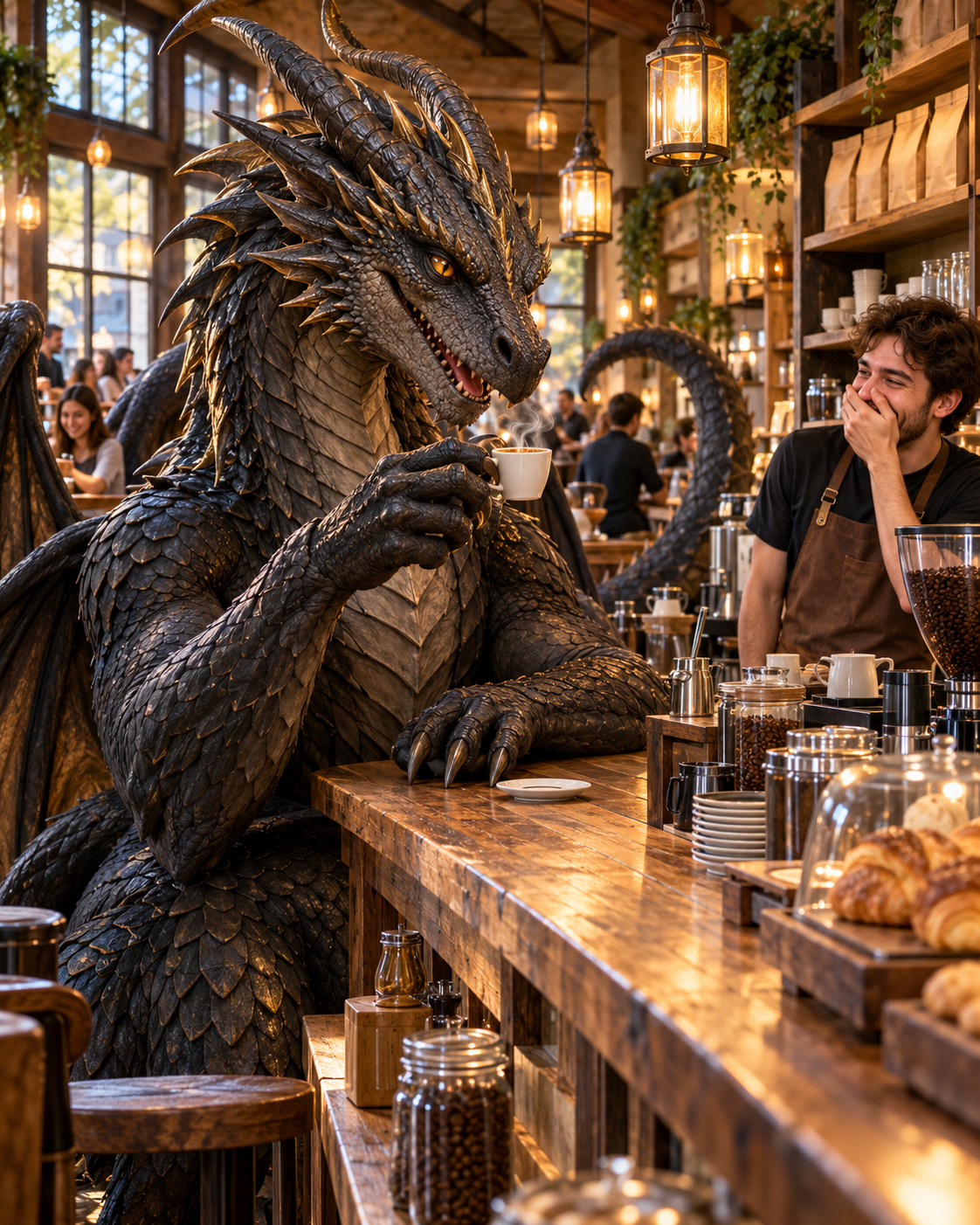
The new shop was twice as large, mostly because Dra couldn’t fit his wings through the original doorway without destroying something.
Again.
Every morning, beings from across the galaxy lined up beneath Tower Seven.
Some came for caffeine.
Some came for music.
Some came because they had heard about the little shop where the galaxy had nearly started a war over a cup of coffee.
But most came for something simpler.
They wanted a place to sit.
One afternoon, a young Draer approached the counter with a nervous expression.
He couldn’t have been older than fifteen.
His wings were still small, his scales a soft gray.
“Are you Rowan Cole?” he asked.
“Depends. Do I owe you money?”
He blinked.
Then laughed.
“My grandfather told me about you.”
“Is your grandfather Dra?”
“No. He was a soldier in the Ash Wars.”
The boy looked down.
“He said humans were weak.”
I raised an eyebrow.
“Charming.”
“He said your weapons were small and your ships were fragile.”
“Also accurate.”
The boy hesitated.
“But then he watched the Harmony transmission.”
I stopped wiping the counter.
“He told me something before he died.”
“What?”
The young Draer lifted his eyes.
“He said he had spent his entire life believing strength meant being able to make others afraid.”
His voice softened.
“But on Earth, he saw one human stand in front of an entire galaxy and make others feel less alone.”
For a moment, the sounds of the shop faded.
Then the boy asked, “Can I try coffee?”
I smiled.
“Of course.”
I poured him a small cup.
He inhaled carefully.
“Is it dangerous?”
“Only if you have six cups and try to negotiate a trade treaty.”
He laughed.
Then tasted it.
His scales lifted.
His wings opened.
And the smile that spread across his face reminded me so much of Dra’s first visit that I started laughing too.
Outside, the streets were filled with voices from a hundred worlds.
Inside, my mother was arguing with Sevil about whether oat milk counted as a diplomatic necessity.
Dra was occupying three chairs.
Varesh was teaching a human child an ancient Draer song.
And above the counter, beneath a photograph of my father, hung a small wooden plaque.
My mother had carved the words herself.
“POWER IS WHAT YOU CAN TAKE.
GREATNESS IS WHAT YOU CAN GIVE.”
Sometimes visitors asked whether I regretted what happened.
Whether I wished I’d stayed out of the negotiations.
Whether I missed the days when my greatest responsibility was remembering who wanted oat milk.
And sometimes, when the shop was quiet, I thought about those questions.
I thought about Hale.
About the years he had stolen from people who might have become friends.
About all the discoveries buried because someone powerful had mistaken control for peace.
I thought about my father, who had believed a simple act of sharing could change history.
And I thought about how close we had come to proving him wrong.
The truth was, coffee hadn’t saved the galaxy.
Neither had music.
Neither had my father’s research.
Those things had only opened a door.
What saved us was the decision thousands of ordinary people made when that door appeared.
They chose curiosity over suspicion.
They chose generosity over fear.
They chose to listen.
And that’s something no ambassador, no army, and no government can manufacture on command.
One evening, after the last customer had left, I stood behind the counter holding my father’s restored coffee pot.
The windows reflected the lights of ships crossing the night sky.
My mother was counting the day’s earnings.
Somewhere upstairs, another historic treaty was being signed.
For once, nobody had asked me to attend.
I was grateful.
The bell above the door gave its tiny, ridiculous chime.
A traveler entered.
Small.
Exhausted.
Wrapped in a cloak covered with dust from worlds I couldn’t name.
Their translator was broken, and they couldn’t explain where they had come from.
They looked frightened.
I recognized that expression.
It was the same one I’d seen in the mirror the morning Dra first walked through my door.
I reached beneath the counter, took out a clean mug, and filled it with something warm.
Then I pulled out a chair.
The traveler hesitated.
I smiled.
“Welcome to Earth.”
They looked at the cup.
Then at me.
I didn’t ask what resources their world possessed.
I didn’t ask how powerful their civilization was.
I didn’t ask whether they had anything worth trading.
I simply waited until they sat down.
Because my father had been right about one thing from the very beginning.
Good things reveal themselves slowly.
And sometimes, the greatest secret in the universe isn’t hidden inside an ancient weapon, a forgotten starship, or a classified government archive.
Sometimes it’s waiting in a small shop beneath a very large tower.
In an ordinary cup.
At an ordinary table.
With an empty chair beside it.
Waiting for someone to say:
“There’s room for you here.”
THE END.