“I sent for a wife, not another mouth to feed,” Gideon Rourke said, staring at the woman who had traveled 2,000 miles to marry him.
“You should have sent her away the moment she arrived,” another man replied.
Winnifred recognized the voice of Silas Mercer, the ranch foreman.
“She has no business looking through our accounts.”
“She was checking the pantry,” Gideon answered. “That’s hardly a crime.”
“Women like her are always looking for something. Give her a little authority, and she’ll want the entire ranch.”
Winnifred felt her stomach tighten.
Then Gideon said something that surprised her.
“She’s not the problem, Silas. We’re three months away from losing everything.”
There was a long silence.
“The bank won’t extend another loan,” Gideon continued. “If the cattle don’t bring enough at the autumn sale, forty-one men will lose their livelihoods.”
“And your bride?”
“She deserves better than what she’ll find here.”
Winnifred stepped backward, accidentally striking a small table with her elbow.
The office door opened immediately.
Gideon stared at her.
“What are you doing here?”
She lifted the ledger.
“Looking for an explanation.”
Silas appeared behind him, his expression darkening when he recognized the book.
Winnifred opened it to the marked pages.
“According to these records, you purchased twelve sacks of flour last month. Only six arrived. The same thing happened with sugar, coffee, and preserved meat.”
Gideon frowned.
“That’s impossible.”
“Your signature appears on every receipt.”
He took the ledger and examined it.
Silas gave a dismissive laugh.
“Kitchen mistakes. Nothing more.”
“Then they’re remarkably expensive mistakes,” Winnifred replied.
Gideon’s expression changed as he turned another page.
“Leave us, Silas.”
The foreman hesitated.
“Gideon—”
“I said leave.”
When they were alone, Gideon lowered himself into his chair.
For the first time since her arrival, Winnifred noticed how tired he looked.
“My father built this ranch,” he said. “When he died, I inherited more debt than land. I’ve spent five years trying to keep it alive.”
“And these purchases?”
“Silas handles deliveries. I sign whatever he puts in front of me.”
Winnifred looked at him in disbelief.
“Without checking?”
“He’s worked here since I was seventeen.”
“Trusting someone doesn’t mean you should stop paying attention.”
Gideon stiffened.
Most people on the ranch would never have dared speak to him that way.
But Winnifred was already gathering the scattered receipts.
“May I examine the rest?”
“Why?”
“Because someone is stealing from you.”
He looked at her for several seconds.
Then he unlocked the bottom drawer of his desk.
By midnight, the two of them had discovered discrepancies totaling nearly eight hundred dollars.
Gideon stared at the figures.
“That could have paid the men’s wages for months.”
Winnifred nodded.
“And this is only what we’ve found tonight.”
He leaned back, rubbing his forehead.
“Where did you learn bookkeeping?”
“My mother owned a boardinghouse in Ohio. After she died, I managed it for seven years.”
“Your uncle never mentioned that.”
“My uncle rarely mentioned anything about me that couldn’t be used to criticize me.”
Gideon looked down.
He remembered his own words when she arrived.
Another mouth to feed.
Suddenly, they seemed particularly cruel.
The following morning, Winnifred received permission to manage the kitchen until the cook recovered.
Within a week, she had reorganized the pantry, repaired the neglected vegetable garden, and arranged for fresh milk to be delivered from a neighboring farm.
The men began arriving early for meals.
Some even volunteered to help wash dishes.
One elderly cowboy named Amos brought her a basket of wildflowers.
“Never seen this place feel so much like home,” he told her.
Winnifred carried the flowers to her room and placed them beside her bed.
It was the first gift anyone had given her in years.
But not everyone appreciated the changes.
Silas watched her growing influence with increasing resentment.
One afternoon, Winnifred found him waiting outside the pantry.
“You’ve made yourself comfortable,” he remarked.
“I’m doing the work that needs doing.”
“Don’t mistake usefulness for affection. Gideon isn’t going to marry you.”
She continued sorting potatoes.
“That’s between Mr. Rourke and me.”
Silas moved closer.
“A woman should know when she’s unwanted.”
Winnifred finally looked at him.
“And a man should know when he’s unwelcome in someone else’s kitchen.”
Amos, standing nearby, nearly laughed aloud.
Silas walked away, his face red with anger.
That evening, Gideon entered the kitchen carrying a small wooden box.
“I thought you might need these.”
Inside were new pencils, a bottle of ink, and a proper accounting book.
Winnifred ran her fingers across its leather cover.
“Thank you.”
He lingered awkwardly.
“The men have been talking about you.”
“I hope they’re not complaining.”
“Quite the opposite.”
A faint smile appeared on his face.
It was the first she had seen.
Then his expression grew serious.
“I owe you an apology.”
Winnifred waited.
“What I said when you arrived was disgraceful.”
“Yes,” she answered.
He seemed startled by her agreement.
“I was expecting you to say it didn’t matter.”
“It mattered very much.”
Gideon lowered his eyes.
“I’m sorry.”
She closed the accounting book.
“I appreciate your apology. But kindness after discovering someone is useful isn’t quite the same as kindness.”
Her words followed him long after he left the kitchen.
Over the next two weeks, Gideon began spending more time around the house.
He repaired a broken pantry shelf without being asked.
He carried heavy flour sacks inside and listened when Winnifred explained her plans.
One evening, she caught him attempting to peel potatoes.
“You’re wasting half the potato,” she said.
“I’m a cattleman, not a cook.”
“Clearly.”
He laughed.
The sound surprised them both.
For a little while, the enormous debts and uncertain future seemed far away.
Then a letter arrived from the bank.
Gideon read it at breakfast, his face turning pale.
The autumn payment had been moved forward.
He had thirty days to produce eighteen hundred dollars.
Otherwise, the ranch would be seized.
Silas recommended selling the eastern pasture to a wealthy neighboring rancher named Everett Harlan.
“He’s offered a fair price,” Silas insisted.
“That pasture contains our only reliable spring,” Gideon replied. “Without it, we won’t survive another dry summer.”
“Better to lose a pasture than the entire ranch.”
Winnifred examined the letter.
“Why has the bank changed the deadline?”
“Apparently, someone reported that our cattle numbers are considerably lower than stated in our loan agreement.”
Gideon turned toward Silas.
“Have we lost cattle?”
“Not enough to matter.”
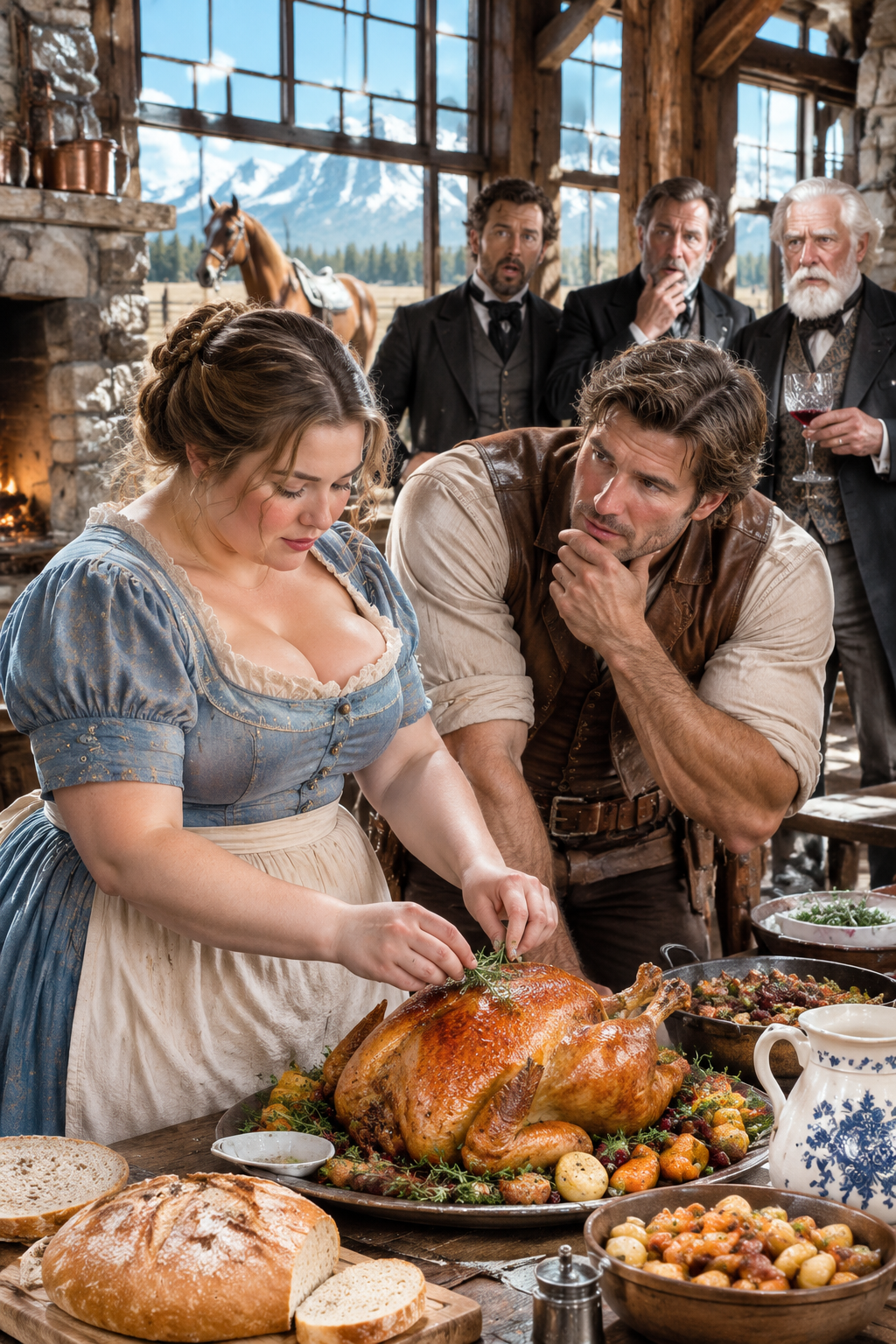
But Winnifred remembered something Amos had mentioned days earlier.
Several dozen animals had disappeared from the northern range.
Silas claimed wolves were responsible.
That afternoon, she asked Amos to accompany her to the old storage barn.
There, beneath a pile of discarded harnesses, she discovered several empty sacks bearing the stamp of the ranch’s usual supplier.
They were identical to the sacks listed as missing in the pantry accounts.
“Someone’s been receiving those deliveries,” she whispered.
Amos scratched his beard.
“Question is, where did everything go?”
Behind the barn, they found deep wagon tracks leading toward the eastern boundary.
Winnifred followed them until she reached a narrow trail disappearing through the trees.
Then she heard approaching horses.
Amos pulled her behind a stack of timber.
Silas rode past with two unfamiliar men.
“Another twenty head tomorrow night,” he told them. “Harlan wants the whole business settled before the bank takes possession.”
Winnifred covered her mouth.
One of the men laughed.
“Your boss won’t have much left by then.”
“He won’t have anything.”
When the riders disappeared, Amos turned toward her.
“Ma’am, we need to tell Gideon.”
But Winnifred knew overheard words would not be enough.
Silas had been Gideon’s trusted friend for nearly twenty years.
They needed proof.
The following morning, Gideon traveled into town to negotiate with the bank.
Winnifred used his absence to examine the delivery records again.
This time, she discovered a small folded receipt tucked inside an old invoice.
It recorded a payment from Everett Harlan to Silas Mercer for thirty cattle.
The animals carried the Rourke ranch brand.
Her hands trembled.
She placed the receipt inside her dress pocket.
At that moment, the housekeeper entered.
“Mr. Mercer wants everyone outside.”
“Why?”
“There’s been a theft.”
In the courtyard, Silas stood beside Gideon, who had returned unexpectedly.
A leather pouch rested on the porch railing.
“Found this beneath Miss Bellamy’s mattress,” Silas announced.
Gideon opened it.
Inside were nearly two hundred dollars in banknotes.
Winnifred stared at the money.
“I’ve never seen that before.”
Silas folded his arms.
“Funny how money starts disappearing the moment she arrives.”
Several workers exchanged uncertain glances.
Gideon looked at Winnifred.
“Did you take it?”
The question struck harder than any insult.
“No.”
“Then how did it get into your room?”
“Perhaps you should ask the man who found it.”
Silas shook his head.
“She had access to the office, the pantry, and every account on this property.”
Winnifred pulled the receipt from her pocket.
“And I found this.”
Gideon read it.
Silas’s face changed.
“That’s a forgery.”
“Is it?” Winnifred asked.
“She manages the books! She could have written anything.”
Gideon stood between them, visibly struggling.
Winnifred watched him hesitate.
In that hesitation, she received the answer she feared.
“You still don’t trust me,” she said.
“Winnifred, I need time to understand what’s happening.”
“Of course.”
She turned toward the house.
An hour later, her suitcase was packed.
Gideon found her waiting beside the road.
“You don’t have to leave.”
“Actually, I do.”
“I never accused you of stealing.”
“You asked me whether I had.”
“What was I supposed to do?”
“Know the difference between investigating an accusation and humiliating someone in front of forty-one men.”
He had no answer.
Winnifred looked toward the distant mountains.
“I spent most of my life trying to earn a place at somebody’s table. I thought coming here might change that.”
Her voice softened.
“But I won’t spend the rest of my life proving that I deserve basic respect.”
Amos arrived with a wagon.
Gideon watched helplessly as she climbed aboard.
For the second time, he had made her feel unwanted.
This time, she was leaving because she understood her own worth.
That night, Winnifred rented a room above the town bakery.
She had enough savings to survive for several weeks.
After that, she would find employment.
She refused to return to Ohio.
Meanwhile, Gideon sat alone in his office, staring at the accounting book she had left behind.
Every expense was carefully recorded.
Every discrepancy was marked.
On the final page, Winnifred had written a detailed plan for saving the ranch without selling the eastern pasture.
She proposed selling preserved vegetables, supplying bread to neighboring properties, and arranging a direct cattle sale with a buyer in Helena.
She had even calculated how much could be saved through better management.
Gideon slowly realized something.
While he had been worrying about losing his father’s ranch, Winnifred had been working to save it.
And he had allowed the man destroying it to drive her away.
The office door opened.
Amos stepped inside.
“You ought to hear what I saw yesterday.”
When the old cowboy finished speaking, Gideon rose from his chair.
“Why didn’t you tell me sooner?”
“Miss Bellamy wanted proof. Reckon she knew you’d have trouble believing it.”
Gideon reached for his hat.
“Where’s Silas?”
“Rode east an hour ago.”
Together, they followed the wagon tracks toward the boundary.
Beyond the trees, they discovered a hidden enclosure containing dozens of missing cattle.
Nearby stood a storage shed filled with stolen ranch supplies.
Gideon felt physically sick.
Then he heard a gun being cocked.
“Should’ve sold that pasture when I told you.”
Silas stood behind them, holding a revolver.
Gideon turned slowly.
“How long?”
“Long enough.”
“You were my father’s friend.”
“Your father was a fool. Worked himself into the grave for land worth a fortune.”
“And Harlan?”
“He pays better than you.”
Gideon clenched his fists.
“You would have destroyed forty-one families for money?”
Silas smiled coldly.
“Forty-one men can find another job.”
Before Gideon could respond, a horse galloped toward the enclosure.
It was one of the younger ranch hands.
“Fire!” he shouted. “The southern fields are burning!”
Silas’s expression faltered.
Gideon looked toward the horizon.
A dark column of smoke was rising above the ranch.
The wind was carrying it directly toward the house.
And the main cattle herd.
Silas mounted his horse and fled.
Gideon didn’t pursue him.
There were lives to save.
In town, Winnifred was helping the baker prepare bread when the church bell began ringing wildly.
A rider stopped outside.
“Rourke ranch is burning!”
Winnifred dropped the mixing bowl.
“How many men are there?”
“Nearly everyone. They’re trying to move the cattle.”
She grabbed her coat.
The baker caught her arm.
“You can’t go out there!”
“Those men have families.”
Within minutes, Winnifred had organized several townspeople, loaded wagons with water barrels, blankets, and medical supplies, and persuaded the blacksmith to bring his workers.
When they reached the ranch, the southern pasture was engulfed in flames.
The frightened cattle were charging against the fences.
Gideon was shouting instructions when he spotted Winnifred.
For a moment, he looked as though he had seen a ghost.
“What are you doing here?”
“Helping.”
She surveyed the chaos.
“Open the eastern gates. Move the cattle toward the spring.”
“The eastern trail is blocked.”
“Then break the fence.”
Gideon immediately ordered the men to follow her instructions.
Winnifred established a treatment station near the well.
She distributed wet cloths, organized water carriers, and sent riders to warn neighboring farms.
Then a young cowboy stumbled toward her.
“Amos is trapped in the stable!”
Without hesitation, Gideon ran toward the burning building.
Winnifred watched him disappear through the smoke.
Seconds passed.
Then a minute.
The roof began to crack.
“Gideon!” she screamed.
Two men rushed forward, but the heat forced them back.
Finally, Gideon emerged, dragging Amos beneath his arms.
They were only halfway across the yard when a burning beam collapsed behind them.
Gideon fell.
Winnifred and the others pulled both men to safety.
Gideon’s arm was badly burned, and he could barely breathe.
As Winnifred knelt beside him, he reached for her hand.
“You came back.”
“Don’t try to speak.”
“I thought I’d never see you again.”
She held his hand tighter.
“Then give me a reason to see you tomorrow.”
By sunrise, the fire had been contained.
Two barns were destroyed, along with miles of fencing and hundreds of acres of grass.
But every ranch hand survived.
Most of the cattle had been saved.
The house remained standing.
And Silas Mercer had been captured near the railway station after Amos’s testimony and the discovery of the stolen herd.
The sheriff also arrested Everett Harlan.
Their scheme had finally collapsed.
Three days later, Gideon received another visitor.
It was the bank manager.
Gideon expected him to demand payment.
Instead, the man placed several documents on the table.
“Miss Bellamy visited my office before the fire. She presented a rather impressive proposal.”
Gideon looked toward Winnifred.
“You did?”
She nodded.
“I thought the ranch deserved a chance, even if I wasn’t staying.”
The bank manager explained that the recovered cattle and evidence of fraud had substantially changed the situation.
The bank would restore the original payment deadline.
A cattle buyer from Helena had also agreed to inspect the herd.
For the first time in years, Gideon could see a way forward.
After the manager departed, he found Winnifred standing beside the kitchen window.
“Why did you help me after everything I did?”
She watched the men rebuilding the fence.
“Because doing the right thing shouldn’t depend on whether someone deserves your kindness.”
Gideon swallowed.
“I want you to stay.”
“As your cook?”
“No.”
“Your bookkeeper?”
He shook his head.
“As my partner. In whatever way you’re willing to accept.”
Winnifred turned toward him.
“Gideon, I won’t marry a man who needs me simply because his life is falling apart.”
“I know.”
“And I won’t be grateful merely because you’ve decided I’m worthy of being your wife.”
“I know that, too.”
He placed a document on the table.
It offered her a paid position managing the ranch’s business, with a share of its future profits.
There was no mention of marriage.
“Whatever you decide about me,” he said, “you’ve earned this.”
Winnifred read the document carefully.
Then she looked up.
“I’m keeping my room in town for now.”
Gideon smiled sadly.
“That’s fair.”
Over the following months, the ranch began to recover.
Winnifred managed its accounts, negotiated purchases, and developed a profitable business supplying bread and preserves to nearby ranches.
Gideon rebuilt the barns and introduced better safeguards for the cattle.
He also began visiting Winnifred every Sunday.
Sometimes he brought flowers.
Sometimes books.
Occasionally, he brought nothing except himself and a willingness to listen.
He learned that she loved thunderstorms, disliked bitter coffee, and dreamed of owning a home with yellow curtains.
She learned that he was surprisingly gentle with injured animals and terribly afraid of disappointing the people who depended on him.
Little by little, affection replaced their uncomfortable beginnings.
One snowy evening, almost a year after Winnifred’s arrival, Gideon invited her to supper at the ranch.
When she entered the dining room, forty-one men rose from their chairs.
Amos stepped forward.
“Ma’am, we’ve got something for you.”
He presented her with a beautifully carved wooden sign.
BELLAMY & ROURKE RANCH.
Winnifred stared at it.
Gideon stood beside the fireplace.
“The papers are ready,” he said. “Half the business is yours, if you want it.”
Her eyes filled with tears.
Then he approached her, holding a small velvet box.
“And there’s something else I’d like to ask.”
The room became silent.
He lowered himself onto one knee.
“Winnifred Bellamy, I cannot promise that life with me will always be easy. But I can promise that you’ll never have to make yourself smaller to fit into it.”
He opened the box.
“Will you marry me?”
Winnifred looked around the room.
She remembered the woman who had arrived with a battered suitcase, believing she needed somebody else’s permission to belong.
That woman had traveled two thousand miles searching for a home.
Along the way, she had discovered something more important.
She could build one herself.
Winnifred smiled.
“Yes, Gideon.”
The dining room erupted in cheers.
They married the following spring beneath a flowering apple tree.
Years later, travelers passing through Montana often heard stories about the remarkable woman who had saved the Rourke ranch.
Some said she was the finest cook in the territory.
Others praised her intelligence, courage, and generosity.
But Gideon always told the story differently.
He told people about the day a woman stepped down from a wagon carrying everything she owned, and how he had been too foolish to recognize the treasure standing before him.
Winnifred never encouraged him to hide that part.
She believed mistakes could become valuable lessons when people had the courage to acknowledge them.
Their ranch prospered, and no hungry traveler was ever turned away from its kitchen.
Above the dining room door hung a small sign Winnifred had written herself.
“There is always room at this table.”
And whenever Gideon watched his wife welcoming strangers into their home, he remembered the words he had spoken on the worst day of his life.
Another mouth to feed.
How little he had understood then.
The woman he had once considered a burden had become his greatest blessing.
Not because she had saved his ranch.
Not because she had filled his pantry or restored his fortune.
But because she had taught him that the true measure of a person was never their appearance, their possessions, or even what they could do for others.
It was the goodness they carried within them.
And Winnifred, who had once believed she needed to earn her place in the world, finally understood that her worth had never been something anyone else could give her.
It had belonged to her all along.
Seven years later, on a cold November morning, a wagon stopped outside the Bellamy & Rourke ranch.
Winnifred was teaching her six-year-old daughter, Clara, how to make biscuits when someone knocked on the kitchen door.
A young woman stood outside, holding a sleeping infant against her chest.
Her dress was torn, her shoes were worn through, and her face was pale with exhaustion.
“I’m sorry to bother you, ma’am,” she whispered. “Someone in town said you might have work.”
Winnifred immediately opened the door wider.
“Come inside before you freeze.”
The woman hesitated.
“I have a baby. Most people won’t hire me because of him.”
“Then we’ll find somewhere warm for both of you.”
Winnifred prepared a bowl of soup while Clara fetched a blanket.
The young woman’s name was Margaret. Her husband had died in a mining accident, leaving her with nothing but unpaid debts.
For three months, she had traveled from town to town, begging for employment.
Nobody wanted the responsibility of a woman with a child.
“I don’t eat much,” Margaret promised desperately. “And I can work from sunrise until midnight.”
Winnifred set down her spoon.
“You won’t have to starve yourself to convince me you’re worth feeding.”
Margaret began to cry.
Gideon entered moments later, carrying firewood.
When he saw the stranger, he quietly placed another log on the fire.
“Have we prepared the spare room?” he asked his wife.
“Clara is getting the blankets.”
“Good. I’ll bring up her belongings.”
Margaret stared at him.
“You don’t even know me.”
Gideon smiled gently.
“Someone once traveled a very long way to reach this house. I made the mistake of judging her before I knew her. I don’t intend to make that mistake again.”
Winnifred looked at her husband with quiet affection.
He had changed more than either of them could have imagined.
But their peaceful life was about to face one final test.
Two days later, a letter arrived from Ohio.
Winnifred recognized the handwriting immediately.
It belonged to her uncle, Arthur Bellamy.
The man who had arranged her marriage.
The man who had spent years reminding her that no respectable husband would ever want a woman like her.
She opened the envelope with trembling fingers.
Arthur was bankrupt.
His business had failed, his property had been seized, and his health was deteriorating.
He had heard about her prosperous ranch and wanted financial assistance.
Gideon read the letter over her shoulder.
“After everything he did to you, he has the nerve to ask for money?”
Winnifred folded the letter.
“He’s still my uncle.”
“That doesn’t mean you owe him anything.”
“I know.”
For several days, she considered what to do.
Then she received a second letter.
Arthur was coming to Montana.
He arrived the following week, wearing an expensive coat that had seen better days.
When Winnifred stepped onto the porch, he barely recognized her.
“Well,” he said, examining the enormous ranch house. “You certainly managed to marry better than I expected.”
Gideon’s expression hardened.
Winnifred remained calm.
“Come inside, Uncle Arthur.”
At supper, Arthur spoke endlessly about his former business, his unfortunate investments, and the people he blamed for his downfall.
Then he turned toward Gideon.
“You should be grateful to me. Without my arrangements, you never would have found yourself a wife.”
Gideon placed his fork on the table.
“I am grateful Winnifred came here. But I owe that gratitude to her.”
Arthur laughed.
“Believe me, I did you both a favor. Finding a husband for a woman of her proportions wasn’t easy.”
The dining room fell silent.
Clara looked up from her plate.
“What’s wrong with Mama?”
Arthur appeared uncomfortable.
“Nothing, child. It’s just that your mother was never particularly fashionable.”
Clara frowned.
“My mama is the most beautiful woman in Montana.”
Gideon smiled.
“I happen to agree.”
Winnifred reached for her daughter’s hand.
Arthur cleared his throat and changed the subject.
Later that evening, he presented Winnifred with a document.
It was a request for five thousand dollars.
“With your husband’s resources, surely that’s a modest sum.”
Winnifred examined the document.
“It’s a considerable amount.”
“You wouldn’t refuse your own family, would you?”
She looked directly at him.
“Do you remember what you told me when I left Ohio?”
Arthur shrugged.
“You said that if Gideon rejected me, I shouldn’t bother coming home.”
He shifted uneasily.
“I was trying to prepare you for reality.”
“No. You were trying to convince me that I had nowhere else to go.”
For once, Arthur had nothing to say.
Winnifred placed the document on the table.
“I will pay for your medical treatment. You may stay in our guest room until you recover. And if you’re willing to work, we’ll find something suitable for you.”
His face reddened.
“You expect me to work on your ranch?”
“I expect you to take responsibility for your future.”
“After everything I sacrificed for you?”
Winnifred rose from her chair.
“Helping someone doesn’t mean allowing them to mistreat you.”
Arthur stared at her.
The timid young woman he remembered was gone.
In her place stood someone who no longer needed his approval.
The following morning, he accepted her offer.
It wasn’t gratitude that persuaded him.
It was the realization that he had nowhere else to turn.
Over the winter, Arthur slowly recovered.
Winnifred assigned him a modest position managing correspondence under her supervision.
At first, he complained constantly.
But as the weeks passed, something unexpected happened.
He began watching the people around him.
He saw Margaret become a skilled seamstress.
He watched former ranch hands become respected managers.
He witnessed Gideon consulting his wife before making important decisions.
And he noticed that nobody laughed at Winnifred’s appearance.
Nobody questioned her authority.
People respected her because she treated them with dignity.
One afternoon, Arthur found her in the kitchen, preparing a birthday cake for Clara.
He stood silently in the doorway.
“Your mother would have been proud of you,” he finally said.
Winnifred stopped stirring.
Arthur lowered his head.
“I wasn’t kind to you after she died.”
“No, you weren’t.”
“I suppose I thought the world would be cruel to you, so I tried to make you understand that.”
“You didn’t protect me from cruelty, Uncle Arthur. You became part of it.”
His eyes filled with tears.
“I’m sorry.”
Winnifred studied his face.
For years, she had imagined hearing those words.
She had believed they might repair every wound he had left behind.
But now she understood that her happiness no longer depended on his apology.
“Thank you,” she answered.
Then she handed him a bowl.
“Would you like to help with the cake?”
Arthur nodded.
It was a small beginning.
But sometimes, a small beginning was enough.
Many years passed.
The Bellamy & Rourke ranch became one of the most successful properties in the region.
Winnifred established a boardinghouse in town for women who needed employment and a safe place to live.
Margaret eventually became its manager.
Clara grew into a confident young woman who inherited her mother’s determination and her father’s love of the land.
Amos lived long enough to see her marry beneath the same apple tree where her parents had exchanged their vows.
When he passed away peacefully at the age of eighty-three, every ranch hand attended his funeral.
Winnifred placed wildflowers beside his grave.
They were the same kind he had brought her during those difficult first weeks.
By then, Gideon’s hair had turned silver.
His hands were rough from decades of ranch work, and Winnifred’s face carried the gentle lines of a life filled with laughter.
One summer evening, they sat together on the porch, watching their grandchildren chase butterflies across the garden.
Gideon reached for his wife’s hand.
“Do you ever regret coming here?”
Winnifred smiled.
“Sometimes I regret not throwing my suitcase at you that first morning.”
He burst into laughter.
“I would’ve deserved it.”
“You certainly would have.”
He grew quiet.
“I still wish I could change what I said to you.”
Winnifred rested her head against his shoulder.
“You cannot change the man you were that day, Gideon. But you’ve spent your life choosing to become a better one.”
He kissed her forehead.
Inside the house, their family was preparing supper.
The kitchen smelled of fresh biscuits and apple pudding.
A knock sounded at the front door.
A weary traveler stood outside, asking whether there was somewhere nearby to purchase a meal.
Before Gideon could answer, one of their grandchildren called from the dining room.
“Grandma says there’s always room for one more!”
Winnifred smiled.
“Bring him inside, sweetheart.”
As the family gathered around the enormous wooden table, Gideon looked at the woman beside him.
He remembered the empty pantry, the unpaid bills, the burning fields, and the terrible loneliness that had once filled this house.
Now it was overflowing with life.
Not because Winnifred had arrived carrying wealth or beauty that everyone immediately recognized.
But because she had possessed something far more valuable.
The courage to remain kind without surrendering her dignity.
The strength to forgive without forgetting her worth.
And the wisdom to understand that love should never require a person to become smaller.
Winnifred had traveled two thousand miles hoping someone would accept her.
Instead, she had built a place where countless others could finally feel accepted.
And long after she and Gideon were gone, their children and grandchildren continued welcoming strangers beneath the little wooden sign above the dining room door.
Its words never changed.
“There is always room at this table.”
For the greatest fortune Winnifred Bellamy had left behind was not the land, the cattle, or the prosperous business bearing her name.
It was the understanding that every human being deserves a place in this world where they are welcomed, respected, and loved without first having to prove that they deserve it.
And that was a legacy no amount of money could ever buy.
THE END.