I had barely stepped off the stagecoach at Black Ridge Ranch when Ethan Callaway looked me over coldly and said, “You’re not the cook I ordered”—but someone had lied to both of us.
I knew that dress.
My mother had sewn it herself, using ivory silk salvaged from a wealthy woman’s discarded curtains. I remembered the tiny pearl buttons running down the front, the embroidered roses along the sleeves, and the blue ribbon she had hidden beneath the collar for good luck.
But the woman in the photograph was not my mother.
At least, I prayed she wasn’t.
Her face was partly concealed by the shadow of the porch, yet something about her posture made my blood turn cold.
She stood with one hand resting against her stomach, the other gripping my father’s arm.
And around her neck hung a silver locket I had buried with Mama.
“Clara?” Ethan whispered.
I could not answer.
I turned the photograph toward the lamplight, searching for some mistake, some reasonable explanation.
Then I noticed the date scratched into its lower corner.
October 17, 1882.
My mother had died in February of 1881.
For several moments, the only sound in the kitchen was the wind beating against the windows.
“Whoever sent this wants us frightened,” Ethan said.
“Then they’ve succeeded.”
Henry rose slowly, his expression twisted with something I had never seen on his weathered face.
Recognition.
“That’s not your mother,” he murmured.
I grabbed his sleeve.
“Then who is she?”
He stared at the photograph before answering.
“Her name is Margaret Vale. And if she’s wearing your mother’s wedding dress, then Samuel’s worst fears have come true.”
Ethan moved toward the door.
“We’re going to the smokehouse.”
Henry caught his arm.
“Not tonight.”
“Someone is watching my ranch, leaving threats on my doorstep, and frightening the woman under my protection. Give me one good reason to wait.”
Henry’s voice dropped.
“Because Margaret Vale was buried three months ago.”
A terrible silence followed.
Then, somewhere beyond the barn, a rifle cracked.
The kitchen window shattered.
Ethan threw himself against me, driving us both to the floor as glass scattered across the table.
A second shot struck the wall above Henry’s head.
“Stay down!” Ethan shouted.
He crawled toward the doorway with his rifle while Henry dragged a heavy cupboard across the broken window.
I lay on the floor, trembling with anger more than fear.
Whoever had brought me to Black Ridge had not merely uncovered my family’s past.
They were trying to bury it again.
Ethan returned several minutes later, his face grim.
“Rider’s gone. Ben found fresh tracks leading toward the eastern ravine.”
“Was anyone hurt?”
“No.”
His eyes fell upon the photograph still clutched in my hand.
“But whoever fired those shots knew exactly where we were standing.”
That night, Ethan ordered two men to guard the house.
He also insisted I sleep in the upstairs bedroom nearest his study.
I objected.
He looked exhausted.
“Clara, please. Just this once, let someone protect you.”
There was something in his voice that made me stop arguing.
I had survived years by depending upon nobody.
Accepting protection felt more frightening than facing winter alone.
Nevertheless, I nodded.
Before dawn, I woke to the sound of footsteps outside my door.
I reached for the iron poker Ethan had left beside my bed.
Then came three quiet knocks.
“Clara,” Henry whispered. “There’s something you need to see before Ethan wakes.”
I opened the door cautiously.
Henry held a narrow leather journal against his chest.
“Found it beneath Samuel’s old saddle. I should have given it to Ethan years ago.”
“Why didn’t you?”
His eyes glistened.
“Because cowardice can disguise itself as loyalty for a mighty long time.”
We sat beside the dying fire while I opened the journal.
The first pages contained cattle purchases, grain shipments, and wages.
Then the handwriting changed.
Names appeared beside enormous sums of money.
Railroad executives.
Territorial officials.
A banker named Victor Harrow.
And, written repeatedly in the margins, my father’s name.
Thomas Whitmore.
Beside one entry, Samuel had written:
The land deeds are forged. Thomas has discovered everything. If Harrow learns what we know, none of us will survive.
My hands went numb.
“What land deeds?”
Henry stared into the fireplace.
“Black Ridge isn’t just a cattle ranch, Miss Clara. Twenty years ago, this entire valley belonged to twelve homesteading families. Harrow’s company claimed they’d abandoned their properties.”
“But they hadn’t?”
“Some hadn’t. Others were driven away. Three men were killed when they refused to sign.”
I turned another page.
There, carefully folded, was a drawing of the valley.
A red line marked a narrow mountain passage.
Beneath it were two words.
Silver Creek.
Henry leaned closer.
“Silver was discovered up there. Enough to make greedy men forget they ever possessed souls.”
“And my father?”
“He was a surveyor. Harrow hired him to measure the land before the railroad arrived. Thomas found proof the deeds were false.”
I swallowed.
“Why didn’t he tell anyone?”
“He tried.”
Henry’s voice broke.
“That’s when your mother became involved.”
Before he could explain, a floorboard creaked behind us.
Ethan stood in the doorway.
He looked from Henry to the journal.
Then he said something that changed everything.
“I’ve seen that book before.”
Henry stiffened.
“Where?”
“In the hands of the man who tried to buy Black Ridge last spring.”
“Victor Harrow?” I asked.
Ethan shook his head.
“No. His son, Daniel.”
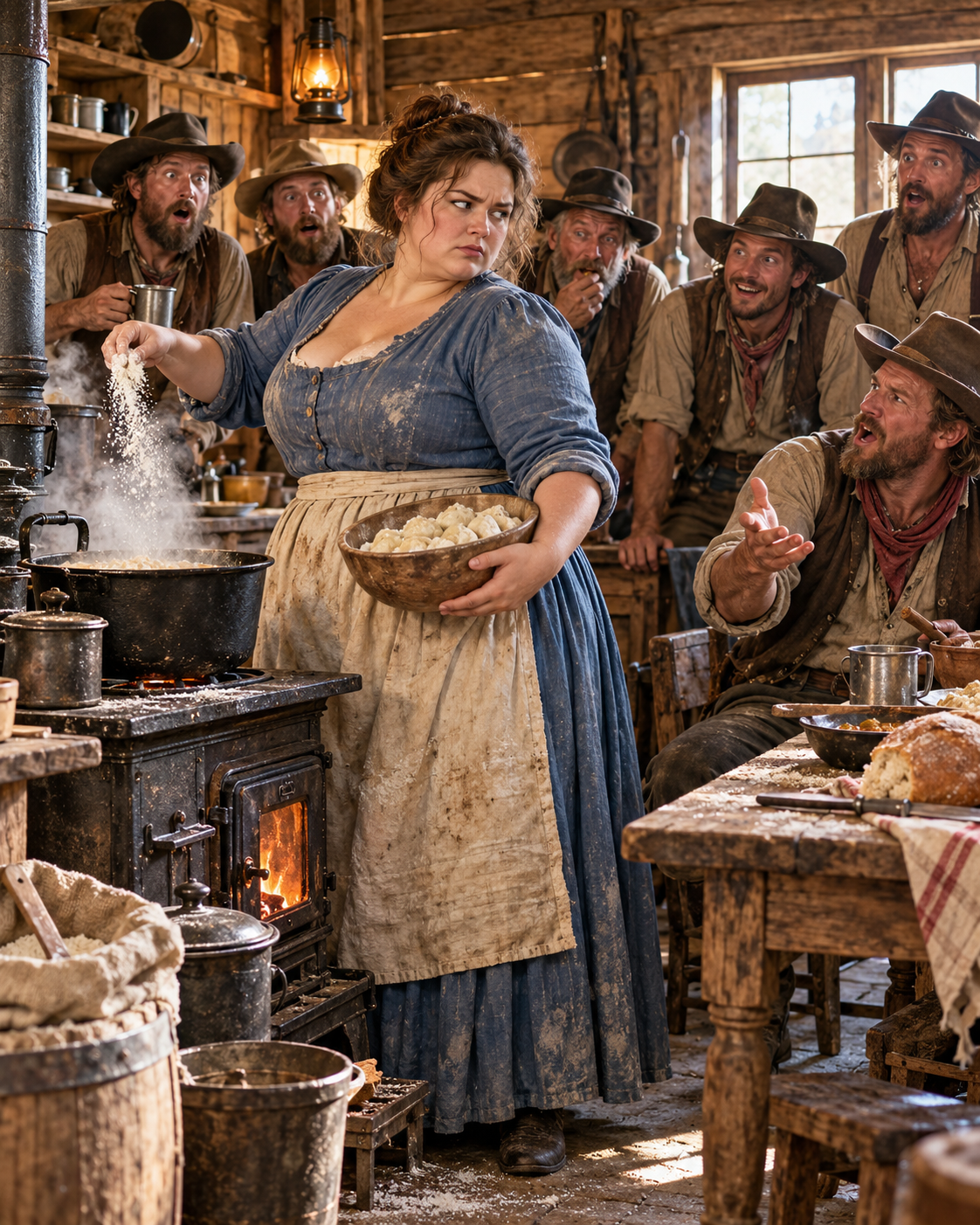
Henry’s face went white.
“Daniel Harrow is alive?”
Ethan nodded.
“He came here offering more money than this ranch has ever earned. When I refused, our cattle started disappearing. The bank called in our loan. Then our cook received a letter promising him twice his wages if he left.”
I remembered the empty cupboards, the starving ranch hands, the mysterious advertisement that had brought me across the country.
“Someone wanted Black Ridge abandoned,” I whispered.
“Or sold,” Ethan answered.
Henry slowly closed his eyes.
“Then Samuel didn’t die for nothing. There’s still time.”
I stood.
“Open the smokehouse.”
Neither man argued.
The morning was gray and bitter when we crossed the yard.
Snow lay deep against the abandoned smokehouse, its roof sagging beneath years of neglect.
Ethan carried a lantern and rifle.
Henry carried the brass key.
I carried my father’s letter.
Inside, beneath a pile of broken barrels, we discovered an iron ring set into the floor.
Ethan pulled.
A trapdoor rose with a groan.
Cold air drifted upward, smelling of earth and old wood.
Stone steps descended into darkness.
At the bottom stood a heavy oak door with a brass lock.
Henry’s fingers shook so badly he could scarcely fit the key.
When the lock finally turned, I felt as though the entire world had stopped breathing.
The room beyond was small.
There were shelves of documents, a wooden desk, and a narrow bed.
On the wall hung photographs of families standing before modest frontier homes.
Someone had crossed their faces out with black ink.
Then I saw the trunk.
My father’s initials were carved into its lid.
T.W.
I fell to my knees and opened it.
Inside lay his surveying tools, a pair of spectacles, and a blue wool scarf I had knitted when I was sixteen.
I pressed it against my face.
For a moment, I was a girl again, watching Papa leave for work while Mama stood beside the stove.
Then Ethan spoke.
“Clara. Look at this.”
He held a folded newspaper dated November 1883.
The headline announced the death of a federal land investigator near Helena.
Beneath it was a photograph.
My father’s face stared back at me.
Not a memory.
Not a resemblance.
My father.
Older than when I buried him, with silver at his temples and a scar beneath his eye.
The room tilted.
I clutched the edge of the trunk.
“He was alive.”
Ethan knelt beside me.
“Clara—”
“He was alive all this time.”
I wanted to scream.
I wanted to weep.
I wanted to find him and demand why his daughter had spent two years believing herself an orphan.
Then I noticed the newspaper’s date.
November 5, 1883.
Two days after the letter.
The article reported that the investigator, traveling under the name Jonathan Reed, had been found dead after a carriage accident.
But someone had written across the bottom:
Not dead. Taken to the old mine.
My heart leaped.
“He could still be alive.”
Henry read the message, then looked toward the stairs.
“We need to leave.”
A voice answered from above.
“I’m afraid that won’t be possible.”
Daniel Harrow stood at the top of the staircase.
He was younger than I expected, perhaps thirty-five, with polished boots and a handsome face that seemed incapable of kindness.
Two armed men stood behind him.
Ethan raised his rifle.
Daniel smiled.
“Careful, Callaway. I’ve already placed men around your house.”
“Get off my property,” Ethan growled.
“Your property?”
Daniel laughed softly.
“That’s the very question we’re here to settle.”
He descended the stairs.
His gaze found me.
“Miss Whitmore. At last.”
I gripped my father’s scarf.
“You brought me here.”
“Of course. Your father refused to tell us where he’d hidden the original survey. We assumed his daughter might know.”
“I knew nothing.”
“I understand that now.”
He glanced at the open trunk.
“But you proved remarkably useful.”
Ethan stepped in front of me.
Daniel lifted his pistol.
“One more movement, and the lady watches you die.”
Henry looked suddenly older than I had ever seen him.
“Your father started this, Daniel. Don’t finish it.”
Daniel’s expression hardened.
“My father built everything this valley possesses.”
“Your father stole everything this valley possessed,” I answered.
He looked at me with cold amusement.
“You sound just like Thomas.”
My breath caught.
“Where is he?”
Daniel hesitated.
Just once.
But it was enough.
“He’s alive,” I whispered.
Daniel’s smile disappeared.
“Not for much longer.”
He ordered his men to bind Ethan and Henry.
When one approached me, Daniel raised a hand.
“Leave her. She’ll come willingly.”
“Why would I?”
“Because I know where your mother is buried.”
The words struck me speechless.
He leaned closer.
“And I know why the grave you visited in Boston never held her body.”
I followed him.
Not because I trusted him.
Because I had spent too many nights mourning people whose stories had never been properly told.
Daniel forced us into a wagon and drove toward the eastern mountains.
Snow thickened as we climbed.
The ranch disappeared behind dark pines.
After nearly two hours, we reached an abandoned silver mine surrounded by weathered cabins.
Smoke rose from one chimney.
Outside the largest building, a woman stood waiting.
She wore a dark cloak.
A silver locket rested against her throat.
My mother’s locket.
The woman stepped forward.
Her face was narrow and pale, with troubled brown eyes.
She looked exactly like the shadowed figure in the photograph.
“Clara,” she whispered.
I stopped breathing.
Not because she resembled Mama.
But because she spoke my name with the familiarity of someone who had whispered it over my cradle.
“Who are you?”
Tears filled her eyes.
“My name is Margaret Vale.”
Daniel seized her arm.
“Enough.”
Margaret pulled free.
“You promised she wouldn’t be harmed.”
“And you promised to bring me the survey.”
Margaret looked at me desperately.
“Your mother didn’t die of fever, Clara. She was poisoned.”
I felt the world fall away beneath my feet.
“Who poisoned her?”
Margaret turned toward Daniel.
“His father.”
Daniel’s hand moved toward his pistol.
Then a voice emerged from the cabin.
“Leave my daughter alone.”
I knew that voice.
A thousand memories had kept it alive.
It had read stories beside our fireplace.
It had sung hymns when Mama was ill.
It had whispered that brave people were not those without fear, but those who chose what was right despite it.
“Papa?”
A man appeared in the doorway, leaning heavily upon a cane.
His hair was nearly white.
His face was thin.
But his eyes were my father’s.
For one suspended moment, neither of us moved.
Then I ran.
He caught me with trembling arms.
“My little Clara.”
I buried my face against his coat and wept with all the grief I had carried for two endless years.
He held me as though I were still a child.
“I’m sorry,” he whispered. “I’m so terribly sorry.”
I pulled back.
“Why?”
His expression crumpled.
“Because I believed disappearing was the only way to keep you alive.”
Before he could continue, Daniel dragged us apart.
“Touching reunion. Now tell me where the survey is.”
Papa looked at him calmly.
“Burning my house didn’t find it. Killing my wife didn’t find it. Locking me in this mine hasn’t found it.”
Daniel’s face twisted.
“Your wife had evidence you refused to surrender.”
“She died protecting the names of twelve innocent families.”
Margaret stepped between them.
“Daniel, please.”
He struck her across the face.
I lunged toward him, but Ethan caught my arm.
Daniel pointed his pistol at Papa.
“The survey. Now.”
I suddenly understood something.
My father had been captured.
The letter had been sent to Black Ridge.
The hidden food, the advertisement, even the photograph had been arranged to bring me into the mystery.
But not everyone involved had the same purpose.
I looked at Margaret.
“You sent the advertisement.”
She nodded faintly.
“And the photograph?”
“Yes.”
“Why?”
“Because your mother saved my life. And I couldn’t bear watching her daughter remain in darkness.”
Daniel turned on her.
“You betrayed me?”
Margaret met his fury without flinching.
“I stopped obeying you.”
He raised his pistol.
A deafening shot tore through the mountain air.
Margaret collapsed.
For an instant, everything became chaos.
Ethan slammed into Daniel, throwing him against the wagon.
Henry struck one guard with his bound hands.
The second guard fired wildly.
I dropped beside Margaret.
Blood spread across her shoulder.
“Stay with me,” I begged.
She gripped my wrist.
“Your mother knew.”
“Knew what?”
Margaret’s breathing grew shallow.
“She knew Samuel had hidden the proof where nobody would think to look.”
“Where?”
Her eyes moved toward my father’s scarf.
“The thing made with love.”
I stared at the blue wool in my hands.
The scarf.
Papa had kept it for years.
Then I remembered how Mama had taught me to knit.
Every seventh row, she had insisted upon a different stitch.
I had complained that the pattern looked strange.
She had smiled.
“Someday, Clara, you’ll understand that even mistakes can carry meaning.”
I turned the scarf over.
Along its edge ran an uneven pattern of knots.
Not decoration.
A code.
A sequence of numbers.
I recognized them from Papa’s surveying lessons.
They were bearings.
Directions.
And they pointed toward Black Ridge.
A gunshot cracked again.
Daniel staggered backward, blood staining his sleeve.
Ethan stood over him with the pistol he had wrestled away.
“Enough,” Ethan said.
But Daniel was already reaching for the rifle lying near the wagon.
Papa pushed me aside.
The rifle fired.
My father collapsed against me.
“No!”
I caught him before his head struck the frozen ground.
Blood soaked his shirt.
I pressed my hands against the wound.
“Papa, stay with me.”
He looked into my face.
“Listen carefully, sweetheart.”
“No. You’re coming home.”
His hand closed around mine.
“Your mother and I made terrible choices trying to keep you safe.”
“Then help me understand them.”
His eyes filled.
“I loved you more than my own life. But love without truth left you alone.”
I shook my head.
“Don’t say goodbye.”
He smiled faintly.
“I’m not asking you to forgive me today.”
Then his eyes closed.
For one terrible moment, I thought I had lost him again.
Ethan knelt beside us.
“He’s breathing.”
I almost collapsed with relief.
“Can we save him?”
“We can try.”
Henry had subdued the remaining guard.
Daniel lay unconscious beside the wagon.
Margaret was still alive.
We had no doctor.
No clean bandages.
And a storm was closing the mountain road.
I looked at Ethan.
“Get everyone inside.”
He hesitated.
“Clara—”
“I’ve spent half my life keeping people alive with whatever I had. I’m not stopping now.”
Inside the cabin, I boiled water, tore clean strips from my petticoat, and used the whiskey Henry found to clean what wounds I could.
Papa’s bullet had passed through his side.
Margaret’s shoulder was badly injured.
Neither was safe.
The storm raged for two days.
During those long hours, Ethan stayed beside me, carrying water, feeding the fire, and changing bandages whenever my hands grew too tired.
At one point, I found him standing beside Papa’s bed.
“You don’t owe this man anything,” he whispered.
I understood.
Papa had abandoned me, whatever his reasons.
I looked at his sleeping face.
“Maybe not. But I don’t want the rest of my life decided by what somebody else failed to give me.”
Ethan took my hand.
His palm was rough and warm.
“Then you’ve already become stronger than the people who hurt you.”
On the third morning, the storm broke.
Papa opened his eyes.
And for the first time since childhood, he asked me for breakfast.
I laughed until I cried.
We returned to Black Ridge with the wounded, our prisoners, and the knowledge that Daniel’s father would stop at nothing to destroy us.
But Victor Harrow had underestimated one thing.
He believed hungry, frightened people were easy to control.
He had never seen what happened when those people finally had something worth defending.
At Black Ridge, the ranch hands gathered around our table.
I spread Papa’s scarf beside Samuel’s journal.
Ethan brought out the old surveying map.
Together, we followed the coded bearings.
They led beneath the kitchen.
Not merely beneath the loose pantry plank.
Deeper.
Behind the stone foundation of the stove.
Ethan and Henry worked for hours, prying away bricks until a narrow cavity appeared.
Inside rested a sealed copper box.
Its contents changed everything.
There were original deeds bearing the signatures of twelve homesteaders.
Maps proving Harrow’s company had falsified property boundaries.
Letters describing bribes paid to territorial officials.
And a sworn statement written by Samuel Callaway, admitting that he had helped cover up the fraud before discovering the murders.
At the bottom lay a letter addressed to me.
It was written in my mother’s familiar hand.
My dearest Clara,
If these papers ever reach you, I pray you will understand why we could not tell you the truth. I thought hiding the evidence would save the families whose homes were stolen. I never imagined it would place you in danger.
Remember what I taught you when you were small. A home is not something powerful men can grant or take away. It is something people build when they choose to care for one another.
You have always been my bravest girl.
Use the truth wisely.
And never believe that love requires you to suffer in silence.
Your loving Mama.
I read the letter three times.
Then I folded it carefully against my heart.
For the first time, I understood that Mama had not merely been a gentle woman who cooked, sewed, and tended our little garden.
She had been brave.
And frightened.
And willing to stand against powerful men.
But courage had cost her dearly.
I decided it would not cost another innocent person their life.
Ethan arranged for two trusted ranch hands to ride to Helena with copies of the evidence.
The originals remained hidden.
Papa insisted upon adding his testimony, though he was barely strong enough to hold a pen.
Margaret confessed to helping Samuel move the documents years earlier.
She also admitted that Daniel had forced her into the photograph, using Mama’s stolen dress and locket to frighten Papa into surrendering the survey.
The locket had been taken from Mama before her burial.
Her grave in Boston was real.
The coffin had held her body.
Only my father’s coffin had been empty.
It hurt to learn how many lies had been built around my grief.
Yet knowing the truth brought a strange peace.
Three weeks later, federal marshals arrived.
Victor Harrow was arrested in Helena after attempting to bribe a witness.
Daniel faced charges for kidnapping, assault, and the shootings at the mine.
Several officials who had accepted Harrow’s money were removed from their positions.
The legal battle over the stolen land continued long after the arrests, but the surviving homesteading families finally had proof of what had been done to them.
Black Ridge was not spared every consequence.
Ethan discovered that Samuel’s wrongdoing had left legitimate claims against portions of the ranch.
He could have fought the families in court for years.
Instead, he invited them to our dining room.
I cooked enough beef stew and fresh bread for twenty people.
At first, nobody spoke comfortably.
Some remembered Samuel as the man who had helped steal their homes.
Others regarded Ethan with suspicion.
Finally, Ethan stood.
“My uncle did terrible things,” he said. “I cannot undo them. But I can refuse to profit from them.”
He placed the deeds on the table.
Then he offered to return the disputed acreage, establish shared grazing rights, and help rebuild the homes that had been destroyed.
One elderly woman began to cry.
Her husband had died believing their land was lost forever.
She reached across the table and took Ethan’s hand.
“Your uncle took twenty years from us,” she whispered. “But maybe you can give our grandchildren a different future.”
That evening, after everyone had gone, Ethan found me washing dishes.
“You should rest,” he said.
“So should you.”
He smiled.
Then his expression grew serious.
“Clara, there’s something I’ve been wanting to ask you.”
My heart began behaving foolishly.
He looked down at his hands.
“When you arrived, I saw only another complication. Someone I hadn’t requested, brought here by circumstances I didn’t understand.”
“I remember.”
“I was wrong.”
I dried my hands slowly.
“You weren’t entirely wrong. I was a complication.”
He laughed.
“The finest one I’ve ever had.”
Then he stepped closer.
“I don’t want you to stay because you need employment. And I don’t want you to stay because your father is recovering here.”
My breath caught.
“Why do you want me to stay?”
“Because somewhere between your first pot of beans and the day you stood against Daniel Harrow, this house became a home.”
His voice softened.
“And every time I imagine tomorrow, you’re in it.”
I had waited years to hear someone say they wanted me to remain.
Yet I found myself afraid.
“What if I disappoint you?”
“You will.”
I stared at him.
He smiled gently.
“And I’ll disappoint you. We’ll argue about the chickens and the accounts and whether the north fence needs repairing before winter.”
“Probably.”
“But I don’t want a perfect woman, Clara. I want the woman who found supper in an empty pantry and courage in a room full of enemies.”
Tears blurred my vision.
“I spent so long believing I was too much,” I whispered. “Too tall. Too broad. Too stubborn. Too difficult to love.”
Ethan took both my hands.
“Then perhaps you’ve spent too long listening to people who never knew what love was.”
He did not ask me to become smaller.
He did not promise life would become easy.
He simply stood before me, offering a future neither of us would have to face alone.
And when he kissed me, I felt something inside my heart finally come home.
We married the following spring beneath the great cottonwood behind the ranch.
Papa walked beside me, slowly but proudly, carrying the cane he would need for the rest of his life.
Margaret, her shoulder healed, stood among the guests.
Henry cried openly and pretended the wind had gotten into his eyes.
The homesteading families brought pies, preserves, and flowers gathered from the first green meadows.
Our wedding feast stretched from the kitchen to the barn.
Nobody went hungry.
Nobody was turned away.
In the years that followed, Black Ridge became known for more than cattle.
We opened a small schoolhouse for the children of the valley.
Papa taught surveying and mathematics when his health permitted.
Margaret helped establish a cooperative store so struggling families would not depend upon dishonest lenders.
Henry lived long enough to teach our first son how to saddle a horse, although he insisted the boy had inherited my stubbornness.
Ethan and I had difficult seasons.
There were droughts, lost cattle, arguments, and nights when worry kept us awake.
But we never allowed silence to become the hiding place of our fears.
And every November, on the anniversary of my arrival, I made the same humble supper.
Beans.
Corn cakes.
Stewed apples.
Our children never understood why their mother treasured such ordinary food.
One year, our daughter asked why I served it when the pantry was full of better things.
I sat beside her and told her the story.
Not only about the hidden deeds, the abandoned mine, or the dangerous men who believed money could purchase the truth.
I told her about a frightened woman stepping off a stagecoach with one battered suitcase.
A woman who believed she had nothing left to offer except the work of her hands.
And a lonely rancher who had forgotten what it meant to welcome someone.
Then I explained that the greatest discovery at Black Ridge had not been silver, stolen land, or even the truth about my father.
It had been something much simpler.
People are not valuable because they are beautiful, wealthy, powerful, or easy to love.
They are valuable because they are human.
Because they can choose kindness when cruelty would be easier.
Because they can tell the truth when lies would protect their comfort.
And because, even after losing everything, they can still build something good.
Years later, I kept Mama’s letter in a wooden box beside my father’s old scarf.
Whenever hardship came, I remembered her words.
A home is something people build when they choose to care for one another.
I had arrived at Black Ridge believing I had been sent to fill an empty position.
But I had been led there by secrets, betrayal, unfinished promises, and a mother’s courage.
Those things explained why I had come.
They did not explain why I stayed.
I stayed because Ethan learned to trust.
Because Papa learned that love without honesty was not enough.
Because frightened men found the courage to admit their wrongs.
And because I finally understood that belonging did not mean making myself smaller so others would have room.
It meant finding people who welcomed all that I was.
On my wedding anniversary many years later, Ethan stood beside me on the porch as the evening sun turned the Montana mountains gold.
Our grandchildren were laughing inside.
The kitchen smelled of bread.
He wrapped his arm around my waist and smiled.
“Do you remember what I said when you first arrived?”
I leaned against him.
“Every word.”
He shook his head regretfully.
“You’re not the cook I ordered.”
I laughed softly.
“No, Ethan. I wasn’t.”
He kissed my forehead.
“Thank God for that.”
And as I watched the lights glowing through the windows of the home we had built together, I realized something I wished I could tell the lonely woman who had stepped down from that stagecoach so many years before.
Sometimes the door that opens for us is not the one we expected.
Sometimes it opens because of someone else’s mistakes, secrets, or desperate hopes.
But what we do after stepping through that door belongs to us.
I had come to Black Ridge to earn my bread.
Instead, I found the truth about my family, the courage to forgive without forgetting, and a love that never asked me to be anyone but myself.
And if my life taught me anything, it was this:
The people who truly belong in your life will never make you feel ashamed of the space you occupy.
They will pull another chair to the table.
They will make room.
And when winter comes, they will help you keep the fire burning.
THE END.