“I didn’t order a woman built like a workhorse,” Warren Pike said, loud enough for everyone at the station to hear.
“Warren Pike.”
Jonah stared at the signature.
“Are you certain?”
Rebecca reached into her suitcase and withdrew a bundle of letters tied with blue ribbon.
“He wrote to me for nearly eight months. I’d recognize his handwriting anywhere.”
She placed one of the letters beside the ledger.
The signatures were identical.
Jonah’s jaw tightened.
“Warren used to handle purchasing for this ranch.”
“Used to?”
“I dismissed him last spring. Money was disappearing, but I couldn’t prove where it went.”
Rebecca looked down at the figures.
“I think I can.”
For the next two hours, they worked without interruption. Rebecca traced payments through several accounts, discovering transactions that had been deliberately concealed beneath legitimate purchases.
By noon, she had uncovered nearly eighteen hundred dollars in missing money.
Aunt Edith nearly dropped her teacup.
“Eighteen hundred?”
“And that’s only what I’ve found so far,” Rebecca answered.
Jonah walked toward the window.
Outside, ranch hands were breaking ice in the watering troughs.
“That money could have kept six families fed through winter.”
Rebecca closed the ledger.
“Someone was counting on you never looking closely enough.”
Jonah turned.
“Then he made a mistake.”
“What mistake?”
“He didn’t expect you.”
For the first time since arriving in Wyoming, Rebecca smiled without forcing herself.
The following morning, Jonah took her into Pine Hollow.
Their arrival attracted immediate attention.
Women whispered outside the dressmaker’s shop. Men stopped talking as Jonah passed.
Rebecca kept her head high.
Inside the general store, the owner, Amos Whitfield, greeted Jonah nervously.
“Mr. Beckett. What brings you here?”
Jonah placed the invoices on the counter.
“An explanation.”
Amos examined them, and the color drained from his face.
“These must be bookkeeping errors.”
“Twenty-seven errors?” Rebecca asked.
Amos looked at her with contempt.
“I wasn’t speaking to you.”
“You are now,” Jonah said.
The store fell silent.
Rebecca opened her notebook.
She explained each discrepancy, showing how duplicate invoices had been submitted and payments diverted.
Amos began sweating despite the cold.
“Warren handled those arrangements.”
“Then fetch him,” Jonah replied.
As though summoned by his own name, Warren entered through the back door.
He stopped when he saw Rebecca.
“Well, well. I heard Beckett had taken in a stray.”
Rebecca felt the familiar sting of humiliation.
But this time, she wasn’t standing alone beside a railway platform.
“Mr. Pike,” she said calmly. “Perhaps you can explain these payments.”
Warren barely glanced at the papers.
“You’ve been here less than a week, and already you’re causing trouble.”
“Numbers don’t cause trouble. Dishonesty does.”
A rancher standing nearby lowered his coffee cup.
Warren’s smile disappeared.
“You should be grateful somebody gave you a roof.”
Jonah stepped forward.
“And you should be grateful we’re discussing this indoors instead of at the sheriff’s office.”
Warren laughed.
“You think anyone will believe her? A desperate woman who traveled halfway across the country begging for a husband?”
Rebecca’s fingers tightened around her notebook.
Then she remembered the countless evenings she’d spent balancing her father’s business accounts while he lay sick upstairs.
She remembered selling her mother’s furniture to pay his medical bills.
She had survived far worse than Warren Pike.
“Whether anyone believes me is irrelevant,” she said. “The receipts speak for themselves.”
Warren stared at her.
Something dangerous moved behind his eyes.
“You’ll regret coming here.”
Jonah gathered the documents.
“No. I suspect you will.”
They left the store beneath a dozen astonished faces.
On the journey home, Rebecca watched the snow-covered hills.
“I’m sorry,” she said.
Jonah glanced at her.
“For what?”
“Bringing more trouble into your life.”
“You didn’t bring trouble. You found it.”
He adjusted the reins.
“There’s a difference.”
That evening, Rebecca discovered a small envelope beside her dinner plate.
Inside were ten dollars.
“My wages aren’t due until Saturday,” she said.
“That’s separate.”
Jonah placed a newly purchased ledger on the table.
“I’d like you to manage all the ranch accounts. Double your original wages.”
Rebecca stared at him.
“You’re serious?”
“I generally am.”
Edith hid a smile behind her napkin.
Rebecca accepted the position.
For the first time in years, her future seemed to belong to her.
Over the following weeks, Black Elk Ridge began changing.
Rebecca negotiated better supply prices, reorganized payroll, and discovered that several cattle shipments had been deliberately undervalued.
The ranch hands, initially suspicious of a woman overseeing their wages, soon learned to appreciate her.
She corrected a mistake that had cost an elderly worker nearly three months’ pay.
She arranged for another man’s injured son to receive medicine.
When a young ranch hand named Samuel admitted he couldn’t read, she began teaching him after supper.
Jonah watched these changes quietly.
He rarely praised anyone, but Rebecca noticed that whenever important decisions arose, he sought her opinion.
One evening, she found him repairing a broken chair in the kitchen.
“Why is everyone afraid of you?” she asked.
His hands stopped moving.
For a moment, she thought he wouldn’t answer.
“Five years ago, my younger brother died.”
Rebecca sat across from him.
“His name was Thomas. He was twenty-three.”
Jonah looked toward the fireplace.
“He caught two men stealing cattle. They shot him and left him in a ravine.”
“Did they catch them?”
“I did.”
Rebecca waited.
“One reached for his gun. I shot him. The other surrendered.”
His voice grew quieter.
“The sheriff cleared me, but people preferred the story about a violent rancher who hunted men through the mountains.”
“Were you angry?”
“More than I’ve ever been.”
“Did you kill the man who surrendered?”
Jonah looked directly at her.
“No.”
“Then you showed restraint when it must have been terribly difficult.”
He seemed surprised by her answer.
Most people, Rebecca suspected, had never bothered asking him what happened.
“Warren worked here even then,” Jonah continued. “He knew Thomas well.”
Something about the way he said Warren’s name troubled her.
“Do you think he was involved?”
“I never had proof.”
Rebecca remembered the hidden accounts.
Perhaps Warren’s dishonesty stretched further back than either of them realized.
The next morning, she began examining the oldest records.
Meanwhile, Warren was telling a different story in town.
According to him, Rebecca had manipulated Jonah into dismissing innocent accusations against her character.
He claimed she had traveled west after stealing money from a previous employer.
He even suggested that Jonah intended to marry her simply to spite the town.
Some people believed him.
Others remembered the invoices.
Then, on a bitter December afternoon, Sheriff Daniel Mercer arrived at Black Elk Ridge.
He carried an official document.
“Miss Sloan, I’m afraid there’s been a complaint.”
Rebecca set down her pen.
“What kind of complaint?”
“Mr. Pike claims you’ve stolen two hundred dollars from him.”
Jonah rose from his chair.
“That’s nonsense.”
“He says the money was intended for your wedding arrangements.”
Rebecca felt her stomach twist.
Warren had never sent her a single dollar.
“Do you have evidence?” she asked.
The sheriff produced a receipt bearing her signature.
Rebecca examined it.
The handwriting resembled hers remarkably well.
But something was wrong.
She studied the date.
Then she hurried upstairs and returned with a small railway ticket and several letters.
“On the day this receipt was supposedly signed, I was still in Ohio.”
Mercer frowned.
“He claims the money was sent by post.”
“Then where is the postal receipt?”
The sheriff hesitated.
Rebecca placed Warren’s letters before him.
“Read them. Every one.”
For nearly an hour, Mercer examined the correspondence.
Finally, he folded the fraudulent receipt.
“I’ll be speaking with Mr. Pike again.”
After he departed, Rebecca sat motionless.
Her hands began trembling.
Jonah crouched beside her chair.
“Rebecca?”
“He won’t stop.”
Her voice broke.
“He humiliated me, and now he’s trying to make me a criminal.”
Jonah didn’t tell her to calm down.
He simply remained beside her.
“What if everyone believes him?” she whispered.
“I don’t.”
She looked at him.
“Why?”
“Because I’ve watched you return money that nobody would have known was missing.”
Rebecca swallowed hard.
“And because a man doesn’t get to decide what kind of woman you are just because you refused to let him destroy you.”
She turned away, wiping her eyes.
Jonah stood.
“I won’t let him drive you from your home.”
The word caught her attention.
Home.
She hadn’t realized how desperately she wanted somewhere she could call that.
Three nights later, Rebecca awoke to frantic shouting.
“Fire!”
She rushed to the window.
Flames were rising from the eastern barn.
Men ran through the snow carrying buckets.
Inside the barn, horses screamed.
Rebecca pulled on her boots and hurried outside.
Jonah was already there, fighting to open the main doors.
“The latch is jammed!” Samuel shouted.
Smoke poured through the roof.
Rebecca remembered a smaller entrance behind the feed room.
She grabbed an axe and ran around the building.
“Rebecca!” Jonah shouted.
She struck the wooden latch until it broke.
Heat rushed against her face.
Three frightened horses were trapped inside.
She loosened their ropes and drove them toward the opening.
The last horse resisted, kicking wildly.
Rebecca seized its halter.
“Come on, sweetheart. Come on.”
A burning beam crashed behind her.
The horse bolted.
Rebecca stumbled and fell.
Suddenly, strong arms lifted her from the ground.
Jonah carried her through the smoke just as part of the roof collapsed.
Outside, he set her down and gripped her shoulders.
“What were you thinking?”
“The horses—”
“You could have died!”
She stared at him.
His face was pale beneath the soot.
He wasn’t angry.
He was terrified.
“I’m all right,” she whispered.
Jonah pulled her against his chest.
For several seconds, neither moved.
By dawn, the barn was destroyed.
All the horses had survived.
Near the rear entrance, Samuel discovered an empty kerosene can.
Jonah recognized the implication immediately.
Someone had started the fire deliberately.
But the most disturbing discovery came an hour later.
While everyone fought the flames, someone had entered the ranch office.
The old financial records were gone.
Rebecca stood before the empty shelves.
“He wanted us outside.”
Jonah cursed under his breath.
“Everything we had against him.”
“Not everything.”
Rebecca walked upstairs.
From beneath her mattress, she retrieved a thick notebook.
“I copied the suspicious entries.”
Jonah stared at it.
“Every one?”
“Every one.”
She opened the final pages.
“And yesterday I found something else.”
Five years earlier, payments had been made to two men under the description of livestock transportation.
Rebecca pointed to their names.
Jonah went completely still.
Those were the men responsible for Thomas’s death.
The payments had been authorized by Warren.
One transaction had occurred the day before Thomas was murdered.
Jonah slowly lowered himself into a chair.
For years, he had believed his brother’s death was the tragic result of an unexpected confrontation.
Now he wondered whether Thomas had discovered something that Warren desperately wanted hidden.
“We need more than copied entries,” Rebecca said gently.
Jonah’s expression frightened her.
“I’m going to find him.”
“And then what?”
He didn’t answer.
Rebecca stepped between him and the door.
“If you confront Warren now, he’ll turn your anger against you. Let the sheriff investigate.”
“He might have murdered my brother.”
“And you deserve justice for Thomas. Not another grave.”
Jonah looked at her for a long moment.
Finally, he removed his gun belt and placed it on the table.
“Get your coat.”
Together, they traveled to town.
Sheriff Mercer listened carefully.
When Rebecca finished, he locked the notebook inside his safe.
“I’ve been hearing complaints about Pike from other ranchers,” he admitted. “But nobody wanted to challenge him.”
“Why?” Rebecca asked.
“His uncle owns half the businesses in town.”
Jonah leaned forward.
“Then perhaps it’s time somebody stopped being afraid.”
Mercer promised to investigate.
Unfortunately, Warren had already learned about the surviving evidence.
That afternoon, Rebecca received a message supposedly written by Aunt Edith.
It claimed Edith had fallen while visiting a neighbor and needed assistance.
Rebecca borrowed a horse and followed the directions.
The abandoned cabin should have warned her.
She dismounted and approached cautiously.
Before she reached the door, Warren emerged.
“You’ve been remarkably inconvenient.”
Rebecca backed away.
“Where’s Edith?”
“Probably sitting beside her fireplace.”
She turned toward her horse.
Amos Whitfield appeared behind her, holding a pistol.
“Inside,” Warren ordered.
Rebecca obeyed.
The cabin smelled of damp wood and old tobacco.
Warren shut the door.
“You could have had a comfortable life somewhere else.”
“You could have honored your agreement.”
He laughed.
“Do you really think I intended to marry you?”
Rebecca stared at him.
Warren poured himself a drink.
“I needed a woman with savings. Someone without family nearby. Your letters made you sound obedient.”
The truth struck harder than his insults at the station.
He had never wanted a wife.
He had wanted someone to exploit.
“Then you discovered I wasn’t what you expected.”
“You weren’t worth the trouble.”
Rebecca straightened.
“And yet here you are, going to extraordinary lengths because of me.”
Amos shifted uneasily.
“Warren, this has gone far enough.”
“Be quiet.”
“You said we’d only frighten her.”
Warren turned on him.
“Would you prefer prison?”
Rebecca watched the two men carefully.
Their partnership was beginning to fracture.
“Amos,” she said, “he’s going to blame everything on you.”
“Shut your mouth,” Warren snapped.
“Think about it. Your store issued the invoices. Your name appears on the receipts. What happens when he claims you acted alone?”
Amos lowered his pistol slightly.
Warren struck Rebecca across the face.
She staggered against the table.
“You think you’re clever?”
Rebecca tasted blood.
“Clever enough to know why Thomas Beckett died.”
Warren froze.
Amos stared at him.
“What is she talking about?”
Rebecca pressed forward.
“Thomas discovered the stolen cattle, didn’t he?”
Warren’s face twisted.
“He should have minded his own business.”
Amos took a step backward.
“You told me those men were hired to move livestock.”
“They were.”
“You knew they killed Thomas?”
Warren reached for his gun.
At that instant, Rebecca overturned the table.
The lamp shattered.
Amos lunged toward the door.
Warren fired.
The bullet struck the wall.
Rebecca grabbed a heavy iron poker from beside the fireplace and swung it against Warren’s wrist.
His pistol fell.
She ran outside.
Snow whipped across the clearing.
Her horse had disappeared.
Behind her, Warren shouted furiously.
Rebecca raced toward the trees.
A shot rang out.
Pain tore through her upper arm.
She fell into the snow.
Warren approached, breathing heavily.
“You should have stayed in Ohio.”
Rebecca struggled to rise.
Then another voice thundered across the clearing.
“Drop the gun.”
Jonah stood between the trees.
Sheriff Mercer and two deputies emerged beside him.
Warren seized Rebecca and pressed his pistol against her shoulder.
“One more step, Beckett.”
Jonah stopped.
Rebecca could feel Warren trembling.
“You killed Thomas,” Jonah said.
“He was going to ruin everything.”
The sheriff raised his weapon.
“It’s over, Pike.”
Warren dragged Rebecca backward.
She waited until his attention shifted toward Jonah.
Then she drove her heel down onto his foot and threw her weight sideways.
Warren lost his balance.
Jonah rushed forward.
The deputies tackled Warren before he could recover his pistol.
For a moment, Jonah stood above the man responsible for his brother’s death.
Warren looked up, terrified.
“Go ahead,” he spat. “Prove what everyone says about you.”
Jonah clenched his fists.
Then Rebecca called his name.
He turned away from Warren and knelt beside her.
“I’m here.”
She managed a weak smile.
“I was beginning to wonder.”
He lifted her carefully.
The sheriff secured Warren’s wrists.
Amos, who had fled the cabin, was captured near the road.
By nightfall, both men were behind bars.
Rebecca’s wound was painful but not fatal.
During the following weeks, Amos confessed to years of fraudulent transactions in exchange for consideration from the court.
His testimony led investigators to additional records hidden beneath the general store.
Warren was eventually convicted of fraud, kidnapping, attempted murder, and his involvement in Thomas Beckett’s death.
Pine Hollow could no longer pretend that Jonah was the dangerous man among them.
When Rebecca returned to town in January, people greeted her differently.
The stationmaster apologized for leaving her in the snow.
Several women invited her to tea.
She accepted their kindness without forgetting how easily they had once withheld it.
At Black Elk Ridge, construction began on a new barn.
Jonah insisted that Rebecca supervise the expenses.
She insisted that he stop hovering whenever she lifted anything heavier than a teacup.
Life gradually became peaceful.
One spring evening, Jonah found her sitting on the porch, watching the sunset.
He sat beside her.
“I have something to ask you.”
Rebecca smiled.
“Another missing receipt?”
“No.”
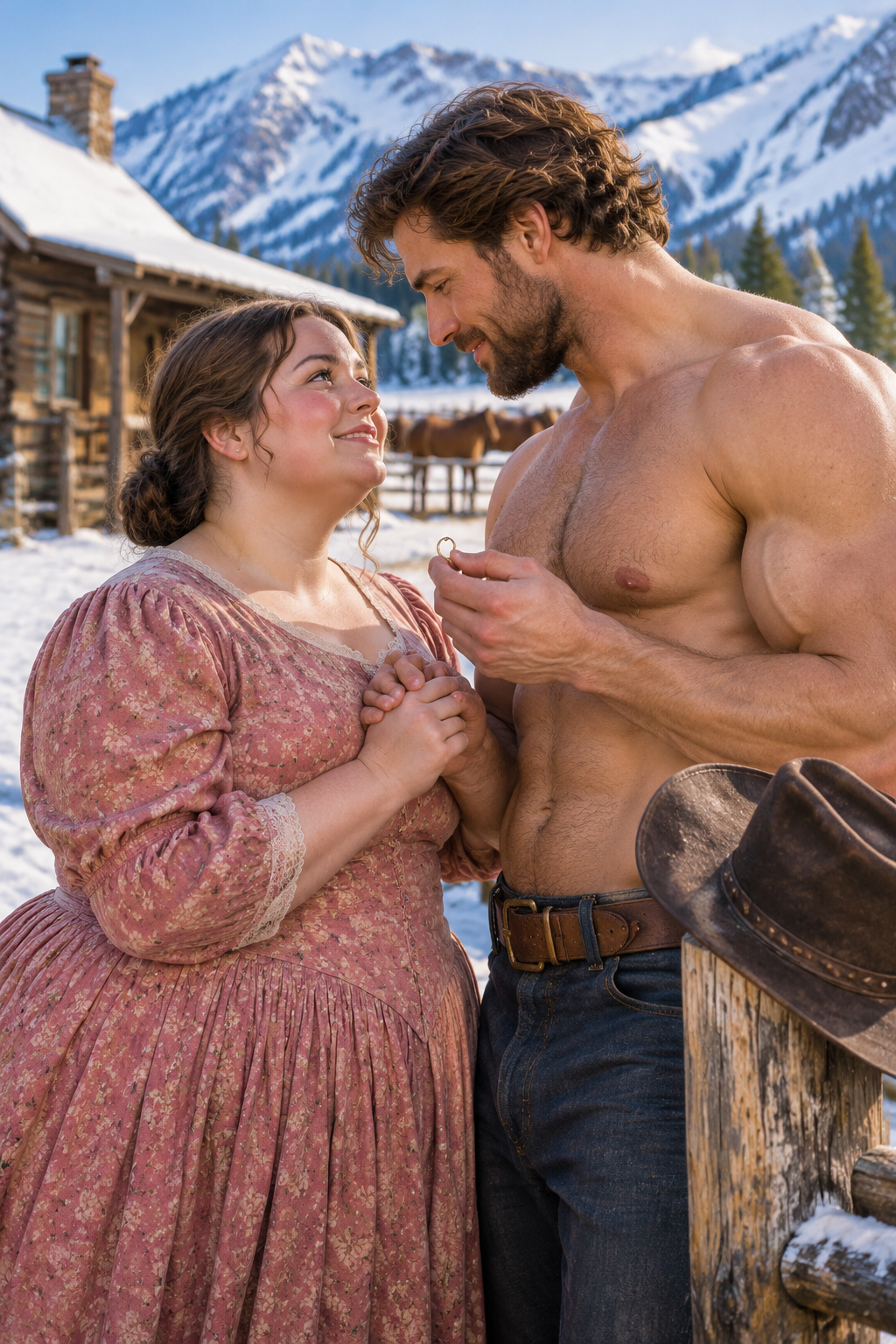
He removed a small velvet box from his pocket.
Inside lay a simple gold ring.
Rebecca’s breath caught.
“I’ve been thinking about asking you for some time,” he said. “But I needed you to know something first.”
She waited.
“You have a home here whether you marry me or not. Your wages, your work, your room. None of that changes.”
Her eyes filled with tears.
“I don’t want gratitude mistaken for love,” he continued. “And I won’t ask you to give up the independence you’ve earned.”
Rebecca looked at the man beside her.
He had never asked her to become smaller, quieter, or less capable.
He had given her room to discover who she could become.
“Jonah Beckett,” she whispered, “are you ever going to ask the actual question?”
He laughed.
It was a deep, wonderful sound.
“Rebecca Sloan, will you marry me?”
“Yes.”
He slipped the ring onto her finger.
She kissed him beneath the golden Wyoming sky.
They married in June beneath a cottonwood tree overlooking the ranch.
Edith cried throughout the ceremony.
Samuel proudly read a passage from the Bible without stumbling over a single word.
Years later, Rebecca established a small employment office in Pine Hollow for women arriving alone in the territory.
Some had been abandoned by prospective husbands. Others were widows or daughters escaping unhappy homes.
Every woman received a warm meal, temporary shelter, and help finding honest work.
Above the office door hung a wooden sign Jonah had carved himself.
It read: A woman’s worth is hers alone.
Rebecca never forgot the winter morning when Warren Pike had looked at her and decided she wasn’t worth taking home.
For a long time, she had believed that rejection was the worst thing that could happen to her.
Now she understood that the greater tragedy would have been spending her life trying to earn the approval of a man who could never recognize her value.
Warren had wanted a woman he could control.
Jonah had loved a woman who could stand beside him.
And Rebecca had finally learned that being chosen by someone else was never as important as having the courage to choose herself.
Twelve years passed before Rebecca Sloan Beckett saw Warren Pike again.
It happened on an unusually warm afternoon in October.
Rebecca was reviewing employment applications when the office door opened.
A thin, gray-haired man stepped inside.
His coat was torn, his boots were covered in dust, and a deep scar ran along his left cheek.
“I’m looking for work,” he said.
Rebecca recognized his voice before she recognized his face.
Her pen stopped moving.
Warren removed his hat.
“Hello, Rebecca.”
For several seconds, neither spoke.
The man who had once humiliated her before an entire town now stood beneath a sign declaring that a woman’s worth belonged to her alone.
“What are you doing here?” she asked.
“Prison released me three weeks ago.”
He looked around the office.
“Nobody in town will hire me.”
Rebecca closed her ledger.
“Can you blame them?”
“No.”
His answer surprised her.
Warren lowered his eyes.
“I heard you help people who have nowhere else to go.”
Rebecca studied him carefully.
She remembered the railway platform, the burning barn, and the bullet that had left a permanent scar on her arm.
She remembered Jonah kneeling beside her in the snow.
Some wounds healed.
Others simply became part of the person who carried them.
“You’re asking me for help?”
“I suppose I am.”
Rebecca walked toward the window.
Across the street, children were leaving the schoolhouse she and Jonah had helped build.
Among them were their two daughters, Clara and Elizabeth.
She had a family, a thriving business, and a life she once could not have imagined.
Warren had lost nearly everything.
But his suffering did not erase what he had done.
“I cannot offer you work at Black Elk Ridge,” she said.
He nodded slowly.
“I understand.”
“And I will never pretend that what happened between us was acceptable.”
“I wouldn’t expect you to.”
Rebecca returned to her desk and wrote an address on a piece of paper.
“There’s a freight company in Cheyenne that hires men who have served prison sentences. The owner believes people should have an opportunity to earn an honest living.”
She placed the paper before him.
“You’ll have to prove yourself.”
Warren stared at the address.
“After everything I did, why would you help me?”
Rebecca considered the question.
“Because I refuse to become cruel simply because someone was cruel to me.”
Warren’s eyes filled with tears.
He opened his mouth, but no words came.
Finally, he whispered, “I’m sorry.”
Rebecca nodded.
“I hope you spend the rest of your life becoming someone who means that.”
Warren put on his hat and walked toward the door.
Before leaving, he turned.
“Beckett was a lucky man.”
Rebecca smiled faintly.
“We were both fortunate.”
That evening, she told Jonah what had happened.
He listened without interrupting.
When she finished, he leaned back in his chair.
“Are you all right?”
“Yes.”
“Were you frightened?”
“A little.”
Jonah reached across the table and took her hand.
“You didn’t owe him anything.”
“I know.”
Rebecca looked toward the fireplace.
“That’s why helping him felt different this time. It was my decision.”
Jonah kissed her fingers.
Outside, their daughters were arguing over whose turn it was to feed the chickens.
Edith, now nearly eighty, shouted instructions from the porch.
The house was filled with the ordinary sounds of a happy family.
Rebecca wouldn’t have traded them for anything.
Winter arrived early that year.
One morning, a young woman appeared at Rebecca’s employment office carrying a sleeping infant.
Her name was Margaret.
Her husband had abandoned her, leaving behind unpaid debts and an empty cupboard.
“I don’t have any useful skills,” Margaret whispered.
Rebecca offered her a chair.
“Can you cook?”
“A little.”
“Can you sew?”
“Yes.”
“Can you learn?”
Margaret looked confused.
“I suppose so.”
“Then we have somewhere to begin.”
Within a month, Margaret was working at the ranch kitchen and saving money for a home of her own.
Within three years, she owned a successful bakery in Pine Hollow.
Her story was one of dozens.
Women who had once arrived frightened and penniless became teachers, seamstresses, shopkeepers, and business owners.
Rebecca never promised them an easy life.
She promised them an opportunity.
And she kept that promise.
As the years continued, Black Elk Ridge became one of the most prosperous ranches in Wyoming.
Jonah often joked that marrying Rebecca had been the best business decision he ever made.
Rebecca always reminded him that he had been fortunate she accepted his proposal.
Their laughter remained as warm as it had been during their first spring together.
Then, one quiet evening, Aunt Edith passed away in her sleep.
Rebecca found her resting peacefully beside an unfinished quilt.
The loss devastated the family.
At the funeral, Samuel, who had become the ranch foreman, stood before the mourners and read a passage about kindness.
Rebecca remembered the shy young man who had once struggled to recognize the letters of his own name.
Now he read with confidence.
After the service, Jonah and Rebecca stood beside Edith’s grave.
“She opened the door for me that first night,” Rebecca said.
Jonah nodded.
“She always knew you belonged with us.”
Rebecca wiped away a tear.
“I wish I could thank her one more time.”
Jonah wrapped an arm around her shoulders.
“You did. Every time you opened a door for someone else.”
Twenty years after Rebecca’s arrival in Pine Hollow, the town held a celebration in her honor.
The schoolhouse was decorated with flowers.
Families traveled from neighboring settlements.
Women Rebecca had helped over the years returned with their husbands, children, and grandchildren.
Margaret brought an enormous cake from her bakery.
Samuel arrived with his wife and four children.
Even the old stationmaster attended.
When Rebecca stepped onto the platform, the crowd rose to its feet.
She looked at the faces before her.
Many belonged to people who had once been strangers.
Some had been among those who watched Warren abandon her in the snow.
Now they were celebrating the life she had built afterward.
The mayor presented her with a plaque recognizing her contributions to Pine Hollow.
Rebecca accepted it with trembling hands.
Then she approached the podium.
“Twenty years ago, I arrived in this town expecting to become someone’s wife.”
The room grew quiet.
“Instead, I found myself standing alone at the railway station, wondering whether my life had any value at all.”
Jonah watched from the front row.
Rebecca smiled at him.
“One man looked at me and saw everything he didn’t want. Another looked at me and saw someone deserving of an opportunity.”
She paused.
“But the most important thing I discovered was that neither man had the power to determine my worth.”
Several women wiped their eyes.
“We cannot always choose how others treat us. We cannot prevent every disappointment or injustice. But we can choose what we build from the pieces they leave behind.”
Rebecca looked toward her daughters.
“And when we find our own strength, we should never forget to help someone else find theirs.”
The applause continued long after she stepped away.
Later that evening, Jonah took Rebecca to the railway station.
The original wooden platform had been replaced, but the surrounding mountains remained unchanged.
Snowflakes drifted beneath the station lamps.
Rebecca stood where Warren had abandoned her so many years earlier.
“Do you remember?” Jonah asked.
“Every moment.”
He smiled.
“You looked ready to fight the entire world.”
“I was terrified.”
“You hid it well.”
Rebecca laughed.
“You looked rather frightening yourself.”
“I was trying to be polite.”
“You needed practice.”
Jonah chuckled and slipped his hand into hers.
For a while, they watched the snow fall.
“Would you change anything?” he asked.
Rebecca thought about the lonely journey from Ohio, the humiliation, the danger, and the years of happiness that followed.
“I would never wish that pain upon anyone,” she said. “But I wouldn’t trade the life I found afterward.”
Jonah kissed her forehead.
“Neither would I.”
They walked home together beneath the falling snow.
Decades later, when Rebecca and Jonah had both grown old, their eldest daughter discovered the original letters Warren had sent her mother.
She also found the railway ticket Rebecca had kept all those years.
“Why did you save these?” Clara asked.
Rebecca sat beside the window, a blanket covering her knees.
“To remember where I began.”
Clara examined the faded ticket.
“Were you really that unhappy?”
“For a time.”
“Did you ever believe you wouldn’t find happiness?”
Rebecca smiled.
“Of course. Most people believe that when they’re standing in the middle of their darkest days.”
She took her daughter’s hand.
“But darkness is not proof that the sun has disappeared. Sometimes, you simply have to keep walking until morning.”
Jonah entered the room carrying two cups of tea.
“Are you telling stories about me again?”
“Only the embarrassing ones.”
“Then we’d better make another pot.”
Clara laughed.
Rebecca looked at her husband.
His hair had turned white, his shoulders had grown less powerful, and his weathered hands now trembled slightly.
Yet she still saw the man who had approached her at the station without judgment.
The man who had offered her honest work instead of empty promises.
The man who had understood that love was not ownership.
He sat beside her and handed her a cup.
Their fingers touched.
Even after all those years, the simple gesture warmed her heart.
Rebecca died peacefully several winters later, surrounded by her family.
Jonah held her hand until her final breath.
She was buried beneath the cottonwood tree where they had exchanged their wedding vows.
On her gravestone, their daughters had a simple inscription carved.
Rebecca Sloan Beckett.
She built a home where others found hope.
Jonah visited her grave every morning until the following spring, when he passed away quietly in the same house they had shared for nearly half a century.
He was buried beside her.
Their children continued running Black Elk Ridge.
Their grandchildren expanded Rebecca’s employment office.
And above its entrance, the original wooden sign remained.
A woman’s worth is hers alone.
Travelers passing through Pine Hollow often heard the story of the woman who had arrived with a suitcase, a broken promise, and nowhere to sleep.
They heard how she exposed corruption, survived betrayal, and transformed an entire community.
But those who knew Rebecca understood that her greatest achievement wasn’t the wealth she accumulated or the criminals she brought to justice.
It was the kindness she preserved despite everything she endured.
Warren Pike had believed that rejecting Rebecca would make her feel worthless.
Instead, his rejection became the beginning of a life more meaningful than anything he could have offered her.
Jonah had given her a chance.
Rebecca had turned that chance into a future for generations of people.
And somewhere in the quiet Wyoming hills, beneath the branches of an ancient cottonwood tree, two people rested side by side.
They had entered each other’s lives on a day when everything seemed lost.
Together, they had discovered that sometimes the door closing before you is not the end of your story.
It is the beginning of the life you were never meant to settle for less than.
THE END.