I collapsed face-first into a plate of beef stew at Maggie Carver’s eating house, and the doctor who promised to save me smiled because he knew what was poisoning me.
“Thomas Carver is alive.”
Those four words struck me harder than the gunshot that had torn through Maggie’s eating house.
For several seconds, I could only stare at Billy Mercer as blood seeped through the cloth Maggie pressed against his shoulder.
Above us, Dr. Sterling’s footsteps moved across the kitchen floor, slow and deliberate, like a man who knew his prey had nowhere left to run.
Maggie’s fingers trembled against Billy’s wound, but her voice remained steady.
“Tell me what you mean, Billy.”
The boy swallowed painfully and looked toward the cellar stairs.
“I saw him three nights ago, Mrs. Carver, and I swear on my mother’s grave it was your husband.”
Maggie shook her head, her face pale in the darkness.
“Thomas died two years ago, and I stood beside his coffin.”
Billy caught her wrist with his uninjured hand.
“Then somebody put another man in that coffin.”
I felt Maggie’s body go still beside me.
For two years, she had carried her husband’s wedding ring around her neck, believing the man she loved had died because of Sterling’s poison.
Now a bleeding stable boy was telling her that grief had been built upon a lie.
Before either of us could speak, Sterling’s voice drifted through the floorboards.
“Come out, Mrs. Carver, and we can settle this like civilized people.”
I gripped the iron shovel more tightly.
Sterling continued speaking, his voice almost gentle.
“Your husband made a terrible mistake, Maggie, and I’d hate to see you make the same one.”
Maggie’s eyes lifted toward the ceiling.
“You knew,” she whispered.
There was no answer from above, only the creaking of old wooden boards.
Then Sterling spoke again.
“Thomas should have understood that some secrets are worth more than a man’s life.”
Maggie rose so quickly that I barely caught her arm.
“Don’t,” I whispered. “That’s exactly what he wants.”
She turned toward me, and I saw something more frightening than anger in her eyes.
I saw a woman realizing that every night she had spent mourning might have been another night her husband was suffering somewhere alone.
“He let me bury an empty life, Colt,” she said.
I wanted to promise that Thomas was alive and waiting for her, but I had learned what false promises could do to a desperate soul.
So I told her the only truth I had.
“We’re going to find out.”
A heavy crash sounded upstairs as Sterling’s companion overturned a cupboard.
Billy struggled to sit upright.
“There’s a drainage passage behind those shelves,” he whispered. “It runs beneath the alley.”
Maggie glanced toward the back wall.
“Thomas dug that years ago to keep the cellar dry.”
I helped Billy to his feet while Maggie pulled aside two wooden crates and uncovered a narrow stone opening.
Cold air rushed through the passage, carrying the smell of mud and rotting leaves.
One by one, we crawled into the darkness.
Behind us, the cellar door slammed against the wall.
“Colt Hadley!” Sterling shouted. “You won’t survive another week without my medicine!”
His words found the weakest place inside me.
Even after days of fighting the poison, part of my body still remembered how easily one swallow could silence the pain.
For one terrible moment, I imagined surrendering.
Then Maggie’s hand reached backward through the darkness and found mine.
“Keep moving,” she whispered.
And I did.
We emerged behind an abandoned livery stable nearly two streets away.
Rain fell across Dodge City, turning the roads into black rivers of mud.
Billy collapsed against a fence, his breathing shallow.
Maggie looked at me helplessly.
“We can’t leave him.”
“We won’t.”
I lifted the boy onto my back and carried him toward the home of Samuel Whitcomb, a physician who had quietly helped oversee my withdrawal after Maggie rescued me.
Whitcomb had no love for Sterling, whose expensive bottles had already ruined several of his patients.
He opened his door with a lantern in one hand and a revolver in the other.
When he saw the blood on Billy’s shirt, he stepped aside without asking questions.
The bullet had passed through the boy’s upper arm, narrowly missing the bone.
Whitcomb cleaned and dressed the wound while Maggie paced beside the window.
At last, Billy began speaking again.
He told us Sterling sometimes paid him to deliver parcels to an abandoned freight office near the railroad depot.
Most deliveries happened after midnight, when respectable townsfolk were safely behind their doors.
Three nights earlier, Billy had arrived early and heard voices inside the building.
One belonged to Sterling.
The other belonged to a man who kept shouting that he wanted to see his wife.
Billy had looked through a broken window.
“The man had a scar across his right eyebrow,” he told Maggie.
She pressed a hand over her mouth.
Thomas had received that scar when a frightened horse kicked him against a fence shortly after their wedding.
Billy continued.
“He was thinner than the photograph, and he walked like one leg hurt him.”
Maggie’s knees buckled.
I caught her before she struck the floor.
For a moment, she seemed unable to breathe.
Then she whispered, “Thomas.”
Whitcomb pulled a chair beside her.
“Mrs. Carver, there’s something you should understand before we do anything reckless.”
Maggie looked up.
“If Sterling has kept a man hidden for two years, we cannot assume he’ll let him go simply because someone comes looking.”
I watched Maggie close her eyes.
When she opened them again, the grief remained, but something stronger stood beside it.
“Then we don’t go looking empty-handed.”
She took the brass key from my palm.
And suddenly, I knew exactly where we had to begin.
By dawn, the storm had passed, leaving Dodge City buried beneath a cold gray mist.
Whitcomb agreed to shelter Billy while Maggie and I went to find Sheriff Daniel Rourke.
Rourke had served the county for nearly a decade, and I had always considered him a fair man.
But when we told him about Sterling, he leaned backward in his chair and folded his arms.
“That’s a mighty serious accusation, Hadley.”
I placed Maggie’s ledger on his desk.
“Then read what we’ve collected.”
He glanced at the names but made no effort to open the book.
“Doctor Sterling is one of the most respected men in this town.”
“Respectability doesn’t make a man innocent,” Maggie replied.
Rourke’s jaw tightened.
“Careful, Mrs. Carver.”
I stepped closer.
“Seven men are dead, Sheriff, and now there’s a boy lying wounded because he saw something Sterling wanted hidden.”
Rourke finally looked at me.
“You got proof the doctor pulled that trigger?”
“No, but Billy heard him order the search.”
The sheriff rose slowly.
“Bring me something a judge can use, and I’ll consider what you have to say.”
We left with the ledger still in Maggie’s hands.
Outside, she stared across the street at Sterling’s handsome medical office.
Its polished windows displayed neat rows of amber bottles beneath a painted sign promising renewed strength and lasting health.
A farmer entered carrying his hat nervously against his chest.
I recognized him immediately.
His name was Joseph Bell, and three months earlier he had borrowed money from me to buy medicine for his headaches.
I had recommended Sterling myself.
Shame burned through my stomach.
Maggie noticed where I was looking.
“Colt, you didn’t know.”
“I should have.”
“You trusted a man who dressed his greed like kindness.”
I looked at the farmer disappearing through the doctor’s doorway.
“Then I owe him more than an apology.”
Maggie didn’t argue.
Instead, she touched the wedding ring beneath her collar.
“First, we find Thomas.”
That night, we approached the freight office from the rear, keeping close to the dark walls of the railroad warehouses.
A freight train idled nearby, its engine breathing clouds of white steam into the cold air.
Maggie guided me toward a side entrance half-hidden behind stacked timber.
Her key turned in the rusty lock.
Inside, dust covered the floor, and the smell of old grain hung heavily in the darkness.
Along one wall stood twenty narrow storage cabinets.
Maggie found the number Thomas had written on the ribbon attached to the key.
Seventeen.
Her fingers hesitated before opening it.
“Whatever’s inside,” I whispered, “we face it together.”
The cabinet door creaked outward.
At first, I saw only folded clothing, a worn Bible, and a small wooden box.
Then Maggie lifted the Bible and found a sealed envelope beneath it.
Her name was written across the front.
She stared at the handwriting.
I watched her recognize every curve of every letter.
With shaking hands, she broke the seal.
The letter began simply.
“My dearest Maggie, if you are reading this, I have failed to come home.”
Her lips moved silently as she read.
Then tears began falling onto the paper.
Thomas had written that Sterling’s tonic contained opium in quantities far greater than most customers understood.
He described how Sterling deliberately changed the strength of his mixtures, ensuring that men who first sought relief soon became desperate for another bottle.
When those men could no longer pay, Sterling accepted cattle, land deeds, and signed debts.
But the worst discovery was not the medicine.
It was what Sterling did with the property.
A businessman from Wichita named Arthur Pembroke had been quietly purchasing the debts and seized ranchland through intermediaries.
Sterling received a share of every profitable transfer.
Men weren’t merely being poisoned.
They were being robbed of their futures.
Maggie reached the final page and went completely silent.
“What is it?” I asked.
She handed me the letter.
Near the bottom, Thomas had written one final warning.
“Do not trust Sheriff Rourke, because the first payment Pembroke made was delivered through his office.”
I read the sentence twice.
Then I remembered the sheriff’s expression when he saw Maggie’s ledger.
He hadn’t looked surprised.
He had looked irritated.
Somewhere behind us, a floorboard creaked.
I turned.
A lantern flared near the entrance.
Sheriff Rourke stood in the doorway with two armed deputies.
“Well,” he said quietly. “Looks like you found what we’ve been searching for.”
Maggie slipped the letter behind her back.
Rourke extended his hand.
“Give me the papers.”
I moved between them.
“You work for Sterling?”
His expression hardened.
“I work for the people who keep this town alive.”
“By poisoning them?”
“By making certain the railroad and cattle business don’t collapse every time some fool borrows money he can’t repay.”
I felt sick.
Men like Rourke had convinced themselves that suffering was acceptable as long as someone powerful profited.
He drew his revolver.
“Enough talking.”
A deputy stepped forward to take the letter.
Then a voice called from the doorway.
“Put that gun away, Daniel.”
Every man in the room turned.
Thomas Carver stood behind the sheriff.
For a heartbeat, nobody moved.
He was gaunt and pale, with a heavy beard and a deep scar above his right eyebrow.
One leg dragged slightly beneath his coat.
But there was no mistaking his eyes.
They were the same gentle brown eyes that watched over Maggie from the photograph beside her bed.
“Thomas?” she whispered.
He looked at her.
And the sound he made nearly broke my heart.
“Maggie.”
She started toward him, but Rourke seized her arm.
“Don’t move.”
Thomas raised both hands.
“Let her go, Daniel, and I’ll tell you where the missing account book is.”
The sheriff froze.
“What account book?”
“The one Sterling’s been hunting since I disappeared.”
Rourke’s eyes narrowed.
“You’re lying.”
Thomas shook his head.
“There’s only one way to know.”
He glanced toward the railroad tracks.
“In the telegraph office, beneath the floorboards under the operator’s desk.”
Rourke studied him for several seconds.
Then he turned to one deputy.
“Go look.”
The man hurried away.
Thomas waited until his footsteps faded.
Then he looked directly at me.
“Colt Hadley?”
I nodded.
“Thank you for keeping my wife alive.”
I didn’t understand why he sounded as though he were saying goodbye.
Then Thomas reached inside his coat.
Rourke lifted his revolver.
“Don’t!”
But Thomas had already pulled out a small pistol.
The gunfire sounded like thunder inside the wooden building.
Rourke staggered backward, clutching his shoulder.
One deputy fired wildly, splintering a cabinet beside my head.
I threw myself against him, knocking his weapon across the floor.
Maggie screamed as Thomas fell against the doorway.
For several frantic seconds, the room became a nightmare of smoke, shouting, and crashing furniture.
Then I managed to pin the deputy beneath my knee.
Rourke lay groaning near the wall, his revolver beyond reach.
Maggie was already beside Thomas.
Blood spread across his coat.
“No,” she whispered. “No, Thomas, please.”
He tried to smile.
“It’s only my side, darling.”
I had seen enough wounded men to know how dangerous those words could be.
Maggie cradled his face between her hands.
“Why didn’t you come home?”
Thomas closed his eyes.
And when he spoke, his voice was barely audible.
“Because they told me you were dead.”
The room seemed to fall away around us.
Maggie stared at him.
“What?”
“Sterling showed me a newspaper notice, and he said you’d been killed in a kitchen fire.”
His face twisted with pain.
“I believed him, Maggie.”
She began shaking her head.
“I’ve been waiting for you every day.”
Thomas opened his eyes.
“I know that now.”
He told us Sterling had kept him confined in an isolated storehouse outside town, forcing him to prepare the tonic under guard.
When he refused, they withheld food and medicine until weakness overcame him.
Eventually, Thomas pretended to cooperate while secretly gathering information about their shipments.
The account book at the telegraph office was a lie meant to draw a deputy away.
But there was real evidence.
Thomas reached inside his shirt and withdrew a folded sheet wrapped in oilcloth.
It contained the location of Sterling’s hidden supply records, along with a list of payments made to Rourke and Pembroke.
He pressed it into my hand.
“Get this to someone outside Dodge City.”
Then he turned toward Maggie.
“I’m sorry I wasn’t stronger.”
She pressed her forehead against his.
“You survived, Thomas, and that’s enough.”
I wanted to leave them together, but the freight office was no longer safe.
Rourke’s remaining deputy had escaped during the struggle.
By sunrise, Sterling would know everything.
I helped Thomas stand, supporting most of his weight as we slipped through the rear entrance.
Maggie kept his hand in hers the entire way.
We reached Whitcomb’s house just before dawn.
The physician examined Thomas and removed a bullet lodged near his ribs.
It had missed his lungs, but he had lost dangerous amounts of blood.
For two days, Maggie barely left his bedside.
I spent those days doing something I had once believed impossible.
I told other men the truth.
I stood in the back room of a church and admitted that I had become dependent on Sterling’s medicine.
I told them about selling my cattle and lying to everyone who cared about me.
I told them how I had nearly died from the poison I believed was saving my life.
Some men looked away.
Others stared at the floor.
Then Joseph Bell stood.
His hands were shaking.
“I’ve been drinking that tonic for four months,” he said.
A second man rose.
Then another.
Before the meeting ended, fourteen men had told their stories.
Several brought empty bottles.
Two had receipts showing that Sterling had charged them increasing amounts for stronger preparations.
One widow brought her husband’s final bill.
She had kept it because it was the last paper he had touched before he died.
When she placed it in my hand, I felt the weight of something no court could fully measure.
Trust destroyed.
Families broken.
Lives shortened by greed.
I promised her we would not let those deaths disappear beneath polite words and expensive suits.
With Whitcomb’s help, we sent a detailed complaint and copies of the evidence by telegraph and courier to the county attorney and state authorities outside Sterling’s circle.
Then we waited.
But Sterling was not waiting.
On the third evening, smoke rose above the eastern end of Dodge City.
Someone was burning Maggie’s eating house.
By the time I reached the building, flames were climbing through the roof.
Neighbors formed a bucket line, passing water from the well.
Maggie stood in the street, watching the place where she had worked since her wedding disappear into fire.
The eating house had been more than a business.
It was the place where lonely railroad workers found warm meals, where hungry children sometimes ate without paying, and where I had collapsed when nobody else would help me.
I stood beside her, feeling helpless.
“I’m sorry,” I said.
She looked at the flames.
“Sterling thinks burning this place will make me stop.”
Her voice hardened.
“He still doesn’t understand me.”
Just then, a rider pushed through the crowd.
It was Arthur Pembroke.
I recognized him from Thomas’s description and the expensive Wichita business cards hidden in Sterling’s papers.
He sat high in the saddle, watching the fire with an expression of mild annoyance.
“Terrible thing, Mrs. Carver,” he said. “A woman alone ought to be more careful.”
Maggie stepped toward him.
“I’m not alone.”
Pembroke glanced at me.
“Hadley, isn’t it? I hear your ranch is considerably smaller these days.”
My fists tightened.
He smiled.
“Perhaps you should mind your remaining business.”
Then he rode away.
I wanted to drag him from the saddle.
But Maggie caught my sleeve.
“Not tonight, Colt.”
I looked at the burning roof.
“He’s laughing at us.”
“Then we’ll make sure he remembers that laugh when the truth comes out.”
The following morning, Whitcomb discovered something disturbing in the documents Thomas had recovered.
Sterling had arranged a large shipment of tonic to leave Dodge City by rail the next night.
The bottles were destined for several towns along the railroad.
Thousands of dollars’ worth of poison.
Hundreds of potential victims.
If that shipment disappeared, Sterling and Pembroke could destroy the remaining records and begin again somewhere else.
We had to stop the train.
The county attorney had received our complaint, but no officer had yet arrived with authority to seize the shipment.
Thomas was still too weak to travel.
Maggie refused to abandon him, and I refused to ask her to.
So I went to the railroad depot with Joseph Bell and three other men who had suffered under Sterling.
We did not carry rifles.
We carried sworn statements, receipts, and a copy of the freight manifest Thomas had obtained.
The stationmaster, Henry Dawson, was an old friend of my father’s.
I found him beside the telegraph desk, preparing the evening schedule.
“Henry, that shipment can’t leave.”
He studied the papers I placed before him.
His face darkened.
“These charges are serious, Colt.”
“I know.”
He looked toward the freight wagons waiting beside the tracks.
“If I hold that train without authority, I could lose my position.”
I thought of Joseph’s trembling hands.
I thought of the widow gripping her husband’s last bill.
Then I remembered Maggie telling me how Thomas had suffered because respectable men were too frightened to speak.
“Henry, how many lives is your job worth?”
He lowered his eyes.
For a long moment, only the ticking of the telegraph sounded between us.
Then he picked up the transmission key.
“I can ask the railroad superintendent to authorize a hold while the authorities investigate.”
He began sending the message.
That was when Sterling entered the station.
He wore his finest black coat, and his silver watch chain gleamed beneath the lamps.
Behind him stood Pembroke and two armed men.
Sterling looked at the documents spread across the desk.
His smile vanished.
“Mr. Dawson,” he said, “I believe those papers are stolen.”
Henry continued working the telegraph.
Sterling turned toward me.
“Colt, you’ve become a terrible disappointment.”
I stood my ground.
“You taught me what desperation feels like, Doctor.”
Sterling took one step closer.
“Without my medicine, you’d still be begging in the streets.”
I looked him in the eyes.
“Without your medicine, I might never have lost my ranch.”
Pembroke laughed quietly.
“Enough of this nonsense.”
He ordered one of his men to seize the papers.
Joseph stepped between them.
For the first time since I had known him, his trembling hands formed steady fists.
“Those papers belong to the men you robbed.”
The hired gunman shoved him aside.
I caught Joseph before he fell.
Then Sterling reached into his coat and drew a small revolver.
“Everyone away from the telegraph.”
Nobody moved.
Henry’s hand hovered above the key.
Sterling aimed the pistol directly at him.
“I said move.”
A sharp voice suddenly sounded from the doorway.
“Drop that weapon, Elias.”
Sheriff Rourke stood beneath the station lamp.
His injured shoulder was wrapped in a dirty bandage, and his face looked gray with exhaustion.
Sterling stared at him.
“Daniel, arrest these men.”
Rourke didn’t move.
Instead, he lifted a revolver in his uninjured hand.
“I said drop it.”
For a moment, I thought the sheriff had finally found his conscience.
Then I saw the desperation in his eyes.
He wasn’t there to save us.
He was there to save himself.
“Those records go with me,” Rourke said.
Pembroke stepped backward.
“You’re making a mistake.”
Rourke laughed bitterly.
“My mistake was trusting you to keep your promises.”
Sterling’s gun shifted toward the sheriff.
Everything happened at once.
Pembroke lunged for the documents.
Joseph grabbed his arm.
Henry struck the telegraph key with his fist.
And Sterling fired.
The bullet shattered the lantern above the desk.
Flames burst across the wooden floor.
I tackled Sterling before he could shoot again.
We crashed against a stack of freight crates, his revolver sliding beneath the loading platform.
He struck me across the jaw.
For an instant, darkness crowded the edges of my vision.
My body was still weak, and every muscle screamed.
Sterling leaned close enough for me to smell the expensive cologne covering the sour odor of his medicine.
“You stupid rancher,” he hissed. “You could have lived comfortably if you’d kept buying my tonic.”
I drove my elbow into his chest.
“And you could have been a real doctor.”
We rolled across the floor.
Behind us, men shouted as flames climbed the curtains.
Then a gunshot echoed through the station.
Sterling went limp beneath me.
I scrambled backward.
Sheriff Rourke stood several feet away, smoke rising from his revolver.
Sterling clutched his leg, blood spreading beneath his trousers.
“He’s alive,” Rourke muttered.
Then he looked toward the burning telegraph desk.
But Henry Dawson had already completed his message.
The railroad superintendent’s response came through the wire while Joseph and the others fought the flames.
The shipment was to be held pending official investigation.
And a deputy United States marshal, already traveling through the region on separate business, had been contacted.
Pembroke tried to escape through the rear entrance.
Joseph and two railroad workers stopped him before he reached his horse.
When the marshal arrived with local officers later that night, he found Sterling wounded, Pembroke restrained, and Sheriff Rourke attempting to explain why his own name appeared in the payment records.
Rourke’s sudden change of allegiance did not save him.
He was taken into custody along with the others.
The stationmaster handed over the freight records, and the men who had gathered outside demanded that every crate be opened.
Inside were hundreds of amber bottles.
Golden Restoration Tonic.
The same familiar labels.
The same promises.
I picked up one bottle and held it toward the lantern light.
For months, I had believed the liquid inside was the only thing standing between me and death.
Now I understood that the most dangerous lies were often the ones that first made us feel safe.
The investigations lasted through the winter.
Sterling’s records exposed years of fraudulent sales, hidden partnerships, and property transfers.
The evidence eventually led to criminal proceedings against Sterling, Pembroke, and Rourke.
Sterling attempted to blame Thomas for the tonic’s manufacture, but Thomas’s letters, payment records, and testimony revealed how the doctor had controlled the business.
Men who had remained silent for years finally came forward.
Some spoke with anger.
Others wept.
Several struggled to complete their testimony because they were still dependent on the medicine.
But nobody laughed at them.
Not anymore.
When the verdicts were delivered the following spring, Sterling and Pembroke were convicted of fraud-related crimes, while Rourke faced punishment for his corruption and his part in the conspiracy.
No judge could return the dead.
No sentence could restore every stolen acre.
And no courtroom could give Maggie back the two years she had spent believing her husband was buried beneath a wooden cross.
Still, justice had finally spoken louder than Sterling’s promises.
My own recovery did not end with the trial.
There were mornings when the old craving returned so fiercely that I had to sit on the edge of my bed and wait for it to pass.
Whitcomb continued helping me, and I learned that healing rarely followed a straight road.
Some days were good.
Others felt like walking uphill through a blizzard.
But I stopped measuring my worth by how little I suffered.
I began measuring it by whether I kept moving forward.
The money I lost was mostly gone forever.
My ranch had shrunk to twenty acres and a weather-beaten barn.
But one afternoon, Joseph Bell arrived leading two young cattle.
He tied their ropes to my fence.
“What’s this?” I asked.
He smiled.
“A beginning.”
I tried to refuse.
He shook his head.
“You helped me tell the truth when I was too ashamed to speak.”
Then he placed the reins in my hands.
“Let me help you remember you’re still a rancher.”
I stood beside those animals long after Joseph left.
For the first time in months, the land didn’t look like evidence of my failure.
It looked like something waiting to grow.
Maggie’s eating house was rebuilt that summer.
The townspeople raised the walls together, and railroad workers donated lumber from an abandoned storage shed.
Thomas, still walking with a cane, helped carve the wooden sign above the entrance.
It read simply, CARVER’S TABLE.
Beneath the name, Maggie insisted on adding four small words.
“Nobody Eats Alone Here.”
On opening day, every table was full.
Farmers sat beside railroad workers.
Widows shared pie with children.
Men who had once hidden their trembling hands beneath dinner tables now spoke openly about their struggles.
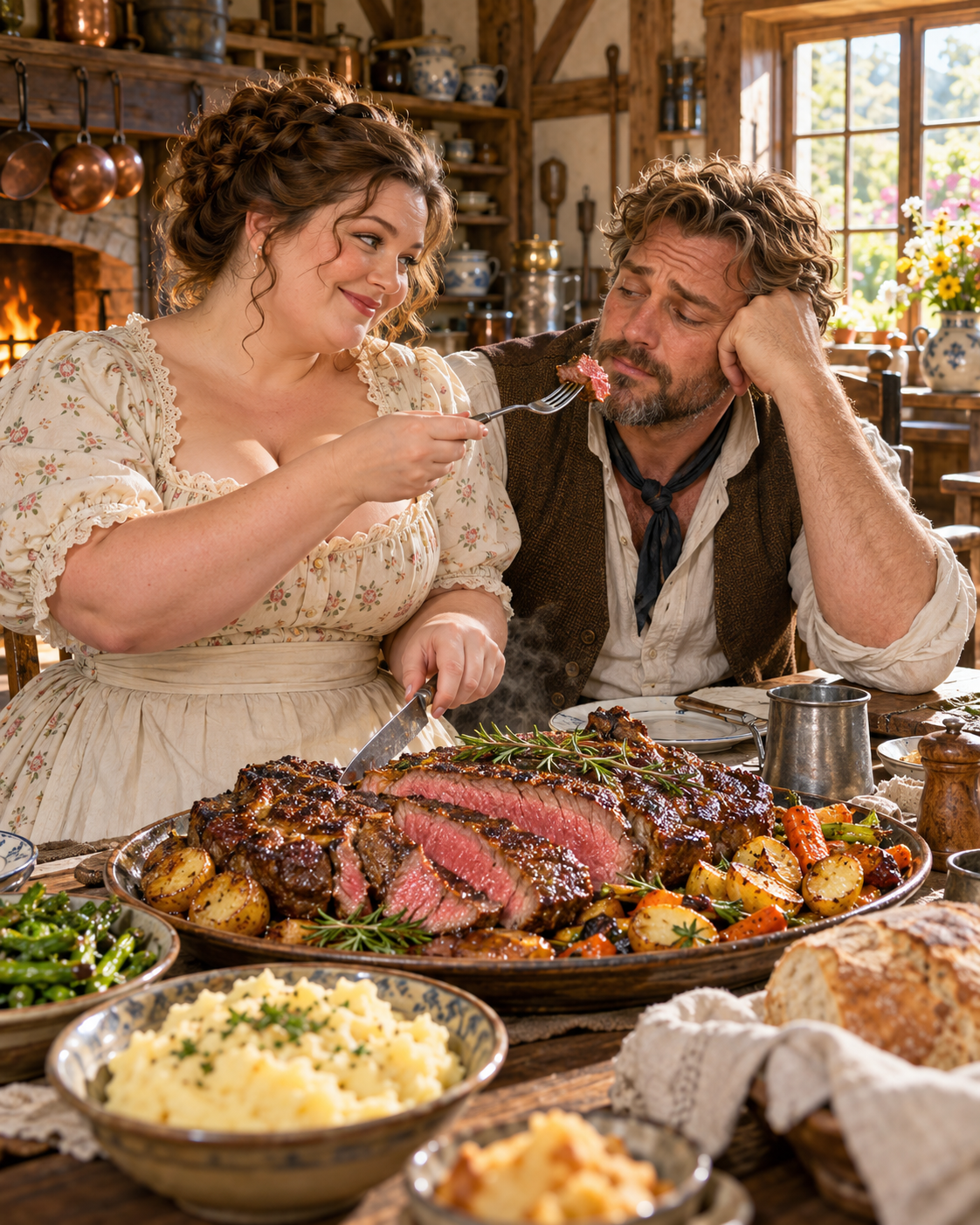
Maggie moved through the crowded room carrying plates of roast beef, laughing whenever Thomas complained that she was working too hard.
I watched them from my favorite seat near the window.
Sometimes Thomas still woke screaming from dreams about the place where Sterling had imprisoned him.
Sometimes Maggie cried quietly when she remembered the lonely winters they could never get back.
Their reunion hadn’t erased the pain.
But it had given them someone to hold when the memories returned.
Late that evening, after the customers had gone, Maggie brought me a cup of coffee.
Thomas sat beside the stove, carving a small wooden horse for Billy Mercer, whose injured arm had healed.
Maggie lowered herself into the chair across from me.
“You know,” she said, “the night you collapsed, I thought we might lose you before morning.”
I smiled faintly.
“I wasn’t much worth saving.”
Her expression changed.
“Don’t ever say that again.”
I looked down at my hands.
They were rough and scarred, but they no longer shook when I lifted the cup.
Maggie continued.
“Sterling wanted you to believe your weakness made you worthless, because ashamed men are easier to control.”
I swallowed hard.
She reached across the table.
“Your suffering was real, Colt, but it was never the whole truth about you.”
I thought about the man I had been when I first entered her eating house.
A proud rancher too frightened to admit he needed help.
A lonely man convinced that asking for kindness was the same as surrendering his dignity.
And I thought about the people who had carried me when I could no longer stand.
Maggie.
Thomas.
Whitcomb.
Joseph.
Even Billy, who had risked his life to bring us the truth.
“I spent so long thinking a strong man never needed anyone,” I admitted.
Maggie smiled.
“Then I’m glad you’ve finally learned better.”
Outside, the summer wind moved gently through the cottonwood trees.
The streets of Dodge City were settling into darkness, and somewhere near the railroad depot, a locomotive whistled beneath the stars.
Thomas rose and crossed the room.
He placed his hand on Maggie’s shoulder.
She reached up and covered it with her own.
I looked at them and understood something I hadn’t known when our troubles began.
Surviving was not the same as living.
Surviving meant getting through another night.
Living meant believing there could still be something worth waking up for.
When I stood to leave, Maggie stopped me at the door.
“Colt, there’s one more thing.”
She handed me an old amber bottle.
For a heartbeat, my chest tightened.
It was Sterling’s tonic.
The label had faded, and the glass was empty.
“I found it in the ashes when we cleared the old kitchen,” she explained.
I stared at the bottle that had once ruled my life.
“Why give it to me?”
“Because I think you should decide what happens to it.”
I carried it outside.
The moon shone against the glass, turning its hollow center silver.
For a moment, I remembered how desperately I had once twisted the cork free.
How many nights I had counted the remaining drops.
How easily I had mistaken temporary relief for salvation.
Then I walked toward the stone wall beside the road.
I raised the bottle above my head.
And I smashed it.
The sound was small.
Almost disappointingly small.
No thunder rolled across the sky.
No church bells rang.
Nothing extraordinary happened.
But when I looked down at the broken glass, I realized I was no longer afraid of the empty bottle.
I had spent months believing it possessed the power to save or destroy me.
Now it was simply glass lying in the dirt.
I returned to the eating house, where Maggie stood watching from the doorway.
She didn’t ask what I had done.
She only smiled and held the door open.
Inside, Thomas was pouring another cup of coffee.
Billy’s wooden horse sat beside the stove.
The air smelled of fresh bread and cinnamon.
And for the first time in a very long while, I knew exactly where I belonged.
Years later, people would still speak about the scandal of Dr. Elias Sterling.
They remembered the arrests, the courtroom, the ruined fortunes, and the secrets discovered beneath Dodge City’s respectable streets.
But whenever someone asked me what had truly saved my life, I never mentioned the sheriff, the trial, or the shattered bottle.
I told them about a woman who had found a broken stranger lying face-first in his supper.
A woman who could have turned him away because he was penniless, ashamed, and painfully difficult to help.
Instead, she had offered him food, shelter, and the stubborn belief that his life still mattered.
I told them that evil sometimes wore a fine coat, carried a medical bag, and spoke with the confidence of a man who expected never to be questioned.
But kindness could be just as powerful.
It could wear a flour-covered apron.
It could sit beside a sickbed through the night.
It could hold a trembling hand without demanding anything in return.
And sometimes, that quiet kindness could bring down an empire built on fear.
I never became the richest rancher in Kansas.
I never recovered all the cattle, land, or years I had lost.
But I learned to live without hiding my scars.
I learned that asking for help was not weakness, and that shame only grew stronger when carried alone.
Most importantly, I learned that a man’s greatest victory was not proving he had never fallen.
It was finding the courage to rise, accept help, and reach back for someone still lying in the dust.
Because the night Maggie Carver saved me, she didn’t simply rescue a dying rancher.
She reminded me that even when the world has taken nearly everything, there is one thing no cruel man can own unless we surrender it.
Our hope.
And as long as we have the courage to share that hope with another human being, no darkness can ever claim the final word.
THE END.