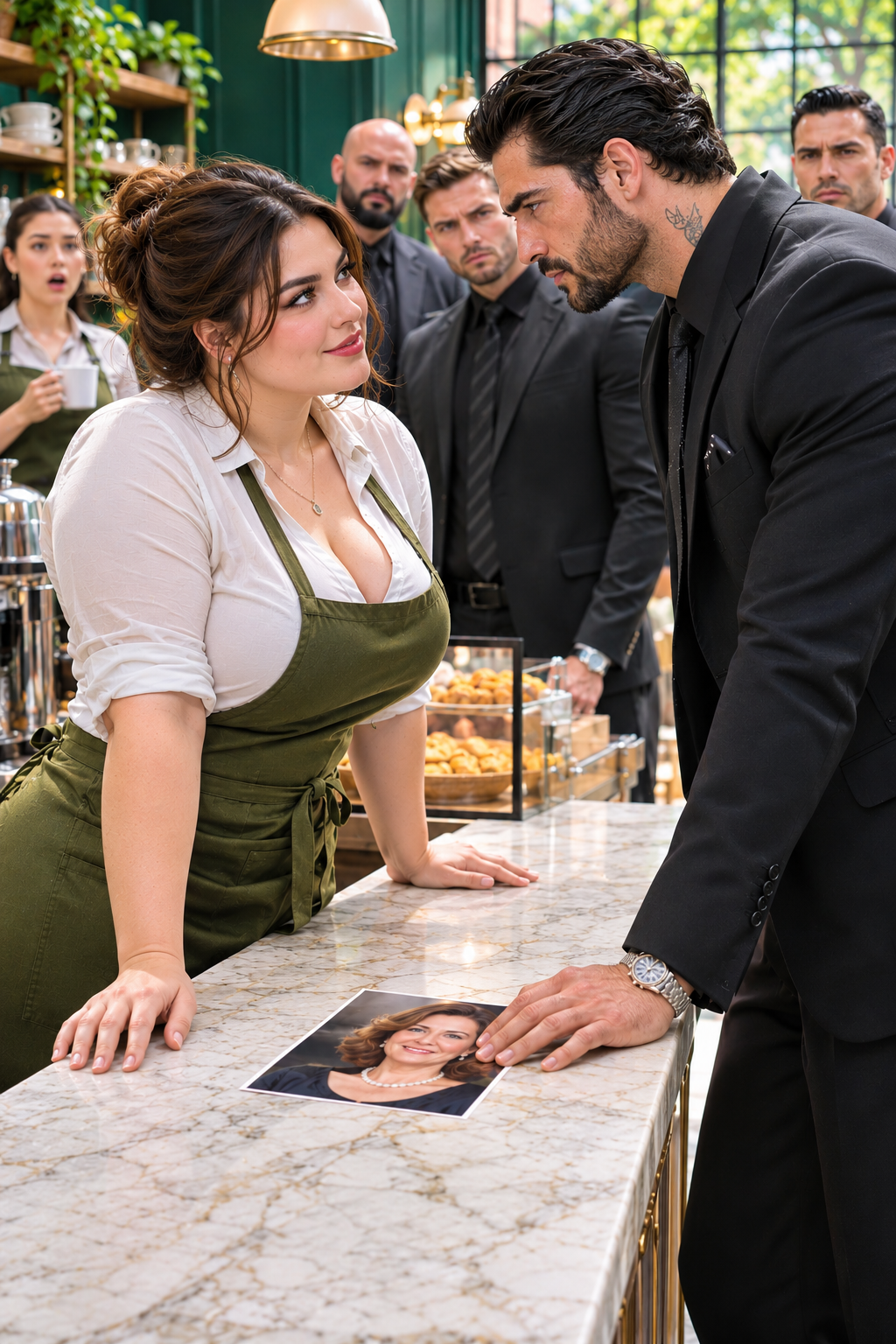
“Get your hands off her, or you can leave my cafe right now,” Hannah Brooks said, stepping between the angry customer and the elderly woman.
Sebastian Moretti sat across from Hannah Brooks, but for once, the powerful man who could silence an entire room with one look seemed unable to find the right words.
Rosa folded her hands on the table and waited.
Hannah looked between mother and son. “Well? I’m listening.”
Sebastian glanced toward the cafe windows, where two of his security men stood beside a black SUV.
“I came back because I owe you an apology.”
Hannah raised an eyebrow. “For the espresso machine?”
“For treating your kindness like something I could purchase.”
That surprised her.
Sebastian continued, “My mother told me you spent twenty minutes helping her after that man left. You made sure she wasn’t hurt. You brought her tea. You even offered to drive her home.”
“Anyone decent would’ve done that.”
“No,” Sebastian said quietly. “Not everyone would.”
Rosa reached across the table and patted Hannah’s hand.
“My son has spent years surrounded by people who want something from him. When someone gives without asking, he doesn’t know what to do.”
“Mother,” Sebastian warned.
“It’s true, darling.”
Hannah studied him for a moment.
“Then perhaps you should try saying thank you instead of buying expensive appliances.”
Sebastian almost smiled.
“Thank you, Hannah.”
“You’re welcome.”
It should have ended there.
But Rosa had other plans.
“Wonderful,” she announced. “Now that we’ve settled that, I’d like you both to have dinner with me Friday.”
Hannah nearly dropped her coffee.
Sebastian looked equally startled.
“Mother.”
“What? A woman my age shouldn’t have to eat alone.”
“You have an entire household,” Sebastian replied.
“And not one person in that house knows how to have a normal conversation.”
Hannah laughed before she could stop herself.
Rosa pointed at her triumphantly.
“See? She understands.”
Sebastian shook his head.
For the first time since meeting him, Hannah saw something beneath his intimidating reputation.
He was simply a son who couldn’t win an argument with his mother.
And somehow, that made him a little less frightening.
Friday evening arrived with a surprise.
Instead of sending a limousine, Sebastian appeared outside the cafe himself.
No driver. No security detail standing beside him.
Just a man in a dark sweater and black trousers, looking strangely uncomfortable.
Hannah locked the front door.
“Where’s the parade?”
“What parade?”
“The three SUVs and the men who look like they’re guarding the president.”
“Mother suggested I might make a better impression without them.”
“She was right.”
Sebastian opened the passenger door of his car.
Hannah stopped.
“Before I get in, we need to establish something.”
His expression turned serious.
“Go ahead.”
“No expensive gifts. No surprise renovations. No buying my business.”
“Understood.”
“And if I say no to something, you accept it.”
Sebastian nodded.
“Agreed.”
Hannah got into the car.
She didn’t notice how long he stood there afterward, staring at the open door.
Nobody usually gave Sebastian Moretti rules.
And nobody had ever made him want to follow them quite so badly.
Dinner at Rosa’s house was nothing like Hannah expected.
The estate was enormous, surrounded by iron gates and beautiful gardens. But inside, Rosa insisted they eat in the kitchen rather than the formal dining room.
There were steaming bowls of pasta, fresh bread, roasted vegetables, and enough food to feed twenty people.
Rosa watched Hannah take her first bite.
“Well?”
Hannah closed her eyes.
“Mrs. Moretti, this might be the best pasta I’ve ever tasted.”
“Call me Rosa, dear. And don’t flatter me unless you mean it.”
“I absolutely mean it.”
Sebastian reached for another piece of bread.
Rosa slapped his hand with a wooden spoon.
“Guests first.”
Hannah burst out laughing.
Sebastian stared at his mother.
“I own this house.”
“And I gave birth to you. Pass the bread.”
For nearly two hours, Hannah forgot who Sebastian was supposed to be.
He listened while she talked about the cafe, the regular customers, and the elderly man who came every Tuesday because he had nobody else to eat breakfast with.
He asked questions.
Real questions.
And when she explained that managing the cafe meant handling everything from broken refrigerators to employee schedules, he seemed genuinely interested.
Then she mentioned the leaking roof.
Sebastian immediately straightened.
“How much will the repairs cost?”
Hannah narrowed her eyes.
“Sebastian.”
“I was only asking.”
“You’re thinking about calling someone.”
“I know an excellent contractor.”
“I’m sure you know twelve.”
Rosa chuckled into her wineglass.
Sebastian held up both hands.
“Fine. I won’t interfere.”
Hannah smiled.
“See? You’re learning.”
Unfortunately, keeping that promise was harder than Sebastian imagined.
Three days later, Hannah arrived at work to find a city inspector standing inside the cafe.
Her stomach dropped.
“Is something wrong?”
The inspector looked uncomfortable.
“There’s been a complaint about the rear storage area.”
Hannah frowned.
They had passed their last inspection without a problem.
The inspector walked through the kitchen, examined several fixtures, and eventually declared that everything was satisfactory.
But as he was leaving, Hannah noticed something strange.
A man in a dark suit was waiting outside.
One of Sebastian’s employees.
Hannah followed him onto the sidewalk.
“Excuse me.”
The man froze.
“Miss Brooks.”
“Why are you here?”
“Just checking on something.”
“Did Sebastian send you?”
The man’s silence was answer enough.
Hannah felt heat rise in her chest.
She took out her phone and called Sebastian.
He answered immediately.
“Hannah.”
“Did you send someone to my cafe?”
A pause.
“I heard there might be a problem with the building.”
“So you sent people without telling me?”
“I wanted to make sure you weren’t being taken advantage of.”
“By whom?”
“The property owner has a reputation for neglecting repairs.”
Hannah closed her eyes.
“Sebastian, I manage this place. I’ve been handling problems here for six years.”
“I know.”
“Then why are you acting like I can’t handle this one?”
“Because I can make things easier.”
“Maybe I don’t want you making decisions for me.”
His voice softened.
“I wasn’t trying to upset you.”
“But you did.”
The silence stretched between them.
Finally, Hannah said, “Please don’t send anyone to my workplace again without asking me.”
Sebastian answered quietly.
“All right.”
She ended the call.
For the rest of the day, she felt terrible.
Not because she regretted standing up for herself.
She regretted how quickly a connection that had begun to feel special was turning into another battle for control.
That evening, she found Rosa waiting outside the cafe.
The older woman was sitting on a bench with two paper cups of tea.
“I thought you might need company,” Rosa said.
Hannah sat beside her.
“Did Sebastian send you?”
“No. He doesn’t know I’m here.”
Hannah took the tea.
“Your son is exhausting.”
Rosa smiled sadly.
“I know.”
For a while, they watched people pass along the sidewalk.
Then Rosa said something Hannah hadn’t expected.
“Sebastian was sixteen when his father died.”
Hannah turned toward her.
“After that, he believed everything was his responsibility. The family business. The house. My safety. Everyone who depended on us.”
“That must have been difficult.”
“It was. But somewhere along the way, he confused protecting people with controlling them.”
Hannah stared into her cup.
Rosa continued.
“He believes that if he can solve every problem before anyone gets hurt, he can prevent another terrible loss.”
“That doesn’t make it right.”
“No,” Rosa said firmly. “It doesn’t.”
She squeezed Hannah’s hand.
“And you shouldn’t surrender your independence just because my son has a painful past.”
Hannah looked at her in surprise.
Rosa smiled.
“Love doesn’t mean letting someone run your life, dear. I learned that long before Sebastian was born.”
The word love made Hannah’s heart stumble.
She wasn’t in love with Sebastian.
She barely knew him.
At least, that’s what she told herself.
But over the next two weeks, Sebastian surprised her.
He didn’t send flowers.
He didn’t send gifts.
He didn’t appear with contractors or expensive equipment.
Instead, he came into the cafe one morning, ordered a regular coffee, and waited patiently in line.
Hannah stared at him.
“Are you lost?”
“Apparently, this establishment serves excellent coffee.”
“You have a machine at home worth more than my car.”
“Yes, but the company is terrible.”
Hannah tried not to smile.
“Two dollars and fifty cents.”
Sebastian handed her a five-dollar bill.
“Keep the change.”
She pushed the extra money back.
“Nice try.”
He laughed.
It was a genuine laugh, warm and unexpectedly boyish.
From then on, he visited twice a week.
Sometimes they talked for fifteen minutes.
Sometimes he simply drank his coffee while Hannah worked.
He learned that her favorite meal was homemade chicken soup, that she hated people who interrupted her, and that she had once dreamed of opening her own cafe.
She learned that he loved old jazz records, couldn’t cook anything without burning it, and secretly watched nature documentaries when he couldn’t sleep.
One Thursday afternoon, Sebastian found Hannah standing behind the counter, staring at a stack of invoices.
“You look worried.”
“Just numbers.”
“Want help?”
She looked up suspiciously.
“What kind of help?”
“The kind where I sit here and listen while you complain about them.”
Hannah studied him.
Then she pulled out a chair.
“Actually, that sounds wonderful.”
For the next thirty minutes, she explained the cafe’s rising expenses, the owner’s reluctance to invest in repairs, and her fear that the place might eventually close.
Sebastian listened without interrupting.
When she finished, he said, “That sounds incredibly frustrating.”
Hannah blinked.
“That’s it?”
“What?”
“No offer to purchase the building? No surprise loan?”
He smiled.
“Would you like advice?”
She considered the question.
“Not today.”
“Then not today.”
Something shifted inside her.
For years, Hannah had been the person everyone depended on.
Employees called her when they were sick.
Customers brought her their problems.
The owner expected her to keep everything running.
She was used to being strong.
But she wasn’t used to someone simply sitting beside her while she felt overwhelmed.
That afternoon, Sebastian stayed until closing.
He helped stack chairs, although he somehow managed to knock over an entire container of sugar.
Hannah laughed so hard she had to lean against the counter.
Sebastian looked down at the mess.
“I negotiate multimillion-dollar contracts.”
“And yet you’ve been defeated by a sugar bowl.”
“I’ll recover.”
“I’m not sure the sugar will.”
He picked up a broom.
And Hannah realized something that frightened her more than his reputation ever had.
She was beginning to fall for him.
Their first real date happened a week later.
Sebastian suggested a famous restaurant overlooking the river.
Hannah suggested the neighborhood diner two blocks from her apartment.
He hesitated.
“Are you serious?”
“Completely.”
“The diner with the cracked red booths?”
“They make excellent burgers.”
He smiled.
“Then burgers it is.”
The waitress nearly dropped her order pad when she recognized him.
But Sebastian paid no attention.
He spent dinner asking Hannah about her life, her dreams, and the things she wanted to accomplish.
At one point, she asked him a question.
“What do you want, Sebastian?”
He frowned.
“What do you mean?”
“Not what your family needs. Not what your business requires. What do you want for yourself?”
He stared at her.
Nobody had asked him that in years.
Finally, he answered, “I want one evening where nobody expects me to fix anything.”
Hannah reached across the table.
“Then you’ve come to the right place.”
He turned his hand beneath hers.
Their fingers intertwined.
For a moment, neither spoke.
Then Sebastian said quietly, “I think I could get used to this.”
“So could I.”
Their relationship grew slowly.
There were disagreements, awkward conversations, and moments when Sebastian’s instincts threatened to take over.
But he was trying.
And Hannah could see it.
When her car developed engine trouble, he asked whether she wanted a mechanic’s number.
When she complained about a difficult supplier, he asked whether she needed help preparing for the meeting.
When she had a terrible day, he brought two sandwiches and sat beside her without demanding an explanation.
For the first time, he was learning that support didn’t always require action.
Sometimes it required restraint.
Then everything changed on a rainy Tuesday morning.
Hannah arrived at the cafe and found a notice taped to the front door.
The building was being sold.
All current tenants would have ninety days to vacate unless the new owner agreed to renew their leases.
Hannah read the notice three times.
Her hands started shaking.
She had spent six years building that cafe into something special.
She knew the regular customers by name.
She knew who needed extra sugar, who couldn’t afford breakfast, and which lonely customers came simply to hear a friendly voice.
Losing the cafe felt like losing part of herself.
Her phone rang.
Sebastian.
She stared at his name.
For one terrible second, she considered asking him to make the whole problem disappear.
He certainly could.
But then she remembered every conversation they’d had about independence.
She answered.
“Hello.”
“Hannah? You sound upset.”
She swallowed.
“The building is being sold.”
“Are you all right?”
“No.”
“Do you want me to come over?”
She looked around the empty cafe.
“Yes,” she whispered. “Please.”
Sebastian arrived twenty minutes later.
Hannah expected him to walk in with a plan.
Instead, he found her sitting at a table, placed a cup of coffee in front of her, and sat down.
“Tell me what happened.”
She showed him the notice.
He read it carefully.
Then he set it down.
“What do you want to do?”
Hannah looked at him.
“I don’t know.”
“That’s okay.”
“No, it isn’t. People depend on this place. My employees need their jobs. Some of our customers have been coming here for decades.”
Her voice cracked.
Sebastian reached across the table.
“You don’t have to decide everything today.”
She shook her head.
“I’ve spent years saving money for my own cafe. I thought someday I’d buy a small building, create my own menu, and make something that belonged to me.”
“Then maybe this is the moment to start looking seriously.”
Hannah stared at him.
“You make it sound simple.”
“It won’t be simple.”
He paused.
“But you have experience. You know your customers. And you’re stronger than you think.”
Tears filled her eyes.
“Please don’t buy the building behind my back.”
Sebastian held her gaze.
“I won’t.”
“Promise?”
“I promise.”
For the next month, Hannah worked harder than ever.
She contacted a small-business adviser, reviewed her savings, explored financing options, and visited several possible locations.
Sebastian accompanied her only when she asked.
He helped her think through questions, but he never made the decisions.
Some properties were too expensive.
Others needed too much work.
One promising storefront turned out to have serious plumbing problems.
There were nights when Hannah sat at her kitchen table surrounded by paperwork, wondering whether she was foolish to keep trying.
Sebastian would call.
“Want me to come over?”
“Only if you bring dinner.”
“What kind?”
“Anything you didn’t cook.”
He laughed.
“Cruel woman.”
“Honest woman.”
They found comfort in small things.
Shared meals.
Late-night conversations.
Walks along the river.
And little by little, Hannah began to understand that independence didn’t mean doing everything alone.
Then a real-estate agent called with news.
A small corner property had become available near the old neighborhood.
It had wide windows, a spacious kitchen, and a little patio that could hold six outdoor tables.
The asking price was within reach if Hannah secured the financing she’d been discussing with the bank.
She visited the building on a Saturday afternoon.
The moment she stepped inside, she could picture it.
Warm lights.
Fresh flowers.
A long wooden counter.
A community table where nobody had to eat alone.
She turned to Sebastian.
“I love it.”
He smiled.
“I can tell.”
She walked from room to room, already imagining where everything would go.
Then the agent said, “There are several interested buyers. The seller is reviewing offers Monday.”
Hannah’s excitement turned to panic.
Monday.
She had only two days.
The bank hadn’t completed its loan review.
She couldn’t make a serious offer without knowing her financing was secure.
That evening, she sat across from Sebastian at Rosa’s kitchen table.
“I might lose it,” she admitted.
Rosa reached for her hand.
“Have you spoken to the bank?”
“Yes. They’re reviewing everything. But it may take longer than I have.”
Sebastian remained silent.
Hannah noticed.
“What are you thinking?”
He looked at her carefully.
“Would you like my opinion?”
She hesitated.
Then nodded.
“I’d like you to tell me what you’d do.”
“I’d ask the agent whether the seller would consider an offer contingent on financing approval. And I’d speak to the bank first thing Monday.”
Hannah considered it.
“That could work.”
“There’s no guarantee.”
“I know.”
Then Sebastian added, “And Hannah, if the answer is no, it doesn’t mean your dream is over.”
She looked at him.
He reached across the table.
“It means we keep looking.”
The word we warmed her more than she expected.
Monday morning, Hannah submitted her offer.
By Wednesday, the seller had accepted it, subject to financing.
By Friday, the bank approved her loan.
Hannah stood in the cafe’s back office, staring at the email on her phone.
Then she screamed.
Her assistant manager, Lily, rushed inside.
“What happened?”
Hannah held up the phone.
“We got it!”
Lily’s eyes widened.
“The new place?”
Hannah nodded, laughing and crying at the same time.
Lily threw her arms around her.
Within minutes, the entire staff was celebrating.
Hannah called Sebastian.
He answered immediately.
“Well?”
“They approved it.”
Silence.
Then she heard him exhale.
“Hannah, that’s incredible.”
“I did it.”
“Yes,” he said warmly. “You did.”
That evening, he arrived with Rosa.
There were no expensive gifts.
No enormous bouquets.
Just a homemade chocolate cake and a bottle of sparkling cider.
Rosa hugged Hannah tightly.
“I knew you could do it.”
Sebastian waited until his mother stepped away.
Then he took Hannah’s hands.
“I’m proud of you.”
She smiled through tears.
“Thank you for not taking over.”
He brushed a strand of hair away from her face.
“Thank you for teaching me there’s another way to help.”
She kissed him.
It was gentle, unexpected, and completely natural.
For a moment, the noise around them disappeared.
Then Rosa clapped.
“Finally!”
Hannah pulled away, laughing.
Sebastian closed his eyes.
“Mother.”
“What? I’ve been patient.”
But their happiness faced one final test.
Two weeks before the new cafe was scheduled to open, Hannah received a call from the contractor.
There was a problem.
An old electrical panel had failed inspection.
Replacing it would be expensive, and the work could delay opening by several weeks.
Hannah spent the morning calling electricians, reviewing her budget, and trying not to panic.
By lunchtime, she was exhausted.
Sebastian arrived carrying sandwiches.
He found her sitting on the floor beside a stack of paint cans.
“Bad day?”
“The worst.”
He sat beside her.
She explained everything.
When she finished, Sebastian stared at the unfinished walls.
Then he asked, “How can I help?”
Hannah opened her mouth.
For a moment, the old response rose automatically.
I can handle it.
But she stopped.
Because she was tired.
Because she trusted him.
And because she finally understood that accepting help wasn’t the same as surrendering control.
“I need someone to help me compare these contractor estimates,” she admitted.
Sebastian smiled.
“I can do that.”
“And maybe help me make a schedule.”
“Absolutely.”
“But I make the final decisions.”
“Of course.”
She leaned against his shoulder.
“Thank you.”
They spent the afternoon reviewing estimates.
Hannah chose a licensed electrician whose proposal fit her budget and included a realistic completion schedule.
The opening would be delayed, but only by ten days.
It wasn’t the disaster she’d feared.
That evening, after everyone had gone home, Hannah stood in the middle of the unfinished cafe.
Sebastian approached from behind.
“What’s wrong?”
She shook her head.
“Nothing.”
“Then why are you crying?”
She laughed softly.
“Because for the first time, I’m standing inside something that’s really mine.”
Sebastian looked around.
The freshly painted walls.
The new wooden tables.
The wide front windows.
Then he looked back at her.
“You built this.”
“We built some of it,” Hannah said.
He shook his head.
“No. You built it. I just helped with a few spreadsheets.”
She smiled.
“Those were very impressive spreadsheets.”
“I have other talents.”
“Like spilling sugar?”
He laughed.
She stepped closer.
“Sebastian, can I ask you something?”
“Anything.”
“Do you ever miss being the man who controls everything?”
He thought for a moment.
“Sometimes. Especially when I’m afraid something might hurt someone I care about.”
“And now?”
“Now I try to remember that the people I love deserve to make their own choices.”
Hannah slipped her arms around his waist.
“That sounds like progress.”
He kissed her forehead.
“I’m still learning.”
Opening day arrived beneath a bright blue sky.
The new cafe had a simple name: Hannah’s Table.
There were fresh flowers on every table, soft music playing, and a handwritten menu beside the counter.
Lily had agreed to become the assistant manager.
Several employees from the old cafe had joined them.
And nearly every regular customer showed up.
The elderly man who used to eat breakfast alone every Tuesday arrived carrying a small potted plant.
“I thought your new place could use something green,” he said.
Hannah hugged him.
“It has the perfect spot by the window.”
By noon, every table was occupied.
Rosa moved through the room greeting customers as though she owned the place.
Sebastian stood near the counter in a rolled-up shirt, helping carry dishes.
Hannah watched him for a moment.
The most intimidating man she’d ever met was carefully delivering two bowls of soup to an elderly couple.
And smiling.
A customer stopped him.
“Excuse me, are you Sebastian Moretti?”
He nodded.
The man’s eyes widened.
“What are you doing working here?”
Sebastian glanced toward Hannah.
“Something more important than most of my meetings.”
Hannah rolled her eyes.
“Don’t encourage him. He’s already asking for employee benefits.”
Sebastian approached the counter.
“I believe I’m entitled to a lunch break.”
“You’ve worked forty minutes.”
“It’s been a demanding forty minutes.”
She handed him a sandwich.
“There’s your bonus.”
He grinned.
Across the room, Rosa wiped a tear from her cheek.
Hannah noticed and walked over.
“Everything okay?”
Rosa nodded.
“More than okay.”
She watched Sebastian laugh with Lily as they struggled to operate the new dishwasher.
“For years, I worried my son would spend his entire life surrounded by people who feared him.”
Hannah squeezed her hand.
“He’s still pretty intimidating.”
“Oh, certainly.”
They both laughed.
Then Rosa said softly, “But now he knows what it feels like to be loved without having to earn it by fixing everything.”
Hannah looked across the room.
Sebastian caught her eye.
He smiled.
And she realized Rosa was right.
That evening, after the final customer left, Hannah locked the front door.
The cafe was quiet.
The chairs were stacked.
A few crumbs remained on the counter.
It had been the happiest, most exhausting day of her life.
Sebastian stood beside the window.
“Come here,” he said.
Hannah approached.
He took her hands.
“I have something to ask you.”
She narrowed her eyes playfully.
“If you’re about to offer to buy me a second cafe, the answer is no.”
He laughed.
“No.”
“Another espresso machine?”
“Definitely not.”
“Then what?”
Sebastian grew serious.
“I’ve spent most of my life believing that love means protecting people from every possible problem.”
Hannah listened.
“But you showed me something different. You showed me that love can mean standing beside someone while they solve their own problems.”
Her eyes softened.
He continued.
“I don’t know what the future will bring. I can’t promise that I’ll always get everything right.”
“Neither can I.”
“But I can promise to listen. To respect your choices. And to keep learning.”
Hannah felt tears gathering.
Sebastian squeezed her hands.
“So here’s my question.”
She waited.
“Would you let me be part of your life? Not as the man who solves everything. Just as the man who shows up, even on the difficult days.”
Hannah looked around the cafe.
At the tables she’d chosen.
The walls she’d painted.
The dream she’d almost given up on.
Then she looked at Sebastian.
The man who had once tried to buy her gratitude had learned to give her something much more valuable.
His respect.
His patience.
His presence.
“Yes,” she whispered. “But I have one condition.”
He smiled.
“Of course you do.”
“When things get difficult, you don’t make decisions for me.”
“I won’t.”
“And I promise not to shut you out just because I’m scared of needing help.”
Sebastian drew her closer.
“Deal.”
She kissed him.
Outside, the city lights reflected against the cafe windows.
Inside, Hannah stood in the place she’d built with her own determination, holding the hand of a man who had finally learned that love was not about ownership.
Months later, Hannah’s Table became one of the neighborhood’s favorite gathering places.
People came for the coffee, the fresh food, and the feeling that someone was always happy to see them.
Sebastian still visited regularly.
Sometimes he arrived after a long day and sat quietly in the corner.
Sometimes he helped clear tables.
And sometimes he simply listened while Hannah talked about her day.
They still disagreed.
He still occasionally offered solutions before she asked.
She still sometimes insisted on handling things alone when she didn’t have to.
But now they recognized those moments.
They talked.
They apologized.
They tried again.
One evening, Hannah found Sebastian sitting at their favorite table, staring thoughtfully at an old photograph Rosa had given him.
It showed him as a teenager, standing beside his father.
Hannah sat across from him.
“What are you thinking about?”
He studied the picture.
“My father used to tell me that a strong man takes care of everyone around him.”
Hannah nodded.
“He probably meant well.”
“He did. But I spent years thinking that meant nobody should ever need anything I couldn’t provide.”
He placed the photograph on the table.
“I think I finally understand what he was really trying to teach me.”
“What?”
Sebastian reached for her hand.
“That strength isn’t measured by how much control you have over other people.”
Hannah smiled.
“What is it measured by?”
“Whether the people beside you feel safe enough to be themselves.”
Hannah squeezed his hand.
And in that quiet moment, she realized that neither of them had rescued the other.
She hadn’t transformed Sebastian into a different man.
He hadn’t saved her from struggle.
They had simply given each other the space to grow.
Hannah had learned that independence didn’t require isolation.
Sebastian had learned that protection without respect could become another kind of prison.
Together, they had discovered something more valuable than money, power, or the ability to make every problem disappear.
They had found a partnership where neither person needed to become smaller for the other to feel strong.
And perhaps that was the most important lesson of all.
Real love doesn’t arrive with a price tag, a list of demands, or a promise to control every storm.
Sometimes it arrives quietly, carrying two sandwiches, pulling up a chair, and asking one simple question.
“How can I help?”
And then, when the answer comes, it listens.
The first anniversary of Hannah’s Table arrived on a rainy Saturday morning, almost exactly one year after Hannah Brooks had walked into an empty storefront and wondered whether she was making the biggest mistake of her life.
Now every table was occupied, the kitchen was busy, and the sound of laughter filled the room.
Hannah stood behind the counter, watching Lily carry a birthday cake toward the center table.
“Happy anniversary, boss!” Lily called.
The customers began applauding.
Hannah covered her mouth, overwhelmed.
“You didn’t have to do all this.”
“Of course we did,” Lily replied. “You gave all of us something worth celebrating.”
Across the room, Rosa Moretti sat beside her son, Sebastian.
The powerful man who once frightened everyone around him was wearing a ridiculous paper party hat.
Hannah stared.
“Sebastian Moretti. Are you seriously wearing that?”
He looked at Rosa.
“Apparently, I wasn’t given a choice.”
Rosa smiled proudly.
“You look adorable, darling.”
The entire room laughed.
And Hannah realized how much had changed.
A year earlier, Sebastian had believed that every problem could be solved with money, influence, or a single phone call.
Today, he knew how to sit quietly beside someone who was struggling.
He knew how to apologize without defending himself.
Most importantly, he knew how to love a woman without trying to control her life.
But their relationship hadn’t become perfect overnight.
There had been difficult days.
Sometimes Sebastian still slipped into old habits, especially when he worried about Hannah’s safety.
Sometimes Hannah was so determined to remain independent that she refused help even when she desperately needed it.
Yet they had made a promise.
They would talk before making decisions that affected each other.
And they would never use love as an excuse to take away the other person’s freedom.
That afternoon, after the celebration ended, Hannah found a small envelope beside the cash register.
Her name was written across the front in Sebastian’s unmistakable handwriting.
She opened it carefully.
Inside was a photograph.
It showed the two of them standing in the original cafe on the day they’d met.
Hannah was pointing toward the door, looking furious.
Sebastian stood opposite her, holding his checkbook.
Apparently, someone had captured the moment when she’d refused his money.
On the back, Sebastian had written:
The day someone finally taught me that not everything worth having can be bought.
Hannah smiled through tears.
Then she noticed another piece of paper.
It was a handwritten note.
Hannah, I spent years believing that being powerful meant never needing anyone. Then you walked into my life and showed me that the greatest strength is allowing someone to stand beside you as an equal.
I don’t want to own your dreams. I want to celebrate them.
I don’t want to make your decisions. I want to respect them.
And I don’t want to protect you from every difficulty. I want to be someone you can count on when difficulties come.
Whatever happens next, I hope we keep choosing each other.
Hannah pressed the note against her chest.
When she turned around, Sebastian was standing in the doorway.
“Did you like it?” he asked.
She walked toward him.
“More than anything.”
He smiled.
“Good. Because I was worried you’d accuse me of buying you another expensive gift.”
She laughed.
“Paper is acceptable.”
“Excellent. I’ve finally discovered something within your approved budget.”
Hannah wrapped her arms around his neck.
“Sebastian?”
“Yes?”
“Thank you for loving me without asking me to become someone else.”
His smile softened.
“Thank you for reminding me that I don’t have to control everything to be worthy of love.”
He kissed her gently.
Outside, the rain continued falling.
Inside, the cafe smelled of fresh coffee and warm bread.
Their story had begun with a frightened elderly woman, an angry customer, and a man who believed money could solve anything.
But it ended with something much simpler.
A woman who had built her own future.
A man who had learned to respect it.
And two people who finally understood that love wasn’t about one person rescuing the other.
It was about walking through life together, sharing the difficult moments, celebrating the small victories, and giving each other room to grow.
Years later, whenever someone asked Hannah how she’d managed to change Sebastian Moretti, she always smiled and gave the same answer.
“I didn’t change him. I told him what I needed, and he decided whether he wanted to learn.”
And whenever someone asked Sebastian how he’d won the heart of a woman who couldn’t be impressed by wealth or power, he answered just as simply.
“I stopped trying to impress her. I started listening.”
Because the strongest relationships aren’t built on perfect people.
They’re built on two imperfect people who keep choosing patience, honesty, respect, and kindness.
True love doesn’t take away your independence. It gives you someone who respects your freedom and still chooses to stand beside you.
THE END.