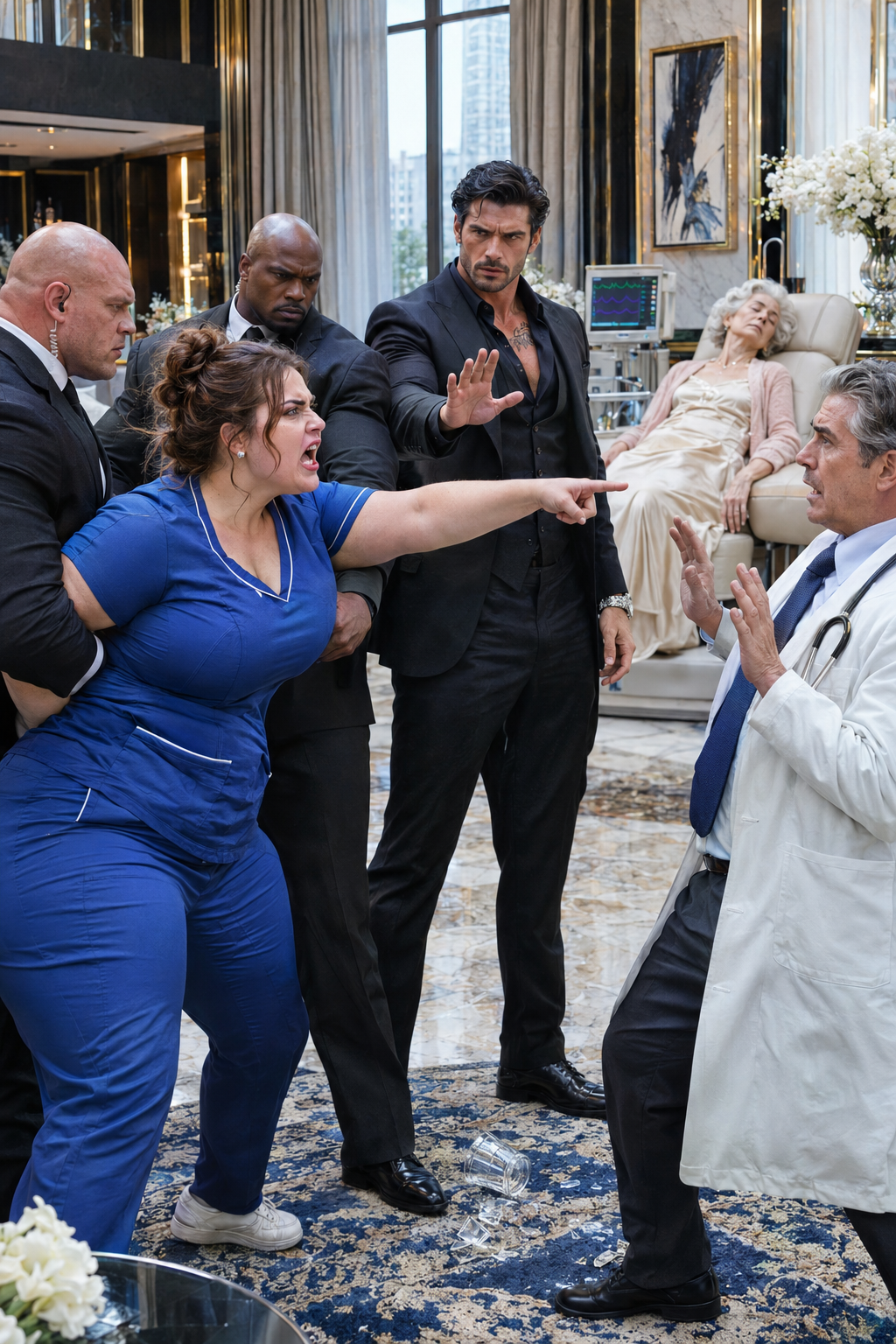
“Get out of my room before I have you fired!” Rosa Moretti snapped, knocking a glass of water off her bedside table.
Matteo stood between Dr. Julian Cross and the bedroom door, his shoulders rigid and his eyes fixed on the physician’s face.
“Tell me what you gave her.”
Cross swallowed. “Matteo, your grandmother was becoming agitated. I administered something to calm her down.”
“Then why isn’t she breathing properly?” I demanded.
He looked at me with open hatred.
“You’re a nurse, Miss Bennett. You don’t understand the full complexity of her condition.”
“I understand that you gave an undocumented injection without telling the nurse responsible for her care.”
Rosa’s breathing became shallow.
I turned away from their argument and focused on the woman lying helplessly in front of me.
“Matteo, I need you to listen carefully. Don’t let him leave, but don’t interfere with the emergency team when they arrive.”
For one terrifying second, he seemed unable to move.
Then he nodded.
I checked Rosa’s pulse again, monitored her breathing, and followed the emergency dispatcher’s instructions while keeping her airway supported.
“Stay with me, Rosa,” I whispered. “You still owe me a rematch at cards.”
Her eyelids fluttered.
Then her body went frighteningly still.
“Grace?” Matteo called.
I didn’t answer.
I was too busy trying to keep his grandmother alive.
The paramedics arrived minutes later, although it felt like an entire lifetime.
They took one look at Rosa and moved immediately.
I gave them her medical history, the medications listed in her chart, and everything I’d witnessed.
“What was injected?” one paramedic asked.
Cross opened his mouth.
“An ordinary sedative.”
“Name and dosage,” I said sharply.
He hesitated.
That hesitation changed everything.
Matteo stepped toward him, but I caught his arm.
“Your grandmother needs you. Don’t give him another distraction.”
Something in my voice reached him.
He stepped back.
As the paramedics wheeled Rosa toward the ambulance, I grabbed her medication records and followed.
Behind me, Matteo spoke into his phone.
“Nobody leaves this property until the police arrive. And I want every camera recording preserved.”
For the first time since I’d entered the Moretti mansion, I heard fear beneath his anger.
Not fear for himself.
Fear of losing the only person in that house who had never been afraid to tell him the truth.
At the hospital, the next forty minutes nearly broke me.
Rosa was taken into emergency treatment while the doctors worked to stabilize her breathing and blood pressure.
I stood outside the room with my hands shaking.
I’d spent years learning how to stay calm in emergencies. How to assess a crisis, make decisions, and set my own emotions aside.
But once the doors closed, every terrible possibility came rushing back.
What if I’d entered the room thirty seconds earlier?
What if I’d stopped Cross before he touched her?
What if my suspicions had been right all along, and I’d waited too long to act?
“Grace.”
I looked up.
Matteo was standing beside the waiting room entrance.
His expensive suit was wrinkled. His dark hair was a mess, and there was something unfamiliar in his face.
He looked like an ordinary man whose family might be falling apart.
“Is she going to die?” he asked.
I wanted to promise him she wouldn’t.
But I couldn’t.
“She’s receiving emergency care. That’s all I know.”
He sat beside me.
For several minutes, neither of us spoke.
Then he said, “I should have believed you.”
I rubbed my hands together, trying to stop them trembling.
“You didn’t have the evidence I did.”
“You told me something was wrong.”
“And now we’re going to find out what.”
He turned toward me.
“Why did you stay? Every other nurse left after a few days.”
I thought about Rosa throwing that glass of water. About her sharp jokes, her stubborn refusal to eat oatmeal, and the way she secretly fed the garden birds despite insisting she hated them.
“Because she’s difficult,” I said. “Not disposable.”
Matteo lowered his head.
And for the first time, I saw the weight of everything he had been carrying.
The emergency physician finally approached us.
“Mrs. Moretti is stable for now.”
Matteo stood so quickly his chair scraped against the floor.
“Can we see her?”
“Not yet. Her condition remains serious, but we’ve supported her breathing and she’s responding to treatment.”
My knees nearly gave out.
The doctor continued.
“We’re investigating the substances administered before her arrival. Some of her symptoms suggest medication-related effects, but we’ll need laboratory confirmation.”
“Will she recover?” Matteo asked.
“We’re cautiously optimistic. However, she’ll need close observation.”
He thanked the physician, then walked away without another word.
I found him several minutes later near a quiet stairwell.
He was staring at his phone, but the screen had gone dark.
“Matteo?”
“My parents died when I was twenty-one,” he said suddenly.
I hadn’t expected that.
“My grandmother buried her son and daughter-in-law, then came home and told me the family needed someone strong.”
His voice grew rough.
“She taught me everything. How to recognize a lie. How to negotiate. How to survive when people smiled while planning to destroy you.”
He looked at me.
“And I let someone hurt her inside her own home.”
“You trusted a physician who had treated her for years.”
“I don’t trust anyone.”
“Then maybe that’s part of the problem.”
His expression tightened.
“Excuse me?”
“You trust your own judgment so completely that you stop listening when someone sees something you missed.”
For a moment, I wondered whether I’d gone too far.
Then he gave a bitter little laugh.
“You’re not scared of me, are you?”
“I was terrified when Rosa stopped breathing. I’m not wasting energy being terrified of you.”
He looked at me for a long time.
Then he said something I would remember for years.
“I think my grandmother hired exactly the right person.”
The next morning, the hospital called to say Rosa was awake.
I was standing beside her bed when she opened her eyes fully.
“Well,” she rasped, “this is an ugly room.”
I laughed before I could stop myself.
“Good morning to you, too.”
“Where’s my grandson?”
“Outside, arguing with the security department because they won’t let him bring six bodyguards onto the ward.”
Rosa closed her eyes.
“That boy has always confused love with an armed invasion.”
I leaned closer.
“You frightened us.”
She studied my face.
Then her expression changed.
“Julian.”
I nodded.
“Do you remember what happened?”
She looked toward the window.
“He told me I was having another episode. I told him I felt fine.”
Her fingers trembled against the blanket.
“He said I was becoming difficult.”
I waited.
“He said sometimes people needed help understanding what was best for them.”
She swallowed.
“Then he gave me something.”
“You’re safe here,” I said.
Rosa turned toward me.
“No, Grace. I’m safe because you didn’t believe him.”
Before I could respond, Matteo entered.
The moment Rosa saw him, she raised one hand.
“Don’t you dare cry.”
“I’m not crying.”
“Then stop looking like someone canceled Christmas.”
He crossed the room and took her hand.
For a few seconds, neither spoke.
Then Rosa gently touched his cheek.
“My beautiful, impossible boy.”
Matteo bent forward and kissed her forehead.
I looked away to give them privacy.
But Rosa wasn’t finished.
“Now,” she announced, “somebody tell me why my physician tried to turn me into a vegetable.”
The investigation began that afternoon.
Hospital staff documented the medical evidence and provided relevant information to the authorities. Matteo’s attorney arranged for Rosa’s medication records to be preserved and reviewed independently.
Dr. Cross had been detained for questioning after investigators learned about the unauthorized injection.
His medical bag had also been collected as evidence.
I assumed the problem would end with his medical practice.
I was wrong.
Two days later, Matteo asked me to join him in Rosa’s hospital room.
An older attorney named Vincent Hale was waiting there with a folder.
Rosa sat upright against her pillows.
She looked stronger, though still exhausted.
“Grace,” she said, “sit down. You’re part of this.”
Vincent opened the folder.
“We’ve reviewed several months of financial activity involving Mrs. Moretti’s business interests.”
I glanced at Matteo.
He looked furious.
“Why financial activity?” I asked.
Vincent exchanged a look with Rosa.
“Because your concerns about the medication records led us to examine other decisions made during her periods of confusion.”
He placed several documents on the table.
“Mrs. Moretti had personally supervised financial distributions for decades. About eight months ago, she began making irregular approvals.”
Rosa frowned.
“I didn’t approve irregular distributions.”
“That’s what we’re trying to establish,” Vincent said.
He pointed to one document.
“A payment of nearly four hundred thousand dollars was authorized using credentials assigned to your office.”
Rosa leaned forward.
“To whom?”
“A consulting company with no clear business operations.”
Matteo spoke through clenched teeth.
“And it wasn’t the only payment.”
Vincent spread out more pages.
I counted seven.
“Altogether, we’ve identified more than two million dollars in suspicious transfers. There may be others.”
Rosa’s face went pale.
“Two million?”
“Some payments were attached to approvals made during periods when you were reported to be confused or medically unfit to attend meetings.”
I remembered the strange entries in her medication chart.
The extra doses.
The unexplained changes.
The mornings when Rosa could barely remember what she’d eaten for dinner.
“Cross was controlling when she could think clearly,” I whispered.
Vincent nodded.
“That is one possibility investigators are examining.”
Matteo turned toward the window.
“Every time she questioned an account, he increased her treatments.”
Rosa looked down at her hands.
“And every time I asked questions, people told me I was getting old.”
The room fell silent.
Then she spoke with a force that startled us all.
“I built those businesses with my husband. I worked when everyone thought a woman should smile and stay quiet. And that man made my own family question whether I understood my life’s work.”
I reached for her hand.
“He didn’t take away who you are.”
Her eyes filled with tears.
“He tried.”
“Yes,” I said. “But he failed.”
That afternoon, another discovery made the investigation even uglier.
The independent medical review found significant concerns about Rosa’s prescribed treatment. Some medications and recorded doses did not match what her condition appeared to require.
The doctors couldn’t immediately explain every symptom, but they began carefully reassessing her entire treatment plan.
Within days, Rosa became noticeably more alert.
Her memory improved.
She stopped drifting into confusion halfway through conversations.
She began asking for newspapers again.
Then she demanded financial reports.
By the end of the week, she was correcting Matteo’s calculations from her hospital bed.
“The Brighton property was purchased through the holding company,” she told him. “If your accountant can’t remember that, find a better accountant.”
Matteo stared at her.
I nearly laughed.
Rosa smiled at me.
“See? My brain still works.”
But while Rosa recovered, the danger surrounding Dr. Cross became clearer.
An examination of the suspicious payments revealed that the consulting company had connections to accounts controlled through Cross’s associates.
Investigators also uncovered records suggesting he had used confidential medical information to justify keeping Rosa away from meetings where the transfers might have been questioned.
For months, he’d presented himself as the concerned physician protecting an elderly woman from stress.
In reality, evidence increasingly showed he was exploiting her vulnerability to steal from businesses she had spent a lifetime building.
And when my questions threatened to expose him, he’d acted desperately.
One evening, Matteo came to the hospital looking more exhausted than I’d ever seen him.
“Cross has been formally charged,” he said.
Rosa put down her book.
“Good.”
“His medical license is under emergency suspension. The financial investigation is expanding.”
“Also good.”
Matteo looked at her.
“Grandma, he could have killed you.”
Rosa’s expression softened.
“But he didn’t.”
Then she pointed at me.
“Because that stubborn girl refused to let you intimidate her.”
I felt my cheeks warm.
Matteo looked at me, and something passed between us that neither of us could easily name.
He’d been watching me differently since the night at the hospital.
At first, I thought it was gratitude.
Then I noticed the small things.
He brought me coffee without asking because he’d learned I took it with milk and no sugar.
He listened when I spoke instead of interrupting.
When I finished a long shift, he asked whether I had eaten.
And once, when I fell asleep in an armchair beside Rosa’s bed, I woke to find a blanket draped over my shoulders.
Matteo was standing near the window.
“That was you?” I asked.
He looked almost embarrassed.
“You looked cold.”
I smiled.
“Thank you.”
He nodded, then quickly changed the subject.
But there was something else.
Something that troubled me more each day.
When we were alone, Matteo was thoughtful and gentle.
In public, he became distant.
Around his employees, he addressed me only as Miss Bennett.
If anyone entered while we were laughing together, he stepped away as though we’d been caught doing something improper.
I understood his world involved danger, privacy, and complicated loyalties.
But I also knew what it felt like to be treated as someone who belonged only behind closed doors.
And I had no intention of accepting that.
Three weeks after Rosa’s emergency, she returned home.
The mansion had been thoroughly reviewed. Medical supplies were secured under a new system, and an independent physician was overseeing her recovery.
The staff lined the entrance when Rosa arrived.
She walked through the doors with a cane, her chin raised like a queen returning to her kingdom.
“Why is everyone staring?” she demanded.
One housekeeper began crying.
Rosa sighed.
“Oh, for heaven’s sake. I’m not attending my own funeral.”
Then she hugged the woman.
I watched from the staircase as Matteo followed his grandmother inside.
For the first time, the mansion felt alive.
That evening, Rosa insisted on dinner in the main dining room.
She ate two servings of pasta, criticized the bread, and made Matteo promise to stop treating her like fragile glass.
After dessert, she asked me to stay behind.
“Grace, sit.”
I sat.
She studied me with those sharp gray eyes.
“Do you love my grandson?”
I nearly dropped my water glass.
“Mrs. Moretti!”
“That’s not an answer.”
“He’s my employer’s grandson.”
“And I’m the Queen of England.”
I laughed despite myself.
Rosa leaned closer.
“Matteo has spent his life building walls. Every person who approaches him wants something. Money. Influence. Protection.”
She paused.
“You walked into this house and told him he was wrong.”
“I wasn’t trying to impress him.”
“Exactly.”
My smile faded.
“He’s not an easy man.”
“No,” she admitted. “But he’s a better man than he allows people to see.”
I looked down at my hands.
“Sometimes he makes me feel like he’s ashamed to be seen with me.”
Rosa’s expression changed immediately.
“Has he said that?”
“No. But he treats me differently when we’re around other people.”
She sat back.
“Ah.”
It was a small sound.
But somehow I knew Matteo was about to have a very unpleasant conversation with his grandmother.
The next afternoon, he asked me to walk with him in the garden.
Autumn sunlight filtered through the trees, and the gravel path crunched beneath our shoes.
“Rosa says you’ve been avoiding me,” he said.
“I’ve been working.”
“Grace.”
I stopped walking.
“What do you want me to say?”
“The truth.”
I took a breath.
“The truth is that I care about you. More than I intended.”
His face softened.
“But?”
“But I won’t become somebody you only acknowledge when nobody else is looking.”
He looked startled.
“That’s not what I’m doing.”
“Then why do you step away when people enter a room? Why do you act like we’re strangers in front of your staff?”
“Because my life is complicated.”
“Everyone’s life is complicated, Matteo.”
“You don’t understand the risks.”
“Then explain them. Don’t make decisions for me.”
He ran a hand through his hair.
“People use anyone close to me. They watch. They threaten. They try to find weaknesses.”
I stepped closer.
“I’m not asking you to put me in danger. I’m asking you not to erase me.”
His expression tightened.
“I’m trying to protect you.”
“Protection without respect can become another kind of control.”
He went silent.
I could tell the words had hurt him.
But they needed to be said.
“I care about you,” I continued. “But I spent years building a life where I could stand on my own. I’m not giving that up to become someone’s hidden companion.”
“Grace—”
“No. Listen to me.”
He closed his mouth.
“If you want a relationship with me, it has to be honest. And Rosa’s medical care can’t depend on whatever happens between us.”
He looked at me for a long moment.
Then he whispered, “I don’t know how to do this.”
For the first time, I believed he was telling me something he had never admitted to another person.
“I don’t need you to know everything,” I said. “I need you to be willing to learn.”
I left him standing in the garden.
For two days, Matteo barely spoke to me.
He wasn’t cruel.
He wasn’t angry.
He simply seemed to have retreated into himself.
I wondered whether I’d asked for something he could never give.
Meanwhile, Rosa continued improving.
Her new physician reduced the unnecessary treatment burden under careful supervision, and her clarity returned enough for her to resume selected business responsibilities.
She also hired a separate professional nursing service, ensuring her care would no longer depend on my personal relationship with the family.
When she told me, I felt a strange mixture of relief and sadness.
“Are you dismissing me?” I asked.
“Absolutely not,” she said. “I’m giving you choices.”
She reached across the table.
“You saved my life, Grace. The last thing I want is for you to feel trapped in this house.”
I squeezed her hand.
“Thank you.”
She smiled mischievously.
“And if my grandson is too foolish to understand what he stands to lose, that is his problem.”
That night, I found an envelope outside my bedroom door.
Inside was a handwritten note from Matteo.
“Meet me downstairs at seven tomorrow evening. If you want to. No pressure. No secrets.”
I read it three times.
Then I laughed.
It was the least commanding message he’d ever sent me.
At seven the following evening, I walked downstairs wearing a simple navy dress.
Matteo stood in the entrance hall.
He wore a dark suit, but his hands were empty.
No phone.
No security briefing.
No impatient assistant hovering nearby.
“You look beautiful,” he said.
“Thank you.”
He offered me his arm.
“Where are we going?”
“To dinner.”
“At one of your private restaurants?”
“No.”
He smiled nervously.
“A very public one.”
I raised an eyebrow.
“Are you sure?”
“Not entirely.”
I laughed.
He took a breath.
“But I want to try.”
The restaurant was elegant but busy.
People recognized him immediately.
Several diners looked our way.
Matteo noticed.
I could feel his body tense beside me.
Then he reached for my hand.
Not secretly beneath the table.
Not behind a curtain.
Right there, where anyone could see.
He held it as the host led us to our seats.
“Is this okay?” he asked quietly.
I looked at our joined hands.
“Yes.”
He smiled.
And for the first time, I saw the man beneath the reputation without any walls between us.
Dinner wasn’t perfect.
He was awkward.
He asked too many questions about my favorite foods and kept checking whether I was comfortable.
At one point, he admitted he’d asked the chef to prepare three different desserts because he didn’t know what I liked.
“Matteo,” I said, laughing, “you could have just asked me.”
“I know.”
“You’re not negotiating a business deal.”
“That’s becoming painfully obvious.”
We laughed together.
It felt wonderfully ordinary.
Several weeks later, the investigation into Dr. Cross reached a decisive stage.
Prosecutors presented evidence connecting him to the unauthorized medical treatment and the financial scheme.
After reviewing the records, bank transactions, and testimony, Cross eventually agreed to a plea arrangement.
He admitted taking part in the embezzlement scheme and intentionally interfering with Rosa’s treatment to conceal his activities.
The criminal court imposed a prison sentence, and the authorities pursued recovery of the stolen funds.
His medical license was revoked through the appropriate disciplinary process.
The man who had once enjoyed complete access to Rosa’s household now had neither his profession nor his freedom.
But Rosa surprised everyone with her reaction.
When Vincent brought news of the sentence, she simply nodded.
“Then it’s finished.”
Matteo frowned.
“You’re not angry?”
“Of course I’m angry.”
She folded her newspaper.
“But I refuse to spend the rest of my life allowing Julian Cross to occupy my thoughts.”
She looked at me.
“He already stole enough of my time.”
I understood what she meant.
Justice mattered.
But so did reclaiming the life he’d nearly taken from her.
Over the following months, Rosa slowly returned to the routines she loved.
She supervised charitable donations, visited an old friend, and insisted on attending her favorite Sunday market.
She also began working with her attorney to strengthen the protections around her business decisions.
No physician would ever again have unchecked influence over her financial independence.
One morning, she asked me to accompany her into the garden.
We sat beneath a large oak tree while sunlight warmed the stone path.
“Do you know what frightened me most?” she asked.
“The injection?”
She shook her head.
“Before that. When I began forgetting things.”
I waited.
“I knew something was wrong. But everyone around me was so certain I was declining that eventually I wondered whether they knew me better than I knew myself.”
Her eyes grew wet.
“That is a terrible thing, Grace. To begin doubting your own mind.”
I took her hand.
“You deserved someone who listened.”
She smiled.
“And that’s exactly what you did.”
For several minutes, we sat quietly.
Then she cleared her throat.
“Now, speaking of people who need to listen, how is my grandson behaving?”
I laughed.
“Better.”
“Only better?”
“Much better.”
“Good. I trained him to run companies. Apparently, I forgot to teach him how to date.”
Six months after the night Rosa nearly died, Matteo invited me to a charity dinner supporting a new medical advocacy program for vulnerable older adults.
Rosa had helped establish it using recovered business funds and additional family contributions.
The program would provide independent care reviews and financial guidance to seniors who might otherwise have nobody willing to question suspicious decisions.
I stood in front of my mirror that evening, fastening a pair of earrings.
For a moment, I thought about the frightened woman I’d been when I first entered the Moretti mansion.
I’d expected a difficult patient and an impossible employer.
Instead, I’d found a family struggling with fear, pride, and misplaced trust.
A soft knock sounded at the door.
“Come in.”
Matteo entered carrying a small velvet box.
My heart skipped.
He noticed my expression and laughed.
“Relax. It’s not what you think.”
Inside was a delicate silver bracelet.
Attached to it was a tiny charm shaped like an oak leaf.
“Grandma chose it,” he explained. “She said you reminded her of the tree in the garden.”
I smiled.
“Strong and stubborn?”
“Her exact words were considerably less polite.”
He fastened it around my wrist.
Then he took both my hands.
“Grace, I need to tell you something.”
I looked up.
“When you first came here, I thought strength meant controlling everything. Every decision. Every risk. Every person I cared about.”
He paused.
“But I couldn’t control what happened to my grandmother. And the harder I tried to control everyone around me, the less I actually saw.”
His voice softened.
“You taught me that protecting someone also means respecting what they have to say.”
Tears pricked my eyes.
“You learned that yourself.”
“Only because you refused to let me ignore it.”
He kissed my forehead.
Then he offered his arm.
“Ready?”
I smiled.
“Ready.”
At the charity dinner, Matteo introduced me openly to friends, colleagues, and business partners.
Not as his employee.
Not as a family acquaintance.
Not as someone whose presence needed explaining away.
“This is Grace Bennett,” he said proudly. “My girlfriend.”
I glanced at him.
He squeezed my hand.
“And the woman who helped save my grandmother’s life.”
Across the room, Rosa raised her glass.
She was wearing a beautiful emerald-green dress and arguing cheerfully with Vincent about the seating arrangements.
When she noticed us watching, she pointed at Matteo and mouthed, “About time.”
I burst out laughing.
Later that evening, Rosa gave a short speech.
She didn’t mention Dr. Cross by name.
Instead, she spoke about the importance of listening when someone vulnerable says something is wrong.
“Too often,” she told the room, “we confuse age with weakness and authority with wisdom.”
The room grew quiet.
“I learned that a person can wear a white coat and still betray your trust. And a young nurse with no fancy title can be the bravest person in the room.”
My eyes filled with tears.
Rosa looked directly at me.
“Sometimes the person who saves you isn’t the one with the most power. It’s the one who refuses to look away.”
The applause rose around us.
Matteo slipped his hand into mine.
I held it tightly.
That night, after the event, we returned to the mansion and found Rosa sitting in the garden beneath her favorite tree.
She had kicked off her expensive shoes.
“Grandma,” Matteo said, “it’s nearly midnight.”
“I’m aware. I can read a clock again, remember?”
He sighed.
She smiled triumphantly.
I sat beside her.
“Did you enjoy tonight?”
“Very much.”
She looked between us.
“Especially the part where my grandson finally behaved like a civilized human being.”
Matteo rolled his eyes.
“Good night, Grandma.”
“Don’t rush away. I have something important to say.”
We waited.
She took my hand in one of hers and Matteo’s in the other.
“For most of my life, I believed loving people meant making sure nothing could ever hurt them.”
She looked at Matteo.
“I taught you that, and I’m sorry.”
His expression softened.
“You kept me safe.”
“I tried. But safety isn’t the same as living.”
She turned toward me.
“Grace reminded this family of something we’d forgotten.”
“What?” I asked.
Rosa smiled.
“That love without respect is just another kind of cage.”
The words stayed with me.
A year later, my life looked nothing like the one I’d imagined when I accepted the private nursing position.
I had returned to independent nursing work and helped develop an elder-care advocacy service connected to Rosa’s foundation.
I still visited her every week.
Usually, she greeted me by complaining that her new nurse was too strict.
Then she’d wink when the nurse wasn’t looking.
Matteo and I continued building our relationship carefully, learning to disagree without retreating into silence or control.
He still worried too much.
I still challenged him.
But now he listened.
And when fear made him want to close every door, he remembered that love wasn’t supposed to feel like imprisonment.
One Sunday afternoon, I arrived at the mansion and found Rosa standing beside the same bedside table where she’d thrown a glass on my first day.
She was holding two glasses of water.
“Do you remember our first meeting?” she asked.
I laughed.
“How could I forget?”
She handed me one.
“I was awful to you.”
“You were.”
She smiled.
“And you refused to leave.”
“I knew you needed someone.”
Rosa’s eyes softened.
“I did. More than either of us realized.”
She lifted her glass.
“To difficult women.”
I raised mine.
“To difficult women.”
We clinked glasses.
Then she added, “And to the men who eventually learn to listen.”
From the doorway, Matteo groaned.
“Am I ever going to hear the end of this?”
Rosa and I looked at each other.
Then we answered together.
“No.”
Our laughter filled the room.
And as I looked at the woman who had survived betrayal, illness, and a terrible abuse of trust, I understood something I’d carry for the rest of my life.
Sometimes courage doesn’t look like fighting an enemy or making a grand speech.
Sometimes it looks like noticing a mistake everyone else has accepted.
Sometimes it means asking one more question when someone powerful tells you to stop.
And sometimes it means refusing to let fear decide how much love, dignity, or freedom another person deserves.
Rosa hadn’t needed someone to control her.
She’d needed someone to believe her.
Matteo hadn’t needed someone who feared him.
He’d needed someone willing to tell him the truth.
And I hadn’t needed a powerful man to rescue me.
I’d needed a partner who could stand beside me without asking me to become smaller.
In the end, Dr. Cross had tried to steal Rosa’s independence, her fortune, and her future.
He lost his own freedom instead.
But the greatest victory wasn’t the money recovered or the sentence imposed.
It was seeing Rosa walk through her garden on her own terms, laughing at the world and making plans for tomorrow.
Because a person’s dignity isn’t measured by age, wealth, strength, or status.
It’s measured by their right to be heard, respected, and treated as fully human.
And sometimes, the most powerful words anyone can say are also the simplest.
“I believe you.”
The following spring, something happened that reminded me how much our lives had changed since the night Rosa Moretti nearly died.
I was finishing paperwork at the elder-care advocacy center when my phone rang.
It was Rosa.
“Grace, darling, are you busy?”
“That depends. Have you frightened another nurse?”
“Not today. I have something important to tell you.”
Her unusually serious voice made me sit straighter.
“Is everything okay?”
“Everything is wonderful. But I need you and Matteo here tonight.”
Before I could ask another question, she hung up.
By seven that evening, Matteo and I were sitting across from her in the mansion’s dining room.
Rosa had prepared an elaborate dinner, which immediately made Matteo suspicious.
“Grandma, what have you done?”
“Why must you always assume I’ve done something?”
“Because the last time you organized a family dinner, you announced you were buying a vacation house without consulting anyone.”
“And it’s a lovely house.”
“That’s not the point.”
She waved him off.
After dessert, Rosa placed a thick envelope on the table.
“I’ve made some changes to my estate plans.”
Matteo’s expression darkened.
“Grandma, you don’t need to discuss that tonight.”
“Yes, I do. Because for years, everyone treated my money as though it were more important than my happiness.”
She looked at me.
“I’ve decided to establish a permanent independent fund for the advocacy center. It will continue helping vulnerable patients long after I’m gone.”
I stared at her.
“Rosa, that’s incredibly generous.”
“It’s necessary,” she replied. “What happened to me could happen to someone without a grandson, a lawyer, or a stubborn nurse.”
Matteo reached for her hand.
“You have my full support.”
She smiled at him.
“Good. Because I wasn’t asking permission.”
We laughed.
Then Rosa looked directly at me.
“Grace, I’d like you to help oversee the program’s patient advocacy standards. Not because you’re part of this family, but because you’ve earned my trust.”
I felt tears gathering in my eyes.
“I would be honored.”
Rosa nodded, satisfied.
“Wonderful. Now we can discuss something far more interesting.”
Matteo groaned.
“What now?”
She pointed at our joined hands.
“When are you two going to stop pretending marriage is a terrifying medical procedure?”
I nearly choked on my water.
Matteo laughed so hard he had to put down his glass.
“Grandma!”
“What? I’m seventy-eight, not blind.”
I looked at Matteo, whose expression suddenly became thoughtful.
For once, he didn’t make a joke or change the subject.
He simply squeezed my hand.
And I realized that whatever our future held, I no longer feared being invisible inside it.
Three months later, Matteo proposed in the mansion garden beneath Rosa’s favorite oak tree.
There were no photographers, no expensive audience, and no dramatic display of wealth.
Just the two of us, surrounded by the flowers Rosa had insisted on planting herself.
Matteo took both my hands.
“I used to believe love meant having someone you couldn’t bear to lose,” he said.
His voice trembled.
“But you taught me something better. Love means choosing someone every day, even when life is uncertain.”
Then he lowered himself onto one knee.
“Grace Bennett, will you marry me?”
I looked at the man who had once frightened an entire household simply by entering a room.
Now he was looking up at me, nervous and hopeful.
“Yes,” I whispered.
His face broke into the most beautiful smile I’d ever seen.
“Yes?”
I laughed through my tears.
“Yes, Matteo.”
He slipped the ring onto my finger and stood to embrace me.
Then a loud voice came from the terrace.
“FINALLY!”
We turned.
Rosa was standing beside the open doors, holding a glass of sparkling cider.
Matteo closed his eyes.
“Grandma, were you watching?”
“Of course I was. Someone had to make sure you didn’t ruin the proposal with a business speech.”
We laughed until our sides hurt.
Our wedding took place that autumn.
Rosa walked proudly down the aisle before the ceremony, wearing an emerald dress and carrying a small bouquet.
When she reached me, she took my hands.
“Do you remember what I told you when we first met?”
“That you wanted me fired?”
She laughed.
“After that.”
I smiled.
“That I had a backbone.”
She nodded.
“Never lose it. Not for my grandson. Not for anyone.”
“I won’t.”
She kissed my cheek.
“Then welcome to the family, my darling.”
As I walked toward Matteo, I thought about everything that had brought us there.
A frightened elderly woman.
A physician who had betrayed his duty.
A grandson who had mistaken control for protection.
And one question that had changed all our lives.
Why was Rosa becoming worse after certain treatments?
That question had saved her life.
But it had also taught us something that money, power, and influence never could.
Trust isn’t earned through a title.
Respect isn’t guaranteed by age or position.
And love means very little unless it leaves room for another person’s voice.
Years later, people would sometimes ask how Matteo and I had met.
He always smiled and told them the same thing.
“She walked into my house, argued with my grandmother, challenged my judgment, and turned my entire life upside down.”
Then he’d take my hand and add, “And thank God she did.”
Rosa, whenever she overheard the story, always had the final word.
“Don’t forget,” she’d say, “I was the one who hired her.”
And she was right.
Rosa had hired me to care for her health.
None of us could have imagined that, by refusing to ignore her suffering, I would help her reclaim her independence, teach Matteo to open his heart, and find a family of my own.
The greatest gift Rosa ever gave us wasn’t her wealth or her name.
It was the lesson she had nearly lost her life learning.
Never surrender your dignity to someone simply because they claim to know what’s best for you. And never underestimate the power of one person who is brave enough to listen, believe, and stand beside you when everyone else looks away.
Because sometimes, saving a life doesn’t begin with a miracle.
It begins with someone saying, “Something isn’t right, and I’m not going to ignore it.”
THE END.