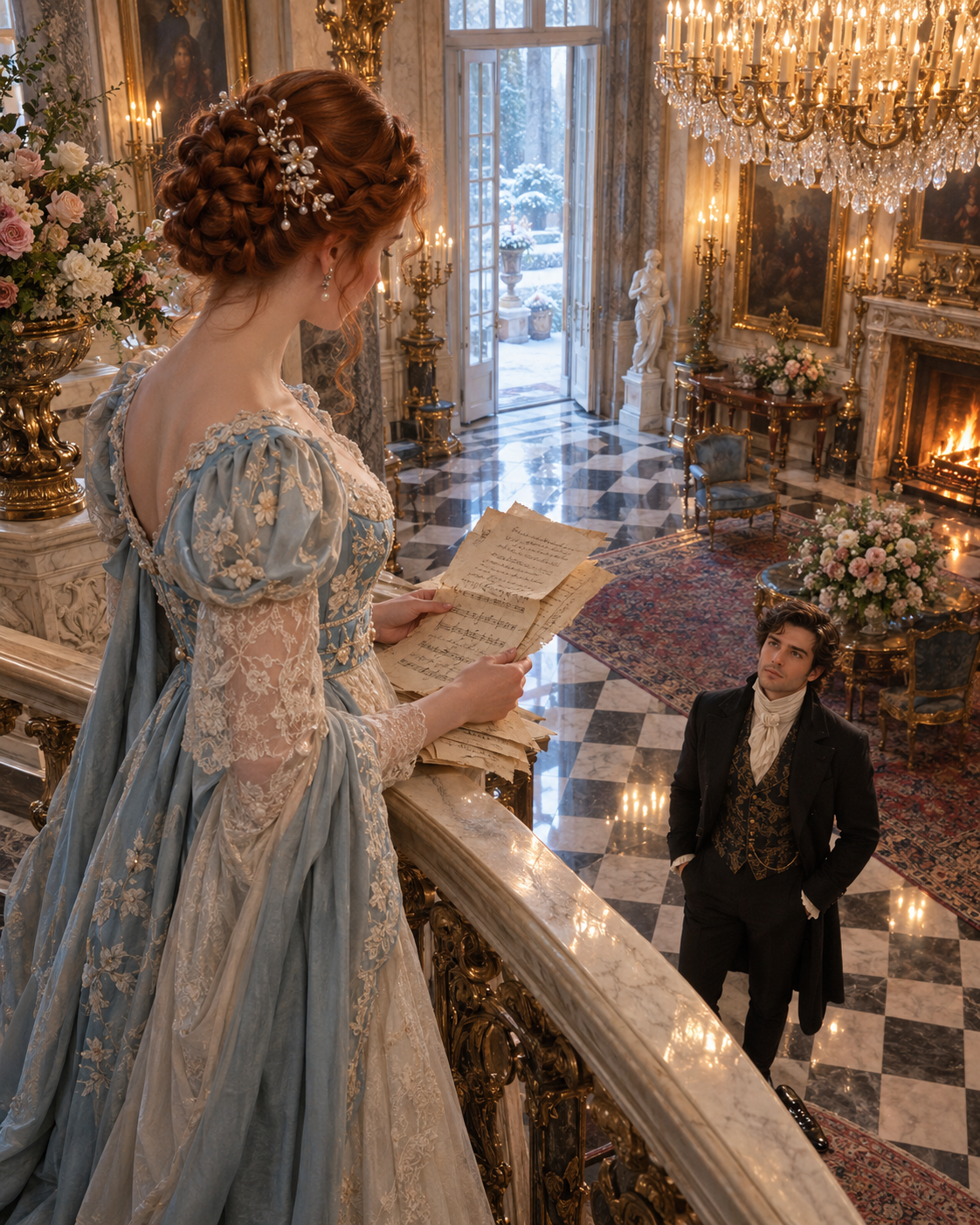
For years, Charlotte Harrington had been the woman behind the doors of Harrington Hall—the historic Virginia estate where old money, political connections, family dinners, and carefully guarded reputations mattered more than almost anything else.
Charlotte’s final words remained with William long after the carriage disappeared beyond the trees.
He stood alone in the entrance hall of Harrington Hall, one hand resting against the cold marble table where Charlotte had once arranged flowers every Monday morning. The house was quiet, but it no longer felt peaceful.
For the first time, William noticed how much of the room had been shaped by her.
The silver bowl on the console had been a gift from Charlotte’s grandmother. The portraits had been rearranged according to her instructions because afternoon sunlight used to fall too harshly across one of the older paintings. Even the large American flag hanging beside the library staircase had been placed there at Charlotte’s request after a veterans’ charity dinner she had organized years earlier.
He had lived among these details without seeing them.
Now every one of them seemed to accuse him of having been blind.
William walked into his study and closed the door.
On his desk lay the separation papers Charlotte had left behind.
He picked them up.
For several minutes, he did nothing.
Then he put them down again.
He had spent his entire adult life believing that control was the same thing as responsibility. As Duke of Harrington, he had inherited a name that opened doors in Washington, New York, Boston, and Virginia. People expected him to protect the family’s standing, settle disputes quietly, and never allow weakness to become public knowledge.
But Charlotte had shown him something he had never wanted to admit.
A family name was not a person.
A reputation was not a marriage.
And protecting one could destroy the other.
That night, William did not sleep.
At half past two in the morning, he returned to the study and opened the oldest drawer in his desk.
Inside was a leather folder containing Edmund’s financial records.
William had already discovered the forged signature.
What he had not yet understood was how long the deception had been operating.
He spread the documents across the desk.
Bank statements.
Property agreements.
Loan applications.
Private correspondence.
Then he saw a date that made him stop.
Three years earlier.
Charlotte’s signature had appeared on a guarantee for a loan Edmund had taken through a private investment company in New York.
William remembered that week.
Charlotte had been in Virginia.
He knew because he had complained about her absence.
She had been attending a charitable foundation meeting in Richmond and then spent several days at Briarwood House reviewing repairs after a winter storm.
She could not possibly have signed the document in Manhattan.
William’s stomach tightened.
He called his attorney before sunrise.
By eight o’clock, the attorney was standing in the study with two financial investigators.
“We need every original,” William said.
“Not copies.”
The investigators exchanged a glance.
“There may be more than one forged document,” one of them said.
William looked toward the windows.
“Find all of them.”
“And Edmund?”
William’s expression hardened.
“Do not warn him.”
By noon, the investigation had uncovered something worse.
Edmund had not simply forged Charlotte’s signature.
He had created a pattern.
Whenever a lender questioned his ability to repay, he used Charlotte’s inherited property and reputation as reassurance. Briarwood House had become a silent guarantee without Charlotte ever knowing it.
The documents had been carefully prepared.
The handwriting was close enough to pass casual inspection.
The names of Charlotte’s attorneys had been referenced.
Even private details about her inheritance had been included.
Someone had helped Edmund.
William knew that immediately.
This was not the work of a careless man making desperate decisions.
It was organized.
And as the investigators followed the trail, one name kept appearing.
Martin Vale.
The Harrington family’s longtime financial adviser.
William stared at the report.
Vale had been with the family for fifteen years.
He had attended Christmas dinners.
He had advised William’s father.
He had once helped Charlotte establish the charitable trust that supported rural hospitals across Virginia.
William could hardly breathe.
“Are you certain?” he asked.
The investigator nodded.
“We traced several transfers. The money did not remain with Edmund.”
“Where did it go?”
“Some of it went through shell companies. Some reached accounts connected to Mr. Vale.”
William closed his eyes.
Suddenly, another memory returned.
Six months earlier, Charlotte had asked him why Vale had requested copies of her estate documents.
William had barely looked up from his phone.
He had told her that Vale handled family finances and probably needed them for routine purposes.
Charlotte had accepted the answer.
She had trusted him.
And William had not even bothered to ask why.
He felt something inside him break.
Not because Edmund had betrayed the family.
Because Charlotte had warned him without even knowing she was warning him.
She had trusted him to care enough to notice.
He had failed.
At three in the afternoon, William drove to Briarwood House.
He did not call ahead.
He almost hoped Charlotte would refuse to see him.
Instead, a housekeeper opened the door.
“Mrs. Harrington is in the library.”
William walked through the familiar hallway.
Briarwood was smaller than Harrington Hall, but warmer. The walls were painted in soft colors, the windows opened toward the old oak trees, and books filled nearly every shelf.
Charlotte stood beside the fireplace with a document in her hand.
She did not look surprised.
“I wondered when you would come.”
William stopped several feet away.
“I found the rest of the evidence.”
“I know.”
He stared at her.
“You know?”
“Your attorney’s office sent me a copy this morning.”
William’s shoulders lowered.
“Charlotte, Edmund forged your signature.”
“I know.”
“And Vale helped him.”
“I know that too.”
For the first time, William realized she had been investigating independently.
“You knew before I did.”
“I suspected.”
“Why didn’t you tell me?”
Charlotte looked at him for a long moment.
“Because the last time I told you something was wrong, you asked me to lie.”
The words landed harder than anger could have.
William nodded slowly.
“You’re right.”
Charlotte’s expression softened, but only slightly.
“I did not need you to believe me because I was your wife. I needed you to investigate because I was innocent.”
“I should have.”
“Yes.”
There was no accusation in her voice.
That made it worse.
William took a folded document from his coat.
“We are filing everything with the authorities. The bank records, the forged guarantees, Vale’s transfers, all of it.”
Charlotte accepted the document.
“Good.”
“I want you to know that your name will be cleared publicly.”
She looked up.
“Why?”
William hesitated.
“Because you deserve it.”
“Only that?”
He understood what she meant.
He shook his head.
“No. Because I was wrong to ask you to carry something you didn’t do.”
Charlotte folded the document carefully.
“That is different.”
“Different from what?”
“From asking me to come home.”
William looked down.
“I know.”
“I need you to understand something, William.”
“I am listening.”
“When you first came here, I thought you wanted to repair our marriage. But if you are clearing my name because you want me back, then you are still making my dignity part of a bargain.”
“I don’t want a bargain.”
“Then prove it without asking anything from me.”
William nodded.
“I will.”
The investigation became public two days later.
The story appeared first in a Virginia newspaper, then in Richmond, Washington, New York, and eventually across national financial publications.
The headline was direct.
A prominent Virginia financial adviser had been accused of helping orchestrate fraudulent loans using forged documents and the identity of a member of the Harrington family.
Charlotte’s name appeared in the article.
But not as an accused party.
As the victim.
William had insisted that the correction be unmistakable.
Her attorneys released a statement explaining that she had never authorized the guarantees and had no involvement in Edmund’s financial arrangements.
For the first time in years, Charlotte saw her own name in the news without feeling the need to defend it.
The response from society was immediate.
Some people apologized.
Others disappeared.
A few sent carefully worded letters that said everything except the words they actually owed her.
Charlotte ignored most of them.
She had learned something important.
Not every apology deserved an answer.
Meanwhile, Edmund’s situation deteriorated rapidly.
His accounts were frozen.
His properties were examined.
The loans were reviewed.
And the comfortable life he had built by borrowing against other people’s trust began to collapse.
Vale resigned from every family position before investigators could formally remove him.
His attorneys insisted he had been acting under pressure from Edmund.
The investigators disagreed.
The evidence would eventually determine what could be proven in court.
William refused to interfere.
That decision mattered.
For years, the Harrington name had been used to make problems disappear.
Now William was allowing the law to decide what happened next.
He also made another decision.
He opened Harrington Hall to the public for a charity event supporting families facing financial fraud.
Charlotte heard about it from a newspaper.
She almost smiled.
It was exactly the sort of thing she would once have organized herself.
But this time, William was doing the work.
Not perfectly.
Not gracefully.
But sincerely.
Weeks passed.
The separation proceedings continued.
Charlotte returned to Briarwood House and began rebuilding her life around choices that belonged entirely to her.
She expanded her charitable foundation.
She hired her own financial advisers.
She traveled to New York without asking permission.
She attended dinners because she wanted to, not because a family calendar required it.
And she discovered that independence did not feel like rebellion.
It felt like breathing.
William, meanwhile, remained at Harrington Hall.
He had expected the house to feel larger without Charlotte.
Instead, it felt empty.
He began noticing all the things she had once handled.
Bills arrived late.
Appointments were missed.
Guests complained about details that had once been effortless.
But this time he did not blame anyone.
He hired staff.
He learned.
He apologized when necessary.
Most importantly, he stopped expecting Charlotte to return simply because he had finally become aware of her value.
One autumn afternoon, nearly four months after she left, William received a letter.
The handwriting was unmistakable.
He opened it slowly.
Charlotte was not asking him to come to Briarwood.
She was inviting him to a charity board meeting.
Nothing more.
William read the letter twice.
Then he smiled.
For the first time, an invitation from Charlotte did not feel like a test.
It felt like an opportunity.
He arrived at Briarwood the following Saturday.
Charlotte greeted him at the door.
They walked together through the garden.
For several minutes, neither spoke.
Finally William said, “I signed the separation papers.”
Charlotte stopped.
He reached into his coat and handed her the envelope.
“I signed them because you asked me to make a decision without expecting you to return.”
Charlotte looked at the papers.
“And?”
“I still don’t know what the future will be.”
She raised her eyes.
William continued.
“But I know I don’t want the man I was to make the decision for me.”
The wind moved through the oak trees.
Charlotte looked toward the house.
“You understand that signing those papers does not make everything disappear.”
“I know.”
“It doesn’t erase what happened.”
“I know.”
“It doesn’t mean I will come back.”
“I know.”
She studied him carefully.
“And you signed anyway.”
“Yes.”
“Why?”
William took a breath.
“Because you were right. Justice should not depend on whether you came home.”
For a long moment, Charlotte said nothing.
Then she placed the envelope on the garden table.
“I believe you.”
It was not forgiveness.
Not yet.
But it was the first thing William had heard from her that sounded like the beginning of trust.
The separation became official several weeks later.
There was no dramatic courtroom scene.
No shouting.
No desperate last-minute declaration.
Only two people sitting across from one another, acknowledging that love could not survive on obligation alone.
Afterward, Charlotte walked out of the courthouse in Richmond and into the crisp autumn air.
William followed several steps behind.
Outside, reporters waited.
One asked Charlotte whether she regretted leaving Harrington Hall.
She paused.
“No,” she said calmly.
Another asked whether she and William would reconcile.
Charlotte looked at William.
He did not answer for her.
That mattered.
She turned back to the reporters.
“That is a private decision.”
Then she walked away.
Months later, something unexpected happened.
Charlotte and William began working together again.
Not as husband and wife.
Not as duke and duchess.
Not because society expected it.
They worked together because they had discovered that they shared something stronger than a title.
A commitment to people who had been overlooked.
Their charity expanded into a financial-literacy program for families in rural Virginia.
They helped victims of identity theft understand their rights.
They funded legal assistance for people who had signed documents without fully understanding what they contained.
Charlotte designed the program.
William secured donors.
Neither tried to control the other.
One evening, after a foundation meeting in Washington, D.C., they stood outside the building beneath the city lights.
William looked at her.
“I used to think protecting a family meant protecting its name.”
Charlotte smiled faintly.
“And now?”
“Now I think it means protecting the people inside it.”
She looked toward Pennsylvania Avenue.
“That took you a while.”
“Too long.”
She laughed softly.
It was the first time William had heard that laugh directed at him in months.
He did not ask for anything more.
That was what made the moment different.
The next spring, Charlotte returned to Harrington Hall for the first time since leaving.
The house had changed.
Not physically.
William had left most things as they were.
But the atmosphere was different.
There were fewer formal dinners.
More charity meetings.
More staff from local communities.
The old rooms no longer felt like monuments to status.
They felt like rooms in a house.
Charlotte walked into the library.
On the desk was a framed document.
Her name was printed beneath a simple statement acknowledging that she had been wrongfully implicated in the fraudulent guarantees and that the record had been publicly corrected.
She touched the frame.
William stood in the doorway.
“I thought you might want to see it.”
Charlotte nodded.
“Thank you.”
He did not move closer.
Neither did she.
Outside, the first rain of spring began tapping against the windows.
Charlotte looked around the library.
“I used to think this house needed me.”
William smiled.
“It did.”
She shook her head.
“No. People needed me. There is a difference.”
William considered that.
“You’re right.”
Charlotte looked at him.
“And now?”
“Now I know the difference.”
They stood quietly for a moment.
There was no promise.
No dramatic reconciliation.
No perfect ending arranged for the comfort of everyone watching.
There was simply understanding.
Charlotte had spent years believing that loyalty meant staying, even when staying cost her dignity.
William had spent years believing that responsibility meant protecting appearances, even when appearances demanded sacrifice from someone he loved.
Both had been wrong.
The truth had not arrived like a grand speech.
It had arrived through documents, signatures, bank records, difficult conversations, and the courage to let consequences happen.
Charlotte did not need Harrington Hall to prove her worth.
William did not need Charlotte to return in order to prove that he had changed.
And perhaps that was the greatest lesson of all.
Sometimes leaving is not the end of love.
Sometimes it is the only way to discover whether love can exist without control, expectation, or fear.
Charlotte walked toward the library window.
Beyond the glass, the Virginia grounds stretched beneath the rain.
William joined her, leaving enough space between them for both to breathe.
Neither knew exactly what would happen next.
For once, neither demanded to know.
And in that uncertainty, there was something neither of them had possessed before.
Freedom.
The rain continued through the afternoon.
Charlotte remained by the library window, watching the gray veil move across the Virginia fields. There had been a time when she would have looked at those grounds and thought only of responsibility.
The gardens needed tending.
The accounts needed reviewing.
The staff needed direction.
The next dinner needed planning.
The family needed protecting.
There was always something.
Now, for the first time, she could simply stand there and watch the rain.
William remained several feet behind her.
Neither of them seemed eager to break the silence.
Then Charlotte noticed something on the desk.
A small brass key.
She picked it up.
“What is this?”
William looked at it.
“The old records room.”
She raised an eyebrow.
“I thought that room was locked.”
“It was.”
“Why?”
“Because I realized something after you left.”
Charlotte waited.
“I had spent years keeping records of everyone else’s obligations while knowing almost nothing about the person whose sacrifices made the house function.”
He walked to the desk and picked up another key.
“I’ve had the room reorganized.”
Charlotte frowned.
“Why?”
“Because I want the foundation records, the family financial records, and the charitable accounts kept separately. No one person should ever have that much unchecked authority again.”
Charlotte studied him.
“That sounds almost sensible.”
William smiled.
“Almost?”
“You still have a tendency to believe a good filing system can solve a human problem.”
He laughed.
“I probably deserve that.”
They walked toward the records room together.
The old room smelled of paper and cedar.
For decades, it had been used to store ledgers, correspondence, property records, and family documents. Charlotte remembered spending entire afternoons there during her first years at Harrington Hall.
She had once found it strangely comforting.
Now she understood why.
Paper could be organized.
People could not.
William unlocked the door.
Inside, everything had been labeled.
Boxes were arranged by year.
Financial records were separated from personal correspondence.
Legal documents had been copied and stored with independent counsel.
At the center of the room stood a new cabinet.
Charlotte opened it.
Inside were files bearing her name.
She froze.
“What are these?”
“Your records.”
“Why are they here?”
“Because you asked me to clear your name.”
He pointed toward the cabinet.
“Everything concerning the forged guarantees, the investigation, the legal proceedings, and the public corrections is there. Your attorneys have copies.”
Charlotte touched the edge of one folder.
“You kept everything.”
“I wanted the truth preserved.”
She looked at him.
“Even if the truth made your family look bad?”
“Especially then.”
That answer stayed with her.
For years, the Harrington family had treated truth as something that could be negotiated.
Now William seemed determined to treat it as something that could not.
Charlotte closed the cabinet.
“I think my grandfather would have liked that.”
“Your grandfather?”
“He used to say that a family that needed lies to survive had already forgotten what survival was for.”
William nodded.
“He sounds like a wise man.”
“He was.”
Charlotte looked around the room.
“And stubborn.”
“Then perhaps you inherited both qualities.”
She smiled.
“Perhaps.”
They returned to the library before dusk.
The rain had stopped.
A pale strip of sunlight appeared beyond the clouds.
William poured two cups of tea.
Charlotte accepted one.
They sat across from each other.
Not as husband and wife.
Not yet as strangers.
Something existed between them that neither had a name for.
It was not the old marriage.
It was not forgiveness.
It was something quieter.
Respect.
William placed his cup on the table.
“May I ask you something?”
“You may.”
“Do you regret marrying me?”
Charlotte looked down at the tea.
It was not an easy question.
“No.”
William looked surprised.
“I regret the years when I stopped asking myself what I wanted.”
She paused.
“And I regret allowing fear of disappointing you to become more important than honesty.”
William nodded slowly.
“Do you think we could have avoided all of this?”
“Maybe.”
He waited.
“But if we had,” Charlotte continued, “I don’t know if either of us would have learned anything.”
William gave a faint smile.
“That is a very Charlotte answer.”
“What does that mean?”
“It means you somehow manage to turn disaster into a lesson.”
“Only after the disaster has finished.”
They both laughed.
The sound felt unfamiliar in the house.
But it also felt right.
Later that evening, Charlotte prepared to leave.
William walked her to the front steps.
The rain had left the stone path shining beneath the porch lights.
She turned toward him.
“Thank you for today.”
“I should thank you.”
“For what?”
“For coming back.”
Charlotte shook her head.
“I came to see the house.”
“I know.”
“And the records.”
“I know.”
“And the foundation.”
“I know.”
William smiled.
“You still haven’t forgiven me.”
Charlotte looked at him.
“I haven’t said that.”
“I know.”
“But I haven’t forgotten what happened either.”
“I don’t want you to.”
She studied his face.
That answer mattered.
The old William would have wanted the past buried.
The new William seemed willing to live with it.
Charlotte stepped toward her car.
Then she stopped.
“William.”
“Yes?”
“If one day I decide I want to have dinner with you, it will be because I want dinner with you.”
His eyes met hers.
“Not because you’re my wife?”
“Not because I’m your wife.”
“Not because you’re expected to return?”
“Not because anyone expects anything.”
William nodded.
“Then I’ll wait for that day without asking when it will come.”
Charlotte smiled.
“Good.”
She drove away.
William remained on the steps until the headlights disappeared.
He did not feel victorious.
He did not feel certain.
For the first time in his life, he understood that love was not something a person won by persistence.
It was something another person freely gave.
And freedom meant accepting the possibility that the answer might be no.
The following months were unexpectedly peaceful.
Charlotte’s foundation grew.
Her work attracted lawyers, accountants, community leaders, and advocates from across Virginia.
The financial-fraud program became one of the foundation’s most successful projects.
People who had once been embarrassed to admit they had been deceived began attending workshops.
Charlotte insisted on one principle.
Victims should never be ashamed of asking questions.
At one meeting in Richmond, an elderly farmer approached her after the presentation.
“My son handled all my paperwork,” he said quietly. “I never learned what I was signing.”
Charlotte listened.
“That doesn’t make you foolish.”
He looked at her.
“What does it make me?”
“Human.”
The man smiled.
“Thank you.”
That evening, Charlotte returned to Briarwood House with a feeling she had not experienced in years.
Purpose.
Not duty.
Not obligation.
Purpose.
Meanwhile, William changed the structure of Harrington Hall.
He created independent oversight for family investments.
He separated charitable funds from private accounts.
He required multiple signatures for major financial decisions.
And he made one rule that caused considerable discomfort among several relatives.
No family member could use another relative’s assets as collateral without written authorization.
Some people complained.
William did not change it.
He had finally learned that a boundary was not an insult.
It was protection.
Edmund’s legal case moved slowly.
There were hearings, negotiations, and disputes over the money that had passed through different accounts.
Vale’s attorneys challenged portions of the evidence.
Some allegations were dismissed.
Others proceeded.
William never publicly speculated about what the final legal outcome would be.
He had learned another lesson.
Justice was not the same thing as revenge.
Charlotte agreed.
She wanted the truth established.
Nothing more.
One winter evening, almost a year after she had left Harrington Hall, Charlotte received an invitation.
Not from William.
From the Harrington Foundation.
The annual charity dinner was being held in Washington, D.C.
She almost declined.
Then she saw the purpose of the event.
The foundation was raising money for legal assistance to victims of financial fraud.
Charlotte smiled.
She accepted.
When she arrived at the hotel ballroom that evening, the room was filled with people she had known for years.
Some looked uncomfortable.
Some looked genuinely pleased to see her.
A few approached with apologies.
Charlotte accepted the sincere ones.
She ignored the performative ones.
Then William appeared.
He was wearing a simple black tuxedo.
He stopped when he saw her.
For a second, neither moved.
Then he smiled.
“You came.”
“I did.”
“Thank you.”
“I’m here for the foundation.”
“I know.”
That answer made her smile.
He had learned.
They spent the evening speaking with donors and community leaders.
There was no attempt to recreate their old marriage in public.
No staged photographs.
No carefully arranged announcement.
At the end of the evening, William found Charlotte standing near the ballroom windows.
The lights of Washington stretched below them.
“Would you like to have dinner sometime?” he asked.
Charlotte turned.
“Are you asking because of the foundation?”
“No.”
“Because people expect it?”
“No.”
“Because you think it means we’re getting back together?”
William shook his head.
“I’m asking because I would like to sit across from you and talk.”
Charlotte considered him.
“Just talk?”
“Just talk.”
She smiled.
“Then yes.”
It was a small word.
But William understood its weight.
Their dinner took place two weeks later.
No reporters knew.
No relatives were invited.
They met at a quiet restaurant in Georgetown.
They talked for three hours.
About books.
About Virginia.
About Charlotte’s plans for the foundation.
About William’s mistakes.
About the absurdity of their old dinner parties.
At one point, Charlotte laughed so hard that she had to put down her glass.
William watched her.
“What?”
“You haven’t laughed like that in years.”
Charlotte’s smile faded slightly.
“Neither have you.”
That silence was different.
It contained regret.
But it also contained possibility.
When the dinner ended, William walked her to her car.
“Thank you,” he said.
“For dinner?”
“For giving me an evening that didn’t have to mean anything.”
Charlotte looked at him.
“Perhaps it means something because it doesn’t have to.”
He smiled.
“Perhaps.”
They began seeing each other occasionally after that.
Not every week.
Not according to a schedule.
Sometimes they went months without meeting.
Other times they spent an entire afternoon walking through Briarwood’s gardens.
Their relationship developed slowly.
There were disagreements.
There were uncomfortable conversations.
There were moments when Charlotte remembered old wounds and pulled away.
William learned not to chase her.
He learned to listen.
Most importantly, he learned to accept that trust was not rebuilt through grand gestures.
It was rebuilt through small choices repeated over time.
One spring morning, Charlotte received a letter from William.
It contained no request.
No apology.
No declaration.
Only a sentence.
“I am grateful that you taught me the difference between being needed and being valued.”
Charlotte read it twice.
Then she placed the letter inside a drawer.
She did not answer immediately.
That evening, she walked through Briarwood House.
The old estate had become completely hers now.
Not an inheritance.
Not a refuge.
A home.
She stood in front of the mirror and remembered the woman she had been before everything happened.
Quiet.
Careful.
Always considering what everyone else needed.
She wondered what she would tell that woman now.
The answer came easily.
You were never difficult for wanting to be respected.
You were never selfish for saying no.
You were never cruel for refusing to carry someone else’s wrongdoing.
And leaving did not mean you had failed.
Sometimes leaving was how you found yourself again.
Charlotte sat at her desk and finally wrote back to William.
“Thank you for understanding.”
Nothing more.
It was enough.
The following summer, Harrington Hall hosted a community celebration.
For the first time, local families who had never been invited beyond the estate gates were welcomed onto the grounds.
There were food stalls.
Music.
Children running across the lawn.
Local artists displayed their work.
The old house looked different beneath the afternoon sun.
Less like a monument.
More like a home.
Charlotte arrived late.
William was standing near the garden.
When he saw her, he smiled.
“You came.”
“I told you I would.”
“I know.”
They watched the crowd together.
A young girl ran past carrying a small American flag.
Her father called after her.
She laughed and kept running.
Charlotte smiled.
“Do you remember when I first came here?”
“Yes.”
“I thought this place was the most intimidating house in Virginia.”
William laughed.
“And now?”
“Now I think it is just a house.”
He looked at her.
“That is probably the best thing anyone has ever said about it.”
Charlotte turned toward him.
“William.”
“Yes?”
“I’ve been thinking.”
His expression changed.
He waited.
“I don’t want to go back to the way things were.”
“I don’t either.”
“I don’t want to become the woman who manages your life while you manage the family name.”
“I don’t want that either.”
“I want my own work.”
“You should have it.”
“I want my own accounts.”
“Of course.”
“I want to be able to leave a room when I disagree with you.”
He smiled.
“I suspect you’ll continue doing that whether I approve or not.”
Charlotte laughed.
“And I want you to understand that if we ever try again, it will be because we choose each other as equals.”
William looked at her for a long time.
“Then that is the only way I would want it.”
She took a breath.
“I’m not promising forever.”
“I know.”
“I’m promising tomorrow.”
William smiled.
“Tomorrow is enough.”
They did not kiss.
Not then.
Instead, they walked together toward the garden where the music was beginning.
The next chapter of their lives would not be a return to the past.
It would be something neither of them had known how to build before.
A relationship without ownership.
A marriage without silence.
A family without fear.
Years later, people would still tell the story of the Harrington scandal.
Some would remember Edmund’s debts.
Others would remember the forged signatures.
Some would remember the newspaper headlines and the legal investigation.
But Charlotte remembered something else.
She remembered the moment she had stood at Harrington Hall and realized that she could walk away.
That moment had changed everything.
Not because leaving solved every problem.
It did not.
Leaving had cost her comfort.
It had cost her certainty.
It had forced her to rebuild a life she had once assumed would remain unchanged.
But it had given her something far more valuable.
Her voice.
Her choices.
Her name.
And eventually, it had given William the chance to understand that loving someone did not mean deciding what they should sacrifice for you.
Years after the scandal, Charlotte was invited to speak at a women’s leadership conference in Richmond.
She stood before a packed room.
The audience listened as she told the story of rebuilding her life after being publicly blamed for something she had not done.
She did not mention every private detail.
She did not need to.
At the end, a young woman raised her hand.
“What was the hardest part?”
Charlotte thought for a moment.
“Leaving was difficult.”
The room became quiet.
“But staying silent had become more difficult.”
Another woman asked, “What did you learn?”
Charlotte looked across the room.
“That your name belongs to you.”
She paused.
“Your reputation can be damaged by other people’s actions. Your trust can be broken. Your circumstances can change. But you still have the right to decide what you will accept.”
The audience remained silent.
Then Charlotte smiled.
“And sometimes the most courageous thing you can say is simply, ‘No. I did not do this. And I will not carry it for you.'”
The room erupted in applause.
William was sitting near the back.
He did not stand immediately.
He watched her.
Not with pride in the way a husband might be proud of his wife.
But with admiration for the woman who had taught him something he should have understood years earlier.
When Charlotte finished, she walked toward him.
“How long have you been sitting there?”
“Long enough.”
“Did you like the speech?”
“I liked the part where you didn’t mention my mistakes.”
She smiled.
“I considered it.”
“Thank you for your restraint.”
They walked outside together.
The evening sky over Richmond was clear.
For a while, they said nothing.
Then William reached for her hand.
Charlotte looked down.
Once, that gesture would have felt like an expectation.
Now it felt like a question.
She chose to answer it.
She placed her hand in his.
They continued walking.
Not toward Harrington Hall.
Not toward the life they had once shared.
Toward something new.
Something chosen.
And that was how Charlotte Harrington finally understood the strange truth at the heart of everything that had happened.
She had not lost her marriage when she left Harrington Hall.
She had lost the version of herself who believed love required her to disappear.
And William had not won her back by clearing her name.
He had only done what he should have done from the beginning.
He had told the truth.
He had accepted the consequences.
He had learned to let her choose.
Whatever happened after that belonged to both of them.
But for the first time, it also belonged to Charlotte.
And that was enough.
Because a woman does not find her worth when someone finally recognizes it.
She finds it when she stops allowing anyone else to define it.
The Harrington name survived.
But more importantly, Charlotte did.
And when the great doors of Harrington Hall closed behind them that evening, neither of them felt as though they were returning to the past.
They were leaving it there.
Together.
By choice.
THE END.