For two years, the Duchess of Ashworth had been the woman her husband could not be bothered to look at.
Alara did not move.
The wind screamed behind the Duke, carrying snow into the entrance hall. It melted against the stone floor, forming a thin trail of water between them.
For several seconds, neither spoke.
Then Alara stepped aside.
“Come in.”
The Duke closed his eyes briefly, as though those two words had cost her more than any forgiveness ever could.
He crossed the threshold.
Alara shut the door behind him.
“You’re freezing.”
“I’ll survive.”
“That has never been the question.”
He looked at her.
There was something in her voice that made him understand exactly what she meant.
The question had always been whether he had deserved to be allowed close enough to matter.
Alara turned away.
“Sit by the fire.”
He obeyed.
The children had been watching from the corridor.
One little boy, Thomas, whispered loudly, “Is that the Duke?”
Another child answered, “He looks like he’s dying.”
Alara glanced over.
“Back to bed.”
The children disappeared, giggling.
For the first time that night, the Duke almost smiled.
Then he coughed.
Alara brought him a blanket and a cup of hot tea.
He accepted both with trembling hands.
“You shouldn’t have come,” she said.
“I know.”
“You could have died.”
“I know.”
“Then why?”
The Duke stared into the fire.
“Because I spent two years believing you would always be there.”
His voice was low.
“I thought your patience was endless. I thought your kindness was something I could take for granted. I thought if I ignored what was happening between us long enough, it would somehow stop hurting.”
Alara said nothing.
“It didn’t.”
The fire cracked.
“It only taught you how to live without me.”
Her expression remained calm.
“Yes.”
That single word hurt him more than anger would have.
“I don’t expect you to forgive me tonight.”
“Good.”
“I don’t expect you to come home with me.”
“I won’t.”
His jaw tightened.
“I don’t expect you to love me.”
Alara looked at him then.
“That is the first honest thing you’ve said.”
He lowered his eyes.
“I deserve that.”
“No,” she said quietly. “You deserve the truth.”
He looked up.
“And the truth is that I loved you so much that I forgot what it felt like to be myself.”
The Duke went still.
“I waited for you. I waited for letters, conversations, meals together, anything. Every small kindness felt like a feast because I was starving.”
She swallowed.
“And then one day I realized I was spending my life standing outside a locked door, hoping the person inside would remember I existed.”
The Duke’s eyes reddened.
“I remembered.”
“Too late.”
He looked down at his hands.
“Yes.”
There was no argument.
No defense.
No excuse.
Only the sound of the storm pressing against the windows.
Eventually, Alara said, “You should sleep.”
“Will you stay?”
She hesitated.
“Not beside you.”
He nodded.
“That isn’t what I meant.”
“I know.”
She brought him a pillow and left him by the fire.
That night, the Duke of Ashworth slept on a narrow bench in an orphanage while his wife slept in a small room upstairs.
For the first time in his life, he understood the difference between having a place to belong and being welcomed there.
The next morning, the storm had weakened.
The Duke woke to the sound of children’s laughter.
When he opened his eyes, Thomas was standing in front of him.
“You snore.”
The Duke blinked.
“I do not.”
“You do.”
A girl beside Thomas nodded seriously.
“Very loudly.”
The Duke sat up.
“I am the Duke of Ashworth.”
Thomas shrugged.
“So?”
The Duke stared at him.
The children burst into laughter.
Something strange happened then.
The Duke laughed too.
It was awkward at first.
Rusty.
Almost unfamiliar.
But it was real.
Alara watched from the doorway.
She had never seen him like that.
Not as the powerful man who commanded servants with a glance.
Not as the distant husband who had treated affection like a weakness.
Just a man sitting on a bench while children mocked his snoring.
Their eyes met.
The Duke’s smile faded.
Alara smiled faintly.
Then she walked away.
It was not forgiveness.
But it was something.
A beginning, perhaps.
Or simply proof that the door was no longer completely locked.
The Duke returned to Ashworth Hall three days later.
Alara did not return with him.
He did not ask her to.
Instead, something unexpected began.
Every morning, a carriage arrived at the orphanage.
Sometimes it carried food.
Sometimes books.
Sometimes medicine.
Once, it carried six new beds because the children had been sleeping two to a mattress.
The Duke never appeared with the deliveries.
He never attached his name.
But Alara knew.
One afternoon, she found him standing in the courtyard.
“What are you doing here?”
“I was told the eastern wall still leaks.”
“It does.”
“I’ll have it repaired.”
“You don’t need my permission.”
“No.”
He paused.
“But I would like it.”
Alara looked at him.
“For what?”
“To do something useful without expecting anything in return.”
That answer stayed with her.
He did not ask for praise.
He did not ask her to come home.
He simply turned and left.
Weeks passed.
Winter deepened.
And slowly, the Duke began changing.
Not dramatically.
Not in ways that would make a good ballad.
There were no grand speeches in crowded halls.
No desperate declarations before witnesses.
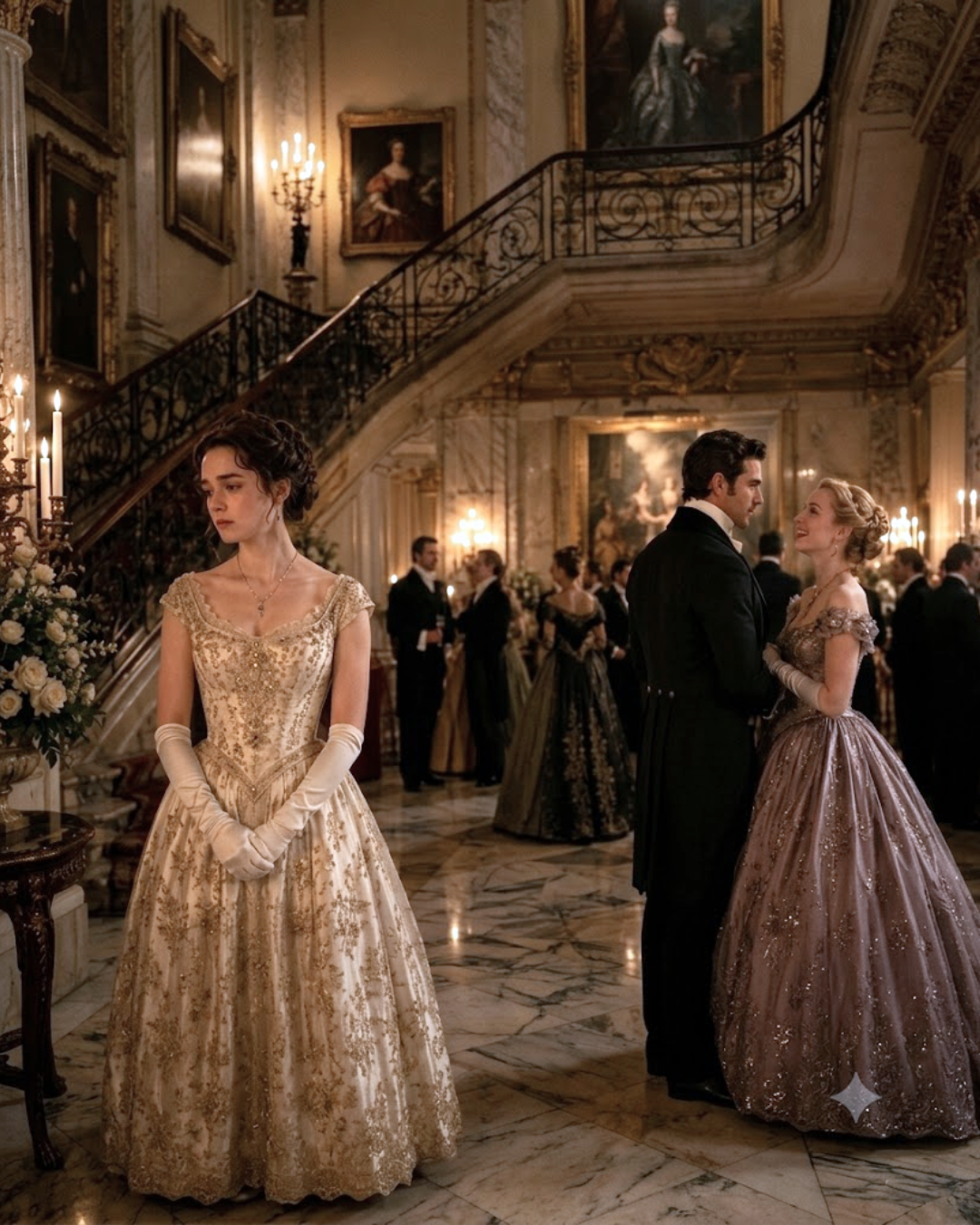
Instead, there were small things.
He began eating meals with his staff instead of alone in his study.
He visited the estate workers.
He learned their names.
He discovered that the old gardener’s wife was ill.
He discovered that the stable boy wanted to study accounting.
He discovered that the cook had been working fourteen-hour days because three servants had left.
Most importantly, he began listening.
And the strangest thing was that Alara heard about all of it from other people.
“You’ve changed him,” Lord Tilney said one afternoon.
Alara shook her head.
“No.”
“You haven’t?”
“No. I left him alone with the consequences of his own choices.”
Tilney smiled.
“That may be even more difficult.”
Alara laughed.
She was beginning to laugh often now.
Not because she was happy all the time.
Because she had finally stopped measuring her happiness by whether someone else noticed it.
One evening, a letter arrived from Ashworth Hall.
There was no greeting.
No formal title.
Only a single sentence.
“I hope you had a good day.”
Alara read it twice.
Then she folded it.
She did not answer.
The next day, another letter arrived.
“The orchard trees survived the frost.”
The following day:
“Thomas’s favorite horse at the orphanage is apparently faster than mine.”
Alara smiled.
Still, she did not reply.
The letters continued.
Never demanding.
Never accusing.
Never asking when she would return.
Then, one morning, she found a letter that was different.
“I have spent years believing that love meant being certain someone would never leave. I was wrong. Love is understanding that someone is free to leave, and choosing every day to become worthy of being asked to stay.”
Alara stared at the words for a long time.
Then she folded the letter and placed it beside her bed.
That evening, she finally wrote back.
“Thomas says your horse is slow.”
The reply arrived the next morning.
“Thomas is a traitor.”
Alara laughed aloud.
And for the first time in two years, she found herself looking forward to a letter.
Spring arrived.
The snow disappeared from the roads.
The orphanage garden began filling with green shoots.
Alara spent her mornings there, while the Duke continued managing Ashworth.
They saw each other occasionally.
Sometimes they spoke for an hour.
Sometimes only for a few minutes.
There were no promises.
No declarations.
No return to the old marriage.
The Duke seemed to understand that trust could not be rebuilt by demanding that the past be forgotten.
Then came the scandal.
A letter appeared in London claiming that the Duchess of Ashworth had abandoned her husband for another man.
The name mentioned was Lord Tilney.
The rumor spread quickly.
Within days, every drawing room seemed to know a different version of the story.
Some said Alara had fallen in love with Tilney.
Others said the Duke had driven her away.
Others simply enjoyed the spectacle.
The Duke was advised to issue a statement.
His secretary placed three drafts before him.
The first blamed the Duchess.
The second denied the affair.
The third suggested that the separation was temporary.
The Duke read all three.
Then tore them apart.
“What will you say?” his secretary asked.
“Nothing.”
“Your Grace, the rumors—”
“Are irrelevant.”
“But your reputation—”
The Duke looked up.
“My reputation is not more important than hers.”
The secretary fell silent.
That afternoon, the Duke attended a gathering at the Royal Society.
Someone made a careless remark about Alara.
The room became quiet.
The Duke stood.
“My wife owes none of you an explanation.”
The speaker laughed nervously.
“I meant no offense.”
“You meant to entertain yourself at her expense.”
The Duke’s voice remained calm.
“You may do so without me.”
He walked away.
By the following morning, the rumors had lost much of their power.
Alara heard what happened from a servant.
She said nothing.
But that night, she wrote another letter.
“You defended me.”
The Duke replied:
“You didn’t need defending.”
“Then why did you?”
“Because I should have protected your dignity when we were married. I failed then. I will not fail now.”
Alara read the words until the candle burned low.
Something inside her shifted.
Not because he had defended her.
Because he had finally understood what respect looked like.
A week later, she returned to Ashworth Hall.
The Duke was standing in the library when she entered.
He looked as though he had been holding his breath for months.
“Alara.”
“Your Grace.”
He smiled faintly.
“Still using my title?”
“For now.”
“I’ll accept that.”
She walked toward the window.
The garden looked different.
The same rose bushes.
The same stone fountain.
But she felt different standing there.
“I came because I want to talk.”
“I’ve been waiting.”
“No.”
He looked at her.
“You’ve been waiting for me to decide whether you deserve another chance.”
His expression softened.
“And?”
Alara turned toward him.
“I haven’t decided.”
His shoulders fell slightly.
“But I am willing to see what happens.”
The Duke nodded.
“That is more than I deserve.”
“Don’t say that.”
He frowned.
“Why?”
“Because if you keep telling me you don’t deserve anything, eventually I’ll have to spend my time convincing you otherwise.”
A smile touched his face.
“That sounds dangerously close to affection.”
“Don’t become arrogant again.”
“I wouldn’t dare.”
They began again.
Not as husband and wife.
Not yet.
As two people learning each other from the beginning.
They walked together in the evenings.
They spoke at dinner.
The Duke asked questions and actually waited for answers.
Alara disagreed with him.
He listened.
Sometimes they argued.
Sometimes they misunderstood each other.
But when that happened, neither walked away.
One summer evening, they returned from the orphanage after helping prepare a feast for the children.
The sky was pink over the fields.
The Duke stopped beside the garden gate.
“May I ask you something?”
“You may.”
“Do you still love me?”
Alara looked at him.
The old version of herself would have answered immediately.
The new version did not.
“I don’t know.”
He nodded.
“That is fair.”
She studied him.
“Does that frighten you?”
“Yes.”
“Good.”
He smiled.
“Why good?”
“Because fear means you finally understand that you cannot take me for granted.”
He looked at her for a long moment.
Then he reached into his pocket.
Alara stiffened.
He noticed.
Immediately, he stopped.
“I was going to give you something.”
“What?”
“A key.”
He opened his palm.
A small silver key rested there.
“To what?”
“The east wing.”
She frowned.
“It has been closed for years.”
“I had it opened.”
“Why?”
He looked toward the manor.
“Because you once told me you wanted a room where you could paint.”
Alara’s breath caught.
She had mentioned it only once.
Two years ago.
Before everything fell apart.
“I remembered,” he said.
“You remembered?”
“I remembered everything.”
She looked at the key.
Then at him.
“What changed?”
He answered honestly.
“You leaving.”
She almost laughed.
“That’s a terrible reason to become a better man.”
“I know.”
He looked down.
“But sometimes people only understand the value of something after they have lost the right to possess it.”
Alara took the key.
Their fingers touched.
Neither pulled away.
That night, she entered the east wing.
Sunlight poured through newly cleaned windows.
There were blank canvases.
Paint.
Books.
A long wooden table.
And on the wall hung a single framed portrait.
It was her.
Not dressed as a Duchess.
Not standing beside him.
She was sitting beneath an apple tree at the orphanage, laughing with the children.
She stared at it in silence.
The Duke stood in the doorway.
“I had it painted from memory.”
“You shouldn’t have.”
“Why?”
“Because you made me look happy.”
He smiled.
“You were.”
Alara looked at the portrait again.
For years, she had thought love meant being seen by one particular person.
Now she understood something else.
Being seen was wonderful.
But seeing herself had been what saved her.
She turned to the Duke.
“Stay.”
He stopped.
“Are you sure?”
“No.”
He smiled.
“That sounds like you.”
She laughed.
“Stay anyway.”
He entered.
They stood together in the quiet room.
There was no kiss.
No dramatic promise.
Only two people standing in the same room without fear.
And perhaps that was more meaningful than any declaration.
Months later, the orphanage held its annual winter feast.
The Duke arrived early.
He carried a sack of flour over one shoulder while Thomas followed behind him, loudly complaining that the Duke had cheated at chess.
“You changed the rules!”
“I did not.”
“You moved the bishop like a knight.”
“That was one time.”
“It was three times.”
Alara stood by the doorway, laughing.
The Duke looked at her.
Their eyes met.
This time, she did not look away.
She walked toward him.
“You’re late.”
“I arrived an hour ago.”
“You’re still late.”
“For what?”
“For dinner.”
He smiled.
“Then I suppose I’ll have to stay.”
“Yes,” she said.
“You will.”
That evening, after the children had gone to bed, Alara and the Duke stood outside beneath the first falling snow.
He offered her his hand.
She took it.
“I used to think the greatest tragedy was being unloved,” she said.
“What do you think now?”
“That it is forgetting to love yourself because you are waiting for someone else to do it.”
The Duke was silent.
“And you?”
“I think the greatest tragedy is loving someone and believing that love gives you the right to stop choosing them.”
She looked at him.
“That’s better.”
“I’ve been practicing.”
She smiled.
Then, slowly, she leaned her head against his shoulder.
The Duke did not move.
He seemed afraid that one careless motion might break the moment.
After a while, Alara whispered,
“You can hold me.”
His arms closed around her.
Gently.
Carefully.
As though she were not something he possessed, but something he had been trusted with.
And this time, when the snow fell around them, neither of them was standing at a locked door.
They had built a new one.
One that opened from both sides.
Their marriage was never the same after that.
It became something quieter.
Stronger.
More honest.
They still disagreed.
They still hurt each other sometimes.
They still had days when pride made conversation difficult.
But they learned the most important lesson slowly:
Love could not survive on memory.
It had to be chosen in the present.
Again.
And again.
And again.
Years later, people would tell the story differently.
Some would say the Duke crossed a terrible snowstorm to win back his wife.
Others would say the Duchess finally forgave him.
But Alara always corrected them.
“He didn’t win me back,” she would say.
“I chose to return.”
And whenever someone asked why, she would look toward the east wing, where sunlight spilled across the floor and children sometimes visited to paint beside her.
“Because forgiveness isn’t pretending the hurt never happened,” she would say.
“It is deciding that the hurt will not be the thing that defines the rest of your life.”
Then she would smile.
“And because he finally learned that love is not something you receive simply because someone once promised to stay.”
“It is something you earn by choosing that person while you still have the chance.”
The Duke would usually hear her from the doorway.
He would pretend not to.
And Alara would pretend not to notice.
But sometimes, when their eyes met, they both smiled.
Because after everything they had lost, they had finally learned what neither of them had understood at the beginning:
A heart does not always leave with a slammed door.
Sometimes it leaves quietly.
And if you wait until the silence becomes unbearable before you listen, you may discover that the person you thought would always be there has already learned how to live without you.
But if they return, it is not because they were helpless without you.
It is because they are strong enough to choose you again.
And that choice, freely given, is worth more than any promise made out of fear.
The Duchess of Ashworth never became the woman who waited by the window again.
She became the woman who opened the door only when she wanted to.
And the Duke never forgot the sound of that door opening.
Because he knew, better than anyone, what it had cost her to close it.
For a while, Alara believed that was where their story ended.
Not with a grand declaration.
Not with a wedding ceremony.
Not with some perfect promise that neither of them would ever hurt the other again.
Simply with two people who had finally learned how to stand beside one another without losing themselves.
But life, as Alara would discover, rarely allows a story to end simply because the heart has found peace.
Three years after that winter, Ashworth Hall was no longer the silent house it had once been.
There were children running through its gardens.
Servants laughing in the kitchens.
Books stacked on every available table.
The east wing had become Alara’s studio, but it was also a place where village children came twice a week to learn reading, painting, and music.
The Duke had helped establish a school on the estate.
He had also learned, much to his servants’ amusement, that managing a school was considerably harder than managing an army of estate workers.
Yet he never complained.
One morning, Alara found him sitting at a small desk surrounded by papers.
He looked exhausted.
“What are you doing?”
He looked up.
“Trying to understand why twelve children need seventeen different books to learn the same alphabet.”
“Because children are complicated.”
“So are taxes.”
“You married me. You should have expected complicated.”
He smiled.
“I did.”
Alara leaned over his shoulder.
“You’ve written the same number three times.”
The Duke looked at the paper.
Then at her.
“I was testing whether you would notice.”
“You’re a terrible liar.”
“I know.”
She kissed his cheek.
“Come to breakfast.”
He caught her hand before she could leave.
“Wait.”
She turned.
“What?”
He hesitated.
There was a strange expression in his eyes.
Not fear exactly.
Something deeper.
“There’s something I need to tell you.”
Her smile faded.
“What happened?”
“Nothing.”
“Then why do you look like that?”
He stood.
“I received a letter this morning.”
“From whom?”
“My brother.”
Alara knew immediately that something was wrong.
The Duke’s younger brother had lived abroad for years.
They rarely spoke.
“What does he want?”
“He is returning.”
“When?”
“Tomorrow.”
Alara waited.
The Duke looked toward the window.
“He wants to challenge my position as Duke.”
Silence filled the room.
Alara had heard enough stories about aristocratic families to understand what that meant.
“If he succeeds?”
“I lose control of the estate.”
“And us?”
The Duke looked at her.
“That is what concerns me.”
Alara frowned.
“Why?”
“Because the council will argue that you should leave with me if I lose the title.”
“And?”
“And I don’t know what I will be able to give you without Ashworth.”
Alara stared at him.
Then she laughed softly.
The Duke looked confused.
“What?”
“You really haven’t learned everything.”
“What haven’t I learned?”
“That I didn’t marry a title.”
He stepped closer.
“You married me.”
“Yes.”
“Then why are you laughing?”
“Because after everything we’ve survived, you still think I might leave because you lost a house.”
His expression softened.
“You have no idea how much that means to me.”
“I think I do.”
She reached for his hand.
“But there is something you need to understand.”
“What?”
“If your brother wants Ashworth, let him fight for the title.”
The Duke frowned.
“And you?”
“I will fight for you.”
The next morning, his brother arrived.
Lord Edmund Ashworth stepped from his carriage wearing a dark coat and an expression of perfect confidence.
He was younger than the Duke by four years.
He had spent most of his life away from England, but he had returned with powerful allies.
At his side stood three influential gentlemen from London.
Alara watched from the staircase as they entered the hall.
Edmund looked around.
“So this is what you’ve done with Father’s estate.”
The Duke remained calm.
“Yes.”
“You’ve turned it into a charity house.”
“A school.”
“A school.”
Edmund laughed.
“You were always sentimental.”
The Duke said nothing.
Edmund’s eyes moved toward Alara.
“And this must be the famous Duchess.”
Alara descended the stairs.
“Lord Edmund.”
He bowed.
“I’ve heard so much about you.”
“I imagine very little of it was accurate.”
Edmund smiled.
“You are direct.”
“I have become more so.”
His smile disappeared for a moment.
Then he turned toward his brother.
“I came to discuss the succession.”
The Duke nodded.
“Then let’s discuss it.”
The meeting lasted four hours.
Old documents were produced.
Arguments were made.
Witnesses were called.
Edmund claimed the Duke had neglected his responsibilities by allowing the estate to become a refuge for the poor.
The Duke’s supporters argued that he had increased the estate’s productivity and improved the lives of its tenants.
Neither side yielded.
Then Edmund produced a final document.
A letter written by the Duke’s father.
It stated that if the eldest son failed to maintain the family’s traditional standing, the title could pass to the younger son.
The room went silent.
The Duke read it carefully.
Alara watched his face.
For the first time in years, she saw the old shadow return.
The fear of losing everything.
The fear of becoming nobody.
Edmund smiled.
“You understand what this means.”
The Duke folded the paper.
“Yes.”
“You have one month to prove that you are fit to remain Duke.”
After Edmund left, the room remained silent.
The Duke stood beside the fireplace.
Alara approached him.
“You’re afraid.”
“Yes.”
“Of losing the title?”
He shook his head.
“Of becoming the man I was before you.”
She understood immediately.
The old Duke had measured his worth through status.
If that status disappeared, what would remain?
“You won’t become him.”
“How do you know?”
“Because he would never have admitted he was afraid.”
The Duke looked at her.
She touched his face.
“Titles don’t make people who they are.”
“No.”
“Choices do.”
The following month became a battle.
Edmund tried to persuade the council that the Duke had become weak.
He pointed to the school.
The orphanage.
The money spent repairing cottages.
The changes in estate management.
He called them signs of poor judgment.
The Duke did not retaliate with insults.
Instead, he opened the estate records.
Every number.
Every repair.
Every wage increase.
Every harvest.
Every improvement.
The accounts proved something Edmund had not expected.
Ashworth was thriving.
The estate had become more profitable while its tenants were living better.
The Duke had not abandoned tradition.
He had changed what tradition meant.
One afternoon, however, disaster struck.
A fire broke out in the east wing.
Alara was inside.
Smoke filled the corridor before anyone realized what had happened.
The Duke was in the courtyard when he heard the alarm.
He ran.
Servants tried to stop him.
“Your Grace, the roof—”
“My wife is inside.”
He entered.
Flames climbed the walls.
Smoke burned his lungs.
“Alara!”
No answer.
He ran deeper into the building.
Then he heard coughing.
The studio door was half open.
Alara was inside, trying to carry a box of children’s paintings.
“What are you doing?”
She looked at him in disbelief.
“Saving these.”
“Leave them!”
“They’re the children’s first paintings!”
“Alara!”
He grabbed her hand.
She refused to move.
“The door is blocked!”
He looked behind them.
Flames were spreading across the ceiling.
For one terrible second, the past seemed to return.
A locked door.
Silence.
Fear.
But this time, he did not walk away.
He lifted a wooden table and smashed the blocked door.
“Go!”
Alara followed.
They reached the corridor just as part of the ceiling collapsed behind them.
Outside, the servants rushed forward.
The Duke fell to his knees.
Alara grabbed his face.
“Are you hurt?”
He shook his head.
“Are you?”
“No.”
He closed his eyes.
Then pulled her against him.
For a moment, neither spoke.
The entire east wing burned behind them.
The next morning, Alara found the Duke standing among the ashes.
He stared at what remained of her studio.
“I failed you again.”
“No.”
“I should have protected this place.”
“You saved me.”
“I nearly lost you.”
“But you didn’t.”
He looked at her.
She held his hand.
“We can rebuild a room.”
He swallowed.
“Yes.”
“We can’t rebuild a person.”
His fingers tightened around hers.
“I know.”
They rebuilt the east wing.
But something else changed after the fire.
The Duke finally stopped fearing loss.
He understood that no house, title, portrait, or piece of land could guarantee that someone would stay.
Everything could disappear.
The only thing a person could control was how they loved while they still had the chance.
When the council met again, Edmund expected victory.
Instead, the council presented the estate records.
Then the school reports.
Then testimony from the tenants.
One by one, people spoke.
The old gardener.
The stable boy who had become an accountant.
The schoolmaster.
The widows whose homes had been repaired.
The children from the orphanage.
Even servants who had once feared speaking in front of the Duke.
They all said the same thing.
The Duke had changed.
Not because someone forced him.
Because he had chosen to.
Edmund listened in silence.
At the end of the hearing, he stood.
“I understand.”
The Duke looked at him.
“You’re withdrawing your claim?”
Edmund nodded.
“I came here believing that power was something you inherited.”
He glanced toward the people gathered in the hall.
“Perhaps I was wrong.”
The Duke offered his hand.
Edmund hesitated.
Then took it.
The conflict ended without a duel.
Without humiliation.
Without one brother destroying the other.
And perhaps that was the final proof of how far the Duke had come.
Years earlier, he would have fought to win.
Now he understood that not every victory required someone else to lose.
That evening, Alara found him in the garden.
The first spring roses had begun to bloom.
“You won,” she said.
He smiled.
“No.”
She raised an eyebrow.
“No?”
“I kept what mattered.”
She stepped closer.
“And what matters?”
He looked at her.
“You.”
She shook her head.
“Careful.”
“Why?”
“You’re starting to sound romantic.”
“I have been told I am improving.”
She laughed.
Then he became serious.
“There is something else.”
“What?”
He reached into his coat.
Alara recognized the small velvet box immediately.
She stared at it.
“Absolutely not.”
He laughed.
“I haven’t even opened it.”
“I know what is inside.”
“Do you?”
“You’re impossible.”
He opened the box.
Inside was a simple ring.
Not a grand diamond.
Not an ornament designed to impress society.
A small silver band engraved on the inside with three words:
Choose Me Again.
Alara’s eyes filled with tears.
He did not kneel.
He did not make a speech.
He simply held out the ring.
“I know we already married.”
“Yes.”
“I know you already chose me once.”
“Yes.”
“And I know I have no right to ask you to promise forever.”
He took a breath.
“So I’m not asking for forever.”
Alara looked at him.
“What are you asking for?”
“Tomorrow.”
She smiled through her tears.
“And the day after that?”
“If you’ll have me.”
“And the day after that?”
“I’ll ask again.”
She took the ring.
“Then I suppose I’ll have to keep answering.”
He smiled.
She slipped the ring onto her finger.
Then she kissed him.
Not because she needed him.
Not because she feared being alone.
Not because she had forgotten what he had done.
She kissed him because she wanted to.
Because love, after everything, had become a choice instead of a desperate plea.
Years passed.
The school grew.
The orphanage expanded.
The estate became known not only for its wealth but for the people it protected.
Alara continued painting.
Her work eventually appeared in galleries in London.
She became known for portraits that seemed to capture not simply faces, but the hidden stories behind them.
Her most famous painting was never sold.
It hung above the fireplace in the east wing.
It showed a woman standing beside an open door.
Snow covered the ground outside.
A man stood several steps away.
He was not reaching for her.
He was simply waiting.
The title of the painting was:
“The Choice.”
People often asked Alara what it meant.
She always gave the same answer.
“It is about the moment when love stops being a demand and becomes a choice.”
The Duke understood.
He always did.
On their twentieth wedding anniversary, they returned to the orphanage where everything had changed.
Thomas, now a grown man, stood beside the door with a wife and two children of his own.
“You still snore,” he told the Duke.
The Duke sighed.
“Some things never change.”
Alara laughed.
They walked through the old corridors.
The walls were different.
The children were different.
But the warmth remained.
That evening, Alara and the Duke stood outside beneath a clear sky.
No storm.
No locked doors.
No fear.
The Duke looked at her.
“Do you remember the first night I came here?”
“Yes.”
“I thought if you opened the door, everything would be forgiven.”
Alara smiled.
“I remember.”
“I was wrong.”
“Yes.”
“You didn’t forgive me that night.”
“No.”
“When did you?”
She thought about it.
“Perhaps I didn’t.”
He looked surprised.
She continued.
“I simply stopped needing the past to change before I could love the present.”
He was quiet.
“Is there a difference?”
“A great one.”
She took his hand.
“Forgiveness isn’t saying the wound didn’t matter.”
She looked toward the distant lights of Ashworth Hall.
“It means refusing to let the wound decide who you become.”
He squeezed her hand.
“And what did I become?”
She smiled.
“Someone who finally learned how to stay.”
He laughed softly.
“And you?”
She looked at the stars.
“Someone who learned that leaving can sometimes be the only way to teach someone what your presence was worth.”
They stood together for a long time.
Then the Duke leaned closer.
“Alara?”
“Yes?”
“Would you marry me again?”
She looked at him.
After all those years, after every argument and every reconciliation, every loss and every new beginning, she still saw the man who had once stood outside a door in a snowstorm.
But she also saw the man who had spent years learning how to become worthy of opening it.
She smiled.
“Yes.”
He kissed her forehead.
“Tomorrow?”
“Tomorrow.”
“And the day after?”
She laughed.
“You’ll have to ask again.”
“I will.”
They walked home together.
Not because one belonged to the other.
Because they belonged beside one another.
And that was the difference.
The world had once taught Alara that a woman was supposed to wait.
Wait for affection.
Wait for apologies.
Wait for a husband to notice her.
Wait for someone else to decide whether she was worthy of being loved.
She had learned otherwise.
And the Duke had learned that love was not proven by possession, wealth, grand gestures, or promises spoken when someone was afraid of losing you.
Love was proven in the ordinary moments.
In listening.
In changing.
In respecting the freedom of the person beside you.
In choosing them when no one was watching.
And most of all, in understanding that forgiveness could be offered without surrendering one’s dignity.
Their story was never really about a Duke winning back his Duchess.
It was about two people discovering that love could not be rebuilt on the ruins of what it had once been.
They had to build something new.
Something stronger.
Something neither of them could claim as a possession.
So whenever snow fell over Ashworth Hall, the Duke would sometimes stand by the window and remember that terrible night.
The night he arrived at the orphanage with nothing but regret.
The night he had expected a closed door.
And the night Alara had opened it.
Not because she had forgotten.
Not because she was weak.
But because she had decided that the future deserved a chance.
And every winter afterward, whenever the first snow began to cover the garden, he would find Alara beside him.
Sometimes she would take his hand.
Sometimes she would simply stand beside him.
Neither needed to say anything.
They had learned that silence could mean two very different things.
Once, silence had meant abandonment.
Now, it meant peace.
And perhaps that was the greatest gift their painful marriage had given them:
The knowledge that love is not measured by how desperately someone holds on to you.
It is measured by how freely you are allowed to choose.
Again.
And again.
And again.
Until one day, after all the storms have passed, you look beside you and realize that the person standing there is no longer someone you are afraid to lose.
They are someone you are grateful to choose.
Every single morning.
Every single night.
For as long as both of you remain free to say yes.
And so the Duchess of Ashworth never returned to the window where she had once waited for someone to notice her.
She did not need to.
The woman standing beside the window now was no longer waiting for anyone.
She was watching the life she had built.
A life filled with children, paintings, laughter, mistakes, forgiveness, and love.
And when the Duke came quietly into the room and reached for her hand, she gave it willingly.
Not because she had to.
Not because she was afraid he might leave.
But because after everything they had endured, she knew the difference between being needed and being chosen.
And that difference had changed everything.
The door between them had once been locked.
Now it remained open.
Not because either of them had forgotten how easily it could close.
But because both had finally learned how to walk through it without ever taking the other for granted again.
THE END