For three years, the Duchess of Westford wore another woman’s face without realizing it.
Lady Genevieve stepped inside.
She did not look surprised.
That was the first thing the Duchess noticed.
Not the emerald cloak.
Not the rain shining on the shoulders of her gown.
Not even the faint smile resting on her lips.
It was the calmness.
The woman had walked into a room where a marriage was collapsing and looked as though she had merely arrived for tea.
Lucian turned toward her.
“Genevieve.”
She closed the door behind her.
“I think,” she said quietly, “we have kept this secret long enough.”
The Duchess stared at her husband.
“Secret?”
Lucian’s jaw tightened.
Genevieve walked farther into the room.
“You asked whose money it was.”
The Duchess nodded.
Genevieve looked at Lucian.
“Tell her.”
He said nothing.
“Tell your wife whose money paid for every dress she wore.”
Still nothing.
Genevieve’s expression changed.
For the first time, the calmness disappeared.
“You promised me you would tell her when the time came.”
Lucian finally spoke.
“It was never supposed to happen like this.”
The Duchess almost laughed.
“Then how was it supposed to happen?”
He looked at her.
“I was going to explain.”
“When?”
His silence answered.
She bent down and picked up the letter from the floor.
Her eyes returned to the sentence.
I kept my promise. She still believes the money is hers.
“Why did you let me believe I was spending your money?”
Lucian took a step toward her.
“Because if you knew the truth, you would have left.”
“Perhaps I should have.”
He flinched.
Genevieve watched them both.
Then she said, “The money was your father’s.”
The Duchess froze.
“My father died twenty-four years ago.”
“I know.”
“My father left debts.”
“No,” Genevieve said. “That is what you were told.”
The room seemed to shrink.
“What are you talking about?”
Genevieve removed a small leather folder from beneath her cloak.
She placed it on the table.
Inside were documents.
Old documents.
Faded signatures.
Seals.
Bank statements.
And at the top of the first page was a name the Duchess had not seen in years.
Edmund Ashcombe.
Her father.
She picked up the paper with trembling fingers.
“What is this?”
“Your inheritance.”
The Duchess looked at Lucian.
“You told me there was nothing.”
“I was wrong.”
“No.”
Her voice hardened.
“You lied.”
“Yes.”
The word came from him quietly.
That hurt more than an excuse would have.
Genevieve folded her arms.
“Your father did not lose everything. He discovered that his business partner had been stealing from him for years. Before he could expose him, he was accused of fraud.”
The Duchess stared at the papers.
“The scandal destroyed his name.”
“And your mother,” Genevieve continued, “was forced to sell nearly everything to protect you.”
The Duchess remembered.
A childhood of rented houses.
A mother who never complained.
A locked study she had never been allowed to enter.
A single sentence repeated whenever she asked about her father.
He made mistakes.
She had believed it.
For years.
“He left a trust,” Genevieve said. “Your mother concealed it because the people who had ruined your father were still looking for it.”
The Duchess looked at Lucian.
“And you found it?”
“Yes.”
“How?”
“Three years ago.”
Her eyes narrowed.
“Three years ago.”
The same year she had married him.
The same year the dresses had begun.
The same year Lucian had slowly transformed her into someone else.
“You knew before our wedding.”
“Yes.”
“Why didn’t you tell me?”
Lucian lowered his gaze.
“Because your father left one condition.”
She waited.
“He wanted the trust to remain untouched until you were thirty.”
The Duchess frowned.
“I am twenty-nine.”
“Exactly.”
“Then why has the money been used?”
Lucian looked toward Genevieve.
She answered for him.
“Because someone began stealing from it.”
Silence.
The Duchess’s heart stopped.
“Who?”
Genevieve’s eyes met hers.
“Your uncle.”
The name struck like a slap.
Lord Henry Ashcombe.
Her father’s younger brother.
The man who had attended the funeral.
The man who had comforted her mother.
The man who had told her, when she was sixteen, that her father had ruined the family through reckless investments.
“He has been taking money from the trust for years,” Genevieve said.
“How?”
“Through companies registered under false names.”
The Duchess looked at the bank statements.
Millions had moved.
Not thousands.
Millions.
“And Lucian?”
“He discovered it.”
Her eyes returned to her husband.
“So you stopped him?”
“I tried.”
“And you used my money to do it?”
Lucian nodded.
“I needed access to the accounts. I needed to appear as though I controlled them.”
“You married me to protect the trust.”
“I married you because I loved you.”
The words came too quickly.
The Duchess shook her head.
“Do not say that now.”
“It is true.”
“Then why did you spend three years turning me into another woman?”
Lucian went still.
Genevieve looked down.
That question was the one no document could answer.
Finally, Lucian said, “Because I was afraid.”
“Of what?”
“That I would lose you.”
The Duchess stared at him.
He swallowed.
“Before I met you, I knew Genevieve.”
Genevieve closed her eyes.
“We were engaged,” she said.
The Duchess looked at her.
“Engaged?”
“For six months.”
Lucian continued.
“It was not love.”
Genevieve gave him a bitter smile.
“It was an arrangement.”
Their families had wanted the marriage.
Lucian had agreed.
Genevieve had agreed.
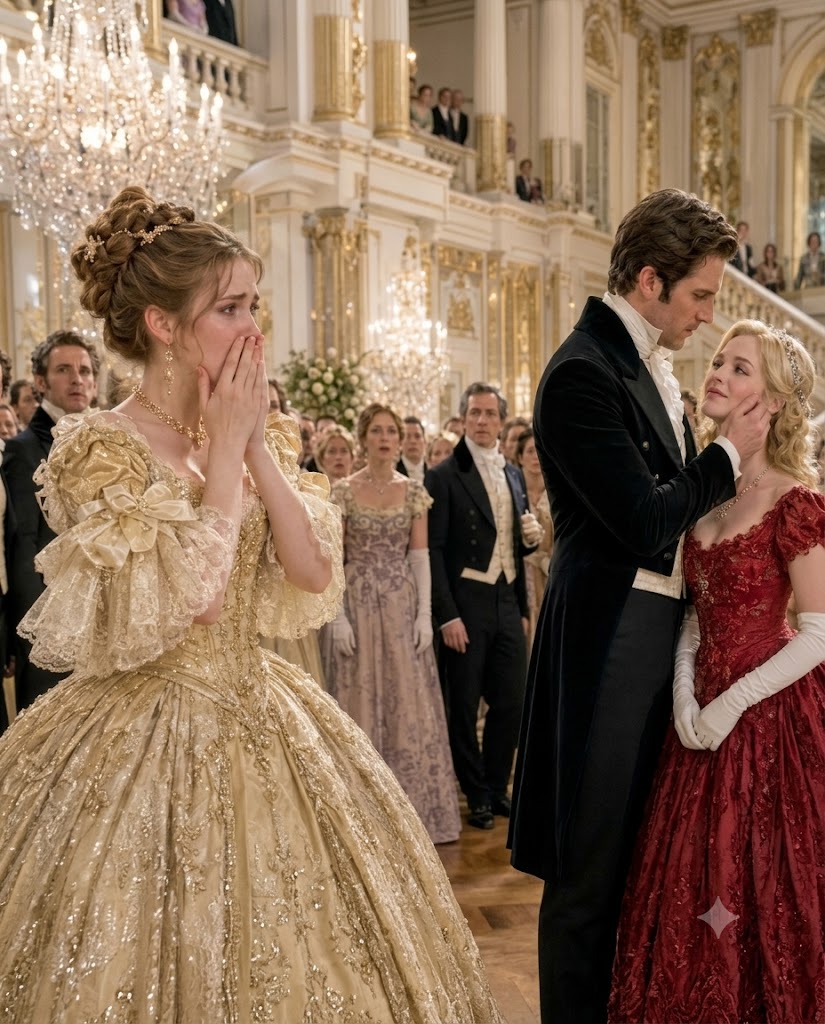
Then her younger brother died suddenly, leaving her family in financial ruin.
The engagement collapsed.
Genevieve left England.
Lucian believed he had lost everything.
Until he met the Duchess.
“She looked like you,” the Duchess whispered.
Genevieve did not deny it.
“Not exactly,” Lucian said.
“But enough.”
The Duchess felt something inside her break.
“So that was it.”
Lucian stepped forward.
“No.”
“You chose the dresses because they were hers.”
“Yes.”
“The perfume.”
“Yes.”
“My hair.”
“Yes.”
“The pearls.”
“Yes.”
She laughed once, without humor.
“For three years, you looked at me and imagined her.”
“That changed.”
“When?”
“The first time you laughed at me during breakfast.”
She stared at him.
“I don’t understand.”
“You were wearing one of those blue dresses. You hated it. You spilled tea on it and laughed instead of getting angry.”
His eyes softened.
“That was the first time I saw you.”
The Duchess said nothing.
“But by then,” he continued, “I had already done too much.”
Genevieve stepped closer.
“You were afraid she would discover the truth.”
Lucian nodded.
“So you kept dressing her like me.”
The Duchess looked at Genevieve.
“Why did you let him?”
Genevieve’s expression tightened.
“Because I believed it was protecting you.”
“That isn’t an answer.”
“No,” Genevieve said. “It isn’t.”
She moved toward the window.
“I was the one who told Lucian how dangerous your uncle was. I was the one who found the first forged document. I was the one who convinced him not to tell you until we had enough evidence.”
“And you thought pretending I was you was acceptable?”
“No.”
Genevieve turned around.
“I thought I was saving your life.”
The words silenced the room.
The Duchess looked at the documents again.
“Is my uncle coming here?”
“He already knows,” Genevieve said.
A cold feeling moved through her.
“How?”
Lucian’s face changed.
“Because the account was accessed this morning.”
He walked to the desk.
A drawer opened.
Inside was a revolver.
The Duchess stared at it.
“You expected trouble.”
“I expected him.”
A sound came from downstairs.
A door slamming.
Then footsteps.
Slow.
Measured.
Coming toward them.
Genevieve went pale.
Lucian moved in front of his wife.
“Stay behind me.”
“No.”
He looked back.
“What?”
“I have spent three years being protected from the truth.”
She picked up the leather folder.
“Not tonight.”
The door opened.
Lord Henry Ashcombe stood there.
He was older than she remembered.
Silver hair.
Perfect coat.
A cane in one hand.
And the same gentle smile he had worn at her father’s funeral.
“My dear,” he said.
“You look just like your mother.”
The Duchess felt her blood run cold.
“You lied to me.”
Henry sighed.
“Your husband has been filling your head with stories.”
“Did my father steal from his own company?”
“No.”
The answer was immediate.
The Duchess stared.
Henry continued.
“Your father was framed.”
“By you.”
He smiled sadly.
“By circumstances.”
“By you.”
His smile disappeared.
“You have always been emotional.”
Lucian stepped forward.
“Leave.”
Henry looked at him.
“You have interfered with my affairs for three years.”
“They are not your affairs.”
“They are my family.”
“No,” the Duchess said.
Everyone turned toward her.
“They are mine.”
Henry’s eyes narrowed.
“You have no idea what you are saying.”
“I know enough.”
She held up the papers.
“I know my father left a trust.”
Henry’s face changed.
“I know you stole from it.”
His grip tightened around the cane.
“And I know you killed him.”
Silence.
Genevieve inhaled sharply.
Lucian looked at her.
Henry’s expression became strangely calm.
“Careful.”
“My father was going to expose you.”
“You have been listening to too many lies.”
“My mother knew.”
Henry’s eyes flickered.
“She wrote everything down.”
The room went silent again.
The Duchess slowly reached into the folder.
There was one final envelope.
Her mother’s handwriting covered the front.
For my daughter, when she is old enough to know the truth.
She opened it.
Inside was a letter.
Her mother’s words were short.
Clear.
Terrified.
She had discovered Henry’s theft.
She had confronted him.
Her husband had planned to expose him.
Then he died.
Not in an accident.
Not from illness.
The letter named the doctor who had been bribed.
The lawyer who had falsified the papers.
And the account where the stolen money had been hidden.
The Duchess finished reading.
Tears filled her eyes.
“My father didn’t abandon us.”
“No,” Henry said quietly.
“He did not.”
For the first time, there was no denial in his voice.
Only something darker.
Resignation.
“He was going to destroy everything I had built.”
“So you killed him.”
“I did what I had to do.”
Lucian raised the revolver.
Henry laughed softly.
“You think you can shoot your way out of this?”
“No,” Lucian said.
“You already did.”
Henry frowned.
Lucian reached into his coat and pulled out a small recording device.
Henry’s face went white.
“Your confession is on record.”
The older man stared at him.
“You planned this.”
“For three years.”
Henry suddenly moved.
The cane struck Lucian’s wrist.
The revolver fell.
Genevieve screamed.
Henry lunged toward the Duchess.
She stepped back.
He grabbed her arm.
“You have no idea what this family costs.”
She fought him.
“Let me go!”
“You will sign the trust over to me.”
“No.”
“You will.”
“Never.”
Henry tightened his grip.
Then Genevieve struck him with the heavy silver candlestick from the table.
He staggered.
The Duchess pulled free.
Lucian caught her.
Henry fell to one knee.
Outside, the sound of horses and carriage wheels approached.
Then voices.
Men shouting.
Henry looked toward the window.
“What did you do?”
Lucian breathed heavily.
“I sent the evidence to the authorities before you arrived.”
Henry’s face collapsed.
“You wouldn’t.”
“I already did.”
The door burst open.
Two officers entered.
Henry looked around the room.
For the first time, he seemed old.
Very old.
As they took him away, he looked at the Duchess.
“You are throwing away your family.”
She watched him disappear.
“No,” she said quietly.
“I am finally taking it back.”
The room became silent.
Rain struck the windows.
Genevieve stood beside the table, staring at the floor.
Lucian picked up the revolver and handed it to an officer.
Then he turned to his wife.
“I know you hate me.”
She looked at him.
“I don’t hate you.”
His expression softened.
“I don’t know if that’s better.”
“It isn’t.”
He nodded.
She walked to the mirror.
For years, she had looked at herself and wondered why the woman staring back never felt entirely real.
Tonight, she understood.
It had never been her face that was wrong.
It had been the eyes of the man looking at her.
She removed the pearl necklace from her throat.
The necklace Lucian had chosen.
She placed it on the table.
Then she removed the earrings.
The bracelet.
One by one.
Not because they belonged to Genevieve.
Not anymore.
Because she no longer wanted to wear anything chosen for a woman she had never been.
Lucian watched silently.
“What will you do now?” he asked.
She turned toward him.
“Find out who I am without you.”
His eyes closed briefly.
“I deserve that.”
“Yes.”
Genevieve approached.
“There is one more thing.”
The Duchess looked at her.
“What?”
“Your father’s trust becomes yours tomorrow.”
She shook her head.
“No.”
Genevieve looked surprised.
“I don’t want it.”
“You cannot refuse it.”
“I can refuse to let it control me.”
She looked toward the window.
“For years, everyone has decided what I should wear, who I should trust, what I should know, and what I should become.”
She turned back.
“My father left me money.”
She smiled faintly.
“But my mother left me something more important.”
“What?”
“The truth.”
Lucian lowered his head.
The Duchess walked past him.
At the doorway, she stopped.
“Lucian.”
He looked up.
She expected to feel anger.
Instead, she felt tired.
“If you ever loved me, do one thing for me.”
“Anything.”
“Never make another woman feel as though she has to become someone else to be loved.”
His eyes filled with tears.
“I won’t.”
She left.
The next morning, London woke beneath a pale winter sky.
By noon, the newspapers had begun printing the scandal.
Lord Henry Ashcombe had been arrested.
Old financial crimes had been reopened.
The Westford household was under investigation.
And the forgotten daughter of Edmund Ashcombe was suddenly one of the wealthiest women in England.
But the Duchess refused every interview.
She did not attend the dinners where people whispered about her.
She did not answer invitations from families suddenly eager to call her a friend.
Instead, she returned to the house where her mother had lived during the final years of her life.
There, she found an old wooden box.
Inside were photographs.
Letters.
A dried flower.
A small silver comb.
And one final note.
You do not owe the world a version of yourself that makes other people comfortable.
She read it twice.
Then she cried.
Not because she was broken.
Because, for the first time, she understood she had never been.
Three months later, the trust was transferred into her name.
She used part of it to restore her father’s reputation.
Another part established scholarships in her mother’s name.
The rest she placed into a foundation that helped women escape controlling marriages and financial abuse.
People called it generosity.
She called it repayment.
To the parents who had lost everything trying to protect her.
To the girl she had once been.
And perhaps, in some small way, to the woman she might have become if someone had told her the truth sooner.
As for Lucian, he did not disappear.
He did not beg.
He did not send flowers or letters.
He gave her the space she had asked for.
Months passed.
Then one evening, a letter arrived.
She almost returned it unopened.
Instead, she read it.
I loved you badly.
I thought protecting you meant controlling what you knew, what you wore, and what you saw when you looked in the mirror.
I was wrong.
You were never a substitute for anyone.
You were never a shadow.
You were never something unfinished.
You were yourself.
I wish I had understood that before I hurt you.
There was no request for forgiveness.
No plea for another chance.
Only the truth.
She folded the letter.
She did not burn it.
She did not keep it beside her bed.
She placed it in a drawer and closed it.
A year later, the Duchess returned to Westford House for the first time.
The great hall had been renovated.
The portraits remained.
But she ordered one change.
A new portrait was commissioned.
Not in a pale silk dress.
Not wearing pearls.
Not styled like Genevieve.
She sat in a simple dark gown with her hair loose around her shoulders.
No jewelry.
No carefully arranged smile.
Just herself.
When the portrait was unveiled, Lucian was not there.
Genevieve was.
She stood beside the Duchess and looked up at the painting.
“You finally look happy.”
The Duchess smiled.
“I finally look like me.”
Genevieve nodded.
“I am sorry.”
“I know.”
They stood together in silence.
Two women who had once been trapped inside the same man’s memories.
Two women who had believed they were rivals when, in truth, neither had been the problem.
The problem had been the lie.
Outside, the bells of Westford Church began to ring.
The Duchess walked toward the window.
Sunlight spilled across the floor.
For three years, she had believed love meant being chosen.
Now she understood something different.
Love was not being molded into someone’s memory.
It was not surrendering your identity to keep someone beside you.
It was not protection that required silence.
Real love did not ask you to disappear.
It made room for you to exist completely.
She looked once more at the portrait.
Then she walked away from it.
Not because she wanted to forget the past.
But because she no longer needed the past to tell her who she was.
And for the first time in her life, when she entered a room, she did not wonder whose face people expected to see.
She knew exactly whose it was.
Her own.
For a while, the Duchess believed the hardest part was over.
Lord Henry Ashcombe was imprisoned.
Her father’s name had been restored.
The trust was finally hers.
And Lucian was no longer standing between her and the woman she had always been.
Herself.
But secrets rarely disappeared simply because the people who created them were gone.
Sometimes they left shadows behind.
And six months after Henry’s arrest, one of those shadows came looking for her.
It arrived on a cold morning in February.
A letter.
No crest.
No name.
Only six words written across the front.
You were never told everything.
She stared at it for several minutes.
Then she opened it.
Inside was a single sheet of paper.
Your father did not die because of Henry alone.
There was another man involved.
A man who still walks freely.
The Duchess read the sentence twice.
Her fingers became cold.
At the bottom was an address.
An abandoned estate outside Canterbury.
And beneath it, one final line.
If you want the truth, come alone.
She should have burned the letter.
Every sensible part of her mind told her to do exactly that.
Instead, she folded it and placed it inside her coat.
That evening, she told no one.
Not Genevieve.
Not her solicitor.
And certainly not Lucian.
She traveled the following morning.
The estate stood beyond a row of dead trees.
It had once belonged to a wealthy family.
Now the windows were broken and ivy covered the stone walls.
The Duchess stepped from the carriage.
The driver looked at the house.
“Are you certain, Your Grace?”
“No.”
She looked toward the dark doorway.
“But I’m going in anyway.”
Inside, the air smelled of dust and damp wood.
She walked through an empty hall.
Then she heard a voice.
“You came.”
She turned.
A man stood near the fireplace.
He was perhaps sixty.
Thin.
Elegant.
His gray hair was neatly combed.
There was something familiar about him.
Not his face.
His eyes.
“I know you,” she said.
He smiled.
“You knew my brother.”
“Who?”
“Henry.”
Her heart sank.
“You are his brother?”
“Edward Ashcombe.”
She stepped back.
“I should leave.”
“You should.”
He did not move to stop her.
“But if you leave, you will never know what your father discovered before he died.”
She remained where she was.
Edward reached into his coat.
He took out an old photograph.
He placed it on the table.
The Duchess approached.
Her father stood in the photograph beside three men.
One was Henry.
One was a younger Edward.
And the third—
She stopped breathing.
Lucian’s father.
She stared at the photograph.
“No.”
Edward nodded.
“Yes.”
Her mind raced.
“Your father and mine knew each other.”
“They were business partners.”
“And Lucian’s father?”
“Also.”
She looked at him.
“Why was this hidden?”
“Because your father discovered that the three families had been moving money through false companies for years.”
She closed her eyes.
“Henry told me he acted alone.”
“Henry lied.”
“Then why confess?”
“Because he had no choice.”
Edward sat down.
“Your father discovered everything. He intended to expose them. Henry panicked.”
“And Lucian’s father?”
“He helped Henry silence him.”
The room seemed to tilt.
Lucian.
His father.
The man who had raised him.
The man whose name had always been spoken with respect.
“He knew?”
Edward hesitated.
“Lucian knew something.”
The Duchess looked sharply at him.
“What?”
“He knew his father had been involved.”
Her heart sank.
“No.”
“Your husband spent three years trying to uncover the truth.”
“Then why didn’t he tell me?”
“Because he was afraid.”
She almost laughed.
“That is always the answer, isn’t it?”
Edward looked at her.
“Fear is what ruined both your families.”
He handed her another document.
It was a letter.
Lucian’s father’s handwriting.
She read it.
I did what Henry asked because I believed Edmund would destroy us all.
I have regretted it ever since.
But regret does not resurrect the dead.
At the bottom was a date.
Two days before her father died.
She folded the letter.
“Why give this to me now?”
“Because Henry is not the only one who deserves to face justice.”
She looked at him.
“Where is Lucian’s father?”
“Dead.”
“And Lucian?”
Edward looked away.
“That depends on what you decide to do with this.”
She understood.
The letter was leverage.
Evidence.
Proof that Lucian’s family had been involved.
She took it.
Then she asked the question she had been afraid to ask.
“Did Lucian know his father was responsible for my father’s death before he married me?”
Edward did not answer immediately.
“No,” he said at last.
“But he suspected.”
She closed her eyes.
Three years.
Three years of dresses.
Three years of lies.
Three years of a husband who had known more than he admitted.
She returned to Westford House before midnight.
Lucian was there.
He stood in the library when she entered.
He looked thinner than she remembered.
Older.
He did not smile.
“You found out.”
She froze.
“You knew.”
“I suspected.”
“You suspected your father helped kill mine.”
“Yes.”
“And you married me anyway.”
“I married you because I loved you.”
She laughed bitterly.
“Do you know how meaningless that sounds now?”
“I know.”
“You knew there was something wrong.”
“Yes.”
“You knew my uncle was involved.”
“Yes.”
“You knew your father might have been involved.”
“Yes.”
“And you still allowed me to believe the only secret was the trust.”
Lucian looked at the floor.
“I was afraid that if I told you everything, you would never let me near you.”
“You were right.”
He nodded.
“I know.”
The Duchess placed the letter on the table.
“This came from Edward Ashcombe.”
Lucian stared at it.
His face changed.
He did not touch it.
“You shouldn’t have that.”
“Why?”
“Because it proves my father was involved.”
“It proves more than that.”
He looked at her.
“It proves he helped destroy my family.”
Lucian’s voice broke.
“I know.”
She studied him.
For the first time, she realized something painful.
He had not been defending his father.
He had been carrying his father’s guilt.
But guilt was not innocence.
“You should have told me.”
“I should have.”
“You should have trusted me.”
“I should have.”
“You should have let me choose whether I wanted to stay.”
His eyes filled.
“I know.”
She looked at him for a long moment.
Then she said something he clearly did not expect.
“I forgive you.”
He looked up.
“But I will not take you back.”
The words landed softly.
Almost gently.
And somehow that made them more final.
Lucian closed his eyes.
“I understand.”
“I don’t forgive you because what you did was acceptable.”
“I know.”
“I forgive you because I refuse to spend the rest of my life carrying your secrets.”
He nodded.
She picked up the letter.
“Tomorrow, this goes to the authorities.”
Lucian looked at her.
“My father’s name will be destroyed.”
“Yes.”
“My family will be ruined.”
“Yes.”
He took a slow breath.
“Then do it.”
She studied him.
“You’re not going to stop me?”
“No.”
“Why?”
“Because for the first time, I think I finally understand what love is.”
He looked at her.
“Love is not protecting someone from the truth because you are afraid of losing them.”
The Duchess said nothing.
“It is trusting them enough to let them choose.”
She turned away.
At the door, she stopped.
“Lucian.”
“Yes?”
“You were wrong about one thing.”
He waited.
“I was never the woman you thought you married.”
A faint, sad smile appeared on his face.
“I know.”
“You were simply too afraid to meet the woman I actually was.”
Then she left.
The investigation began three weeks later.
The evidence was overwhelming.
Lucian’s father’s name was removed from several charitable foundations.
Old business records were reopened.
Several men who had escaped justice for decades were questioned.
Edward testified.
Then Genevieve testified.
Finally, Lucian did.
He told the truth.
All of it.
He admitted what he had known.
What he had suspected.
What he had hidden.
He did not defend himself.
He did not ask for mercy.
He simply told the truth.
And that changed everything.
The Duchess watched the proceedings from a private gallery.
She expected to feel satisfaction.
She did not.
She felt grief.
Not for the men being exposed.
For the years lost because adults had been too afraid to tell the truth.
After the final hearing, Lucian found her outside the courthouse.
He stopped several feet away.
“I won’t bother you,” he said.
She looked at him.
“I know.”
“I only wanted to thank you.”
“For what?”
“For making me tell the truth.”
She smiled sadly.
“You should have done that without me.”
“Yes.”
He turned to leave.
“Lucian.”
He stopped.
She looked at him.
“You don’t have to spend the rest of your life punishing yourself.”
He said nothing.
“Your father made his choices.”
“So did I.”
“Yes.”
She took a breath.
“But you can make different ones now.”
He nodded.
Then he walked away.
This time, she did not watch him disappear.
She turned toward the city instead.
Toward the life waiting for her.
Years passed.
Westford House changed.
The great halls that had once felt like a prison became something else.
A school was established in the eastern wing.
The old servants’ quarters were converted into apartments for women who had escaped abusive marriages.
The ballroom became a library.
The portrait gallery became an exhibition space where the stories of forgotten women were displayed.
And above the entrance to the foundation, the Duchess placed a simple inscription:
NO ONE SHOULD HAVE TO DISAPPEAR TO BE LOVED.
People asked her why she had chosen those words.
She always gave the same answer.
“Because I nearly did.”
Genevieve remained in her life.
Not as a rival.
Not as the ghost Lucian had once tried to recreate.
As a friend.
They traveled together.
Worked together.
Sometimes they even laughed about the absurdity of the past.
One summer evening, they stood in the garden beneath the old oak tree.
Genevieve looked toward the house.
“Do you ever miss him?”
The Duchess considered the question.
“Sometimes.”
“Do you want him back?”
“No.”
“Why?”
She smiled.
“Because missing someone is not the same as belonging to them.”
Genevieve nodded.
“That took you a long time to learn.”
“Yes.”
The Duchess looked toward the sunset.
“I thought love was something someone gave me.”
“And now?”
“Now I think love is something that should make me more myself, not less.”
Genevieve smiled.
“That sounds like wisdom.”
“No.”
The Duchess laughed softly.
“It sounds like experience.”
Years later, the Duchess stood in the same room where everything had begun.
The same wardrobe.
The same mirror.
The same tall windows.
She had kept one dress.
The first dress Lucian had chosen for her.
It was still beautiful.
Pale silk.
Delicate embroidery.
Perfectly made.
She had never worn it again.
That evening, she took it from the wardrobe.
Her daughter stood beside her.
“Mother?”
The Duchess looked at the dress.
“Do you like it?”
Her daughter touched the silk.
“Yes.”
“Then take it.”
The girl looked surprised.
“But I thought you hated it.”
“I did.”
“Why?”
The Duchess smiled.
“Because I thought it belonged to someone else.”
She placed the dress in her daughter’s hands.
“It doesn’t.”
Her daughter frowned.
“What do you mean?”
The Duchess knelt before her.
“I spent years believing that if someone loved me, I had to become what they wanted.”
She touched her daughter’s cheek.
“Never make that mistake.”
Her daughter nodded.
“What if someone says they love me but wants me to change everything?”
“Then ask yourself whether they love you—or the person they want you to become.”
The girl was quiet.
Then she asked:
“Did Father love you?”
The Duchess looked toward the window.
There was no anger in her face anymore.
“Yes.”
Her daughter looked surprised.
“Then why didn’t you stay?”
“Because love is not always enough.”
She paused.
“Sometimes two people can love each other and still hurt each other.”
“Is that what happened?”
“Yes.”
“Do you hate him?”
“No.”
“Do you forgive him?”
“Yes.”
“Would you marry him again?”
The Duchess smiled.
“No.”
Her daughter laughed.
“Why?”
“Because forgiveness is not the same thing as returning to the place where you were wounded.”
The girl thought about that.
Then she hugged her mother.
The Duchess held her tightly.
Outside, the evening bells began to ring.
She looked toward the portrait hanging above the fireplace.
Her own portrait.
The woman in it wore no pearls.
No silk chosen by another person.
No carefully arranged expression.
She was simply herself.
And suddenly the Duchess understood the final lesson of everything she had survived.
For years, she had believed her tragedy was that the man she loved had mistaken her for another woman.
But that had not been the deepest wound.
The deepest wound was that she had eventually begun to mistake herself for the woman he wanted.
She had looked into mirrors searching for Genevieve.
She had changed her clothes.
Her hair.
Her voice.
Her habits.
She had become quieter.
Smaller.
More agreeable.
All because she believed being loved required becoming easier to love.
It did not.
The truth was much simpler.
She had never needed to compete with another woman.
She had never needed to become more beautiful.
More elegant.
More desirable.
She had never needed to erase the parts of herself that made someone uncomfortable.
She only needed to remember that she was already whole.
Years later, when people told the story of the Duchess of Westford, they often called it a scandal.
A marriage ruined by secrets.
A family destroyed by greed.
A fortune recovered after decades of deception.
But the Duchess never called it that.
She called it an awakening.
Because she had entered her marriage believing that being chosen was the greatest proof of her worth.
She left it knowing that her worth had never depended on being chosen at all.
On the anniversary of her father’s death, she visited his grave.
She placed a white flower beside the stone.
“I know now,” she whispered.
“I know you didn’t abandon us.”
The wind moved through the trees.
She closed her eyes.
For the first time, the past did not feel like a chain.
It felt like a road she had already walked.
She could remember it without returning to it.
Before leaving, she touched the cold stone.
“I forgive you too.”
Then she stood.
And walked away.
Not as the wife who had once been dressed like another woman.
Not as the daughter of a disgraced man.
Not as the Duchess whose husband had lied to her.
She walked away as herself.
And perhaps that was the greatest victory of all.
Not the money.
Not the title.
Not the ruined men who had once controlled her family’s fate.
It was the quiet certainty that no one could ever again convince her that she had to disappear in order to deserve love.
Because love that demanded her disappearance was never love worth keeping.
And a life built on truth, however painful, was always better than a beautiful life built on a lie.
The Duchess of Westford had spent three years wearing another woman’s face.
It took her a lifetime to understand that she had never needed a different one.
She only needed the courage to look into the mirror—
and finally recognize her own.
THE END