For three years, Marielle, Duchess of Hartzell, had lived inside a marriage that looked perfect from the outside—but felt strangely empty once the grand doors of the Hartzell estate closed behind her.
The breakfast room had never seemed so large.
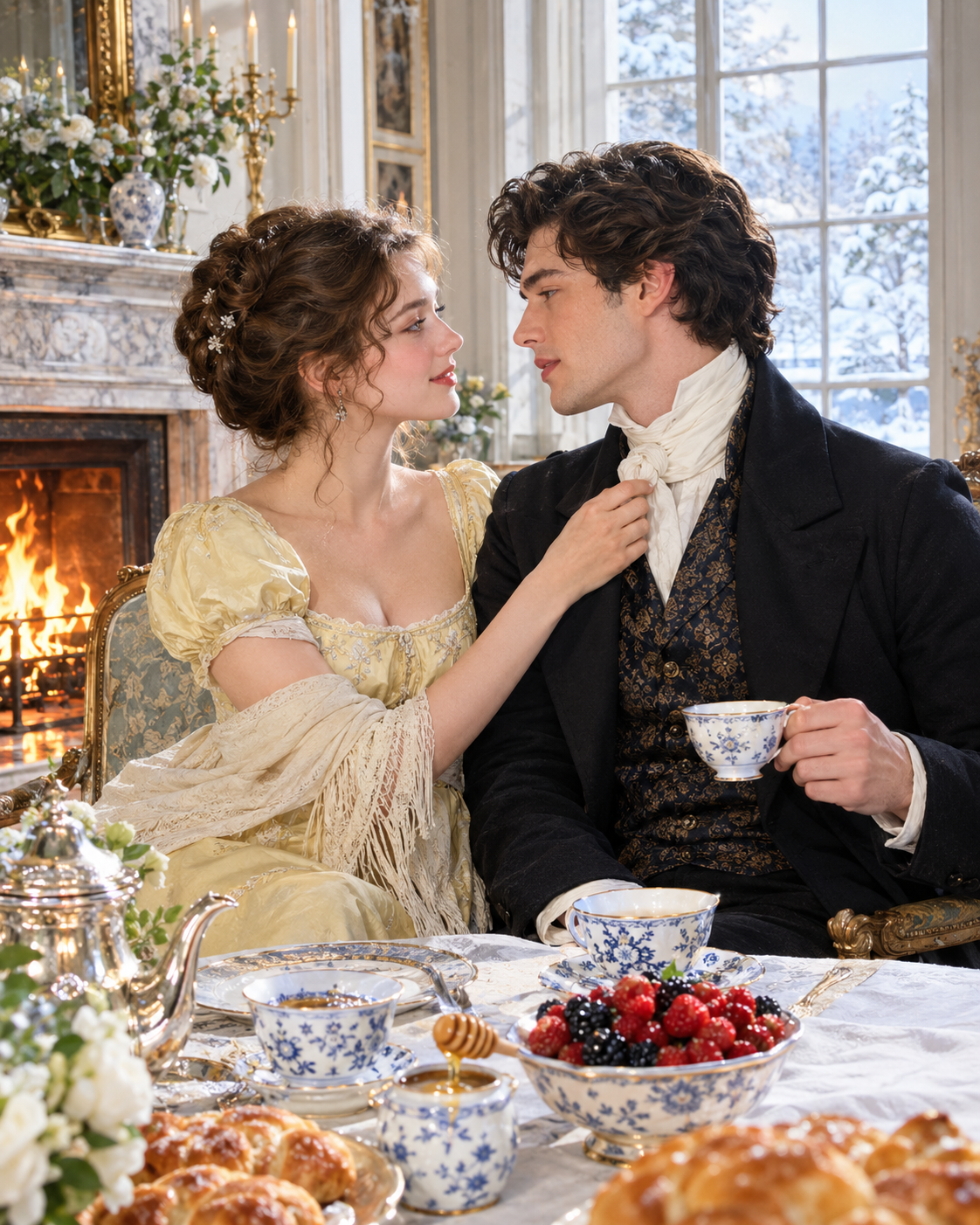
Morning light spilled across the long mahogany table, catching on silverware, crystal glasses, and the pale winter roses arranged in the center. Beyond the tall windows, the Hudson Valley lay beneath a hard blanket of snow. The American countryside was beautiful that morning, almost painfully so, but Marielle could not see any of it.
She could only hear the echo of her own memories.
Three years.
Three years of trying to make a marriage work.
Three years of sitting across from a husband who rarely looked at her.
Three years of wondering whether she had made a terrible mistake by believing that affection might eventually grow between them.
And now she remembered the trunk.
The letter.
The departure she had planned.
She stood near the doorway with her gloves clasped tightly in one hand.
“I am going to Bath,” she said quietly.
No one at the table moved.
Reald looked at her.
For several seconds, he said nothing.
His mother lowered her teacup.
His younger brother stared at him with an expression of disbelief.
Even the servants seemed to disappear into the background, leaving only the four members of the Hartzell family caught inside the unbearable silence.
Then Reald rose.
“If you have decided to leave,” he said, “I will not stop you.”
Marielle’s fingers tightened around her gloves.
She had expected resistance.
She had expected another cold argument, perhaps even indifference.
She had not expected permission.
“You won’t?”
“No.”
His voice was steady, but something in his eyes had changed.
“I have no right to ask you to remain simply because I have finally discovered what I should have understood three years ago.”
Marielle swallowed.
His mother looked sharply at him.
“Reald—”
“No, Mother.”
He turned toward the table.
“For three years, everyone in this family believed that Marielle and I simply had a quiet marriage. They thought we preferred privacy. They thought we were comfortable with distance.”
He paused.
“They were wrong.”
Marielle’s breath caught.
Reald looked directly at her.
“I was wrong.”
The room became completely still.
“I made this marriage cold,” he continued. “Not because she failed me. Not because she was difficult. Not because she expected too much. I did it because I was afraid of what would happen if I allowed myself to care.”
Marielle stared at him.
“You cared?”
The question escaped before she could stop it.
Reald’s expression tightened.
“I did.”
“Then why did you never tell me?”
“Because I was a coward.”
His mother’s face changed.
His brother slowly lowered his eyes.
Reald continued before anyone could interrupt.
“I convinced myself that keeping my feelings under control was the same as being responsible. I thought if I gave you a respectable home, security, a name, and everything money could provide, I had fulfilled my duty.”
His voice became quieter.
“But I never gave you myself.”
Marielle felt something break inside her—not dramatically, not loudly, but with the slow ache of a wound finally being touched after years of numbness.
“You could have told me.”
“I know.”
“You could have spoken to me.”
“I know.”
“You could have asked me what I wanted.”
“I know.”
Her eyes filled.
“And instead, you let me believe you didn’t love me.”
Reald lowered his head.
“That was the worst thing I did.”
For a moment, Marielle could not speak.
Then she looked toward the window.
“I wrote that letter because I thought you would be relieved.”
“You were wrong.”
“How could I have known?”
“You couldn’t.”
His answer came immediately.
“That is why I cannot blame you for leaving.”
He walked slowly toward her but stopped several feet away.
“I want you to hear something before you go.”
Marielle looked back at him.
“I love you.”
The words were simple.
No grand speech.
No elaborate promise.
Just four words spoken in a room where they should have been spoken years ago.
Marielle closed her eyes.
Reald continued.
“I don’t expect you to forgive me because I finally said it. I don’t expect the last few weeks to erase three years. And I certainly don’t expect you to remain because I have suddenly become the husband I should have been from the beginning.”
He took a breath.
“If you go to Bath, I will make certain you travel safely. If you never return, I will accept that. But if you stay…”
His voice faltered for the first time.
“If you stay, I will court you properly.”
Marielle opened her eyes.
“Court me?”
“Yes.”
“After three years of marriage?”
A faint, almost embarrassed smile appeared on his face.
“I realize the timing is unconventional.”
Despite everything, a tiny laugh escaped her.
It surprised them both.
Reald smiled too.
“I would like to know you,” he said. “Not as my duchess. Not as my wife. As Marielle.”
She looked at the man standing before her.
For the first time, she could see how exhausted he was.
Not physically.
Emotionally.
As though admitting the truth had cost him every defense he had spent years constructing.
“I don’t know if I can trust you,” she whispered.
“You shouldn’t trust me yet.”
His answer stopped her.
“You should watch what I do.”
The honesty in his voice frightened her more than a promise would have.
Because promises were easy.
Actions were not.
Marielle glanced at the clock.
Her carriage would be waiting.
She had imagined this departure countless times.
She had imagined walking through the doors with relief.
She had imagined reaching Bath and beginning again.
But she had never imagined standing there with the one thing she had secretly wanted for three years:
the truth.
She picked up her travel case.
Reald stepped aside.
He did not reach for it.
He did not plead.
He simply opened the door.
Marielle walked through.
But she did not leave the estate.
Instead, she stopped beneath the covered porch.
Snow fell softly beyond the stone steps.
Behind her, Reald remained inside.
Waiting.
Not demanding.
Waiting.
She turned around.
“How long would this courtship last?”
He looked almost startled.
“However long you require.”
“And if I decide I don’t love you?”
“Then I will accept it.”
“And if I do?”
His eyes met hers.
“Then I will spend the rest of my life making sure you never have to wonder again.”
Marielle looked away before he could see the tears in her eyes.
“Then perhaps,” she said, “we should start with breakfast.”
Reald blinked.
“Breakfast?”
“I am still hungry.”
For the first time in years, laughter filled the Hartzell breakfast room.
It was not the polished laughter of a formal gathering.
It was imperfect.
Unexpected.
Real.
And that was how their second beginning started.
Not with a grand ball.
Not with a public announcement.
Not with an extravagant declaration.
With breakfast.
Over the following weeks, Reald discovered that courting his own wife was considerably more difficult than he had imagined.
He learned that Marielle hated being surprised before breakfast but loved spontaneous walks after lunch.
She liked old jazz records played softly in the library and disliked the overly sweet pastries his chef insisted on serving.
She loved driving into the nearby American towns without an entourage and stopping at small cafés where nobody cared about titles.
She could spend an entire afternoon in a bookstore and emerge with seven books she had no intention of reading immediately.
Reald learned all of this because he asked.
That simple act changed everything.
Marielle noticed.
She noticed when he waited for her opinion before making decisions about the estate.
She noticed when he began leaving handwritten notes beside her morning coffee.
She noticed when he stopped assuming silence meant agreement.
And most importantly, she noticed that he no longer treated affection as something dangerous.
One Saturday, they drove into town together.
It was one of those cold American afternoons when the streets were bright with winter sunlight and every shop window seemed to glow against the gray sky.
Marielle wore a simple wool coat.
Reald wore no formal jacket.
They walked side by side without servants.
At the corner, Marielle stopped.
“Do you know what is strange?”
“What?”
“I have lived here for three years, and I never really saw this town.”
Reald looked around.
“Neither did I.”
She smiled.
“Perhaps we were both looking at the wrong things.”
He smiled back.
“Perhaps.”
They entered a small coffee shop.
The woman behind the counter recognized Reald but politely said nothing.
They sat near the window.
Marielle stirred her coffee.
“Do you regret it?”
“Regret what?”
“The last three years.”
Reald was quiet.
“Yes.”
She looked at him.
“But I also know regret isn’t useful if it only makes you miserable.”
He reached across the table.
His hand stopped halfway.
He waited.
Marielle looked at it.
Then she placed her fingers in his.
“I am still angry with you,” she said.
“I know.”
“I may be angry for a long time.”
“I know.”
“And sometimes I may remember something and become angry all over again.”
“I know.”
She studied him.
“You say that a lot.”
“I am learning.”
That made her smile.
The healing did not happen quickly.
There were difficult days.
There were mornings when Marielle woke with the memory of those lonely years and felt the old hurt return.
There were evenings when Reald’s silence accidentally reminded her of the man he had once been.
Once, during an argument, she accused him of pretending again.
The words struck him hard.
But he did not become defensive.
He simply said, “Then tell me what you need me to explain.”
So she did.
They talked until midnight.
Not because they solved everything.
Because for the first time, neither of them walked away when the conversation became uncomfortable.
Months passed.
Spring replaced winter.
The snow disappeared from the Hudson Valley, and the estate slowly filled with color.
The first warm evening of the season, Marielle stood on the terrace overlooking the gardens.
Reald came outside carrying two glasses of wine.
He handed one to her.
“You look thoughtful.”
“I was thinking about the trunk.”
He stiffened.
Marielle noticed.
“I don’t mean it as a threat.”
“I know.”
She looked toward the garden.
“I used to think that trunk was proof of the end.”
“And now?”
“Now I think it was proof that I finally listened to myself.”
Reald nodded.
“You were right to leave if you believed staying meant losing yourself.”
She turned toward him.
“Do you know why I stayed?”
“Because I asked?”
“No.”
He waited.
“Because you didn’t.”
Reald’s expression softened.
“You gave me the choice.”
“I should have given you that choice from the beginning.”
“Yes.”
There was no accusation in her voice.
Only truth.
“And I should have demanded honesty sooner.”
He shook his head.
“We were both learning.”
Marielle smiled.
“Still learning.”
“Always.”
That evening, they returned to the house.
The trunk remained upstairs.
Neither of them destroyed it.
Neither of them hid it again.
It became a quiet reminder of the life they nearly lost and the truth that had eventually saved them.
A year later, the Hartzell estate hosted another winter gathering.
The same family members returned.
The same long table stood in the breakfast room.
The same Hudson Valley snow covered the fields.
But everything else felt different.
Marielle entered the room laughing.
Reald followed behind her.
His mother watched them from her seat and smiled.
His brother leaned toward her.
“Do you remember what this room was like last year?”
She nodded.
“Yes.”
“And now?”
She looked at Marielle, then at Reald.
“Now it sounds like a home.”
Marielle heard her.
She smiled.
Reald took her hand beneath the table.
There was no need for a dramatic declaration.
Everyone could see it.
The difference was not that their marriage had become perfect.
It had become honest.
They still disagreed.
They still misunderstood each other.
They still had difficult conversations.
But neither of them mistook silence for peace anymore.
And neither of them believed love could survive without being spoken, shown, and chosen again.
Later that night, after the guests had gone, Marielle returned upstairs.
She opened the old trunk.
The letter was still inside.
She read it once.
Then she folded it carefully.
She did not burn it.
Instead, she placed it beneath a new letter.
This one was addressed to Reald.
He entered the room a moment later.
“What are you doing?”
“Keeping a record.”
“Of what?”
She smiled.
“Of how far we have come.”
He sat beside her.
“Should I be worried?”
“Very.”
He laughed.
Marielle handed him the new letter.
He opened it.
There were only a few lines.
Not promises of forever.
Not declarations written for anyone else to admire.
Just the truth.
She loved him.
She had chosen him.
And she wanted them to keep choosing each other.
Reald looked up.
“Do you know what I learned?”
“What?”
“That love is not proved by how desperately you hold on to someone.”
Marielle waited.
“It is proved by whether you are willing to tell the truth even when the truth gives them a reason to leave.”
Her eyes softened.
“And what did I learn?”
He smiled.
“You tell me.”
She closed the trunk.
“That a marriage cannot be rebuilt from memory.”
She took his hand.
“It has to be rebuilt from what is true now.”
Outside, snow began falling again over the Hudson Valley.
Inside, the lights of the Hartzell estate glowed warmly against the winter darkness.
The trunk remained closed.
But this time, it no longer contained an escape.
It contained a reminder.
Of the woman who had once been brave enough to leave.
Of the man who finally learned to speak.
And of two people who discovered that sometimes love does not return by erasing the past.
Sometimes it returns when two people finally stop hiding from it.
The winter that followed was unlike any winter Marielle had known.
Not because the snow was heavier or the nights were longer, but because, for the first time, she no longer feared what silence might mean.
There had once been a time when every quiet evening in the Hartzell estate had felt like a warning.
Now silence could simply be silence.
Reald might be reading in the library.
Marielle might be upstairs writing letters.
Sometimes they could spend an entire hour in the same room without speaking, and neither of them wondered whether the other had grown tired of the marriage.
They had learned the difference between distance and peace.
That difference had taken them years to understand.
But their new happiness was tested one final time.
It happened in February, when an envelope arrived from New York.
Marielle recognized the seal immediately.
It belonged to the attorney who had handled her affairs during the months before her illness.
Her hands went cold before she even opened it.
Reald noticed.
“What is it?”
She handed him the envelope.
“I don’t know.”
He opened it carefully.
Inside was a letter concerning the property Marielle had once intended to establish for herself in Bath.
There was a legal matter requiring her presence.
Nothing dangerous.
Nothing urgent.
But it meant she would have to travel.
For a moment, neither spoke.
Reald folded the letter.
“When do you leave?”
Marielle looked at him.
“You aren’t going to ask me not to go?”
“No.”
The answer came without hesitation.
“Why would I?”
“Because of what Bath means.”
Reald’s eyes softened.
“Bath was where you planned to begin a life without me.”
She nodded.
“And now?”
He smiled faintly.
“Now Bath is simply a place.”
Marielle studied him.
“You really aren’t afraid?”
“I am.”
That surprised her.
Reald took her hand.
“But I have learned that loving someone does not mean making their world smaller so you can feel safe.”
Her eyes filled with tears.
“You’ve changed.”
“So have you.”
She leaned against him.
“Would you come with me?”
He looked almost amused.
“I was hoping you might ask.”
Three weeks later, they traveled east.
The journey was long, and there were moments when Marielle found herself staring through the carriage window, thinking about the woman she had once been.
That woman had packed her belongings in desperation.
She had believed that leaving was the only way to save herself.
Marielle no longer hated that version of herself.
She understood her now.
She had not been weak.
She had been lonely.
There was a difference.
When they arrived, Marielle insisted on visiting the house she had once planned to rent.
It was smaller than she remembered.
The garden was untended.
The rooms felt strangely unfamiliar.
She stood in the doorway for a long time.
“This was supposed to be my new life,” she whispered.
Reald remained beside her.
“You could still have it.”
She looked at him.
“Would you let me?”
He smiled.
“I wouldn’t let you do anything.”
She laughed softly.
“I meant—”
“I know what you meant.”
He touched her cheek.
“And yes. If this is where you wanted to live, I would come here. If you wanted to remain in New York, I would remain there. If you wanted to travel every year, I would learn to pack faster.”
She smiled through her tears.
“But I don’t want to run anymore.”
“Then don’t.”
That evening, they walked through the quiet streets together.
Marielle realized something she had not understood before.
She had spent so much of her life believing that choosing love meant giving something up.
Her freedom.
Her independence.
Her voice.
But Reald had finally taught her that real love could make room for all of those things.
When they returned to Hartzell, something unexpected awaited them.
The family had gathered in the great hall.
His mother stood near the fireplace.
His brother was there too.
And beside them stood a young woman Marielle had never seen before.
Reald’s mother stepped forward.
“There is something you should know.”
Marielle looked at her husband.
“What is this?”
His mother smiled.
“Your brother has decided to marry.”
Everyone laughed as his brother protested.
“I haven’t decided anything.”
The young woman beside him turned red.
Marielle laughed.
For a moment, the old heaviness that had once surrounded the Hartzell family seemed completely gone.
They spent the evening together.
Stories were told.
Glasses were raised.
Arguments broke out over dinner.
Someone spilled wine.
Someone else dropped a plate.
And Marielle realized that this noisy, imperfect gathering was the very thing she had once wanted and never believed she could have.
A family that spoke.
A husband who listened.
A home where she did not have to disappear to belong.
Later that night, she found Reald standing alone in the library.
“You escaped.”
“I needed five minutes of quiet.”
She closed the door behind her.
“Are you happy?”
He looked at her.
“Yes.”
She smiled.
“That’s all?”
“No.”
He walked toward her.
“I am grateful.”
“For what?”
“For the woman who once packed that trunk.”
Marielle frowned.
“Why?”
“Because if she had not been brave enough to leave, I might never have realized how close I was to losing you.”
Marielle looked down.
“I sometimes wish I had never become ill.”
“I don’t.”
She looked up sharply.
Reald continued.
“Not because I am grateful for your suffering. I would never wish that on you.”
He took her hands.
“But the illness forced us to confront something we had both avoided. And when your memories returned, you could have left.”
“I almost did.”
“I know.”
“But you let me.”
“Because I finally understood that love without freedom isn’t love.”
Marielle leaned closer.
“And if I had gone?”
“I would have spent my life regretting what I had done.”
She smiled sadly.
“But you wouldn’t have followed me?”
“I would have followed you to the station.”
“And then?”
“I would have let you go.”
Her eyes filled.
“Even though you loved me?”
“Especially because I loved you.”
For a moment, neither spoke.
Then Marielle kissed him.
It was not the desperate kiss of two people afraid of losing each other.
It was quiet.
Certain.
Chosen.
When they separated, Reald rested his forehead against hers.
“I have one more confession.”
She laughed.
“Another?”
“I am considering breaking tradition.”
“That sounds dangerous.”
“I want us to renew our vows.”
Marielle stared at him.
“Why?”
“Because our first vows were made before we knew each other.”
He took a breath.
“I want new ones.”
Her smile slowly grew.
“Then we’ll make them.”
They did not invite hundreds of people.
They did not announce it to society.
They chose the garden behind the estate in early spring, when the first flowers had begun to appear.
Only family and a handful of close friends attended.
There was no elaborate ceremony.
No orchestra.
No grand display.
Reald stood opposite Marielle beneath an old tree.
He looked nervous.
She had never seen him nervous on their wedding day.
That made her smile.
When it was his turn to speak, he did not read from a prepared page.
“I once believed being a husband meant protecting a woman from uncertainty,” he said.
“I was wrong.”
He looked directly at Marielle.
“A husband should not protect his wife by keeping the truth from her. He should stand beside her while they face the truth together.”
Marielle’s eyes filled.
“I cannot promise that I will never make mistakes.”
A few people smiled.
“I certainly have enough evidence to know I will.”
Everyone laughed.
“But I promise that I will speak. I will listen. I will ask. And when I am afraid, I will tell you I am afraid instead of pretending I feel nothing.”
He took her hand.
“And if you ever decide you need to walk away, I will remember that loving you means respecting your choice.”
Marielle squeezed his fingers.
When it was her turn, she looked at him for several seconds.
“I once believed the opposite of loneliness was being loved.”
She paused.
“Now I know it isn’t.”
Reald listened carefully.
“The opposite of loneliness is being known.”
Her voice trembled.
“To be known means someone sees the beautiful parts of you and the difficult ones. The frightened parts. The angry parts. The parts you would rather hide.”
She smiled.
“And they stay honest with you.”
She looked around at their family.
“That is what we have learned.”
Then she turned back to Reald.
“I don’t promise never to be angry with you.”
He laughed softly.
“I would worry if you did.”
“I don’t promise never to doubt you.”
“I know.”
“I don’t promise that our life will always be easy.”
She took his hand.
“But I promise that I will never again mistake silence for love.”
Reald’s eyes shone.
“And I promise,” she whispered, “that I will never again be afraid to speak.”
They exchanged their new vows beneath the spring sky.
When the ceremony ended, Marielle looked toward the house.
Somewhere upstairs, in a quiet room, the old trunk remained.
She had thought about getting rid of it.
In the end, she decided not to.
There were things worth keeping, even painful things.
Not because they deserved to control the future.
Because they reminded us of how far we had traveled.
Years later, when people asked Marielle about the secret to her marriage, she never gave them the answer they expected.
She did not say patience.
She did not say devotion.
She did not say sacrifice.
She simply said, “Truth.”
And if they asked what she meant, she would smile.
“Truth before comfort. Truth before pride. Truth before fear.”
Reald always added one more sentence.
“And the courage to let the person you love choose freely.”
Their marriage was never perfect.
There were disagreements.
There were misunderstandings.
There were days when one of them was tired and the other was impatient.
But they never returned to the old silence.
That was the promise they kept.
Every year, when winter returned to the Hudson Valley, Marielle would remember the night of her fever.
She would remember waking up believing she was loved.
She would remember discovering that she had been wrong about the past.
And she would remember the morning when Reald had finally told the truth.
Sometimes she wondered what would have happened if she had never found the trunk.
Perhaps they would have continued living inside the illusion created by her lost memories.
Perhaps Reald would have continued pretending.
Perhaps she would never have discovered how deeply he loved her.
But life had given them something strange.
Not a second chance to erase the first marriage.
A second chance to build a better one.
One founded not on appearances, duty, or assumptions, but on two people willing to be vulnerable.
One evening, many years after the fever, Marielle found Reald asleep in the library.
A book had fallen open across his chest.
She stood in the doorway smiling.
He opened one eye.
“Are you watching me?”
“Perhaps.”
“How long?”
“Long enough to decide you’re getting old.”
He laughed.
She walked over and removed the book.
“Come upstairs.”
“In a moment.”
“No.”
She held out her hand.
He looked at it.
Then he took it.
They walked toward the staircase together.
Halfway up, Reald stopped.
“What?”
He looked toward the library.
“Do you remember the trunk?”
Marielle smiled.
“Of course.”
“I was thinking we should finally move it.”
“Where?”
“Somewhere less dramatic.”
She laughed.
“Maybe the attic.”
“Agreed.”
The next morning, they carried it upstairs together.
Neither opened it.
They did not need to.
The trunk had already given them everything it was ever going to give.
At the attic window, Marielle looked out over the estate.
The same land.
The same house.
A completely different life.
She rested her head against Reald’s shoulder.
“Do you ever think about how close we came to losing everything?”
“Every winter.”
“And what do you think saved us?”
He looked at her.
“You.”
She shook her head.
“Both of us.”
He smiled.
“Both of us.”
Outside, snow began falling across the fields once more.
But this time, Marielle did not feel trapped by the winter.
She watched the snow with a peaceful heart.
There had been a time when she believed love meant never leaving.
Then she believed love meant finally leaving.
She understood now that neither was the whole truth.
Sometimes love meant staying.
Sometimes it meant letting go.
And sometimes, when two people were willing to become honest enough to truly see one another, love meant being given the freedom to choose—and choosing each other anyway.
Marielle closed the attic window.
Reald reached for her hand.
Together, they walked downstairs.
They did not walk toward a perfect life.
They walked toward a real one.
And that, in the end, was better.
Because the marriage they built after the fever was not the marriage they had once pretended to have.
It was something far more precious.
It was a marriage they finally knew was true.
THE END.