For Sixteen Years, No One Had Dared Laugh at Duke Nathaniel Briarwood’s Dinner Table. Four Days After Their Wedding, His New Wife Broke That Silence—And Accidentally Awakened the One Memory He Could Not Bear.
Clara stood outside the locked bedroom, listening to the silence that followed those terrible words. Somewhere beyond the thick oak door, two people were discussing a death that had imprisoned her husband for sixteen years, and neither seemed aware that the new Duchess of Briarwood was standing only a few feet away.
She pressed her palm against the cold wall, forcing herself to remain still.
Inside, a man cleared his throat.
“The Duchess has already begun asking questions. We cannot allow her to find the letters.”
“Then perhaps,” answered the second voice, “you should have destroyed them when you had the opportunity.”
Clara recognized that voice.
Mrs. Whitmore.
The housekeeper who had trembled at the dinner table was now speaking with a cold authority Clara had never heard before.
A key scraped against metal.
Clara retreated into the shadow of a marble statue just as the bedroom door opened.
Mrs. Whitmore emerged first, carrying a small wooden box beneath her shawl. Behind her stood a broad-shouldered gentleman in a dark traveling coat, his silver hair brushed neatly backward.
Clara had seen him only once, in a portrait hanging above the grand staircase.
Lord Edmund Briarwood.
Nathaniel’s uncle.
The man who had governed the estate during the terrible months following Edward’s death.
“You will leave before breakfast,” Mrs. Whitmore whispered.
Edmund adjusted his gloves.
“And the Duchess?”
“She knows nothing.”
“Then see that it remains so.”
They disappeared down the servants’ staircase.
Clara remained behind the statue until their footsteps faded.
Then she stepped into the corridor.
The bedroom door had not closed completely.
A thin line of golden light spilled across the floor.
She pushed it open.
The room smelled of beeswax, old books, and cold winter air. A fire burned low in the grate, contradicting everything Nathaniel had told her about the chamber remaining untouched.
Edward’s belongings filled the room.
A wooden rocking horse stood beside the fireplace. A collection of painted soldiers occupied the mantelpiece. An unfinished chess game waited on a little table, its white queen lying on her side.
But what held Clara’s attention was the desk beneath the window.
Someone had recently searched it.
One drawer hung slightly open, and a stack of papers had been disturbed.
She approached cautiously.
A photograph stood beside an inkstand.
It showed two boys standing beneath a summer tree.
One was Nathaniel, perhaps eighteen, solemn even then.
The younger boy beside him was laughing so hard that his eyes were nearly closed.
Edward.
Clara lifted the frame.
Beneath it lay a folded scrap of paper.
The handwriting was hurried, almost childish.
Nathaniel says Uncle Edmund will be angry if he discovers what I saw. But I think Uncle Edmund already knows.
Clara read the sentence twice.
A floorboard creaked behind her.
“Put that down.”
Nathaniel stood in the doorway.
His face was pale, his dressing coat hanging loosely over his shoulders.
Clara turned toward him, still holding the note.
“Your uncle was here tonight.”
Nathaniel’s expression changed.
For a brief instant, anger gave way to unmistakable alarm.
“Where?”
“In Edward’s room. With Mrs. Whitmore.”
He crossed the room and seized the paper from her hand.
When he recognized the writing, he stopped breathing.
“Where did you find this?”
“Under his photograph.”
Nathaniel stared at the words.
His thumb moved slowly across the paper, tracing the uneven letters.
Clara had never seen him look so defenseless.
“Please,” she said softly. “Tell me what happened.”
He lowered himself into the chair beside Edward’s desk.
For a long time, he remained silent.
Then he spoke.
“Edward was fourteen when he died. I was twenty-two. Our father had been buried only six months earlier, and I had inherited a title I was not ready to carry.”
His gaze moved toward the chessboard.
“Edward used to say I had become an old man overnight.”
Clara sat opposite him.
“He sounds rather perceptive.”
“He was unbearable.”
A faint, painful smile appeared.
“He hid my correspondence, stole my gloves, and once convinced the cook that I had developed a terrible allergy to vegetables.”
Nathaniel looked down.
“I adored him.”
Clara said nothing.
“That evening, we were arguing over a letter he claimed to have found in our father’s study. He said Edmund was stealing from the estate. I told him he had misunderstood.”
Nathaniel’s voice roughened.
“Edward became furious. Then he made some ridiculous imitation of our uncle, and I laughed.”
His fingers tightened around the note.
“It was the last time.”
“What happened afterward?”
“He ran from the study. I followed him into the old east wing. There was a staircase leading to the lower gallery.”
Nathaniel closed his eyes.
“I heard him fall.”
Clara felt the room grow colder.
“When I reached him, he was lying at the bottom. His neck was broken.”
She looked at the note in his hand.
“Did anyone witness the fall?”
“Edmund arrived moments later. He said Edward must have slipped.”
“And you believed him?”
Nathaniel opened his eyes.
“I had no reason not to.”
Clara considered the locked room, the fresh fire, the whispered conversation.
“You do now.”
Nathaniel stared at her.
She leaned forward.
“Your brother discovered something about your uncle. Sixteen years later, Edmund is still searching this room. Does that sound like an accident?”
Nathaniel rose abruptly.
“You are speaking of a man who raised us after our father’s death.”
“And I am speaking of a boy who died before he could explain what he knew.”
The words struck harder than she intended.
Nathaniel turned away.
For a moment, Clara feared he would retreat into the familiar silence.
Instead, he placed Edward’s note on the desk.
“What do you propose?”
Clara glanced around the room.
“We find whatever frightened your uncle enough to bring him back here.”
Before sunrise, they searched Edward’s bedroom together.
They examined drawers, books, the underside of furniture, and the small compartment beneath the window seat.
They found nothing.
At seven o’clock, Nathaniel was summoned to meet his uncle in the library.
Clara watched him leave, then returned to the chessboard.
Something about it troubled her.
Edward’s white queen lay beside the board, although the remaining pieces stood in their proper places.
She picked it up.
A shallow cut ran around its wooden base.
Clara twisted gently.
The base came loose.
Inside was a tiny brass key.
She stared at it.
Then she remembered the crooked crown carved beneath Edward’s chair in the dining room.
She hurried downstairs.
The dining room was empty, breakfast still an hour away.
Clara knelt beside the memorial chair and inspected its underside.
There, hidden behind a decorative panel, was a small keyhole.
Her fingers trembled as she inserted the key.
A click sounded.
A narrow drawer slid open.
Inside lay a leather-bound notebook and three sealed letters.
Clara carried them to the morning room, locked the door, and began reading.
The first letter was addressed to Edward from the estate’s former steward, Thomas Vale.
It described payments made from the Briarwood accounts to a shipping company that did not exist.
The second contained copies of signatures, including Nathaniel’s father’s name, forged on documents dated after his death.
The third was written in Edward’s own hand.
If anything happens to me, Nathaniel must know I did not steal the papers. Uncle Edmund threatened Mr. Vale, and now Mr. Vale has disappeared. I heard them arguing near the east staircase. There is something wrong with the railing.
Clara read the final sentence several times.
The railing.
She remembered Nathaniel describing his brother’s fall.
A child running down a staircase.
A broken neck.
An accident accepted without question.
Her thoughts were interrupted by a knock.
“Your Grace?”
Mrs. Whitmore.
Clara slipped the letters into her dress.
“Come in.”
The housekeeper entered carrying a breakfast tray.
Her gaze moved immediately toward Clara’s hands.
“His Grace has asked that you remain in your rooms this morning.”
“How considerate.”
Mrs. Whitmore set down the tray.
“Lord Edmund believes the country roads are becoming dangerous.”
“Does he?”
Clara lifted the teapot.
“Perhaps he should concern himself with the staircases instead.”
The housekeeper went perfectly still.
For the first time, Clara saw fear beneath her carefully maintained composure.
“What have you found?”
Clara lowered the teapot.
“Enough to know you have been lying.”
Mrs. Whitmore closed her eyes.
Then, unexpectedly, she began to cry.
Not loudly.
Not dramatically.
A single tear slipped down her cheek before she wiped it away with an angry movement.
“I tried to protect him.”
“Whom?”
“His Grace.”
Clara waited.
Mrs. Whitmore sat without being invited, as though sixteen years of exhaustion had finally overcome every rule of the household.
“Edward came to me that afternoon. He was frightened. He said Lord Edmund had threatened to send him away if he spoke about the accounts.”
“Why didn’t you tell Nathaniel?”
“Because Lord Edmund told me he would destroy His Grace.”
Clara’s voice hardened.
“Explain.”
The housekeeper twisted her hands together.
“After Edward died, Edmund claimed Nathaniel had been drinking before the accident. He said the authorities might believe Nathaniel had pushed his brother during an argument.”
Clara felt her stomach tighten.
“Was Nathaniel drinking?”
“One glass of wine at dinner. Nothing more.”
“And you believed Edmund could accuse him of murder?”
“He had witnesses willing to swear whatever he demanded. He controlled the money, the servants, and every document in the estate office.”
Mrs. Whitmore stared at the floor.
“I had a daughter then. She was ill. Edmund threatened to dismiss us and withdraw the money paying for her treatment.”
Clara understood the terrible calculation.
A frightened woman.
A powerful man.
A child whose life depended upon obedience.
“But why keep Edward’s room?”
Mrs. Whitmore looked up.
“Because I promised him I would.”
Clara frowned.
“Edward?”
“He told me the night before he died that he had hidden proof somewhere Nathaniel would never think to look.”
Her eyes filled again.
“I kept the room as it was because I hoped the truth would eventually be found.”
Clara touched the letters concealed in her pocket.
“Then you must help me finish what he began.”
Mrs. Whitmore glanced toward the door.
“Lord Edmund will not permit it.”
Clara stood.
“Fortunately, he is not the Duke of Briarwood.”
At that moment, a carriage rolled across the courtyard.
Through the window, Clara saw two unfamiliar men climb down carrying heavy document cases.
Mrs. Whitmore’s expression changed.
“His solicitor,” she whispered. “And the magistrate.”
Clara turned sharply.
“Why would Edmund summon a magistrate?”
The housekeeper’s answer came almost soundlessly.
“Because he intends to have His Grace declared unfit to manage his own estate.”
Clara did not hesitate.
She gathered the notebook and letters and hurried toward the library.
But two footmen blocked the corridor.
“His Lordship has requested that you remain upstairs, Your Grace.”
Clara stopped.
Both men looked uncomfortable.
Neither moved.
She understood immediately.
Edmund had anticipated her.
She stepped closer.
“Who pays your wages?”
The younger footman glanced at his companion.
“The Duke, Your Grace.”
“And who owns this house?”
“His Grace.”
“Then I suggest you remember whom you serve.”
The older footman lowered his eyes.
But he remained where he stood.
Clara recognized the familiar paralysis of people who had lived too long beneath another man’s authority.
She could not force her way past them.
So she turned toward the servants’ staircase.
Behind her, a voice called her name.
“Clara.”
Nathaniel stood at the far end of the corridor.
Two strangers accompanied him.
His face was rigid.
In his hand was a folded document bearing an official seal.
“Edmund says you have been behaving irrationally,” he said.
Clara’s breath caught.
Nathaniel approached slowly.
“He says you entered Edward’s room, accused him of murder, and threatened the household.”
The two strangers watched her closely.
Clara looked at her husband.
“Do you believe him?”
Nathaniel did not answer.
For one terrible moment, she saw the young man who had once believed his uncle’s explanation of a broken staircase.
Then Nathaniel extended his hand.
“Give me what you found.”
Clara hesitated.
She could surrender the letters.
Or she could trust the man who had spent sixteen years afraid of the truth.
She placed the notebook in his hand.
Nathaniel opened it.
His eyes moved across the pages.
Behind him, Lord Edmund appeared in the doorway.
“That is private family property.”
Nathaniel continued reading.
Edmund’s voice sharpened.
“Nathaniel, I insist you hand it over.”
The Duke lifted his head.
For the first time since Clara had met him, there was no uncertainty in his expression.
“No.”
A single word.
Quiet.
Absolute.
Edmund stopped.
Nathaniel turned toward the magistrate.
“You were summoned to assess my competence, I believe.”
The magistrate shifted awkwardly.
“I was informed there were concerns regarding your judgment, Your Grace.”
“Then perhaps you would be interested in examining sixteen years of falsified estate accounts.”
Edmund took a step forward.
“Those papers are fabrications.”
“Then you will have no objection to an investigation.”
Clara moved beside Nathaniel.
She placed Edward’s letters on the table.
The solicitor opened the first document.
His expression changed as he examined the signatures.
“These dates are impossible,” he murmured.
Nathaniel watched him.
“My father died in March. Several payments were authorized in his name during June.”
Edmund’s composure began to fracture.
“Your father gave me authority to manage the accounts.”
“Not to forge his signature after his death.”
The room fell silent.
Then Edmund laughed.
It was a sharp, contemptuous sound.
“Do you imagine these childish scraps prove anything?”
Clara studied him.
“No,” she said. “But perhaps the staircase will.”
Edmund’s smile disappeared.
She saw it then.
A flicker of recognition.
Not surprise.
Fear.
“Mrs. Whitmore told me the railing was damaged,” Clara continued. “Edward wrote about it before he died.”
Edmund’s gaze darted toward the door.
Nathaniel noticed.
“What happened on those stairs?”
His uncle straightened.
“The boy fell.”
“Why was the railing loose?”
“Old houses require repairs.”
“Then why was it replaced the morning after his death?”
Edmund turned pale.
Nathaniel’s voice remained controlled, but his hands trembled.
“Because I remember the carpenter arriving. I remember being told to stay upstairs while the work was done.”
Edmund looked toward the magistrate.
“This is becoming absurd.”
The magistrate closed the notebook.
“Lord Edmund, I believe these allegations require formal examination.”
For a moment, Edmund appeared to accept the situation.
Then his hand moved beneath his coat.
Clara saw the movement before anyone else.
” Nathaniel!”
A small pistol appeared.
The magistrate recoiled.
Edmund seized Clara by the arm and pulled her against him.
“Everyone stays where they are.”
Nathaniel froze.
Clara felt the cold metal brush her shoulder.
Edmund’s breathing was uneven now, his polished manners stripped away.
“Give me the letters.”
Nathaniel slowly lowered the papers.
“Let her go.”
“Those documents belong to me.”
“They belong to Edward.”
At the sound of the boy’s name, something twisted across Edmund’s face.
“He was a foolish child who should have minded his own affairs.”
Nathaniel took one step forward.
Edmund raised the weapon.
“Another step and your pretty wife suffers for your stubbornness.”
Clara felt her pulse pounding, but she forced herself to watch his hand rather than his face.
The pistol trembled.
He was frightened.
A frightened man could make a terrible decision.
She spoke carefully.
“Edward wasn’t supposed to die, was he?”
Edmund’s grip tightened.
“Be quiet.”
“You only meant to frighten him.”
“Silence.”
“You damaged the railing because you knew he had discovered the missing money.”
Edmund’s face contorted.
“I told him to surrender the papers!”
The words burst from him before he could stop them.
Everyone in the room went still.
Edmund seemed to realize what he had said.
His eyes widened.
Clara continued softly.
“But he refused.”
“He threatened to tell Nathaniel everything.”
“And you followed him.”
Edmund shook his head.
“He ran. I tried to stop him.”
Nathaniel’s voice broke.
“What did you do?”
Edmund looked at his nephew.
For a brief moment, the older man appeared almost human.
Then his expression hardened.
“I caught his sleeve. He pulled away. The railing gave way.”
Nathaniel staggered backward as though struck.
Clara closed her eyes.
There it was.
The truth that had waited sixteen years behind locked doors and frightened silences.
“You knew the railing was broken,” she whispered.
Edmund did not answer.
“You let him run toward it.”
“He wasn’t supposed to fall.”
Nathaniel stared at him.
“And afterward?”
Edmund’s voice became barely audible.
“I told the servants it was an accident.”
Nathaniel’s jaw tightened.
“You let me believe I had caused his death.”
Edmund looked away.
“You were easier to control when you blamed yourself.”
The sentence struck the room with a cruelty no raised voice could have matched.
Nathaniel’s face emptied.
For sixteen years, he had carried a grief deliberately sharpened by the man standing before him.
Clara felt Edmund’s grip loosen slightly.
She seized the opportunity.
With both hands, she pushed his weapon arm away and stumbled toward Nathaniel.
The pistol discharged.
A deafening crack shattered the silence.
A framed painting fell from the wall.
Then the magistrate and the older footman rushed Edmund together, forcing his arm downward before he could fire again.
The pistol struck the carpet.
Nathaniel caught Clara against his chest.
For several seconds, neither spoke.
His arms closed around her so tightly that she could feel him trembling.
“Are you hurt?”
She shook her head.
“No.”
He pulled back just enough to examine her face.
“Clara.”
“I’m here.”
His forehead rested briefly against hers.
Behind them, Edmund struggled as the men restrained him.
The magistrate ordered the servants to summon the constables.
But Nathaniel barely seemed to hear.
His attention remained fixed upon his wife.
“You could have been killed.”
Clara touched his cheek.
“So could Edward.”
Nathaniel closed his eyes.
When he opened them again, there were tears on his face.
He made no attempt to conceal them.
Edmund was taken from the estate that afternoon.
The investigation lasted several months.
Records recovered from the Briarwood offices confirmed years of stolen funds and falsified accounts. A retired carpenter testified that Edmund had ordered him to replace the broken railing immediately after Edward’s death and had paid him to remain silent.
Mrs. Whitmore gave her statement as well.
Her voice shook when she described the threats against her daughter, but she answered every question.
The court eventually convicted Edmund of financial crimes and manslaughter.
He was sentenced to prison.
For the first time in sixteen years, Nathaniel’s brother was remembered publicly as more than the victim of an unfortunate fall.
But justice did not immediately restore happiness to Briarwood Manor.
Nathaniel struggled with the truth.
Some mornings, Clara found him sitting beside Edward’s photograph, staring at the laughing boy beneath the summer tree.
Other evenings, he walked alone through the gardens until darkness concealed the paths.
Clara never demanded that he recover quickly.
She understood now that grief did not vanish simply because guilt had been lifted from it.
One afternoon, she found him in the old east gallery.
He stood beside the staircase, where the repaired railing gleamed beneath the winter sunlight.
“I keep thinking about that evening,” he confessed.
Clara approached quietly.
“Which part?”
“The argument. Edward wanted me to believe him, and I dismissed him.”
Nathaniel looked down at his hands.
“He was trying to protect me.”
Clara rested one hand on the railing.
“He was your younger brother. Perhaps protecting you made him feel brave.”
Nathaniel smiled faintly.
“He always wanted to be brave.”
“Then remember that about him.”
Nathaniel turned toward her.
“What if I cannot stop remembering how he died?”
Clara took his hand.
“Then we make room for remembering how he lived.”
The following Sunday, Nathaniel asked Mrs. Whitmore to open the dining room early.
The housekeeper entered expecting another solemn instruction.
Instead, she found the Duke standing beside Edward’s chair.
Clara waited near the fireplace.
Nathaniel examined the little crooked crown beneath the armrest.
“I had forgotten he carved this,” he murmured.
Mrs. Whitmore smiled through sudden tears.
“His Lordship said every prince deserved a throne.”
Nathaniel laughed softly.
The sound surprised all three of them.
Then he lifted the chair.
Mrs. Whitmore moved forward instinctively.
“Your Grace?”
Nathaniel paused.
“Would you help me?”
Together, they carried it toward the window.
There, overlooking the gardens Edward had loved, Nathaniel placed a small table beside it.
On the table, he arranged Edward’s photograph, the wooden chess queen, and the little notebook that had finally revealed the truth.
Clara watched from the doorway.
Nathaniel turned toward her.
“I don’t want his chair to remind us only of his death.”
She approached him.
“Then what should it remind us of?”
He looked toward the photograph.
“That he was here. That he was loved.”
Mrs. Whitmore wiped her eyes.
For the first time in years, she did not seem ashamed of her tears.
Spring arrived slowly at Briarwood Manor.
The gardens filled with pale blossoms, the windows remained open longer, and the servants gradually stopped lowering their voices whenever the Duke entered a room.
Clara began hosting small dinners.
Nathaniel initially resisted.
Then, one evening, he surprised her by inviting several neighboring families himself.
When dessert arrived, Clara noticed an enormous pudding trembling precariously on its silver platter.
She looked toward Nathaniel.
He looked back.
For a moment, they maintained perfect composure.
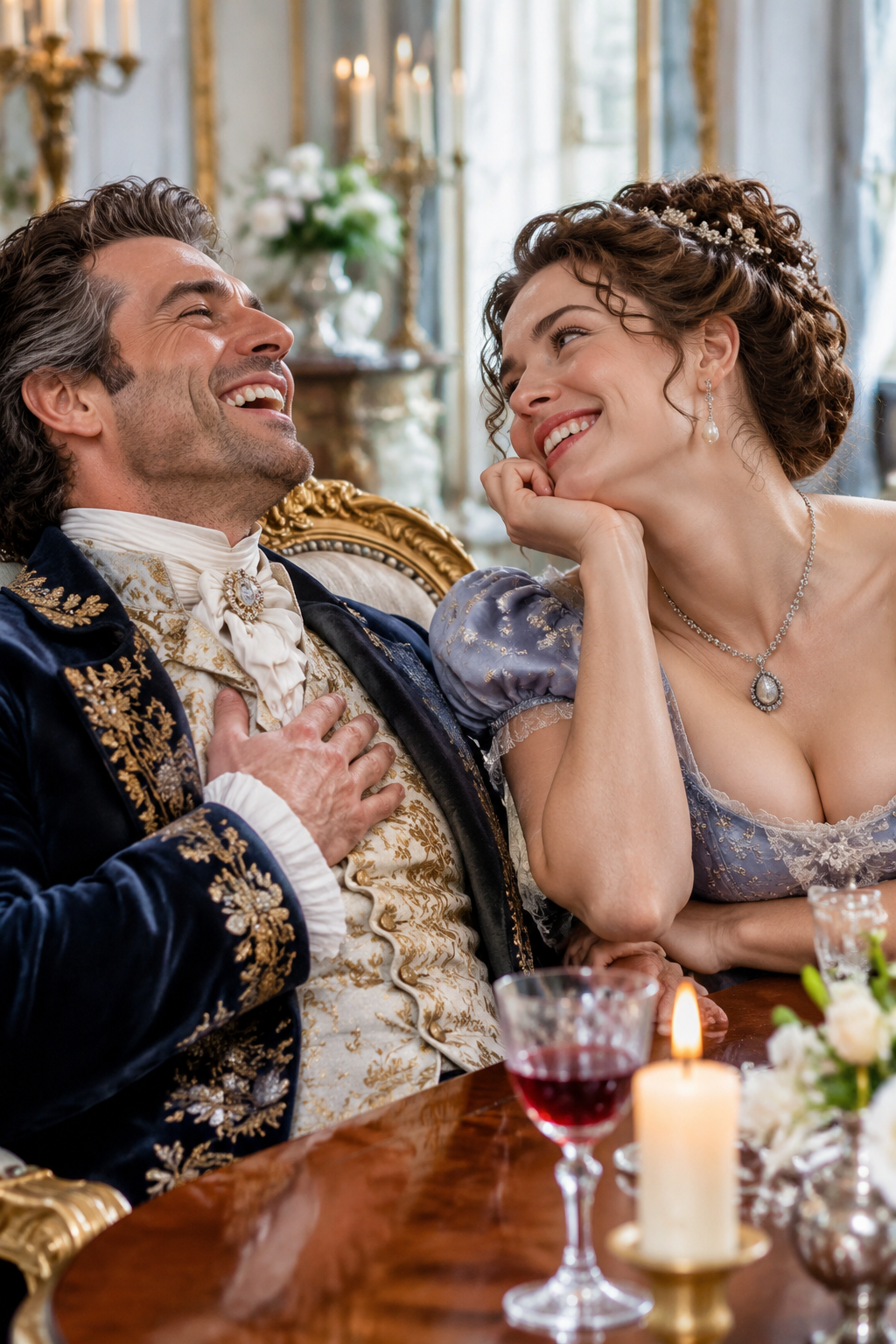
Then he leaned closer.
“Do you intend to attack the furniture again, Duchess?”
Clara raised an eyebrow.
“Only if the furniture behaves suspiciously.”
Nathaniel laughed.
Not cautiously.
Not apologetically.
He laughed until the guests began smiling, uncertain what they had missed.
Mrs. Whitmore stood beside the doorway, holding a serving tray.
Her eyes shone.
Later that evening, after the guests departed, Clara and Nathaniel remained beside the fireplace.
The room had grown quiet, but it was a gentle quiet now, filled with the fading warmth of conversation rather than fear.
Nathaniel took Clara’s hand.
“I thought I had nothing left to give you when we married.”
She turned toward him.
“You gave me a place beside you.”
“I gave you a house full of locked doors.”
“And you opened them.”
Nathaniel glanced toward Edward’s photograph by the window.
“I spent sixteen years believing that happiness would mean forgetting him.”
Clara rested her head against his shoulder.
“And now?”
He kissed her hair.
“Now I think Edward would be furious that I wasted so much time being miserable.”
Clara smiled.
“He sounds like the sort of boy who would have thrown pudding at you.”
Nathaniel laughed again.
“He would have aimed better.”
Outside, the last spring rain tapped gently against the windows.
Inside, the Duke of Briarwood held his wife close, while the memory of his younger brother rested peacefully in the room where silence had once ruled.
Years later, when visitors asked why a beautifully carved chair stood beside the dining room window, Nathaniel never avoided the question.
He told them about Edward.
About his terrible jokes, his crooked wooden crown, his courage, and the stubborn affection that had survived even the cruelty of betrayal.
Sometimes the story brought tears.
Often it brought laughter.
And Nathaniel welcomed both.
Because Clara had taught him something no one else had dared to say during those sixteen silent years.
Love was not measured by how long a person remained imprisoned in sorrow.
It was measured by the courage to remember without surrendering the rest of one’s life.
The dead were not honored by the destruction of the living.
They were honored whenever their kindness, courage, and joy continued through those who remained.
And in Briarwood Manor, where even laughter had once seemed forbidden, the happiest sound was no longer treated as a betrayal.
It was treated as a homecoming.
The years that followed brought changes to Briarwood Manor that even its oldest servants could scarcely have imagined. The great dining room, once governed by the careful movement of silverware and the solemn ticking of the grandfather clock, now welcomed conversation, music, and the occasional burst of laughter that carried through the corridors.
Yet there was one final piece of Edward’s story that Clara had not discovered.
It appeared on a quiet autumn morning, nearly two years after Lord Edmund’s conviction, when Mrs. Whitmore arrived at the breakfast table carrying a narrow parcel wrapped in faded blue cloth.
Nathaniel looked up from his newspaper.
“What is that?”
The housekeeper placed it carefully beside his plate.
“It belonged to Lord Edward, Your Grace. I found it among my late husband’s belongings.”
Clara noticed that Mrs. Whitmore’s hands trembled, though her expression held none of the old fear.
Nathaniel unfolded the cloth.
Inside was a small wooden music box, its surface scratched and its brass handle slightly bent.
He stared at it.
“I remember this.”
His voice softened.
“Edward bought it with his birthday money. He insisted it played the most beautiful melody in England, although half the notes were wrong.”
Clara smiled.
“That sounds entirely like him.”
Nathaniel turned the little handle.
A delicate melody filled the breakfast room.
It was uneven and slightly out of tune, but something about it made Nathaniel close his eyes.
Then the music stopped.
A faint clicking sound came from inside the box.
Clara leaned forward.
“There’s something loose.”
Nathaniel examined the underside and discovered a narrow wooden panel secured by a tiny screw.
He fetched a small tool from the writing desk and carefully opened it.
A folded piece of paper slipped into his palm.
The handwriting was unmistakable.
Edward’s.
Nathaniel’s breathing grew shallow as he unfolded the letter.
It was addressed simply:
To my brother, Nathaniel.
Clara reached across the table and covered his free hand with hers.
Nathaniel began reading aloud.
“My dearest Nathaniel, if you have found this, then I suppose I have finally managed to keep a secret from you.”
His voice faltered, but he continued.
“I know you think I am troublesome. You say I talk too much, laugh too loudly, and never understand when something is serious. Perhaps you are right about all three.”
A fragile smile touched Nathaniel’s lips.
“But I also know you have been terribly unhappy since Father died. You believe you must become him, and I wish you would stop trying. Father was Father. You are Nathaniel. That is quite enough.”
Nathaniel lowered the letter for a moment.
Clara squeezed his hand.
He swallowed and continued.
“When I am older, I intend to travel the world and discover things you have never seen. And when I return, I shall tell you so many ridiculous stories that you will be forced to laugh, even if you insist upon being the most serious duke in England.”
The grandfather clock sounded softly in the corridor.
Nathaniel reached the final paragraph.
“If anything ever happens to me, I hope you will remember the summers when we raced through the gardens, the winters when we stole cakes from the kitchen, and the time you fell into the lake trying to rescue my hat. Please do not remember me only when you are sad. That would make all my efforts to amuse you a dreadful waste.”
Nathaniel’s voice broke.
He covered his mouth.
For several moments, he could not continue.
Clara moved beside him and rested her hand upon his shoulder.
At last, he read the final sentence.
“Promise me that wherever life takes you, you will always find something worth laughing about. Your annoying and devoted brother, Edward.”
Nathaniel bowed his head.
The letter trembled between his fingers.
Clara did not interrupt his tears.
She simply held him as the morning sunlight spread across the table.
After a while, Nathaniel looked toward the window.
“He knew,” he whispered.
Clara brushed a tear from his cheek.
“Knew what?”
“That I had forgotten how to be happy.”
He looked down at the letter again.
“And he was trying to bring me back, even then.”
That afternoon, Nathaniel carried the music box into the dining room and placed it beside Edward’s photograph.
He stood there for a long time.
Then he turned to Clara.
“I want to do something in his name.”
Clara waited.
“Not another monument. Not another room filled with things no one dares touch.”
“What, then?”
Nathaniel glanced toward the gardens beyond the window.
“Edward loved children. He used to complain that the village school was too small and that half the boys were sent to work before they could properly read.”
Clara smiled slowly.
“Then perhaps we should give them something he would have liked.”
Within a year, the Briarwood School opened on a portion of the estate’s southern grounds.
It welcomed children from surrounding villages, including those whose families could not afford tuition.
Nathaniel funded the building and provided books, teachers, and meals.
Clara supervised the gardens, persuaded neighboring families to contribute supplies, and insisted that every classroom have large windows.
Above the entrance, a simple inscription was carved into the stone:
In memory of Edward Briarwood, who believed that life should contain more laughter.
On opening day, Nathaniel stood before a crowd of villagers, teachers, and children.
For once, he had prepared no formal speech.
Instead, he reached into his pocket and removed the little wooden chess queen.
“My brother,” he began, “was the most extraordinary nuisance I ever knew.”
The children laughed.
Nathaniel smiled.
“He believed rules were useful only when they protected people. When they prevented happiness, he considered them rather foolish.”
Clara stood beside the front steps, watching him.
“Edward died far too young,” Nathaniel continued. “For many years, I allowed the manner of his death to become more important than the life he lived.”
He paused.
“That was my mistake.”
The courtyard grew quiet.
“My brother was curious, stubborn, affectionate, and extraordinarily brave. I cannot give him the years he lost. But I can make certain that other children have opportunities he would have wanted them to enjoy.”
He looked toward Clara.
“And I have my wife to thank for reminding me that a life worth honoring should never become a reason to stop living.”
The applause began gently, then spread through the courtyard.
Clara felt her eyes fill.
Nathaniel descended the steps and offered her his hand.
She took it.
That evening, they returned to Briarwood Manor beneath a sky streaked with pale gold.
The house glowed warmly through its many windows.
From the kitchens came the sound of servants talking over supper.
Somewhere upstairs, a young maid was singing.
Nathaniel stopped in the entrance hall and listened.
Clara glanced at him.
“Is something wrong?”
He shook his head.
“No.”
He smiled.
“I was just thinking how beautiful this house sounds.”
Years later, when Clara and Nathaniel’s children became old enough to ask about the boy in the photograph, their father told them Edward’s stories.
He described a mischievous younger brother who hid frogs in drawing-room slippers, persuaded the cook to make enormous puddings, and once declared himself king of the household after carving a crown beneath his favorite chair.
Their children demanded those stories again and again.
Sometimes Nathaniel laughed while telling them.
Sometimes his voice softened.
But he never turned away from either feeling.
One Christmas evening, their youngest daughter climbed into the old wooden chair beside the dining room window.
She was holding a small slice of pudding.
Nathaniel looked over and raised an eyebrow.
“That chair belonged to your Uncle Edward.”
The little girl examined the carved crown beneath its armrest.
“Was he very important?”
Nathaniel considered the question.
Then he knelt beside her.
“Yes,” he said. “Very important.”
“Was he a king?”
Clara, standing nearby, pressed her lips together to hide a smile.
Nathaniel shook his head.
“No, darling. He was something much better.”
“What?”
“He was someone who made the people around him feel loved.”
The child thought about this.
Then she lifted her spoon.
“Do you think he would have liked me?”
Nathaniel smiled through suddenly shining eyes.
“He would have adored you.”
She nodded solemnly.
Then, with the magnificent clumsiness of childhood, she dropped her pudding directly onto the cushion.
For one suspended moment, the entire family stared.
Clara covered her mouth.
Nathaniel looked at the ruined dessert.
Then at his daughter.
Then at the little crooked crown.
And he laughed.
The children joined him.
Clara laughed until tears gathered in her eyes.
From the doorway, Mrs. Whitmore watched the scene with a smile that carried no trace of fear.
Outside, snow settled over the gardens.
Inside, the laughter continued.
And for the first time in many years, the empty chair no longer seemed empty.
It held the stories of a boy who had been loved, the memory of a brother who had finally forgiven himself, and the promise that sorrow would never again be allowed to silence an entire household.
Nathaniel drew Clara close and kissed her forehead.
“Thank you,” he whispered.
“For what?”
“For refusing to let me spend the rest of my life inside the worst moment of it.”
Clara rested her cheek against his chest.
“You were never meant to live there forever.”
He looked at his children, at the music box beside Edward’s photograph, and at the warm room filled with the ordinary sounds of family life.
Then he understood something he wished he had known sixteen years earlier.
Grief was not proof of love simply because it lasted.
Love did not demand a lifetime of punishment.
And remembering someone did not mean refusing every happiness they would have wished for you.
Some people leave this world far too soon, but the kindness they gave, the courage they showed, and the laughter they created can continue long after their voices are gone.
Nathaniel could not change the night Edward died.
He could not recover the years stolen by betrayal or return to the staircase where he had lost his brother.
But he could choose what happened to the years still ahead.
And he chose to live them.
Fully.
Tenderly.
Without shame.
The little music box began playing again, its imperfect melody rising above the children’s laughter.
Nathaniel glanced toward Edward’s photograph and smiled.
“Well, little brother,” he murmured, “I believe you finally got your wish.”
And beneath the warm Christmas candlelight, the Duke of Briarwood laughed once more—not because he had forgotten his brother, but because he would remember him with love for the rest of his life.
THE END.