For nearly a year, the old estate in upstate New York had felt less like a home and more like a house holding its breath.
The silence after Sophia’s words seemed to stretch across the entire room.
Frederick stared at her as though the world had shifted beneath his feet.
“You never asked for a divorce?”
Sophia shook her head.
“No.”
Her voice was quiet, but there was no uncertainty in it now.
“I never wrote that letter. I never told anyone I wanted to leave you. I never said I regretted marrying you.”
Frederick’s fingers tightened around the edge of the table.
For the first time that evening, anger replaced the exhaustion in his eyes.
“Then who told me you did?”
Sophia swallowed.
“I think you already know.”
His gaze moved toward the doorway.
Neither of them had to say her name.
The Dowager Duchess had spent decades making herself indispensable to the Uldren family. She knew which servant could be trusted, which lawyer would answer her call at midnight, which relative would repeat a private conversation before breakfast.
She also knew exactly how to make Frederick doubt himself.
But there was something Frederick had not yet understood.
The letters.
Sophia crossed the room and opened the small writing desk she had kept locked since the winter after the miscarriage.
From the bottom drawer, she removed a bundle of envelopes tied together with faded blue ribbon.
“I found these this morning.”
Frederick stepped closer.
The first envelope carried his handwriting.
Sophia had recognized it immediately.
“What are they?”
“Your letters.”
His expression changed.
“I wrote you.”
“You did.”
“I was told you never answered.”
Sophia looked down at the envelopes.
“I was told you never wrote.”
For several seconds, neither moved.
Then Frederick reached for the nearest letter.
The seal had been broken.
His face hardened.
He opened it carefully and read the first few lines.
The color drained from his face.
“I wrote this three days after we buried the baby.”
Sophia nodded.
“I know.”
“No.” He looked at her. “You couldn’t know. I wrote that I wanted to come home. I wrote that I was sorry. I wrote that I didn’t know how to speak to you without making everything worse.”
Sophia’s eyes filled with tears.
“I never received it.”
Frederick looked at the broken seal again.
Then another letter.
And another.
Some had been opened.
Some had never reached Sophia at all.
One had been returned to Frederick’s office with a note claiming Sophia had refused to receive it.
He stared at the note for a long moment.
“That isn’t her handwriting.”
“I know.”
The room became unbearably still.
Outside the tall windows, rain had begun to fall over the estate grounds.
Frederick walked toward the fireplace but stopped before reaching it.
His shoulders rose and fell slowly.
For an entire year, he had believed that Sophia had closed the door on him.
For an entire year, Sophia had believed that Frederick had chosen distance over her.
And somewhere between those two beliefs, their marriage had nearly disappeared.
“Why?” Frederick whispered.
Sophia knew what he meant.
Why would his mother do this?
Why would anyone destroy a marriage after a tragedy?
“I don’t know everything,” Sophia said. “But I found something else.”
She opened the drawer again.
This time, she took out a folded sheet of paper.
Frederick recognized the seal.
His mother’s private correspondence.
“Where did you get that?”
“I found it inside the old library.”
He unfolded the page.
The handwriting belonged to the Dowager Duchess.
Frederick read it once.
Then again.
His jaw tightened.
The letter did not explicitly confess to destroying their marriage.
It did something more revealing.
It spoke about preserving the family’s future, protecting Frederick from “an unstable emotional attachment,” and ensuring that Sophia would not “complicate the succession.”
Frederick stopped reading.
“The succession,” he said.
Sophia said nothing.
He looked at her.
“You’re pregnant.”
It wasn’t a question.
Sophia’s hand instinctively moved toward her stomach.
“Yes.”
The word was barely audible.
Frederick closed his eyes.
For one terrible second, Sophia thought he might step away.
Instead, he crossed the room.
He stopped in front of her and looked at her with an expression she had not seen in more than a year.
Not anger.
Not grief.
Hope.
“You’re carrying our child?”
Sophia nodded.
Frederick’s breath caught.
“Why didn’t you tell me?”
“Because I was afraid.”
“Of me?”
“Of losing another child while we were still fighting a war neither of us understood.”
He lowered his gaze.
She continued.
“I wanted to tell you when I knew the baby was safe. I wanted to tell you when I believed you actually wanted to hear from me.”
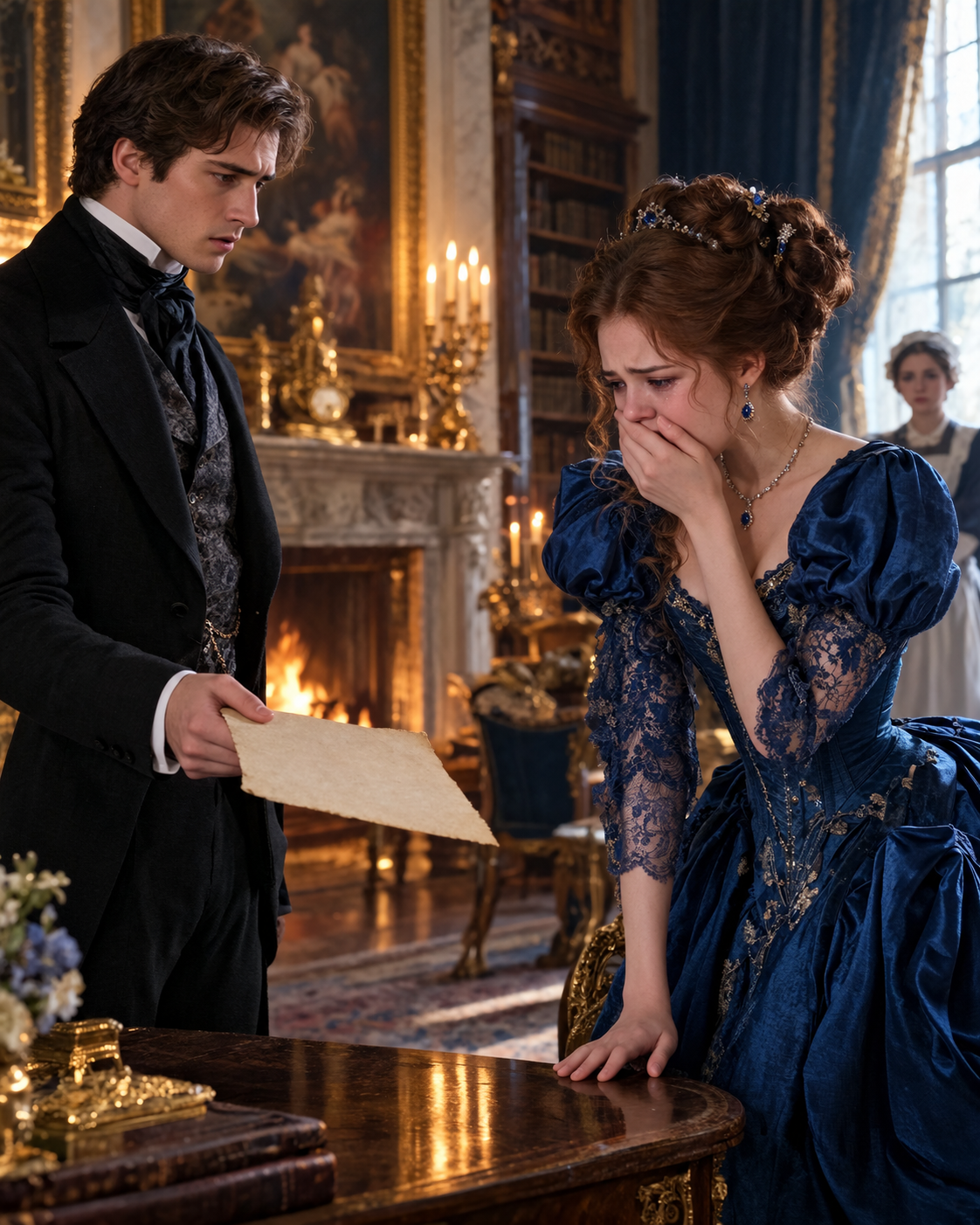
Frederick’s face crumpled for the briefest moment.
“I always wanted to hear from you.”
Sophia looked at him.
“Then why didn’t you come?”
His answer came slowly.
“Because I thought you didn’t want me there.”
The truth was almost unbearable in its simplicity.
They had both been waiting for the other to make the first move.
And while they waited, someone else had been making decisions for them.
Frederick reached for Sophia’s hand.
She hesitated.
Then she let him take it.
“I should have asked you,” he said.
“Yes.”
“I should have come to you.”
“Yes.”
“I should never have believed anyone over my wife.”
Sophia’s eyes filled again.
“And I should have asked you instead of believing the silence.”
He nodded.
Neither of them pretended that forgiveness could erase the past year.
It couldn’t.
There were nights they would never get back.
There were words that could not be unsaid.
There was grief that would always have a place at their table.
But for the first time, they were grieving together instead of separately.
A knock sounded at the door.
One of the household staff stood there, pale and uncertain.
“Your Grace, the Dowager Duchess has asked to see you.”
Frederick’s expression changed.
“Tell her no.”
The servant hesitated.
“She says it concerns the family.”
Frederick looked at Sophia.
Then he turned back.
“Tell her the family is no longer available for private arrangements.”
The door closed.
Sophia stared at him.
“What are you going to do?”
“What I should have done months ago.”
He walked toward the hallway.
Sophia followed.
They found the Dowager Duchess waiting in the grand sitting room, dressed in dark silk, perfectly composed.
She looked at Sophia first.
Then at Frederick.
Her eyes narrowed slightly when she noticed them standing together.
“I understand there has been some confusion,” she said.
Frederick did not sit.
“There has.”
She smiled faintly.
“These things become exaggerated when people are grieving.”
“Did you intercept my letters?”
Her smile disappeared.
Silence answered before she did.
“I was trying to protect you.”
“From my wife?”
“From a marriage that had become destructive.”
Sophia stepped forward.
“You told him I wanted a divorce.”
The Dowager Duchess looked at her.
“You told me you wanted space.”
“I told you I needed time to grieve.”
“And you were incapable of seeing what that grief was doing to my son.”
Frederick’s voice became colder.
“You had no right.”
“I had every right to protect this family.”
“No,” he said. “You had a right to advise me. You did not have a right to manufacture decisions and call them advice.”
For the first time, the older woman’s composure cracked.
“You don’t understand what is at stake.”
“I understand perfectly.”
His eyes dropped briefly to Sophia’s hand resting against her stomach.
“My wife is carrying my child.”
The Dowager Duchess went still.
“You’re pregnant?”
“Yes,” Sophia said.
Something unreadable passed across the woman’s face.
Then she recovered.
“That changes nothing.”
“It changes everything,” Frederick replied.
She took a step toward him.
“You cannot throw away your duty because of sentiment.”
“My duty,” Frederick said, “is not to a title, a property, or a family reputation.”
He looked at Sophia.
“My duty is to the people I chose.”
The Dowager Duchess stared at him.
“You will regret humiliating me.”
Frederick’s expression did not change.
“You have mistaken consequences for humiliation.”
He called for the estate manager.
Within minutes, instructions were given.
The Dowager Duchess would leave the Uldren residence that evening.
Her rooms would remain available, her personal accounts untouched, and her dignity protected in public.
But she would no longer control the household.
She would no longer have access to their correspondence.
And she would no longer speak on behalf of Frederick or Sophia.
As she walked toward the door, she stopped.
“You think this will make everything right?”
Frederick looked at her.
“No.”
His voice softened.
“But it will stop making it worse.”
She left without another word.
The great doors closed behind her.
Sophia stood beside Frederick in the quiet hallway.
Neither celebrated.
There was nothing to celebrate.
A family had been broken by grief and deception, and no dramatic confrontation could undo that.
But something had changed.
The silence no longer belonged to someone else.
Weeks passed.
The estate slowly changed with them.
Frederick moved his workroom closer to Sophia’s rooms so they could speak at the end of each day.
Sophia began leaving letters on his desk again, even when she was only going downstairs.
At first, it felt strange.
Then it became natural.
They learned to ask questions before making assumptions.
They learned that an unanswered message was not automatically rejection.
They learned that grief did not make either of them weak.
Most importantly, they stopped pretending they could protect one another by hiding painful truths.
One snowy morning in December, Sophia woke before dawn.
She found Frederick sitting beside the window, watching the first light touch the fields.
“You’re awake,” she whispered.
He turned.
“I couldn’t sleep.”
She sat beside him.
“What are you thinking about?”
He smiled faintly.
“How close we came.”
Sophia knew exactly what he meant.
The divorce papers were still locked in the desk.
Neither had destroyed them.
Not because they intended to use them.
Because they wanted to remember how close they had come to losing everything without ever asking the simplest question.
“Do you regret marrying me?” Sophia asked.
Frederick looked almost offended.
“Never.”
“Even after everything?”
“Especially after everything.”
He took her hand.
“I used to think love meant protecting someone from pain.”
Sophia waited.
“Now I think it means being honest enough to face the pain beside them.”
She rested her head against his shoulder.
Outside, snow covered the grounds of the Uldren estate.
The same house that had once felt cold now carried the quiet sounds of rebuilding—a fire being lit, servants preparing breakfast, footsteps in the hallway.
And beneath Sophia’s heart, a new life continued to grow.
They knew the future would not be perfect.
They would still argue.
They would still remember the child they had lost.
There would be days when grief returned without warning.
But they would face those days together.
Months later, when their child was born, Frederick held the baby in his arms with tears running freely down his face.
Sophia watched him from the bed.
Neither of them said anything for a long time.
They didn’t need to.
The child was not a replacement for the baby they had lost.
Nothing could ever replace that life.
Instead, this new beginning became something different—a reminder that love could survive sorrow without pretending the sorrow had never happened.
Frederick leaned down and kissed Sophia’s forehead.
“We’re going to tell our child the truth,” he whispered.
“About everything?”
“About the things that matter.”
Sophia smiled.
“And what matters?”
He looked at their newborn.
“That silence can become a prison. That assumptions can become weapons. And that the people we love deserve the chance to speak for themselves.”
Sophia reached for his hand.
Their fingers intertwined.
For a year, someone else had controlled the story of their marriage.
Now, finally, the story belonged to them.
And perhaps that was the greatest lesson of all.
Sometimes a relationship does not break because love disappears.
Sometimes it breaks because fear speaks first, pride speaks louder, and silence speaks longest.
But when two people finally choose honesty over assumption, even a wounded love can begin again.
Not as the marriage they once had.
But as something stronger—one built deliberately, truthfully, and together.
For the first time in many months, the Uldren estate felt like a home again.
Not because the past had disappeared.
It hadn’t.
Some evenings, Sophia still woke from dreams about the child they had lost. Sometimes she would reach across the bed and find Frederick already awake, staring into the darkness.
Neither of them tried to pretend those moments didn’t hurt.
Instead, Frederick would take her hand.
And Sophia would hold his.
That simple gesture became their quiet promise: neither of them would carry grief alone again.
But rebuilding a marriage was not as simple as exposing a lie.
There were consequences waiting beyond the walls of the estate.
Frederick had spent years allowing his mother to manage family affairs, correspondence, introductions, and social obligations. Now that authority had been removed, rumors began moving through New York society.
Some claimed the Duke had been manipulated by his wife.
Others whispered that Sophia had used her pregnancy to regain her position.
A few even suggested that the Dowager Duchess had been treated unfairly.
Frederick refused to answer any of them.
When a reporter approached him outside a charity gala in Manhattan, he simply said, “My marriage is a private matter, and I will not discuss my wife as though she were a subject of public debate.”
Then he walked inside.
Sophia heard about it the next morning.
“You didn’t have to defend me.”
Frederick looked up from his coffee.
“I wasn’t defending you.”
She raised an eyebrow.
“I was protecting our privacy.”
A small smile appeared on her face.
“That sounds suspiciously like defending me.”
“Then perhaps I’m becoming predictable.”
She laughed.
It was a small sound.
But Frederick stopped and looked at her.
He hadn’t heard that laugh often enough during the previous year.
And suddenly, he realized how much he had missed it.
Their reconciliation did not happen overnight.
There were still difficult conversations.
One afternoon, Sophia finally asked the question she had avoided for months.
“Why did you believe your mother so easily?”
Frederick went quiet.
Because the honest answer was uncomfortable.
“Because she had always been there,” he said eventually.
“She raised me to believe that she knew what was best for the family.”
Sophia waited.
“And after we lost the baby, I didn’t trust myself anymore.”
His eyes lowered.
“I thought you hated me.”
“I never hated you.”
“I know that now.”
She reached across the table.
“But you need to understand something, Frederick. I didn’t need you to have all the answers. I needed you to ask me what I was feeling.”
He nodded slowly.
“I know.”
“I needed you to come home.”
“I should have.”
The apology was simple.
There was no excuse attached to it.
That was what made it matter.
Sophia squeezed his hand.
“I should have come looking for you too.”
“You were hurting.”
“So were you.”
They looked at each other.
For years, their families had taught them that strength meant silence.
Now they were learning something different.
Strength could also mean saying, “I’m afraid.”
It could mean saying, “I don’t understand.”
It could mean admitting, “I need you.”
Spring arrived in the Hudson Valley.
The snow melted from the stone paths, and the gardens began to bloom again.
Sophia’s pregnancy progressed safely.
Every doctor’s appointment became an event Frederick treated with almost absurd seriousness.
He attended every examination he could.
He asked questions.
He took notes.
He even annoyed the physician by requesting clarification about things the doctor had already explained twice.
Sophia teased him about it.
“You’re becoming impossible.”
“I nearly lost my family once.”
His expression softened.
“I don’t intend to make that mistake again.”
One evening, they walked slowly through the garden.
Sophia stopped beside an old oak tree.
“This is where we used to sit.”
Frederick looked toward the bench beneath the branches.
“Before everything changed.”
“Yes.”
He sat beside her.
For a moment, neither spoke.
Then Sophia said, “Do you think we’ll ever stop thinking about what happened?”
Frederick shook his head.
“No.”
She looked at him.
“Neither do I.”
He took her hand.
“But maybe that’s all right.”
The wind moved gently through the leaves.
“Our first child will always be part of our story,” he continued. “We don’t have to erase that chapter just because another one is beginning.”
Sophia’s eyes filled with tears.
She leaned against him.
“I was afraid I’d forget.”
“You won’t.”
“How do you know?”
“Because I won’t let myself forget either.”
Months later, the baby arrived on a quiet morning.
There was no dramatic storm.
No emergency.
No tragedy.
Just the soft gray light of dawn entering the bedroom as Sophia held their newborn daughter against her chest.
Frederick stood beside the bed, speechless.
The man who had once faced rooms full of politicians, lawyers, investors, and aristocrats without hesitation suddenly didn’t know what to say.
Sophia smiled through exhausted tears.
“Come here.”
He approached slowly.
She placed the baby into his arms.
Frederick stared down at the tiny face.
Then he began to cry.
Sophia reached for his sleeve.
“You’re all right.”
“I know.”
He laughed through his tears.
“I just… I can’t believe she’s here.”
Sophia smiled.
“She is.”
He looked at his wife.
“Thank you.”
“For what?”
“For staying.”
Sophia shook her head.
“We both stayed.”
That distinction mattered.
Their marriage had not been saved by one person sacrificing everything for the other.
It had survived because both of them finally chose to participate in rebuilding it.
They named their daughter Eleanor.
The name had belonged to Sophia’s grandmother.
Frederick had suggested it.
“I want her to have a name that reminds us of where we came from,” he said.
“And where we’re going,” Sophia added.
He smiled.
“Exactly.”
The christening was held several weeks later at a small church outside Manhattan.
Only close friends and family attended.
The Dowager Duchess was not present.
She had moved to another property several states away.
There had been no public scandal.
Frederick had deliberately refused to expose every detail of what had happened.
Sophia had initially wondered why.
Then she understood.
They weren’t hiding the truth.
They simply refused to turn their pain into entertainment.
That was another lesson they had learned.
Not every truth needed an audience.
Some truths existed to heal the people who had lived through them.
After the ceremony, Sophia stood outside beneath the church steps with Eleanor sleeping peacefully in her arms.
Frederick joined her.
“She has your eyes.”
Sophia smiled.
“That’s unfortunate for you.”
“Why?”
“She’ll probably use them to get whatever she wants.”
Frederick laughed.
“I’ve already surrendered.”
Sophia looked toward the road.
For a moment, she imagined the version of herself who had stood in the same country months earlier, believing her marriage was over.
She barely recognized that woman now.
Not because the grief had disappeared.
But because she had stopped allowing grief to define the rest of her life.
Frederick slipped his arm around her.
“What are you thinking?”
She looked at him.
“That we almost lost this.”
He nodded.
“Yes.”
“And it all started because neither of us asked one simple question.”
“What question?”
“Is this really what you want?”
Frederick looked down at their daughter.
“No more assumptions.”
“No more secrets.”
“No more letting someone else speak for us.”
He kissed Sophia’s temple.
“Agreed.”
Years later, Eleanor would grow up hearing stories about the old Uldren estate.
She would hear about the gardens, the library, the long winter evenings, and the little bench beneath the oak tree.
But she would also hear about the family they had lost before she was born.
Her parents never treated that loss as something shameful.
They taught her that grief and gratitude could exist together.
That loving someone who was gone did not prevent you from loving someone who was still here.
And most importantly, they taught her to ask questions.
Never assume.
Never let silence write a story that only honesty can tell.
One summer evening, long after the scandal had faded from public memory, Sophia and Frederick sat together beneath the same oak tree.
Eleanor was playing nearby.
The Hudson Valley glowed beneath the setting sun.
Frederick looked at Sophia.
“Do you remember the night I brought you the divorce papers?”
She gave him a knowing smile.
“How could I forget?”
“I thought that night was the end.”
“So did I.”
He looked toward their daughter.
“Funny.”
“What?”
“The worst night of our marriage became the night we finally started telling each other the truth.”
Sophia rested her head against his shoulder.
“Maybe the truth was there all along.”
“Waiting for us to stop being afraid of it.”
She smiled.
The evening breeze moved through the branches above them.
For a while, they simply listened to Eleanor’s laughter.
There was no grand declaration.
No perfect ending.
Because their lives were not perfect.
They still carried scars.
They still remembered the child they had lost.
They still knew that love could be fragile when people stopped speaking honestly.
But they also knew something they had not understood before.
A marriage was not protected by avoiding difficult conversations.
It was protected by having them.
Trust was not created by never making mistakes.
It was created by telling the truth after making them.
And love was not proven by never experiencing pain.
It was proven by refusing to let pain turn two people into strangers.
Frederick reached for Sophia’s hand.
She intertwined her fingers with his.
Across the lawn, Eleanor ran toward them.
“Mother!”
Sophia opened her arms.
The little girl ran straight into them.
Frederick watched them with a smile.
For one brief moment, he remembered the man he had been the night he placed those divorce papers on the table.
A grieving husband.
A frightened son.
A man who had trusted someone else’s version of his own marriage.
He was no longer that man.
And Sophia was no longer the woman who believed silence was safer than confrontation.
They had both changed.
Not because their past had disappeared.
Because they had finally learned how to live honestly with it.
As the sun disappeared beyond the trees, Frederick kissed Sophia’s hand.
“I choose you,” he said quietly.
She looked at him.
“Every time?”
“Every time.”
And this time, there was no letter intercepted.
No voice speaking for them.
No silence standing between them.
Only two people who had nearly lost each other—and had finally learned that sometimes the greatest act of love is not holding someone tightly enough to keep them from leaving.
It is trusting them enough to hear the truth.
The Uldren family would never again be exactly what it had been.
But perhaps that was the point.
Some families are rebuilt not by returning to the past, but by choosing something better for the future.
And beneath the old oak tree, with their daughter laughing beside them, Sophia and Frederick began that future together.
THE END.