Ethan Cole found a resignation letter on his kitchen table while a winter storm buried the roads outside his Montana home.
Ethan swallowed, suddenly aware that the truth he had been hiding was not nearly as noble as he had once imagined.
“I need you to know that I never meant to hurt you.”
Norah stared through the windshield, watching snow gather along the edges of the deserted highway.
“I believe you, Mr. Cole. But people can be hurt by things we never intend to do.”
He looked at her, searching for an answer that might somehow undo the past three months.
“I’ve been afraid of losing you.”
She turned slowly.
“Then why did you make it impossible for me to stay?”
The question struck harder than any accusation could have.
Ethan opened his mouth, but nothing came out.
Norah had worked in his home for almost five years. She knew which floorboard creaked outside his bedroom, how he liked his coffee, and which days were hardest for him after his wife died. She had kept the house running through blizzards, illness, and endless stretches of loneliness.
Somewhere along the way, Ethan had begun thinking of her as something permanent.
And permanence, he realized, had made him careless.
“I thought you’d always be there,” he admitted.
Norah gave a small, exhausted smile.
“That was your first mistake.”
Before he could answer, she leaned forward and studied the dashboard clock.
“The bus leaves at eleven. We should keep moving.”
Ethan glanced toward the road. The nearest station was twenty-eight miles away, and the snow was growing heavier.
“Norah, the highway might already be closed.”
“Then take me as far as you can.”
“Where are you going?”
“Helena.”
“Why Helena?”
For the first time, something like fear crossed her face.
“My sister is there. Or at least, she was supposed to be.”
Ethan frowned.
“Supposed to be?”
Norah tightened her fingers around the envelope.
“My sister, Clara, has been in a rehabilitation center since September. She had a stroke. Her husband passed away two years ago, and there’s nobody else to look after her.”
Ethan stared at her.
“I didn’t know you had a sister.”
“I told you about her.”
“When?”
“Three times.”
The silence that followed was almost unbearable.
Norah looked away.
“The first time was when she went into the hospital. The second was when the doctors said she might never walk normally again. And the third was yesterday, when I asked for my wages.”
Ethan remembered vaguely hearing something about a hospital bill. He had been reviewing contracts for a new cattle operation and had waved her away.
“Why didn’t you tell me how serious it was?”
She looked directly at him.
“I did.”
He felt his face burn.
“She needs to leave the center by tomorrow,” Norah continued. “Her insurance won’t cover any more days. I found a small apartment near the hospital where I can take care of her, but the landlord needs the deposit by noon tomorrow.”
“And you couldn’t pay it.”
“No.”
“Because of me.”
Norah didn’t answer.
She didn’t have to.
Ethan turned the truck back onto the highway.
For several miles, neither spoke.
Then Norah reached into her purse and pulled out a folded photograph.
It showed two young women standing beside a yellow farmhouse, laughing into the sunlight.
“That was Clara before everything happened,” she said quietly. “She’s two years younger than me. When our parents died, we promised we’d never abandon each other.”
Ethan studied the picture.
“You look happy.”
“We were.”
“Where was the farmhouse?”
“Outside Missoula. It’s gone now.”
“What happened?”
“We sold it to pay for our mother’s medical care.”
Ethan glanced at her hands. They were red and cracked from years of scrubbing, cleaning, carrying firewood, and tending to a house that had never truly belonged to her.
“How much does Clara need?”
Norah immediately folded the photograph.
“Please don’t.”
“I’m only asking.”
“And I’m telling you that I don’t want charity.”
“It’s not charity if I owe you.”
“You’ve already paid what you owed.”
Ethan wanted to argue that he owed far more than money, but the truck suddenly lurched.
A sharp cracking sound came from beneath the tires.
He hit the brakes.
The vehicle skidded sideways, slammed against a frozen snowbank, and stopped.
For a moment, there was only the sound of the wind.
“Are you hurt?” Ethan asked.
Norah shook her head.
He tried shifting into reverse.
The engine roared, but the truck didn’t move.
He stepped outside and immediately discovered the problem.
The right rear tire had slid into a drainage ditch hidden beneath the snow. Worse, the wheel was wedged against a broken wooden culvert.
He climbed back inside.
“We’re stuck.”
Norah closed her eyes.
Ethan reached for his phone.
No signal.
He lifted it toward the windshield.
Nothing.
“How far are we from the station?” she asked.
“About sixteen miles.”
“And the nearest house?”
“Maybe four.”
Norah checked her watch.
“Then we need to walk.”
“Absolutely not.”
“Mr. Cole—”
“You nearly froze to death an hour ago. You’re not walking another four miles through this storm.”
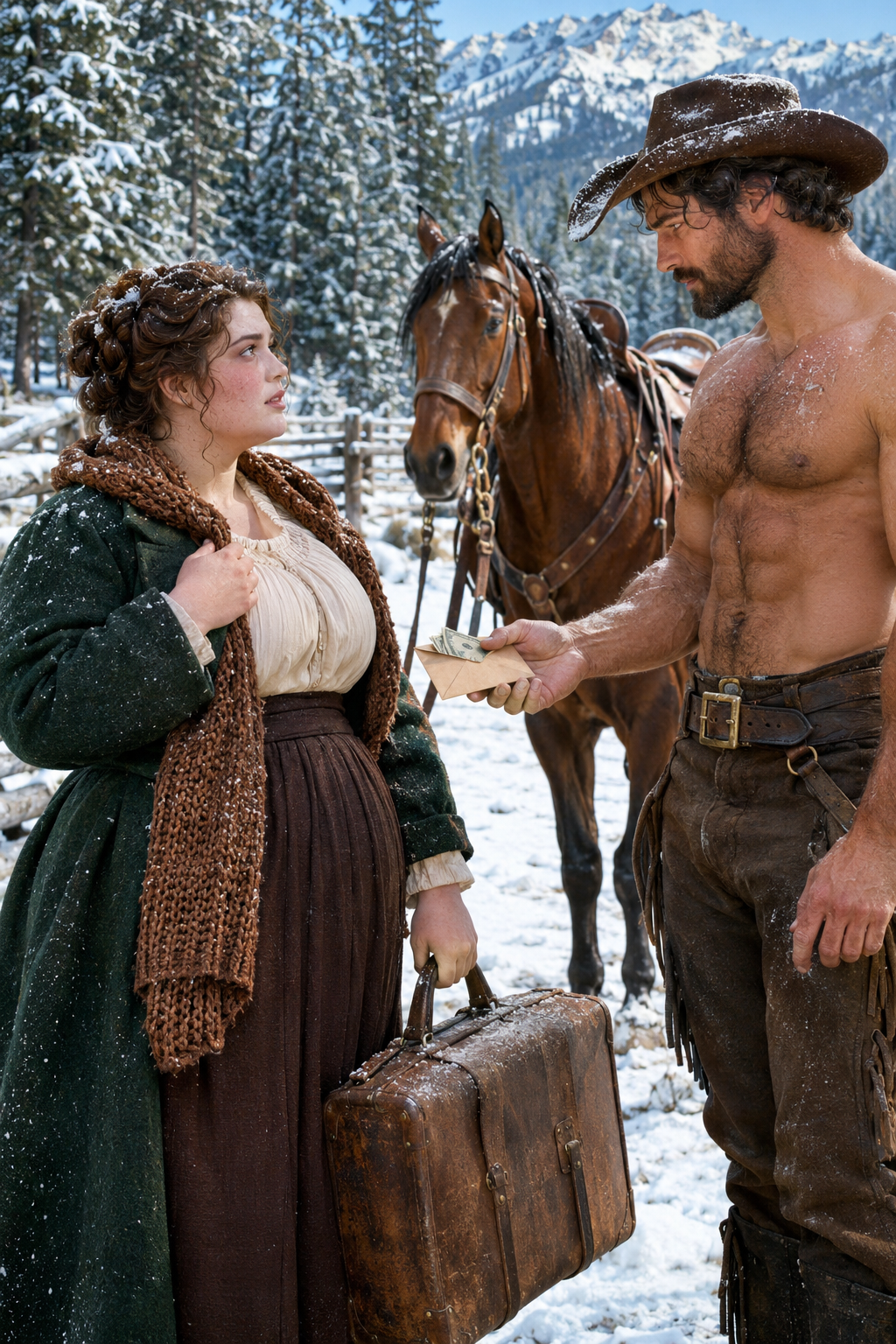
She turned toward him, her expression hardening.
“Then what do you suggest?”
Ethan looked toward the dark line of trees along the highway.
There was an old hunting cabin about half a mile away, built by his grandfather decades earlier. He had not visited it in years, but he remembered the location.
“There’s a shelter nearby,” he said. “We can wait there until the storm passes.”
Norah followed his gaze.
“And if it doesn’t?”
“Then I’ll find another way.”
She stared at him for a long moment.
“That’s what you always say.”
Ethan had no defense.
They gathered blankets, a flashlight, bottled water, and the emergency supplies stored beneath the rear seat. Ethan carried Norah’s suitcase while she leaned on his arm.
The walk to the cabin took nearly forty minutes.
By the time they reached it, Norah was trembling again.
Ethan forced the swollen wooden door open and guided her inside.
The cabin smelled of old pine, dust, and cold ashes. Fortunately, the fireplace was intact, and a stack of dry firewood remained under a canvas cover.
Within twenty minutes, flames were climbing the chimney.
Norah sat beside the hearth, warming her hands.
Ethan found a kettle and set water to boil.
“You’ve done enough,” she said when he began searching the cupboards.
“No, I haven’t.”
He found a tin of beans, crackers, and two chipped mugs.
For the first time that day, Norah almost laughed.
“Your grandfather never did believe in keeping a proper kitchen.”
Ethan stopped.
“You knew my grandfather?”
“Of course.”
“How?”
“He hired me for my first job in Montana.”
Ethan stared at her.
“I thought my mother hired you.”
“Your mother hired me to work at the ranch house. But your grandfather was the one who convinced me to come west.”
She looked into the fire.
“He told me the Cole family always took care of its own.”
Ethan slowly lowered himself into the chair opposite her.
Norah’s voice softened.
“He was a good man. When my mother got sick, he paid for my trip home. He told me there were some things more important than work.”
Ethan felt something shift inside him.
His grandfather, Samuel Cole, had been dead for twelve years. Ethan remembered him as a stubborn rancher who wore the same battered hat for twenty winters and refused to replace boots until the soles fell off.
He also remembered a saying Samuel repeated whenever Ethan complained about paying ranch hands too much.
“A man’s worth isn’t measured by what he keeps, son. It’s measured by what he refuses to take from someone who has less.”
Ethan had forgotten those words.
Or perhaps he had simply stopped living by them.
“Norah,” he said, “why didn’t you leave sooner?”
She watched the fire.
“Because your wife asked me not to give up on you.”
Ethan went completely still.
“Margaret?”
Norah nodded.
“She knew you would struggle after she was gone. She was worried you would bury yourself in work and forget how to live.”
His throat tightened.
Margaret had died four years earlier after a long battle with cancer. In the final months of her illness, Norah had become far more than a housekeeper. She had prepared meals Margaret could barely swallow, sat through sleepless nights, and brought fresh flowers into the bedroom when the world outside seemed to have lost its color.
Ethan had always known Norah was devoted to Margaret.
He hadn’t understood how deeply.
“She asked you to stay?”
“She asked me to make sure you didn’t disappear inside your grief.”
Norah wiped her eyes.
“I promised I’d try.”
Ethan looked at the woman sitting across from him.
“And you did.”
“For a long time.”
“Why didn’t you tell me?”
“Would it have changed anything?”
He opened his mouth, then closed it.
Outside, the wind struck the cabin walls with enough force to make the windows rattle.
Norah reached into her suitcase and removed a small cloth pouch.
“There was something else I wanted to leave behind, but I couldn’t bring myself to do it.”
She handed him the pouch.
Inside was a silver pocket watch.
Ethan recognized it immediately.
His father’s watch.
He hadn’t seen it since Margaret’s funeral.
“Where did you find this?”
“Margaret gave it to me three days before she died.”
Ethan opened the watch.
Inside the cover were four words engraved in tiny letters.
Time is never owed.
He remembered his father saying those words when Ethan was a boy.
Norah continued quietly.
“Margaret told me you’d understand them someday.”
A terrible thought entered Ethan’s mind.
“She knew I would become like this?”
“No,” Norah said. “She knew grief could make good people forget what’s right in front of them.”
Ethan stared at the watch until his vision blurred.
For years, he had treated time as an endless resource. Tomorrow, he would visit Margaret’s grave. Tomorrow, he would call his brother. Tomorrow, he would thank Norah properly.
Tomorrow, he would become the man he kept promising himself he still was.
And all those tomorrows had turned into years.
“I’ve been selfish,” he whispered.
Norah shook her head gently.
“You’ve been lonely. But loneliness doesn’t excuse the way you’ve treated people.”
Ethan nodded.
For the first time, he didn’t search for an explanation.
He simply accepted the truth.
That evening, as the storm intensified, Ethan told Norah things he had never admitted aloud.
He confessed that he sometimes sat in Margaret’s old bedroom because the silence in the rest of the house frightened him. That he had stopped visiting friends because their happiness reminded him of everything he had lost. That he had kept Norah busy with unnecessary tasks because he dreaded the day she might decide she no longer needed to stay.
Norah listened without interrupting.
Finally, she said, “You could have asked me to stay because you valued me. Instead, you made me feel trapped.”
Ethan lowered his head.
“I know.”
“No, I don’t think you do. Every morning, I wondered whether asking for my wages would make you angry. Every night, I counted what little money I had left. And every time you promised tomorrow, I had to decide whether to believe you again.”
Her voice broke.
“My sister was frightened, Ethan. She kept asking when I was coming. And I had to tell her I didn’t know.”
It was the first time she had called him by his first name.
Somehow, that made her words hurt even more.
“I can’t undo that,” he said.
“No.”
“But I can make sure it never happens again.”
Norah looked at him.
“Then start by keeping the next promise you make.”
They slept in separate corners of the cabin, wrapped in heavy blankets near the fire.
At dawn, Ethan woke to an unfamiliar sound.
An engine.
He hurried to the window.
Through the clearing storm, he saw headlights moving slowly along the highway.
A county snowplow.
He pulled on his boots and ran outside, waving both arms.
The driver stopped when he reached the road.
“Ethan Cole? What in the world are you doing out here?”
It was Deputy Marcus Bell, a longtime acquaintance who also worked emergency road clearing during severe storms.
Ethan explained what had happened.
Marcus listened, then glanced toward the cabin.
“Is Norah with you?”
“Yes.”
The deputy’s expression changed.
“People have been looking for her.”
Ethan felt his stomach tighten.
“What do you mean?”
“Her sister called the sheriff’s office last night. Apparently, Norah was supposed to meet her at the rehabilitation center this morning. When nobody could reach her, Clara got frightened.”
Ethan looked back toward the cabin.
“She doesn’t know.”
“Know what?”
Marcus hesitated.
“The center was evacuated yesterday afternoon. A heating failure caused a pipe to burst, and several patients were moved to another facility.”
“Where?”
“Over in Boulder.”
Ethan frowned.
“Boulder? That’s nearly thirty miles beyond Helena.”
Marcus nodded.
“And there’s something else. Clara fell during the transfer. She’s in the hospital now.”
Ethan didn’t wait.
He ran back toward the cabin.
Norah was standing beside the fireplace, folding her blanket.
When she saw his face, the blanket slipped from her hands.
“What happened?”
He told her everything.
She pressed one hand against her mouth.
“Is she alive?”
“Yes.”
“Are you certain?”
“Marcus says she’s in the hospital.”
Norah swayed.
Ethan caught her before she fell.
“I have to get to her.”
“We will.”
She gripped his arm.
“Please don’t promise me something you can’t do.”
Ethan looked directly into her eyes.
“Then I won’t promise. I’ll act.”
Within half an hour, Marcus had helped them reach the nearest county maintenance station, where a working telephone was available.
Ethan called the hospital.
After several transfers, a nurse finally confirmed that Clara was stable but had fractured her hip. She would need surgery once the doctors cleared her for the procedure.
Norah sank into a chair.
Ethan asked to speak with the hospital’s social worker.
He learned that Clara’s discharge from the rehabilitation center had been suspended because of her hospitalization. The apartment deposit deadline, however, remained unchanged.
Norah’s landlord had already warned her that another applicant was waiting.
She looked helplessly at the clock.
“I’ll lose it.”
Ethan took out his phone.
The signal had returned.
He called his business manager, Thomas Reed.
“Thomas, I need you to arrange a bank transfer immediately.”
Thomas sounded surprised.
“How much?”
Ethan glanced at Norah.
“First, calculate every hour of overtime Norah worked over the last five years, including evenings when Margaret was ill.”
There was silence.
“Ethan, that’s going to take time.”
“Then get the payroll records and start.”
“What’s going on?”
“I’ve discovered I’ve been a disgraceful employer.”
Thomas cleared his throat.
“Are you certain you want to reopen five years of payroll?”
“Absolutely.”
Ethan continued.
“Second, contact Norah’s landlord in Helena. Find out whether there’s a lawful way to hold the apartment while she handles her sister’s medical emergency.”
Norah started shaking her head.
“Ethan, please—”
He covered the receiver.
“I’m not buying you an apartment. I’m asking whether the place you’ve already chosen can be held until you decide what to do.”
She hesitated, then nodded.
Thomas returned with a question.
“And your meeting with the investors?”
“Cancel it.”
“Ethan, they’re flying in from Denver. This is a multimillion-dollar agreement.”
“Then tell them I finally have something more important to do.”
Thomas went silent.
Ethan ended the call.
Norah looked at him with an expression he couldn’t quite read.
“You’ve never canceled a meeting like that.”
“No.”
“Not even when Margaret was sick.”
The observation struck him like a blow.
He remembered the day Margaret had asked him to accompany her to a medical appointment. He had promised to meet her afterward, then arrived three hours late because a contract negotiation had run long.
She had smiled when he finally appeared.
He had mistaken her forgiveness for proof that no harm had been done.
Ethan stared at the phone in his hand.
“I can’t change what I did to Margaret.”
Norah’s eyes filled.
“No. But you can stop doing it to everyone else.”
By noon, the highway toward Helena had partially reopened.
Marcus arranged transportation to the hospital through a county emergency vehicle already heading in that direction.
Ethan and Norah arrived shortly after two.
Clara was lying in a narrow hospital bed, her silver hair spread across the pillow.
When Norah entered, Clara began to cry.
“You came.”
Norah hurried to her side.
“Of course I came.”
“I thought something happened to you.”
“Something did,” Norah whispered. “But I’m here now.”
Ethan stood quietly near the doorway.
He watched the sisters hold each other, and for the first time in years, he understood how frightening it must be to have only one person left in the world.
Clara eventually noticed him.
“Who is that?”
Norah wiped her cheeks.
“Ethan Cole. My employer.”
Clara’s expression hardened.
“The man who wouldn’t pay you?”
Ethan stepped forward.
“Yes, ma’am.”
Clara stared at him.
“Do you have any idea what you’ve put my sister through?”
“Yes.”
“No, I don’t think you do. She sold her jewelry to send me money. She skipped meals. She told me she wasn’t hungry because she was saving for an apartment.”
Ethan went cold.
He turned toward Norah.
“You sold your jewelry?”
She looked away.
Clara continued.
“She even sold Mother’s wedding ring.”
Norah closed her eyes.
“Clara, please.”
But Ethan was already remembering a small gold ring Norah had worn for years.
He had noticed it missing in October.
He hadn’t asked why.
“I didn’t know,” he whispered.
Clara’s voice trembled.
“That’s exactly the problem, Mr. Cole. You never knew because you never bothered to ask.”
Ethan accepted every word.
Then he did something neither sister expected.
He pulled a chair beside Clara’s bed and sat down.
“You’re right,” he said. “I failed your sister. I failed her badly. And I won’t ask either of you to pretend otherwise.”
Clara studied him.
“I’ve paid her the overdue wages, but that doesn’t erase the hardship I caused. My accountant is reviewing the rest of her compensation, and I’ll pay anything else she’s owed.”
Norah looked at him in surprise.
“What are you hoping she’ll say?” Clara asked.
“Nothing.”
“Then why are you here?”
Ethan glanced at Norah.
“Because she needed someone to help her reach you, and I was finally in a position to do something useful.”
Clara watched him for a long moment.
Then she turned to her sister.
“He looks exhausted.”
Norah let out an unexpected laugh.
“He’s had a difficult night.”
Clara raised an eyebrow.
“Good.”
For the first time since finding the resignation letter, Ethan smiled.
Three days later, Clara underwent successful surgery.
Norah stayed in Helena, visiting her every morning and helping arrange her recovery.
Ethan rented a room at a modest hotel nearby, refusing to leave until he was certain Norah had everything she needed to settle into her new life.
He did not insist that she return to Montana.
He did not ask her to reconsider her resignation.
Instead, he began making changes.
The first was financial.
Thomas discovered that Norah had worked hundreds of additional hours over the years without proper compensation. Ethan ordered every documented hour paid, with the applicable overtime and interest calculated by an outside payroll specialist.
The second change involved his ranch.
Ethan reviewed the employment records of all twenty-three workers. He found delayed reimbursements, missing bonuses, and several employees who had never received the paid leave promised in their contracts.
The discoveries humiliated him.
For years, he had considered himself a fair man because he paid above the local average.
He had never considered that fairness required attention, not merely generosity.
He corrected the records and established an independent payroll system so that no employee would ever have to ask him personally for wages already earned.
Then he visited Margaret’s grave.
The cemetery stood on a quiet hillside overlooking the valley.
Snow lay thick over the headstones.
Ethan brushed the white powder from her name and placed a bouquet of winter roses beside it.
“I thought keeping the ranch successful was how I honored you,” he whispered.
The cold wind moved through the trees.
“But I forgot everything you taught me about being kind.”
He opened his father’s pocket watch.
The hands were still moving.
“I don’t know if I deserve another chance,” he said. “But I’m going to spend whatever time I have left becoming someone who does.”
When Ethan returned to Helena a week later, he found Norah outside Clara’s hospital room.
She was holding a small paper bag.
“I brought you something,” she said.
Inside was a homemade sandwich.
He stared at it.
“You made this for me?”
“You’ve been eating hotel food for a week. I thought you might appreciate something decent.”
Ethan laughed softly.
“Thank you.”
They sat together near the window.
After a while, Norah said, “Thomas called me.”
Ethan straightened.
“Is something wrong?”
“He told me about the payroll review.”
“You deserved every penny.”
“He also said you changed the ranch policies.”
“They should have been changed years ago.”
Norah studied him.
“Why are you doing all this?”
Ethan considered his answer carefully.
“Because I spent too long believing that being a good man was something I could claim without proving it.”
She looked down.
“And because of me?”
“You made me see the truth. But the people who work for me deserve better whether you forgive me or not.”
Norah was silent.
Then she said, “I do forgive you, Ethan.”
He felt his chest tighten.
“But that doesn’t mean I’m coming back.”
“I know.”
She seemed almost surprised by his answer.
“You’re not going to ask?”
“No.”
“Why?”
“Because you spent five years putting everyone else first. I think it’s time you made a choice for yourself.”
Norah turned toward the window.
A tear slipped down her cheek.
“That’s the kindest thing you’ve ever said to me.”
Ethan didn’t reach for her hand.
He simply sat beside her.
In the weeks that followed, Clara recovered steadily.
Norah secured her apartment, and with help from a local home-care agency, began planning a future that revolved around her sister rather than the demands of someone else’s household.
Ethan returned to his ranch.
The house felt enormous.
For the first few nights, he caught himself calling Norah’s name whenever he couldn’t find something.
Then he remembered.
She was no longer there.
He learned to cook breakfast, wash his clothes, and keep the kitchen clean.
He also began visiting his brother, Daniel, whom he had barely spoken to since Margaret’s death.
One Sunday, Daniel looked across the dinner table and said, “I thought we’d lost you for good.”
Ethan lowered his fork.
“You nearly did.”
“What changed?”
“A woman finally told me the truth, and I couldn’t pretend I hadn’t heard it.”
Daniel nodded slowly.
“Then she did you a greater kindness than you probably deserved.”
Ethan smiled sadly.
“She did.”
Spring arrived late that year.
By April, the snow had retreated from the fields, and the first wildflowers were appearing along the fences.
One afternoon, Ethan received a letter.
The handwriting was familiar.
He opened it at the kitchen table.
“Dear Ethan,
Clara is walking again. Slowly, and with a cane, but she’s determined to regain her strength. We found a little garden near our apartment, and she’s already planning what flowers to grow.
I wanted you to know that we’re doing well.
I also wanted to thank you for respecting my decision. Leaving the ranch was one of the hardest things I’ve ever done, but it gave me something I hadn’t realized I’d lost.
The freedom to decide how my own life should look.
Clara says you should visit when the roses bloom. She also says you should bring something better than canned beans.
With gratitude,
Norah.”
Ethan read the letter twice.
Then he laughed.
Clara had clearly not forgotten their first conversation.
He placed the letter beside Margaret’s photograph and returned to his work.
Two months later, he drove to Helena carrying a basket of fresh vegetables, homemade bread, and a rosebush from Margaret’s old garden.
Norah opened the apartment door.
For a moment, they simply looked at each other.
She appeared healthier than he remembered. Her cheeks had color again, and there was a lightness in her face that had been missing during those final months at the ranch.
“Ethan,” she said warmly.
“Norah.”
She glanced at the rosebush.
“What’s this?”
“Margaret always loved these. I thought Clara might like one for her garden.”
Norah’s eyes softened.
“She would.”
From inside the apartment, Clara called, “If that’s Mr. Cole, tell him he can come in, but he’d better have brought real food.”
Ethan laughed.
“I brought bread.”
“Did you bake it yourself?”
“Yes.”
There was a pause.
“Then we’d better keep the hospital number handy.”
All three laughed.
That afternoon, Ethan helped the sisters plant the rosebush beneath their kitchen window.
Clara directed the work from a garden chair, offering so many instructions that Norah finally threatened to put her back inside.
When the planting was finished, they sat together drinking lemonade.
Ethan watched the two sisters talk and laugh.
Something inside him felt peaceful for the first time in years.
As the sun began to set, Norah walked him to his truck.
“Will you come again?” she asked.
Ethan looked at her carefully.
“Would you like me to?”
She smiled.
“Yes. I think I would.”
He nodded.
“Then I will.”
As he opened the driver’s door, she touched his arm.
“Ethan?”
He turned.
“I need you to understand something.”
“Of course.”
“When I left your house that morning, I thought I was walking away from the only home I had left.”
Ethan’s expression softened.
“But I discovered something while I was gone.”
“What?”
“A home isn’t a place where people need you so badly that they forget to appreciate you.”
She glanced toward the apartment window, where Clara was waving.
“It’s a place where you’re free to be yourself, and the people who love you want you there anyway.”
Ethan looked at the modest building, the little garden, and the roses beginning to settle into the earth.
Then he looked back at Norah.
“You’re right.”
She smiled.
“I know.”
He laughed.
And when he drove away that evening, he did not feel the old familiar emptiness.
He felt grateful.
Because he finally understood that love was not proven by holding someone close.
Sometimes, it was proven by opening your hands and allowing them to choose.
Over the following years, Ethan became a regular visitor to Helena. He and Norah developed a friendship built on honesty, mutual respect, and the freedom to disagree. Clara eventually began calling him her honorary brother, although she never stopped teasing him about his terrible cooking.
Back at the ranch, Ethan established an annual scholarship for the children of agricultural workers and created an emergency assistance fund managed independently of him. No employee had to depend on his personal goodwill to receive wages, benefits, or support they had earned.
He named the scholarship after Margaret.
But the most important change wasn’t something money could buy.
Ethan began paying attention.
He remembered birthdays, attended school plays, visited sick neighbors, and learned the names of the people who worked beside him.
He stopped treating tomorrow as a guarantee.
And every winter, on the anniversary of the morning Norah had walked away, he took his father’s pocket watch from its drawer and read the four engraved words.
Time is never owed.
Years later, when Norah asked him whether he regretted chasing her into the storm, Ethan shook his head.
“I regret that you had to leave for me to understand what I was losing.”
Norah smiled.
“And what did you learn?”
Ethan looked around at the people gathered in Clara’s garden, their laughter filling the warm summer evening.
“That the greatest mistake a person can make isn’t losing someone they love.”
He paused.
“It’s making that person feel invisible while they’re still standing right in front of them.”
Norah reached across the table and squeezed his hand.
This time, Ethan noticed.
And he held it gently, with the quiet gratitude of a man who had finally learned that kindness delayed too long could become cruelty, that apologies mattered only when followed by change, and that the people who make our lives better deserve to know their worth before they have to walk away to find it.
Many years passed, and the friendship between Ethan and Norah became one of the most important parts of their lives.
Clara eventually passed away peacefully at the age of eighty-one, surrounded by the people she loved. Norah was devastated, but she was not alone. Ethan stayed beside her throughout the funeral arrangements, never once suggesting that she should return to the ranch simply because she now had no family to care for.
One evening, several weeks after Clara’s funeral, Norah found Ethan sitting in the garden beside the rosebush he had planted years earlier.
“Do you ever think about that morning in the snow?” she asked.
“Every day,” Ethan answered.
“After all these years?”
He nodded.
“Because that was the morning I nearly lost someone who had given me more kindness than I ever deserved.”
Norah sat beside him.
“You know, Ethan, I was angry with you for a long time.”
“You had every right to be.”
“But I stopped being angry when I realized you’d actually changed. Not because you wanted me to come back, but because you finally understood why you needed to.”
Ethan smiled.
“I learned from a very stubborn teacher.”
Norah laughed.
“And you were a very difficult student.”
They watched the evening sunlight settle over Clara’s garden.
After a while, Ethan reached into his coat pocket and removed the old silver watch.
He placed it in Norah’s hand.
“I want you to have this.”
She immediately shook her head.
“Ethan, it belonged to your father.”
“And Margaret gave it to you because she trusted you to help me understand what it meant.”
Norah opened the watch and read the familiar inscription.
Time is never owed.
Her eyes filled with tears.
“I think Margaret would be proud of you,” she whispered.
Ethan looked toward the roses.
“I hope so.”
The following spring, Norah made a decision that surprised him.
She sold her apartment and moved into a small cottage near Ethan’s ranch. It was a home she purchased with her own savings, overlooking a meadow filled with wildflowers.
When Ethan offered to help her move, she smiled.
“You can carry the boxes, Mr. Cole. But I’m not coming back to clean your house.”
He laughed.
“I wouldn’t dream of asking.”
Norah spent her days gardening, reading, and volunteering at the local community center. Ethan visited often, sometimes bringing groceries, sometimes sharing dinner, and sometimes simply sitting on her porch without saying much at all.
Their relationship never needed a title.
They had become family through the choices they made, the forgiveness they earned, and the years they spent showing up for one another.
When Ethan eventually passed away peacefully in his sleep at eighty-four, Norah discovered a letter addressed to her among his personal belongings.
Her hands trembled as she opened it.
“Dear Norah,
If you’re reading this, I have finally run out of tomorrows.
There is something I should have told you long ago.
You saved my life.
Not when you cooked my meals, cleaned my house, or cared for Margaret. You saved me when you found the courage to leave.
That morning, I thought I was driving into a snowstorm to rescue you. I didn’t understand that you were the one who would lead me out of the darkness I had been living in for years.
You taught me that gratitude is not something we should feel silently while taking someone’s kindness for granted.
You taught me that love without respect is simply another kind of selfishness.
And most importantly, you taught me that becoming a better person means nothing unless the people around us can feel the difference.
I hope I made you feel that difference.
Thank you for giving me the chance to become the man Margaret always believed I could be.
Your friend, always,
Ethan.”
Norah pressed the letter against her chest and cried.
But beneath her grief was something she hadn’t felt on that terrible winter morning so many years earlier.
Peace.
At Ethan’s funeral, the church was overflowing.
Ranch workers, neighbors, former employees, scholarship recipients, and families he had helped filled every pew.
One young woman stood to speak.
“My father worked for Mr. Cole for twenty-six years,” she said. “When I was seventeen, my family couldn’t afford college. The Margaret Cole Scholarship changed my life. Today, I’m a doctor because someone believed my future mattered.”
An older ranch hand followed.
“Mr. Cole once told me that a paycheck is not a favor. It’s a promise. He spent the rest of his life making sure he kept that promise.”
Norah listened, tears running down her face.
The man they described was not the careless employer who had once ignored her pleas.
He was the man Ethan had chosen to become.
After the service, Norah visited his grave alone.
She placed a small bouquet of winter roses beside his headstone.
“Do you remember what I told you in that truck?” she whispered. “That I couldn’t survive another month without being paid?”
A gentle breeze moved through the cemetery.
“Well, you finally understood.”
She smiled through her tears.
“And because you did, so many other people never had to feel the way I felt.”
Norah rested her hand against the stone.
“Goodbye, Ethan. You kept your last promise.”
On the headstone, beneath his name, were the words he had requested:
He learned that the greatest wealth in life is not what we possess, but how we treat the people who trust us.
Norah stood there until the sun began to set.
Then she turned toward home, carrying the silver pocket watch in her coat.
Its hands continued moving, marking every precious second.
And the woman who had once walked into a deadly snowstorm because she believed she had nowhere else to go finally understood how far her courage had carried her.
She had not merely escaped a life where she was unappreciated.
She had helped change another human being’s heart.
And that change had reached hundreds of lives beyond her own.
In the end, Ethan Cole was not remembered for the size of his ranch, the money in his accounts, or the deals he had made.
He was remembered for the kindness he learned to give before it was too late.
Because money can repay a debt, but only genuine change can rebuild trust.
And the people who stand beside us through our darkest days should never have to disappear before we recognize the light they bring into our lives.
THE END.