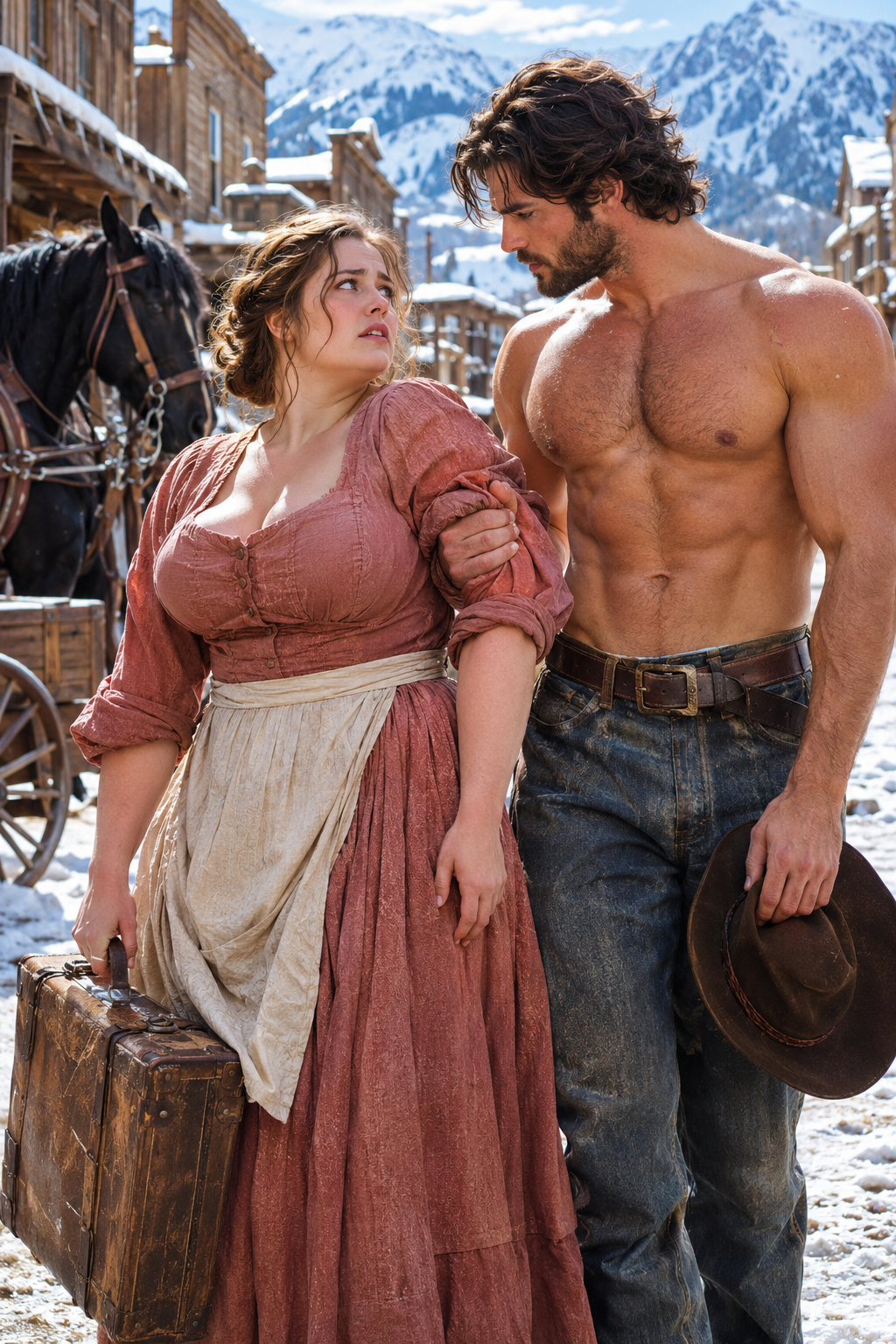
Elsie Thornton had almost escaped Pine Creek when a man on horseback blocked the freight wagon.
“I came because I couldn’t bear the thought of you leaving without knowing that someone wanted you to stay.”
Elsie stared at him, unable to speak.
Grant’s breath rose in a pale cloud between them. Behind him, his horse shifted impatiently, stamping its hooves against the frozen ground.
“I know what you’re thinking,” he continued. “That I’m a lonely rancher who’s grown accustomed to having a capable woman around. That Owen needs someone to look after him. That I’m asking you to fill a place left empty by someone else.”
“Aren’t you?”
“No.”
The certainty in his voice startled her.
“I’ve spent six weeks watching you turn a house back into a home. But it wasn’t because you cooked our meals or kept our accounts straight. It was because you made us remember how to laugh.”
Elsie looked down at her gloved hands.
“Grant, you barely know me.”
“I know you put aside the best apples for Owen because he likes them baked. I know you pretend not to notice when I burn the biscuits. I know you sit by the kitchen window when you think everyone’s asleep, staring at the road as though you’re expecting someone to come and take everything away.”
Her heart gave a painful twist.
“And I know,” he added quietly, “that whatever happened before you came to Pine Creek, it taught you that leaving was safer than staying.”
Elsie’s eyes filled.
The wagon driver cleared his throat.
“Ma’am, I can’t hold the freight much longer. Storm’s coming over the western ridge.”
Grant stepped aside.
“I’m not here to force you into anything. If you want to go, I’ll help you onto that wagon myself.”
He looked at her with an expression she had never seen on his face before.
“But if even a small part of you wants to come home, I’ll be waiting.”
Home.
The word struck her harder than any declaration of love could have.
For years, Elsie had forbidden herself from using it.
She glanced toward the wagon, toward the road that would carry her east, where a position awaited her at a boardinghouse in Silver Junction. A respectable position, with wages and a room of her own.
A place where nobody expected her to stay.
Then she looked at Grant.
“There’s something about me you don’t know,” she whispered.
“Then tell me.”
“I can’t. Not yet.”
Grant studied her face.
“Are you in trouble?”
She hesitated.
“Not the kind you can fix.”
“Maybe not. But that doesn’t mean you have to face it alone.”
For one wild moment, she nearly told him everything.
Instead, she reached for her suitcase.
Grant’s expression fell, but he didn’t move to stop her.
Then the driver called, “Last chance, miss!”
Elsie closed her eyes.
She thought of Owen’s empty breakfast plate, Grant’s coffee waiting on the stove, and the little blue curtains she had sewn for the kitchen.
She thought of all the years she had spent running from things that had already happened.
And for the first time, she wondered whether leaving was truly protecting her.
Or merely punishing her.
“Take my trunk off the wagon,” she said.
Grant blinked.
“What?”
She swallowed hard.
“I said, take my trunk off.”
The driver muttered something about foolish women and stubborn ranchers, but Grant was already reaching for her luggage.
When the wagon finally disappeared around the bend, Elsie stood beside him in the falling snow.
“I’m not promising forever,” she warned.
Grant’s mouth curved into the smallest smile.
“I’m not asking for forever today.”
“Then what are you asking?”
“Breakfast tomorrow.”
Despite herself, Elsie laughed.
“That’s all?”
“For now.”
He helped her mount behind him, and together they rode toward High Meadow.
Neither noticed the dark carriage waiting beneath the pines a quarter mile behind them.
Inside it, a man in a black felt hat watched until they disappeared.
Then he unfolded a newspaper clipping bearing Elsie’s name.
“Found you,” he murmured.
By the time they reached the ranch, Owen was standing on the porch.
The boy saw Elsie and froze.
For a heartbeat, nobody moved.
Then Owen ran.
He threw himself against her skirts so hard she nearly lost her balance.
“You came back!”
Elsie knelt and wrapped both arms around him.
“I’m sorry I left without saying goodbye.”
“Are you leaving again?”
The question was so small that it broke her heart.
“I don’t know what the future holds,” she answered gently. “But I promise I won’t disappear without telling you.”
Owen considered this.
Then he nodded solemnly.
“Good. Because Uncle Grant makes terrible porridge.”
Grant sighed.
“Six weeks of feeding that boy, and this is the gratitude I receive.”
Their laughter followed them into the house.
For three days, life at High Meadow settled into a happiness Elsie scarcely dared to trust.
The snow deepened. Ranch hands repaired fences when the weather allowed. Owen practiced his letters beside the stove, while Grant found increasingly ridiculous excuses to pass through the kitchen.
One evening, Elsie discovered a small wooden box on her bedside table.
Inside lay a silver thimble, polished until it shone.
A folded note accompanied it.
For the woman who keeps mending things she never broke.
There was no signature.
There didn’t need to be.
Elsie held the thimble against her heart.
And then, on the fourth morning, the past arrived.
The man came shortly after noon.
He introduced himself as Silas Vane, an attorney from Silver Junction.
He wore an expensive coat, carried a leather document case, and smiled without warmth.
Grant met him in the yard.
“What business brings you here?”
“Private business with Miss Thornton.”
Elsie appeared in the doorway carrying a basket of laundry.
The moment she saw him, the basket slipped from her hands.
White sheets spilled across the porch.
Silas smiled.
“Good afternoon, Mrs. Whitcomb.”
Grant turned sharply.
“Mrs. Whitcomb?”
Elsie’s face went bloodless.
“That isn’t my name anymore.”
“Legally,” Silas replied, “that remains a matter of dispute.”
Grant stepped between them.
“Explain yourself.”
Silas opened his case and produced a folded document.
“Your housekeeper was married to a gentleman named Arthur Whitcomb. A businessman of considerable standing in Kansas City.”
Elsie’s hands trembled.
“Arthur is dead.”
“Indeed. A tragic accident three years ago.”
“Then what do you want?”
Silas’s smile vanished.
“Something that belongs to the Whitcomb family.”
Grant looked at Elsie.
She stared at the document as though it were a snake.
“I don’t have anything of theirs.”
“Are you certain?”
“Leave.”
Silas lowered his voice.
“Your late husband’s brother is a patient man, Mrs. Whitcomb. But patience has limits.”
Grant took one step forward.
“You heard her.”
For the first time, Silas seemed to notice the size of the man confronting him.
He returned the document to his case.
“Very well. But I suggest you reconsider before innocent people suffer from your stubbornness.”
He glanced toward the house, where Owen watched through the window.
Then he departed.
Grant waited until the carriage vanished beyond the gate.
“Elsie.”
She couldn’t look at him.
“I was going to tell you.”
“When?”
“I don’t know.”
“Was he telling the truth?”
“Some of it.”
Grant’s jaw tightened.
“Are you married?”
“No!” She looked up desperately. “Arthur died three years ago. That much is true.”
“Then who is this man, and what does he want?”
Elsie pressed her hands against her face.
And finally, the story she had buried began to emerge.
Arthur Whitcomb had owned a shipping company in Kansas City. When Elsie married him at twenty-two, she believed herself fortunate.
He was charming, ambitious, and generous in public.
Behind closed doors, he was another man entirely.
He controlled her money, opened her letters, and kept her isolated from friends.
When she discovered he had been falsifying shipping records and stealing from small investors, she confronted him.
Arthur laughed.
Then he locked her in their house for three days.
“I thought he’d kill me,” Elsie whispered.
Grant stood motionless.
“One night, there was a fire at one of his warehouses. Arthur went there to destroy records before the authorities could inspect them.”
“What happened?”
“The roof collapsed. He never came out.”
Elsie swallowed.
“His brother, Victor, accused me of setting the fire. He claimed I’d stolen the company ledgers and hidden them. He said he’d make certain I was imprisoned unless I surrendered them.”
“Did you take them?”
“No.”
She hesitated.
“Not exactly.”
Grant frowned.
“Elsie.”
“Before Arthur died, I copied certain entries into a little blue notebook. Names, dates, payments. I thought if I could prove what he was doing, I might finally be free.”
“Where is it?”
“I hid it.”
“Where?”
She looked toward the stairs.
“In the lining of my suitcase.”
Grant exhaled slowly.
“Does Vane know?”
“He suspects.”
“Then we take it to the sheriff.”
Elsie shook her head.
“Victor has friends everywhere. The last deputy who promised to help me delivered my whereabouts directly to him.”
Grant was silent for a moment.
Then he said, “This isn’t Kansas City.”
“You don’t understand what men like Victor can do.”
“Maybe not. But I understand what happens when decent people stay silent because they’re afraid of powerful ones.”
Elsie looked at him.
“You’re angry.”
“Yes.”
“At me?”
Grant’s expression softened.
“At the man who taught you that telling the truth would only make your life worse.”
For the first time since Silas arrived, she began to cry.
Grant crossed the room and held her.
He didn’t demand that she stop trembling.
He simply stayed.
That evening, they decided to ride into Pine Creek the following morning and speak with Sheriff Daniel Mercer.
But the morning never came quietly.
Shortly after midnight, a gunshot shattered a window downstairs.
Grant was out of bed before the second shot.
“Elsie! Get Owen!”
She rushed into the boy’s room.
Owen sat upright, terrified.
“What’s happening?”
“Come with me.”
She wrapped him in a blanket and guided him toward the cellar.
Outside, horses thundered through the yard.
A man’s voice shouted, “Bring out the woman and the book!”
Grant fired from behind the front door.
The answering shot splintered the frame.
Elsie pushed Owen into the cellar and lifted the trapdoor.
“Stay here. Don’t make a sound.”
“You’re coming too?”
“In a moment.”
“Promise?”
She hesitated only a heartbeat.
“I promise I’ll do everything I can.”
She shut the door and hurried upstairs.
Her suitcase lay open beside the bed.
She tore at the lining with a pair of sewing scissors until the small blue notebook fell into her hands.
Another shot rang out.
Then she heard Grant cry out.
Elsie ran downstairs.
He stood against the wall, blood spreading across his left sleeve.
“Grant!”
“Just a graze. Stay back.”
Through the shattered window, she saw three mounted men. One carried a lantern. Another was dragging a burning branch toward the barn.
“They’re going to set the buildings on fire!” she cried.
Grant swore.
The ranch had barely survived the wildfire.
Another blaze would destroy what little remained.
Elsie looked from Grant to the notebook in her hand.
Then she made a decision.
She opened the front door.
“Stop!”
Grant seized her arm.
“Elsie, no!”
She pulled free and stepped onto the porch.
The riders turned.
“I have what you want!”
The man holding the lantern dismounted.
It was Silas Vane.
“Wise woman.”
“Put out that fire.”
“Give me the notebook.”
“First, put out the fire!”
Silas nodded to one of his men.
The rider stamped the burning branch into the snow.
Elsie lifted the book.
“Come closer.”
Silas approached, smiling.
“You should have cooperated years ago.”
“Perhaps.”
She waited until he reached the steps.
Then she hurled the notebook behind him, straight into the darkness.
Silas spun.
At that instant, Grant fired at the lantern.
Glass exploded.
Flames scattered over the snow, and the yard plunged into confusion.
Elsie ran toward the barn.
Silas shouted, “Get her!”
A horse reared.
Someone fired blindly.
Grant shouted her name.
Elsie reached the barn door and grabbed the hanging iron bell used to summon the ranch hands.
She rang it with all her strength.
The sharp sound split the night.
Once.
Twice.
Again and again.
Lights appeared in the bunkhouse.
Doors flew open.
Within moments, six ranch hands rushed into the yard carrying rifles.
Silas’s men tried to flee.
One escaped through the northern gate, but the others were forced from their saddles.
Silas himself bolted toward the trees.
Grant caught him before he reached his horse.
Despite his wounded arm, the rancher struck him hard enough to knock him into the snow.
“That,” Grant said through clenched teeth, “was for threatening a child.”
The ranch hands bound the attackers and locked them in the tack room.
Elsie stood trembling beside the barn.
Only when Grant approached did she realize her hands were bleeding from gripping the bell rope.
“Where’s Owen?” he asked.
“In the cellar.”
Grant’s expression changed.
He ran toward the house.
Elsie followed.
But when they opened the cellar, Owen was gone.
For several seconds, neither could comprehend the empty space.
Then Grant noticed the rear cellar hatch standing open.
Snow had blown across the steps.
A small boot print marked the ground outside.
Beside it was a much larger print.
And beyond them, two deep wheel tracks led toward the western pasture.
Grant went pale.
“The third rider.”
Elsie stared at the tracks.
“He wasn’t escaping.”
Grant’s voice was barely audible.
“He took Owen.”
They found a scrap of paper nailed to the fence.
Bring the notebook to Blackstone Mill before sunrise. Come alone, or the boy dies.
Grant read the message twice.
Then he crumpled it in his fist.
“I’m going after him.”
“You’ll be walking into a trap.”
“That’s my boy.”
“I know.”
Elsie reached for his hand.
“But we have to think.”
Grant looked toward the dark hills.
His face carried a kind of fear Elsie had never witnessed.
After his sister died, Owen had become the center of his world.
Losing him would destroy something no fire could touch.
Elsie forced herself to breathe.
“Victor wants the notebook. That means he doesn’t know what it contains.”
“Does it matter?”
“Yes. Because I know something he doesn’t.”
She looked toward the yard.
“The book I threw wasn’t the real one.”
Grant stared.
“What?”
“I took two notebooks from my suitcase. The blue one held my household expenses. The real records are sewn inside the leather cover of my old prayer book.”
For a moment, Grant simply looked at her.
Then, despite everything, a grim smile touched his face.
“You’ve been preparing for men like this a long time.”
“Too long.”
She squeezed his hand.
“Now we use that preparation to bring Owen home.”
They sent two ranch hands riding for Sheriff Mercer while Grant and Elsie prepared the horses.
Grant insisted she remain behind.
Elsie refused.
“Victor is after me. If you arrive without me, he’ll know something’s wrong.”
“Elsie, I can’t risk losing you too.”
She stepped close.
“You don’t get to decide that my safety matters more than your life or Owen’s. We’re doing this together.”
He stared at her, then nodded.
“Together.”
The ride to Blackstone Mill took nearly two hours.
Snow fell thickly through the pine trees. The abandoned mill stood beside a frozen stream, its enormous waterwheel motionless beneath a crust of ice.
A lantern glowed behind the broken windows.
Grant dismounted in the trees.
“There’s only one horse outside.”
“Victor’s?”
“Probably.”
They approached cautiously.
Inside, Owen sat tied to a chair beside an iron stove.
Victor Whitcomb stood behind him.
He was tall, elegantly dressed, and bore the same cold gray eyes Elsie remembered from Arthur.
“Welcome, sister-in-law.”
Elsie stepped into the light.
“Let him go.”
Victor smiled.
“Still giving orders, I see.”
Grant entered behind her, rifle raised.
Victor pressed a revolver against Owen’s temple.
“Put that down.”
Grant froze.
Slowly, he lowered the rifle.
Owen’s eyes filled with tears.
“Uncle Grant, I’m sorry.”
“You’ve done nothing wrong, son.”
Victor extended his free hand.
“The notebook.”
Elsie held up her prayer book.
“It’s in here.”
“Bring it.”
She took one step forward.
“First, untie him.”
Victor laughed.
“You always did mistake courage for bargaining power.”
He cocked the revolver.
Elsie stopped.
“Arthur’s warehouse,” she said suddenly.
Victor’s smile faded.
“What about it?”
“I know who started the fire.”
For the first time, Victor looked uncertain.
“Careful.”
“It wasn’t Arthur.”
Grant turned toward her.
Elsie kept her eyes on Victor.
“Arthur wrote me a letter two days before he died. He said he’d discovered money missing from accounts that even he hadn’t falsified. Someone was stealing from him.”
Victor’s face hardened.
“You’re lying.”
“He suspected his own brother.”
Victor’s hand trembled slightly.
“The fire destroyed the records,” Elsie continued. “How convenient for you.”
“Shut up.”
“Arthur went to that warehouse because you told him the authorities were coming. You knew he’d rush inside.”
“I said shut up!”
Victor struck the stove with his free hand.
The gun shifted away from Owen’s head.
Grant moved instantly.
He lunged forward, knocking the revolver aside.
It discharged into the ceiling.
Owen screamed.
Victor and Grant crashed against the table.
Elsie rushed toward the boy.
She cut his ropes with the small sewing knife she carried in her pocket.
“Run!”
Owen stumbled toward the door.
But Victor broke free and grabbed Elsie by the hair.
He dragged her backward, pulling a second pistol from his coat.
“Nobody moves!”
Grant stopped.
Victor’s face was twisted with rage.
“You think you can ruin me with a few scribbled numbers?”
Elsie struggled to breathe.
“I think you’ve already ruined yourself.”
Victor pressed the pistol against her ribs.
“Then you can die knowing how foolish you were.”
A shot thundered.
Elsie flinched.
Victor staggered.
His weapon fell to the floor.
Behind him stood Sheriff Mercer, smoke rising from his revolver.
Two deputies rushed into the mill.
Victor collapsed against the table, clutching his wounded shoulder.
Grant caught Elsie before she fell.
The sheriff approached.
“Everyone alive?”
Owen burst through the doorway and threw himself into Grant’s arms.
Only then did the rancher begin to shake.
He held the boy tightly, his face buried in Owen’s hair.
Elsie watched them, tears streaming down her cheeks.
Sheriff Mercer knelt beside Victor.
“You are under arrest for kidnapping, attempted murder, and several other offenses I’m certain we’ll discover.”
Victor spat blood onto the floor.
“You have no idea who I am.”
Mercer secured the handcuffs.
“I know exactly who you are. A man who thought his money made him untouchable.”
He glanced toward Elsie.
“Turns out he was mistaken.”
By sunrise, the prisoners were on their way to Pine Creek.
The truth, however, proved more complicated than anyone expected.
The notebook contained records of fraudulent investments, forged shipping bills, and payments to several officials in Kansas City.
It also contained a series of transactions that implicated Victor in the warehouse fire.
But the most important evidence came from Silas Vane.
Faced with serious charges, the attorney confessed that Victor had ordered the fire to eliminate records of his own embezzlement.
Arthur had entered the building unexpectedly.
Victor had refused to send help.
For three years, Elsie had lived beneath the shadow of a crime she hadn’t committed.
Now, at last, that shadow began to lift.
Sheriff Mercer arranged for the evidence to be forwarded to federal authorities.
Victor and Silas were transferred to Kansas City to stand trial.
The case made headlines across three states.
Several small investors recovered portions of their stolen savings.
Two corrupt officials resigned before warrants could be issued.
And Elsie Thornton received something she had almost forgotten existed.
A future that belonged to her.
Yet freedom was not quite as simple as she had imagined.
In the weeks following the attack, Elsie grew strangely restless.
She had spent so long fearing discovery that safety felt unfamiliar.
Every unexpected knock made her flinch.
Every passing carriage drew her eyes toward the window.
Grant noticed, but he never pressed her.
Instead, he did what he had done since the beginning.
He brought her coffee.
He listened when she wanted to speak.
And when she couldn’t, he sat beside her without demanding explanations.
One afternoon, she found him repairing the fence near the southern meadow.
The snow was melting, and patches of green grass appeared beneath the winter-browned earth.
“Grant?”
He looked up.
“Something wrong?”
“No.”
She hesitated.
“That’s the strange part.”
He set down his hammer.
Elsie approached the fence.
“For years, I imagined what it would feel like when I stopped running. I thought I’d wake one morning and feel completely different.”
“And do you?”
“Not really. I still get frightened. I still wonder whether happiness can disappear without warning.”
Grant leaned against the post.
“I reckon it can.”
She looked at him, surprised.
He continued.
“My father used to say life never promises to be gentle. It only gives us the chance to decide what kind of people we’ll be when it isn’t.”
Elsie smiled faintly.
“He sounds wise.”
“He was stubborn and terrible with money.”
She laughed.
“But he knew a thing or two about living.”
Grant reached through the fence and took her hand.
“I can’t promise nothing bad will ever happen again, Elsie. I can’t promise there won’t be hard winters, sickness, or years when the cattle prices fall.”
“I know.”
“But I can promise you’ll never have to wonder whether you’re facing those things alone.”
Her eyes filled.
“Grant…”
He reached into his coat.
For a moment, he seemed almost embarrassed.
Then he withdrew a small velvet box.
“I bought this before I rode after you that morning.”
Elsie stared at him.
“You did?”
“Hadn’t intended to give it to you right away. Thought I’d wait until I was certain.”
“Certain of what?”
“That you could choose me because you wanted to, not because you needed somewhere safe to hide.”
He opened the box.
Inside was a simple gold ring with a tiny blue stone.
“It belonged to my mother.”
Elsie covered her mouth.
Grant took a breath.
“Elsie Thornton, I don’t need a perfect woman. I don’t need someone who never gets frightened or never makes mistakes. I want the woman who rang a bell in the middle of a gunfight because she refused to let fear make her helpless.”
A tear slipped down her cheek.
“I want the woman who makes Owen laugh, argues with me about how much salt belongs in stew, and somehow convinced every man on this ranch to wash his hands before supper.”
She laughed through her tears.
“And most of all, I want the woman who finally understands that being loved isn’t the same as being trapped.”
He stepped closer.
“Will you marry me?”
Elsie looked at the ring.
Then at the house beyond the meadow.
She thought of the frightened young woman who had fled Kansas City carrying a suitcase and a secret.
She thought of every boardinghouse where she had slept with her belongings packed.
Every morning when she had left before anyone could ask her to stay.
For so long, she had mistaken motion for freedom.
But freedom wasn’t merely having the ability to leave.
It was having the courage to stay somewhere because her heart had chosen it.
“Yes,” she whispered.
Grant blinked.
“Yes?”
She laughed.
“Yes, you stubborn man. I’ll marry you.”
He slipped the ring onto her finger.
Then he kissed her.
It wasn’t a hurried kiss born of danger or desperation.
It was gentle, certain, and filled with all the words they no longer needed to say.
From somewhere behind the fence, a small voice cried, “Finally!”
They turned.
Owen stood beside the barn, grinning from ear to ear.
Grant groaned.
“How long have you been there?”
“Long enough.”
“Were you spying?”
“No, sir.”
Owen paused.
“I was supervising.”
Elsie burst into laughter.
Owen ran toward them.
“Does this mean you’re really staying?”
She knelt before him.
“Yes, sweetheart.”
“Forever?”
Elsie glanced at Grant.
Then she answered with a certainty she had never known before.
“I’m planning on it.”
Owen hugged her fiercely.
“Good. Because I told Mr. Bennett you were going to be my aunt, and he said I shouldn’t count my chickens before they hatched.”
Grant raised an eyebrow.
“And what did you tell him?”
Owen grinned.
“I told him our chickens are very dependable.”
Their wedding took place in late spring.
By then, High Meadow’s pastures had recovered enough for the cattle to graze again.
The orchard, blackened by the wildfire, surprised everyone by producing pale blossoms from branches the men had considered dead.
Edna Porter supplied the wedding supper.
The ranch hands decorated the porch with wildflowers.
Sheriff Mercer attended wearing his best coat, although Owen declared that he looked more comfortable carrying a rifle than a bouquet.
Elsie wore a cream-colored dress she had sewn herself.
At the last moment, Edna pinned a small blue ribbon near the collar.
“Something old, something new, and something blue,” she said.
Elsie smiled.
“And something borrowed?”
Edna placed a hand over hers.
“My faith that you were always worth loving, even when you couldn’t believe it yourself.”
Elsie embraced her.
The ceremony was simple.
Grant’s voice shook when he spoke his vows.
Elsie’s did too.
But neither tried to hide it.
When the minister pronounced them husband and wife, Owen cheered so loudly that the horses in the nearby pasture lifted their heads.
That evening, after the guests departed, Elsie stood alone on the porch.
The last light of sunset stretched over the valley.
Grant joined her.
“Regrets?”
She rested her head against his shoulder.
“One.”
He stiffened.
“What’s that?”
“I wish I’d stopped running sooner.”
Grant kissed her forehead.
“Then perhaps we wouldn’t have met when we did.”
She considered this.
“Perhaps not.”
From inside the house came the sound of Owen laughing with the ranch hands.
The kitchen smelled of fresh bread.
A breeze stirred the blue curtains.
Elsie looked toward the distant road that had once seemed to promise her escape.
She no longer feared it.
She knew she could travel whenever she wished. She could visit cities, make new friends, or pursue any dream she chose.
The difference was that she finally had somewhere she wanted to return to.
Months later, a letter arrived from Kansas City.
Victor Whitcomb had been convicted. His associates had received prison sentences, and the remaining legal claims against Elsie had been dismissed.
She read the letter once.
Then she folded it neatly and placed it in the stove.
Grant watched as the paper curled into ash.
“Are you sure?”
Elsie nodded.
“I don’t need to keep proof that I’m innocent.”
She watched the final corner disappear into the flames.
“I know who I am.”
Years passed.
High Meadow prospered.
Owen grew tall enough to help Grant with the cattle and eventually became a man as steady and kind as the uncle who raised him.
Elsie established a small schoolroom for the children of ranch workers, teaching them reading, arithmetic, and something she considered equally important: that a person’s circumstances did not determine their worth.
Whenever a frightened or lonely traveler arrived in Pine Creek, Elsie made certain there was a warm meal waiting.
She never asked why someone had come so far from home.
She knew that some stories needed time before they could be told.
And sometimes, when winter settled over the valley and the wind rattled the windows, Grant would find her standing beside the kitchen window, looking toward the road.
He would slip an arm around her waist.
“Thinking of leaving?”
She would smile.
“Not today.”
Then she would turn toward the warmth of the house, where love lived not as a promise that nothing painful would ever happen, but as a promise that pain would never have to be faced alone.
For Elsie had learned something no journey could have taught her.
A home is not a place where fear has never entered.
It is a place where fear no longer has the final word.
And the bravest thing a wounded heart can do is not always to walk away from what might hurt it.
Sometimes, the bravest thing is to open the door, let love enter, and finally believe that it deserves to stay.
But the story of Elsie Thornton and Grant Hail did not end with a wedding, a peaceful ranch, or even the passing of many happy years. Life, as Grant’s father had once warned, never promised to be gentle.
It was in the autumn of their twelfth year of marriage that High Meadow faced its greatest trial.
The summer had been unusually dry. The river ran low, and the grass turned brittle beneath the relentless sun. Although the ranch had survived fires, storms, and hard winters, Grant had never seen the valley so desperately thirsty.
Then, one September morning, a letter arrived from the county land office.
Elsie found Grant sitting at the kitchen table, the letter spread before him. His expression reminded her of the day Silas Vane had first appeared on their doorstep.
“What is it?” she asked.
Grant rubbed his forehead.
“A railroad company has purchased the land north of our property. They’re claiming an old water easement gives them the right to divert Pine Creek.”
Elsie frowned.
“But Pine Creek supplies half the ranches in this valley.”
“I know.”
“If they divert it, the cattle will die.”
“Not just ours.”
Grant looked through the window toward the distant hills.
“Every family downstream will suffer.”
Within days, representatives of the railroad arrived in Pine Creek, promising jobs, prosperity, and a brighter future.
Their spokesman, a polished gentleman named Charles Whitfield, assured the townspeople that the water diversion would be temporary.
But Elsie had learned long ago to distrust men who made generous promises while refusing to answer simple questions.
She attended the town meeting with Grant and listened as Whitfield spoke about progress.
When he finished, she rose.
“Mr. Whitfield, exactly how much water will your company take?”
Whitfield smiled.
“Only what our operations require, Mrs. Hail.”
“That wasn’t my question.”
A murmur moved through the crowd.
Whitfield adjusted his collar.
“The precise figures are technical matters.”
“Then perhaps you should bring someone who understands them.”
Several ranchers laughed.
Whitfield’s smile disappeared.
“Madam, I assure you the company has considered every possible consequence.”
Elsie looked around the room.
“Then they should have no objection to showing us their plans.”
The meeting ended without an agreement.
Three days later, the railroad offered Grant an extraordinary sum for High Meadow.
Enough money to retire comfortably.
Enough to purchase a fine house in any city Elsie desired.
Grant placed the offer before his wife.
“What do you think?”
Elsie studied the figures.
Then she looked at him.
“What do you think?”
“I think they’re paying us to stop asking questions.”
“Then you already know my answer.”
Grant smiled faintly.
“I thought you might say that.”
But the railroad was not accustomed to being refused.
Work crews arrived at the northern ridge. Trees were cut down. Survey stakes appeared along the stream, and armed guards began patrolling the company’s newly acquired property.
One night, someone tore down the fences separating High Meadow’s cattle from the rocky ravine.
By morning, seventeen animals were missing.
Grant and Owen spent two days finding them.
Three had fallen to their deaths.
Owen, now a young man, returned home with blood on his sleeve and fury in his eyes.
“They did it deliberately.”
Grant nodded grimly.
“Likely.”
“Then we should do something.”
“We will.”
“When?”
“When we can prove who’s responsible.”
Owen struck the table with his fist.
“While we wait, they’ll destroy everything!”
Elsie crossed the kitchen and placed a hand on his shoulder.
“Anger can give you the courage to act,” she said. “But if you let it make your decisions, it can also lead you straight into a trap.”
Owen looked away.
She recognized the expression.
It was the same stubborn frustration Grant had worn years earlier.
That evening, Elsie returned to the little schoolhouse she had established beside the orchard.
She searched through county maps, property records, and old documents collected during her years managing the ranch.
Near midnight, she found something extraordinary.
An original land survey from thirty-eight years earlier showed Pine Creek as a protected community waterway.
A handwritten provision stated that no private company could divert its natural course without the consent of every downstream landowner.
Elsie’s pulse quickened.
The railroad’s claim was not merely questionable.
It appeared to be illegal.
The following morning, she rode into Pine Creek to see Sheriff Mercer, now gray-haired but still sharp-eyed.
He examined the survey carefully.
“Where did you find this?”
“In Grant’s father’s records.”
Mercer frowned.
“If it’s genuine, Whitfield’s company has a serious problem.”
“Can you stop them?”
“I can request an injunction from the county judge.”
“How long will that take?”
“Possibly a week.”
Elsie looked toward the window.
Beyond the town, dark clouds gathered over the western mountains.
“A week may be too late.”
That night, heavy rain began falling in the hills.
At first, everyone welcomed it.
But by midnight, the creek had risen dangerously.
And at the railroad construction site, an unfinished earthen dam began to fail.
The workers had blocked a narrow gorge to create a reservoir. When the sudden flood struck, the poorly constructed barrier cracked beneath the pressure.
A young railroad laborer rode through Pine Creek shouting warnings.
“The dam’s breaking! Everyone below the gorge has to get out!”
The town erupted into confusion.
Grant was already saddling his horse when Elsie reached the stable.
“The lower farms are directly in the flood’s path,” he said.
“How long?”
“An hour. Maybe less.”
Elsie grabbed the schoolhouse bell.
“Then we warn everyone.”
They split into groups.
Owen rode toward the eastern homesteads.
Grant headed for the southern ranches.
Elsie and Sheriff Mercer organized wagons to evacuate families living near the stream.
Rain lashed the roads.
Thunder shook the hills.
At the Miller farm, Elsie found a mother struggling to carry two frightened children while her elderly father refused to leave his bed.
“We can’t move him!” the woman cried.
Elsie handed the children to a ranch hand.
“Find a door. Take it off its hinges.”
Within minutes, they had secured the old man to the wooden door and carried him to a wagon.
As the horses pulled away, a terrible roar echoed through the valley.
The dam had broken.
Water surged from the gorge, carrying logs, rocks, and pieces of shattered timber.
Elsie watched in horror as the torrent swallowed the lower road.
Then she heard a cry.
Across the flooded pasture, a little girl stood stranded on the roof of a chicken shed.
The water was rising around her.
Elsie recognized her immediately.
It was Mary Bennett, the youngest daughter of one of the ranch workers.
“Mary!”
The child waved desperately.
A broken fence floated between them.
There was no bridge.
No safe crossing.
Elsie seized a coil of rope from the wagon.
Sheriff Mercer caught her arm.
“You can’t go out there!”
“She’s seven years old!”
“The current will kill you!”
Elsie looked at the terrified child.
Then she remembered a winter night long ago, when Owen had been taken from the cellar.
She had made a promise to herself after that night.
Never again would fear be allowed to decide what kind of woman she became.
She tied the rope around her waist.
“Hold the other end.”
Before Mercer could argue, she stepped into the freezing water.
The current nearly knocked her down.
She grabbed a fence post, dragged herself forward, and fought for every inch.
By the time she reached the shed, water had climbed to the roof.
Mary threw her arms around Elsie’s neck.
“I’m scared!”
“I know, sweetheart.”
Elsie held her tightly.
“But I’m here.”
She secured the rope around the child and signaled to the men on shore.
They began pulling.
The first few yards went smoothly.
Then a floating tree trunk struck the shed.
The structure collapsed.
Elsie vanished beneath the water.
On shore, Mercer shouted her name.
The rope snapped taut.
For several terrifying seconds, nothing appeared above the surface.
Then Mary’s head emerged.
The men dragged her toward safety.
But Elsie was gone.
When Grant returned from the southern farms, he found a crowd gathered beside the flooded road.
Someone was holding Mary’s trembling little body beneath a blanket.
Sheriff Mercer stood in the rain, his face gray.
Grant looked from one person to another.
“Where’s Elsie?”
Nobody answered.
His voice rose.
“Where is my wife?”
Mercer lowered his eyes.
“She saved the child, Grant.”
Grant stumbled backward.
“No.”
“We couldn’t find her.”
“No!”
He ran toward the river.
Owen caught him before he reached the water.
“Uncle Grant!”
“Let me go!”
“The current’s too strong!”
Grant struggled against him.
“She’s out there!”
Owen held on, tears streaming down his face.
For years, Grant had been the strongest man Owen knew.
Now he watched that strength break beneath the weight of love.
Search parties rode along the creek throughout the night.
They carried lanterns and called Elsie’s name until their voices grew hoarse.
At dawn, the rain finally stopped.
The floodwaters began to recede.
Grant stood beside a fallen cottonwood, staring into the muddy river.
He had not slept.
He had barely spoken.
Then Owen came galloping down the bank.
“Uncle Grant!”
Grant turned.
Owen was pointing toward a bend in the creek.
“There’s someone!”
Grant ran.
Beyond a tangle of branches, half-hidden beneath reeds, lay a woman in a torn blue dress.
Elsie.
He dropped to his knees beside her.
Her face was pale, and her lips were almost colorless.
“Elsie?”
No answer.
He pressed trembling fingers against her neck.
Then he felt it.
A pulse.
Faint, but unmistakable.
“She’s alive!”
The cry echoed across the valley.
Grant gathered her into his arms.
“Stay with me, sweetheart,” he whispered. “You promised me breakfast tomorrow.”
Elsie’s eyes did not open.
But her fingers moved weakly against his coat.
It was enough.
They carried her to High Meadow, where Dr. Sullivan worked through the morning to warm her and treat her injuries.
For two days, Elsie drifted between fever and unconsciousness.
Grant scarcely left her bedside.
Owen sat with him whenever the doctor allowed.
On the third morning, sunlight spilled across the quilt.
Elsie stirred.
Grant leaned forward.
“Elsie?”
Her eyes opened slowly.
She looked at him for a long moment.
Then she whispered, “Did Mary make it?”
Grant laughed through his tears.
“Yes. She’s safe.”
“Good.”
Her eyes closed again.
Grant pressed his forehead against her hand.
“You frightened ten years off my life.”
A faint smile touched her lips.
“You always said I was troublesome.”
He kissed her fingers.
“Then promise me you’ll keep being troublesome for another forty years.”
She opened her eyes.
“Only if you stop making that terrible porridge.”
Grant laughed so hard that Owen came running from the hallway.
When the young man saw Elsie awake, he stopped in the doorway.
For a moment, he looked exactly like the frightened little boy who had once waited on the porch for her return.
Then he crossed the room and embraced her.
“I thought we’d lost you.”
Elsie held him close.
“You haven’t.”
Outside, the valley bore terrible scars.
Several homes had been destroyed, and hundreds of cattle were lost.
But because the warning had reached the farms in time, every family survived.
The railroad company could no longer hide what its construction had caused.
The old survey Elsie discovered became central evidence in a lawsuit brought by the valley’s landowners.
An investigation revealed that Whitfield had concealed engineering warnings and ordered work to continue despite serious concerns about the dam.
The company was forced to compensate the families and abandon its diversion project.
Whitfield himself faced criminal charges for falsifying safety records.
But Elsie’s greatest satisfaction came from something much smaller.
One afternoon, Mary Bennett appeared at High Meadow carrying a crooked bouquet of wildflowers.
She stood beside Elsie’s chair, twisting the stems nervously.
“My mama says you saved my life.”
Elsie smiled.
“Your mama is very kind.”
Mary shook her head.
“I remember. You came through the water when everybody said it was too dangerous.”
Elsie took the flowers.
“I was frightened too, Mary.”
The little girl frowned.
“But brave people aren’t supposed to be scared.”
Elsie gently drew her closer.
“Oh, sweetheart. That’s not what courage means.”
“What does it mean?”
“It means being afraid and still choosing to do what is right.”
Mary considered this carefully.
“Then I think I can be brave someday.”
Elsie kissed her forehead.
“I believe you already are.”
That winter, the people of Pine Creek gathered to rebuild the damaged schoolhouse.
No one asked Elsie to organize the work.
They simply arrived with lumber, tools, food, and whatever money they could spare.
Grant watched from the doorway as neighbors who had once barely spoken to one another worked side by side.
He turned to his wife.
“Look what you’ve done.”
Elsie shook her head.
“I didn’t do this.”
“Then who did?”
She looked across the room at the farmers, widows, ranch hands, and children laughing together.
“We all did.”
Years later, when Elsie’s hair had turned silver and Grant’s once-powerful shoulders had begun to stoop, they still sat together on the porch every evening.
Owen had married and raised children of his own.
The orchard had grown tall, the schoolhouse had expanded, and High Meadow had become a place where generations gathered for celebrations, comfort, and friendship.
One golden autumn evening, their granddaughter climbed onto Elsie’s lap.
“Grandma, is it true you almost left Grandpa before you got married?”
Elsie smiled.
“Very true.”
“Why?”
“Because I was afraid.”
“Of Grandpa?”
Elsie laughed.
“No, darling. I was afraid of being happy.”
The little girl looked bewildered.
“That doesn’t make sense.”
“No,” Elsie agreed softly. “It didn’t.”
Grant reached across the space between their chairs and took her hand.
Their fingers fit together as naturally as they had on the day he placed his mother’s ring upon hers.
The granddaughter studied them.
“So what made you stay?”
Elsie looked at the man beside her.
She remembered the frost on his coat, the freight wagon waiting on the road, and the trembling uncertainty in his voice when he told her that he had not come for the ranch.
Then she remembered something even more important.
“He gave me a choice,” she answered.
“And you chose Grandpa?”
“I chose to stop letting my past decide my future.”
The child thought about this.
Then she smiled.
“I’m glad you did.”
“So am I, sweetheart.”
As the sun sank behind the mountains, Grant squeezed Elsie’s hand.
“Breakfast tomorrow?” he asked.
Elsie turned toward him, her eyes bright with the same warmth he had fallen in love with so many years before.
“For as many tomorrows as we’re given.”
And that was the greatest promise they ever made.
Not that their lives would be free from storms.
Not that love would protect them from loss, disappointment, or fear.
But that whatever came, they would keep choosing one another.
Because in the end, a meaningful life is not measured by how successfully we avoid being hurt.
It is measured by how deeply we dare to love, how courageously we rise after suffering, and how much kindness we leave behind for others.
Elsie had once believed that surviving meant never allowing anyone close enough to break her heart.
But she eventually discovered a far greater truth.
The heart was not made merely to survive.
It was made to love.
And sometimes, the road that leads us to the life we were always meant to live begins with one simple, terrifying decision.
To turn around.
To go home.
And to stay.
THE END.