Eleanor Vale waited four years for the man she loved to return from overseas. When he finally came home, he introduced her to his wife.
Clara read the document three times before she allowed herself to believe what it said. Julian Whitmore had borrowed nine hundred and eighty pounds from Eleanor Vale, promising to repay the full amount upon his return to England. Beneath his signature was the signature of Eleanor’s father, who had witnessed the agreement.
The date was only two days before Julian had departed overseas.
Clara lowered herself into the chair behind her husband’s desk. She remembered the stories Julian had told her during their courtship. He had claimed that his success abroad had come entirely from his own determination and careful investments. He had spoken proudly of beginning with almost nothing.
Now she understood where that money had come from.
But something else disturbed her even more. The document had been folded and unfolded so many times that the paper had nearly split along the creases. Julian had not forgotten his debt. He had been reminded of it repeatedly.
As Clara prepared to return the document to its hiding place, she noticed several smaller sheets beneath it. One contained an unfinished letter. There was no signature, but she recognized Julian’s handwriting immediately.
The letter suggested that the Duke of Ravensworth had employed Eleanor Vale for reasons that had little to do with her professional abilities.
Clara felt suddenly sick.
She had heard those same accusations at dinner parties. Women had repeated them behind their fans, and gentlemen had laughed about them over drinks.
Her husband had started the rumors.
The following morning, Julian entered the breakfast room to find Clara sitting beside the window. Her tea remained untouched.
“You were awake rather late last night,” he remarked.
“I had difficulty sleeping.”
He buttered a piece of toast without looking at her.
“Perhaps you should spend less time worrying about other people’s affairs.”
Clara studied his face.
“Did you intend to marry Eleanor Vale before you went abroad?”
Julian stopped moving.
“Who has been telling you such nonsense?”
“Did you?”
“We were young. People make promises they have no intention of keeping.”
Clara felt the cruelty of his answer more deeply than she expected.
“And the money she gave you?”
His expression changed.
“Eleanor’s father encouraged certain investments. Unfortunately, matters did not proceed as expected.”
“Then why did you sign a promise to repay her?”
Julian slowly placed his knife on the table.
For several seconds, neither spoke.
“You have been searching through my private belongings.”
“I found something you should have told me before we married.”
“You had no right.”
“And what right did you have to take everything she possessed?”
Julian stood so abruptly that his chair struck the floor behind him.
“You will not discuss this matter again. Eleanor Vale is a foolish woman who cannot accept that circumstances change.”
Clara rose from her seat.
“Circumstances may change, Julian. A debt does not.”
He stared at her with an expression she had never seen before. It was not embarrassment or regret. It was anger at having been discovered.
“You would do well to remember whose wife you are.”
Clara watched him leave the room.
For the first time since their wedding, she wondered whether becoming his wife had been the greatest mistake of her life.
Across the county, Eleanor was preparing to leave her childhood home. Her new position as a governess would take her to a family nearly seventy miles away.
She packed carefully, placing her father’s books between layers of clothing. Most of her furniture had already been sold. The remaining possessions would be stored with an elderly neighbor.
As she closed a small wooden trunk, someone knocked at the door.
It was the Duke of Ravensworth.
“I was told you were leaving tomorrow.”
“Yes, Your Grace.”
“Without saying goodbye?”
Eleanor looked down.
“I thought it would be easier for everyone.”
The Duke glanced around the nearly empty room. He had seen prosperous families lose their fortunes before, but there was something especially painful about watching a capable woman abandon the life she deserved because another person had behaved dishonorably.
“The commissioners have reviewed your corrections,” he said. “They were astonished by what you discovered.”
“Then I am pleased my work was useful.”
“Useful? Miss Vale, you prevented dozens of families from losing land to which they were entitled.”
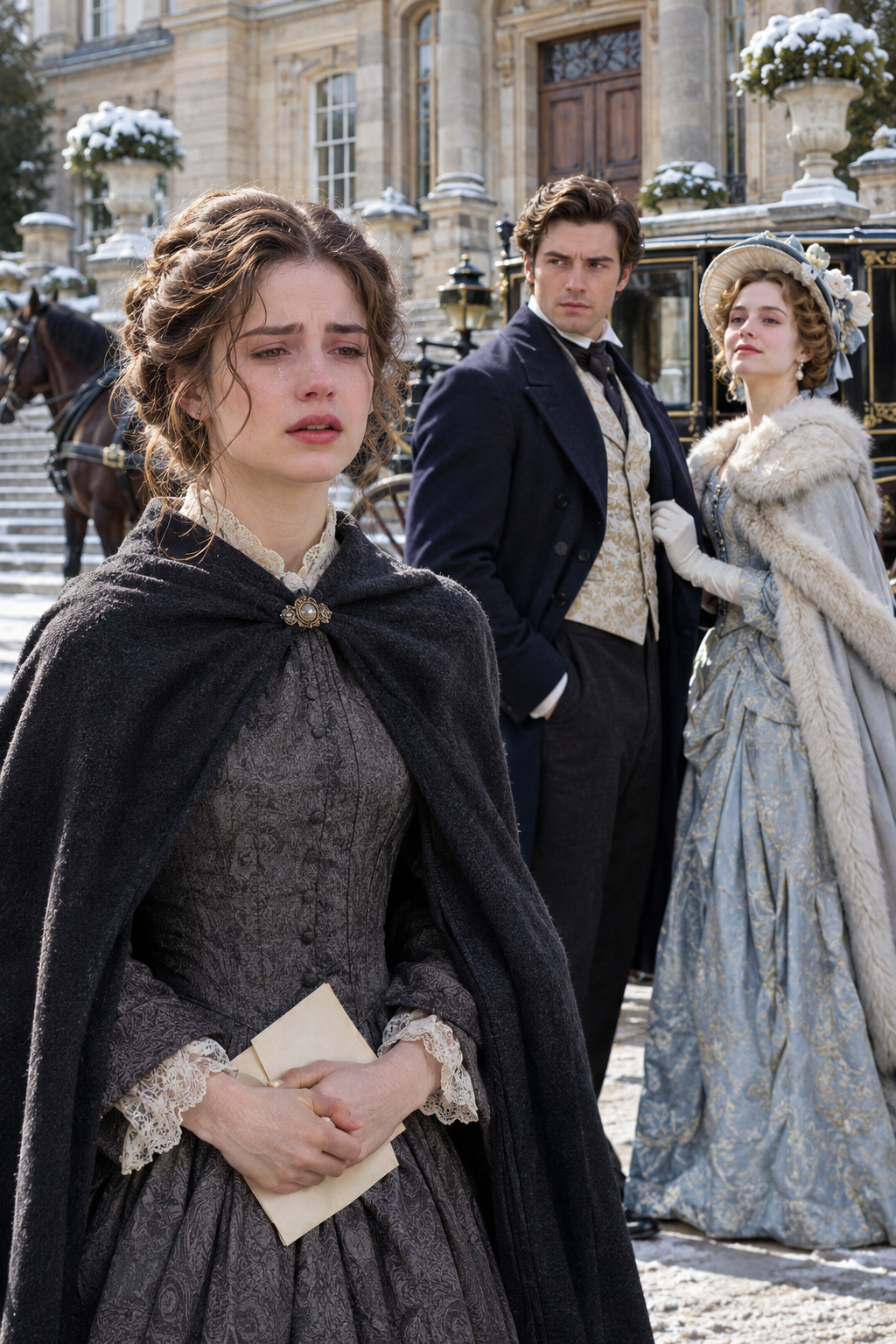
Eleanor smiled faintly.
“Then perhaps something good has come from all this.”
He stepped closer.
“You need not leave.”
“If I remain, the accusations will continue. People will question your judgment and the fairness of the award.”
“Let them question me.”
“But they will not stop with you.”
She looked toward her father’s portrait.
“I know what people can do to a woman’s reputation. I will not allow my work to become another reason for innocent families to suffer.”
The Duke wanted to argue, but he recognized the determination in her voice.
His sister had once spoken with similar quiet courage. At the time, he had advised her to endure the gossip until it passed. Instead, the scandal had followed her until her death.
He had regretted his silence ever since.
“I wish you would permit me to help you.”
“You already have.”
Eleanor held out her hand.
“Thank you for allowing me to be useful again.”
The Duke accepted her hand, but the farewell felt terribly wrong.
He left the cottage with a heavy heart.
That afternoon, Clara arrived unexpectedly at Ravensworth Hall.
She carried a small leather case and refused to explain the purpose of her visit to anyone except the Duke himself.
When Alaric entered the drawing room, he found her standing beside the fireplace.
“Mrs. Whitmore. This is unexpected.”
“I apologize for arriving without an invitation.”
“Is something wrong?”
Clara opened the case and placed the promissory note on the table.
The Duke recognized it immediately.
“Where did you obtain this?”
“From my husband’s private cabinet.”
She placed the unfinished letter beside it.
“And this.”
Alaric read the letter. His face hardened.
For weeks, he had suspected Julian of spreading the accusations. Now the proof lay before him.
“Does your husband know you have brought these?”
“No.”
Clara took a deep breath.
“I married a man who told me he had earned his fortune through honest work. I have since discovered that another woman paid for his opportunities and received nothing but humiliation in return.”
The Duke remained silent.
“I cannot change what Julian has done,” she continued. “But I have money of my own. My father arranged a marriage settlement that protects a portion of my inheritance.”
She withdrew another document.
“I wish to use it to repay Miss Vale.”
Alaric looked at her in surprise.
“You are offering to settle your husband’s debt?”
“Yes. Every penny, together with whatever interest is appropriate.”
“Mrs. Whitmore, you are not responsible for his conduct.”
“Perhaps not. But I have enjoyed comforts that were made possible by his dishonesty. Now that I know the truth, I cannot pretend otherwise.”
The Duke studied her for a long moment.
“And what do you expect in return?”
“Nothing.”
“Not even her silence?”
Clara shook her head.
“Especially not her silence.”
For the first time that afternoon, the Duke’s expression softened.
He summoned his solicitor and instructed him to prepare the necessary arrangements. But he made one condition clear: Eleanor would decide whether to accept the settlement.
No one would make that decision for her.
Meanwhile, Julian returned home and discovered that his private cabinet had been opened again.
The promissory note was missing.
So was the unfinished letter.
He questioned the servants until a frightened maid admitted that Clara had taken a carriage to Ravensworth Hall.
Julian immediately ordered his horse.
By the time he arrived, Clara and the Duke were discussing the proposed settlement with the solicitor.
Julian entered without waiting to be announced.
“Clara, we are leaving.”
She remained seated.
“I have not finished.”
“You have no business here.”
The Duke rose.
“Mr. Whitmore, I suggest you lower your voice.”
Julian noticed the documents on the table.
His face turned pale.
“That is private property.”
“The debt it records is not imaginary,” Alaric replied.
Julian reached for the unfinished letter, but the solicitor moved it beyond his grasp.
“This is outrageous. You have encouraged my wife to interfere in matters she does not understand.”
Clara looked directly at him.
“I understand them perfectly.”
“You would disgrace your own husband for the sake of a woman you barely know?”
“No. You disgraced yourself when you took her money and tried to destroy her reputation.”
Julian looked toward the Duke.
“You believe everything Eleanor tells you because you have developed an attachment to her.”
Alaric’s expression became cold.
“Be very careful.”
“Everyone in the county knows what has been happening.”
“Indeed,” the Duke replied. “And we now know who has been telling them.”
Julian fell silent.
The solicitor unfolded the unfinished letter.
“Would you care to explain this, sir?”
Julian’s confidence began to disappear.
He claimed the letter was merely a private expression of concern. He insisted that others had misunderstood his intentions. He even suggested that Eleanor had exaggerated their former relationship to gain sympathy.
Clara listened until she could bear no more.
“Have you ever told the truth when a lie was more convenient?”
Julian turned toward her.
“You are my wife.”
“And Eleanor was once the woman you promised to marry. Neither of those facts seems to mean much to you.”
The Duke instructed a servant to bring Eleanor to the hall before her departure.
When she arrived an hour later, she was astonished to find Julian and Clara waiting beside the solicitor.
Her first instinct was to leave.
“Please stay,” Clara said gently. “I owe you an explanation.”
Eleanor looked uncertainly at the Duke.
He nodded.
Clara approached her.
“I did not know about your agreement with Julian when I married him. Had I known, I would never have accepted his proposal.”
Eleanor’s eyes moved toward Julian.
He looked away.
Clara explained what she had discovered and what she intended to do.
When Eleanor heard the amount being offered, she shook her head.
“I cannot accept your inheritance.”
“It is not a gift.”
“But you did not borrow the money.”
“No. And I am not asking you to forgive him.”
Clara’s voice trembled.
“I am asking you to accept what should have been returned to you long ago.”
Eleanor looked at the documents.
For years, she had imagined what she would say if Julian ever admitted what he owed her. In those imagined conversations, he had always appeared ashamed. Sometimes he had even apologized.
Now he stood only a few feet away, angry because someone had finally held him accountable.
“Why did you do it?” she asked.
Julian frowned.
“Do what?”
“The letters. The rumors. Was it not enough that you married someone else?”
He gave an impatient sigh.
“You should have accepted that our lives had taken different paths.”
“I did accept it. I found employment. I asked nothing of you.”
“You were becoming too close to the Duke. I could not risk you telling him everything.”
Eleanor stared at him.
The answer was so simple that it was almost unbearable.
He had not spread the rumors because she had threatened him. He had done it because he feared she might eventually speak.
“You were willing to ruin my life to protect your own.”
Julian said nothing.
Clara turned toward the solicitor.
“Please ensure that the settlement includes a written acknowledgment of the debt and its repayment.”
The Duke added another requirement.
“And a signed withdrawal of every accusation Mr. Whitmore has made concerning Miss Vale’s character and employment.”
Julian protested immediately.
“You cannot expect me to sign such a statement.”
“Then I shall place the evidence before the appropriate authorities and allow the matter to proceed publicly,” the Duke replied.
Julian looked around the room.
For the first time, there was no one willing to defend him.
He sat down.
The solicitor prepared the documents while Eleanor stood near the window, struggling to understand how completely her circumstances had changed in a single afternoon.
When the papers were ready, Julian signed them.
His hand shook as he wrote his name.
Eleanor watched without satisfaction. She had once believed that seeing him humbled would bring her happiness. Instead, she felt only the sadness of recognizing how little she had truly known the man she loved.
Clara signed the settlement documents after him.
Then she placed the pen before Eleanor.
“You deserve to begin again.”
Eleanor looked into her eyes.
“Thank you.”
It was the first moment either woman smiled.
Over the following weeks, the truth spread throughout the county.
Julian’s written withdrawal was delivered to the people who had received his accusations. The commissioners publicly confirmed that Eleanor’s corrections to the Westmere Common award had been accurate, valuable, and entirely professional.
Families who had once avoided her began visiting again.
Some brought flowers. Others offered invitations. A few attempted awkward apologies.
Eleanor accepted sincere apologies but no longer felt obliged to welcome everyone into her life.
She had learned that forgiveness did not require forgetting who had abandoned her when she needed kindness most.
Julian discovered that recovering his own reputation would be considerably more difficult.
Several business associates withdrew their support. Invitations to important gatherings disappeared. Men who had once admired his success now questioned how much of it had been honestly earned.
Clara returned to her father’s family home for an extended separation. She made arrangements through her trustees to protect her remaining fortune.
Julian sent letters asking her to return.
At first, he blamed the Duke. Later, he blamed Eleanor. Eventually, he claimed that Clara had misunderstood his ambitions.
Not once did he express genuine regret for what he had done.
She stopped answering.
Months later, Eleanor received a letter from Clara.
“I hope you will not think me presumptuous,” she wrote, “but I would be grateful to know whether you are happy. I have often wondered what your life might have been if you had never met my husband. I hope the years ahead will give you the freedom to discover it.”
Eleanor read the letter beside the window of her restored cottage.
She replied that same evening.
“I spent too long believing that my future depended upon another person’s promises. I am beginning to understand that it belongs to me. I hope you will discover the same thing.”
By spring, Eleanor had resumed her legal work under a new arrangement with the Duke. Her responsibilities were clearly documented, and her contributions were formally acknowledged.
Other landowners soon requested her assistance.
She helped widows understand their property rights, corrected unfair agreements, and advised families who could not afford expensive legal services.
With part of her recovered inheritance, she established a small office in the village.
Above her desk hung her father’s portrait.
One afternoon, the Duke visited her there and found three young women studying legal documents under her guidance.
“You appear to have created quite an enterprise,” he remarked.
Eleanor laughed.
“Someone must teach them what my father taught me.”
When the young women departed, Alaric remained behind.
“There is something I have wanted to tell you for some time.”
Eleanor put aside her work.
He spoke about his sister, explaining how he had once allowed fear of public opinion to prevent him from defending someone he loved.
“I cannot undo what happened to her,” he said. “But knowing you has reminded me that silence can be a terrible form of cruelty.”
Eleanor reached across the desk and touched his hand.
“You defended me when you had nothing to gain.”
“I gained considerably more than you realize.”
She looked at him.
The Duke smiled, suddenly appearing less certain than she had ever seen him.
“I have grown rather fond of our conversations. And of you.”
Eleanor felt warmth rise to her cheeks.
“I would like to call upon you,” he continued. “Not as your employer, and certainly not as your protector. Simply as a man who wishes to know you better.”
She considered him for a moment.
“Then you may call on Thursday.”
“Thursday?”
“I have appointments until then.”
He laughed.
“Thursday it is.”
Their relationship developed slowly over the following year. Alaric never asked Eleanor to abandon her work, and she never felt that accepting his affection required surrendering her independence.
When he eventually proposed, he did so in her modest office rather than beneath the grand chandeliers of Ravensworth Hall.
Eleanor accepted because she loved him, not because she needed rescuing.
Clara attended their wedding.
Before the ceremony, Eleanor found her standing alone near the church entrance.
“Are you happy?” Eleanor asked.
Clara smiled.
“I am learning to be.”
The two women embraced.
Neither had received the future she once imagined, but both had discovered something more valuable than the promises Julian had made them.
They had discovered the freedom of living according to their own principles.
Years later, people still spoke about the remarkable woman who had become the Duchess of Ravensworth. They admired her intelligence, her generosity, and the opportunities she created for women who possessed talents society often overlooked.
But Eleanor never forgot the frightened young woman who had stood in a crowded drawing room, watching the man she loved introduce another woman as his wife.
She sometimes wished she could return to that moment and whisper a few words into her younger self’s ear.
She would tell her that betrayal was not the end of her story. That losing someone who did not value her was not the same as losing her worth. That kindness could arrive from the most unexpected places, even from the woman she once believed had taken everything from her.
Julian had thought money, reputation, and marriage could protect him from the consequences of his choices.
Instead, the two women he had deceived became stronger because they refused to let his dishonesty determine who they would become.
And Eleanor learned that the most precious inheritance her father had left her was never the nine hundred and eighty pounds.
It was the courage to stand by the truth, the knowledge to build a life of her own, and the understanding that genuine love would never ask her to sacrifice her dignity in exchange for a promise.
Seven years after Eleanor married the Duke of Ravensworth, a letter arrived at the estate on a cold November morning.
The handwriting was familiar, although she had not seen it in years.
It belonged to Julian Whitmore.
Eleanor hesitated before breaking the seal.
The letter was surprisingly short.
“Dear Eleanor,
I have recently returned to England under circumstances considerably different from those of my previous arrival. I am aware that I have no right to request anything from you. Nevertheless, there is something I must say before it is too late. If you are willing to receive me, I would be grateful for a few minutes of your time.”
Eleanor read the letter twice before placing it on her desk.
When Alaric entered the room, she handed it to him.
“Do you wish to see him?” he asked.
“I think I do.”
“Then I shall respect your decision.”
Three days later, Julian arrived at Ravensworth Hall.
Eleanor barely recognized him.
His expensive clothing had been replaced by a worn coat. His hair had turned gray at the temples, and the confidence that once made him so charming had disappeared.
He stood awkwardly before her.
“Your Grace.”
“Please sit, Julian.”
He accepted the invitation but seemed unable to meet her eyes.
“I heard about your marriage. And your work with the women in the village.”
Eleanor waited.
“I suppose you know that my business failed.”
“I had heard something of it.”
“Everything is gone. The investments, the house, the people who once called themselves my friends.”
He paused.
“For years, I blamed everyone except myself.”
Eleanor studied him quietly.
“Why have you come?”
Julian reached inside his coat and removed a small envelope.
Inside were several banknotes.
“There are forty pounds here. It is all I have managed to save.”
Eleanor frowned.
“Clara settled your debt years ago.”
“I know. But she should never have been required to do so.”
His voice broke slightly.
“I cannot repay everything I took from you. Not the money, not the years, and certainly not the damage I caused. But I wanted to begin somewhere.”
For the first time, Eleanor heard something in Julian’s voice that she had waited years to hear.
Genuine remorse.
“I was ashamed of where my success came from,” he admitted. “When I returned with Clara, I feared you would expose me. So I decided that if people stopped believing you, I would be safe.”
He lowered his head.
“I destroyed the reputation of the one person who had believed in me when I had nothing.”
Eleanor felt an unexpected sadness.
“Do you understand now what you did?”
“Yes.”
“And Clara?”
“I wrote to her last year. I apologized without asking her to return. She replied that she hoped I would become a better man.”
A faint, painful smile crossed his face.
“She deserved better than me. So did you.”
Eleanor pushed the envelope back toward him.
“Keep your money.”
Julian looked surprised.
“I did not come here seeking charity.”
“And I am not offering it. You have already acknowledged what you owed. Use this money to build an honest life.”
He stared at her.
“Can you forgive me?”
Eleanor looked through the window toward the garden, where her two children were playing beneath the watchful eye of their father.
She thought about the years she had spent waiting for Julian, the humiliation of his return, and the loneliness that had followed.
Then she thought about everything that had come afterward.
“I forgave you long ago, Julian.”
His eyes filled with tears.
“But forgiveness does not mean that the past disappears,” she continued. “It means I no longer allow it to control my future.”
Julian nodded slowly.
When he left Ravensworth Hall, Eleanor watched his carriage disappear beyond the gates.
She felt neither anger nor triumph.
Only peace.
Several months later, Clara arrived for her annual visit.
She had established a small school for girls whose families could not afford an education. Eleanor had supported the project from its earliest days, providing books and helping Clara manage its finances.
Together, they walked through the gardens.
“Julian came to see me,” Eleanor said.
Clara stopped.
“Did he?”
“He apologized.”
Clara was silent for a moment.
“Then perhaps he has finally learned something.”
“I hope so.”
They continued walking until they reached a stone bench overlooking the countryside.
Clara smiled as she watched Eleanor’s children chasing each other across the lawn.
“Do you ever wonder what would have happened if I had never opened that cabinet?”
Eleanor considered the question.
“I imagine I would have spent several years teaching children in someone else’s home.”
“And I might still be living with a man whose character I never understood.”
Clara shook her head.
“How extraordinary that a single piece of paper changed so many lives.”
“It was not the paper,” Eleanor replied.
Clara looked at her.
“It was what you chose to do after finding it.”
The following summer, Eleanor and Clara opened a larger school near Westmere Common. In addition to reading, writing, and arithmetic, the students learned bookkeeping, property management, and the practical skills necessary to earn an independent living.
Above the entrance hung a simple wooden sign bearing the name of Eleanor’s father.
The opening ceremony attracted families from across the county.
Among them were women who had once repeated the cruel rumors about Eleanor. Some now brought their daughters to study under her guidance.
Eleanor welcomed the children without hesitation.
Their mothers’ mistakes were not theirs to carry.
At the end of the ceremony, a young girl approached Eleanor with a question.
“Your Grace, my mother says women cannot do the same work as men. Is that true?”
Eleanor knelt beside her.
“Some people will tell you that there are things you cannot do simply because you are a girl.”
The child listened carefully.
“But you must never confuse what other people believe about you with what you are capable of becoming.”
The little girl smiled.
“Then I should like to become a solicitor.”
Eleanor smiled back.
“Then you must study very hard. And never stop asking questions.”
That evening, Eleanor returned to Ravensworth Hall with Alaric.
They sat together beside the fireplace after their children had gone to bed.
“Your father would have been proud today,” Alaric said.
Eleanor rested her head against his shoulder.
“I hope so.”
“I know so.”
She looked at the portrait of her father hanging above the fireplace.
For years, she had believed that protecting his memory meant remaining silent about the injustice she had suffered.
Now she understood that honoring him meant using everything he had taught her to make life better for others.
Her father’s greatest legacy was no longer confined to the pages of his legal books.
It lived in every young woman who entered the school believing she deserved a future of her own.
Many years later, when Eleanor’s eldest daughter asked how she had first met her father, Eleanor told her the entire story.
She spoke of Julian’s betrayal, Clara’s courage, and Alaric’s kindness.
Her daughter listened with wide eyes.
“Were you not angry with Clara when you first met her?”
“I was hurt,” Eleanor admitted. “But Clara had not stolen anything from me. She had been deceived, just as I had.”
“And you became friends?”
“The very best of friends.”
Her daughter thought about this for a moment.
“Then something wonderful came from something terrible.”
Eleanor smiled.
“Yes, my darling. But only because people chose to make something wonderful out of it.”
Outside, the evening sun settled over the fields of Westmere Common. Families walked along paths that Eleanor’s careful legal work had helped preserve decades earlier.
The school bell rang in the distance.
Alaric appeared in the doorway, carrying two cups of tea.
Eleanor looked at the man she loved, then at her daughter, and felt a quiet gratitude for the life she had built.
She had once given everything to a man who promised her happiness.
In the end, she discovered that happiness was not something another person could promise, purchase, or take away.
It was something she could build through courage, purpose, kindness, and self-respect.
And although Julian Whitmore had broken the first great promise of her life, Eleanor never allowed his betrayal to break her belief in goodness.
That was her greatest victory.
Not becoming a duchess.
Not recovering her fortune.
Not watching the man who betrayed her face the consequences of his actions.
Her greatest victory was becoming a woman who could have every reason to be bitter and still choose to be kind.
Because the true measure of a person’s character is not what happens to them when life is fair.
It is what they choose to become when it is not.
And Eleanor Vale, who had once stood alone in a crowded drawing room with a broken heart, spent the rest of her life making certain that other women would never have to stand alone.
THE END.