“Don’t drink that coffee!” Mia shouted, grabbing the porcelain cup just inches from Luca Moretti’s mouth.
Daniel stood frozen beneath the kitchen lights, his right hand pressed against the inside of his jacket.
Luca Moretti watched him without blinking.
“I asked you a question, Daniel.”
The technician swallowed.
“Mr. Moretti, I can explain.”
“Then explain with your hands where I can see them.”
Slowly, Daniel removed a small black object from his pocket.
It was a flash drive.
Vincent, standing near the doorway, suddenly stepped forward.
“That belongs to the maintenance company,” he said. “It’s probably nothing important.”
Luca didn’t even look at him.
“Funny. I don’t remember asking you.”
The silence that followed was almost painful.
Mia stood beside the antique espresso machine, her heart pounding so hard she could feel it in her throat.
Two weeks ago, she’d been a struggling barista looking for steady work.
Now she was standing between a powerful mafia boss and two men who clearly wanted her to stop asking questions.
Luca held out his hand.
“Give it to me.”
Daniel hesitated.
One of Luca’s guards moved closer.
The technician surrendered the drive.
“Marco,” Luca said to his head of security, “take this upstairs. Have our computer specialist examine it. Make a copy first.”
Marco nodded and left.
Vincent gave a nervous laugh.
“Luca, surely we aren’t going to turn breakfast into a criminal investigation because a waitress noticed some stains.”
Mia felt the insult, but she refused to lower her eyes.
“I’m a barista,” she corrected. “And those stains weren’t normal.”
Vincent’s expression hardened.
Luca turned toward her.
“Tell me exactly what you found.”
Mia pointed toward the espresso machine.
“The water line has green corrosion around the connection. There’s also a strange smell coming from the boiler. I thought it was just old equipment until I noticed something else.”
“What?”
“The machine has been serviced recently, but the screws on the rear panel don’t match.”
Daniel shook his head.
“Replacement screws. That’s common.”
“Then why are there fresh tool marks around a compartment that isn’t supposed to be opened during regular maintenance?”
Daniel opened his mouth.
Nothing came out.
Luca’s gaze shifted between them.
For three years, he’d endured unexplained pain, exhaustion, trembling hands, and periods of dizziness.
He had visited specialists in New York, Boston, and Switzerland.
Some doctors suspected an autoimmune condition. Others blamed stress or medication.
None had found a complete explanation.
He had begun to believe his body was simply failing him.
And every morning during those three years, Vincent had insisted that his favorite antique espresso machine remain in service.
The machine had belonged to Luca’s father.
It was one of the few things Luca refused to replace.
“Open it,” Luca ordered.
Daniel immediately shook his head.
“You’ll destroy a priceless piece of equipment.”
Luca looked at the machine.
Then at Mia.
“Can you open it?”
She hesitated.
“Not without damaging the outer casing. The boiler is sealed behind it.”
“Then damage it.”
Vincent stepped forward.
“Luca, think about what you’re doing. Your father loved that machine.”
Something flickered across Luca’s face.
For a moment, Mia thought he might change his mind.
Instead, he said quietly, “My father loved me more.”
Mia reached for Daniel’s toolbox.
Daniel grabbed the handle.
“Don’t touch my equipment.”
Marco’s deputy stepped between them.
“Let go.”
Daniel released the toolbox.
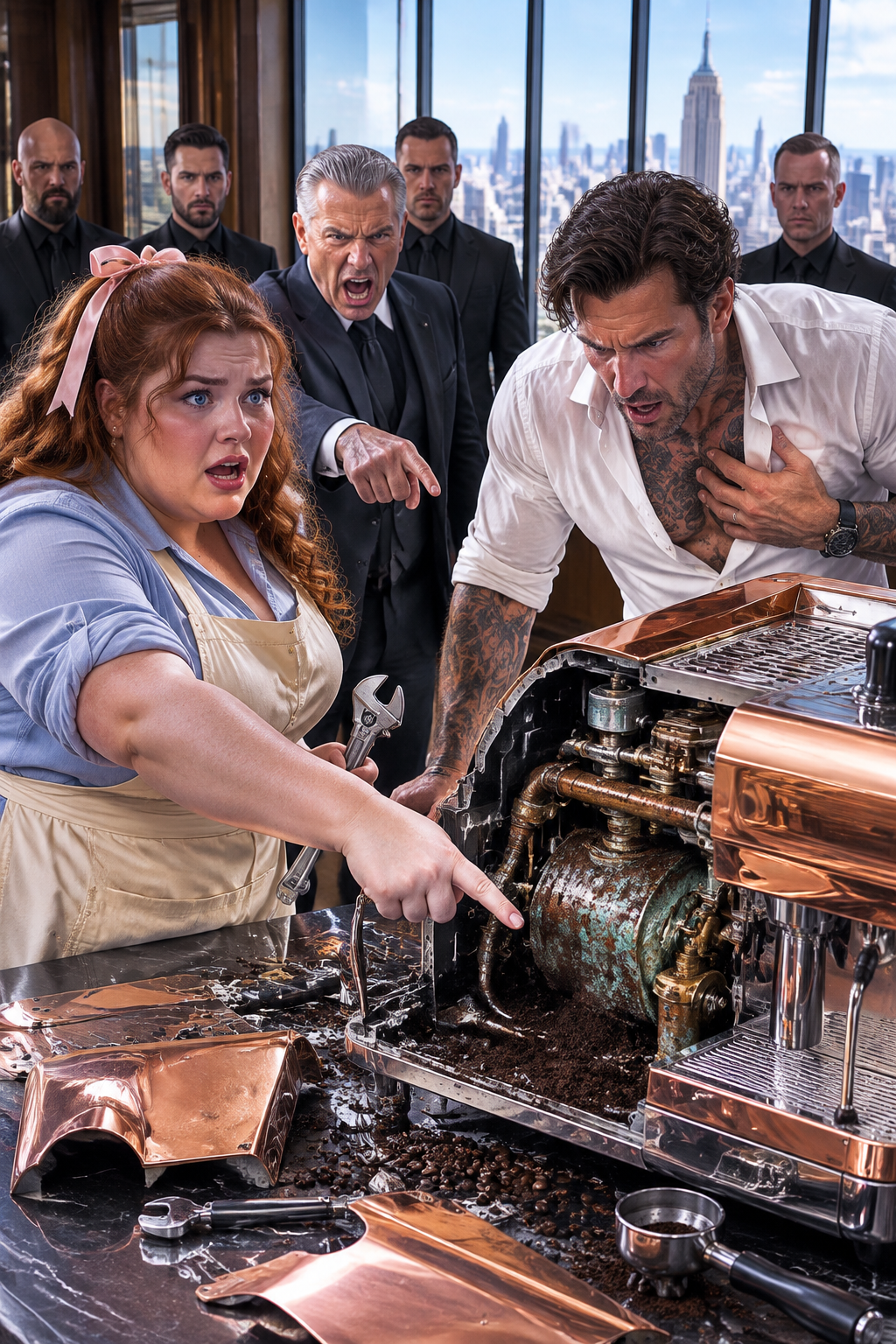
Mia selected a screwdriver and carefully removed the accessible rear screws.
The panel came loose.
A sour, metallic smell escaped.
She recoiled.
Inside, the machine looked nothing like the polished antique displayed in Luca’s kitchen.
Dark moisture coated the insulation.
Greenish deposits surrounded several copper connections.
Near the boiler, a concealed section was covered with damp, discolored material.
Mia stared.
“This isn’t right.”
Luca approached.
“What am I looking at?”
“Corrosion. Possibly mold contamination. And someone has altered the plumbing.”
Daniel’s voice rose.
“That’s ridiculous. You can’t determine anything just by looking.”
Mia nodded.
“You’re right. We need laboratory testing.”
She turned toward Luca.
“But until then, nobody should drink anything from this machine.”
Luca studied the exposed interior.
“Three years,” he murmured.
Vincent folded his arms.
“Old machines deteriorate. That doesn’t prove sabotage.”
“No,” Mia answered. “It doesn’t.”
Then she pointed to a narrow metal fitting hidden behind the boiler.
“But that part doesn’t belong there.”
Daniel’s face lost its color.
Mia had worked with commercial espresso equipment for years. She knew the difference between an ordinary repair and an unusual modification.
The fitting connected a concealed chamber to the machine’s water system.
Someone had installed it deliberately.
She reached toward it.
“Don’t!” Daniel shouted.
Everyone turned.
He immediately tried to recover.
“The boiler could still be hot.”
Mia stepped back.
“Then we’ll disconnect the power and let a qualified technician handle it safely.”
Luca looked at Daniel.
“You seem very concerned about this particular part.”
“I’m concerned about your safety.”
“That’s interesting,” Luca said. “Because for three years, I’ve paid you to maintain the machine that may have been making me sick.”
Daniel’s hands began shaking.
Vincent moved toward the doorway.
“I’m calling your physician.”
Luca’s voice stopped him.
“You can make that call from right here.”
Vincent slowly turned around.
For the first time, Mia noticed how carefully Luca was watching his oldest adviser.
Vincent had served the Moretti family for twenty-six years.
He had managed Luca’s father’s business affairs.
He had attended family funerals, negotiated dangerous disputes, and stood beside Luca during the worst years of his life.
If Luca trusted anyone, it was Vincent.
And that was exactly what made the look in his eyes so frightening.
An hour later, Luca’s personal physician, Dr. Samuel Hayes, arrived with an independent equipment inspector.
Dr. Hayes immediately ordered blood and urine tests and arranged for Luca to be evaluated at a private hospital.
“Copper exposure is one possibility,” he explained, “but we need proper testing. These symptoms can have several causes.”
Luca nodded.
“Then test everything.”
Meanwhile, the inspector photographed the machine, documented the altered components, and collected sealed samples.
Mia watched as the inspector examined the hidden chamber.
His expression grew serious.
“Who installed this?”
Daniel stared at the floor.
“I’m not sure.”
The inspector looked up.
“You’ve been servicing this machine for years.”
“I handle routine maintenance.”
“Then you should know who modified the water system.”
Daniel said nothing.
The inspector removed a small section of the compromised assembly after documenting it.
Inside were heavy mineral deposits, deteriorated material, and signs of long-standing moisture.
He placed the evidence into a sealed container.
“We’ll need a laboratory to determine exactly what’s present.”
Luca stood near the window, looking unusually pale.
Mia approached him.
“Sir, you should sit down.”
“Are you giving me orders now?”
His tone was dry, but there was no anger in it.
“You nearly collapsed when you stood up earlier.”
He studied her for a moment.
Then, unexpectedly, he sat.
“Most people in this house pretend not to notice when I’m weak.”
Mia folded her hands.
“Pretending doesn’t make someone stronger.”
Something in Luca’s expression softened.
Before he could answer, Marco returned.
He carried a tablet.
“We recovered files from the drive.”
Vincent immediately straightened.
“What kind of files?”
Marco ignored him.
“Maintenance records. Payment schedules. Copies of invoices.”
He paused.
“And a folder containing medical information.”
Luca frowned.
“My medical information?”
“Yes, sir.”
Dr. Hayes stepped forward.
“Those records should be confidential.”
Marco placed the tablet on the table.
The folder contained copies of Luca’s blood test results, medication schedules, and physician appointments.
Some documents were dated more than two years earlier.
Mia felt cold.
“Why would an espresso machine technician have those?”
Nobody answered.
Marco opened another file.
It showed a series of payments to Daniel’s maintenance company.
Most appeared ordinary.
But several large transfers had come from a private holding company.
Luca leaned forward.
“Who owns it?”
Marco hesitated.
“We’re still tracing the ownership.”
Vincent cleared his throat.
“This could be a misunderstanding. Daniel works for several wealthy clients.”
“Then I’m sure he can explain,” Luca said.
Daniel looked toward Vincent again.
That brief glance was enough.
Luca saw it.
“Separate them,” he ordered.
Vincent’s expression changed instantly.
“Luca, after everything we’ve been through, you’re treating me like a suspect?”
“I’m treating everyone like someone who needs to answer questions.”
Marco directed Daniel into the adjoining sitting room while another guard remained with Vincent.
Neither man was allowed near the machine or the recovered files.
Mia expected Luca to begin shouting.
Instead, he sat silently, staring at the photograph of his father above the fireplace.
When he finally spoke, his voice was almost a whisper.
“My father told me there were two kinds of enemies.”
Mia waited.
“The ones who threaten you openly, and the ones who convince you they love you.”
He looked at Vincent through the glass doorway.
“I always thought I knew the difference.”
By evening, Luca was admitted to the hospital.
Mia assumed her part in the situation was finished.
She had reported what she’d seen.
The doctors were investigating.
The machine was being tested.
There was nothing more she could do.
She collected her bag from the staff room and prepared to leave.
Marco appeared in the doorway.
“Mr. Moretti wants to speak with you.”
“Now?”
“He asked specifically.”
Mia followed him to a secure hospital suite.
Luca sat upright in bed, looking exhausted.
His usual tailored suit had been replaced by a plain hospital shirt.
Without his guards surrounding him, he looked less like a feared mafia boss and more like a man who had spent years fighting an invisible illness.
“You’re leaving?” he asked.
“My shift ended six hours ago.”
“Fair point.”
He gestured toward a chair.
“Sit for a minute.”
Mia hesitated before obeying.
Luca studied her.
“Why did you speak up?”
She frowned.
“Because I thought something was wrong.”
“You knew who I was.”
“Everyone knows who you are.”
“And you weren’t afraid?”
Mia gave a small, tired smile.
“I was terrified.”
“Then why risk it?”
She looked down at her hands.
“My mother was sick for a long time. People kept telling her she was tired, stressed, imagining things.”
Luca remained silent.
“By the time someone listened, she was much worse.”
“Did she recover?”
Mia swallowed.
“No.”
The room grew quiet.
“I couldn’t stand there and watch another person suffer while everyone acted like nothing was happening,” she continued.
Luca looked away.
For several seconds, neither spoke.
Then he said, “You may have saved my life.”
“We don’t know that yet.”
“Maybe not.”
He looked back at her.
“But you were the first person in this house who questioned something everyone else accepted.”
A knock interrupted them.
Dr. Hayes entered, carrying preliminary laboratory results.
His expression was serious.
“Luca, we need to discuss something.”
Mia immediately stood.
“I should go.”
“Stay,” Luca said.
The doctor glanced at her, then continued.
“Your initial testing shows elevated copper levels. We still need confirmation and additional evaluation, but this is medically significant.”
Luca stared at him.
“Could it explain my symptoms?”
“It could explain several of them. We also need to evaluate your liver, kidneys, and nervous system.”
“Will I recover?”
Dr. Hayes paused.
“With the exposure stopped and appropriate treatment, improvement is possible. But I won’t promise a complete recovery until we understand the extent of the damage.”
Luca nodded slowly.
For three years, he’d asked doctors what was wrong with him.
Now he finally had a possible answer.
But the relief lasted only a moment.
Because if the machine was responsible, someone had allowed him to keep drinking from it.
And if the modification was deliberate, someone had wanted him sick.
The next morning, Mia received a call from Marco.
“Don’t return to your apartment yet.”
Her stomach tightened.
“Why?”
“Someone entered it last night.”
She gripped the phone.
“Was anything stolen?”
“We’re checking. Stay at the hospital until I arrive.”
Twenty minutes later, Marco showed her photographs.
Her apartment door had been forced open.
Drawers were emptied.
Her laptop was missing.
The small notebook where she recorded observations about the espresso machine had disappeared.
Mia felt her knees weaken.
“Someone was looking for my notes.”
“That’s what it appears.”
“Do you think Daniel did it?”
“We don’t know.”
Marco lowered his voice.
“But someone knew you’d been documenting the machine.”
Mia remembered something.
Two days earlier, she’d mentioned her notebook to another employee in the kitchen.
She had assumed the conversation was harmless.
Now she wondered who might have overheard.
Luca was furious when he learned about the break-in.
“She’s under my protection,” he told Marco.
Mia immediately objected.
“I don’t want anyone hurt because of me.”
Luca turned toward her.
“Neither do I.”
“Then let the police handle it.”
He looked at her for a long moment.
“You really don’t know how things usually work in my world.”
“Maybe that’s the problem.”
His expression tightened.
Mia expected anger.
Instead, he nodded.
“Call the police, Marco. Give them the photographs and the evidence.”
Marco looked surprised.
Luca noticed.
“What?”
“Nothing, sir.”
“Good. Then do it.”
By afternoon, investigators had begun examining the apartment break-in and the suspected tampering.
The equipment inspector’s laboratory results arrived the following day.
The machine’s internal samples showed extensive contamination, including mold growth in damp sections and unusually high copper concentrations in deposits associated with the altered water system.
Additional testing supported the concern that the machine had been introducing copper into Luca’s daily coffee.
The hidden chamber appeared to have been installed to retain contaminated water and expose it to deteriorating copper components.
The inspector could not establish intent from the machine alone.
But the modifications had no legitimate purpose in the original design.
When Dr. Hayes explained the findings, Luca closed his eyes.
“Three years,” he whispered.
Mia stood beside the window.
She wanted to say something comforting.
Nothing seemed large enough.
Then Marco entered with news.
Daniel had agreed to speak with investigators.
He wanted legal representation.
And he claimed he hadn’t acted alone.
Luca opened his eyes.
“Who gave him instructions?”
Marco hesitated.
“He says he’ll provide names if the authorities consider his cooperation.”
Luca looked toward the door.
“Vincent.”
It wasn’t a question.
Marco remained silent.
But silence was no longer enough.
Investigators obtained records linking the suspicious payments to a company controlled through intermediaries.
The money trail eventually led to Vincent.
Daniel’s lawyer then arranged a formal interview.
According to Daniel, Vincent had approached him three years earlier with an unusual request.
He wanted Luca’s antique machine modified so it would repeatedly expose him to contaminated water.
Daniel initially refused.
Then Vincent offered him enough money to erase his debts.
Daniel accepted.
The first modification was made during a scheduled service appointment.
Subsequent maintenance visits concealed the deteriorating components and kept the system operating.
Daniel claimed Vincent supplied Luca’s medical information to monitor whether the plan was working.
Mia listened to the summary with a sick feeling in her stomach.
This hadn’t been a careless repair.
It had been a deliberate campaign.
A slow, calculated attack disguised as ordinary maintenance.
But one question remained.
Why?
Vincent already had money.
He had influence.
He was trusted with major decisions.
Why would he risk everything to poison the man who had treated him like family?
The answer arrived through an investigation into Moretti business records.
During Luca’s illness, Vincent had gradually taken control of several companies.
He had persuaded Luca to sign temporary management agreements whenever his health deteriorated.
Some documents were legitimate.
Others contained altered terms.
One agreement would have transferred controlling interests if Luca were declared permanently unable to manage his affairs.
Vincent had been preparing for that possibility.
He wasn’t trying to kill Luca quickly.
He wanted Luca weakened, dependent, and eventually removed from power.
And he had been doing it while calling himself Luca’s closest friend.
When Luca learned the truth, he didn’t speak for nearly a minute.
Then he asked Marco to bring Vincent to the conference room.
Marco shook his head.
“Sir, the investigators have already requested that we avoid direct contact. They’re preparing to question him.”
Luca’s jaw tightened.
“I want to look him in the eyes.”
“I understand.”
“Do you?”
Marco stepped closer.
“I’ve worked for you for twelve years. I know what loyalty means to you. But confronting him now could damage the case.”
Luca stared at him.
Finally, he nodded.
“Then let the authorities do their work.”
It was one of the hardest decisions he’d ever made.
For most of his life, Luca had answered betrayal with power.
Now, for the first time, he chose restraint.
But Vincent wasn’t finished.
That evening, Mia received a message from an unknown number.
It contained a photograph of her younger brother, Ethan, leaving his workplace.
Below it were six words.
Tell Moretti you made it up.
Mia’s blood turned cold.
She called Ethan immediately.
He answered on the third ring.
“Hey, Mia. What’s wrong?”
“Where are you?”
“Walking home.”
“Go back inside. Right now.”
“What?”
“Please, Ethan. Just do it.”
He heard the fear in her voice.
“Okay. I’m going back.”
Mia contacted Marco.
Within minutes, security personnel and police were notified.
Ethan was escorted safely from his workplace.
But the message changed everything.
Vincent had lost control of the investigation.
Now someone was trying to silence the witness.
Mia sat in Luca’s hospital room, staring at the threatening photograph.
“I never wanted my brother involved.”
Luca looked devastated.
“I brought this danger into your life.”
“No,” she said. “The people who did this brought it into our lives.”
“I should have seen what Vincent was doing.”
“You trusted someone.”
“I trusted the wrong person.”
Mia sat beside him.
“Then learn from it. Don’t let it turn you into someone who trusts nobody.”
Luca looked at her.
“How can you still believe that?”
“Because if we stop trusting everyone, people like Vincent win twice.”
He didn’t answer.
But he reached for her hand.
She let him hold it.
The next day, investigators traced the threatening message to a prepaid phone connected to one of Vincent’s associates.
That associate was located and questioned.
Phone records and financial evidence strengthened the case.
Vincent was arrested two days later.
Daniel was also charged in connection with the deliberate tampering, and investigators continued examining the financial scheme.
Luca watched the news from his hospital room.
There was no celebration.
No triumphant smile.
Only a man staring at the face of someone he’d trusted since childhood.
“He was there when my father died,” Luca said.
Mia sat quietly beside him.
“He helped me carry the coffin.”
His voice broke slightly.
“I thought that meant something.”
“It probably meant something to you.”
Luca looked down.
“Apparently not to him.”
Mia shook her head.
“You don’t have to erase the good memories to admit someone betrayed you.”
He looked at her.
“You make complicated things sound simple.”
“They aren’t simple,” she said. “But sometimes the truth is.”
Weeks passed.
Luca’s treatment continued under close medical supervision.
His copper levels began to improve after the exposure stopped.
The trembling in his hands became less severe.
His appetite returned.
Some days were better than others.
There were headaches, exhaustion, and moments when he feared the damage might never fully heal.
Mia never promised him miracles.
Instead, she brought him fresh coffee from a safe, professionally maintained machine after his doctors approved it.
The first time he tasted it, he smiled.
“That’s different.”
“That’s what coffee is supposed to taste like.”
He laughed.
It was the first genuine laugh she’d heard from him.
As the investigation continued, Luca also began examining the life he’d built.
He reviewed his businesses with independent attorneys and accountants.
He replaced compromised managers.
He ended several dangerous arrangements that had allowed people like Vincent to gain power without oversight.
Some decisions cost him money.
Others cost him relationships.
But Luca had spent three years wondering whether he would live long enough to see another spring.
He no longer wanted to waste the time he had left.
One afternoon, Mia found him standing beside the windows of his Manhattan penthouse.
The city stretched beneath them.
He was holding an old photograph.
In it, a younger Luca stood beside his father and Vincent.
All three were smiling.
“I used to think being powerful meant nobody could hurt me,” he said.
Mia approached.
“And now?”
“Now I think it means having the courage to admit when someone has.”
He placed the photograph inside a drawer.
Then he turned toward her.
“I have a question.”
Mia raised an eyebrow.
“That sounds dangerous.”
He smiled.
“I need a personal barista.”
She laughed.
“You have an entire kitchen staff.”
“None of them argues with me.”
“That’s supposed to be a selling point?”
“Absolutely.”
Mia folded her arms.
“What exactly would the job involve?”
“Making coffee. Managing equipment. Making sure nobody serves me something that tastes like melted pennies.”
She tried not to smile.
“And?”
“And telling me when I’m being an idiot.”
“That sounds like a full-time position.”
“Excellent benefits.”
Mia laughed again.
But then her expression became serious.
“Luca, I don’t want to spend my life surrounded by danger.”
He nodded immediately.
“I know.”
“I don’t want my brother threatened. I don’t want guards following me because somebody has a grudge.”
“You shouldn’t have to live that way.”
“And I won’t be someone you keep around because you think you owe me.”
Luca stepped closer.
“I don’t owe you a job, Mia.”
She looked at him.
“Then why offer it?”
“Because I trust your judgment. Because you’re good at what you do. And because this place feels different when you’re here.”
Her heart gave a small, unexpected jump.
Luca continued.
“But if you say no, I’ll make sure you receive fair compensation for the work you’ve already done, and you can walk away.”
Mia studied his face.
For the first time, she believed he truly meant it.
“I need time to think.”
“Take as much as you need.”
Three days later, she returned with a list of conditions.
Luca read it carefully.
A proper employment contract.
Independent control over kitchen safety.
Regular equipment inspections.
No involvement in illegal business activities.
A safe workplace.
Freedom to leave whenever she wished.
And one final condition.
“No more antique espresso machines without professional inspection.”
Luca looked up.
“That one seems personal.”
“Very.”
He signed the contract.
Then he handed her the pen.
“Anything else?”
Mia thought for a moment.
“Yes.”
“What?”
“Stop pretending you’re invincible.”
Luca smiled faintly.
“I’ll work on it.”
Months later, the criminal proceedings were still moving forward.
Daniel’s cooperation had provided important evidence.
Vincent faced serious charges connected to the poisoning scheme, financial misconduct, and conspiracy.
The court process would take time, and Luca knew no verdict could return the years he’d lost.
But the evidence had finally brought the hidden betrayal into the open.
Mia’s brother returned to his normal routine.
Her apartment was repaired.
She moved into a secure residence of her own choosing, close enough to work without feeling trapped inside Luca’s world.
And every morning, she entered the penthouse kitchen before sunrise.
She checked the water system.
She inspected the equipment.
Then she prepared Luca’s coffee.
One morning, Luca arrived earlier than usual.
He looked healthier than he had in years.
There was still a slight tremor in his left hand, but his movements were steadier.
Mia placed a cup on the counter.
“Your usual.”
He took a sip.
“Perfect.”
“You say that every morning.”
“Because it’s true.”
He leaned against the counter.
“Do you ever regret staying?”
Mia considered the question.
Outside, sunlight spilled across Manhattan.
The city was waking up.
Cars moved through the streets below.
Somewhere, thousands of people were beginning ordinary days without knowing how precious ordinary days could be.
“No,” she said.
“Even after everything?”
“Especially after everything.”
Luca looked at her.
“Why?”
“Because I stayed by choice. Not because I was afraid. Not because you needed saving.”
She smiled.
“I stayed because I found a place where my voice matters.”
Luca reached across the counter and gently took her hand.
“It always mattered.”
Mia squeezed his fingers.
“Then don’t forget it.”
He didn’t.
Their future wasn’t suddenly free of danger.
Luca still had difficult decisions to make, old enemies to face, and a long road toward rebuilding his health and his life.
Mia understood that.
But she also understood something she hadn’t known when she first walked into the mansion.
Courage wasn’t always a dramatic act.
Sometimes it was noticing something wrong when everyone else looked away.
Sometimes it was asking an uncomfortable question.
Sometimes it was refusing to stay silent, even when the most powerful person in the room wanted an easy answer.
And sometimes courage meant trusting again after betrayal, without surrendering the right to protect yourself.
Years later, Luca would remember the day Mia knocked the coffee cup from his hand.
Not because she embarrassed him in front of his family.
Not because she uncovered the machine’s terrible secret.
But because, in a house filled with people who feared his power, one ordinary woman cared more about his life than his anger.
The antique espresso machine was never restored to service.
Its surviving pieces remained preserved as evidence until the legal proceedings allowed their release.
Afterward, Luca kept one harmless exterior panel in a small display case.
Beside it, he placed a simple photograph of himself and Mia standing together in the kitchen.
Whenever visitors asked why he kept a broken piece of machinery, Luca gave the same answer.
“It reminds me that the most dangerous betrayal can come from someone you trust completely.”
Then he would glance toward the kitchen, where Mia was usually preparing coffee.
“And that the person who saves your life may be the one nobody thinks is important enough to listen to.”
Because in the end, loyalty wasn’t measured by years of service, expensive promises, or the number of times someone stood beside you when life was easy.
It was measured by what they did when telling the truth might cost them everything.
And sometimes, the smallest voice in the room carries the truth that everyone else is too afraid to hear.
Six months after Vincent’s arrest, Luca Moretti received a letter that made him question everything he thought he knew about his father’s death.
It arrived on a rainy Tuesday morning, sealed inside a plain brown envelope with no return address.
Mia was preparing his espresso when she noticed him standing unusually still beside the kitchen island.
“Luca?”
He didn’t answer.
His eyes remained fixed on the paper in his hands.
She set down the cup.
“What is it?”
He slowly turned the letter toward her.
There were only three sentences.
Vincent didn’t begin betraying your family three years ago. Your father discovered what he was doing before he died. Ask why the original medical records disappeared.
Mia felt a chill.
“Who sent this?”
“I don’t know.”
“Do you think it’s real?”
Luca stared at the familiar photograph of his father hanging above the fireplace.
“I don’t know that either.”
For years, Luca had accepted that his father died from complications following a sudden heart attack.
He had been sixty-two, exhausted from decades of running a dangerous business.
The doctors had called it natural.
Vincent had handled the funeral arrangements.
Vincent had collected the medical records.
Vincent had even convinced Luca that reopening painful questions would only make grieving harder.
Now, standing in the kitchen where someone had secretly poisoned him for three years, Luca wondered whether he’d been foolish to accept any of it.
Mia reached for his hand.
“Whatever you decide, don’t investigate this alone.”
He looked at her.
“You think there’s more?”
“I think someone wants you to believe there’s more. That doesn’t make it true.”
Luca nodded.
It was one of the things he valued most about Mia.
She never told him what he wanted to hear.
She told him what she believed was right.
That afternoon, Luca contacted his attorney, Rebecca Shaw, and asked her to review his father’s death records through proper legal channels.
Rebecca was cautious.
“An anonymous letter isn’t evidence, Luca.”
“I understand.”
“And reopening this could bring up things you aren’t prepared to hear.”
He glanced toward Mia.
“I’ve already learned that avoiding the truth doesn’t make it disappear.”
Rebecca agreed to investigate.
Three days later, she called with unexpected news.
The hospital that had treated Luca’s father still possessed archived records.
But the medical file Vincent had provided to the family years earlier was incomplete.
Several pages were missing.
Rebecca had requested certified copies.
When they arrived, she discovered something unusual.
Two weeks before his death, Luca’s father had requested a private toxicology consultation.
There was no indication that poisoning had been confirmed.
But the consultation had never been mentioned to Luca.
More troubling, the notes referred to concerns about unexplained symptoms and possible environmental exposure.
Luca read the documents twice.
Then he placed them on the table.
“My father was suspicious.”
Rebecca nodded.
“Possibly. But we need to distinguish what he suspected from what actually happened.”
Mia sat beside Luca.
“Did he ever say anything about feeling sick?”
Luca closed his eyes.
“He complained about headaches. Fatigue. Sometimes his hands shook.”
His voice grew quieter.
“I thought it was stress.”
Mia didn’t interrupt.
Luca looked down at his own hands.
“The same things happened to me.”
The similarity frightened him.
But Rebecca reminded them that similar symptoms could have many causes.
They needed facts, not assumptions.
The investigation continued.
Meanwhile, Vincent’s criminal case was approaching a critical hearing.
Daniel had formally agreed to cooperate with prosecutors.
His testimony described the modifications to Luca’s espresso machine, the payments he received, and Vincent’s instructions to conceal the contamination.
Financial investigators had also uncovered documents showing Vincent’s attempts to take control of Moretti-owned companies.
The evidence against him was substantial.
But Vincent still refused to admit responsibility.
Through his attorney, he insisted that Daniel had acted independently and that the financial transfers were legitimate consulting payments.
Then Rebecca received a call from the prosecutor.
Vincent wanted to discuss a possible agreement.
He claimed he possessed information about Luca’s father.
Luca listened without speaking.
When Rebecca finished explaining, he asked one question.
“What does he want?”
“Reduced charges and a recommendation for a lighter sentence.”
Luca gave a bitter laugh.
“Of course.”
“He also claims someone else helped him.”
Mia looked up.
“Someone else?”
Rebecca nodded.
“He hasn’t identified the person.”
Luca walked toward the window.
For years, he had believed Vincent was the closest thing he had to a second father.
Now the man was using memories of his actual father as bargaining chips.
Mia approached him.
“You don’t have to meet him.”
“I know.”
“You don’t owe him another conversation.”
Luca watched the rain sliding down the glass.
“I don’t want revenge anymore, Mia.”
“Then what do you want?”
He turned toward her.
“I want to know what happened. And I want it to end.”
A week later, Vincent provided a recorded statement to prosecutors with his lawyer present.
Luca did not attend.
Rebecca later explained what Vincent had admitted.
Years before Luca became ill, his father had discovered that Vincent was secretly diverting company money.
He had planned to remove Vincent from his position.
But before the confrontation could happen, Luca’s father suffered his fatal medical emergency.
Vincent claimed he had not caused the death.
He admitted, however, that he had concealed financial documents afterward.
He had also withheld the complete medical records because he feared Luca might begin examining everything his father had been investigating.
“Did he poison my father?” Luca asked.
Rebecca shook her head.
“There is no evidence establishing that.”
Luca looked disappointed, but he understood.
The truth was painful enough without inventing another crime.
Then Rebecca revealed the final piece.
Vincent had kept a letter Luca’s father wrote shortly before his death.
It had been found among documents recovered during the investigation.
The letter was addressed to Luca.
Rebecca handed him a certified copy.
Luca recognized his father’s handwriting immediately.
His fingers trembled as he unfolded the pages.
My son,
If you’re reading this, there are things I didn’t have the courage to tell you while I was alive.
I spent too many years believing that fear was the same thing as respect.
I built a business that gave us wealth, but I also built a life where I couldn’t always tell who loved me and who needed something from me.
I don’t want that for you.
Trust people, Luca, but never give anyone complete control over your judgment.
And when someone tells you that kindness makes you weak, remember that cruelty is often the easiest choice.
The strongest man isn’t the one everyone fears.
He’s the one who can do the right thing even when doing the wrong thing would be easier.
I hope you become a better man than I was.
Love, Dad.
Luca read the letter without moving.
Then he read it again.
By the third reading, tears were falling silently onto the paper.
Mia sat beside him.
She didn’t tell him to be strong.
She didn’t offer an easy explanation.
She simply rested her hand over his.
For the first time since his father’s funeral, Luca allowed himself to grieve without anger.
The legal proceedings continued for several more months.
Daniel pleaded guilty to charges connected with the deliberate tampering and agreed to testify.
Vincent eventually admitted his role in the poisoning conspiracy and financial fraud as part of a negotiated resolution.
The court imposed a substantial prison sentence.
The investigation into Luca’s father’s death found no sufficient evidence of criminal poisoning, and the medical findings remained consistent with a fatal cardiac event.
Luca accepted that answer.
Not because every question had disappeared, but because he had learned that truth sometimes included uncertainty.
He could not recover the years he’d lost.
He could not undo his father’s death.
And he could not turn Vincent back into the man he’d once believed him to be.
But he could decide what happened next.
Over the following year, Luca continued rebuilding his life.
He worked with legal advisers to separate himself from criminal operations and place his legitimate businesses under independent management.
He strengthened financial oversight, introduced employee protections, and created a confidential system for reporting misconduct.
Some former associates walked away.
Others threatened to ruin him.
Luca refused to reverse course.
For the first time, he understood that having power over others meant very little if he couldn’t control his own choices.
His health improved slowly.
The tremors became less frequent.
He regained strength.
Some nerve symptoms remained, and his doctors warned that recovery might never be complete.
But Luca stopped measuring his life by what he had lost.
Instead, he began paying attention to what he still had.
And Mia was there through the difficult days.
She never became a silent assistant who simply agreed with everything he said.
She argued with him about working too late.
She insisted that every kitchen employee receive proper training.
She refused expensive gifts that made her uncomfortable.
And when Luca tried to solve every problem with money, she reminded him that some things required patience instead.
One evening, nearly two years after the morning she’d knocked the poisoned coffee from his hand, Luca invited her onto the penthouse terrace.
Manhattan glittered beneath a clear autumn sky.
Mia found a small table waiting beside the railing.
There were two cups of coffee, a simple arrangement of white flowers, and a familiar photograph.
It showed them standing together in the kitchen shortly after Luca returned from the hospital.
Mia smiled.
“What’s all this?”
Luca looked unusually nervous.
“I wanted to thank you.”
“You thank me every morning.”
“Not for the coffee.”
She stepped closer.
He took a breath.
“When I met you, I thought I had everything. Money. Influence. People who would do anything I asked.”
He paused.
“But I was surrounded by people who were afraid to tell me the truth.”
Mia listened quietly.
“You walked into my life with a screwdriver, a terrible attitude toward authority, and absolutely no interest in being impressed by me.”
She laughed.
“My attitude was excellent.”
“It was terrifying.”
“Good.”
Luca smiled.
Then his expression softened.
“You taught me that being loved isn’t the same as being obeyed.”
Mia’s eyes filled with tears.
“And you taught me,” she replied, “that people can change when they actually want to.”
Luca reached into his jacket.
For a second, Mia stopped breathing.
But he didn’t take out a ring.
He removed a small brass key.
“What’s that?”
“A key to the new café.”
Mia stared at him.
“What café?”
“The one you’ve been talking about for a year.”
She looked confused.
“Luca…”
He quickly raised his hand.
“Before you argue, listen.”
He explained that a small commercial property near Washington Square had recently become available.
He had arranged an introduction to the owner and gathered information about financing.
Nothing had been purchased in Mia’s name.
No contracts had been signed.
No decisions had been made for her.
“The key is for a viewing appointment,” he said. “That’s all.”
Mia stared at him.
“You remembered?”
“Every word.”
She looked down at the key.
For years, she’d dreamed of opening a café where employees were treated fairly, customers felt welcome, and good coffee didn’t cost a fortune.
But she’d always pushed the dream aside.
There had been bills.
Family responsibilities.
Unexpected emergencies.
And the quiet fear that perhaps she wasn’t meant to have something of her own.
Luca gently closed her fingers around the key.
“If you want to pursue it, I’ll help you find the right people. If you don’t, nothing changes.”
Mia looked at him through her tears.
“You really mean that?”
“More than anything.”
She stepped forward and wrapped her arms around him.
He held her close.
For a long time, neither spoke.
Six months later, Mia opened her café.
She called it Second Chance.
It wasn’t enormous or extravagant.
There were warm wooden tables, large windows, fresh pastries, and a beautiful modern espresso machine that passed every safety inspection.
Ethan helped manage the business.
Mia hired experienced baristas and paid them fairly.
She also offered training opportunities to people trying to rebuild their lives after difficult circumstances.
Luca attended the opening quietly.
He didn’t arrive with a crowd of bodyguards or expensive gifts.
He wore a simple dark jacket and stood in line like everyone else.
When he reached the counter, Mia smiled.
“What can I get you?”
He pretended to study the menu.
“One espresso, please.”
“Anything else?”
He leaned closer.
“Maybe dinner with the owner?”
She laughed.
“I’ll have to check her schedule.”
“Tell her I’m very patient.”
“That’s a lie.”
“I’m improving.”
She handed him his coffee.
Their fingers touched.
And for a moment, both remembered the morning when a different cup of espresso had nearly cost him his life.
One year later, Luca asked Mia to marry him.
He did it in the same café, after closing time, with no audience and no elaborate performance.
Mia said yes.
Their wedding was small.
Ethan stood beside his sister.
Marco attended with his family.
Dr. Hayes came with his wife.
Several café employees cried during the ceremony.
Luca kept his father’s letter folded inside his jacket.
When it was time for his vows, he looked directly at Mia.
“I used to believe that love meant protecting someone from every danger.”
His voice trembled.
“But you taught me that real love means respecting someone’s freedom, listening when they disagree, and choosing honesty even when it’s difficult.”
Mia squeezed his hands.
“I can’t promise you a life without problems,” he continued.
“But I promise you will never have to make yourself smaller to stand beside me.”
Mia smiled through her tears.
“And I promise,” she said, “to keep telling you when your coffee is terrible.”
Everyone laughed.
Luca laughed too.
Then he kissed her.
Years later, Second Chance became a beloved neighborhood café.
Mia expanded carefully, opening a second location while keeping the original shop exactly as welcoming as she’d imagined.
Luca continued working in legitimate business investments and supporting community programs.
Their life wasn’t perfect.
They still argued.
They still worried.
There were difficult mornings and unexpected setbacks.
But their home was filled with something Luca had once believed impossible.
Peace.
On the fifth anniversary of the day they met, Luca brought Mia a cup of coffee in bed.
She took one sip and made a face.
He looked offended.
“What?”
“Too bitter.”
“I followed your instructions.”
“You forgot the temperature.”
Luca sighed dramatically.
“I married the most demanding barista in America.”
Mia laughed and pulled him closer.
“And you love her.”
He kissed her forehead.
“More than she’ll ever know.”
Later that morning, they visited the original café together.
A young employee had recently started working there.
She was quiet, nervous, and afraid of making mistakes.
When Mia noticed her struggling with the espresso machine, she walked over.
“Something wrong?”
The young woman hesitated.
“I think the water pressure is off, but I don’t want to bother anyone.”
Mia immediately stopped the machine.
“Then let’s check it.”
“But we’re busy.”
“Equipment safety comes before being busy.”
The young woman looked relieved.
Mia smiled.
“Never be afraid to speak up when something doesn’t seem right.”
Across the café, Luca heard those words.
He looked at his wife.
Then he looked at the ordinary cup of coffee in his hand.
And he remembered everything.
The illness.
The betrayal.
The broken machine.
The frightened young barista who had refused to remain silent.
He understood that his life hadn’t changed because someone powerful had rescued him.
It had changed because someone brave had cared enough to tell him the truth.
And because, eventually, he had learned to listen.
That evening, Luca placed his father’s letter back inside its wooden keepsake box.
Beside it lay a photograph from the opening of Second Chance.
He smiled at the two reminders of the most important lessons of his life.
His father had taught him that strength without kindness was empty.
Mia had shown him that kindness without courage could never protect the people who needed it.
Together, those lessons had given him something greater than the empire he’d once fought so hard to control.
They had given him a life worth living.
And whenever someone asked Luca Moretti what had saved him, he never mentioned his wealth, his connections, or the doctors who had eventually helped him recover.
He simply smiled and said, “A woman who wasn’t afraid to tell me my coffee was killing me.”
Because sometimes the person who changes your life doesn’t arrive with power, money, or an impressive title.
Sometimes they arrive wearing an apron, carrying a toolbox, and asking the one question everyone else is afraid to ask.
And sometimes the greatest second chance begins the moment we finally listen.
THE END.