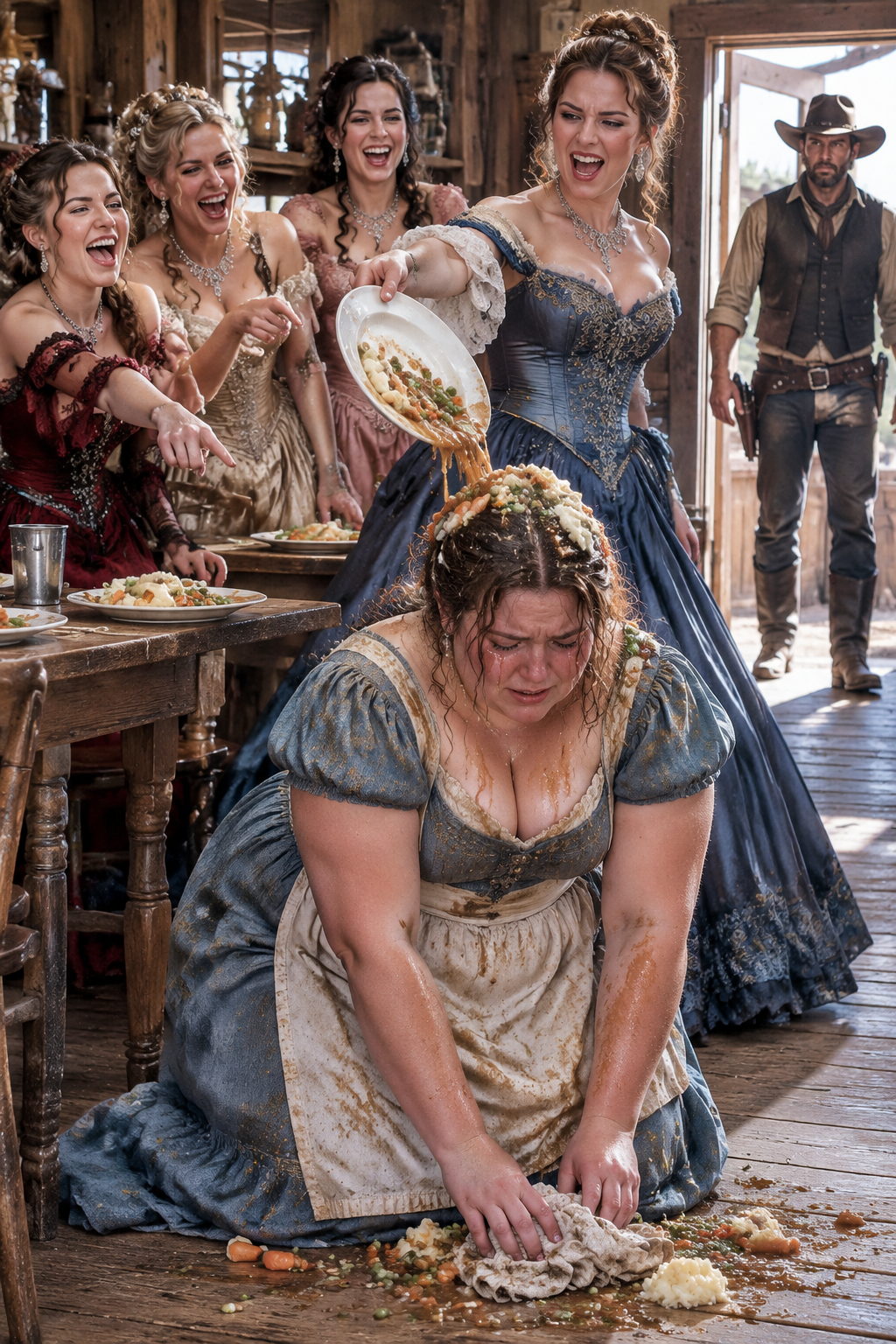
Celeste Ashford dumped an entire plate of food down the kitchen maid’s dress, then laughed as the richest guests at the Bellamy Harvest Ball watched.
Rosalie turned the worn notebook toward Everett, revealing a page covered in faded ink, carefully drawn columns, and a name written three times in her father’s unmistakable handwriting.
Everett leaned forward.
At the top of the page were four words that made his blood run cold.
Callaway Ranch. Private Transactions.
“Where did your father get these figures?” he asked.
Rosalie swallowed. “He discovered them six years ago, just before he was accused of stealing from Bennett Mercantile.”
Celeste’s expression changed.
“That notebook is worthless,” she said sharply. “Your father was a thief, Rosalie. Everyone in this county knows it.”
Rosalie flinched, but Everett didn’t take his eyes off the page.
Because beneath the figures was another name.
Victor Langford.
His accountant.
The man who had managed Callaway Ranch’s finances for nearly twelve years.
Everett slowly straightened.
“Miss Ashford,” he said, “I believe this conversation no longer concerns you.”
Celeste gave a brittle laugh. “You’re making a terrible mistake.”
“Then I’ll have to live with it.”
Her eyes narrowed before she turned and swept from the kitchen.
Only when the door closed did Rosalie finally breathe.
“My father wasn’t a thief,” she whispered. “But nobody believed him.”
Everett studied her face.
“Tell me what happened.”
Rosalie looked down at the notebook.
“My father owned Bennett Mercantile. It wasn’t much, but he supplied several ranches with grain, tools, and cattle feed. He taught me everything he knew about bookkeeping. He used to say numbers were honest, even when people weren’t.”
A faint smile touched her lips, then disappeared.
“Six years ago, he discovered that someone was ordering supplies under false accounts. The shipments were charged to ranches, but the goods never reached their destinations.”
Everett’s jaw tightened.
“What happened when he reported it?”
“He went to Mr. Langford.”
Everett went still.
“Langford?”
Rosalie nodded.
“Three days later, money disappeared from my father’s business accounts. Forged documents appeared. He was accused of embezzlement, and the bank demanded immediate repayment of loans he never understood.”
“Was he arrested?”
“No. But he lost everything. The store, our home, his reputation. He died the following winter.”
Her voice broke.
“My mother still believes the shame killed him before the fever ever could.”
Everett closed the notebook carefully.
For twelve years, Victor Langford had been his most trusted adviser.
For six years, Everett had believed the ranch’s growing debts were the unfortunate result of poor seasons and expensive improvements.
And now he was beginning to suspect that the woman standing before him held the first real evidence of a crime that had ruined more than one family.
“Miss Bennett,” he said quietly, “I want you to come to Callaway Ranch tomorrow morning.”
Rosalie looked up.
“And I want you to bring every notebook your father left behind.”
By sunrise, the entire town was talking.
Some said Everett Callaway had fallen in love with a kitchen maid.
Others claimed Rosalie Bennett had bewitched him with her pretty face.
Celeste Ashford encouraged both rumors.
She had expected Everett to marry her by Christmas.
Their families moved in the same circles, and her father, Harrison Ashford, controlled one of the county’s largest banks.
A marriage to Everett would have secured her position as the most influential woman in the valley.
Rosalie Bennett threatened more than that future.
She threatened secrets Celeste had overheard behind locked doors.
At Callaway Ranch, Rosalie arrived wearing her best gray dress and carrying a leather satchel.
The housekeeper, Mrs. Whitcomb, greeted her with undisguised surprise.
“Mr. Callaway said to show you directly to his office.”
Rosalie followed her down a hallway lined with polished oak and family portraits.
Everett stood beside a large desk covered in ledgers.
“Good morning, Miss Bennett.”
“Good morning, sir.”
“Everett will do.”
She blushed. “I don’t think that would be proper.”
He smiled faintly.
“Then we shall begin with Mr. Callaway and see what happens.”
For the next four hours, Rosalie worked silently.
Everett watched as she compared invoices, bank records, and delivery receipts.
She made notes in two separate columns.
One recorded legitimate expenses.
The other recorded transactions that didn’t make sense.
By noon, the second column was disturbingly long.
Finally, she lifted her head.
“Mr. Callaway, someone has been stealing from you for at least seven years.”
Everett felt the words settle heavily.
“How much?”
“I cannot say precisely without the bank records. But from these books alone, more than forty thousand dollars.”
He stared at her.
It was enough money to purchase several hundred acres of prime grazing land.
“Are you sure?”
Rosalie pointed to a sequence of payments.
“Your ranch paid for lumber to build three additional barns. But your property records show only one barn was constructed.”
“The other two were canceled.”
“Then why were the payments never refunded?”
Everett said nothing.
She turned another page.
“And these cattle sales. Your records claim seventy head were lost to disease last spring.”
“They were.”
“Then why does the auction register show seventy cattle sold in Red Creek under the name Blackstone Holdings?”
Everett leaned over the desk.
“Blackstone Holdings?”
“A company registered through Ashford Bank.”
His expression hardened.
The same bank that held his ranch’s mortgages.
The same bank whose president was Celeste’s father.
A knock interrupted them.
Victor Langford entered without waiting for permission.
He was a thin man with silver spectacles and a practiced smile.
“Everett, I heard you’ve hired some additional help.”
His gaze landed on Rosalie.
The smile vanished.
“Bennett?”
Rosalie’s hands tightened around her pencil.
“Good afternoon, Mr. Langford.”
He turned to Everett.
“Surely you understand the danger of allowing that family anywhere near your accounts.”
Everett folded his arms.
“Miss Bennett has already discovered several discrepancies.”
“Then she’s either mistaken or deliberately misleading you.”
“Which one?”
Langford hesitated.
Everett stepped closer.
“Because I intend to find out.”
For the first time in twelve years, Victor Langford looked frightened.
That evening, Rosalie returned home to find her mother sitting beside the fireplace.
Margaret Bennett’s illness had left her thin and pale, but her eyes remained gentle.
“How was your first day, darling?”
Rosalie knelt beside her chair.
“Better than I expected.”
Margaret touched her cheek.
“Your father would be proud.”
Rosalie smiled sadly.
“I wish he were here.”
“So do I.”
Her mother hesitated.
“There’s something I’ve never told you.”
Rosalie looked up.
Margaret glanced toward the window, as though someone might be listening.
“Three nights before your father lost the mercantile, Mr. Ashford came to our house.”
Rosalie froze.
“Celeste’s father?”
“Yes. He offered your father five thousand dollars to destroy certain records.”
“Why didn’t you tell me?”
“Your father made me promise. He feared what Ashford might do if anyone knew.”
Rosalie’s heart began pounding.
“What records?”
Margaret gripped her hand.
“Your father hid something beneath the floorboards of the old mercantile. He said if the truth ever needed proving, it would be there.”
Rosalie rose so quickly her chair scraped against the floor.
The mercantile had stood abandoned for years.
But the building now belonged to Ashford Bank.
And the bank had announced plans to demolish it the following week.
The next morning, Everett found Rosalie waiting at the ranch gate.
Her face was pale with exhaustion.
“Something happened,” he said immediately.
She told him everything.
When she finished, he reached for his hat.
“Then we’ll go together.”
The old Bennett Mercantile stood at the edge of town, its windows boarded and its sign hanging crookedly.
Inside, dust covered the shelves where Rosalie had once helped her father arrange jars of candy.
For a moment, memories overwhelmed her.
She could almost hear his laughter.
Almost smell the fresh coffee he brewed every morning.
Everett remained beside the doorway, giving her space.
Finally, Rosalie walked to the rear office.
“My father kept his desk here.”
They searched the floor carefully.
After nearly an hour, Everett noticed a board slightly shorter than the others.
He pried it loose with his pocketknife.
Beneath it sat a narrow metal box.
Rosalie’s breath caught.
Inside were receipts, signed delivery agreements, several letters, and a small black ledger.
She opened the ledger.
Every missing shipment was recorded.
Every false payment.
Every forged transfer.
And beside the largest transactions were two signatures.
Victor Langford.
Harrison Ashford.
Rosalie pressed a hand over her mouth.
“He kept everything.”
Everett examined a letter.
It was written on Ashford Bank stationery.
The final paragraph contained a threat.
If Nathaniel Bennett refused to cooperate, his business would be seized and his family left penniless.
Everett’s expression darkened.
“They destroyed your father because he wouldn’t help them steal.”
Rosalie began crying.
Not the quiet tears of embarrassment she had shed at the ball.
These were years of grief finally breaking free.
Everett placed a steady hand on her shoulder.
“We can prove it now.”
Then the front door slammed.
Both turned.
Victor Langford stood in the entrance with two men behind him.
“Well,” he said coldly, “that is unfortunate.”
Everett stepped in front of Rosalie.
“Victor.”
Langford looked at the metal box.
“I had hoped those records had been burned.”
Rosalie clutched the ledger.
“You knew what happened to my father.”
Langford’s face showed no remorse.
“Your father was a stubborn fool. He could have taken the money and lived comfortably.”
“He was an honest man.”
“And honesty bought him a grave.”
Everett lunged forward, but one of the men drew a revolver.
“Careful, Callaway.”
Langford extended his hand.
“The ledger, Miss Bennett.”
Rosalie glanced at Everett.
He gave the slightest shake of his head.
She swallowed.
“You can take the book. But you cannot erase what you’ve done.”
Langford laughed.
“People believe what powerful men tell them to believe.”
Rosalie slowly placed the ledger on a nearby counter.
As Langford reached for it, Everett moved.
He struck the armed man’s wrist, sending the revolver across the floor.
A violent struggle followed.
Rosalie seized a heavy iron scale weight and struck the second man across the shoulder.
He stumbled backward into a shelf.
Glass shattered.
Everett forced the first attacker against the wall.
But Langford snatched the ledger and ran.
“Stop him!” Rosalie cried.
Everett rushed outside.
Langford was already climbing into a waiting carriage.
The horses bolted down the street.
Everett returned moments later, breathing heavily.
“He’s gone.”
Rosalie looked at the scattered papers.
For one terrible second, despair threatened to swallow her.
Then she remembered something.
“My father never trusted a single copy.”
She knelt beside the open box.
A false bottom concealed a second bundle.
Inside were duplicate bank drafts and a sworn statement, signed and dated by Nathaniel Bennett.
Everett read the opening lines.
Then he looked at Rosalie with unmistakable admiration.
“Your father was a very clever man.”
Rosalie held the statement close.
“Yes,” she whispered. “He was.”
They took the documents directly to Sheriff Thomas Mercer.
But the sheriff’s reaction was not what Everett expected.
Mercer looked through the papers, then shut his office door.
“Everett, you need to understand something.”
“What?”
“Ashford Bank holds the mortgages on half the businesses in town.”
“That doesn’t place him above the law.”
“No. But it gives him friends in dangerous places.”
Rosalie stepped forward.
“Will you help us?”
Mercer studied her.
He had known Nathaniel Bennett.
He had also watched the man’s reputation collapse.
At last, he opened his desk drawer.
Inside was an old envelope.
“Your father came to me six years ago,” he said.
Rosalie went still.
“He asked me to keep this in case anything happened to him.”
“Why didn’t you use it?”
“Because he told me not to unless I had proof that would stand in court. What he gave me was only a list of names. I thought it was nothing.”
Mercer handed her the envelope.
Inside were the names of fourteen ranchers, merchants, and farmers.
All had lost property after receiving loans from Ashford Bank.
And at the bottom was a handwritten note.
They are not simply stealing money. They are taking the valley.
Everett stared at the list.
His name was there.
So was the name of an elderly widow whose farm had been seized the previous autumn.
The truth became clear.
Ashford and Langford had created false debts, siphoned money through fictitious companies, and forced struggling landowners into foreclosure.
Callaway Ranch was their largest remaining target.
Mercer rose.
“I’ll send a rider to the circuit judge. But until he arrives, you both need protection.”
Everett nodded.
“I’ll take Rosalie and her mother to the ranch.”
Rosalie hesitated.
“I don’t want to put your household in danger.”
Everett looked directly at her.
“You’ve spent six years carrying a burden that never belonged to you. You won’t carry this one alone.”
Something in his voice made her heart ache.
Not with sorrow.
With the unfamiliar possibility of being safe.
For three days, Callaway Ranch became a place of guarded secrets.
Everett stationed trusted men near the barns.
Mrs. Whitcomb prepared a comfortable room for Margaret Bennett.
And Rosalie worked late into the evenings, organizing the evidence for the judge.
During those quiet hours, Everett often joined her.
They spoke about her father, his childhood, the demands of ranching, and the lives they had imagined before disappointment taught them caution.
One evening, Rosalie found him standing beneath the porch lantern.
“You should be resting,” she said.
“So should you.”
He smiled.
She stood beside him, watching moonlight settle across the fields.
“Why did you help me that night?” she asked.
“At the ball?”
“Yes.”
Everett considered his answer.
“My mother worked as a housekeeper before she married my father. She used to say a person’s character was easiest to recognize by watching how they treated someone who couldn’t offer them anything.”
Rosalie turned toward him.
“She sounds wonderful.”
“She was.”
He looked down at her.
“Seeing what Celeste did reminded me of something I’d nearly forgotten.”
“What?”
“That wealth means very little if it makes a man too comfortable to notice cruelty.”
Rosalie’s eyes softened.
For a moment, neither spoke.
Then Everett reached for her hand.
“Rosalie, I don’t know what happens when this is over. But I know I want you to remain in my life.”
Her heart beat painfully fast.
“I don’t want anyone to think I accepted your help because I expected something more.”
“Then don’t accept anything you haven’t chosen freely.”
He released her hand gently.
“And know that whatever you choose, your work here is valuable.”
Rosalie had spent years being told what she was worth.
That evening, for the first time, someone offered her the freedom to decide for herself.
Before she could answer, a gunshot rang out.
A rider galloped into the yard.
“Mr. Callaway! The south barn’s on fire!”
Flames tore through the night sky.
Everett raced toward the barn with his ranch hands.
Inside were twenty horses and enough stored feed to sustain the herd through winter.
Rosalie ran toward the water troughs, organizing a bucket line before anyone thought to instruct her.
Smoke filled the yard.
Men shouted.
Horses screamed.
Then Mrs. Whitcomb appeared, terrified.
“Margaret! She’s gone!”
Rosalie’s blood turned cold.
Her mother had been resting in the guest room.
But when Rosalie searched the house, she found only an open window and a folded note.
Bring the evidence to Ashford Bank before midnight, or you will never see your mother again.
For a moment, Rosalie couldn’t move.
Then she ran back outside.
Everett emerged from the burning barn, his sleeve blackened.
“Rosalie, what’s wrong?”
She handed him the note.
His expression changed instantly.
“They took her.”
Rosalie’s voice shook.
“I have to go.”
“You’re not going alone.”
“They said—”
“I know what they said.”
Everett called for Sheriff Mercer and ordered two ranch hands to saddle fresh horses.
Then he turned back to her.
“Listen carefully. Those documents are the only thing protecting your mother’s life. We cannot surrender them without a plan.”
Rosalie wiped her eyes.
“What if they hurt her?”
Everett held her shoulders.
“Then we make certain they never have the chance.”
At eleven forty-five, Rosalie entered Ashford Bank carrying a leather satchel.
The building was dark except for the president’s office.
Harrison Ashford sat behind his desk.
Victor Langford stood beside the fireplace.
And Margaret Bennett occupied a chair near the window, pale but alive.
“Mother!”
Rosalie hurried forward.
Langford blocked her path.
“The documents first.”
Rosalie stopped.
“Let her go.”
Ashford smiled.
“You are in no position to bargain, Miss Bennett.”
She placed the satchel on the desk.
Ashford opened it.
Inside were neatly arranged papers.
He examined the first page, then relaxed.
“Excellent.”
“Now release my mother.”
“Of course.”
He nodded toward Langford.
But instead of freeing Margaret, Langford locked the office door.
Rosalie’s stomach tightened.
Ashford sighed.
“You really are your father’s daughter. Clever with figures, hopelessly naive about people.”
He walked toward the fireplace.
“Once these papers are burned, there will be nothing connecting us to those unfortunate business failures.”
Rosalie watched him lift the documents.
“What about all the people whose homes you stole?”
Ashford gave a dismissive shrug.
“Business is not a charity.”
“And my father?”
“He should have accepted my offer.”
Margaret struggled to her feet.
“You threatened him!”
Ashford’s face hardened.
“He threatened everything I built.”
Rosalie kept her voice steady.
“So you framed him.”
“He forced my hand.”
“And you’ve been stealing from Callaway Ranch ever since.”
Langford laughed.
“Your precious rancher would have lost his property by spring.”
Ashford glanced at the clock.
“Enough.”
He tossed the papers into the fireplace.
Flames curled around the edges.
Rosalie watched without moving.
Then she said quietly, “Those aren’t the originals.”
Ashford froze.
“What?”
“They’re copies. And the numbers on three of the pages have been deliberately changed.”
Langford snatched a burning sheet from the hearth.
His eyes widened.
“She tricked us!”
Rosalie stepped backward.
“No. I gave you an opportunity to admit what you did.”
Ashford reached into his desk.
But before he could retrieve his revolver, the office door crashed inward.
Everett entered with Sheriff Mercer and four armed deputies.
“Step away from the desk,” Mercer ordered.
Ashford stared at Rosalie.
“You planned this?”
Everett moved beside her.
“We heard enough.”
Rosalie had insisted on entering alone, but the sheriff’s men had approached through the bank’s adjoining records room.
An open ventilation passage carried the conversation into the next office, where Mercer and two deputies had listened.
He had taken written notes of the admissions, and Margaret was prepared to testify.
Ashford tried to regain his composure.
“You have no authority to arrest me.”
Mercer held up a warrant.
“Circuit Judge Holloway disagrees.”
Langford lunged toward the window.
A deputy caught him before he reached it.
Harrison Ashford stood motionless as iron handcuffs closed around his wrists.
For the first time in his life, money couldn’t buy him another escape.
But the greatest confrontation came the following morning.
The town square filled with people as news of the arrests spread.
Farmers who had lost their fields stood beside merchants who had been forced into bankruptcy.
Widows brought old mortgage notices.
Ranchers carried receipts.
Each person had once believed their failure was their own.
Now they discovered they had been victims of the same elaborate scheme.
Celeste Ashford arrived in a dark carriage, her face pale beneath an expensive hat.
She pushed through the crowd and confronted Rosalie outside the courthouse.
“You’ve destroyed my family.”
Rosalie looked at her calmly.
“No, Celeste. Your father made choices that destroyed your family.”
Celeste’s eyes filled with angry tears.
“You think you’re better than me now?”
“No.”
Rosalie paused.
“I think I should have been treated better than you treated me.”
The words silenced her.
For once, Celeste had no clever insult ready.
Everett approached, but Rosalie lifted a hand.
She didn’t need rescuing this time.
“I don’t wish you harm, Celeste,” she continued. “But I won’t apologize for telling the truth.”
Celeste stared at her for several seconds.
Then she turned away.
Months later, investigators would discover that Celeste had known about several suspicious transfers and had deliberately concealed letters connecting her father to Langford.
Though she hadn’t designed the scheme, her silence had helped protect it.
She was required to testify.
Her social standing collapsed almost overnight.
And the people she had once entertained with cruel laughter were suddenly unwilling to invite her into their homes.
The trial lasted six weeks.
Rosalie testified for nearly an entire day.
She explained each forged invoice, duplicate payment, and falsified delivery record.
Defense attorneys attempted to discredit her because of her employment as a maid.
One asked whether she had received any formal education beyond childhood.
Rosalie answered calmly.
“My father taught me bookkeeping, sir.”
“So you possess no professional qualifications?”
“I possess the ability to add correctly.”
Several people in the courtroom smiled.
The attorney reddened.
Rosalie opened a ledger.
“And these figures suggest that ability was missing from the management of Ashford Bank.”
Even the judge struggled to conceal his amusement.
More importantly, the evidence was undeniable.
The prosecution presented Nathaniel Bennett’s original records, bank drafts, witness testimony, and the results of a court-ordered audit.
Victor Langford eventually confessed to his role in exchange for consideration at sentencing.
He admitted that he and Harrison Ashford had falsified accounts, diverted ranch revenues, and engineered foreclosures.
And he confirmed that Nathaniel Bennett had been framed after refusing to participate.
When the verdict came, both men were convicted.
The court also ordered the fraudulent transactions examined for restitution and the wrongfully seized properties reviewed.
Not every family recovered everything it had lost.
Some damage could never be undone.
But the machinery that had quietly stolen their futures was finally stopped.
Nathaniel Bennett’s name was publicly cleared.
When the judge formally acknowledged his innocence, Margaret Bennett began to cry.
Rosalie held her mother’s hand.
For six years, they had lived beneath a lie.
Now the truth had finally spoken louder.
Winter arrived softly that year.
The first snowfall covered Callaway Ranch in silver, and the financial records finally reflected what Everett had suspected all along.
His ranch had never been failing.
It had been robbed.
With the fraudulent charges removed and recovery proceedings underway, the business was secure enough to begin rebuilding its reserves.
Everett offered Rosalie a permanent position as chief financial manager.
The salary was more than she had ever imagined earning.
But Rosalie surprised him.
“I’d like to accept,” she said. “On one condition.”
Everett raised an eyebrow.
“Only one?”
She smiled.
“I want to establish a bookkeeping school for women who cannot afford formal education.”
He studied her for a moment.
“Why?”
“Because I was fortunate. My father taught me a skill that gave me a way forward. There are girls working in kitchens, laundries, and boardinghouses who are just as capable as I am. They’ve simply never been given the opportunity.”
Everett nodded slowly.
“Then we’ll find a building.”
Rosalie shook her head.
“I want to earn the money myself.”
His smile widened.
“Then I’ll help you find the right building when you’re ready to purchase it.”
She laughed.
“You’re a very persistent man.”
“Only when something matters.”
The school opened the following spring, funded by Rosalie’s savings and supported by contributions from several local families.
She named it the Bennett School of Practical Accounting.
Its first class had eleven students.
Within a year, there were thirty-seven.
Women who had once been dismissed as uneducated servants began finding work in stores, offices, and businesses across the county.
Some opened businesses of their own.
And every student learned the lesson Nathaniel Bennett had taught his daughter.
Numbers could reveal the truth.
But courage was necessary to defend it.
One warm evening in early summer, Everett invited Rosalie to walk beside the river.
The sun was setting behind the hills.
Wildflowers swayed along the bank, and the air smelled of fresh grass.
They stopped beneath an old willow tree.
Everett seemed unusually nervous.
Rosalie noticed immediately.
“Is something wrong?”
“No.”
He cleared his throat.
“Actually, there is something I’ve been meaning to ask you.”
She smiled.
“Is this about the cattle inventory?”
“Not remotely.”
He reached into his pocket and withdrew a small velvet box.
Rosalie’s breath caught.
“Everett…”
He opened it.
Inside lay a simple gold ring with a small sapphire.
“I’ve spent most of my life believing that success meant owning more land, raising better cattle, and making enough money to leave something behind.”
He looked at her tenderly.
“Then you walked into my life with a notebook full of numbers and showed me how much I had overlooked.”
Tears gathered in her eyes.
“You stood beside people when it cost you something,” he continued. “You defended your father’s honor when everyone else had forgotten him. And you’ve used your own good fortune to open doors for others.”
He took her hand.
“I don’t want a wife who will simply stand beside me at grand parties. I want a partner who will challenge me, teach me, and build something worthwhile with me.”
He lowered himself to one knee.
“Rosalie Bennett, will you marry me?”
She laughed through her tears.
“Yes.”
Everett smiled.
“Yes?”
“Yes, Everett. A thousand times yes.”
He slipped the ring onto her finger.
And when he rose to kiss her, Rosalie felt something she had once believed was lost forever.
A future that belonged to her.
Their wedding took place that autumn in the meadow beside Callaway Ranch.
There were no enormous chandeliers.
No tables arranged according to wealth or social standing.
Instead, long wooden benches welcomed everyone.
Ranch hands sat beside merchants.
Schoolteachers shared seats with former kitchen maids.
Mrs. Whitcomb cried throughout the ceremony.
Margaret Bennett, healthier than she had been in years, walked her daughter down the flower-covered aisle.
Rosalie wore a simple ivory dress she had helped sew herself.
As the ceremony ended, Everett took her hands.
“You know,” he whispered, “I still have that jacket.”
Rosalie looked puzzled.
“The one I placed around your shoulders at the Harvest Ball.”
She laughed softly.
“Why would you keep it?”
“Because it reminds me of the best decision I ever made.”
“Offering me a job?”
He shook his head.
“Standing up when everyone else remained seated.”
Across the meadow, the guests began applauding.
Rosalie looked out at the gathering and recognized faces that had once been bent beneath hardship.
The widow who had recovered her farm.
The shopkeeper who had reopened his store.
The young women whose wages now supported their families.
Their lives were not perfect.
Neither was hers.
There were losses no court could repair and memories that no happiness could entirely erase.
But there was dignity in what they had rebuilt together.
Years later, people in the county would remember the scandal at the Bellamy Harvest Ball.
Some remembered the spilled gravy.
Others remembered the wealthy woman whose cruelty had exposed the arrogance of an entire social circle.
But Rosalie remembered something different.
She remembered kneeling on a cold floor, believing she had no choice but to accept humiliation.
She remembered a stranger offering his jacket.
And she remembered the moment she discovered that her knowledge, her courage, and her father’s legacy were worth far more than the opinions of those who had mocked her.
One afternoon, many years later, a young student at the Bennett School asked Rosalie a question.
“Mrs. Callaway, were you ever afraid you weren’t important enough to do something great?”
Rosalie closed the ledger in front of her.
“Every day,” she answered.
The girl looked surprised.
“Then how did you become brave?”
Rosalie smiled.
“I stopped waiting to feel important before doing what was right.”
She walked toward the classroom window, where the afternoon sunlight fell across rows of desks.
“Never confuse someone’s position with their worth,” she told the students. “A wealthy person can be dishonest. A servant can be brilliant. A frightened person can be courageous. And someone the world dismisses today may be the very person who changes it tomorrow.”
The room grew quiet.
Then Rosalie added one final lesson.
“Your circumstances may determine where your story begins, but your choices determine what your story becomes.”
Outside, the bells of the little town began to ring.
And somewhere beyond the schoolyard, beneath the wide and endless western sky, the life Rosalie had built continued to flourish.
Not because a wealthy rancher had rescued a poor maid.
But because one act of kindness had opened a door, and a determined young woman had found the courage to walk through it.
For true greatness is never measured by how many people bow before you, but by how many people can stand taller because you chose to lift them up.
Yet Rosalie’s story did not end with her marriage, her school, or the restoration of her father’s good name.
The most important test of everything she had learned came seven years later, on a cold November morning, when a little girl appeared at the doors of the Bennett School carrying a torn envelope and a secret that threatened to reopen the darkest chapter of the valley’s history.
The girl was no older than twelve.
Her coat was threadbare, her boots were muddy, and her fingers trembled as she held out the envelope.
“Are you Mrs. Callaway?” she asked.
Rosalie knelt to meet her eyes.
“Yes, sweetheart. What’s your name?”
“Clara.”
“Clara what?”
The child hesitated.
“Clara Langford.”
Rosalie felt the blood drain from her face.
Langford.
The name of the man who had helped destroy her father.
The girl lowered her head.
“My grandfather said you were the only person who would understand.”
Rosalie looked at the envelope.
Across the front, written in a shaky hand, were five words.
For Rosalie Bennett. The final truth.
For several seconds, she could only stare.
Then she gently took the girl’s cold hands.
“Come inside, Clara.”
Victor Langford had died three days earlier.
After serving part of his sentence, he had been released because of failing health. He spent his final years in a small cottage beyond Red Creek, estranged from nearly everyone who had once known him.
Clara was his granddaughter.
Her parents had died during a fever outbreak, leaving her in the care of the man whose crimes had disgraced their family.
“He talked about you before he died,” Clara explained.
Rosalie sat across from her in the school office.
“What did he say?”
“That you were the one person who had every reason to hate him.”
Rosalie looked down.
“He wasn’t wrong.”
Clara’s eyes filled with tears.
“He said there was something he never told the judge. Something about your father.”
Rosalie slowly opened the envelope.
Inside was a handwritten confession.
The first pages repeated facts she already knew: the fraudulent invoices, the stolen ranch revenues, and Harrison Ashford’s scheme to acquire property throughout the valley.
But the final page contained a revelation that made her grip the edge of her desk.
Nathaniel Bennett had not merely discovered the conspiracy.
He had secretly protected the families who were about to lose their homes.
For months, he had used his own savings to repay small portions of their debts, buying them time while he searched for evidence.
When Ashford discovered what Nathaniel was doing, he demanded that Langford ruin him completely.
And there was something else.
Before his death, Nathaniel had entrusted Langford with a small packet of letters meant for his daughter.
Langford had hidden them for years.
Clara reached into her coat and produced a bundle tied with faded blue ribbon.
“Grandfather said he was too ashamed to give these to you himself.”
Rosalie recognized her father’s handwriting immediately.
Her hands shook as she opened the first letter.
My dearest Rosie,
If you are reading this, then perhaps the world has finally learned what happened to our family.
I wish I could promise you that doing the right thing always brings a reward. It does not. Sometimes honesty costs us everything we can see.
But there are things no dishonest man can take from us unless we surrender them ourselves: our compassion, our courage, and our ability to choose what kind of people we become.
Rosalie pressed the letter against her heart.
She had spent so many years wishing she could hear her father’s voice one more time.
Now, across the distance of death and injustice, he had found a way to speak to her.
That evening, Everett found Rosalie sitting alone on the porch.
Their two children were asleep upstairs.
The farmhouse glowed warmly behind her, but she barely noticed the cold.
He sat beside her.
“Mrs. Whitcomb told me about the little girl.”
Rosalie nodded.
“She has no one, Everett.”
He looked toward the dark fields.
“Langford’s granddaughter?”
“Yes.”
“She must have suffered greatly because of his name.”
Rosalie smiled sadly.
“I know what that feels like.”
Everett took her hand.
“What are you thinking?”
“That I could send her to an orphanage. I could tell myself her family’s troubles have nothing to do with me.”
“But?”
Rosalie looked at him.
“But that would make her pay for crimes she never committed.”
Everett was silent for a moment.
Then he squeezed her hand.
“There’s an empty bedroom at the end of the hallway.”
Rosalie stared at him.
“You mean that?”
“I do.”
She leaned against his shoulder.
“You know what people will say.”
Everett laughed softly.
“Rosalie, people have been talking about us since the night you ruined Celeste Ashford’s favorite ball gown with gravy.”
She elbowed him gently.
“I didn’t ruin anything. She threw the plate.”
“Then perhaps we should thank her.”
Rosalie laughed through her tears.
The following morning, Clara Langford came to live at Callaway Ranch.
At first, the girl rarely spoke.
She flinched whenever someone raised a voice.
She apologized for eating too much, for walking too loudly, even for leaving a book on the table.
One evening, Rosalie found her secretly washing the kitchen floor after everyone had gone to bed.
“Clara, sweetheart, what are you doing?”
The child looked terrified.
“I wanted to make sure you wouldn’t send me away.”
Rosalie knelt beside her.
“You don’t have to earn your place here.”
Clara’s lips trembled.
“But my grandfather was a bad man.”
Rosalie took the wet cloth from her hands.
“Your grandfather made terrible choices. Those choices belong to him, not to you.”
“Do you hate him?”
Rosalie considered the question carefully.
“For a long time, I did.”
“And now?”
“I wish he had chosen differently.”
Clara lowered her eyes.
“Is that the same as forgiveness?”
“Not exactly.”
Rosalie brushed a strand of hair from the girl’s forehead.
“Forgiveness doesn’t mean pretending that harm never happened. It means deciding that the harm will not control every good thing we choose to do afterward.”
Clara began to cry.
Rosalie held her until the tears stopped.
The years passed.
Clara grew into an intelligent, determined young woman with a remarkable gift for mathematics.
She eventually became one of the Bennett School’s finest teachers.
Everett and Rosalie watched their children grow, watched the ranch flourish, and watched the little school expand into an academy that welcomed students from counties far beyond their own.
One spring afternoon, Rosalie received an invitation to speak at the opening of a new schoolhouse in Red Creek.
The invitation had been signed by dozens of former students.
She accepted.
On the morning of the ceremony, Everett accompanied her to the town square.
The new building stood where an abandoned bank office had once been.
A plaque beside the entrance read:
THE NATHANIEL BENNETT HALL OF LEARNING
Dedicated to the belief that knowledge, integrity, and opportunity belong to everyone.
Rosalie stared at the inscription.
For a moment, she was once again the young kitchen maid kneeling among broken china, ashamed and frightened, wondering whether her father’s name would ever mean anything but disgrace.
Then she looked around.
There were children carrying schoolbooks.
There were mothers holding their daughters’ hands.
There were farmers, ranchers, shopkeepers, and teachers.
And beside her stood Everett, his hair now touched with silver, smiling with the same quiet kindness he had shown her all those years ago.
When Rosalie stepped onto the platform, the crowd fell silent.
She unfolded the speech she had prepared.
Then she looked at the words and slowly folded the paper again.
“I was once told,” she began, “that some people are born to command and others are born to serve.”
A few people shifted in their seats.
“I believed that for a long time. Not because it was true, but because the world around me seemed determined to make it true.”
She looked toward Clara, standing among the teachers.
“I have learned something different.”
Her voice strengthened.
“We are all responsible for the way we treat people who have less power than we do. And we are all responsible for what we do with the opportunities placed before us.”
Rosalie paused.
“My father lost his business because he refused to abandon his principles. For years, I thought that meant honesty had failed him.”
She touched the folded letter she always carried inside her handbag.
“But I was wrong. His honesty did not save his fortune. It saved something far more enduring. It gave his daughter a foundation on which to build a life. And through the people he helped, his goodness continued long after he was gone.”
The square was utterly quiet.
“Most of us will never change the world with one extraordinary act. But we can change someone’s world with an ordinary act of kindness. We can offer a chance where others offer judgment. We can tell the truth when silence would be easier. We can refuse to let the mistakes of one generation become the punishment of the next.”
Rosalie looked at Everett.
“And sometimes, when we see someone being humiliated, all we have to do is stand up.”
The applause began slowly.
Then it spread across the square until people were rising from their seats.
Everett stood among them, his eyes bright with tears.
That night, after the celebration, Rosalie returned home and placed her father’s letters inside the old notebook she had carried to the Bellamy Harvest Ball.
Its cover was worn.
Its pages were yellow.
But every calculation remained clear.
Everett appeared in the doorway.
“Are you coming to bed?”
“In a moment.”
He walked over and looked at the notebook.
“Still keeping accounts?”
Rosalie smiled.
“Of a different kind.”
“What are you counting?”
She glanced through the window.
In the distance, lamplight glowed from the little cottage where Clara was preparing lessons for the next morning.
Beyond the fields stood the barns, the workers’ homes, and the land that had once nearly been stolen.
Upstairs, their children slept peacefully.
And in towns throughout the valley, women who had passed through the Bennett School were building futures that had once seemed impossible.
Rosalie closed the notebook.
“Things money could never measure.”
Everett kissed her forehead.
“Then I suspect you’re a very wealthy woman.”
She looked up at him.
“I am.”
He offered his hand.
Together, they turned down the lamp and walked upstairs.
And the notebook remained on the desk, no longer a record of loss, but a reminder of everything that had grown from the courage to confront it.
Rosalie Bennett Callaway had never forgotten the humiliation of that terrible evening.
She had never forgotten the plate shattering at her feet or the laughter that followed.
But those memories no longer defined her.
What defined her was everything she had chosen afterward.
She had uncovered injustice without becoming cruel.
She had achieved success without forgetting the powerless.
She had found love without surrendering her independence.
And when the chance came to punish an innocent child for the sins of her family, she had chosen compassion instead.
In the end, the greatest victory of Rosalie’s life was not that she rose from poverty to prosperity.
It was that, having experienced the pain of being treated as though she were worth nothing, she devoted her life to making certain others knew their worth.
And that was the legacy she left behind.
Not the ranch.
Not the fortune.
Not even the school bearing her father’s name.
But the quiet, powerful belief that dignity belongs to every human being, and that one person’s kindness, joined with another person’s courage, can change the course of generations.
Because the true measure of a life is not how far we rise above others, but how many people we help rise alongside us.
THE END.