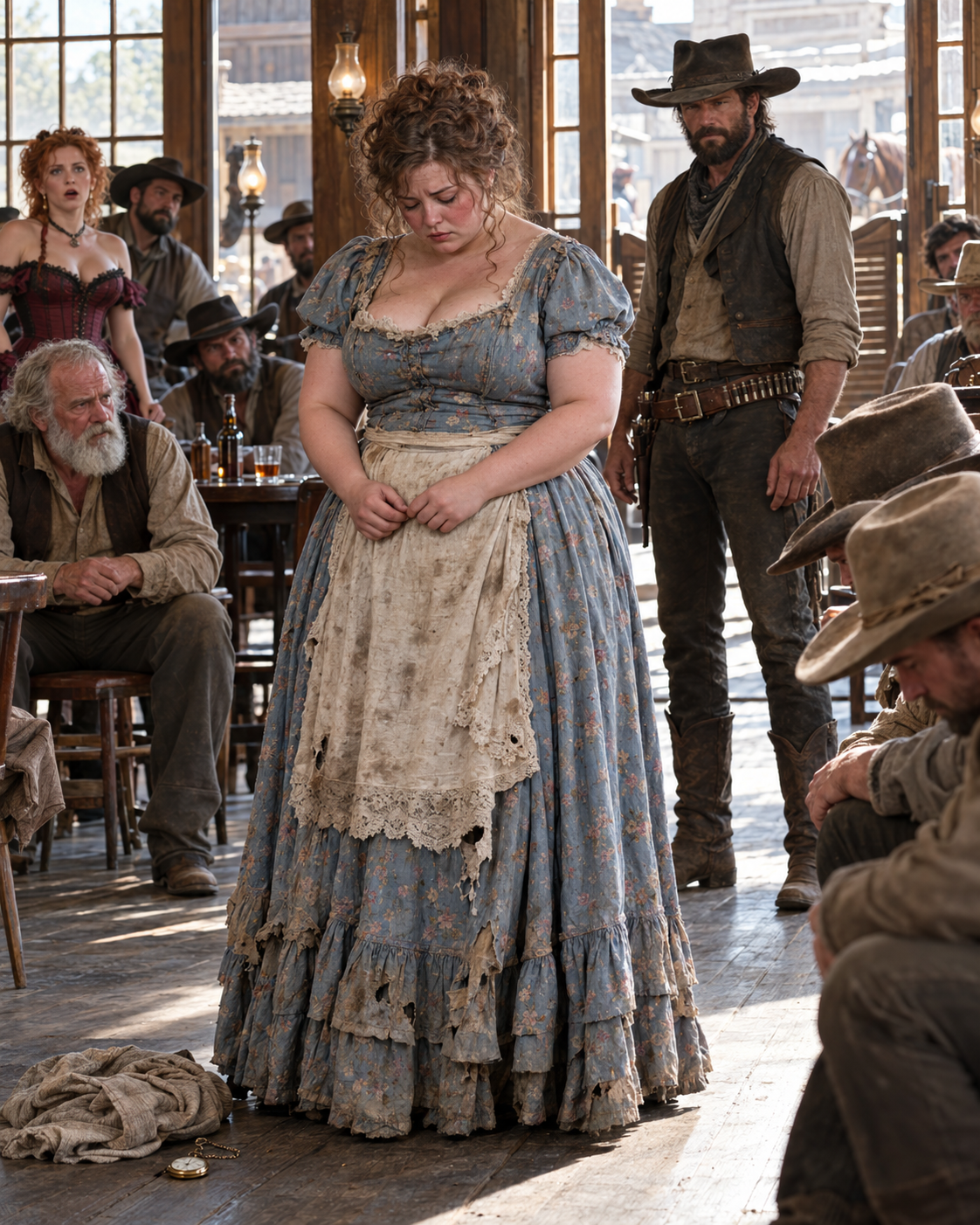
Calvin Rusk threw my dead husband’s wedding ring across the crowded saloon and called me a beggar, never realizing I’d uncovered his darkest crime.
“The man guarding your husband is someone you trusted with your life.”
Elijah Boone’s trembling words hung in the cold night air, and for a moment, I forgot how to breathe.
I knelt beside him on the burned farmhouse floor, pressing my hands against the blood spreading across his shirt.
“Who is it, Elijah?” I whispered desperately.
He tried to answer, but a terrible cough shook his body, leaving dark blood against his lips.
Wade dropped to his knees beside us and pulled a clean cloth from his coat.
“Save your strength, old man,” Wade said gently.
But Elijah grabbed my wrist with surprising force.
“The sheriff,” he finally whispered.
My stomach turned to ice.
I looked toward the darkness where Sheriff Daniel Hargrove had disappeared moments earlier.
The same sheriff who had brought me news of Thomas’s death.
The same man who had stood beside me at the funeral and told me to accept God’s will.
The same man who had personally nailed shut my husband’s coffin.
“He told me Thomas was dead,” I whispered.
Elijah shook his head.
“He made sure you believed it.”
Before I could ask another question, Wade lifted Elijah carefully into his arms.
“We have to get him somewhere safe before Rusk comes back.”
We carried him to Wade’s wagon, hiding the bloodstained ledger beneath a loose board.
The eastern sky was beginning to pale when we reached the ranch.
Wade laid Elijah on the spare bed while I boiled water and gathered every clean cloth I could find.
The bullet had torn through his shoulder, but thankfully, it had missed his heart.
Still, the old man’s breathing was shallow.
As I washed the blood from his face, he opened his eyes and stared at me.
“You look like your mother,” he whispered.
My hands stopped moving.
“My mother?”
He closed his eyes again.
“She was brave, too.”
I wanted to shake him awake, to demand what he meant, but Wade caught my hand.
“Let him rest, Mabel.”
I stepped outside, where morning sunlight was creeping across the empty pasture.
For two years, I had prayed for one impossible thing.
To hear Thomas call my name again.
Now that prayer had become a nightmare.
Because if Thomas was alive, someone had deliberately stolen two years of our lives.
And someone I trusted had helped them do it.
Wade found me sitting on the porch steps.
He handed me a cup of coffee and lowered himself beside me.
Neither of us spoke for a while.
Then he said, “We’re going to find him.”
I looked at his tired face.
“You don’t even know if he’s still alive.”
“No,” Wade admitted.
“But Elijah does, and I believe he was telling the truth.”
I stared toward the hills.
“Why would you risk your life for a man you’ve never met?”
Wade rubbed his hands together slowly.
“Because my father spent his last years begging people to believe him.”
His voice grew quieter.
“Nobody did.”
Something inside me softened.
I had thought Wade was simply a lonely rancher who preferred silence.
Now I understood that silence had become the place where he buried his grief.
I touched his hand.
“This time, somebody will believe us.”
He looked at me, and for the first time since we met, I saw the faintest trace of hope in his eyes.
By noon, Elijah was strong enough to speak.
Wade and I sat beside his bed while he told us the truth.
Sixteen years earlier, Calvin Rusk had begun stealing land from struggling ranchers by forging loan agreements.
Wade’s father had discovered the scheme after noticing that payments he’d made were missing from the bank’s records.
When he threatened to expose Rusk, the banker arranged a false foreclosure.
The Mercers lost their home, their cattle, and nearly every acre they owned.
Wade’s father died believing he’d failed his family.
But Rusk’s crimes hadn’t stopped there.
Thomas had discovered the fraud while reviewing old accounts at the bank.
At first, he believed the missing money was a bookkeeping mistake.
Then he found the names of dead farmers listed on newly issued loans.
Some of those loans had been recorded years after the men were buried.
Thomas secretly copied the transactions, determined to bring them before a territorial judge.
“Then Rusk found out,” Elijah said.
I leaned forward.
“What happened to my husband?”
Elijah looked ashamed.
“They caught him outside the bank the night he planned to leave town.”
My hands tightened around the edge of the mattress.
“Sheriff Hargrove took him to Red Hollow.”
I closed my eyes.
Thomas had told me that evening he would be home before supper.
I had prepared his favorite chicken stew.
I remembered watching the food grow cold while darkness settled over our little house.
“Why didn’t they kill him?” Wade asked.
“Because Thomas knew where the original records were hidden,” Elijah replied.
“Rusk needed those papers destroyed before anyone could expose him.”
I glanced toward the ledger on the table.
“Then why is Thomas still there?”
Elijah hesitated.
“There’s another set of records.”
Wade leaned closer.
“What records?”
“A list of the people Rusk paid to help him.”
Elijah swallowed painfully.
“Judges, deputies, railroad officials, and men who own half the businesses in Blackwater.”
A dreadful realization settled over me.
Calvin wasn’t simply a dishonest banker.
He controlled the men who were supposed to protect us.
“And the sheriff?” I asked.
Elijah nodded.
“He has guarded Thomas whenever Rusk needed him questioned.”
I rose from the chair.
“Then we’re going to Red Hollow.”
Wade stood immediately.
“Not in daylight, and not without knowing what we’re walking into.”
I turned toward him.
“My husband is out there.”
“I know.”
“He may be hurt.”
“I know, Mabel.”
“Then don’t ask me to sit here while he suffers.”
Wade looked at me for a long moment.
“I’m not asking you to stay.”
His voice softened.
“I’m asking you to come back alive.”
Those words nearly broke me.
Nobody had worried about whether I lived or died in a very long time.
That afternoon, we made our preparations.
Wade packed ammunition, blankets, water, and enough food for several days.
I wrapped the original ledger in oilcloth and hid it inside a flour sack beneath the kitchen floorboards.
Elijah drew a rough map of the abandoned mine.
He marked an old drainage tunnel that ran beneath the eastern hillside.
“Rusk sealed the main entrance years ago,” he explained.
“But that tunnel still reaches the lower chambers.”
Wade studied the map carefully.
“How many guards?”
“Usually three, including the sheriff.”
“And tonight?”
Elijah’s face darkened.
“After what happened at the farmhouse, there could be more.”
Before sunset, Wade rode into town alone.
He returned with troubling news.
Calvin had announced that Elijah Boone was wanted for attempting to murder the sheriff.
Worse, there was a reward for my capture.
Rusk claimed I had stolen valuable bank documents and threatened innocent men with false accusations.
“They’re calling you dangerous,” Wade told me.
I almost laughed.
Three days earlier, I had been too hungry to stand upright in a saloon.
Now the most powerful man in Blackwater feared me enough to put a price on my head.
“What about the territorial judge?” I asked.
“He’s still expected Friday morning.”
“Then we have two nights.”
Wade nodded.
“Two nights to bring Thomas home.”
We left after midnight.
The prairie stretched around us beneath a sky crowded with stars.
Cold wind pulled at my coat while Wade guided our horses through dry creek beds and narrow passes.
By the time the dark outline of Red Hollow appeared, my hands were numb.
We tied our horses among the cottonwoods and approached the eastern hillside on foot.
The drainage tunnel was barely large enough for us to crawl through.
Mud soaked my dress as I followed Wade into the darkness.
Above us, somewhere deep inside the mountain, I heard a metallic scraping sound.
Then a man coughed.
I stopped moving.
The sound came again.
Weak.
Painful.
Human.
Wade turned and raised one finger to his lips.
We crawled another twenty feet before reaching a broken wooden grate.
Beyond it lay a narrow chamber illuminated by a single lantern.
A man sat chained to an iron support.
His hair hung over his face.
His shoulders were bent, and his clothing looked like rags.
But I knew those hands.
I knew the small scar across his left thumb.
Thomas had gotten it while carving a wooden cradle for the baby we’d lost.
My heart seemed to stop.
“Thomas?”
The man lifted his head.
For one terrible second, he stared at me without recognition.
Then his lips parted.
“Mabel?”
The sound of my name shattered something inside me.
I pushed against the grate, desperate to reach him.
Wade caught my shoulder.
“Careful.”
But Thomas was already struggling to stand.
“No,” he whispered.
“No, you can’t be here.”
Tears streamed down my face.
“I thought you were dead.”
He reached toward me with trembling fingers.
“I know, sweetheart.”
His voice cracked.
“I know.”
Wade broke the rusted fastening with the butt of his revolver.
I stumbled into the chamber and fell to my knees beside my husband.
Thomas gathered me against him.
He smelled of damp stone, sweat, and suffering.
His body was frighteningly thin.
But his arms were real.
His heartbeat was real.
And when he pressed his lips against my forehead, I began to sob.
“I’m sorry,” he whispered again and again.
I held him tighter.
“Don’t you dare apologize for being alive.”
For a moment, the world outside that chamber disappeared.
There was only the man I had buried in my heart and the impossible warmth of his skin.
Then Wade whispered, “We have to move.”
Thomas stiffened.
“Did you bring the ledger?”
“Yes,” I answered.
His eyes filled with fear.
“Then Rusk will never let you leave Blackwater.”
“We’re taking it to the judge,” Wade said.
Thomas shook his head.
“That isn’t enough.”
He reached beneath his torn shirt and pulled out a small brass key hanging from a cord.
“There’s a second ledger inside the bank’s private vault.”
I remembered Elijah’s warning.
“The names of everyone Rusk paid?”
Thomas nodded.
“And something worse.”
Before he could explain, footsteps echoed from the corridor.
Wade extinguished the lantern.
A voice called from the darkness.
“Thomas, you’ve got visitors.”
Sheriff Hargrove appeared in the doorway, holding a revolver.
Behind him stood two armed deputies.
I felt Thomas’s fingers tighten around mine.
The sheriff smiled without warmth.
“Well, isn’t this a touching reunion?”
Wade stepped between us.
“Put the gun down, Hargrove.”
The sheriff laughed.
“You should have stayed on your ranch, Mercer.”
His eyes moved toward me.
“And you should have accepted your husband’s funeral, Mrs. Witkim.”
I stared at the man who had stood beside Thomas’s empty coffin.
“You watched me cry over a grave.”
His smile faded.
“You don’t understand what powerful men can do.”
“I understand exactly what you did.”
For the first time, the sheriff looked uncomfortable.
Then Thomas spoke.
“Tell her about the boy, Daniel.”
Silence fell over the chamber.
The sheriff’s face went pale.
“What boy?” I whispered.
Thomas looked at me with haunted eyes.
“The sheriff’s son.”
I remembered young Samuel Hargrove, who had supposedly died of fever three winters earlier.
“He didn’t die of fever,” Thomas said.
“He was killed while carrying stolen money for Rusk.”
Hargrove raised his revolver.
“Shut your mouth.”
But Thomas continued.
“Rusk convinced Daniel that keeping quiet was the only way to protect his family from disgrace.”
The sheriff’s hand began to shake.
“Samuel was sixteen,” he whispered.
His voice broke.
“He thought Rusk was his friend.”
I saw something terrible in his eyes.
Not innocence.
Not forgiveness.
Only a father’s grief twisted into obedience.
“Then why are you still protecting the man who destroyed your son?” I asked.
Hargrove stared at me.
“Because he has Samuel’s letters.”
Thomas lifted his head.
“Those letters are in the vault, Daniel, and Rusk has been lying to you.”
For one breath, nobody moved.
Then one deputy glanced toward the sheriff.
“Boss, we were told to kill them.”
Hargrove turned sharply.
“What?”
The deputy raised his rifle.
“Mr. Rusk said nobody leaves this mine alive.”
A gunshot tore through the chamber.
The deputy collapsed before he could fire again.
Hargrove stood trembling, smoke curling from his revolver.
The second deputy dropped his weapon and fled.
Wade grabbed Thomas while I pulled his arm across my shoulders.
“Move!”
We stumbled through the drainage tunnel as shouting erupted behind us.
Thomas could barely walk, but he refused to let go of my hand.
When we finally reached the cottonwoods, dawn was beginning to color the horizon.
Hargrove emerged from the tunnel moments later.
Wade raised his gun.
The sheriff stopped.
“I’m not here to arrest you.”
“Then what do you want?” Wade demanded.
Hargrove looked at Thomas.
“I want Samuel’s letters.”
Thomas nodded.
“Help us reach the vault, and you’ll have them.”
The sheriff lowered his head.
For the first time since I’d known him, he looked like an old man.
“Rusk will kill us all.”
“Maybe,” I said.
“But he’s already stolen enough lives.”
We returned to Wade’s ranch by separate routes.
Thomas slept for nearly twelve hours while I sat beside him, afraid to close my eyes.
Every few minutes, I touched his wrist to reassure myself that he was still breathing.
When he finally woke, the afternoon sunlight was falling across the quilt.
He looked around the unfamiliar room.
“Where are we?”
“Somewhere safe.”
His eyes settled on my face.
“You’re thinner.”
I smiled through tears.
“So are you.”
He reached for my hand.
“Did you hate me?”
The question hurt more than I expected.
“I thought you’d left me.”
His face crumpled.
“I tried to get back.”
“I know that now.”
“I counted every Christmas, every birthday, every day I imagined you waiting.”
I rested my forehead against his.
“I stopped celebrating birthdays.”
He closed his eyes.
“I’m going to spend the rest of my life making that right.”
I wanted to believe him.
But after losing someone once, happiness itself becomes frightening.
Because you learn how easily the world can take it away.
That evening, Wade entered with news.
Calvin had arranged for the bank’s records to be burned at midnight.
The judge was still expected the following morning.
“If we don’t reach that vault tonight,” Wade said, “everything Thomas endured could disappear.”
Thomas tried to stand.
His legs buckled immediately.
I caught him before he fell.
“You’re not going anywhere.”
“Mabel—”
“No.”
I knelt beside him.
“For two years, you carried this alone, and now you have to let someone carry it for you.”
His eyes filled with tears.
Slowly, he handed me the brass key.
Wade looked at me.
“We’ll go together.”
Shortly before midnight, we entered Blackwater through the abandoned freight yard.
Sheriff Hargrove met us behind the bank.
He wore no badge.
Only a worn coat and the expression of a man who knew his past had finally caught him.
“The night watchman is gone,” he whispered.
“Rusk sent him home.”
Wade frowned.
“That’s too convenient.”
Hargrove nodded.
“He may be expecting us.”
I thought of Thomas lying helpless in Wade’s guest room.
Then I thought of every family whose land had been stolen.
“We’re going in.”
The bank smelled of polished wood and expensive tobacco.
Moonlight spilled across the marble floor.
Hargrove guided us through a narrow passage behind Calvin’s office.
At the end stood a heavy iron door.
My hands shook as I fitted Thomas’s key into the lock.
It turned.
Inside, shelves were stacked with money, jewelry, deeds, and sealed wooden boxes.
Wade found the second ledger almost immediately.
Beside it lay a packet marked with the sheriff’s name.
Hargrove opened it with trembling fingers.
A faded letter slipped into his hands.
He read the first lines, and suddenly his knees gave way.
I knelt beside him.
“What does it say?”
He looked at me with an expression I will never forget.
“Samuel wanted to tell the truth.”
Tears fell onto the paper.
“Rusk told me my boy died stealing from him.”
His voice broke.
“But Samuel discovered the stolen land deeds and tried to warn the families.”
Wade slowly removed his hat.
Hargrove pressed the letter against his chest.
“I helped the man who murdered my son.”
Before anyone could speak, a familiar voice sounded from the doorway.
“Actually, Daniel, you helped me become a very wealthy man.”
Calvin Rusk stood beneath the office lamp, flanked by two armed men.
He wore the same black coat he’d worn when he humiliated me in the saloon.
Only now, there was no laughter in his eyes.
“Put the books down,” he ordered.
Wade moved slightly in front of me.
Calvin smiled.
“Still protecting worthless people, Mercer?”
Wade’s voice remained calm.
“Your time is over, Rusk.”
Calvin laughed.
“My time ends when I say it ends.”
He turned toward me.
“And you, Mrs. Witkim, have caused me more trouble than your husband ever did.”
I held the ledger against my chest.
“Then you should have left him alone.”
Calvin’s expression hardened.
“I gave Thomas every opportunity to cooperate.”
“You chained him underground.”
“He was stubborn.”
I looked into the face of the man who had ruined so many lives.
“Did you kill Wade’s father?”
The room fell silent.
Calvin studied me.
Then he shrugged.
“The old fool couldn’t survive losing his precious ranch.”
Wade took a step forward.
I caught his sleeve.
Calvin smiled cruelly.
“That’s right, Mercer, keep your temper.”
He raised his gun toward Wade’s chest.
“Your father couldn’t control his either.”
For one frightening moment, I thought Wade would rush him.
Instead, he lowered his hands.
“My father died an honest man.”
Calvin sneered.
“Honesty doesn’t buy land.”
“No,” Wade answered.
“But theft doesn’t make you its rightful owner.”
Something changed in Calvin’s face.
He lifted his revolver.
Then Hargrove stepped forward.
“Enough.”
Calvin turned.
“Daniel, take their weapons.”
The sheriff didn’t move.
Calvin frowned.
“I gave you an order.”
Hargrove held up Samuel’s letter.
“You murdered my son.”
Calvin looked at the paper and went perfectly still.
Then he smiled.
“Your boy made a foolish decision.”
Hargrove’s voice trembled.
“He was trying to stop you.”
“He was interfering with business.”
The sheriff raised his revolver.
Calvin’s guards immediately aimed at him.
I could hear my own heartbeat.
Then a crash sounded from the hallway.
One guard turned toward the noise.
Wade seized the moment.
He slammed his shoulder into the nearest man, sending the rifle skidding across the floor.
Hargrove fired at the second guard.
Calvin lunged toward me.
His fingers closed around my throat as he dragged me backward.
The ledger fell from my hands.
“Nobody moves!” he shouted.
His revolver pressed against my temple.
Wade froze.
Calvin began retreating toward the rear entrance, pulling me with him.
“You think a starving widow can destroy everything I’ve built?”
I struggled to breathe.
His grip tightened.
“You were nothing when you walked into my saloon.”
I looked at Wade.
His eyes were filled with helpless terror.
Then I remembered Thomas’s hands reaching through the broken grate.
I remembered Wade’s father dying under the weight of a lie.
I remembered every hungry night when I had believed my life was worth nothing.
And something inside me refused to bend again.
“No,” I whispered.
Calvin pressed the gun harder against my head.
“What did you say?”
“I said no.”
I drove my heel down onto his boot and twisted sharply beneath his arm.
The gun discharged.
Pain exploded through my shoulder.
I fell against the doorway as Calvin staggered backward.
Wade caught me before I struck the floor.
Hargrove seized Calvin and knocked the revolver from his hand.
For the first time, the powerful banker lay helpless before the people he had tormented.
Calvin struggled against the sheriff.
“You can’t arrest me!”
Hargrove fastened iron cuffs around his wrists.
“Watch me.”
I pressed a hand against my bleeding shoulder.
Wade held me close.
“Stay with me, Mabel.”
I tried to smile.
“I’ve survived worse than this.”
But my vision was beginning to blur.
The last thing I heard was Wade calling desperately for a doctor.
When I opened my eyes again, sunlight was shining through white curtains.
Thomas sat beside my bed.
He looked frightened and exhausted, but his hand was wrapped around mine.
“Don’t ever do that again,” he whispered.
I managed a weak smile.
“Get myself shot?”
He laughed through tears.
“Terrify me like that.”
I touched his cheek.
“Then don’t disappear for another two years.”
He bowed his head against my hand and cried.
I held him as best I could.
Neither of us needed to pretend we were unbroken.
We had both suffered too much for that.
Three days later, the territorial judge ordered Calvin Rusk held for trial.
The ledgers exposed years of forged loans, stolen land, bribery, and murder.
Several officials were arrested.
The bank’s assets were seized, and the judge appointed a receiver to begin returning property to its rightful owners.
Sheriff Hargrove confessed to his part in the conspiracy.
He surrendered his badge and accepted that he would face punishment alongside the men he had helped.
Before they took him away, he came to see me.
“I don’t deserve forgiveness,” he said.
I studied the man who had helped steal my husband.
“No,” I answered quietly.
“But telling the truth was the first decent thing you’ve done in years.”
He nodded, tears standing in his eyes.
“I hope your husband gets the life he deserves.”
I watched him leave without answering.
Some wounds can heal without being forgiven.
Others remind us that justice and mercy are not the same thing.
Winter arrived early that year.
Thomas grew stronger, though the mine had left scars that would never completely disappear.
Some nights he woke screaming.
Sometimes I found him sitting beside the window, staring toward the dark hills.
On those nights, I simply sat beside him.
We did not always speak.
Love, I learned, was not always knowing the right words.
Sometimes it was staying when the silence became difficult.
Wade received notice that much of his family’s land would finally be returned.
He stood on the porch reading the papers while the evening wind moved through the grass.
I saw tears slip down his weathered cheeks.
“My father should’ve lived to see this,” he whispered.
Thomas placed a hand on his shoulder.
“He knew he was innocent, Wade.”
Wade looked toward the distant pasture.
“Maybe now I can believe it, too.”
In the spring, Wade offered Thomas work helping restore the ranch.
My husband accepted gratefully.
Together, the two men repaired fences, rebuilt the old barn, and planted a small orchard near the creek.
For the first time in years, laughter returned to those lonely fields.
One evening, Wade brought me a small wooden box.
Inside lay the silver wedding ring Calvin had thrown across the saloon floor.
“I went back for it,” Wade said.
I stared at the ring.
There was a new scratch across its surface.
For some reason, that tiny mark brought tears to my eyes.
“I thought I’d lost it.”
Wade smiled gently.
“Some things are worth finding again.”
I slipped the ring onto Thomas’s finger that night.
He held my hand and kissed my knuckles.
“We can’t get those years back,” he whispered.
“No,” I said.
“But we can choose what to do with the years ahead.”
The following summer, Thomas and I opened a small boardinghouse for widows, travelers, and families who had lost their homes.
We used part of the money returned from the bank to keep a table where nobody was turned away hungry.
Wade supplied vegetables, milk, and fresh bread whenever he could.
People sometimes asked why we fed strangers who couldn’t pay.
I always remembered the woman I’d been that terrible night in the Blackwater Saloon.
The woman who had stood trembling while wealthy men laughed at her hunger.
And I remembered how one quiet rancher had offered kindness when the rest of the town offered humiliation.
Years later, I would still wake beside Thomas and reach for his hand in the darkness.
Sometimes he would wake and squeeze my fingers without saying a word.
We never forgot what happened.
We simply stopped allowing those memories to own every moment of our lives.
One autumn evening, Wade joined us on the porch while the sun sank beyond the prairie.
Children were laughing in the yard, and the scent of fresh bread drifted through the open windows.
Wade looked toward the hills where his father’s ranch once stood.
“Funny thing,” he said softly.
“I spent half my life thinking justice meant making Rusk suffer.”
Thomas glanced at him.
“And now?”
Wade watched the children running through the grass.
“Now I think it means making sure nobody else suffers the way we did.”
I looked at the two men who had helped bring me back from despair.
Then I remembered the day Calvin threw my husband’s wedding ring across the saloon.
He had wanted the entire town to see how powerless I was.
Instead, that single act of cruelty had exposed everything he tried to hide.
I had walked into that saloon believing hunger was the worst pain a person could endure.
I had been wrong.
Losing hope was worse.
Believing your life no longer mattered was worse.
But I had also discovered something Calvin Rusk never understood.
Money could purchase land, influence, and even the silence of frightened men.
It could not purchase the kind of loyalty that made someone risk everything for another human being.
That evening, Thomas reached for my hand while Wade sat quietly beside us.
The prairie wind moved through the cottonwoods, and the last sunlight settled over the home we had built from everything we’d survived.
I looked at my wedding ring, its scratched silver glowing softly in the fading light.
Once, that scratch had reminded me of the worst humiliation of my life.
Now it reminded me that broken things could still hold something precious.
And whenever a hungry stranger appeared at our door, I welcomed them inside before asking their name.
Because I knew what it felt like to be judged by an empty purse.
I also knew how one unexpected act of kindness could change the course of an entire life.
Calvin Rusk had spent years building an empire by taking everything from people who had almost nothing.
In the end, the people he considered worthless were the ones who brought that empire down.
And I finally understood the truth my suffering had taught me.
A person’s worth is never measured by the money they possess, the power they command, or the hardships they endure, but by the kindness they offer when someone else has nothing left.
THE END.