By the time the first hard frost silvered the grass outside the Coburn ranch house, everyone in that corner of Wyoming knew one thing about Bertha Platt
The cowboy who remained behind was named Eli Mercer, a narrow-faced young man from Missouri who had been working cattle at the Coburn ranch for less than a year.
He stood beside the long dining table with his hat still in his hands while the other men crowded toward the door.
Buck Thorp stopped on the porch.
“Mercer.”
Eli looked at him.
“You forget how doors work?”
A few men laughed, but this time the laughter sounded thin.
Eli glanced down at the plate in front of him. Steam curled from a thick slice of beef beside potatoes glazed with gravy. Bertha had baked biscuits that afternoon, and their warm, buttery smell had followed the men all the way from the bunkhouse.
“I reckon I’m eating here tonight.”
The ranch went quiet.
Buck stepped back inside.
For weeks, Bertha had watched him command men with a raised eyebrow or a shift in his voice. Now his face hardened.
“You reckon wrong.”
Eli swallowed.
Bertha continued arranging spoons.
She did not look at either man.
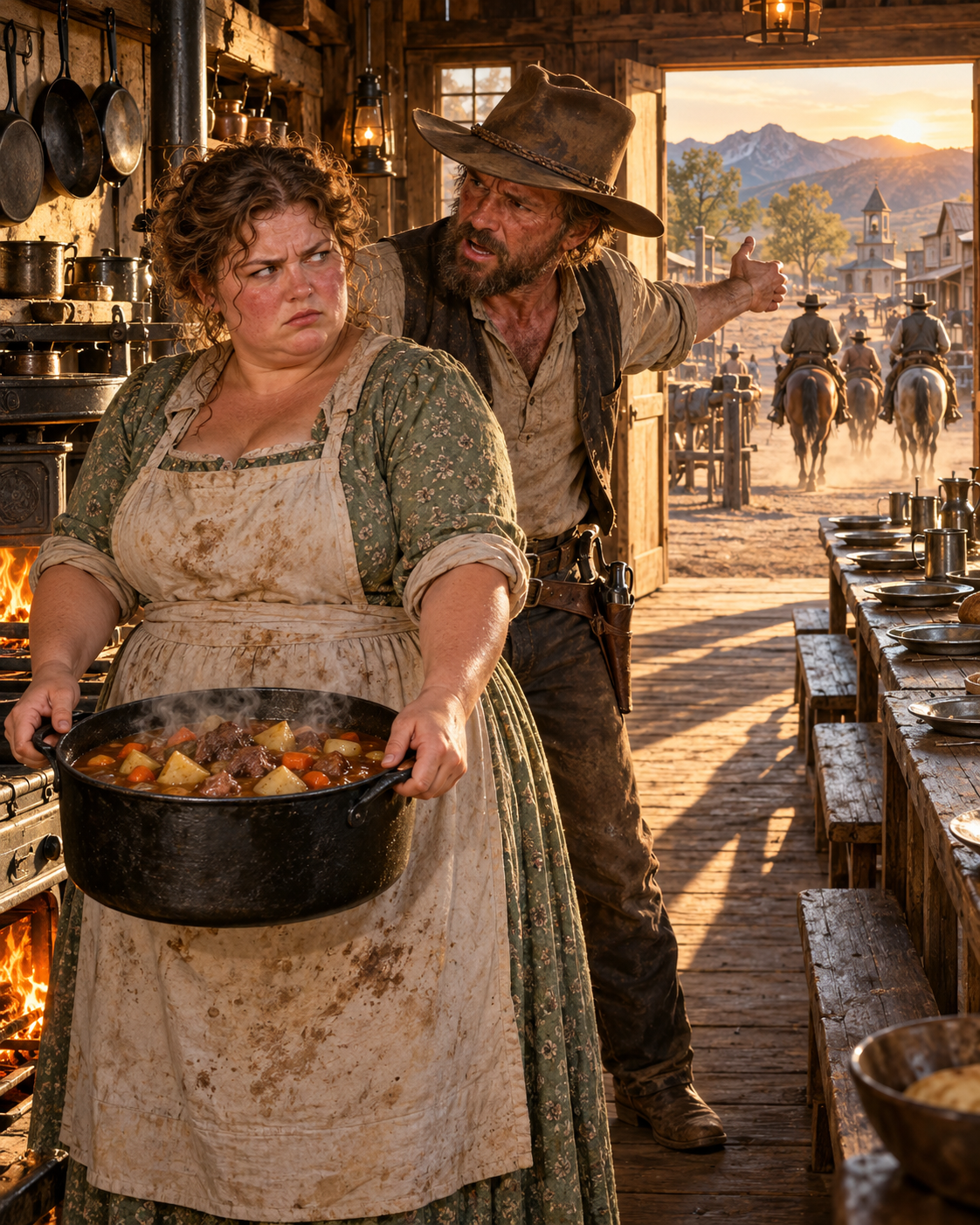
Buck walked to the table and planted both hands against it.
“Everybody saddles up.”
Nobody moved for several seconds.
Then an older hand named Sam Dugan slowly removed his coat.
“I’m tired of riding six miles for supper.”
Buck turned on him.
“You got something to say, Dugan?”
“I just said it.”
Sam took a seat beside Eli.
A third man hesitated.
Then a fourth.
The spell did not break dramatically. No one shouted. No one made a speech. The rebellion happened chair by chair, hat by hat, coat by coat.
Within a minute, nine cowboys were sitting at Bertha’s table.
Buck stared at them.
“You boys forgetting who runs this outfit?”
From the head of the room came Andrew Coburn’s voice.
“I believe that would be me.”
Andrew had entered unnoticed.
He was twenty-six, young enough that Buck had spent two years treating him like a boy wearing his father’s boots. Andrew usually allowed it because Buck knew cattle, water rights, weather, horses, and every mile of fence on the Coburn property.
But something in Andrew’s expression that night had changed.
Buck straightened.
“Just handling the hands.”
“Looks like they’re handling themselves.”
The remaining men stood between the table and the door.
Bertha finally lifted her eyes.
She did not plead with them.
She did not smile.
She simply began serving.
One plate.
Then another.
The sound of the ladle touching china seemed strangely loud.
A cowboy named Frank pulled out a chair.
Then two brothers from Nebraska sat beside him.
Soon more followed.
Buck’s face reddened.
“You walk out with me now,” he said, “or you can collect your wages.”
The room froze again.
Andrew stepped forward.
“No one is being fired for eating supper in my house.”
Buck turned toward him.
“You taking her side over mine?”
“I didn’t know there were sides.”
“There weren’t until she came.”
Bertha laid down the ladle.
“No, Mr. Thorp,” she said calmly. “There were sides before I came. I just put plates where everybody could see them.”
A murmur went through the room.
Buck laughed once.
“You hear that? Now the cook’s running the ranch.”
“I’m cooking,” Bertha replied. “You’re the one worried about where men eat.”
That struck closer than Buck expected.
His eyes narrowed.
Bertha saw it.
So did Andrew.
“Why do you care so much?” Andrew asked.
Buck said nothing.
Andrew repeated the question.
“Why does it matter to you whether thirty men eat here or at Aller’s?”
Buck pushed away from the table.
“Because the food there is better.”
Eli looked down at his nearly empty plate.
“No, it ain’t.”
Several men chuckled.
Even Andrew almost smiled.
Buck did not.
He snatched his coat from a peg.
“Suit yourselves.”
He walked outside, slammed the door, mounted his horse, and rode into the darkness alone.
For the first time in weeks, the Coburn dining room filled with the sounds Bertha had been cooking for all along.
Forks scraped plates.
Biscuits were passed from hand to hand.
Someone asked for more gravy.
Someone else wanted seconds.
The men who had once laughed when Buck dumped her stew into the hog trough now ate so quickly that Bertha had to put another skillet of potatoes on the stove.
No one apologized that night.
Bertha did not ask them to.
Apologies, her mother used to say, were useful only when people had learned what they were apologizing for.
By eight o’clock every plate was empty.
Sam Dugan carried his own dish to the washbasin.
Then Eli brought his.
Soon the other men followed.
Andrew remained seated after everyone else had returned to the bunkhouse.
“You knew something,” he said.
Bertha scrubbed a serving spoon.
“I know several things.”
“About Buck.”
She stopped.
Andrew waited.
Bertha dried her hands and faced him.
“If I tell you what I heard, Mr. Coburn, you need to decide what to do with it yourself. I won’t be the excuse.”
“The excuse for what?”
“For something you should already have been paying attention to.”
It stung because it was true.
Andrew pulled out a chair.
Bertha told him about the conversation at Lester Aller’s saloon.
She repeated only what she had heard: Lester complaining that several hands had ordered the cheaper supper the night before, Buck answering that he was still owed three dollars because he had brought thirty men through the door, and Lester telling him the arrangement was ten cents a head, same as always.
Andrew’s face changed as she spoke.
Not anger at first.
Embarrassment.
Then disbelief.
Then something colder.
“How long?”
“I don’t know.”
“You’re certain it was Buck?”
“I know his voice.”
Andrew stared toward the window.
The ranch account books were kept in an office off the front hall. For months, Buck had told him that morale required occasional trips into town and that ranch hands worked better when they were given freedom.
Andrew had admired his experience.
Now he remembered how often Buck insisted wages be distributed before a town night.
He remembered supply invoices that seemed higher than expected.
He remembered his father once warning him that a ranch could survive a dry summer faster than it could survive a dishonest foreman.
“Why didn’t you tell me immediately?”
Bertha looked at the thirty washed plates stacked beside the sink.
“Would you have believed me?”
Andrew opened his mouth.
Then closed it.
That answer was enough.
The following morning, Buck returned before sunrise.
He acted as though nothing had happened.
He barked orders in the yard, assigned fence work, sent two riders north to check a herd, and criticized a stable boy for leaving tack damp overnight.
Andrew watched from the office window.
For the first time, he noticed how men obeyed Buck.
Not because they respected him.
Because they were accustomed to him.
There was a difference.
Andrew spent the morning going through ranch ledgers.
By noon, he had found no proof of the saloon arrangement. Buck had not been foolish enough to write down bribes.
But he found other irregularities.
Small ones.
Horse feed purchased twice in one month.
Fence wire billed at quantities that did not match the storage shed.
A payment for three replacement saddles when Andrew could find only two.
Nothing dramatic enough to explain itself.
Together, however, the numbers formed a pattern.
Late that afternoon, Andrew rode into town.
Bertha watched him go.
Buck watched too.
At Lester Aller’s saloon, Andrew ordered coffee.
Lester seemed surprised.
“Early for your crew.”
“They won’t be coming tonight.”
Lester’s expression flickered.
Andrew saw it.
“That so?”
“That so.”
Andrew drank half the coffee.
Then he placed thirty dimes on the bar.
Lester stared at them.
Andrew said, “I hear thirty men are worth about this much to some people.”
The saloon keeper’s face emptied.
“I don’t know what you mean.”
“Good.”
Andrew slid the coins closer.
“Then you won’t mind telling me why my foreman expects three dollars when my crew eats here.”
Lester looked toward the door.
That was all Andrew needed.
But Lester, realizing the situation had already turned against him, tried to save himself.
“Wasn’t my idea.”
“Whose?”
“You know whose.”
“How long?”
Lester hesitated.
Andrew waited.
“Since before your father died.”
That answer hurt more than the others.
Andrew’s father had spent his final year ill, trusting Buck to take on responsibilities he could no longer handle personally.
“How much?”
“Ten cents each man.”
“Every night?”
“Most nights.”
“For years?”
Lester spread his hands.
“He brought customers. I paid for customers. That’s business.”
“No,” Andrew said. “That’s buying influence with my payroll.”
He left the thirty dimes on the bar.
When he rode back to the ranch, the sun was disappearing behind a purple Wyoming horizon.
Buck met him near the barn.
“Heard you went to town.”
“I did.”
“Anything I ought to know?”
Andrew dismounted.
“Yes.”
He handed the reins to a stable boy.
“Supper is in twenty minutes.”
Buck stared at him.
“That it?”
“For now.”
The dining room filled before Bertha rang the bell.
All thirty ranch hands came in.
Not twenty-nine.
Not twenty-eight.
Thirty.
Bertha had expected some of them to return to their old habit once Buck was back.
None did.
Buck entered last.
His plate waited at the foreman’s usual place.
He looked at it, then at Bertha.
“You set one for me?”
“I set thirty plates.”
“I’m the thirty-first.”
Bertha nodded toward Andrew’s place.
“Mr. Coburn makes thirty-one.”
Buck understood.
For weeks, Bertha had not been setting a place for the owner.
She had been setting thirty places for the thirty workers Buck had led away.
She had never counted Buck among the men she was waiting for.
His mouth tightened.
Andrew entered carrying a ledger.
He did not sit.
“Before we eat, I have ranch business.”
Buck leaned back.
“This can wait.”
“No.”
Andrew opened the book.
He asked about feed purchases.
Buck answered smoothly.
He asked about wire.
Buck blamed a broken section of north fence.
Andrew said he had inspected it.
Buck changed his explanation.
The room grew still.
Then Andrew mentioned the saddles.
Buck’s temper surfaced.
“You calling me a thief?”
“I’m asking questions.”
“Sounds like you made up your mind.”
“I rode into town today.”
That ended the performance.
Buck looked toward Bertha.
“You.”
Bertha stood by the stove.
“I cooked supper.”
“You went running to him.”
“No.”
Andrew closed the ledger.
“She told me what she heard after I finally asked the right question.”
Buck shoved back his chair.
“You’re throwing away ten years because of some cook who’s been here a month?”
Andrew looked around the room.
“No. I’m examining ten years because a cook who’s been here a month noticed something I should have noticed myself.”
Buck’s face darkened.
“I kept this place running when your old man was dying.”
Andrew flinched, but he did not retreat.
“You did.”
“I kept cattle alive through the winter of ’88.”
“Yes.”
“I know every spring and every fence post on this property.”
“Yes.”
“And now you think you can run it without me?”
Andrew paused.
That was the question Buck had relied upon for years.
Not whether he was honest.
Whether he was indispensable.
“I suppose we’re about to find out.”
Buck moved before anyone expected him to.
He grabbed the ledger from Andrew and hurled it across the room.
It struck the wall.
Several men rose.
Buck pointed at them.
“Sit down!”
Nobody sat.
He looked from face to face and seemed, for the first time, to understand that authority had left him before his job had.
“You ungrateful fools,” he said.
Sam Dugan stepped forward.
“You charged us to obey you without telling us the price.”
“I never took a cent from you.”
“You took it from where we were expected to spend it.”
Eli added, “And you made us treat her like dirt so you could keep doing it.”
Buck rounded on him.
“You were laughing with the rest.”
Eli went pale.
He could not deny it.
Bertha spoke.
“He was.”
Every eye turned toward her.
“So were plenty of others.”
Eli lowered his gaze.
Bertha continued, “A man doesn’t become decent by pretending he was never a coward. He becomes decent when he decides when he’s done being one.”
Eli slowly looked up.
The room changed with those words.
The men did not need to invent innocence.
They only needed to choose what happened next.
Andrew faced Buck.
“You’re finished as foreman.”
Buck laughed harshly.
“You firing me?”
“Yes.”
“Then pay me.”
“I will. Every dollar you’re legitimately owed.”
“And if I don’t leave?”
Andrew looked toward the thirty men.
He did not need to answer.
Buck saw it too.
He took his hat from the table.
At the door, he stopped beside Bertha.
“This is your doing.”
She met his eyes.
“No. This is the result of yours.”
He walked out.
The next morning Buck Thorp rode away from Coburn ranch with two horses, his personal saddle, and the wages Andrew had verified from the books.
No one followed him.
For several weeks, the ranch struggled.
Buck had been dishonest, but he had also been competent.
Those truths existed together, and replacing him was not as simple as celebrating his departure.
A water pump failed.
Two calves went missing during a storm.
A shipment of feed arrived late because Buck had been the only person who knew which supplier extended the ranch credit.
Andrew made mistakes.
Several.
One cost him half a day when he sent riders to the wrong grazing section.
Another nearly cost him a breeding bull after he ignored Sam Dugan’s warning about a damaged gate.
One evening he came into the kitchen exhausted and dropped into a chair.
“My father would have known what to do.”
Bertha kneaded biscuit dough.
“Probably.”
Andrew looked offended.
She continued working.
“He also had years to learn it.”
“I don’t have years.”
“You have tomorrow.”
“That doesn’t sound like enough.”
“It’s all anybody ever gets at once.”
Andrew considered that.
Then he smiled weakly.
“You always talk like your mother?”
“When I’m tired.”
The ranch began changing.
Andrew stopped trying to replace Buck with another Buck.
Instead, he divided responsibility.
Sam supervised cattle movements.
A quiet hand named Thomas Reed took over supplies because he had an unusual talent for numbers.
Eli managed horses.
Andrew inspected the books himself every Saturday.
No one person held enough control to make the entire ranch dependent on him.
Bertha changed too.
She no longer cooked in silence.
The men began appearing in the kitchen before supper, first with excuses.
Someone needed coffee.
Someone wanted to know whether she had seen a missing glove.
Someone claimed he was checking the stove pipe.
Eventually they stopped inventing reasons.
They simply came in.
Eli was the first to apologize.
It happened on a freezing November morning.
He stood beside the kitchen door holding an armful of split wood.
“I laughed that first night.”
Bertha was rolling pie crust.
“I remember.”
“I shouldn’t have.”
“No.”
He waited, perhaps hoping she would make forgiveness easy.
She did not.
“I was afraid of Buck.”
“I know.”
“That doesn’t make it right.”
“No.”
He set the wood down.
“I’m sorry.”
Bertha looked at him then.
“Thank you.”
That was all.
But Eli left the kitchen standing straighter than when he entered.
One by one, others found their own ways to make amends.
Sam repaired a loose pantry shelf.
Frank cleaned the stove chimney without being asked.
Two cowboys hauled a new kitchen table from town after discovering Bertha had been working on a surface that tilted toward one corner.
None of it erased the hog trough.
It did something better.
It made the future different from the past.
Winter settled over Wyoming.
Snow buried fence lines and softened the hills.
The Coburn ranch became isolated for days at a time when storms closed the road to town.
Had Buck still been foreman, the saloon trips would have ended anyway.
But by then, no one spoke about Lester Aller’s suppers.
They spoke about Bertha’s beef stew.
They argued over whether her apple pie or blackberry cobbler was better.
They learned that the cast-iron pot had belonged to her mother for twenty-seven years.
They learned why Bertha had refused to leave.
Her mother had run a boardinghouse after Bertha’s father died, feeding railroad workers, salesmen, drifters, widowers, and anyone else who could pay a few coins for supper.
Some could not pay.
They ate anyway.
“When Mama set a plate,” Bertha explained one evening, “it meant she had decided there was room for you before you ever came through the door.”
Sam looked around the table.
“That what you meant by a promise?”
Bertha nodded.
“A plate says someone expects you to be better than your worst day.”
Eli stopped eating.
He understood more than anyone.
By Christmas, Andrew had recovered most of the money lost through Buck’s padded supply orders by renegotiating contracts and selling unused equipment hidden in an old storage shed.
He did not recover everything.
Some losses could not be repaired.
But the ranch was stable.
On Christmas Eve, Bertha prepared more food than thirty-one people could possibly eat.
There was roast beef, potatoes, carrots, biscuits, preserves, two pies, a pudding, and a pot of stew because Sam insisted Christmas without Bertha’s stew would be “an insult to the territory.”
Just before supper, Andrew entered the kitchen carrying a package wrapped in brown paper.
“For you.”
Bertha frowned.
“What is it?”
“Open it.”
Inside was a new cast-iron pot.
It was larger than her mother’s, black and perfectly seasoned, purchased from a merchant in Cheyenne.
Bertha ran her hand over the rim.
“It’s beautiful.”
Andrew looked pleased.
“Thought the old one deserved retirement.”
Bertha became very still.
Then she lifted her mother’s pot from its hook.
The bottom was scarred.
The handle had been repaired twice.
Its surface showed decades of fires.
She placed the new pot beside it.
“No.”
Andrew’s face fell.
“No?”
“The new one can work beside it.”
He looked at the old pot.
“You’re never giving that thing up, are you?”
“No.”
“Why?”
Bertha smiled.
“Because something doesn’t stop being useful just because it’s survived being mistreated.”
Andrew understood she was not speaking only about cookware.
He nodded.
“Fair enough.”
The men entered for supper.
Thirty places had been set as always.
But this time Andrew noticed something different.
At the far end of the table sat a thirty-second plate.
“Expecting company?”
Bertha was stirring gravy.
“Maybe.”
“Who?”
She shrugged.
“Someone might need supper.”
A storm was building outside.
No sensible traveler would be on the road.
Yet Bertha left the plate.
Halfway through the meal, a knock sounded at the door.
Everyone fell silent.
Eli went to answer.
A stranger stood on the porch, half-frozen, with snow on his shoulders and an exhausted horse tied near the rail.
His wagon had broken an axle two miles east.
He had seen the ranch lights through the storm.
“Sorry to trouble you,” he said. “Just looking for somewhere to stay until morning.”
Eli looked toward Bertha.
She said nothing.
She did not have to.
He opened the door wider.
“We’ve got a plate.”
Years later, men who had worked the Coburn ranch would remember that Christmas better than they remembered Buck Thorp.
They remembered the stranded traveler.
They remembered Andrew laughing when Sam burned his fingers stealing a biscuit.
They remembered Eli telling the story of the first night he refused to ride into town.
Each version grew slightly more dramatic with time.
In one telling, Buck threatened to shoot somebody.
In another, Bertha chased him with a frying pan.
Neither was true.
The truth was quieter.
And perhaps that was why it mattered.
No hero had delivered a grand speech.
No single dramatic act had changed the Coburn ranch.
A woman had simply continued setting thirty plates.
Night after night.
Even after humiliation.
Even when they stayed untouched.
Even when the people they were meant for did not deserve her effort.
She had not done it because surrender would have meant admitting Buck was stronger.
She had done it because she refused to let his behavior determine hers.
That distinction followed Andrew for the rest of his life.
Years later, after the ranch expanded and he became known as one of the most dependable cattlemen in the county, he would tell younger ranchers that the most expensive mistake he ever made was believing competence and character were the same thing.
Buck Thorp had been capable.
He had also been corrupt.
Andrew had ignored the second quality because he feared losing the first.
From Bertha, he learned that leadership was not proven by making people obey.
It was proven by building a place where people could tell the truth without fearing what honesty would cost them.
Eli learned something different.
He stayed at Coburn for six more years before buying a small place of his own.
On the day he left, Bertha packed biscuits and cold beef for his journey.
He stood in the kitchen longer than necessary.
“You know,” he said, “I still think about that first night.”
“So do I.”
“I wish I’d been the one who stayed then.”
Bertha handed him the food.
“You stayed when you finally understood why it mattered.”
“Was that enough?”
She considered him.
“It has to be. Otherwise nobody could ever become better.”
Eli nodded.
Before leaving, he touched the back of the chair where he had sat on the night everything changed.
Bertha remained at Coburn long after people stopped calling her the new cook.
Her mother’s pot remained above the stove.
The newer pot Andrew gave her eventually became nearly as scarred.
The ranch changed with the years.
New barns were built.
Old hands left.
Young men arrived.
Wyoming moved toward a new century.
But one custom remained.
At supper, the table was always set for one more person than expected.
Sometimes the extra place stayed empty.
Sometimes a neighboring rancher filled it.
Sometimes a lost traveler, a salesman, a deputy, or a hungry boy looking for work sat there.
No one at Coburn questioned it.
They understood.
A set plate was a promise.
Not that everyone who entered the room would deserve kindness.
Not that generosity would always be rewarded.
Not that doing the right thing would immediately defeat someone doing wrong.
The promise was simpler.
Cruelty would not be allowed to decide what kind of people they became.
And in the end, that was the victory Buck Thorp never understood.
He had believed power meant making thirty men walk away from a table.
Bertha Platt proved that sometimes real power was having the patience to keep their places waiting until they found the courage to come back.
Years passed, and the Coburn ranch became a different place from the one Bertha had first entered with a battered suitcase and her mother’s cast-iron pot.
The ranch grew.
Andrew bought another stretch of grazing land to the east, added a new barn, and eventually replaced the old bunkhouse with a larger one that did not leak snow through the roof every winter.
Men came and went.
Some stayed only a season.
Some stayed long enough to watch their hair turn gray.
But almost every man who worked at Coburn eventually heard the story of the thirty plates.
They heard about Buck Thorp.
They heard about the stew dumped into the hog trough.
They heard how thirty grown men rode into town night after night because they were too afraid to be the first one to refuse.
And sooner or later, someone would point toward the kitchen.
There, above the stove, hung Bertha Platt’s old cast-iron pot.
By then its bottom was blacker than coal.
The handle had been wrapped with wire where it had cracked.
One side carried a faint dent from the day it had slipped from a wagon years before.
Andrew offered to replace it more than once.
Bertha always refused.
“Some things earn their place,” she would say.
The extra plate remained too.
Every evening, no matter how many men were expected for supper, one more place was set at the table.
Young ranch hands sometimes laughed when they first noticed it.
“Who’s that for?” they would ask.
And one of the older men would usually answer before Bertha could.
“Someone who might need it.”
At first, the younger men thought it was a joke.
Then sooner or later, the extra plate would be used.
A cattle buyer stranded by rain.
A deputy whose horse had gone lame.
A widow passing through with two tired children.
A boy looking for work.
A drifter whose boots were falling apart.
Sometimes the person could pay.
Sometimes they could not.
No one asked before the food was served.
That was Bertha’s rule.
“You can decide what you think of a man after he’s eaten,” she said. “Hunger makes poor company.”
Andrew came to understand that the extra plate became more than a habit.
It became the measure of the ranch.
If there was room for one more, then the place had not yet become too proud of itself.
If a stranger could sit among them without being made to feel like a burden, then the men had not forgotten what it was like to stand on the outside of a room.
That lesson was tested one bitter February afternoon almost eight years after Buck left.
The wind had been blowing since dawn.
Snow moved across the open range in long white sheets, covering wagon tracks almost as quickly as they appeared.
Most of the men were inside repairing tack when a rider appeared at the southern fence.
He was barely upright in the saddle.
Eli Mercer was no longer working at Coburn by then, but Sam Dugan was still there.
He spotted the rider from the barn.
“Somebody’s out there!”
Three men ran into the storm.
They reached the horse just as the rider slid sideways.
He was older than Andrew remembered.
Thinner.
Gray at the temples.
But there was no mistaking him.
Buck Thorp.
For several seconds, nobody spoke.
Buck looked from one face to another.
Sam’s expression hardened.
“What do you want?”
Buck tried to answer, but his lips were blue from the cold.
He looked toward the ranch house.
“Just… need shelter.”
Sam hesitated.
Another ranch hand muttered, “Let him ride.”
Buck heard it.
He lowered his eyes.
Andrew arrived from the office.
He stopped when he saw the man in the snow.
Buck gave a tired laugh.
“Guess this is a surprise.”
Andrew said nothing.
The years between them suddenly seemed very small.
He remembered the ledger hitting the wall.
He remembered Buck’s anger.
He remembered years of misplaced trust.
Most of all, he remembered how afraid he had once been of running the ranch without him.
Buck tried to straighten.
“I’m not asking for work.”
Andrew looked at the snow gathering on Buck’s shoulders.
“What happened?”
“My horse threw a shoe. I’ve been riding since yesterday.”
“Where are you headed?”
“West.”
“That doesn’t answer the question.”
Buck stared past him.
“Anywhere that’ll have me.”
The men exchanged glances.
Bertha stepped onto the porch.
She was older now too.
Her hair had more silver than brown.
But her eyes were unchanged.
She looked at Buck.
Then at the men.
Then she opened the door.
“Supper’s nearly ready.”
Sam stared at her.
“Bertha.”
She looked at him.
“He’s freezing.”
“You remember what he did.”
“Yes.”
“He never apologized.”
“I remember that too.”
Buck said quietly, “I can leave.”
Bertha shook her head.
“No man rides out into that weather from my door.”
Buck looked at Andrew.
Andrew was silent for a long moment.
Then he stepped aside.
“Put your horse in the barn.”
Buck entered the ranch house for the first time in eight years.
No one spoke to him as he removed his coat.
The room that had once obeyed him now belonged to people who barely knew his name.
At supper, he stood awkwardly beside the table.
Every chair seemed occupied.
Then he noticed the extra plate.
It sat at the far end.
Bertha nodded toward it.
Buck did not move.
“Who’s that for?”
Bertha answered, “Tonight?”
She looked at him.
“You.”
Something in Buck’s face shifted.
He sat down.
For the first few minutes, the only sounds were forks, plates, and the fire in the stove.
Buck ate slowly.
He looked thinner beneath his coat than anyone had realized.
When Bertha offered him more stew, he accepted without meeting her eyes.
After supper, most of the men returned to the bunkhouse.
Sam stayed near the door.
Andrew remained at the table.
Buck stared into his empty bowl.
“I heard the ranch did well.”
Andrew nodded.
“It did.”
“You expanded east.”
“Yes.”
“Good grass over there.”
“It is.”
Buck gave a faint smile.
“I always told your father that.”
Andrew almost smiled back.
Then the silence returned.
Finally, Buck said, “I suppose you want to know what happened to me.”
Andrew leaned back.
“Only if you want to tell it.”
Buck looked at his hands.
After leaving Coburn, he had found work at another ranch in Montana.
He had lasted less than a year.
The owner discovered that Buck had been skimming money from horse sales.
After that, word traveled.
He moved farther west.
Worked cattle.
Drove freight.
Managed a stable.
Lost one job after another.
Sometimes because people learned about his past.
Sometimes because he had not changed enough.
“I kept thinking everybody else was the problem,” Buck said.
“No surprise there,” Sam muttered.
Bertha glanced at him.
Sam fell silent.
Buck continued.
“I thought if men didn’t trust me, they were fools. If someone questioned me, they were weak. If I got caught, they were ungrateful.”
He gave a humorless laugh.
“Took me a long time to understand I was the one following myself from place to place.”
Andrew studied him.
“Why come back here?”
“I wasn’t planning to.”
Buck looked toward the window.
“The storm turned me around.”
“That all?”
Buck shook his head.
“No.”
He swallowed.
“I wanted to see whether it was true.”
“What?”
“That this place got better after I left.”
Nobody answered.
Buck looked at Andrew.
“It did.”
Andrew said nothing.
Buck nodded as if that silence confirmed everything.
Then his eyes moved toward Bertha.
“And you’re still here.”
“I am.”
He looked at the old cast-iron pot hanging above the stove.
“You still use that thing?”
“Every week.”
Buck lowered his head.
“I should’ve never touched it.”
Bertha waited.
Buck took a breath.
“I shouldn’t have poured that stew out.”
Sam folded his arms.
Buck continued.
“I shouldn’t have made those men ride to town.”
Another pause.
“And I shouldn’t have taken the money.”
No one rescued him from the discomfort of saying it.
Bertha did not say it was all right.
Andrew did not say the past was forgotten.
Buck looked at Bertha.
“I was cruel to you because I thought making you leave would prove I still controlled the place.”
Bertha nodded.
“I know.”
“I’m sorry.”
For the first time in many years, Buck Thorp seemed like a man with no authority left to hide behind.
Bertha looked at him for a long moment.
Then she stood.
She took his empty bowl.
“Thank you for saying it.”
Buck looked surprised.
“That’s all?”
“What else were you expecting?”
“I don’t know.”
“Forgiveness?”
He did not answer.
Bertha carried the bowl toward the kitchen.
Then she stopped.
“Forgiveness is not pretending something never happened.”
Buck looked at her.
“It means I don’t have to carry your mistake for you anymore.”
She continued toward the sink.
Buck remained still.
Andrew watched him.
“You staying the night,” he said.
Buck looked toward the storm.
“Looks like I have to.”
“In the morning, the weather should clear.”
Buck nodded.
Then Andrew added, “You can have breakfast before you go.”
Sam looked surprised.
Buck did too.
“Why?”
Andrew glanced toward the extra plate.
“Because we learned something after you left.”
Buck followed his gaze.
The answer seemed to hurt and comfort him at the same time.
The next morning, the storm passed.
The sky over Wyoming turned a hard, brilliant blue.
Snow covered the range from fence to horizon.
Buck saddled his horse after breakfast.
Before mounting, he stood outside the kitchen door.
Bertha was inside cutting bread.
He held his hat in both hands.
“I don’t expect you to believe I’m a different man.”
“I don’t.”
Buck almost laughed.
“That sounds like you.”
Bertha sliced another piece of bread.
“But you can become one.”
He looked at her.
“That easy?”
“No.”
She finally faced him.
“That possible.”
Buck nodded slowly.
He turned to leave.
Then he stopped.
“You really would have fed me even if Andrew had said no?”
Bertha looked offended.
“It’s my kitchen.”
For the first time, Buck laughed without bitterness.
He mounted his horse.
Andrew walked beside him to the gate.
“You know,” Buck said, “I spent years thinking you fired me because that woman turned you against me.”
Andrew rested one hand on the fence.
“And now?”
“Now I think she stopped you from becoming me.”
Andrew considered that.
“Maybe.”
Buck looked back at the ranch.
“No.”
He shook his head.
“Definitely.”
Then he rode west.
That was the last time anyone at the Coburn ranch saw Buck Thorp.
Years later, a letter arrived from Oregon.
It was addressed to Bertha.
Inside was a short note.
Buck wrote that he had found steady work managing horses for a small freight company.
He said he no longer handled the books.
“That seems safer for everybody,” he added.
At the bottom, he wrote one final sentence:
I set an extra plate now.
Bertha read the letter twice.
Then she folded it and placed it in the wooden box where she kept recipes, receipts, and the few letters from her mother that had survived the years.
She did not show it to anyone that day.
But at supper, Andrew noticed she had set two extra places instead of one.
“Expecting company?”
Bertha smiled.
“Maybe.”
Andrew shook his head.
“You never change.”
“Oh, I change.”
She looked toward the door.
“I just try not to change the important parts.”
Andrew eventually married and had children.
His oldest son grew up at the ranch and learned early that every man, including the owner, carried his own plate to the kitchen after supper.
When he asked why, Andrew told him about a time when men had confused fear with loyalty.
He told him about a foreman who believed being needed gave him permission to be dishonest.
And he told him about a cook who understood that dignity did not need permission from anyone.
Bertha lived long enough to see Andrew’s children become adults.
Her hands grew stiff with age.
Eventually she stopped cooking every meal.
A younger woman named Clara took over the kitchen.
On Clara’s first night, Bertha sat beside her while she prepared stew.
“How many places?” Clara asked.
“Count the people.”
Clara did.
“Twenty-four.”
Bertha nodded.
“Set twenty-five.”
Clara smiled.
“I know. The extra plate.”
Bertha looked toward her mother’s cast-iron pot.
“Not extra.”
Clara frowned.
“What do you mean?”
“It belongs to somebody.”
“Who?”
Bertha smiled.
“We just don’t know their name yet.”
A few years later, Bertha died quietly in a room overlooking the eastern pasture.
She was buried on a hill beyond the cottonwoods where the morning sun reached first.
Nearly every living man who had once worked at Coburn attended.
Eli Mercer returned from his own ranch.
Sam Dugan, walking with a cane, stood beside him.
Andrew spoke only a few words.
He said Bertha had never owned an acre of Coburn land.
She had never driven a herd.
She had never held any official authority.
Yet she had changed the ranch more than anyone who ever carried the title of foreman.
After the burial, the men returned to the ranch house.
Clara had prepared supper.
Andrew entered the dining room last.
He stopped.
Twenty-six people were present.
Twenty-seven plates had been set.
At the empty place sat Bertha’s old cast-iron pot.
No one spoke.
Andrew walked over and touched the worn handle.
For a moment, he was twenty-six again, standing in a kitchen and asking why a stubborn woman kept setting places for men who refused to come.
He could almost hear her answer.
A set plate is a promise.
Andrew lifted the pot and carried it into the kitchen.
That night, everyone ate together.
The extra place remained empty.
But no one removed it.
The custom outlived Bertha.
It outlived Andrew.
It outlived nearly every man who had known Buck Thorp.
Years later, when automobiles began appearing on roads where cowboys had once ridden, travelers sometimes stopped at the Coburn ranch asking for water, directions, or shelter.
They were often invited inside.
Many noticed the extra plate.
Some asked about it.
The answer changed depending on who told the story.
Some said it was for strangers.
Some said it was for people who had lost their way.
Others said it was a reminder never to confuse strength with cruelty.
But the oldest version was the simplest.
A plate was set because someone might still choose to come back.
That was Bertha Platt’s real victory.
Not that Buck lost his job.
Not that Andrew uncovered the theft.
Not even that the thirty ranch hands eventually chose her table over Lester Aller’s saloon.
Her victory was that no one else’s cruelty succeeded in making her cruel.
She had endured humiliation without letting humiliation become her language.
She had been rejected without learning to reject everyone in return.
She had held people accountable without deciding they were forever beyond redemption.
And the people around her slowly learned the same lesson.
Justice did not require hatred.
Forgiveness did not require forgetting.
Kindness did not require blindness.
And strength did not always arrive with a raised voice.
Sometimes strength looked like a woman standing alone in a Wyoming kitchen, washing a cast-iron pot after thirty men had walked away.
Sometimes courage looked like setting the same thirty plates again the following night.
And sometimes the greatest change began when one frightened man finally pulled out a chair and decided to sit down.
Long after Bertha was gone, long after the names had faded from payroll books and weathered headstones, the Coburn ranch still set one more plate than it needed.
Because everyone who knew the story understood one thing.
There should always be room at the table for a person willing to become better than the person they were yesterday.
THE END.