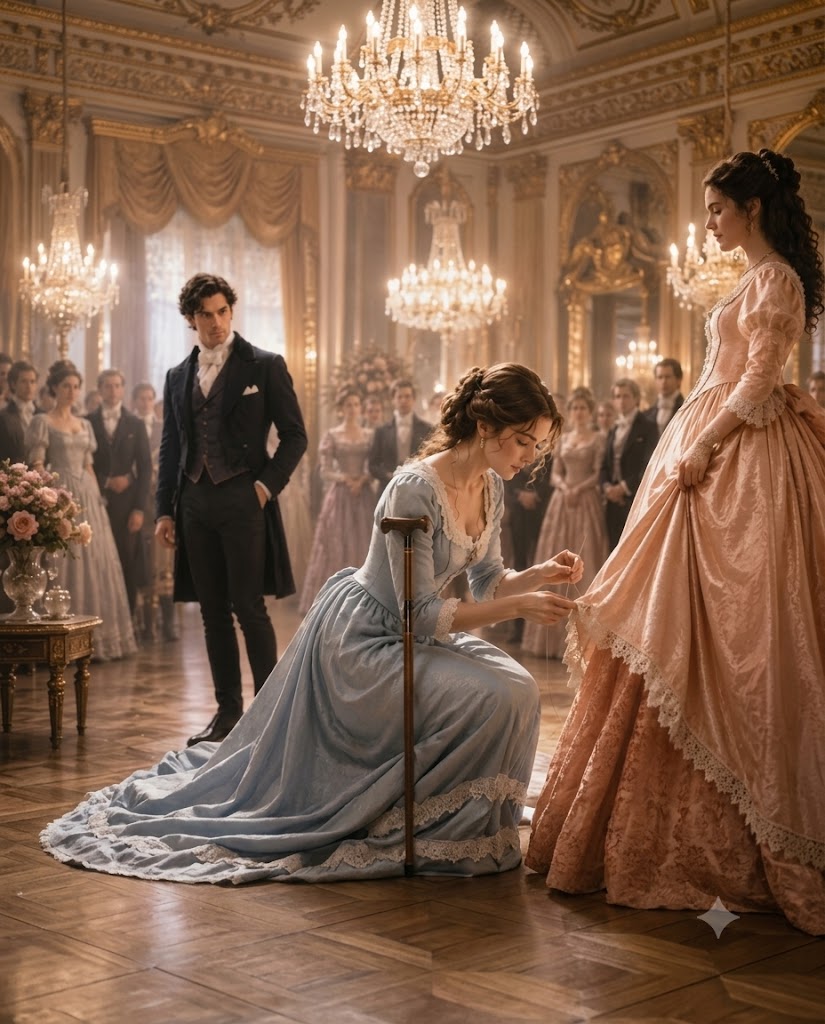
By the time Duke Julian Ashbourne realized the entire ballroom had gone silent, Clara Bennett had already accepted his hand.
“Then tell me what you do want,” Julian said, his voice so quiet that Clara almost missed the desperation beneath it.
She turned slowly, her hand still resting on the door.
For months, she had watched this man command rooms with a glance, silence arguments with a raised eyebrow, and dismiss powerful gentlemen without ever lifting his voice. Yet now, standing before her in the fading afternoon light, the Duke of Ashbourne looked like a man who had misplaced the one thing his fortune could not recover.
“I want you to stop deciding what is best for me without asking,” she answered.
Julian lowered his eyes.
“I thought giving you the school would make it easier.”
“Easier to do what?”
“To leave.”
Clara felt something tighten painfully in her chest.
“And did you want me to leave?”
He looked toward the rain-streaked window.
“That was our agreement.”
“That wasn’t my question.”
For a long moment, the only sound was the fire settling in the grate.
Then Julian looked at her.
“No,” he said. “I have dreaded that day for weeks.”
Clara’s fingers loosened around the door handle.
Before she could answer, a violent knock sounded from the corridor.
The butler entered, unusually pale.
“Your Grace, Lord Edmund Vale has arrived. He insists upon seeing you immediately.”
Julian’s expression hardened.
“Tell him I’m occupied.”
“I did, Your Grace. He said you would reconsider when you saw this.”
The butler held out a newspaper.
Across its front page, beneath a headline printed in enormous black letters, was Clara’s name.
THE DUKE’S DECEPTION: A PURCHASED BRIDE AND A VANISHING FORTUNE.
Julian took the paper.
Clara watched the color drain from his face.
It was the first time she had ever seen him afraid.
Not angry.
Not embarrassed.
Afraid.
“Who is Lord Vale?” she asked.
Julian folded the newspaper with deliberate care.
“My cousin.”
“And why does he think he can frighten you?”
Julian looked at the solicitor’s papers on his desk.
“Because he knows what happened to the money.”
Clara felt the room grow colder.
“What money?”
“The money I used to save Ashbourne.”
Before he could explain, footsteps approached.
Lord Edmund Vale entered without invitation.
He was a handsome man in his early forties, with silver at his temples and the polished smile of someone who had never apologized sincerely in his life.
His gaze moved from Julian to Clara’s cane.
“Well,” he said. “How touching. The happy couple together at last.”
Julian stepped between them.
“You will leave my house.”
Edmund smiled more broadly.
“I would love to, cousin. Unfortunately, I have brought news that may make this house considerably less yours.”
He placed a sealed envelope on the desk.
Clara noticed the red wax.
A court seal.
Julian did not touch it.
Edmund continued pleasantly.
“A petition has been filed challenging your stewardship of the Ashbourne estate. Mismanagement, concealment of debt, and unauthorized transfers of capital.”
“You know perfectly well those accusations are dishonest,” Julian said.
“Dishonesty is a matter for the court.”
Edmund turned toward Clara.
“And what an extraordinary witness your wife will make. A penniless dressmaker elevated to a duchess in exchange for a building and an annual income.”
Clara met his gaze.
“If you have something to say to me, Lord Vale, say it without pretending it is a compliment.”
His smile faltered.
Only for a moment.
Then he laughed.
“Good heavens. She speaks.”
Julian moved forward, but Clara gently placed a hand against his sleeve.
“Let him,” she said.
Edmund regarded her with renewed interest.
“Very well. Your marriage was a transaction, Mrs. Ashbourne. When the newspapers finish with it, every respectable family in England will know.”
Clara tilted her head.
“Then they’ll know a duke kept his word to a working woman. I can think of worse scandals.”
Edmund’s expression darkened.
“This is not a game.”
“No,” Clara replied. “I suspect you’ve made quite certain of that.”
He turned back to Julian.
“You have until Monday to relinquish management of the estate voluntarily. Otherwise, we proceed publicly.”
“And if I refuse?”
“Then your tenants, your servants, and your precious wife will discover just how much of Ashbourne you have gambled away.”
Edmund left his envelope behind.
When the door closed, Julian sat heavily in his chair.
Clara remained standing.
“Tell me everything.”
He rubbed a hand over his face.
“Five years ago, my father died leaving debts concealed beneath three generations of impressive portraits. The estate was nearly insolvent.”
Clara listened without interrupting.
“I sold investments, reduced household expenses, and mortgaged portions of the land. I thought I could manage.”
“But you couldn’t.”
“No. Then Edmund offered to arrange private financing through a merchant syndicate. He said it would preserve the estate until our harvest revenues recovered.”
Julian’s mouth tightened.
“The terms changed. Penalties appeared. Every repayment seemed to increase what I owed.”
“And you trusted him?”
“He was family.”
Clara looked toward the envelope.
“Family can be the most expensive kind of trust.”
Julian gave a humorless laugh.
“Apparently.”
“Why didn’t you tell me?”
“Because the arrangement was mine to correct. Because I was ashamed.”
“And the school?”
“Paid for from the proceeds of my mother’s private inheritance. Money Edmund could not touch.”
Clara stared at him.
“You gave away the one fortune that was safely yours?”
“Not all of it. Enough to secure the school.”
“Julian—”
“I promised you something permanent. I would not allow my failures to take it away.”
She looked at the man seated before her.
For months, she had mistaken his silences for pride alone.
Now she saw something more dangerous.
A man who believed love meant carrying every burden privately until the weight destroyed him.
She lowered herself into the chair opposite his desk.
“Show me the ledgers.”
Julian blinked.
“Clara, this is complicated.”
“So is fitting a wedding gown onto a woman whose measurements change every week. Yet somehow dressmakers manage.”
“This concerns thousands of pounds.”
“And I’ve spent twenty years keeping accounts where a missing sixpence could mean no supper.”
His expression shifted.
She held out her hand.
“The ledgers, Julian.”
He gave them to her.
For the next two hours, Clara read.
She asked questions that Julian had never considered, traced payments through columns of figures, and compared dates against letters from the lending syndicate.
Near midnight, she stopped.
“This charge,” she said, tapping the page. “Why was interest assessed three days before the payment was due?”
Julian leaned closer.
“A contractual adjustment, supposedly.”
“And this one?”
“Another adjustment.”
“They’re identical.”
He frowned.
Clara turned several pages.
“And here. Again. The same amount entered under another description.”
Julian stared at the figures.
“Good God.”
She pulled a sheet of paper toward her.
“Someone has been charging you twice.”
He studied the entries.
“Not merely twice.”
His face hardened.
“Across almost every account.”
Clara looked up.
“Then we have somewhere to begin.”
The following morning, London awakened to scandal.
Carriages slowed outside Ashbourne House. Reporters gathered at its gates. Invitations were withdrawn with astonishing speed.
Lady Marlowe, who had once described Clara as a refreshing novelty, sent a letter explaining that her daughters could not risk association with the household.
Julian read it over breakfast and tossed it into the fire.
Clara continued buttering her toast.
“You seem remarkably calm,” he observed.
“I’ve spent my life being judged by people who cannot thread a needle. Their opinion has rarely improved my breakfast.”
Julian nearly smiled.
Then the housekeeper entered.
“Your Grace, three servants have received letters offering employment elsewhere.”
Julian’s expression darkened.
“Who?”
“The under-footman, one kitchen maid, and Mr. Harris from the stables.”
Clara set down her knife.
“Have they accepted?”
“No, Your Grace.”
“Then why do you look worried?”
The housekeeper hesitated.
“Because the offers included more money than we pay.”
Clara rose carefully.
“Ask everyone to gather in the servants’ hall after luncheon.”
Julian frowned.
“For what purpose?”
“To tell them the truth.”
“Clara, we cannot expose the estate’s finances to the entire staff.”
“Why not? They are the people who will suffer first if it collapses.”
He had no answer.
That afternoon, Clara stood before forty members of the household.
She did not make promises she could not keep.
She told them the estate was threatened, that wages might become difficult, and that anyone seeking other employment would receive references without resentment.
When she finished, the room remained silent.
Then the elderly butler stepped forward.
“My lady, I served His Grace’s father for thirty-two years. I know what loyalty costs.”
Clara nodded.
“Then I would never ask you to purchase it with your hunger.”
The butler’s eyes grew bright.
“That is precisely why I intend to stay.”
One by one, others agreed.
The stable master.
The cook.
The footmen.
The maids.
Even the kitchen boy, whose sister had begun receiving sewing lessons from Clara, declared that he would work without wages.
Clara immediately forbade it.
“Good intentions do not fill empty stomachs,” she told him.
A ripple of laughter moved through the room.
From the doorway, Julian watched the people who had served his family for decades choose to remain not because of his title, but because someone had finally treated their lives as equal in importance to his own.
He felt humbled.
And strangely hopeful.
But Edmund had not finished.
Two days later, Clara arrived at the old nursery to discover the windows broken.
Fabric lay scattered across the floor.
The desks she had ordered were smashed.
Across the far wall, someone had written in black paint:
A CRIPPLE CANNOT TEACH GIRLS TO STAND.
For several seconds, Clara could not move.
The room seemed to tilt beneath her.
She had endured cruelty before.
She had heard whispers in ballrooms, endured strangers staring at her cane, and watched employers lose interest the moment she entered a room.
But this was different.
Someone had entered the place where she intended to give children a future and deliberately destroyed it.
Julian arrived moments later.
When he saw the wall, his expression became terrifyingly still.
“Who did this?”
The footman beside him shook his head.
“We don’t know, Your Grace.”
Julian looked at Clara.
She was staring at the broken desks.
“I’ll find them,” he said.
She didn’t respond.
“I swear to you—”
“Don’t.”
Her voice stopped him.
“Don’t make another promise about protecting me.”
He approached cautiously.
“Clara.”
She gripped her cane until her knuckles whitened.
“When I was fourteen, I worked for a woman who hired only girls without families. She said we should be grateful because nobody else wanted us.”
Julian stood motionless.
“One winter, I fell carrying cloth down an icy staircase. My leg never healed properly. She dismissed me because I could no longer climb quickly enough.”
Her voice trembled.
“I spent months believing she was right about me.”
Julian reached for her hand.
Clara let him take it.
“I promised myself that if I ever had enough money, no girl would be made to feel worthless simply because someone powerful found her inconvenient.”
He looked around the ruined room.
“Then we’ll rebuild it.”
Her eyes filled.
“Someone will destroy it again.”
“Perhaps.”
“And what happens then?”
Julian gently touched her cheek.
“Then we rebuild it again. But this time, you won’t have to do it alone.”
Clara stared at him.
Something in her expression softened.
Then she stepped closer and rested her forehead against his chest.
Julian held her carefully.
Not as though she might break.
As though she mattered.
The next morning, Clara did something nobody expected.
She opened the school anyway.
Not in the ruined nursery.
In the great hall of Ashbourne House.
She instructed the servants to bring tables, chairs, needles, and whatever fabric could be salvaged.
By nine o’clock, twelve girls had arrived.
By ten, there were nineteen.
By noon, twenty-seven.
Some were daughters of farm laborers. Others came from London workshops. Two had walked nearly six miles.
Clara stood before them with her cane in one hand and a length of blue silk in the other.
“This,” she announced, “is not a lesson about sewing.”
The girls exchanged confused glances.
“It is a lesson about mistakes.”
She held up the silk.
“Every stitch can be corrected. Every torn seam can be repaired. And if someone tells you that one mistake has ruined the whole garment, they do not understand the craft.”
A small girl in the front row raised her hand.
“What if the cloth is too damaged, ma’am?”
Clara smiled.
“Then we make something different.”
Julian listened from the staircase.
He had heard speeches in Parliament delivered by men who believed they were changing history.
None had moved him quite like those simple words.
That evening, he kissed Clara.
There was no grand declaration.
No orchestral music.
Only the quiet drawing room and a candle burning low beside the fireplace.
He had been helping her remove a splinter from her finger when she looked up.
“You’re staring.”
“Yes.”
“Why?”
“Because I think I’ve loved you for some time, and I’ve been too much of a coward to admit it.”
Clara’s breath caught.
Julian continued before courage deserted him.
“I first asked you to marry me to humiliate people I despised. I told myself it was noble, but I used you to make a point.”
“Yes,” she whispered.
“I was arrogant.”
“Frequently.”
“And foolish.”
“Spectacularly.”
He laughed softly.
Then grew serious.
“But somewhere between your terrible jokes about my handwriting and your insistence that everyone in this house deserves kindness, I stopped wanting to prove anything.”
His fingers brushed hers.
“I simply wanted you to stay.”
Clara’s eyes shone.
“You should have asked.”
“I am asking now.”
She moved toward him.
Their kiss was gentle at first.
Then it became the answer to every unfinished conversation between them.
For one brief evening, the world outside Ashbourne House seemed very far away.
But the following morning, a messenger arrived from London.
Edmund had obtained an emergency hearing.
Julian was ordered to appear before the court within forty-eight hours.
If the petition succeeded, he would lose control of the estate immediately.
Worse, the school building purchased for Clara had been named in the proceedings as a possible fraudulent transfer of assets.
Julian read the notice twice.
Clara recognized the look on his face.
He intended to sacrifice himself.
“What are you planning?” she asked.
“An agreement with Edmund.”
“No.”
“You haven’t heard it.”
“I know your face when you’re about to do something regrettably noble.”
Julian placed the notice on the table.
“If I surrender management, Edmund will withdraw his challenge to your school.”
“Has he promised that?”
“His solicitor has suggested it.”
“Then we have precisely nothing.”
“Clara—”
“No. You are not giving him everything because you’re frightened of losing me.”
Julian went still.
She stepped closer.
“You cannot buy love with sacrifices I never asked you to make.”
His eyes closed briefly.
“Then what would you have me do?”
“Fight.”
“With what evidence?”
Clara looked toward the stack of ledgers.
“With the truth.”
That night, they worked until dawn.
The solicitor returned with copies of bank records. The estate steward supplied receipts. Clara reorganized the figures into a sequence so clear that even Julian could follow the deception.
Yet one crucial piece remained missing.
The name of the person who had authorized the false charges.
Without it, Edmund could blame the lending syndicate and escape responsibility.
At breakfast, the kitchen boy approached Clara nervously.
“My lady, may I tell you something?”
“Of course, Thomas.”
He glanced toward Julian.
“The gentleman who broke the school windows. I think I saw him.”
Julian rose.
“When?”
“The night it happened. I was bringing coal from the yard.”
“Why didn’t you tell anyone?”
Thomas swallowed.
“Because he said he’d have my father dismissed from the mill if I spoke.”
Clara gently guided him into a chair.
“Tell us what you remember.”
“He wore a dark coat. Had a silver ring with a black stone.”
Julian’s face changed.
Clara noticed immediately.
“You recognize it.”
“Yes.”
“Who?”
Julian’s voice was icy.
“Edmund’s private secretary.”
By afternoon, they had located the man at a coaching inn outside London.
His name was Mr. Felix Granger.
He initially denied everything.
Then Julian placed a copy of the fraudulent accounts before him.
Granger’s eyes widened.
“You cannot prove I wrote those.”
Clara leaned forward.
“Actually, we can.”
She pointed to the figures.
“You use an unusual seven, with a crossbar and a downward hook. The same mark appears in the letters sent to our steward.”
Granger stared.
“And,” she continued, “you made one other mistake.”
He looked at her.
“You kept the same reference number when you entered the false charges.”
Granger’s expression collapsed.
Julian studied Clara in astonishment.
She shrugged.
“When you’ve spent years matching patterns, you notice when someone repeats one.”
They offered Granger a choice.
He could provide the original instructions from Edmund, or face prosecution alongside him.
For a long time, he refused.
Then Clara asked a question Julian had not considered.
“Does Lord Vale pay your mother’s nursing expenses?”
Granger looked up sharply.
“How did you know?”
“You have a hospital receipt in your coat pocket. You’ve been touching it whenever you’re frightened.”
His face twisted.
“He promised to continue paying if I did what he asked.”
“And threatened to stop if you refused?”
Granger nodded.
Clara’s voice softened.
“You’ve hurt people to protect someone you love. I understand the fear. But the man who uses your mother against you will never stop using her.”
Granger covered his face.
Then he told them everything.
Edmund had deliberately inflated the estate’s debts, arranged for false interest charges, and planned to force Julian out before the fraud could be discovered.
The newspaper scandal had been manufactured to weaken Julian’s standing.
The school vandalism was intended to frighten Clara into leaving.
And there was one final revelation.
Edmund had secretly arranged to sell several villages belonging to Ashbourne to a manufacturing company whose directors included his associates.
The tenants would be evicted.
Their homes demolished.
Their fields converted into industrial property.
Julian sat in stunned silence.
Clara reached beneath the table and took his hand.
“This was never about your title,” she whispered.
“It was about everyone who trusted it.”
The hearing took place on a bitterly cold Monday morning.
The courtroom was crowded with aristocrats, journalists, estate representatives, and curious spectators eager to witness the downfall of a duke who had married a dressmaker.
Edmund arrived smiling.
He stopped smiling when Granger entered behind Julian’s solicitor.
The proceedings began badly.
Edmund’s counsel described Julian as reckless, irresponsible, and dangerously influenced by a woman who lacked the education required to understand matters of finance.
Clara sat quietly.
Then her name was called.
She rose with difficulty and approached the witness stand.
A murmur traveled through the courtroom as she walked with her cane.
Edmund’s barrister smiled.
“Mrs. Ashbourne, before your marriage, you worked as a dressmaker?”
“Yes.”
“And you possessed no formal training in estate management?”
“No.”
“Then by what extraordinary qualification do you claim to understand these accounts?”
Clara considered him.
“I can count.”
Laughter broke across the gallery.
The judge struck his desk for silence.
The barrister flushed.
“Surely you are not suggesting that household arithmetic is equivalent to the management of a great estate?”
“No,” Clara replied. “I’m suggesting that dishonest arithmetic remains dishonest, however impressive the estate.”
She then explained the ledgers.
Patiently.
Precisely.
Without a single unnecessary flourish.
She showed how one payment had been charged three times, how fraudulent penalties had accumulated, and how funds had been diverted into companies associated with Edmund.
The barrister attempted to interrupt.
Clara continued.
He questioned her intelligence.
She answered with figures.
He mocked her profession.
She explained that a dressmaker who miscalculated fabric would lose money, while a gentleman who miscalculated thousands of pounds apparently expected sympathy.
By the time she finished, the courtroom had fallen completely silent.
Then Granger testified.
He produced letters bearing Edmund’s instructions and copies of the original accounts.
Edmund leaped to his feet.
“Lies!”
The judge ordered him to sit.
“These are forgeries!”
Granger’s voice trembled.
“No, my lord. You told me to destroy the originals. I kept them because I knew one day you would blame me.”
Edmund looked around the courtroom.
For the first time, there was nowhere to hide behind his smile.
The judge adjourned briefly to review the evidence.
When proceedings resumed, he dismissed Edmund’s petition, ordered the disputed accounts and transfers placed under further investigation, and referred the evidence of fraud to the proper authorities.
The ruling did not erase Ashbourne’s genuine debts.
It did something more important.
It gave Julian the opportunity to repair them honestly.
Outside the courthouse, reporters crowded around the couple.
“Your Grace! Is your marriage a fraud?”
“Mrs. Ashbourne! Did you marry for money?”
“Will you now seek a divorce?”
Julian stopped.
He looked at Clara.
For once, he did not answer for her.
Clara faced the reporters.
“Yes,” she said clearly, “our marriage began as an arrangement.”
The crowd stirred.
“I needed a school. My husband needed to learn that a person’s worth does not come from their family name.”
Someone laughed nervously.
Clara continued.
“We both entered the marriage believing we understood exactly what the other could offer.”
She looked at Julian.
“We were wrong.”
A reporter pushed forward.
“Then what is your marriage now?”
Julian offered Clara his hand.
She took it.
“A choice,” he said.
“And one we intend to keep making,” Clara added.
Their answer appeared in newspapers across England.
Some mocked it.
Others praised it.
But among the letters that began arriving at Ashbourne House, the most meaningful were not from aristocrats.
They came from seamstresses, governesses, factory workers, and young women who had been told their ambitions were inappropriate.
One letter, written in uncertain handwriting, read:
My father says there is no purpose in teaching a girl who will only marry. But I think I should like to learn enough to choose what happens to me.
Clara read that letter three times.
Then she placed it on Julian’s desk.
“We need more classrooms.”
He examined the letter.
“How many?”
“As many as we can afford.”
Julian smiled.
“Then we’d better become very good at affording them.”
The following months were not easy.
Ashbourne remained heavily indebted. Julian sold his racing horses, several unnecessary properties, and a collection of paintings that had hung untouched for generations.
When a friend expressed horror at the loss of the ancestral collection, Julian replied, “My tenants cannot eat portraits.”
He renegotiated leases fairly and invited tenant representatives to review decisions affecting their livelihoods.
Some aristocrats called him dangerously progressive.
Others simply stopped inviting him to dinner.
He found he missed very few of them.
Clara, meanwhile, discovered that running a school required far more than good intentions.
There were teachers to hire, accounts to balance, parents to persuade, and students who arrived hungry or exhausted from working before dawn.
She made mistakes.
Once, she ordered twice as many writing slates as they needed and half as much coal.
Another time, she dismissed a teacher too quickly, only to discover she had misunderstood a quarrel.
Each time, she apologized.
Each time, she learned.
And every evening, Julian listened as she described her triumphs and disasters with equal intensity.
They argued occasionally.
Sometimes fiercely.
Julian still had a habit of assuming money could solve a problem.
Clara still believed she could survive on sheer determination.
But they had learned to recognize the moment pride began speaking louder than love.
On those evenings, one of them would reach across the table.
And the other would take the offered hand.
One spring morning, nearly a year after their wedding, Clara stood in the completed schoolhouse.
Sunlight poured through tall windows onto neat rows of desks.
On the wall hung a simple wooden sign.
BENNETT SCHOOL FOR GIRLS.
Beneath the name were words Clara had chosen herself.
YOUR BEGINNING DOES NOT DECIDE YOUR ENDING.
Fifty-three students filled the classrooms.
Some learned sewing and embroidery. Others studied mathematics, reading, bookkeeping, and practical trades.
Several older girls were already earning wages from businesses they had started themselves.
The little girl who had once asked what happened when cloth was too damaged to repair now stood beside Clara holding a beautifully made jacket.
“I made this from the scraps nobody wanted,” she announced proudly.
Clara examined the careful seams.
“It is extraordinary, Mary.”
The girl beamed.
“Do you think someone will buy it?”
“I think someone will be fortunate to own it.”
Mary hesitated.
“Do you ever wish your leg was different, my lady?”
Clara looked at her cane.
There had been years when that question would have wounded her.
Years when she had prayed to wake without pain, to walk across a room without anyone turning to stare.
“Sometimes,” she answered.
Mary looked disappointed.
Clara smiled.
“But wishing something were different does not mean the life you have is worth less.”
The girl considered this.
“Did the duke fall in love with you even though you limp?”
Clara laughed softly.
“I believe he fell in love with me partly because I kept walking into places where people thought I didn’t belong.”
From the doorway, Julian cleared his throat.
“I can confirm that.”
Mary giggled and hurried back to her desk.
Julian approached Clara carrying a small parcel.
“What’s this?” she asked.
“A wedding present.”
“We’ve been married nearly a year.”
“I was rather unprepared for the first one.”
She opened the wrapping.
Inside lay a slender silver thimble, engraved with a tiny rose and the words:
For everything you have mended, and everything you have made possible.
Clara touched the inscription.
“Julian.”
He looked suddenly nervous.
“There is something else.”
He took a folded paper from his pocket.
Clara raised an eyebrow.
“If it’s another contract, I may strike you with my cane.”
He laughed.
“No contract.”
He unfolded the paper.
It was a marriage certificate.
Their marriage certificate.
“I thought,” he said, “that perhaps we might have another ceremony. Nothing grand. Just our friends, the household, and the girls.”
Clara’s eyes filled.
“Why?”
“Because the first time I married you, I was trying to prove the world wrong.”
He took her hand.
“This time, I want to spend the rest of my life proving you right.”
Clara looked at the certificate for a long moment.
Then she shook her head.
Julian’s face fell.
“No?”
“No second ceremony,” she said.
He swallowed.
“May I ask why?”
“Because I don’t wish to replace the day we married.”
She stepped closer.
“That foolish, arrogant man who asked me to marry him in front of an entire ballroom is part of our story. And so is the frightened woman who accepted because she wanted a school more than she feared being humiliated.”
Julian listened.
“I don’t want to pretend we began perfectly.”
She placed his hand over her heart.
“I want us to remember that we began imperfectly and chose to become better.”
Julian kissed her forehead.
“Then what should we do with the money I intended for the ceremony?”
Clara smiled.
“I know forty girls who need winter coats.”
He groaned.
“Of course you do.”
But he was smiling when he said it.
That evening, they walked through the gardens of Ashbourne House.
The first roses had begun to bloom.
Beyond the stone walls, the estate fields stretched green beneath the setting sun.
Julian offered Clara his arm as they approached the gravel path.
She accepted, but when they reached the familiar uneven stones, she stopped.
“Do you remember the ballroom?” she asked.
“Every humiliating second.”
“You thought you were rescuing me.”
“I did.”
“And I thought I was using you.”
“You were.”
She smiled.
“So we were both terribly mistaken.”
Julian looked toward the schoolhouse, its windows glowing warmly in the distance.
“I thought being a duke meant having the power to change other people’s lives.”
“And now?”
He looked at her.
“Now I think it means very little unless those people are free to change their own.”
Clara rested her head briefly against his shoulder.
They stood together as the last sunlight faded.
Years later, people would tell the story differently.
Some would say a duke had saved a poor dressmaker from obscurity.
Others would insist a clever woman had married above her station and transformed a crumbling estate.
Neither version was entirely true.
Julian had not rescued Clara.
Clara had not rescued Julian.
They had simply met at a moment when both were trapped by what the world expected them to be.
And, slowly, painfully, imperfectly, they had taught each other how to become something more.
The school grew.
The estate recovered.
Edmund’s name eventually disappeared from respectable conversation, while the girls educated at Bennett School carried their skills into shops, offices, workshops, and homes across the country.
Some became teachers.
Some became business owners.
Some married.
Some did not.
All were encouraged to believe that the choice belonged to them.
And whenever a frightened new student arrived, ashamed of her clothes, her poverty, or some difference she had been taught to conceal, Clara would sit beside her with a needle and a piece of fabric.
She would show her how a torn seam could be strengthened, how an imperfect pattern could become something beautiful, and how the smallest careful stitch could hold together what once seemed beyond repair.
Then she would tell the girl something she had learned from her own extraordinary, unlikely marriage.
“Never confuse the place where someone finds you with the place where you are meant to remain.”
For Clara Bennett Ashbourne had discovered that love was not a grand gesture performed before a watching ballroom.
It was not a fortune offered in exchange for gratitude.
It was not even the promise that life would never become difficult.
Love was the freedom to remain yourself beside someone who wanted to see you grow.
And the greatest gift Julian had ever given her was not a school, an estate, or a title.
It was the day he finally understood that she had never needed his permission to be extraordinary.
She had only needed someone willing to stand beside her while she proved it.
And in learning to stand beside her, the proud duke had become something far greater than the man he once believed himself to be.
He had become worthy of the woman who chose him.
THE END