Bethany Whitaker was standing at the altar when the man she had traveled hundreds of miles to marry looked her over and shook his head.
Bethany stared at the envelope in Patrick Morgan’s hand, feeling the cold settle somewhere beneath her ribs.
She had known this moment would come. She had simply hoped it wouldn’t come while snow still covered the fields and the children were finally learning how to laugh again.
“Have I done something wrong?” she asked.
Patrick looked genuinely startled. “No. Why would you think that?”
“Because you look as though you’re about to dismiss me.”
He glanced at the envelope, then at the traveling dress spread across her lap.
“You’re preparing to leave.”
“You told me I must.”
For several seconds, neither spoke.
Then Patrick placed the envelope on her little writing desk.
“There’s three months’ wages in there. Paid ahead.”
Bethany frowned. “I haven’t earned that.”
“You will. If you agree to stay until June.”
Her heart gave a painful little leap.
“June?”
“I need more time to arrange things.”
“What things?”
Patrick rubbed a hand across his jaw. He was a strong man, accustomed to controlling horses, handling difficult winters, and making decisions without asking anyone’s permission. Yet standing in her small room, he looked strangely uncertain.
“The children have taken to you,” he finally said. “I don’t want them disappointed before there’s someone else.”
Someone else.
Two simple words, and Bethany understood.
She wasn’t being asked to stay because she belonged. She was being asked to remain until she could be replaced.
“I see,” she whispered.
Patrick seemed to hear something in her voice.
“Bethany—”
“I’ll stay until June, Mr. Morgan. If that is what you need.”
He nodded, but his expression tightened.
As he turned toward the door, she asked the question she had been afraid to ask since arriving.
“Why are your children so frightened of losing people?”
Patrick stopped.
For a moment, she thought he might finally tell her about his wife.
Instead, he said, “Because they’ve already lost enough.”
Then he left.
Bethany sat motionless, staring at the envelope.
She didn’t touch the money.
The next morning, six-year-old Molly Morgan appeared in the kitchen carrying a small wooden box.
“Miss Bethany, can you fix something?”
Bethany smiled. “I’ll certainly try.”
Molly opened the box.
Inside lay a delicate silver music box, its lid engraved with tiny flowers. The winding key had broken, and one side was badly dented.
“It was Mama’s,” Molly explained. “Papa put it away because it made him sad.”
Bethany carefully lifted the little treasure.
“Where did you find it?”
“In the room we’re not supposed to go into.”
Before Bethany could respond, twelve-year-old Daniel appeared in the doorway.
“Molly! You’re going to get us in trouble.”
Molly clutched Bethany’s skirt.
“I only wanted to hear Mama’s song.”
Daniel’s face hardened.
“Put it back.”
Bethany noticed his trembling hands.
“Daniel, sweetheart, there’s nothing wrong with remembering someone you love.”
His eyes flashed.
“You don’t understand.”
“Then help me understand.”
He looked toward the hallway.
“Papa says talking about Mama won’t bring her back.”
Bethany lowered herself into a chair.
“No, it won’t. But forgetting her won’t make losing her hurt any less.”
Daniel stared at her.
For one brief moment, she saw the little boy beneath the angry expression.
Then he turned and disappeared upstairs.
That afternoon, Bethany went into Bitter Pine to purchase flour, lamp oil, and sewing thread.
The general store was crowded with ranch hands sheltering from an approaching storm.
She had just finished paying when a familiar voice sounded behind her.
“Well, if it isn’t Miss Whitaker.”
Bethany froze.
Standing near the counter was Thomas Caldwell, the man who had abandoned her at the altar.
He looked almost exactly as he had on their wedding day: polished boots, handsome face, expensive coat, and the same unpleasant confidence.
“Thomas.”
He smiled broadly.
“I heard you were still in town. Working as a servant, apparently.”
Several customers turned to listen.
Bethany tightened her grip on her parcels.
“I’m employed at the Morgan ranch.”
“Patrick Morgan?” Thomas laughed. “That miserable widower?”
Bethany said nothing.
Thomas stepped closer.
“I suppose you’re grateful somebody was willing to take you in.”
She could feel heat rising into her cheeks.
Once, such words would have reduced her to tears.
But she had spent months carrying water, baking bread, nursing frightened children through nightmares, and working until her hands ached.
Something inside her had changed.
“I’m grateful for honest work,” she answered calmly.
Thomas’s smile faded slightly.
“Still pretending you’re too good for me?”
“No, Mr. Caldwell. I finally understand that I was always too good for the way you treated me.”
A ranch hand near the doorway coughed to conceal a laugh.
Thomas’s expression darkened.
“You’d better watch that sharp tongue. A woman in your position can’t afford enemies.”
Bethany lifted her chin.
“Then it’s fortunate I no longer need your approval.”
She walked past him without looking back.
But outside the store, her hands were shaking.
She didn’t notice the elderly woman standing beneath the awning until the woman spoke.
“That was well said, dear.”
Bethany turned.
The woman introduced herself as Margaret Ellison, the town’s schoolteacher.
“I knew Patrick’s wife,” Margaret said quietly. “Eleanor Morgan was my niece.”
Bethany’s heart tightened.
“She must have been very loved.”
“She was. And her death was not what people think.”
Before Bethany could ask another question, Margaret glanced toward the store window.
Thomas Caldwell was watching them.
Margaret’s expression changed.
“Be careful around that man,” she whispered. “And if you ever want to understand what happened at the Morgan ranch, come see me.”
Then she hurried away.
Bethany returned to the ranch with more questions than answers.
That evening, Patrick found her standing beside the sitting-room window.
“Something happened in town,” he said.
She turned.
“How would you know?”
“One of my men saw Caldwell speaking to you.”
Bethany studied him.
“You know Thomas?”
Patrick’s jaw tightened.
“Everybody in this county knows Thomas Caldwell.”
“Then perhaps you know why he seemed so interested in your family.”
Patrick went very still.
“What did he say?”
“Nothing worth repeating.”
“Bethany.”
She had never heard him speak her name quite that way.
“He called you a miserable widower. He also seemed pleased to see me working here.”
Patrick looked toward the darkening windows.
“Stay away from him.”
“Why?”
“Because he’s dangerous.”
“That isn’t an explanation.”
Patrick’s expression hardened.
“I don’t owe you one.”
The words struck harder than Bethany expected.
She set down the curtain she had been mending.
“No, Mr. Morgan. You don’t. But you cannot ask me to help raise children who wake screaming at night while refusing to tell me what they’re afraid of.”
Patrick opened his mouth, then closed it.
Bethany continued, her voice shaking despite her determination.
“I know I’m only your housekeeper. I know I’ll leave in June. But those children deserve peace, and someone in this house must be willing to speak honestly.”
She walked past him before he could answer.
That night, a storm swept across the valley.
Wind battered the shutters, and snow piled against the doors.
Shortly after midnight, Bethany awoke to the sound of shouting.
She hurried into the corridor.
Daniel stood outside his father’s bedroom, pounding on the door.
“Papa! The barn!”
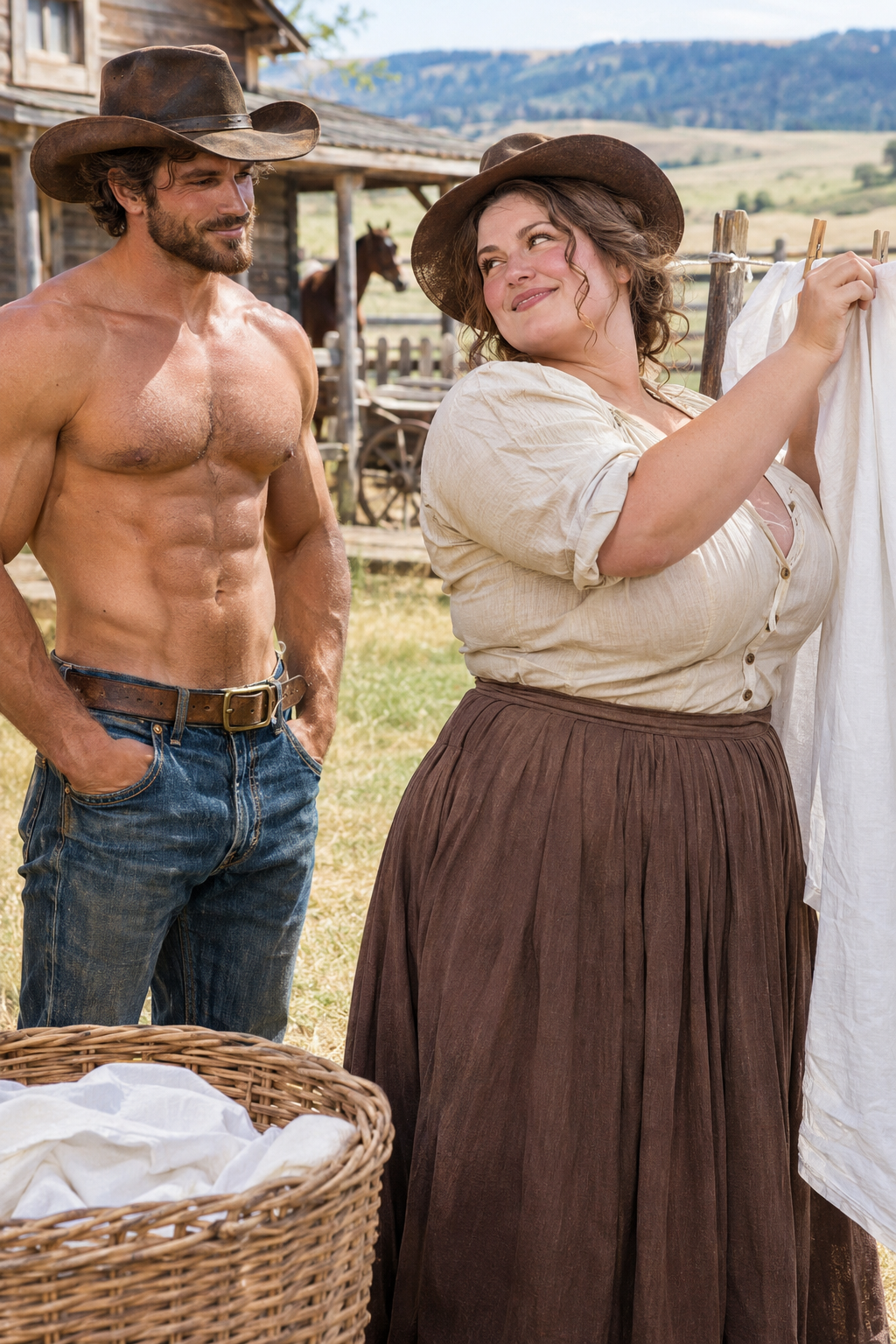
Patrick emerged wearing his trousers and pulling on his coat.
Through the window, Bethany saw an orange glow beyond the yard.
The hay barn was burning.
“Stay inside!” Patrick ordered.
He rushed downstairs with Daniel following.
Bethany seized the boy’s arm.
“You stay with your sisters.”
“But the horses!”
“Your father needs to know you’re safe.”
Outside, ranch hands raced through the snow, carrying buckets and dragging frightened animals away from the flames.
Bethany gathered Molly and ten-year-old Grace into the kitchen.
She wrapped blankets around them and kept the stove burning while the storm howled.
Then Grace cried out.
“Where’s Daniel?”
Bethany looked toward the staircase.
The boy was gone.
Her stomach dropped.
She rushed to the window.
Beyond the yard, a small figure was running toward the burning barn.
“Dear Lord.”
Bethany grabbed Patrick’s spare coat and hurried outside.
The heat struck her face before she reached the building.
Daniel was near the entrance, pulling at the rope of a terrified young mare.
“Daniel!”
“The foal’s inside!”
Bethany looked past him.
Through the smoke, she could hear frantic kicking from a stall near the rear wall.
The roof creaked ominously.
She knew she should turn back.
Instead, she wrapped her scarf across her mouth and followed the sound.
The little foal was trapped beneath a fallen wooden beam.
Bethany struggled against the weight, coughing as smoke filled her lungs.
Then strong arms reached around her.
Patrick.
“Get out!” he shouted.
“The foal!”
Patrick looked toward the animal, swore, and shoved the beam aside.
Bethany pulled the frightened creature free while Patrick guided them toward the entrance.
They had barely stumbled into the snow when the roof collapsed behind them.
The sound shook the ground.
Patrick caught Bethany by both shoulders.
“Are you out of your mind?”
She could barely breathe.
“Daniel went inside.”
Patrick looked toward his son.
The boy stood trembling beside the rescued mare.
For one terrible moment, Bethany thought Patrick might strike him.
Instead, the rancher dropped to his knees and pulled Daniel into his arms.
“Never do that again,” he whispered hoarsely. “I couldn’t bear losing you too.”
Daniel began to sob.
Bethany turned away, giving them privacy.
By dawn, the barn was gone.
Two horses had suffered minor burns, but no one had been killed.
Patrick’s foreman, Samuel Briggs, found something troubling near the eastern wall.
A broken lantern.
Its glass was scattered beneath fresh snow, far from any place where the ranch hands normally worked.
“There shouldn’t have been a lantern here,” Samuel said.
Patrick examined the blackened metal.
His expression changed.
Bethany recognized the look immediately.
Fear.
Not fear of losing property.
Fear of something returning.
Three days later, Margaret Ellison came to the ranch.
She brought schoolbooks for Grace and Daniel, along with a small package for Molly.
Inside was a replacement key for Eleanor’s music box.
“I found a clockmaker who could repair it,” Margaret explained.
Molly’s face lit up.
When the delicate melody filled the sitting room, Grace began crying.
Daniel stood completely still.
Patrick, who had just entered from the yard, stopped in the doorway.
The music continued.
Then he crossed the room and shut the little box.
“Enough.”
Molly flinched.
Bethany rose.
“Patrick.”
His face was pale.
“I said enough.”
Margaret stepped forward.
“Eleanor loved that music.”
Patrick looked at her sharply.
“Please don’t.”
“Your children deserve to remember their mother.”
“Not today.”
His voice broke on the last word.
He turned and walked outside.
Molly began crying.
Bethany gathered her into her arms.
Margaret watched the doorway with deep sadness.
Later, when the children were occupied, she asked Bethany to walk with her.
They stood near the frozen garden beneath a pale afternoon sky.
“Eleanor died two years ago,” Margaret began. “Not in childbirth, as some people say. Not from fever.”
Bethany waited.
“She was killed in a carriage accident on the western road.”
“I’m sorry.”
“Patrick was supposed to accompany her that morning. But Thomas Caldwell came demanding payment on a disputed cattle contract. They argued terribly.”
Bethany felt a chill unrelated to the weather.
“Thomas?”
Margaret nodded.
“Eleanor left alone to fetch medicine for Molly. Her carriage went over a ravine.”
“Was it an accident?”
“The sheriff believed so.”
“But you don’t?”
Margaret’s eyes filled with tears.
“Eleanor told me the night before that Caldwell had threatened Patrick. She was frightened. And the carriage wheel had been repaired only a few days earlier.”
Bethany looked toward the ruined barn.
“Did Patrick know?”
“He suspected something. But there was no proof. Eventually he stopped speaking of Eleanor altogether. He believed silence would protect the children from his grief.”
Margaret reached for Bethany’s hand.
“He’s not a cruel man, dear. He’s a frightened one.”
That evening, Bethany found Patrick repairing a saddle in the workshop.
She closed the door behind her.
“Margaret told me about Eleanor.”
His hands stopped moving.
“I didn’t ask her to.”
“Perhaps you should have told me yourself.”
Patrick set down his tools.
For a long moment, he stared at the floor.
“I loved my wife,” he said finally. “More than anything. We married young. Built this place together. She could make a home out of a tent and a handful of wildflowers.”
Bethany remained silent.
“The morning she died, we argued.”
“About Caldwell?”
Patrick nodded.
“She wanted me to involve the sheriff. I told her I could handle it. She said I was too proud to ask for help.”
His voice grew rough.
“Those were nearly the last words I ever said to her.”
Bethany stepped closer.
“You couldn’t have known.”
“She begged me to ride with her. I refused because I wanted to finish proving I was right.”
He looked up.
“And when they brought her home, I couldn’t even tell my children why their mother wasn’t coming back.”
A tear slipped down his cheek.
Bethany had never seen him cry.
She didn’t reach for him immediately.
Instead, she said softly, “Patrick, your children aren’t asking you to stop loving their mother.”
He looked at her.
“They’re asking you to remember her with them.”
Something in his face crumpled.
He covered his eyes.
Bethany moved beside him and rested a hand against his shoulder.
For a long time, neither spoke.
Then Patrick whispered, “I’m afraid if I start grieving, I won’t know how to stop.”
“You don’t have to do it alone.”
He reached up and covered her hand with his.
For one brief moment, Bethany imagined the distance between them disappearing.
Then Patrick stepped away.
“You should go inside. It’s getting cold.”
She nodded.
But something between them had changed.
Not into love, exactly.
Into trust.
And that frightened Bethany almost as much.
As winter slowly weakened, Patrick began joining the children after supper.
He told stories about Eleanor’s terrible singing voice, her stubbornness, and the time she’d accidentally chased a visiting banker from the yard with a broom.
For the first time, the children laughed while hearing their mother’s name.
Molly began sleeping through the night.
Daniel stopped hiding his tears.
And Grace, who had remained quiet for so long, began singing Eleanor’s lullaby while helping Bethany wash dishes.
Then, one morning in March, Samuel rode into the yard with terrible news.
The county bank had issued a notice against the Morgan ranch.
Patrick owed nearly four thousand dollars on an old cattle agreement.
If he failed to pay before the end of April, Caldwell could seek possession of the northern pasture and its valuable spring water.
Bethany found Patrick in his study, staring at the documents.
“Is it true?”
He looked exhausted.
“The original contract was supposed to be settled two years ago. Caldwell claims there’s unpaid interest.”
“Do you have proof of payment?”
“The records were in Eleanor’s desk. After she died, I couldn’t bear to open it. When I finally did, the papers were missing.”
Bethany remembered Margaret’s warning.
“And now he wants the land.”
“The spring runs through that pasture. Without it, I can’t keep the cattle through summer.”
He gave a bitter laugh.
“I’ve survived blizzards, droughts, and losing the woman I loved. Now that snake may take everything she helped me build.”
Bethany watched him for a moment.
Then she asked, “Where is Eleanor’s desk?”
Patrick looked up.
“Why?”
“Because somebody needs to look again.”
They spent the afternoon searching the locked bedroom.
The room had been preserved almost exactly as Eleanor left it.
A blue shawl hung over a chair. A half-finished embroidery frame rested beside the window. On the dresser stood a family portrait taken the summer before her death.
Bethany felt like an intruder.
But Patrick handed her the desk key.
“She was better at keeping accounts than I ever was.”
They searched every drawer.
Nothing.
Then Bethany noticed faint scratches along the underside of the desk.
She knelt and found a narrow wooden panel, barely visible beneath the bottom drawer.
It slid free with a soft click.
Inside was a folded packet wrapped in oilcloth.
Patrick went completely still.
Bethany placed it on the desk.
He opened it carefully.
Inside were three receipts, a handwritten account ledger, and a letter addressed to Margaret Ellison.
Patrick read the documents twice.
Then his hands began shaking.
“Eleanor knew.”
Bethany leaned closer.
The receipts showed that Caldwell’s debt had been paid in full, with the final installment accepted six weeks before Eleanor’s death.
But the letter contained something worse.
Eleanor had written that Caldwell was demanding the northern pasture despite receiving payment. She had discovered irregularities in his accounts and feared he intended to ruin the ranch.
Near the bottom, she’d added a troubling sentence.
If anything happens to me, please make certain Patrick knows I never believed the threats were empty.
Bethany felt the blood drain from her face.
“Patrick…”
He was staring at his wife’s handwriting.
“She tried to warn me.”
He rose abruptly.
“I’m going to Caldwell’s place.”
Bethany stepped into his path.
“No.”
“Move.”
“Patrick, think about your children.”
His face twisted with anger.
“He threatened my wife!”
“And if you ride over there with a gun, what happens to Molly, Grace, and Daniel?”
He stopped.
Bethany’s own voice trembled.
“You’ve spent two years believing you failed Eleanor. Don’t fail yourself now by giving Caldwell another way to destroy this family.”
For several agonizing seconds, Patrick stared at her.
Then his shoulders sagged.
“What do I do?”
“We take these papers to the sheriff.”
By noon the following day, Sheriff Amos Reed had examined Eleanor’s documents.
The receipts were convincing, but one problem remained.
Caldwell claimed the signatures were forged.
Without another witness or a bank record, the dispute might still reach court.
Then Bethany remembered something.
Thomas had once bragged about his close friendship with the bank’s former bookkeeper, a nervous man named Walter Finch.
He’d boasted that Walter could make a troublesome debt disappear.
At the time, Bethany had thought it was merely another example of Thomas’s arrogance.
Now it sounded different.
She told Sheriff Reed everything.
The sheriff’s expression sharpened.
“Walter Finch left town last autumn. But his sister lives in Helena.”
He sent a telegram immediately.
Three days later, Walter Finch arrived in Bitter Pine under the sheriff’s protection.
He looked frightened even before entering the office.
When shown Eleanor’s receipts, he closed his eyes.
“She kept them.”
Patrick leaned forward.
“You know these papers?”
Walter nodded miserably.
“Caldwell paid me to remove the settlement from the ledger and create a new balance. He wanted Morgan’s northern land.”
The sheriff asked, “And Eleanor Morgan?”
Walter’s face went white.
“I warned her to stay out of it.”
Patrick rose so suddenly his chair crashed backward.
“What happened to my wife?”
Walter began trembling.
“I didn’t kill her.”
“Then who did?”
“I don’t know. Caldwell told me to make sure the repairman was paid, but he never said what for.”
The room fell silent.
Sheriff Reed asked for the repairman’s name.
Walter swallowed.
“Henry Voss.”
The same man who had repaired Eleanor’s carriage.
By the next morning, Sheriff Reed had located Voss working at a logging camp beyond Silver Creek.
Under questioning, Voss admitted Caldwell had paid him to loosen a crucial fastening on the carriage wheel.
He insisted he believed Caldwell intended only to frighten Eleanor.
But the damaged wheel had broken on the steep western road, sending her carriage into the ravine.
The news devastated Patrick.
He sat in the kitchen that evening while the children slept upstairs, staring at his untouched supper.
Bethany sat across from him.
“I should have listened to her,” he whispered.
“Patrick…”
“I knew Caldwell was dangerous. She begged me to act.”
Bethany reached across the table.
“You did not loosen that wheel.”
He shook his head.
“You don’t understand.”
“I understand that a wicked man made a terrible choice. And you’ve spent two years taking the blame for his cruelty.”
Patrick finally looked at her.
“How do you forgive yourself?”
Bethany thought of the church, the humiliation, and the months she’d spent believing she must be lacking something because Thomas Caldwell had rejected her.
“Sometimes,” she said slowly, “you begin by accepting that another person’s cruelty doesn’t prove you failed.”
Patrick’s eyes filled.
He reached for her hand.
This time, neither pulled away.
The following week, Thomas Caldwell was arrested.
The town buzzed with the news.
Some residents expressed shock. Others admitted they had feared him for years.
The sheriff secured the altered ledger, Walter’s testimony, and Voss’s confession. The prosecutor charged Caldwell and Voss in connection with Eleanor’s death, while the fraudulent debt claim was withdrawn.
The Morgan ranch was safe.
Yet peace did not return all at once.
Patrick spent long hours riding alone, struggling to accept that Eleanor’s death had been deliberate.
The children sensed his sorrow.
And Bethany, watching spring slowly brighten the hills, began preparing for her departure.
One afternoon, she found Molly sitting beside a patch of melting snow.
The little girl held three tiny purple flowers in her palm.
“Look, Miss Bethany. The flowers came back.”
Bethany knelt beside her.
“They certainly did.”
Molly’s smile faded.
“Does that mean you have to go?”
Bethany couldn’t answer.
“Papa said people don’t always leave because they want to.”
The words broke something in her chest.
She hugged Molly tightly.
“Whatever happens, sweetheart, you must remember that being loved doesn’t end when someone goes away.”
Molly pulled back.
“But I don’t want you to go away.”
Neither did Bethany.
That evening, Patrick found her folding clothes into her old traveling trunk.
He stood in the doorway for a long moment.
“So you’re leaving.”
“June is almost here.”
“I know.”
Bethany continued folding.
“Margaret has offered me a position helping at the school. There’s a small cottage nearby.”
Patrick looked at the trunk.
“You’ve made arrangements.”
“You asked me to.”
He flinched.
“I did.”
The silence stretched.
Finally, he said, “Bethany, there’s something I should have told you months ago.”
She waited.
“When I first hired you, I believed I was doing you a favor.”
Her face warmed.
“I know.”
“No. You don’t.”
He stepped closer.
“I was angry at the world. Angry at Eleanor for leaving, though God knows she didn’t choose to. Angry at myself. Angry at my children because their grief reminded me of mine.”
His voice grew rough.
“Then you walked into this house and began doing the one thing I was too frightened to do.”
“What was that?”
“Living.”
Bethany’s eyes filled.
Patrick took another step.
“I told you to leave in spring because I thought I could never love another woman. And because I was afraid of how much the children already loved you.”
“Patrick…”
“But somewhere along the way, I began waiting for the sound of your voice. I started coming home early because supper was the happiest part of my day.”
He swallowed.
“And when I saw you carrying Daniel out of that burning barn, I realized losing you would break my heart in a way I hadn’t believed possible.”
Bethany gripped the edge of her trunk.
“You never said anything.”
“I didn’t know how.”
“You could have asked me to stay.”
“I was afraid you’d think I wanted another housekeeper. Or another mother for my children.”
He shook his head.
“That’s not what I want.”
Bethany whispered, “Then what do you want?”
Patrick looked directly into her eyes.
“You. Not because this house needs you. Not because my children love you. Because I do.”
Tears spilled down Bethany’s cheeks.
For months, she’d told herself she was foolish to imagine such a thing.
But hearing the words now frightened her.
“Patrick, I won’t be somebody’s second choice.”
His expression softened.
“You wouldn’t be.”
“I won’t spend my life competing with Eleanor’s memory.”
“You never could. And I would never ask you to.”
He took her hand.
“I loved Eleanor. I always will. She gave me three beautiful children and years I wouldn’t trade for anything.”
His thumb gently brushed her fingers.
“But loving her doesn’t mean my heart has no room left. It means I understand how precious love is.”
Bethany began crying openly.
“I came here because another man told me I wasn’t pretty enough to marry.”
Patrick’s face tightened with sadness.
“Then he was blind to everything that matters.”
She laughed weakly.
“That’s easy for you to say.”
“No.”
Patrick cupped her cheek.
“I’ve watched you knead bread before sunrise, teach Daniel his sums, braid Grace’s hair, and sit beside Molly through nightmares. I’ve seen you work with burned hands and tired eyes. I’ve heard you laugh when you thought no one was listening.”
His voice lowered.
“Bethany, you’re the most beautiful woman I’ve ever known. And I would have loved you even if you’d never lifted a finger in this house.”
For the first time, she believed him.
But love, she had learned, needed more than beautiful words.
“There’s something I need to ask,” she said.
“Anything.”
“If we marry, will I have a voice in this family? Will you listen when I disagree with you?”
Patrick smiled faintly.
“I expect you’ll disagree with me often.”
“I certainly will.”
“Then I’d better learn to listen.”
Bethany rested her forehead against his.
“And I want to keep teaching at the school sometimes. I don’t want to lose myself inside these walls.”
“Then we’ll make room for that too.”
He drew a small breath.
“I won’t ask you to marry me tonight. You’ve already had one man decide your future without considering your heart.”
He released her hand gently.
“But if you choose to stay, I’ll spend the rest of my life showing you that you belong here.”
Bethany looked toward the open trunk.
Then toward the window, where the last snow was disappearing beneath the evening sun.
“I think,” she whispered, “I’d like to stay.”
Patrick’s face changed completely.
He laughed, a deep astonished sound she had never heard from him before.
Then he kissed her.
It was gentle, hesitant, and full of all the things they had been too afraid to say.
From the hallway came a sudden squeal.
They turned.
Molly stood in the doorway, with Grace and Daniel crowded behind her.
“Does that mean she’s staying?” Molly demanded.
Patrick looked at Bethany.
Bethany smiled through her tears.
“Yes, sweetheart.”
Molly flew across the room and wrapped both arms around her.
Grace joined them, laughing and crying at once.
Daniel remained near the doorway.
Then he approached Patrick.
“Papa?”
“Yes, son?”
“Would Mama be angry?”
The room grew still.
Patrick knelt before his son.
“No, Daniel. I don’t believe she would.”
Daniel looked at Bethany.
“Because we still love her.”
“Of course we do,” Bethany whispered.
Patrick nodded.
“Love isn’t a pie that gets smaller every time you give someone a piece. It grows.”
Daniel considered this carefully.
Then he stepped forward and hugged Bethany.
It was the first time he’d done so without being asked.
She held him tightly.
And in that moment, she understood that a family wasn’t always something you were born into.
Sometimes it was something wounded people built together, one act of trust at a time.
Patrick did not propose the following morning.
Instead, he kept his promise to let Bethany choose her future.
She began spending two afternoons each week helping Margaret at the school. Patrick hired additional help so she could have time for herself, and he encouraged the children to share chores rather than expecting her to do everything.
They spoke honestly about money, responsibilities, and the life they wanted.
Sometimes they disagreed.
Patrick discovered Bethany was much more stubborn than her gentle manner suggested.
Bethany discovered Patrick could be impossible when he believed he was protecting someone.
But they learned to listen.
And slowly, affection became something stronger than loneliness or gratitude.
It became partnership.
In July, Patrick took Bethany to the little meadow beyond the northern pasture.
Wildflowers covered the grass, and the spring that Caldwell had tried to steal ran clear between the stones.
There, beneath a cottonwood tree, Patrick knelt.
He held a simple gold ring that had belonged to his grandmother.
“Bethany Whitaker,” he said, his voice unsteady, “I can’t promise a life without hardship. But I promise you will never face it alone if I can help it.”
She smiled through tears.
“And I promise the same.”
He took a breath.
“Will you marry me?”
“Yes, Patrick. I will.”
Their wedding took place in September.
The same little church where Bethany had once stood humiliated was filled with neighbors, ranch hands, and children carrying flowers.
Bethany wore the wedding dress she’d made the previous year.
She had altered the sleeves and added delicate embroidery around the collar.
When Margaret asked why she hadn’t chosen a new one, Bethany smiled.
“Because there was never anything wrong with the dress.”
At the altar, Patrick waited with Daniel beside him.
Grace carried a bouquet of wildflowers.
Molly scattered petals down the aisle with such enthusiasm that several guests began laughing.
As Bethany entered, Patrick’s eyes filled with tears.
He didn’t look her over.
He didn’t judge her beauty.
He simply reached for her hand.
And before the minister began, Patrick whispered, “Thank you for choosing us.”
Bethany squeezed his fingers.
“Thank you for making room for me.”
At the reception, Daniel surprised everyone by standing on a chair and asking for silence.
He held a folded piece of paper in his trembling hands.
“I wanted to say something about my mama,” he began.
Patrick’s eyes filled immediately.
“She was kind, and she loved us. And when she died, I thought being happy again meant we didn’t love her anymore.”
He glanced at Bethany.
“But Miss Bethany taught us that remembering someone and loving someone new aren’t opposite things.”
The boy swallowed.
“So I think Mama would be happy today.”
By the time he finished, half the room was crying.
Patrick embraced his son.
Bethany looked toward the window, where sunlight poured over the mountains.
And for the first time since arriving in Montana, she felt no need to prove that she deserved happiness.
She simply allowed herself to have it.
Years later, visitors to the Morgan ranch would notice two things.
The house was always full of laughter.
And on the mantelpiece stood a little silver music box beside a framed wedding photograph.
Eleanor’s memory remained part of the family. Her stories were told, her birthday remembered, and her children grew up knowing they had been loved deeply by two remarkable women.
Bethany eventually helped establish a small schoolhouse for children from the scattered ranches surrounding Bitter Pine.
She taught reading, arithmetic, and sewing, but the lesson her students remembered most was one she rarely put into words.
A person’s worth could never be measured by another person’s willingness to love them.
As for Thomas Caldwell, he was convicted for his role in Eleanor’s death and the fraud against the Morgan family. He spent the years that followed behind prison walls, while the woman he’d once publicly humiliated built a life richer than anything his money could have purchased.
One autumn evening, long after the children had grown, Bethany and Patrick sat together on the porch watching the sunset.
Their hair had silvered, and their hands bore the marks of years spent working side by side.
Patrick looked toward the distant mountains.
“Do you ever think about that day in the church?” he asked.
Bethany smiled.
“Sometimes.”
“Does it still hurt?”
She considered his question.
“A little. But not for the reasons it once did.”
“What do you mean?”
“I used to remember the shame. How everyone stared. How I wondered what was wrong with me.”
She took his hand.
“Now I think about how close I came to believing him.”
Patrick kissed her knuckles.
“I’m glad you didn’t.”
“So am I.”
They sat quietly as the sun slipped behind the hills.
Then Bethany looked toward the house, where the sound of grandchildren laughing drifted through the open windows.
“If Thomas had married me,” she said softly, “I might have spent my whole life trying to become someone worthy of his approval.”
Patrick smiled.
“And instead?”
“Instead, I learned I was worthy all along.”
He drew her closer.
The evening wind stirred the golden grass.
Somewhere inside, Eleanor’s old music box began playing its familiar melody, followed by the delighted laughter of a little girl who had discovered it.
Bethany closed her eyes.
Once, she’d believed that being abandoned at the altar was the worst thing that could happen to her.
Now she understood that it had been the beginning of a journey she never would have chosen, but one that led her toward a love she could never have imagined.
Not every rejection is a judgment of your worth. Sometimes it is simply the moment life frees you from a place where you were never meant to remain.
And sometimes the family waiting for you isn’t the one you dreamed of when you were young.
It is the one that teaches you that love is not about being chosen because you are perfect.
It is about being cherished for exactly who you are.
Bethany had traveled hundreds of miles hoping someone would make her his wife.
But the greatest gift she found in Bitter Pine was not a husband, a ranch, or even a second chance at marriage.
It was the discovery that she had never needed anyone’s approval to be worthy of love.
And from that truth, she built a beautiful life.
THE END.