Bennett Whitmore rejected me before the entire Montana stagecoach station, but his cruel silence concealed a secret buried inside his ranch’s financial records.
The elderly woman standing on Caleb’s porch looked at me as though she had just witnessed a miracle, but the fear in her eyes told me our nightmare was far from over.
“My darling Evelyn,” she whispered again, pressing one trembling hand against her chest.
I stood frozen in the kitchen doorway, unable to speak.
The woman was perhaps sixty, with silver hair tucked beneath a faded blue bonnet and a face marked by years of grief.
Yet there was something painfully familiar about her eyes.
They were the same pale green as mine.
Caleb stepped forward, keeping himself between us.
“Who are you, ma’am?”
The woman swallowed hard.
“My name is Eleanor Vale, and I believe I’m standing before my granddaughter.”
The kitchen seemed to tilt beneath my feet.
“My grandmother died before I was born,” I whispered.
“That is what your father wanted you to believe.”
I backed against the table, knocking over a tin cup.
The metallic sound made everyone flinch.
For twenty years, I had carried memories of a dead mother and a distant father who never spoke about the past.
Now a stranger had appeared in the middle of the night, claiming those memories had been carefully constructed.
“Prove it,” I said, surprised by the sharpness of my own voice.
Eleanor slowly opened her worn leather handbag.
From inside, she withdrew a small piece of yellowed fabric.
It was part of a child’s dress, embroidered with tiny blue flowers.
I recognized it immediately.
I had worn that dress in the only photograph of myself as a little girl.
“My mother made this for your eighth birthday,” Eleanor whispered.
“She stitched a little bird beneath the collar because you were frightened of thunderstorms.”
A memory struck me without warning.
A warm hand brushing my hair, a woman singing beside a window, and a tiny bird sewn into blue cotton.
My knees weakened.
Caleb caught my arm before I fell.
“How did you find me?” I managed.
Eleanor’s expression darkened.
“Because Bennett Whitmore made a mistake when he brought you back to Montana.”
Outside, the wind rattled the porch railing.
“And if he discovers I’ve reached you first,” she continued, “he will do everything he can to silence us.”
Caleb locked the kitchen door.
“Then you’d better tell us everything.”
Eleanor sat near the stove, holding her handbag so tightly that her knuckles whitened.
She explained that my mother, Margaret Vale, had grown up on a prosperous ranch near Silver Creek.
Her father had owned thousands of acres, including the spring that supplied water to three neighboring properties.
The land was valuable, but the water rights were worth even more.
When Margaret married a charming young businessman named Thomas Hartwell, Eleanor believed her daughter had found happiness.
Instead, she had married a man who loved money more than his own family.
Thomas had borrowed heavily from the Whitmores.
When his debts became impossible to repay, Bennett’s father offered him a terrible bargain.
If Thomas helped transfer the Vale family’s inheritance into Whitmore hands, his debts would disappear.
Margaret discovered the arrangement before the documents could be completed.
She refused to sign.
Then, one winter night, the family house caught fire.
Eleanor’s voice broke as she described the flames.
“Your grandfather died trying to save the records.”
I pressed my fingers against my mouth.
“And my mother?”
“She escaped with you, but Thomas found her before she could reach the sheriff.”
Eleanor stared at the floor.
“He took you away and told everyone Margaret had died in the fire.”
I shook my head slowly.
“But I remember my mother dying in Ohio.”
“You remember a woman lying in bed,” Eleanor said gently.
“Thomas hired a nurse who resembled Margaret, and after she died of fever, he told you she was your mother.”
The room fell silent.
I wanted to call Eleanor a liar.
I wanted to demand that she leave.
But the memories I had spent years refusing to examine were beginning to rearrange themselves.
My father had never taken me to visit my mother’s grave.
He had never allowed me to speak to anyone from Montana.
And whenever I asked about my childhood, he became angry.
“Where is she?” I whispered.
Eleanor’s eyes filled with tears.
“Margaret survived, but Thomas had her declared mentally unfit and confined to a private institution under another name.”
The words struck harder than any physical blow.
My mother had been alive while I cried myself to sleep believing she was buried.
She had been alive while I celebrated birthdays alone.
She had been alive while I waited for letters that never came.
“Why didn’t you rescue her?”
Eleanor closed her eyes.
“I tried, Evelyn, but the institution moved her repeatedly, and every official I approached had been paid to look away.”
Caleb knelt beside my chair.
“Do you know where Margaret is now?”
Eleanor nodded.
“Three days ago, she was transferred to a small medical house outside Helena.”
I remembered the message written on the photograph.
Your mother was never buried.
For the first time, those words carried something more painful than fear.
They carried hope.
Then a crash came from the yard.
Caleb sprang toward the window.
One of the cowboys was running across the darkness, shouting that someone had cut the horses loose.
A moment later, a flaming arrow struck the porch roof.
“Everybody out!” Caleb shouted.
The ranch erupted into chaos.
Men rushed with buckets while sparks scattered across the dry timber.
Caleb grabbed my hand, pulling me toward the back door.
Eleanor stumbled behind us.
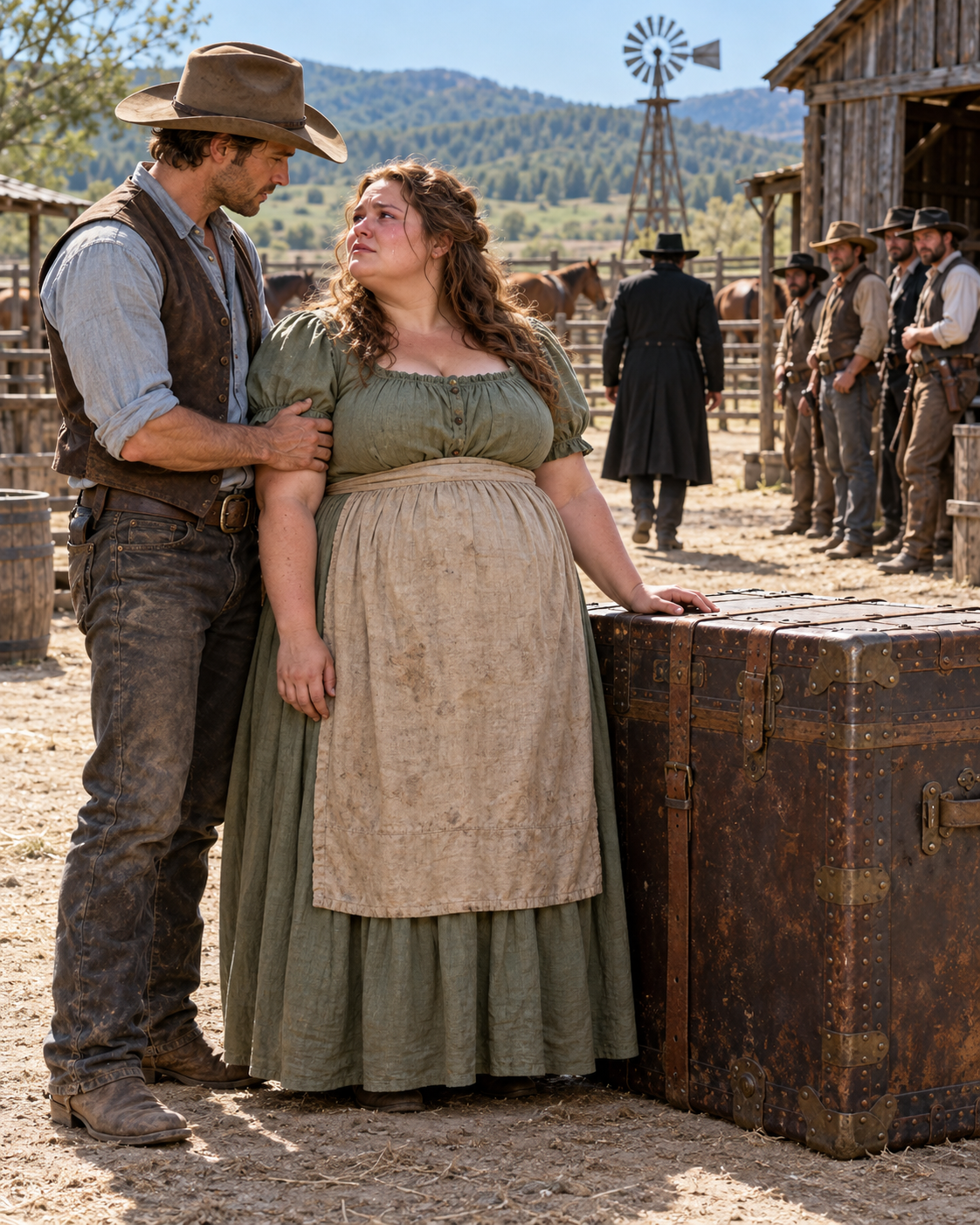
As we reached the yard, a rider emerged from the darkness and aimed a pistol toward the kitchen.
Caleb pushed me behind a water trough.
The gunshot shattered a window above our heads.
Then the rider disappeared into the trees.
By the time the flames were extinguished, half the porch had burned.
Caleb stood in the smoking ruins, his face streaked with soot.
Bennett Whitmore had stopped pretending.
And now we knew exactly how far he was willing to go.
At sunrise, Caleb gathered the ranch hands in the barn.
I stood beside him with Eleanor and the damaged financial ledger.
“We’ve been robbed, threatened, and nearly burned alive,” Caleb told them.
“Anyone who wants to leave will receive every dollar I owe him.”
Nobody moved.
Finally, old Hank, the cook’s former assistant, stepped forward.
“Miss Evelyn fed us when the pantry was empty and kept this place running when we couldn’t pay our bills.”
He removed his hat.
“If someone wants to hurt her, they’ll have to get through us.”
The other men nodded.
I turned away before they could see my tears.
For most of my life, I had believed that being unwanted was something written into my bones.
Yet these rough, exhausted cowboys were willing to stand between me and danger.
Caleb caught my eye.
He didn’t smile.
He simply looked at me as though my place beside him had never been in question.
Later that morning, Eleanor showed us another document.
It was a copy of my grandfather’s original will.
His ranch and water rights had been placed in trust for Margaret and her descendants.
But there was a condition.
If Margaret remained unable to claim the estate, her daughter could inherit upon reaching twenty-eight.
I stared at the date on the document.
My twenty-eighth birthday had passed just six weeks earlier.
“That explains why Bennett sent for you now,” Caleb said.
Eleanor nodded.
“He needed you in Montana, where he could pressure you into signing a transfer.”
“But he rejected me.”
“Because he recognized that you resembled Margaret far more than he expected.”
My humiliation at the stagecoach station returned with terrible clarity.
The cold inspection, the sudden silence, and the way Bennett had hurried away.
Perhaps my appearance had disappointed him.
But his cruelty had also concealed a deeper fear.
He had brought me across the country expecting a lonely woman who would be grateful for any marriage proposal.
Instead, he had encountered a living reminder of the family his father had destroyed.
“He didn’t want a wife,” I whispered.
“He wanted my signature.”
Caleb’s hand closed around mine.
“Then we make certain he never gets it.”
We traveled to Helena two mornings later.
Caleb insisted on accompanying me, while Hank and two trusted ranch hands followed in a second wagon.
Eleanor carried the documents hidden inside the lining of her coat.
The road twisted through pine-covered mountains beneath a sky heavy with clouds.
Every passing rider made my stomach tighten.
Halfway there, Caleb pulled the wagon beside a narrow creek to water the horses.
I stood watching the current rush over stones.
“Are you frightened?” he asked.
“Terrified.”
He rested one hand against the wagon wheel.
“You don’t have to pretend otherwise.”
I looked at him.
“All my life, I thought being brave meant never needing anyone.”
“And now?”
“Now I’m beginning to think it means accepting someone’s hand when you cannot stand alone.”
Caleb’s expression softened.
He reached toward me, then hesitated.
“Evelyn, I need to tell you something.”
My heartbeat quickened.
“Then tell me.”
“I was engaged once.”
I hadn’t expected those words.
“Her name was Rebecca,” he continued.
“She left when my father’s debts became impossible to hide.”
He gave a small, bitter laugh.
“She said she couldn’t build a life with a man who had nothing.”
“I’m sorry.”
“For years, I believed she was right.”
He looked toward the mountains.
“Then you arrived with four dollars and a suitcase, and somehow made everything around you richer.”
I felt tears gathering.
“Caleb…”
“I’m not asking you for anything,” he said gently.
“Not when you’re carrying so much uncertainty.”
He brushed a loose strand of hair from my face.
“I only want you to know that whatever happens in Helena, you have a home to return to.”
I wanted to kiss him.
Instead, I rested my forehead against his shoulder.
For that quiet moment, the world felt merciful.
But mercy did not last.
When we reached the medical house outside Helena, the front doors were locked.
A stern woman wearing a dark uniform informed us that no patient named Margaret Vale lived there.
Eleanor presented the transfer record.
The woman’s expression changed.
“That patient was moved yesterday.”
“Moved where?” Caleb demanded.
“I cannot disclose private medical information.”
I stepped forward.
“That woman is my mother.”
The attendant looked at me with something resembling pity.
“I’m sorry, miss.”
Then she closed the door.
I stood staring at the brass handle, feeling hope collapse inside my chest.
Eleanor began to cry quietly.
Caleb examined the building.
“Something isn’t right.”
He pointed toward an upstairs window.
A curtain had moved.
And behind the glass, I had seen a woman’s pale face.
Before anyone could stop me, I ran toward the side entrance.
I pushed through a narrow hallway that smelled of disinfectant and damp wool.
A frightened nurse emerged from a nearby room.
“You aren’t supposed to be here.”
“I’m looking for Margaret Vale.”
The nurse froze.
Then she glanced toward the stairs.
“Room twelve,” she whispered.
“Please hurry.”
I climbed so quickly that my lungs burned.
At the end of the corridor stood a wooden door secured with a heavy lock.
From inside came the faint sound of someone singing.
It was a lullaby.
The same lullaby I remembered from childhood.
My knees nearly gave way.
“Mother?”
The singing stopped.
For several seconds, nothing happened.
Then a trembling voice answered.
“Evie?”
Nobody had called me that since I was eight years old.
I pressed both hands against the door.
“It’s me.”
A sob sounded from the other side.
“My baby?”
Caleb reached the hallway with the nurse, who hurriedly unlocked the door.
I pushed it open.
A thin woman sat beside a small iron bed, her dark hair streaked with silver.
Her hands were scarred, and her face carried the exhaustion of years spent waiting for something that never came.
But her eyes were mine.
She stood unsteadily.
“Evie?”
I crossed the room and fell into her arms.
Neither of us spoke at first.
There were no words large enough to hold twenty years of stolen birthdays, missed embraces, and unanswered prayers.
She touched my cheeks as though afraid I might disappear.
“You’re grown,” she whispered.
“I’m so sorry I wasn’t there.”
I shook my head, crying against her shoulder.
“You didn’t leave me.”
“No, sweetheart.”
She held me tighter.
“I never stopped trying to come home.”
For the first time in my life, I understood that abandonment and separation were not the same thing.
Someone had stolen my mother from me.
But she had never stopped loving me.
Footsteps thundered down the hallway.
The head attendant appeared with two men carrying pistols.
“Step away from the patient!”
Caleb moved in front of us.
“These women are leaving.”
“Not without authorization.”
One of the armed men raised his weapon.
Before he could aim, Hank appeared at the opposite end of the hall.
“That would be a mistake, friend.”
Behind him stood our two ranch hands.
The armed men hesitated.
Then the young nurse stepped forward.
“I’ve seen what they’ve done to that woman,” she said.
“I’ve seen the letters they burned and the medicine they forced her to swallow.”
Her voice shook.
“I won’t lie for them anymore.”
She held out a packet of papers.
“They kept records of every payment.”
On the first page was Bennett Whitmore’s signature.
On the second was another name I knew.
Thomas Hartwell.
My father.
A sickening cold settled over me.
Even after taking me to Ohio, he had continued paying to keep my mother imprisoned.
And every year, someone had sent him money in return.
We escaped through the back entrance before the local constable arrived.
By nightfall, we reached the outskirts of Helena and found shelter at a small boardinghouse.
Margaret slept beside Eleanor, who refused to release her daughter’s hand.
I sat downstairs with Caleb, studying the payment records beneath a flickering oil lamp.
The truth was worse than we imagined.
Bennett’s father had used forged deeds to claim portions of my grandfather’s estate.
Bennett had inherited those fraudulent holdings along with his father’s fortune.
But several of the original documents remained missing.
Without them, proving the theft would be difficult.
Then I noticed a familiar name in the records.
Silas Mercer.
Caleb’s missing foreman.
Beside his name was a payment made just before the barn fire.
“He was working for Bennett,” Caleb said bitterly.
I turned another page.
Silas had also received money for transporting a locked iron box from Whitmore’s office to an abandoned mining cabin.
I remembered the missing deeds.
“Caleb, what if the originals are inside that box?”
He studied the entry.
“If they are, Bennett will destroy them the moment he realizes we’re looking.”
We needed help from someone Bennett could not easily buy.
The following morning, Eleanor took us to meet Judge Samuel Prescott, an old friend of my grandfather.
He listened without interruption as Margaret described her imprisonment.
The young nurse testified about the payments and false medical reports.
I placed the forged agreements and Caleb’s ledgers before him.
Prescott examined the evidence for nearly an hour.
Finally, he removed his spectacles.
“These documents suggest fraud, unlawful confinement, and a conspiracy involving several prominent men.”
“Can you arrest Bennett?” I asked.
“Not without establishing the ownership of the land and authenticating the documents.”
He leaned forward.
“But I can arrange protective custody for Margaret and issue orders to preserve the disputed property.”
My heart sank.
“So Bennett still walks free?”
“For the moment.”
The judge looked directly at me.
“Justice moves slowly, Miss Hartwell, especially when wealthy men have spent years teaching it to look the other way.”
We returned to Caleb’s ranch under the protection of two deputy marshals.
But the sight awaiting us made my blood run cold.
The main gate had been chained shut.
A notice nailed to the fence declared that the property had been seized for unpaid debts.
Beneath it was Bennett Whitmore’s signature.
Caleb tore down the notice.
“He can’t do this.”
One of the deputies examined the document.
“It appears he’s obtained an emergency foreclosure order from the county court.”
Eleanor whispered, “He’s trying to take the ranch before the judge can stop him.”
For several moments, Caleb stood motionless.
Then he looked toward the house.
“Nobody touches my people.”
We entered through a neighboring pasture.
Inside, the cowboys were gathered around the kitchen table, worried and angry.
Bennett had sent men to remove the cattle at sunrise.
Caleb could not pay the disputed debt.
And unless we found the original deeds, the ranch might be lost.
I took out my account books.
For two hours, I examined every invoice, loan payment, and land survey.
Then I found something strange.
Caleb’s father had paid an annual fee for access to the southern spring.
But the original ranch map showed that the spring rose inside Caleb’s property.
“Why would your father pay someone to use water he already owned?” I asked.
Caleb frowned.
“He said Whitmore controlled the rights.”
“According to whom?”
He thought for a moment.
“Silas handled those payments.”
The truth settled over us.
Bennett had invented a debt using water rights that might never have belonged to him.
The forged documents were not merely stealing my inheritance.
They were being used to steal Caleb’s ranch as well.
That night, Caleb and I rode to the abandoned mining cabin.
The moon hung low above the mountains, illuminating a narrow trail between black pine trees.
Neither of us spoke much.
We knew we were approaching the heart of Bennett’s scheme.
The cabin stood beside a collapsed mine entrance.
A lantern glowed behind its dirty window.
Through a crack in the boards, I saw Silas seated beside an iron strongbox.
Bennett stood across from him.
“You were supposed to burn everything,” Bennett hissed.
Silas slammed his fist against the table.
“And lose the only proof that keeps you from killing me?”
Bennett drew a pistol.
“You’ve become inconvenient.”
A shot exploded inside the cabin.
I gasped.
Caleb grabbed my arm and pulled me behind a fallen tree.
Through the window, we watched Silas collapse.
Bennett approached the strongbox, but before he could open it, Caleb kicked the cabin door inward.
“Drop the gun!”
Bennett spun around.
He fired.
The bullet struck Caleb in the shoulder.
I screamed as he fell against the doorway.
Something inside me changed.
For months, I had allowed Bennett’s cruelty to define my worth.
Now the man who had given me dignity lay bleeding because of his greed.
I snatched a heavy iron shovel leaning beside the door and swung it toward Bennett’s wrist.
His pistol flew across the floor.
Caleb lunged forward despite his wound, forcing Bennett against the wall.
I grabbed the gun.
“Don’t move.”
Bennett stared at me in disbelief.
“You wouldn’t dare.”
I aimed steadily.
“You left me in the dust because you thought I was powerless.”
His expression twisted.
“You have no idea what I’ve sacrificed.”
I stepped closer.
“Neither do you.”
Outside, hoofbeats thundered toward the cabin.
Hank and the deputies had followed our trail after finding the note I’d left on the kitchen table.
Bennett struggled once more, but Caleb held him until the deputies rushed inside.
Within minutes, Bennett was handcuffed.
Silas was still breathing, although his wound was grave.
Before the deputies carried him away, he seized my sleeve.
“The box,” he whispered.
“There’s another letter.”
I opened the iron strongbox.
Inside were the original Vale deeds, my grandfather’s will, and records of fraudulent transfers stretching back decades.
At the bottom lay an envelope addressed to me.
I recognized my father’s handwriting.
The letter had been written shortly before his death.
He confessed that Bennett’s father had threatened to expose his debts unless he surrendered Margaret and helped steal her inheritance.
Thomas admitted that he had chosen money over his wife.
He also admitted that he had lied to me because he feared I would someday discover what kind of man he truly was.
The final lines were almost impossible to read.
“I told myself I was protecting you, Evelyn, but I was only protecting my cowardice.”
“Your mother loved you more than anything, and I was too weak to understand the difference between love and possession.”
I folded the letter slowly.
For years, I had blamed myself for my father’s coldness.
I had believed that if I were prettier, kinder, or more obedient, he might have loved me.
Now I understood something that broke my heart and somehow set it free.
A child’s worth is never measured by a parent’s failure to love.
I tucked the confession into my coat.
Then I knelt beside Caleb.
Blood darkened his shirt, and his face had grown pale.
“Don’t you dare leave me,” I whispered.
He managed a faint smile.
“You’re giving orders again.”
“Someone has to keep this ranch running.”
His fingers found mine.
“Evelyn, there’s something I’ve been meaning to ask you.”
“You can ask me when you’re well.”
“What if I don’t get another chance?”
Tears spilled down my cheeks.
“You will.”
He closed his eyes.
And for one terrible second, I thought I had lost him.
The following days passed in a blur.
A doctor removed the bullet and told us Caleb was fortunate it had missed his lung.
Margaret sat beside me through the longest night, holding my hand just as I had once dreamed she would.
When Caleb finally opened his eyes, I was asleep in the chair beside his bed.
He whispered my name.
I woke instantly.
“You’re alive.”
“That seems to be the general opinion.”
I laughed through tears.
Then, before fear could silence me, I kissed him.
His hand rose gently to my cheek.
When we drew apart, he smiled.
“I suppose that’s one way to answer my question.”
“Don’t become too confident, Mr. Whitlock.”
“I wouldn’t dream of it.”
Outside, the first snow of the season drifted past the window.
And for once, I wasn’t frightened by the coming winter.
The investigation that followed shook the entire county.
The original deeds proved that Bennett’s family had forged land transfers and manipulated water rights.
The payments from Caleb’s ledger exposed the false debts used to threaten his property.
Silas survived long enough to testify against Bennett and several officials who had helped conceal the fraud.
The medical-house records established that my mother had been unlawfully confined for years.
Bennett was convicted of fraud, conspiracy, unlawful imprisonment, and assault.
His influence could not protect him once the surviving witnesses and documents told the same story.
Some of his victims recovered their property.
Others received compensation from the sale of his holdings.
But no court could return the years he had stolen.
On the afternoon of his sentencing, Bennett looked at me across the courtroom.
For a moment, I remembered the stagecoach station.
I remembered standing alone with four dollars while strangers laughed.
He had looked at me then as though I were something shameful.
Now he seemed to expect hatred.
Instead, I felt something quieter.
Freedom.
“You ruined my life,” he muttered as the deputies led him away.
I looked at him steadily.
“No, Bennett.”
“You ruined your own life when you decided other people existed only for what you could take from them.”
He lowered his eyes.
And I walked away without waiting for another word.
Spring arrived gently that year.
The southern pastures turned green, newborn calves stumbled through the grass, and the creek ran clear beneath the cottonwood trees.
Margaret moved into a small cottage near Caleb’s house.
Eleanor planted roses beside the porch, insisting that every proper home needed something beautiful growing outside.
My mother was still learning how to live without locked doors.
Some nights, she woke frightened, convinced someone was coming to take her away.
I would sit beside her until the trembling stopped.
Healing was not a single joyful reunion.
It was a hundred ordinary mornings in which she discovered she was safe.
We baked bread together.
We shared stories from the years we had lost.
Sometimes we cried.
Sometimes we laughed until our sides hurt.
And sometimes we sat in silence, grateful that neither of us had to explain anything.
The recovered inheritance was larger than I had imagined.
I could have purchased a grand house, hired servants, and spent the rest of my life without working.
But wealth no longer impressed me the way it once might have.
I knew how quickly money could become a weapon in the wrong hands.
Instead, I established a fund for women who had been abandoned, widowed, or left without employment.
We offered temporary lodging, practical training, and wages for honest work.
The first woman who arrived carried a crying baby and seventy-three cents.
She stood in my doorway apologizing for her appearance.
I recognized the shame in her voice.
I took her suitcase.
“Come inside,” I told her.
“There’s supper on the stove.”
She began to cry before crossing the threshold.
I knew exactly how she felt.
Caleb’s ranch prospered that summer.
With honest books, fair contracts, and improved grazing arrangements, we finally repaid the legitimate debts.
The cowboys still complained about washing dishes.
But they washed them anyway.
Hank claimed my apple cobbler was responsible for the ranch’s remarkable recovery.
I allowed him to believe it.
One evening, Caleb found me sitting on the porch, watching the sunset paint the mountains gold.
He lowered himself into the chair beside me.
His shoulder had healed, although the scar remained.
“Do you ever think about Ohio?” he asked.
“Sometimes.”
“Do you miss it?”
I considered the question.
“I miss the girl I was before she learned to be ashamed of herself.”
Caleb studied my face.
“She’s still here.”
I smiled faintly.
“Not entirely.”
“No?”
“She’s grown into someone stronger.”
He reached for my hand.
“Then I suppose I should introduce myself to her properly.”
He stood, reached into his coat, and withdrew a small velvet box.
My heart nearly stopped.
“Caleb…”
He knelt before me, his expression suddenly nervous.
“Evelyn Hartwell, I don’t have a grand speech prepared.”
“That would be unlike you.”
He laughed softly.
“I can promise you difficult winters, stubborn cattle, and more broken fences than any sensible woman should endure.”
I wiped away a tear.
“But I can also promise that you will never have to earn your place beside me.”
He opened the box.
Inside lay a simple gold ring.
“Will you marry me?”
I thought about Bennett’s unanswered letters.
The three-week journey.
The dust rising around the carriage that had abandoned me.
The cold fear of believing I was unworthy of love.
Then I looked at the man kneeling before me.
He had seen me exhausted, frightened, angry, and uncertain.
He had seen my scars and never asked me to hide them.
“Yes,” I whispered.
Then, louder, I said, “Yes, Caleb, I will.”
He slipped the ring onto my finger and pulled me into his arms.
From inside the house came an enormous crash.
We turned to see Hank standing in the doorway, having dropped an entire tray of dishes.
“Did she say yes?”
Caleb laughed.
“She did.”
Hank shouted toward the kitchen.
“Everybody, she said yes!”
Within seconds, the house erupted in cheering.
My mother appeared beside Eleanor, both women crying and laughing.
I looked around at the people gathered on that old porch.
Once, I had traveled across the country searching for one man’s acceptance.
Instead, I had found an entire family.
We married beneath the cottonwood trees in early autumn.
Margaret fastened the silver crescent necklace around my neck before the ceremony.
“This belonged to my mother,” she told me.
“She gave it to me when I was young.”
I touched the familiar silver.
“For so long, I thought it was the only piece of you I had left.”
Margaret kissed my forehead.
“Now you have all the years ahead of us.”
Caleb waited beneath the trees in his best dark suit.
His eyes filled with tears when he saw me approaching.
I wore a simple ivory dress that fit my body exactly as it was.
I had not starved myself to make it smaller.
I had not hidden my shoulders beneath heavy lace.
For the first time in my life, I wanted to be seen.
When Caleb took my hands, he whispered, “You’re beautiful.”
I believed him.
Not because he had finally made me beautiful.
But because I had stopped believing that someone else’s approval determined my worth.
The ceremony was small.
The celebration afterward was anything but.
The cowboys danced until midnight, Hank ruined two wedding cakes before producing a third, and Eleanor insisted on telling embarrassing stories about my mother’s childhood.
Later, when the guests had gone and the stars filled the Montana sky, Caleb and I stood alone beside the fence.
“Any regrets, Mrs. Whitlock?” he asked.
I looked toward our home, where a lamp glowed in the kitchen window.
“Only that I spent so many years believing I deserved so little.”
He kissed my forehead.
“Then we’ll spend the rest of our lives proving otherwise.”
I rested against him, listening to the wind move through the grass.
I had arrived in Montana carrying four dollars, a battered suitcase, and the terrible belief that I was difficult to love.
I had been rejected by a man who mistook kindness for weakness and believed a woman’s value could be measured by her appearance.
But that rejection had led me to a ranch that needed my hands, a family that needed my courage, a mother who had never stopped searching for me, and a man who loved me without conditions.
Years later, when young women came to our door with broken hearts and frightened eyes, I always told them the same thing.
“Never mistake someone’s inability to recognize your worth for proof that you have none.”
Because the door that closes in your face may be the very door that saves your life.
And sometimes, the road that begins with humiliation leads you somewhere you would never have dared to dream of going.
I never forgot the afternoon Bennett Whitmore abandoned me in the dust.
But I no longer remembered it as the day my life fell apart.
I remembered it as the day my life finally began.
And every evening, when Caleb returned from the fields and called my name across the yard, I was reminded of the simplest truth I had learned.
Real love does not ask you to become smaller so someone else can feel important.
It makes room for you to stand tall, exactly as you are.
That was the home I had searched for all my life.
And at last, I was home.
THE END.