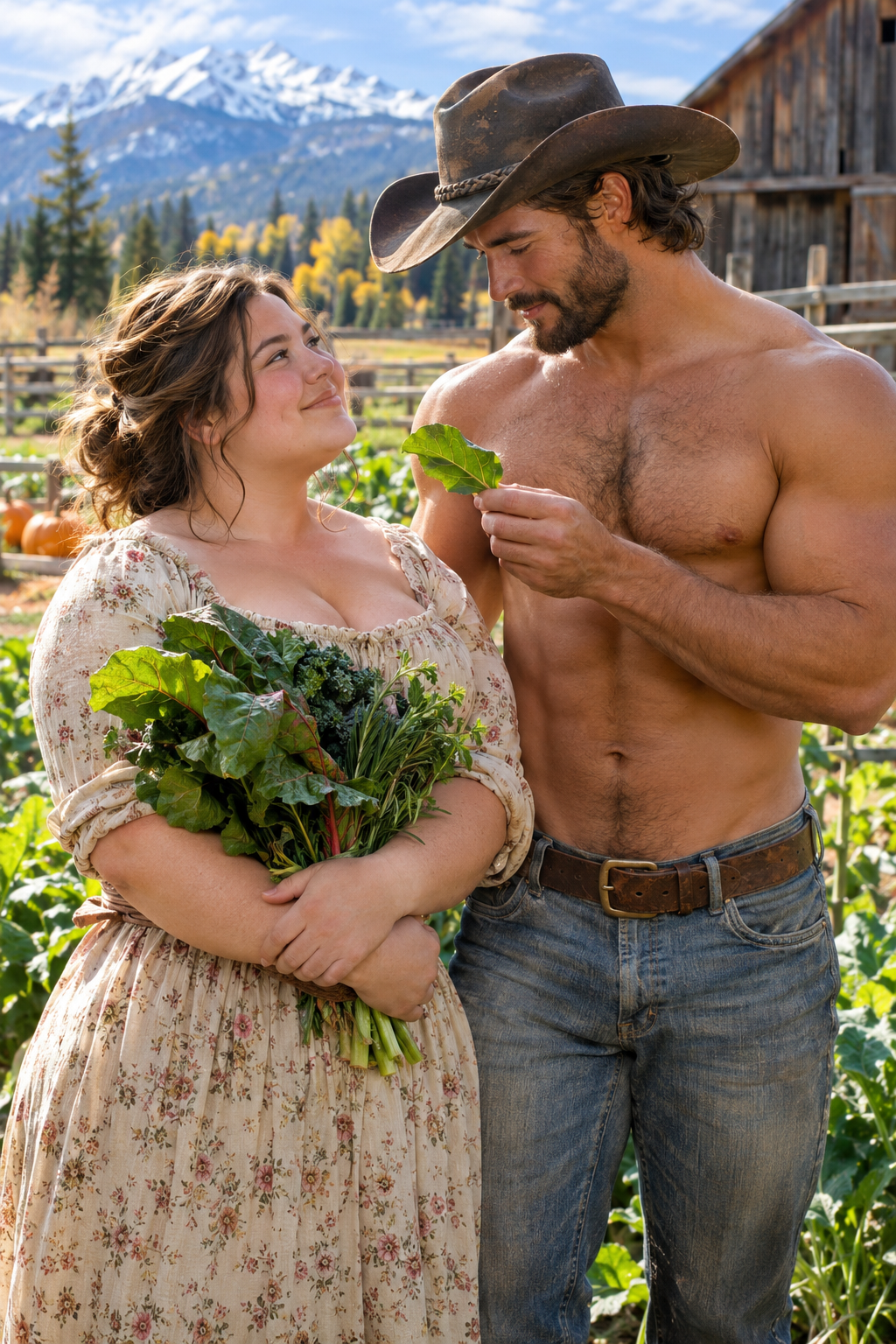
Benjamin Mercer watched his wife carry another basket of weeds into their farmhouse while their vegetable garden was dying. Finally, he lost his patience.
Behind the curtain stood an entire wall of wooden shelves, each one filled with carefully sealed jars, sacks of dried food, and baskets covered with clean linen.
Benjamin stepped closer, hardly believing what he was seeing.
There were jars of preserved berries, dried mushrooms, wild greens, roasted roots, and something that looked remarkably like flour. Small cloth bags hung from wooden pegs, each marked with a date and a name.
He turned toward Rebecca.
“How long have you been doing this?”
“Since early spring.”
“All of it?”
“Most of it. Some I started preparing last autumn.”
Benjamin stared at the shelves again. There was enough food to sustain their household for months if they were careful.
“But how?” he whispered.
Rebecca reached for a small sack and poured a handful of pale flour into her palm.
“Cattail roots. Your father used to call them useless marsh weeds. My grandmother taught me how to process them into flour.”
She pointed toward another shelf.
“Dried nettles, wild amaranth, blackberries, mulberries, and acorns that I carefully processed to remove their bitterness. Every plant was identified, cleaned, and prepared the way Grandmother taught me.”
Benjamin picked up a jar of dark purple preserves.
“And these?”
“Wild plum preserves. The fruit ripened before the drought became serious.”
He could hardly speak.
For weeks, he had watched his wife return from the creek carrying baskets of what he considered worthless vegetation. He had mocked her, dismissed her concerns, and complained about the time she spent away from their struggling garden.
All the while, she had been preparing for the very disaster he refused to acknowledge.
“Why didn’t you tell me?” he finally asked.
Rebecca looked at him with a sadness that made his chest tighten.
“I did, Benjamin. Just not in words you were willing to hear.”
He lowered the jar.
Outside, the evening wind rattled the dry leaves against the farmhouse windows.
Benjamin wanted to apologize, but the words felt painfully inadequate.
Instead, he asked, “Will it be enough for Thomas and his family?”
Rebecca studied the shelves.
“For tonight, certainly.”
“And after tonight?”
“That depends on what we do next.”
Benjamin looked at her.
“What do you mean?”
Rebecca walked to the table and unfolded a small, weathered notebook.
It had belonged to her grandmother. Its pages were yellowed, its corners worn smooth by decades of use.
Inside were drawings of plants, records of rainfall, and detailed notes about which roots survived dry seasons.
But Benjamin noticed something else.
Between the drawings were names.
Dozens of names.
Beside some were quantities of food. Beside others were dates and short messages.
“What’s this?”
“My grandmother’s records from the drought of 1887,” Rebecca explained. “She helped organize food for fourteen families. Nobody had enough alone, but together they survived.”
Benjamin traced one finger over the faded handwriting.
At the bottom of the page, a sentence had been underlined twice.
“When the fields fail, remember that the land has more than one way of feeding its children.”
For the first time in weeks, Benjamin felt something besides despair.
He felt hope.
That evening, Thomas arrived with his wife, Eleanor, and their three children.
The youngest, little Samuel, clung to his mother’s skirt. His cheeks were hollow, and his eyes followed the smell drifting from Rebecca’s kitchen.
She had prepared a thick stew with dried greens, beans saved from the previous harvest, wild roots, and the last of their smoked meat.
There were also small, golden flatbreads made from the flour Benjamin had discovered.
Samuel stared at the bread.
“Is that really for us?”
Rebecca knelt beside him.
“Every piece on that plate.”
The boy took one cautious bite, then began eating so quickly that Eleanor gently touched his arm.
“Slow down, sweetheart.”
But her own hands trembled as she lifted her spoon.
Benjamin watched the family eat, feeling an unexpected shame.
He had spent his whole life measuring a farm’s worth by the size of its harvest.
Yet tonight, food he would once have thrown into a compost heap was keeping three hungry children from going to bed without supper.
When Thomas finished, he looked at Benjamin.
“I don’t know how to repay you.”
Benjamin glanced toward Rebecca.
“Neither do I,” he admitted.
Rebecca smiled faintly.
“You can begin by helping us tomorrow.”
Thomas straightened.
“With what?”
“Finding food for everyone else.”
The next morning, four adults walked toward the creek carrying baskets, knives, and a handwritten list.
Rebecca led them beyond the familiar pasture, where the creek curved around a patch of woodland Benjamin rarely visited.
She stopped beside a cluster of green plants growing near the damp bank.
“These are worth gathering,” she explained. “But only after we’re certain of their identity. Some harmless plants have dangerous look-alikes.”
She demonstrated how to recognize the specimens she knew, which parts could be harvested, and which should be left untouched.
Thomas listened carefully.
Eleanor wrote everything down.
Benjamin, however, kept glancing toward the distant hills.
He was still troubled by something.
“What happens when the creek dries up completely?”
Rebecca looked toward the shallow water.
“Then we will need more than gathered food.”
“What more?”
“Water, cooperation, and enough sense not to destroy the very plants we’re depending upon.”
They worked until midday, harvesting only small portions from each patch.
By afternoon, Rebecca had collected enough edible plants to supplement several meals, and Benjamin had begun repairing the old rain barrels behind the farmhouse.
For the first time since the drought began, everyone had a purpose.
But hope, Benjamin soon discovered, could attract trouble as easily as desperation.
Three days later, a stranger rode into their yard.
His name was Silas Crowley, a grain merchant from the neighboring county.
His wagon carried sacks of cornmeal, dried beans, and wheat.
Benjamin hurried outside when he saw it.
“Are you selling food?”
Crowley smiled beneath his dusty hat.
“Selling, trading, whatever makes sense.”
“What are you asking?”
“Twenty dollars for a sack of cornmeal.”
Benjamin stared.
Before the drought, that same sack had cost less than three.
“Twenty dollars?”
“Supply and demand, Mr. Mercer. People are hungry.”
Benjamin’s hands curled into fists.
Crowley looked past him toward the open kitchen window.
He could smell something cooking.
“Seems you’re doing better than most folks around here.”
Rebecca appeared in the doorway.
“We’re managing.”
Crowley’s eyes moved toward the jars cooling on the windowsill.
“Preserves?”
“Yes.”
“Interesting. I hear you’ve been gathering food from the woods.”
Benjamin stiffened.
“Who told you that?”
“People talk.”
Crowley stepped down from his wagon.
“I could offer you a reasonable arrangement. You tell me where you’re finding these plants and how you’re preparing them. I’ll purchase whatever you can gather.”
Rebecca folded her arms.
“And what would you do with them?”
“Sell them, naturally.”
“At what price?”
Crowley smiled again.
“Whatever the market allows.”
Rebecca shook her head.
“People shouldn’t have to sell their farms to purchase food growing beside their own homes.”
The smile disappeared.
“You’re making a mistake, Mrs. Mercer.”
“Perhaps.”
Crowley climbed back onto his wagon.
“Remember this conversation when winter comes.”
He drove away in a cloud of dust.
Benjamin watched until the wagon vanished.
“That man will cause trouble.”
Rebecca nodded.
“I believe he already has.”
Within a week, word of Rebecca’s knowledge spread throughout the valley.
Families began arriving at the Mercer farmhouse carrying empty baskets and frightened expressions.
Some were embarrassed to ask for help. Others were too desperate to hide their hunger.
Rebecca welcomed them all.
But she refused to simply hand out food without teaching those who were able to learn.
Each morning, she gathered small groups near the creek, showing them the plants she knew and explaining why careful identification, proper preparation, and restraint mattered.
She insisted that unfamiliar plants remain untouched.
She also taught people to dry food safely, store it away from moisture, and use what remained in their pantries before anything spoiled.
Benjamin organized the men and older children to repair wells, mend storage sheds, and carry water to households with sick or elderly residents.
Thomas began keeping a record of each family’s needs.
By the end of the second week, eleven households were working together.
Then the first accusation came.
Benjamin was repairing a fence when Jacob Miller, a farmer from the northern ridge, stormed into the yard.
“Your wife has been sending people onto my land!”
Benjamin set down his hammer.
“What are you talking about?”
“Those creek banks are mine! I’ve caught three families digging near my property.”
Rebecca came outside.
“Jacob, I told everyone to stay on the common land.”
“Well, someone didn’t listen.”
His face was red with anger.
“And now my livestock have nothing left to graze!”
Benjamin understood his frustration. Jacob had lost nearly all his crops, and his remaining cattle were frighteningly thin.
“We’ll speak to everyone,” Benjamin promised.
Jacob pointed toward Rebecca.
“This is what happens when people start believing weeds are worth more than proper farming.”
He left before she could answer.
That evening, Rebecca gathered the families and addressed the problem directly.
“No one enters another person’s property without permission. And no one strips a patch bare. If we take everything today, we’ll have nothing tomorrow.”
Most agreed immediately.
A few looked dissatisfied.
Hunger was beginning to change people.
Three nights later, someone broke into the Mercer storage room.
Benjamin woke to the sound of shattering glass.
He grabbed his lantern and rushed downstairs.
The back door stood open.
Two shelves had been emptied, several jars lay broken across the floor, and a sack of flour was missing.
Rebecca stood motionless in the doorway.
Benjamin lifted the lantern higher.
“Whoever did this knew exactly where to look.”
Then he noticed muddy footprints leading through the doorway.
He followed them outside.
They disappeared near the lane.
But something had been dropped beside the fence.
A small silver button, engraved with a black crow.
Benjamin recognized it immediately.
Silas Crowley had worn a coat with identical buttons.
By sunrise, Benjamin was ready to ride into town and confront him.
Rebecca stopped him beside the stable.
“We have no proof that Silas himself came here.”
“He threatened us.”
“Yes.”
“And now someone has stolen our food!”
“I know.”
Benjamin stared at her.
“How can you remain so calm?”
“Because anger won’t put those jars back on the shelves.”
That answer frustrated him more than he wanted to admit.
But Rebecca’s next words silenced him.
“Someone has learned that our food is valuable. We need to protect our supplies, but we also need to understand why this happened.”
Benjamin turned away.
For most of his life, he had believed that strength meant acting quickly and decisively.
Rebecca was teaching him that sometimes strength meant resisting the urge to strike.
The following afternoon, Thomas arrived with disturbing news.
Crowley had been visiting farms throughout the valley, offering grain in exchange for land deeds.
Three desperate families had already signed agreements.
“He’s taking their farms for almost nothing,” Thomas said.
Benjamin slammed his fist against the table.
“That thief!”
Rebecca’s expression darkened.
“Then we need to speak with those families before anyone else signs.”
They traveled to the first farmhouse that evening.
An elderly widow named Martha Collins opened the door.
Her hands shook when Benjamin asked about the agreement.
“He promised enough grain to carry me through winter,” she said. “What choice did I have?”
Rebecca sat beside her.
“Did he give you the grain?”
“Only two sacks. He said the rest would come after the papers were recorded.”
Benjamin exchanged a look with Thomas.
“What exactly did you sign?”
Martha brought out a folded document.
Benjamin read it slowly.
His stomach tightened.
Crowley had not purchased the rights to a single harvest.
He had obtained an agreement to acquire the entire farm if Martha failed to repay an impossible sum within thirty days.
“She doesn’t understand what she signed,” Thomas whispered.
Rebecca looked at Martha’s frightened face.
“Then we’ll make sure she does. And we’ll find out what can be done legally.”
Over the following days, they discovered two more families had received similar contracts.
Crowley’s scheme was larger than any of them had imagined.
But confronting him would require evidence, witnesses, and help from the county authorities.
Meanwhile, the drought was worsening.
The creek had become a narrow ribbon of muddy water.
Livestock wandered through empty pastures.
Even the wild plants Rebecca depended upon were beginning to disappear.
One evening, Benjamin found her sitting behind the farmhouse, her grandmother’s notebook open in her lap.
For the first time, she looked defeated.
“What’s wrong?” he asked.
Rebecca pointed toward the dry hills.
“We’re gathering faster than the land can recover.”
“Then we’ll go farther.”
“And when the farther places are empty?”
Benjamin had no answer.
She closed the notebook.
“There was something my grandmother wrote about the worst year of that drought.”
“What?”
“She mentioned an underground spring beneath the eastern ridge. It continued flowing when every creek around it dried up.”
Benjamin frowned.
“The eastern ridge? That’s Crowley’s land.”
“Not all of it.”
She opened the notebook again and showed him an old hand-drawn map.
A crooked line marked a narrow ravine beyond the abandoned mill.
Beside it were the words: Stone Spring.
Benjamin studied the drawing.
“I’ve lived here twenty years. I’ve never heard of it.”
“Neither had I until I found this page.”
“Do you think it’s still there?”
“I don’t know. But if it is, it may be our only chance.”
At dawn, Benjamin, Rebecca, Thomas, and Eleanor set out toward the eastern ridge.
The journey was harder than expected.
The old mill road had nearly vanished beneath fallen branches and loose stones.
Twice, they were forced to turn back and find another path.
By noon, the heat was unbearable.
Their drinking water was running low.
Thomas leaned against a tree.
“We should head back.”
Rebecca looked at the notebook.
“Just a little farther.”
Benjamin was about to object when he noticed something unusual.
A narrow strip of moss clung to the shaded side of a rock.
Everywhere else, vegetation was brittle and brown.
He crouched beside it.
“Rebecca.”
She hurried over.
Benjamin touched the moss.
It was damp.
They followed the rocky slope downward into a narrow ravine.
At first, there was nothing but stone.
Then Eleanor heard it.
“Listen.”
They stood perfectly still.
Somewhere beneath the rocks came the faint sound of trickling water.
Benjamin dropped to his knees and began moving loose stones.
Thomas joined him.
Within minutes, they uncovered a shallow channel.
Clear water flowed through it.
Rebecca pressed a hand to her mouth.
“The spring.”
Benjamin laughed.
It was an exhausted, disbelieving sound.
He cupped his hands beneath the water and lifted it toward the sunlight.
They had found what the entire valley desperately needed.
But their relief lasted only moments.
A voice echoed from above.
“Step away from that spring.”
Silas Crowley stood at the top of the ravine with two hired men.
A rifle rested across his arm.
Benjamin rose slowly.
“This spring doesn’t belong to you.”
Crowley descended several steps.
“Everything on this ridge belongs to me.”
Rebecca held up the notebook.
“The old mill boundary runs east of this ravine. The spring is on common land.”
Crowley laughed.
“An old drawing doesn’t prove anything.”
“Neither does your word,” Benjamin replied.
Crowley’s expression hardened.
“You’ve caused me enough trouble, Mercer.”
Thomas stepped beside Benjamin.
“We know about the contracts.”
For a moment, Crowley said nothing.
Then he smiled.
“Contracts signed willingly by grown adults.”
“By people who were starving,” Rebecca said.
“Starving people make their own decisions.”
Benjamin felt his anger rising.
But before he could speak, Eleanor noticed a movement behind Crowley.
One of the hired men, a young fellow named Peter, was staring at the water.
His lips were cracked, and his face was pale.
Rebecca recognized the look immediately.
“Peter, when did you last drink?”
Crowley turned sharply.
“That’s none of your concern.”
The young man swayed.
Then his knees buckled.
He fell heavily against the rocks.
Rebecca rushed forward.
Crowley raised the rifle.
“Stay where you are!”
Benjamin stepped between them.
“Put that thing down! The boy needs help!”
For several terrible seconds, nobody moved.
Then Crowley’s other employee lowered his eyes.
“Mr. Crowley, Peter’s been sick since yesterday.”
The rifle remained raised.
Rebecca looked directly at Crowley.
“If you care more about that spring than about a man’s life, then you’re poorer than anyone in this valley.”
Something flickered across Crowley’s face.
Slowly, he lowered the weapon.
Rebecca and Eleanor moved Peter into the shade, cooled him with damp cloths, and gave him small amounts of water while Thomas prepared to seek medical help.
Crowley watched without speaking.
When Peter was able to respond, he whispered something to Benjamin.
“Mr. Mercer… I was at your house.”
Benjamin went still.
“What?”
“The storage room. I took the food.”
Crowley stiffened.
“Be quiet, boy.”
But Peter continued.
“My little sister hadn’t eaten in two days. Mr. Crowley promised grain if I found out what you were storing.”
He swallowed painfully.
“He never gave us any.”
Benjamin looked toward Crowley.
The merchant’s face had gone pale.
For a moment, Benjamin imagined dragging him through the valley and making him answer for every hungry child.
Then he looked at Peter, barely conscious beneath the tree.
His anger did not disappear.
But it changed direction.
“This is going to end,” Benjamin said quietly.
They carried Peter back to the village on a makeshift stretcher.
Crowley followed at a distance, his rifle unloaded and tied to his saddle by Thomas’s insistence.
By evening, more than forty people had gathered outside the Mercer farmhouse.
Benjamin stood on the porch with Rebecca beside him.
He explained what they had discovered.
The hidden spring.
The fraudulent-looking contracts.
The stolen food.
And Peter’s confession.
Angry voices rose through the crowd.
Several men demanded Crowley’s arrest.
Others wanted to seize his grain immediately.
Benjamin raised both hands.
“I understand your anger. I feel it myself. But if we turn against one another, we’ll lose the very thing that has kept us alive.”
He looked at Crowley.
“We’ll take the contracts to the county magistrate. Every family deserves a fair hearing.”
Crowley opened his mouth, then closed it.
Thomas stepped forward.
“And the spring?”
Rebecca unfolded the map.
“We need a proper survey to establish the boundary. Until then, we’ll ask the county to protect access so that no one can claim it through intimidation.”
The villagers murmured in agreement.
Then Jacob Miller pushed through the crowd.
“That spring won’t save us if we can’t carry water all the way down here!”
Benjamin nodded.
“No. It won’t.”
He turned toward the old mill road.
“But the abandoned irrigation channel might.”
The villagers fell silent.
Years earlier, the mill had operated using water diverted through a stone-lined channel.
Most of it had collapsed, but portions still remained.
If they could repair the channel and establish a safe, sustainable route from the spring, they might bring water closer to the farms.
It would require weeks of labor.
And every able-bodied person in the valley.
Rebecca looked at Benjamin with unmistakable pride.
He had finally stopped thinking like a man whose only responsibility was his own field.
The work began two days later, after the county surveyor confirmed that the spring lay on land reserved for shared use.
The magistrate also ordered Crowley’s disputed contracts reviewed and warned him against interfering with the water supply.
Crowley was required to appear before the court.
Peter, meanwhile, recovered under the care of the local physician.
Benjamin refused to let the boy’s mistake destroy his future.
“You’ll repay what you stole by helping us rebuild,” he told him.
Peter’s eyes filled with tears.
“I will, sir.”
Each morning, the villagers gathered beneath the rising sun.
Some cleared rocks.
Others repaired broken sections of the channel.
Families took turns preparing meals.
Rebecca continued teaching safe food preservation and responsible gathering, while Eleanor organized a shared pantry where every contribution was recorded and supplies were distributed according to need.
Progress was painfully slow.
There were arguments, injuries, and days when exhaustion nearly overcame them.
One afternoon, a section of the repaired channel collapsed, destroying three days of work.
Jacob threw down his shovel.
“This is hopeless!”
Benjamin stood staring at the broken stones.
Months earlier, he would have agreed.
Instead, he picked up his shovel.
“Then we’ll build it stronger.”
Jacob looked at him.
Then he picked up his own.
The others followed.
But their greatest test came in the final week.
A fierce windstorm swept across the valley, bringing clouds of dust so thick that daylight turned brown.
Workers abandoned the ridge.
Families sheltered inside their homes.
By morning, part of the channel had filled with debris, and a wooden support above the ravine had broken loose.
Worse, the temporary water storage tank near the village had cracked.
Their remaining reserve was leaking into the dry ground.
Benjamin and Thomas raced toward it.
They tried sealing the break with cloth and wooden braces, but the pressure kept forcing water through the opening.
“It’s no use!” Thomas shouted.
Benjamin stared at the widening crack.
Then Rebecca appeared, carrying a bucket of thick clay mixed with straw.
“Move aside!”
She pressed the mixture into the damaged section while Eleanor brought wooden boards and tools.
Together, they reinforced the wall and reduced the leak enough to preserve most of the remaining water.
Benjamin looked at Rebecca in amazement.
“Where did you learn that?”
“My grandmother,” she replied.
He laughed despite the danger.
“Of course.”
Yet the channel still had to be cleared before the water reserve ran out.
That afternoon, almost the entire village returned to the ridge.
Men and women worked shoulder to shoulder.
Teenagers carried stones.
Older residents prepared food and clean water.
Even children helped by gathering small branches and sorting supplies.
As sunset approached, Benjamin stood beside the final blockage.
Only a wall of packed earth and stone separated the upper channel from the repaired lower section.
He lifted his shovel.
“Ready?”
Thomas nodded.
Jacob gripped his pickaxe.
Peter stood behind them.
Together, they broke through.
At first, nothing happened.
Then a thin stream slipped through the opening.
It trickled over the stones, hesitated, and began moving down the channel.
The villagers watched in silence.
The stream widened.
Water flowed around the bend, disappearing toward the farms below.
A cheer rose from the workers.
Benjamin dropped his shovel.
For the first time in months, he wept openly.
Rebecca slipped her hand into his.
They stood together as the water continued flowing.
It wasn’t a miracle that would erase the drought.
It wasn’t enough to restore every ruined field.
But it was enough to support drinking water collection, carefully rationed household needs, and small plots of food-producing plants, provided they protected the spring and managed its flow responsibly.
It was enough to give the valley a chance.
Over the following weeks, the community changed.
Families planted small, carefully chosen gardens instead of wasting water on fields they could no longer sustain.
They shared seeds, repaired tools, and learned to preserve whatever they harvested.
Rebecca helped establish a permanent storehouse, where each household contributed what it could.
Benjamin built a large wooden table outside the farmhouse so the villagers could gather and make decisions together.
As autumn approached, the county court ruled that Crowley’s most abusive agreements could not be enforced as written.
Martha Collins and the other families retained their farms.
Crowley was ordered to return improperly obtained property documents and pay restitution.
He lost much of the wealth he had accumulated during the crisis.
But the most surprising moment came when he appeared at the Mercer farmhouse one cold morning.
He stood near the porch, hat in hand.
Benjamin approached cautiously.
“What do you want?”
Crowley looked older than he had only weeks before.
“I’ve come to ask for work.”
Benjamin stared at him.
“Work?”
“My business is nearly gone. People won’t trade with me.”
“Can you blame them?”
“No.”
Crowley looked toward the communal storehouse.
“I was afraid of losing everything. So I tried to make certain everyone else lost first.”
Benjamin said nothing.
Crowley lowered his eyes.
“I know an apology doesn’t undo what I’ve done.”
“No,” Benjamin replied. “It doesn’t.”
Rebecca appeared beside him.
“But what you do afterward matters.”
Crowley looked up.
She pointed toward a pile of timber near the barn.
“We need another storage building before winter. The work is difficult, and no one will give you special treatment.”
For a long moment, Crowley stood motionless.
Then he removed his coat.
“Where do I begin?”
Trust did not return overnight.
Some villagers refused to speak to him.
Others watched him with open suspicion.
And Crowley discovered that rebuilding a reputation required more patience than accumulating money ever had.
But he came back each morning.
He carried lumber, repaired wagons, and eventually used his old trading connections to obtain affordable grain for the community.
Slowly, people began to judge him by his actions rather than his promises.
Winter arrived earlier than expected.
Cold winds swept across the fields, and the first frost silvered the hills.
Yet when the families gathered at the Mercer farmhouse for their winter meal, not one table was empty.
There were preserved fruits, vegetable stews, flatbreads, dried beans, and dishes made from the modest harvest of their new gardens.
It was not a feast of abundance.
It was a feast of survival.
Thomas stood to offer a toast.
“To Rebecca Mercer, who saved this valley when the rest of us had given up.”
The room filled with applause.
Rebecca blushed and shook her head.
“I didn’t save anyone alone.”
She looked around at the familiar faces.
“Every person here helped. Some gathered food. Some repaired the channel. Some cared for the sick. Some shared their last handful of grain.”
Her eyes rested on Benjamin.
“And some learned to listen.”
A gentle laugh moved through the room.
Benjamin rose slowly.
“I spent twenty years believing that being a good farmer meant knowing everything about my land.”
He paused.
“When Rebecca warned me, I thought she was worrying over nothing. When she gathered plants I didn’t recognize, I called them weeds. When she tried to prepare us, I treated her wisdom as foolishness.”
He turned toward his wife.
“I nearly let my pride starve us.”
The room grew quiet.
Benjamin took her hand.
“My wife didn’t need to prove that she was wiser than me. She needed me to trust that she might see something I couldn’t.”
Rebecca’s eyes shone.
“And when I finally listened,” he continued, “I discovered that the greatest resource on this farm wasn’t the soil, the crops, or even the water.”
He looked around the room.
“It was the knowledge we were willing to share.”
That night, after the last guests had departed, Benjamin and Rebecca sat together on the porch.
The air was cold, and the stars glittered above the sleeping valley.
For a while, neither spoke.
Then Benjamin asked a question that had been troubling him for months.
“Rebecca, why did you keep preparing all that food when I made it so difficult?”
She thought for a moment.
“Because I knew you were afraid.”
Benjamin frowned.
“Afraid?”
“You’ve spent your life providing for this family. When I told you something was wrong, you heard it as a warning that all your hard work might not be enough.”
He looked down at his hands.
She was right.
He had not rejected her warnings because they made no sense.
He had rejected them because accepting them meant admitting that the future was beyond his control.
Rebecca leaned against his shoulder.
“I never wanted you to feel small, Benjamin. I only wanted us to be ready.”
He kissed her forehead.
“I wish I’d listened sooner.”
“So do I,” she whispered. “But you listened when it mattered.”
The following spring, rain finally returned to the valley.
It began softly, tapping against the farmhouse windows.
Benjamin woke to the sound and lay still, afraid that moving might somehow make it stop.
Then he heard Rebecca laughing outside.
He hurried to the porch.
She stood in the yard with her face lifted toward the sky, letting the rain soak her hair and dress.
Benjamin stepped into the rain beside her.
For a moment, they simply stood together.
Then he took her hands and spun her around like the young man who had married her twenty years earlier.
Across the valley, people emerged from their houses.
Children danced in muddy puddles.
Farmers lifted their faces toward the clouds.
And in the distance, the creek began to fill again.
But the village never returned to its old ways.
The repaired channel remained.
The shared storehouse continued operating.
Families preserved food even during good harvests, and the community established rules to protect the creek banks, woodlands, and wild plants.
Rebecca began teaching regular classes in the old schoolhouse.
She showed children how to observe seasonal changes, recognize the limits of their knowledge, and respect the natural world.
Benjamin attended the first lesson.
He sat in the back row beside seven-year-old Samuel, who had grown healthy and strong.
Rebecca held up a small green plant.
“Does anyone know what this is?”
Several children raised their hands.
Benjamin studied it carefully.
Then he raised his own.
Rebecca smiled.
“Yes, Benjamin?”
He cleared his throat.
“I don’t know what it is. But I’d like to learn.”
The children giggled.
Rebecca’s smile softened.
“That’s an excellent place to begin.”
Years later, when Benjamin’s hair had turned silver and his hands had grown stiff with age, visitors still came to the Mercer farm.
They came to see the old irrigation channel, the community storehouse, and the gardens that now flourished beside carefully protected patches of wild plants.
But many came for another reason.
They had heard the story of the farmer who almost lost everything because he refused to listen to his wife.
One afternoon, a young farmer approached Benjamin while he was tending a row of vegetables.
“Mr. Mercer, is it true your wife saved the whole valley with weeds?”
Benjamin smiled.
He rested both hands on his shovel.
“No, son. She saved us with knowledge, patience, and the courage to prepare when nobody believed her.”
The young man glanced toward Rebecca, who was teaching a group of children beneath an apple tree.
“And what did you do?”
Benjamin considered the question.
Then he laughed softly.
“I finally learned that being wrong isn’t the worst thing a man can be.”
“What is?”
“Being too proud to admit it.”
The young farmer nodded thoughtfully.
Benjamin looked toward the thriving garden.
“There was a time when I could tell you the value of every acre of soil on this farm. But I couldn’t recognize the value of the woman standing beside me.”
He paused.
“Don’t make that mistake with the people who love you.”
That evening, after the visitors had gone, Rebecca joined him beneath the old oak tree near the creek.
She carried a small basket.
Benjamin peered inside.
A handful of freshly gathered greens rested beneath a clean cloth.
He raised an eyebrow.
“More weeds?”
Rebecca laughed.
“Something like that.”
Benjamin took the basket from her.
“Well, we’d better bring them inside before supper.”
They walked toward the farmhouse together, their shadows stretching across the earth.
The garden was green.
The creek was flowing.
And the storage room, once hidden behind a locked door, now stood open for anyone who wished to learn.
Above its entrance, Benjamin had carved a sentence into a wooden sign.
It was a lesson he wished he had understood long before the drought.
“Wisdom does not always grow where we expect it, and love does not always speak in words we understand.”
Beneath it, in smaller letters, Rebecca had added another thought.
“The greatest harvest is not what we keep for ourselves, but what we help others grow.”
And that became the legacy of the Mercer family.
Not merely the memory of a drought survived, or a spring discovered beneath forgotten stones.
It was the understanding that pride can blind even hardworking people, that overlooked knowledge can become priceless in a crisis, and that true security is built not by hoarding what we have, but by sharing what we know.
For Benjamin, the most important lesson was also the simplest.
Sometimes the person who sees the answer is the one we have stopped listening to.
And sometimes, what looks like a basket full of worthless weeds is actually someone quietly carrying the future home.
The story has already reached its conclusion, with Benjamin and Rebecca growing old together and leaving behind a legacy of wisdom, generosity, and community.
However, there was one final chapter in their lives that the people of the valley would remember long after they were gone.
It began on a quiet autumn morning, nearly thirty years after the terrible drought.
Benjamin was sitting beneath the old oak tree when Rebecca approached him with her grandmother’s weathered notebook.
The pages had become so fragile that she could barely turn them without worrying they might tear.
“I think it’s time,” she said.
Benjamin looked up.
“Time for what?”
“To give this to someone who will carry on what we started.”
He studied her face.
For the first time, he noticed how tired she seemed.
Her steps had become slower, and she sometimes paused to catch her breath after walking up the farmhouse stairs.
“Rebecca, are you feeling all right?”
She smiled gently.
“I’m getting old, Benjamin. That’s all.”
But something in her voice told him there was more she wasn’t saying.
That winter, Rebecca became seriously ill.
The village physician visited frequently, and neighbors took turns bringing meals and helping around the house.
Benjamin rarely left her bedside.
One evening, as snow gathered against the windows, Rebecca reached for his hand.
“Promise me something.”
“Anything.”
“Don’t let everything we’ve learned disappear when we’re gone.”
Benjamin swallowed.
“It won’t.”
“Knowledge is like a seed,” she whispered. “If you lock it away, it eventually dies. But if you plant it in other people, it grows long after you’ve stopped tending it.”
Benjamin pressed her hand against his cheek.
“You’ll be planting seeds for many years yet.”
Rebecca smiled, but she didn’t answer.
Three weeks later, she passed away peacefully in her sleep.
For Benjamin, the world seemed to lose its color.
He walked through the farmhouse as though he were a stranger in his own home.
Every room reminded him of her.
The kitchen where she had prepared countless meals.
The storage room where she had quietly saved their family.
The porch where she had held out her hand and asked him to trust her.
For days, Benjamin could barely speak.
Then one morning, he found her grandmother’s notebook resting on the kitchen table.
Tucked between its final pages was a letter addressed to him.
His hands trembled as he unfolded it.
“My dearest Benjamin,
If you’re reading this, then I’ve gone somewhere you cannot follow just yet.
Please don’t spend the years you have left mourning all the mornings we won’t share.
Instead, remember the thousands we did.
Remember our first harvest, the terrible drought, the rain that finally returned, and the wonderful people who became our family.
You once told me that I saved your life.
But you saved mine, too.
You gave me a home where my grandmother’s teachings could become something greater than memories.
And when you finally opened your heart to what I knew, you helped an entire community learn to listen.
Now I have one last request.
Open the schoolhouse doors to everyone, young and old.
Teach them everything.
Not because another drought will certainly come, but because life will always bring difficulties we cannot predict.
And when those difficulties arrive, let the people of this valley face them together.
All my love,
Rebecca.”
Benjamin read the letter three times.
Then he folded it carefully and placed it against his heart.
The following spring, the village gathered for the opening of the Rebecca Mercer School of Practical Wisdom.
It wasn’t a grand building.
There were wooden benches, shelves of books, jars of seeds, and maps of the surrounding countryside.
But its doors were open to everyone.
Farmers learned methods of conserving water and protecting their soil.
Children studied plants, weather patterns, and the importance of preparing for difficult seasons.
Families learned food preservation, first aid, and the value of mutual assistance.
Benjamin attended every lesson he could.
Sometimes he taught.
Sometimes he listened.
And whenever someone asked how he had become so knowledgeable, he would smile and answer, “I had a very patient teacher.”
Years passed.
Benjamin grew weaker, but the school flourished.
Then, one beautiful summer afternoon, he sat beneath the same oak tree where he and Rebecca had spent so many evenings together.
A group of children were playing beside the creek.
One little girl approached him carrying a basket of freshly gathered plants.
“Mr. Mercer,” she asked, “are these weeds?”
Benjamin looked inside the basket.
He recognized several familiar leaves, though he knew better than to identify everything at a glance.
He smiled.
“Perhaps. But before we decide what they’re worth, shouldn’t we learn what they are?”
The girl nodded eagerly.
“Mrs. Thomas at the school says every plant has a purpose.”
Benjamin chuckled.
“Not every plant is food, sweetheart. Some are dangerous, and some are best left growing. But every plant can teach us something if we’re willing to pay attention.”
The girl thought about that.
“Is that what Mrs. Rebecca taught you?”
Benjamin looked toward the farmhouse.
For a moment, he could almost see his wife standing in the doorway, a basket resting against her hip and sunlight shining through her hair.
“Yes,” he whispered. “That was one of the things she taught me.”
The little girl skipped away.
Benjamin leaned back against the oak tree and closed his eyes.
A gentle breeze moved through the leaves.
The creek murmured over its stones.
And somewhere in the distance, the school bell rang.
He smiled.
For the first time since Rebecca’s passing, he felt completely at peace.
Benjamin Mercer died quietly that evening.
He was buried beside Rebecca on a small hill overlooking their farm.
The villagers planted two apple trees near their graves.
Over time, the branches grew toward each other until they intertwined, forming a single canopy.
Every spring, the trees blossomed together.
Every autumn, their fruit was gathered and shared among the village children.
The farmhouse became part of the school, and Rebecca’s grandmother’s notebook was preserved in a glass case.
Beside it rested Benjamin’s final handwritten words:
“I once believed that a man’s greatest strength was his ability to provide for those he loved. Now I know that his greatest strength is his willingness to learn from them.”
Generations later, the people of the valley still told the story of Benjamin and Rebecca Mercer.
They remembered the drought, the hidden spring, the shared harvests, and the woman who had quietly prepared for disaster while everyone else dismissed her efforts.
But above all, they remembered the lesson that had transformed their community.
Never mistake someone’s quiet wisdom for ignorance simply because it looks different from your own. Never let pride prevent you from listening to those who love you. And never underestimate the extraordinary good that can grow when ordinary people choose to help one another.
Because the things we overlook today may become the very things that save us tomorrow.
And the greatest legacy we leave behind is not the wealth we accumulate, the land we own, or the recognition we receive.
It is the knowledge we share, the kindness we practice, and the lives that become better because we were here.
The End.